HIPAA-Compliant AI Voice Agents for Healthcare: A Practical Guide
HIPAA voice agents carry patient PHI across telephony, STT, an LLM, and TTS. See the safeguards they need and how to evaluate a vendor.
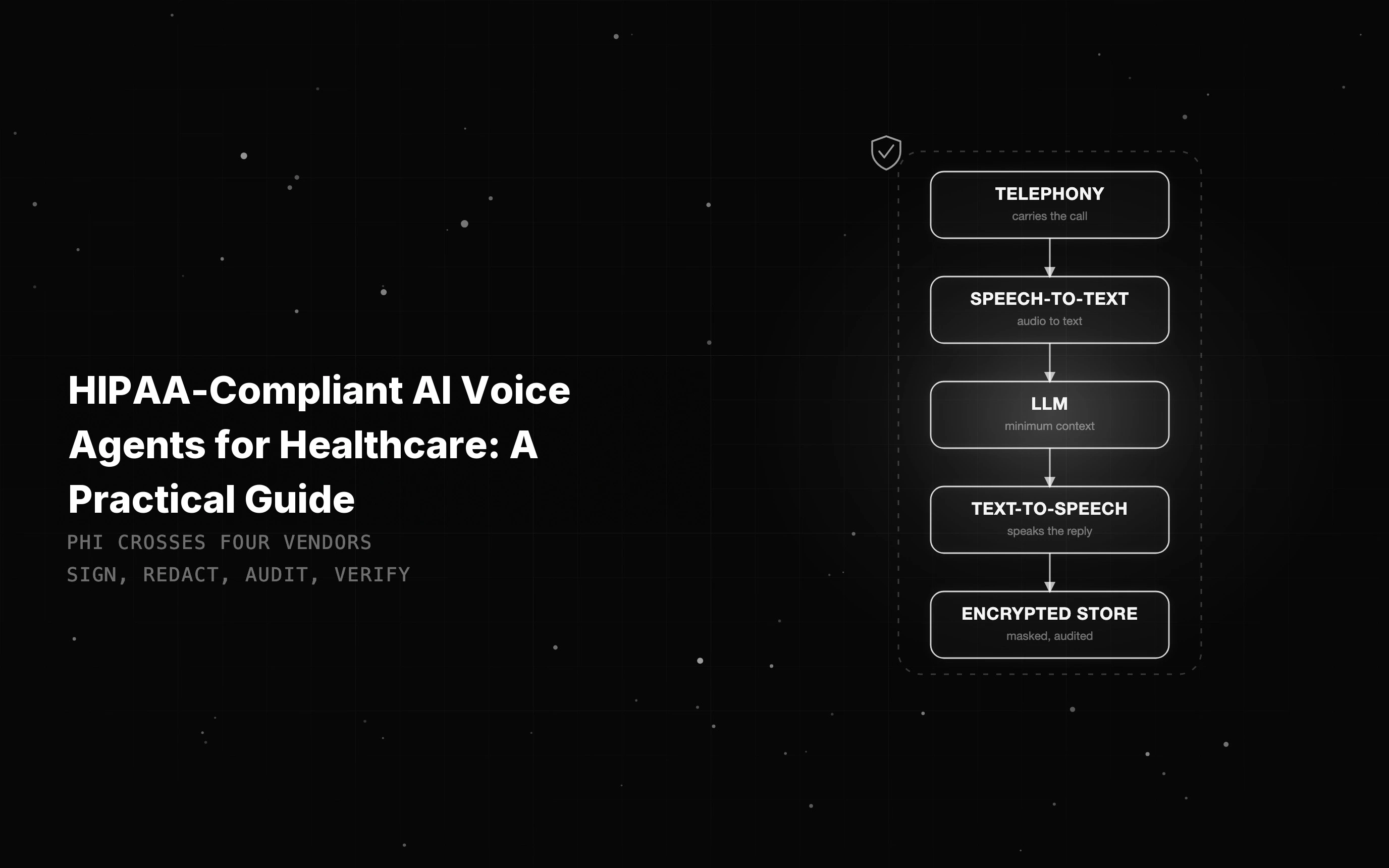
Table of Contents
A patient calls to move a Tuesday appointment. She gives her name, her date of birth to verify identity, the clinic she sees, and the reason she needs a new slot. In the ninety seconds that call takes, her protected health information has passed through a telephony provider, a speech-to-text service, a language model, and a text-to-speech engine. Four vendors, four copies of her PHI, before anyone at the clinic has picked up.
That is the reality of a healthcare voice agent. Patients get no hold music and no menu tree, but every hop in the pipeline is a place PHI can leak, get logged in the clear, or sit in a cache no one is watching. A signed Business Associate Agreement is where compliance starts, not where it ends.
This guide covers the HIPAA requirements relevant to a voice agent, safeguards that can support compliance, and how to evaluate a vendor past the “we signed a BAA” line. It is implementation guidance, not a guarantee that a particular deployment is compliant.
TL;DR
- A healthcare voice agent may create, receive, maintain, or transmit PHI, depending on the caller, data, and workflow; vendors that perform those functions on behalf of a covered entity may be business associates.
- A signed BAA is the start of compliance, not the end; applicable subcontractor arrangements and operational safeguards still have to be addressed.
- HIPAA’s Security Rule (§164.312) names five technical safeguards: access control, audit controls, integrity, authentication, and transmission security.
- Minimize PHI in logs and caches; where full PHI is not required, redact or de-identify it before storage.
- Simulate the hard calls before a patient reaches the agent, and confirm appropriate agreements and safeguards for each service that handles PHI.
What HIPAA-compliant voice agents do in healthcare
A HIPAA-compliant voice agent is a phone automation system that handles protected health information under the safeguards HIPAA requires. In healthcare it takes the call volume that buries front-desk and call-center staff: appointment scheduling and rescheduling, prescription refill requests, pre-visit intake, benefits and eligibility checks, and post-discharge follow-up. All of it is high volume and phone-first.
Voice matters here more than in most industries. A large share of patients, older adults, people managing chronic conditions, anyone without a portal login, still reach their provider by phone. An agent that answers naturally, verifies identity, and completes the task without a hold queue frees clinical staff for the calls that need a person.
The workflows differ in how much PHI they touch. Scheduling needs a name, a date of birth to verify, and a slot. Refills add a medication and often a pharmacy. Pre-visit intake can pull in symptoms, history, and insurance. That range is why healthcare voice deserves its own design discipline, and why you map each workflow through healthcare agent simulation before automating any of it.
None of this works if the agent cannot be trusted with the data. The rest of this guide is about that trust: what the law requires, how to build a pipeline that satisfies it, and how to tell a vendor who has done the work from one who has only signed a form.
Why healthcare voice AI is harder than consumer voice AI
A consumer voice agent that orders pizza faces a different regulatory context. In healthcare, identifiable information connected to care or payment can be PHI when it is created, received, maintained, or transmitted by a covered entity or business associate. A service that handles that PHI on behalf of a covered entity may be a business associate depending on its role; HHS recognizes limited exceptions, including certain conduit services.
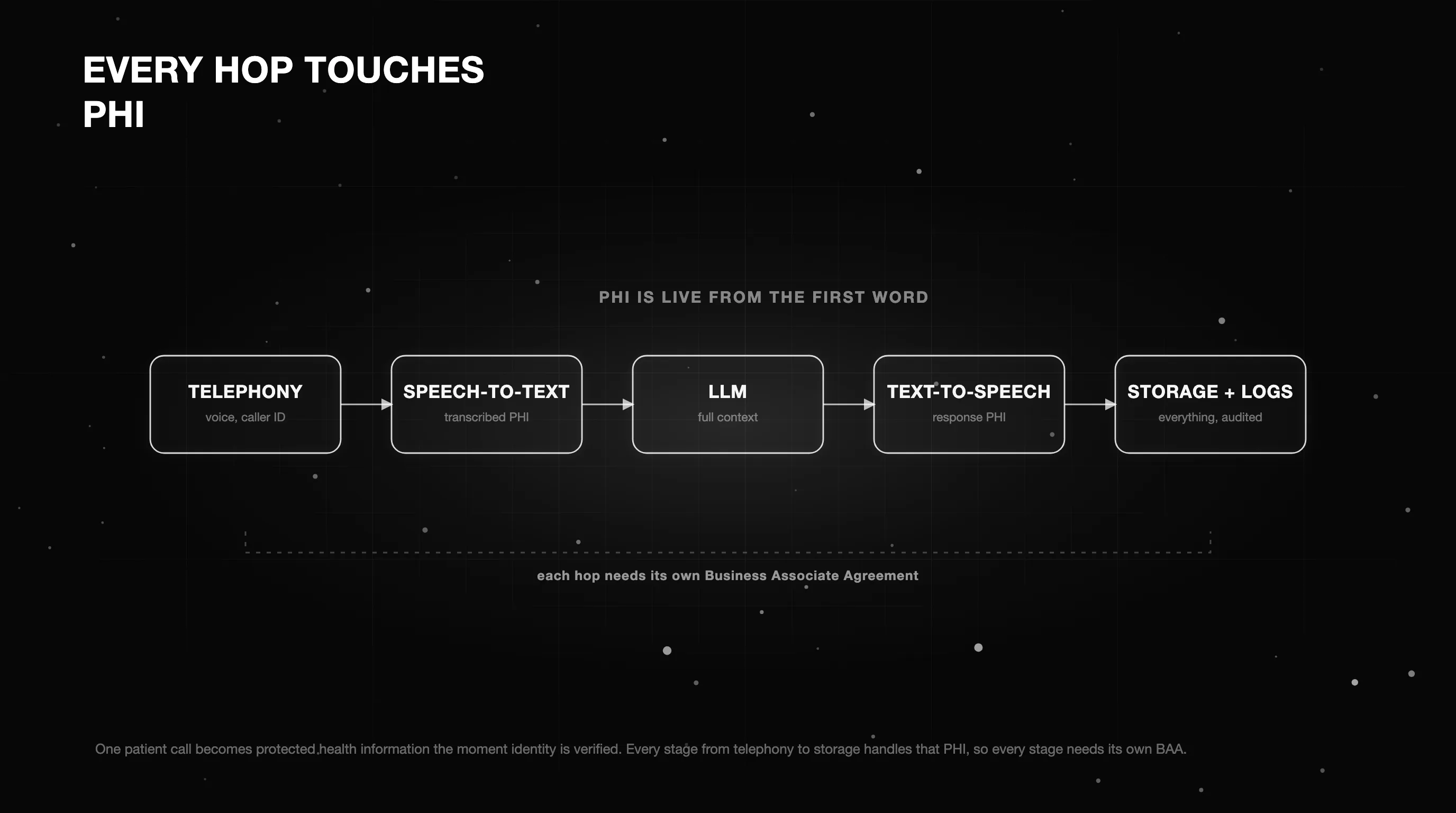
That is the subprocessor chain problem. A single call can flow through telephony, speech-to-text, a language model, text-to-speech, and storage. Teams must determine which services create, receive, maintain, or transmit PHI and document the appropriate contracting chain. A business associate must obtain satisfactory assurances from subcontractors that handle PHI on its behalf; the contract may be between the business associate and its subcontractor rather than directly with the healthcare provider.
Then there is the BAA-alone fallacy. Teams sign a BAA with their platform, check the compliance box, and move on. A BAA is a contract about responsibility. It does not encrypt a payload or restrict who can read a call log. Those are technical safeguards you still have to build and enforce. The paperwork is necessary and nowhere near sufficient.
The clearest way to see the exposure is to map it to the pipeline. For each stage, determine whether it handles PHI, what contractual relationship applies, and which safeguards reduce the identified risk.
| Pipeline stage | Potential PHI | Contract review | Primary risk |
|---|---|---|---|
| Telephony | Voice, caller ID | Determine role and any conduit exception | Call recording storage |
| Speech-to-text | Transcribed PHI | BAA/subcontractor terms if acting as a business associate | Transcript retention |
| LLM reasoning | Prompt and response context | BAA/subcontractor terms if acting as a business associate | Prompt/log leakage |
| Text-to-speech | Response PHI | BAA/subcontractor terms if acting as a business associate | Cached audio |
| Storage/logs | Stored call data | BAA/subcontractor terms if acting as a business associate | Access control, audit |
Read the table as a risk-mapping aid, not a legal conclusion. Every row needs a documented role, data-flow decision, and appropriate safeguards. HHS explains these role and contracting rules in its business-associate guidance.
What HIPAA actually requires (technical safeguards)
HIPAA compliance for a voice agent comes down to a specific, enforceable list. The Security Rule’s Technical Safeguards, at 45 CFR §164.312, name five standards, and each one translates directly into something you build.
Access control means unique user identification and an emergency access procedure to reach ePHI in a crisis, both required, plus automatic logoff and encryption of stored ePHI, which HIPAA lists as addressable. Every person and service gets its own identity, a break-glass path exists when someone needs records fast, and idle sessions do not stay open. Audit controls mean recording and examining activity in systems that hold PHI, which for a voice agent is a complete, queryable log of every call and every data access.
Integrity means protecting PHI from improper alteration or destruction. Person or entity authentication means verifying that anyone or anything requesting PHI is who it claims to be, including the services inside your own pipeline. Transmission security means encrypting PHI while it moves.
Translate that to engineering and it gets concrete: unique service credentials and per-user identity, automatic session logoff, AES-256 for data at rest, TLS 1.2 or higher (with SRTP for the call audio) in transit, authentication on every internal service call, and an append-only audit log of every call and read. HIPAA marks some of these required and others addressable: audit controls, integrity, and authentication are required outright, while implementation details like automatic logoff and encryption fall under addressable. Addressable does not mean optional; it means you implement it or document a defensible reason not to.
The Privacy Rule adds one principle voice teams routinely miss: minimum necessary. An agent should get only the PHI the task needs, not the caller’s whole record. Scheduling does not need a diagnosis history in the prompt. All of this sits inside a wider regulatory picture, where HIPAA lines up with the consent laws and telecom rules a healthcare agent also has to satisfy. Enforcement is real, backed by tiered civil penalties from the HHS Office for Civil Rights, so none of this is a best-effort suggestion.
A reference architecture that supports HIPAA compliance
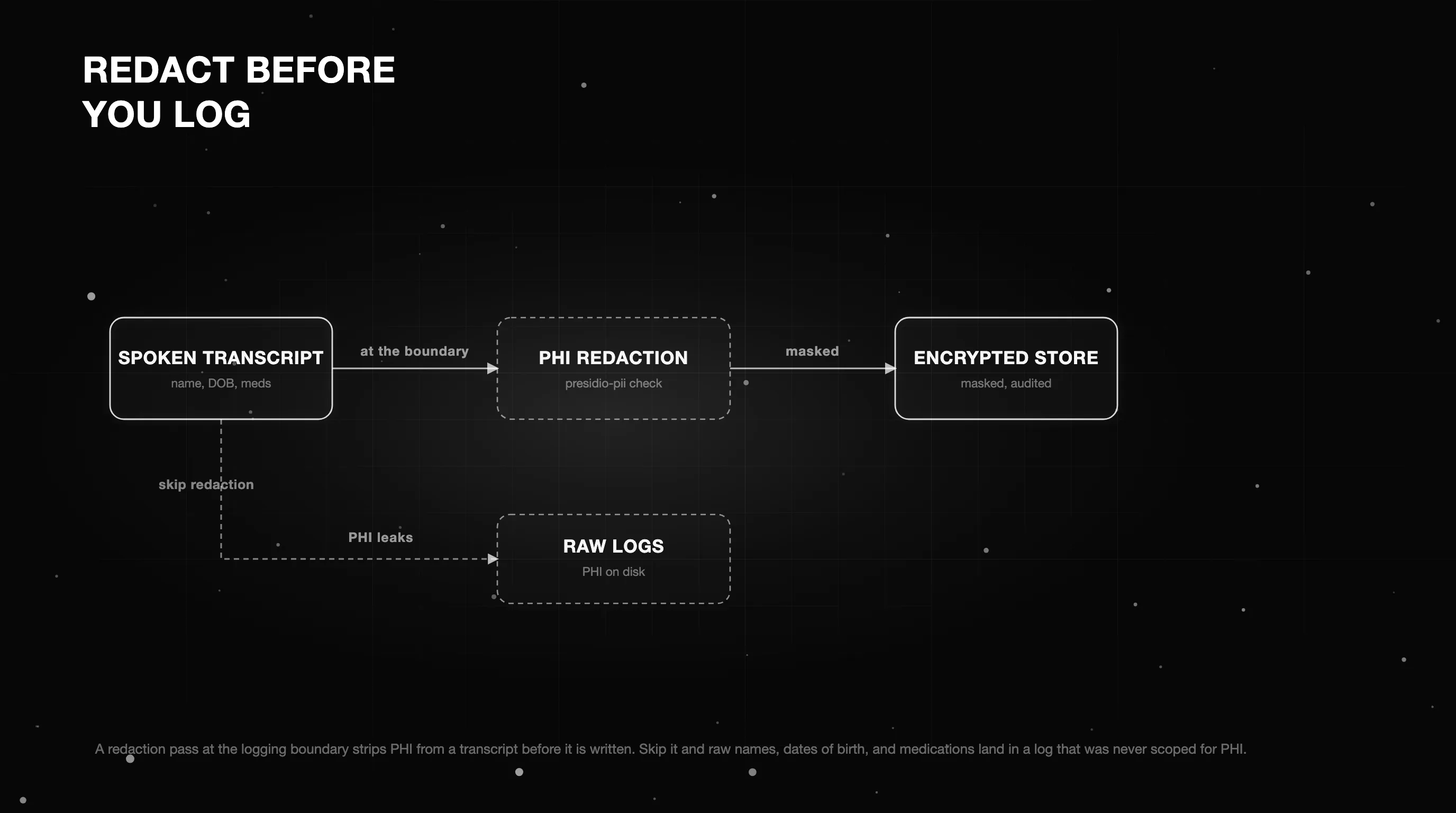
Put the safeguards together and a pipeline designed to support HIPAA compliance has a clear shape. Telephony, speech-to-text, model, text-to-speech, and storage services receive only the data they need, operate under appropriate agreements where required, and apply safeguards selected through risk analysis. Storage is encrypted and auditable; logs and caches exclude or minimize PHI unless storing it is necessary and the system is authorized to protect it.
That last step is one teams often skip. Logging a raw transcript for debugging can write names, dates of birth, and diagnoses into a system that was never authorized for PHI. When the operational use does not require the identifiers, a redaction pass at the boundary reduces that exposure. Microsoft Presidio, which Future AGI’s guardrails expose as the presidio-pii check, is one tool for this control.
from presidio_analyzer import AnalyzerEngine

analyzer = AnalyzerEngine()
transcript = "Hi, this is John Carter, DOB 04/12/1979, calling about my prescription."

results = analyzer.analyze(
    text=transcript,
    entities=["PERSON", "DATE_TIME", "PHONE_NUMBER", "US_SSN"],
    language="en",
)
for r in results:
    print(f"{r.entity_type}: '{transcript[r.start:r.end]}' (score={r.score:.2f})")
Run it against that line and Presidio returns two spans: PERSON “John Carter” at 0.85 and DATE_TIME “04/12/1979” at 0.60, the patient’s name and date of birth, both PHI. We also asked for PHONE_NUMBER and US_SSN; this sentence contains neither, so the analyzer returns nothing for them. That is the point: it surfaces the PHI actually present so you can mask it before the transcript is stored. Wire that pass in front of your logger and raw PHI never lands on disk.
Future AGI documents the same idea as a PII detection guardrail you run per request. The speech layer feeding it carries its own accuracy demands, because a mis-transcribed medication or dosage becomes a patient-safety problem, not just a data one.
Use cases mapped to their PHI footprint
The same workflows from earlier look different once you ask what PHI each one actually needs. Minimum necessary is a design constraint that shrinks your exposure on every call, not just a compliance line.
Scheduling needs a name, a date of birth to verify identity, and an open slot. It does not need a diagnosis or medication list, so none of that should enter the prompt or the log. Refills need the patient, the medication, and a pharmacy, which runs more sensitive, because a drug name can imply a condition. Pre-visit intake is the heaviest: symptoms, history, sometimes insurance, all of which demand the tightest handling and the shortest retention.
Eligibility checks need coverage details but rarely clinical data. Post-discharge follow-up stays low-PHI if it keeps to “did you fill your prescription” and turns high-PHI the moment it asks about symptoms.
The pattern is to give each workflow only the fields it needs and to cut everything else out of the context window. A voice agent that never receives a piece of PHI cannot leak it.
Some calls should never be fully automated. Clinical advice, medication changes, anything that shades into diagnosis or treatment belongs behind a human, with the agent gathering context and handing off, not deciding. Routing that PHI safely between the agent, your models, and downstream services is its own layer, and an AI gateway that enforces those rules in the request path keeps the routing itself compliant.
EHR integration without widening the attack surface
A voice agent earns its value when it can read and write the systems of record, which in healthcare means the EHR. Integration usually runs over FHIR or the older HL7 v2, the standards Epic, Cerner, and the rest expose for structured clinical data. The moment your agent can query an EHR, though, it becomes another door into the most sensitive database the organization owns.
Keep that door narrow. Scope every access token to the specific resources the workflow needs, and make it read-only wherever the task allows, so a scheduling agent can read availability without any write path into clinical records. Where a write is required, such as booking an appointment, scope it to that single action. Every read and write the agent makes should be logged with the same audit trail HIPAA requires everywhere else, so an investigator can reconstruct exactly what the agent saw and did.
The goal is an integration that adds a capability without adding a broad new attack surface. A narrowly scoped, fully audited, read-mostly connection is the difference between a helpful agent and a liability wired straight into the record.
Consent and call recording disclosure
Recording a healthcare call adds a second legal layer on top of HIPAA. Many states require all-party consent to record, so the agent has to disclose the recording and capture agreement before it stores audio. Automated outbound calls carry their own constraint under the TCPA, which governs prior consent for autodialed and prerecorded calls, and those rules shift, so confirm the current requirements before you design an outbound campaign. When in doubt, disclose, capture consent explicitly, and log that you did.
How to evaluate a HIPAA voice AI platform
Vendor claims are cheap, so evaluate a HIPAA voice AI platform on evidence. Six things separate a vendor who has done the work from one who has a compliance page.
Ask whether the vendor will sign an appropriate BAA and request its relevant subprocessor list. Ask for concrete encryption standards rather than “bank-grade,” and ask whether audit logs are tamper-resistant and exportable. Review how PHI is minimized, retained, deleted, and protected in logs. Ask for independently audited assurance such as SOC 2 Type II or certification to ISO 27001. Do not ask for a “HIPAA certification”: HHS does not recognize private certifications as proof of compliance. Ask directly about incident history and remediation.
| Requirement | What to ask for | Red flag |
|---|---|---|
| BAA coverage | BAA + subprocessor list | ”We’re working on it” |
| Encryption | AES-256 rest, TLS 1.2+ transit | Vague “bank-grade” |
| Audit logs | Per-call, tamper-evident | No export |
| PHI redaction | Pre-log redaction proof | Logs raw transcripts |
| Independent assurance | SOC 2 Type II, ISO 27001 | Self-attested only |
| Breach history | Disclosure + remediation | Non-answer |
The way to use the table is to make vendors show, not tell. Request the actual BAA, the actual subprocessor list, and the most recent penetration-test summary. A vendor who has built for healthcare hands them over; one who has not will stall on exactly the documents that matter most. The guardrail layer that enforces these controls at runtime deserves its own scrutiny, and knowing how guardrails differ from evals shows what that runtime enforcement looks like in practice.
Future AGI for HIPAA-conscious healthcare voice agents
Everything here has two hard parts: finding failures before a voice agent takes a real patient call, and controlling PHI once it does. Future AGI provides tools for both. Its Simulation rehearses a healthcare voice agent on hard calls, identity checks, refill edge cases, and upset patients, then scores each one through supported voice providers such as Vapi, Retell, and Bland.ai. Simulation reduces risk but does not prove that a deployment is safe or compliant.
On the PHI-boundary side, Future AGI’s Protect can run guardrail checks, including PII detection, and apply configured block, warn, mask, or log actions. You can also write custom evaluations for healthcare-specific call requirements. Future AGI supports HIPAA-compliant deployments when appropriately configured and publishes its security and compliance posture on its trust page; BAAs are available for eligible customers. These capabilities support a customer’s compliance program, but they do not make the customer’s complete workflow compliant by themselves. Future AGI’s open-source core is Apache-2.0 and self-hostable, with the code on GitHub.
Deploy voice care without gambling with PHI
Go back to that reschedule call and the patient reading out her date of birth. In a pipeline built with the controls described here, exposure is reduced: services receive only the fields they need, applicable business-associate relationships are documented, unnecessary identifiers are excluded from logs, and access is auditable. Those controls still need to sit inside the organization’s risk analysis, policies, training, and incident-response program.
Getting there is a sequence. Map your pipeline’s PHI touchpoints stage by stage. Determine each vendor’s role and confirm BAAs or subcontractor terms where required. Apply safeguards based on risk analysis, including access control, authentication, audit controls, and appropriate transmission protection. Minimize or redact PHI in logs when identifiers are unnecessary, and simulate the hard calls before a patient reaches the agent. Then have your privacy and security owners validate the complete deployment rather than treating any one product or checklist as proof of compliance.
Frequently Asked Questions
Are AI voice agents HIPAA compliant?
Is a BAA enough for HIPAA compliance?
What PHI do healthcare voice agents handle?
How do you evaluate a HIPAA voice AI vendor?
What are the HIPAA technical safeguards for voice AI?
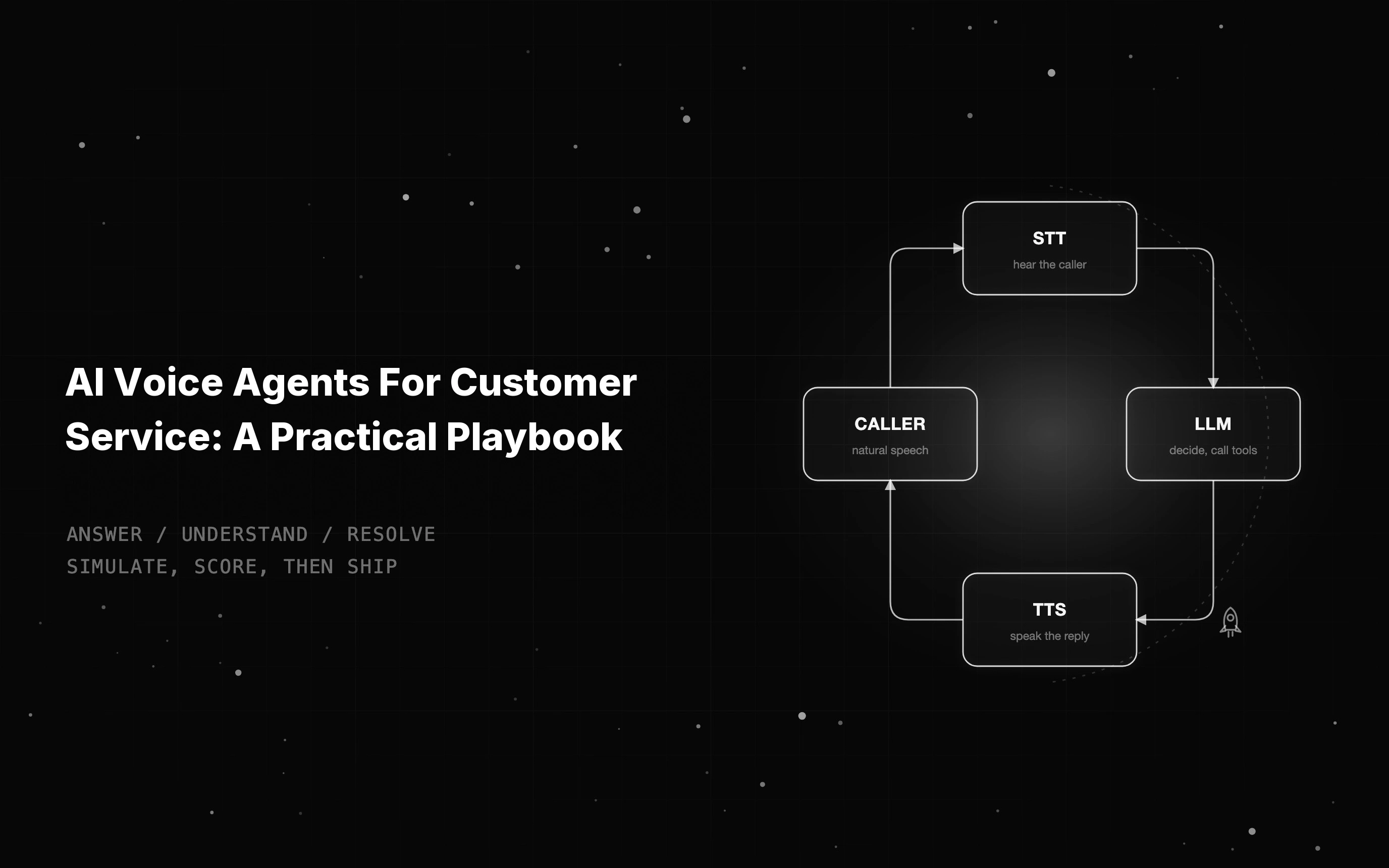
AI voice agents for customer service resolve routine calls end to end. See which workflows to automate first, the metrics that prove it works, and how to test before launch.

Inside Future AGI open source in Q2 2026: the platform shipped under Apache 2.0, Error Feed and the Agent Command Center went live, traces hit billions.


Gemini 3.5 Flash dropped today at Google I/O 2026. The 8 benchmark numbers that matter, $1.50/$9 pricing breakdown, and what to instrument before you swap.
