AI Evaluation ROI 2026: Future AGI vs In-House Build (3-Year TCO Analysis)
Future AGI vs in-house AI evaluation 2026: $400K savings, 3-year TCO breakdown, payback in weeks, build vs buy decision framework with verified pricing.
Table of Contents
AI Evaluation Platform ROI 2026: Future AGI vs Building In-House
Teams shipping LLM products in 2026 face a recurring CFO question: do we buy a managed AI evaluation platform like Future AGI, or do we build the evaluation stack in-house? This guide answers it with concrete 3-year TCO numbers, payback math, and a build-vs-buy decision framework.
TL;DR: 3-Year TCO Snapshot
| Path | Year 1 cost | Years 2-3 cost | 3-year total | Time to live |
|---|---|---|---|---|
| Future AGI Pro (cloud) | ~$600 + usage | ~$1,200 + usage | ~$1,800 base + usage | Same day |
| Future AGI Enterprise (VPC/on-prem) | Custom | Custom | Custom; compare vs build case | 1-2 weeks |
| In-house build (cloud, lean) | ~$131K | ~$270K | ~$401K | 3-4 months |
| In-house build (regulated, modeled at benchmark midpoint) | ~$300K | ~$950K | ~$1.25M | 6-12 months |
| Recovered eng-hours value | n/a | n/a | $50K+ per ML engineer per year | from week 2 |
Assumptions and cited inputs (accessed 2026-05): senior ML engineer base $130K to $200K (Coherent Solutions market data), DevOps $125K to $150K (Indeed salary tracker), SOC 2 readiness $30K to $50K per cycle (Sprinto), AWS p4d.24xlarge $32.77 per hour (AWS published rate). Future AGI pricing from futureagi.com/pricing as of 2026-05.
Why Building In-House AI Evaluation Pipelines Costs More Than Most Teams Expect
Shipping quality GenAI products requires solid evaluation infrastructure, there is no way around it. Teams know this, which is why they spend weeks building evaluation pipelines, writing custom scripts, and stitching together dashboards to measure model performance. The hidden problem: while your engineers are wiring up testing systems, they are not improving your models or shipping the features that drive revenue.
A basic prototype of an in-house evaluation system can cost anywhere from $14,200 to $28,100 (284 hours at $50 to $99 per hour). After the initial build, you keep paying for infrastructure scaling, metric updates, and edge-case adaptation. You also see developers and data scientists pulled off core model work to fix pipelines and rationalize scoring inconsistencies, which slows release cycles.
As your models and datasets expand, in-house systems buckle under pressure. Custom tools often lack built-in collaboration features, which makes it hard for PMs, engineers, and other stakeholders to share evaluation results. When you finally need enterprise-grade audit logs or compliance support, surprise licensing and consultant costs can put you well into budget overruns.
This guide breaks down a real-world ROI analysis with concrete numbers and timelines so you can decide when it makes sense to build your own evaluation platform and when buying is the smarter choice. For a deeper treatment of the decision itself, see the eval SDK vs eval platform vs build framework.
Executive Summary: Key Findings from the 3-Year TCO and ROI Analysis
3-Year Total Cost of Ownership Comparison
A recent build-vs-buy analysis from OpenLedger on building in-house real-time reporting layers tracks well with AI evaluation infrastructure where engineering salaries, on-call ownership, infrastructure scaling, and compliance audits dominate cost (LLM API spend itself is a separate line item layered on top). Two reference points:
- OpenLedger reference range: Their published 3-year TCO falls between roughly $850,000 and $1.65 million for the regulated, multi-engineer end of the build. A regulated full-stack build near the midpoint of that range covers roughly $300K of upfront development plus about $200K per year for maintenance and compliance, with the remainder allocated to infrastructure scaling, audit cycles, observability tooling, and on-call rotation.
- This article’s lean-build model: A leaner cloud-native AI evaluation build (smaller team, no SOC 2 in year 1) bottoms out closer to roughly $400K over 3 years, which is what the lean line item in the TL;DR table tracks. The two ranges represent different scenarios, not the same one.
- Buying SaaS: The OpenLedger study shows a 3-year range of $87,000 to $420,000 for subscription-based solutions. Even the high end is 60 to 80 percent cheaper than the regulated in-house build.
Time-to-Value Analysis
- Building an in-house evaluation pipeline typically requires 3 to 4 months of iterative development. Your engineering team cycles through design, implementation, testing, and refinement, with each iteration requiring specialized expertise in ML evaluation frameworks, data pipeline architecture, and performance optimization.
- Future AGI’s cloud spins up the same day; the Enterprise VPC deployment lands in 1 to 2 weeks. Teams begin scoring traffic and writing custom evaluators on day one.
Team Productivity Impact
- Offloading evaluation tooling lets AI teams shift more engineering capacity back to model research and feature work (exact lift varies by team size and pipeline maturity).
- Ready-made dashboards, built-in collaboration, and automated reporting cut context switching, so engineers and data scientists stay focused on the model and the product surface.
Risk Mitigation
- SaaS systems ship with SLAs, security certifications, and audit logs. They help the business hit compliance criteria without adding headcount.
- As data volume increases, vendors handle scalability, version upgrades, and infrastructure health. This eliminates surprise maintenance overruns and reduces unplanned outage risk.
The True Cost of Building AI Evaluation In-House: Development, Infrastructure, and Security
At first glance, building an AI evaluation system in-house may look like a cost-saver, but development salaries, cloud bills, monitoring fees, and maintenance add up fast.
Development Costs Breakdown
When you look at the costs of developing AI evaluation in-house, salaries dominate the budget:
- Senior ML engineer, US: typical range $130,000 to $200,000 base per year, with recent averages near $160,000 and upper bounds around $200,000.
- DevOps engineer, US: averages cluster around $125,000 to $150,000 base per year across major trackers.
- UI or UX designer, US: averages commonly fall near $110,000 to $125,000 base per year.
Infrastructure Costs
- Compute and GPUs: An AWS p4d.24xlarge with 8 A100 GPUs is about $32.77 per hour on demand, which is roughly $23,900 for a 24x7 month. One training-grade GPU node alone can add a five-figure monthly line item.
- Storage: S3 Standard is $0.023 per GB per month for the first 50 TB, so 10 TB is about $230 per month and 50 TB is about $1,150 per month.
- Example sizing: Each additional p4d.24xlarge adds about $23,900 per month at on-demand rates, while storage scales linearly with data volume.
Monitoring and Security Costs
- Observability: Datadog Infrastructure Monitoring starts around $15 per host per month on annual Pro plans and about $23 per host per month on annual Enterprise plans, with APM and logs billed separately.
- Compliance stack: A typical SOC 2 effort spans readiness, risk assessment, pentest, tooling, and the formal audit, with a total budget often falling between $30,000 and $50,000 depending on scope and size.
- Penetration testing: Market rates commonly range from $5,000 to $50,000 per engagement, with complex scopes exceeding $50,000 in many cases.
Figure 1: Hidden Expenses of In-House AI Evaluation
Future AGI Platform Pricing and ROI Analysis: Free, Pro, and Enterprise Plans
Future AGI Pricing (2026)
Future AGI runs on a usage-based pay-as-you-go model. You only pay for the evaluator calls, traces, and storage you actually consume.
Free plan: $0/month for up to 3 seats. Includes core features for building, observing, and improving models. Usage-based model with a generous free tier for traces and storage. You only pay if you exceed the free limits.
Pro plan: $50/month for up to 5 seats. Adds alerting, dashboards, error localizer, and evaluator feedback loops. Billed monthly with usage metering; two months free on annual commitment.
Enterprise plan: Custom pricing with volume discounts, SLAs, on-prem and self-hosted options, SSO/SAML, and compliance certifications including SOC 2 Type II and GDPR.
Free trial: Custom access for a pre-determined period so you can test every capability before committing.
Same-Day Implementation
- Account and keys: Create the organization, add API keys (
FI_API_KEYandFI_SECRET_KEY), and invite the team in minutes. - Connect SDKs: Wire in OpenAI, Anthropic, Google, or any LiteLLM-supported provider through the Future AGI SDK to begin capture immediately.
- Enable tracing: Turn on end-to-end OpenTelemetry tracing with the
fi_instrumentationmodule (the traceAI library) to see cost, latency, and anomalies without custom pipeline work. - Turn on evaluators and guardrails: Start collecting scores with built-in evaluator templates and apply safety filters to production endpoints out of the box.
- Go live: Dashboards, alerts, and incident views are ready the same day, backed by vendor-managed infrastructure with enterprise options when needed.
Total implementation cost: subscription fees start at $0 to $50/month plus standard onboarding time, versus six months of full-time engineer salaries for in-house builds.
3-Year TCO Comparison: In-House AI Evaluation vs Future AGI Platform
In-House Solution 3-Year TCO
Year 1 in-house costs:
- Development: $70,500 (loaded salaries for ML engineers, DevOps, and UI/UX over the build window)
- Infrastructure: $36,000 (about $3,000/month for networking, storage, and cloud servers)
- Maintenance: $25,000 (about 20 to 30 percent of the development budget for bug fixes and feature add-ons)
Year 1 total: $131,500
Years 2 and 3 in-house costs:
- Ongoing development: $40,000 (incremental feature work and bug fixes per year)
- Scaling the infrastructure: $60,000 (additional servers, autoscaling, backups)
- Maintenance and support: $35,000 (security patches, compliance audits)
Years 2-3 total: $270,000
3-year in-house total: $401,500
Future AGI Platform 3-Year TCO
Future AGI Pro: $50/month on monthly billing equals $1,800 over 36 months. Annual commitment (two months free per year) cuts the 3-year base to about $1,500.
Implementation: $0 (included onboarding, training, and consulting support).
3-year total: $1,500 to $1,800 base plus variable usage. Typically lower than fixed alternatives due to the pay-as-you-go structure and the use of proprietary Future AGI Turing models, which run evaluation inference at a low per-call cost.
ROI Calculation and Savings
Total cash savings (base subscription only, excluding metered evaluator usage): $401,500 (in-house) minus $1,800 (Future AGI Pro base) equals $399,700.
ROI on base subscription: ($399,700 / $1,800) times 100 equals roughly 22,200 percent on the base-subscription comparison. Actual savings shrink as your evaluator-call volume grows, but Turing usage avoids the fixed engineering and infrastructure burden of building, scaling, and maintaining your own scoring stack.
Payback period: under one month relative to the in-house base case. In-house averages about $11,153 per month versus Future AGI’s $50 base plus metered usage.
The table form:
| Category | In-House (36 Months) | Future AGI Pro (36 Months) |
|---|---|---|
| Development and staffing | $70,500 (Year 1); $40,000/year (Years 2-3) | n/a |
| Infrastructure and cloud | $36,000/year | Included |
| Maintenance and support | $25,000 (Year 1); $35,000/year (Years 2-3) | Included |
| Scaling and upgrades | $60,000/year (Years 2-3) | Included |
| Implementation and onboarding | n/a | Included ($0) |
| Subscription fee | n/a | $50/month × 36 = $1,800 plus usage-based metering |
| 3-year TCO total | $401,500 | $1,800 base + usage-based metering |
| Net savings (in-house minus Future AGI) | n/a | $399,700 using base subscription only; actual savings vary with usage |
Table 1: 3-Year Total Cost of Ownership (TCO) Comparison
Build vs Buy AI Evaluation Platform: Risk Comparison and Decision Framework
In-House Development Risks
- Technical risks: Roughly 70 to 85 percent of AI initiatives miss their timelines or fail to hit key objectives. Around 67 percent of bespoke infrastructure projects run past their original schedule.
- Talent risks: Most internal evaluation stacks ride on top of open-source frameworks (LangChain, Hugging Face, FastAPI). Losing an ML or DevOps engineer mid-project can stall development for weeks; 89 percent of open-source projects lose a core contributor at least once and 70 percent do so within their first three years.
- Scaling risks: Over 40 percent of custom AI stacks require urgent re-engineering before they can reliably operate at production scale.
Future AGI Risk Mitigation
- Production-ready platform: The SDK ships open-source (Apache 2.0) and powers evaluation workloads for AI teams across regulated and consumer domains. See the GitHub repo for issue activity and customer references on futureagi.com/customers.
- Compliance options available: SOC 2 Type II, GDPR support, and SSO/SAML are available on the Enterprise plan as part of the standard contract.
- 24/7 support on Enterprise: Enterprise plans include round-the-clock incident response and a named TAM.
- SLA available on Enterprise: Enterprise contracts include written uptime SLAs (specific targets are defined in the plan terms).
How to Build Accurate AI Evaluation: In-House Challenges vs Future AGI Advantage
Building an AI evaluation system is hard. Building one that produces accurate and reliable metrics is even harder. Here is why in-house solutions often fall short and how Future AGI gives you a decisive advantage.
The In-House Challenge
When teams build their own evaluation tools, they quickly discover that accuracy is a moving target:
- Time-consuming frameworks: Creating a truly accurate evaluation framework from scratch takes months. You define metrics, write scoring logic, and handle countless edge cases. This is time your engineers could spend on your core product.
- Generic metrics fall apart: Simple metrics like pass/fail or keyword matching are not enough for modern multimodal agents. You need semantic similarity, faithfulness against retrieved context, factual correctness, and policy compliance, all of which require modern judge models and infrastructure to get right.
- The “eval as a product” trap: To stay accurate, your evaluation system needs to be treated like its own product. It needs a roadmap, constant updates, and a team to maintain it. This adds significant overhead and pulls focus away from your main business.
The Future AGI Advantage
Future AGI’s platform is built to deliver accurate evaluations out of the box.
- Proprietary Turing evaluation models: Future AGI ships its own Turing family (turing_flash, turing_small, turing_large), trained specifically for scoring tasks. They deliver high agreement with human raters at much lower cost than using a frontier LLM as a judge.
- Pre-built and custom evaluators: You get a library of pre-built evaluators for common tasks like summarization, question-answering, faithfulness, and tone. You can also create custom evaluators with the Python SDK:
from fi.evals import evaluate, Evaluator
from fi.evals.metrics import CustomLLMJudge
from fi.evals.llm import LiteLLMProvider

# Built-in evaluator: faithfulness against retrieved context
score = evaluate(
    "faithfulness",
    output="Refunds are processed within 30 days.",
    context="Our policy guarantees refunds within 30 calendar days.",
)

# Custom LLM-judge evaluator using any LiteLLM-supported provider
custom_judge = CustomLLMJudge(
    name="brand_voice",
    prompt="Score the brand voice consistency from 0 to 1.",
    provider=LiteLLMProvider(model="gpt-5-2025-08-07"),
)- Focus on what matters: With Future AGI, you offload the burden of building and maintaining an accurate evaluation system. Your team interprets results and improves models instead of debugging evaluator scripts.
Team Productivity and Efficiency Gains with Future AGI vs In-House Evaluation
Developer Productivity Metrics
Switching to Future AGI delivers immediate, measurable productivity benefits by automating evaluation work and accelerating feedback loops.
- Evaluation setup: What used to take teams two weeks now takes a few hours through SDK initialization and built-in evaluator templates.
- Model testing cycles: Weekly evaluations become daily because synthetic test runs are pre-wired into the platform.
- Incident response time: Automated alerts plus trace-level error localization cut mean time to detection from hours to minutes.
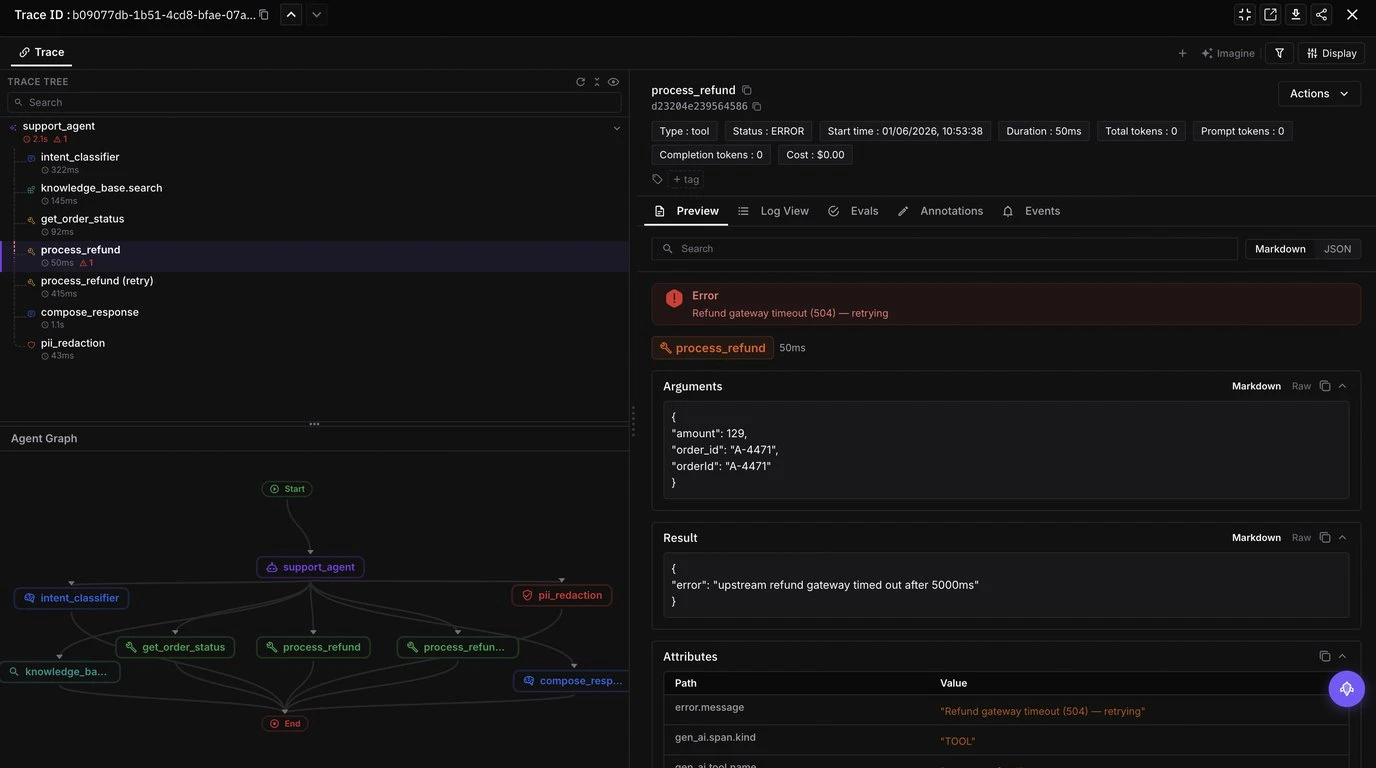
- Onboarding new team members: New hires get up to speed in days through guided in-app tutorials, not weeks of hand-holding.
Quantified Productivity Benefits
- Time saved for engineers: Each ML engineer recovers about 15 hours per week that used to go to setup, maintenance, and bug fixes.
- Faster iteration cycles: Teams can test models three times faster, turning hypotheses into confirmed results three times faster.
- Reduced context switching: Engineers stay focused on the model instead of jumping between dashboards, scripts, and deployment tooling.
- Per-engineer ROI: An ML engineer billed at $75/hour reclaiming 15 hours per week recovers about $58,500 of capacity per year.
Real-World Case Studies
Illustrative Scenario: Mid-Size Startup Building a Meeting Summarization Product
Challenge: A mid-size AI startup is building a meeting summarization product and the engineering team is stuck in a multi-month loop of building and tuning custom evaluation pipelines. The launch slips while engineers spend cycles on maintenance instead of product work.
Future AGI workflow: The team wires the SDK into their existing prompt library, attaches pre-built summary and faithfulness evaluators, and sets up automated alerts via guardrails. The fi.simulate runner generates realistic multi-turn meeting transcripts to seed the regression suite.
Modeled outcomes (assumptions stated explicitly):
- Compressed launch timeline: Removing the evaluation bottleneck frees roughly four months of engineering wall time previously allocated to pipeline rework.
- Engineering cost recovered: Two senior engineers reallocated for six months represents roughly $180K of recovered capacity at $90K loaded cost per quarter.
- Faster iteration: Model testing cycles compress from weekly to daily because evaluator runs and dashboards are managed.
Illustrative Scenario: Enterprise AI Division with 50+ Models
Challenge: A large enterprise AI division runs over 50 language and vision models. Their internal evaluation system requires manual pipeline adjustments per model and produces inconsistent metrics across teams.
Future AGI workflow: The IT and data science teams connect every model endpoint to one Future AGI workspace using the SDK and MCP integration. Evaluators are defined once and reused across models. Observability traces feed back into the eval pipeline.
Modeled outcomes (assumptions stated explicitly):
- Lower infrastructure footprint: Replacing self-hosted scoring servers with a managed SaaS plan removes a substantial cloud bill.
- Faster model deployment cadence: Standardized evaluation pipelines let new models and updates ship in days instead of weeks.
- Operational uptime: Vendor-managed infrastructure offloads scaling, version upgrades, and on-call rotation. SLA targets are defined on the Enterprise plan contract.
- Compliance options: SOC 2 Type II and GDPR support are available on Enterprise, removing audit drag.
When to Build vs Buy an AI Evaluation Platform: Decision Guide for AI Teams
When to Build In-House
- Unlimited engineering resources and long timelines: If you can give a full team 6 to 12 months of work without pulling them off core AI roadmap, building can make sense.
- Core competitive advantage lives in the evaluation layer: If you use proprietary scoring or custom metrics as a moat, owning every line of code is a strategic choice.
- Strict data locality requirements that vendors cannot satisfy: If regulations forbid any vendor data access, an in-house solution may be the only fit. Note that Future AGI’s VPC and on-prem deployment satisfies most of these requirements without forcing a full build.
When to Choose Future AGI
- Time-to-market is critical: Future AGI spins up the same day on cloud, or 1 to 2 weeks in VPC, versus 3 to 6 months for a custom build.
- You want engineering focused on core AI innovation: Offload dashboards, alerts, and maintenance so your ML experts stay on modeling and product.
- You have specialized evaluation needs: Use the Python SDK’s
CustomLLMJudgeandevaluateprimitives to ship custom evaluators in minutes, not sprints. - You need scalable infrastructure: Future AGI is designed for high-volume evaluator workloads and offloads re-architecture risk from your team.
- You need enterprise-grade security and compliance: Built-in GDPR, SOC 2 Type II, and SSO/SAML come out of the box without audit delay risk.
How Future AGI Delivers $399K in Savings and Live Pipelines in Under Two Weeks
Over three years, choosing Future AGI over an in-house build drops your TCO from $401,500 (lean cloud build) to roughly $1,800 plus metered usage, and gets you from a 3 to 4 month development delay (or 6 to 12 months for a regulated full-stack build) to a live pipeline in days. You also offload uptime, SLA, and compliance management to the vendor (specific terms defined on the Enterprise plan), while in-house efforts carry the documented 70 to 85 percent project-failure risk.
By offloading evaluation infrastructure, your ML engineers reclaim around 15 hours per week for core model work instead of pipeline maintenance. Faster feedback loops and fewer incidents keep innovation front and center, not debugging dashboards.
Next steps:
- Calculate your ROI with Future AGI to see your personalized savings and break-even point.
- Sign up for a free account and run the fi.evals quickstart in the next 10 minutes.
- Read the related deep-dives: LLM evaluation 2026, top LLM observability tools, and RAG evaluation metrics.
Frequently Asked Questions
What is the 3-year TCO of building an in-house AI evaluation platform in 2026?
How much do teams save with Future AGI vs an in-house AI evaluation build?
When should teams build evaluation in-house instead of buying Future AGI?
What payback period can teams expect from Future AGI in 2026?
Does Future AGI run on-prem or in customer VPCs for regulated industries?
How do Future AGI Turing evaluator models compare on cost vs LLM-as-judge?
What does Future AGI's Agent Command Center add to the ROI story?
Is Future AGI's evaluation SDK open source?
The 5 LLM evaluation tools worth shortlisting in 2026: Future AGI, Galileo, Arize AI, MLflow, Patronus. Features, pricing, and which workload each wins.

Future AGI, DeepEval, RAGAS, Arize Phoenix, OpenAI Evals, LangSmith ranked for LLM eval in 2026. Metrics taxonomy, templates, best practices.

Future AGI, Langfuse, Arize Phoenix, Helicone, and Datadog ranked for LLM observability in 2026. Compare OTel support, eval depth, pricing, and self-host.