Agentic AI Workflows in 2026: Architecture, Reliability, and Use Cases for Autonomous Systems
Agentic AI workflows in 2026: 4 architecture patterns, 6 reliability metrics, use cases in healthcare, finance, ops with traceable, evaluable agents.
Table of Contents
Agentic AI Workflows in 2026: Architecture, Reliability, and Use Cases for Autonomous Systems
Agentic AI workflows are systems where an LLM-driven agent plans, calls tools, observes results, and iterates toward a goal without per-step human direction. In 2026, after a year of production deployments, the distinguishing question is no longer whether agents work but whether they are reliable, traceable, and evaluable. This guide covers the four patterns that dominate, the six metrics that predict reliability, the operational stack that keeps an agent debuggable, and the regulatory backdrop that shapes deployment.
TL;DR
| Question | Answer (May 2026) |
|---|---|
| What changed in 2026? | EU AI Act GPAI rules applied since Aug 2025; high-risk rules phase in through 2026 and 2027. |
| Best starting architecture | Single-agent tool-use loop on a mid-tier reasoning model with typed tools. |
| Top reliability metrics | Task success, tool-call correctness, hallucination on intermediate steps, plan-adherence, trace length, unrecoverable-error rate. |
| Observability standard | OpenTelemetry spans via traceAI, OpenLLMetry, or OpenInference. |
| Evaluation pattern | LLM-judge plus simulation plus sampled human review. |
| Cost-optimal topology | Single-agent loop with 3 to 5 typed tools and a bounded step budget. |
| Top eval and debug stack | Future AGI Protect + Agent Command Center, LangSmith, Arize Phoenix. |
What changed since 2025
Three shifts redefined the agentic stack between 2025 and 2026.
First, the EU AI Act entered application phases. GPAI obligations under Article 53 and Article 55 have been in effect since 2 August 2025. High-risk system obligations (risk management, data governance, logging, transparency, human oversight) continue to phase in through 2 August 2026 and 2 August 2027. Agents that take autonomous actions in regulated domains (healthcare triage, credit decisions, hiring screens) fall inside the high-risk perimeter.
Second, the engineering consensus moved from “more agents” to “simpler agents”. The Anthropic essay Building Effective Agents and the OpenAI Agents SDK both recommend starting with a single-agent loop and adding hierarchy only when measured task success demands it. Multi-agent systems show up in production for orchestration roles, not as a default.
Third, observability moved from logs to traces. The Model Context Protocol specification on modelcontextprotocol.io standardised tool interfaces. Apache 2.0 traceAI, Traceloop’s OpenLLMetry, and Arize OpenInference all emit OpenTelemetry-compatible spans so an agent loop is now a first-class object in any APM tool.
What Are Agentic AI Workflows? Definition, Core Concepts, and How They Work
An agentic AI workflow has four ingredients: an LLM that produces structured output, a tool surface the LLM can invoke, an execution loop that runs until a stop condition, and an observability layer that records every step.
The minimum loop is:
plan -> tool_call -> observe -> update_state -> stop_or_continueThe interesting failures sit between those arrows. The model picks the wrong tool. The tool returns malformed JSON. The state update drops a constraint. The stop condition never fires. Span-level traces make these failures visible.
A useful mental model is the agent as a finite-state machine with an LLM-driven transition function. Some implementations make the FSM explicit (LangGraph, OpenAI Agents SDK, Google ADK). Others leave the FSM implicit in the prompt. Explicit FSMs are easier to evaluate and debug.
Real-World Applications of Agentic AI Workflows Across Industries
Three categories of use case dominate production deployments in May 2026.
Agentic AI in Healthcare: Clinical Triage, Summaries, and Decision Support
Agents draft summaries from clinical notes, triage incoming patient messages, and surface decision-support evidence from medical literature. Treatment suggestions always go to a clinician for review before reaching a patient. The architecture is almost always supervisor-worker: a triage agent routes to specialist agents (radiology summary, drug-interaction check, prior-authorisation drafting). Every action lands in an audit trail. The relevant regulatory references are HIPAA at hhs.gov, the EU AI Act high-risk Annex III, and the FDA AI/ML Software as Medical Device action plan.
Agentic AI in Finance: Research, Risk Assessment, Compliance Evidence, and Human-Reviewed Decisions
Agents do not place trades autonomously in production at any regulated bank. They draft research notes, reconcile data across systems, generate compliance evidence, and surface anomalies for human review. The risk surface is hallucination on numbers, prompt-injection from analyst documents, and audit-trail completeness. The relevant references are SEC guidance on AI use and FINRA Regulatory Notice 24-09 on generative AI.
Agentic AI in Customer Service: End-to-End Autonomous Issue Resolution and Learning
Customer support agents resolve refunds, lookups, and policy questions end-to-end. The architecture is single-agent with three to seven typed tools (order lookup, refund-issue, knowledge-base search, ticket-update, escalate-to-human). Reliability depends on three things: tool-call correctness, policy adherence on outputs, and a hard fallback when confidence drops below threshold.
These use cases share an operational pattern: the agent does not eliminate humans; it does the structured-data drudgework and routes the judgement calls. The 2026 production stack assumes a human-in-the-loop fallback for everything outside the agent’s confidence envelope.
Benefits of Agentic AI Workflows: Efficiency, Scalability, Adaptability, and Cost Reduction
The benefits are real but measurable; the gains are not free.
How Agentic AI Workflows Drive 24/7 Throughput Without Human Fatigue
Agents run continuously. For high-volume structured workflows (data entry, document classification, first-line support) the throughput gain is the headline value. Measure it as cases-per-hour at fixed quality, not as cases-per-hour alone.
Why Agentic AI Workflows Scale Faster Than Traditional Rule-Based AI Systems
A trained agent generalises across edge cases that would require hundreds of explicit rules. The cost is observability: rule-based systems are inspectable by definition, agents are not. Span-level traces close the gap.
Adaptability: How Agentic AI Learns from New Data and Adjusts in Real-Time
The 2026 reality is more nuanced than “real-time learning”. Most production agents do not update weights online. They adapt by consulting retrieval indexes that get refreshed daily and by following updated system prompts. Online weight updates remain rare because they break evaluation reproducibility.
How Agentic AI Reduces Operational Costs While Improving Decision-Making Speed
Cost savings come from labour displacement on structured work and from faster cycle times on long workflows. The headline trap is over-architecting: a hierarchical multi-agent setup can triple LLM cost without improving the task metric. Start simple. See the companion guide on AI agent cost optimization for the full cost-vs-reliability tradeoff.
The Four Agentic Architecture Patterns Worth Knowing in 2026
1. Single-agent tool-use loop
One LLM plans, picks a tool, observes the result, and iterates. The cheapest and most reliable pattern when the task fits. Use a typed tool surface (JSON schema validation on every call) and a bounded step budget so the loop cannot run away.
2. Planner-executor split
A planner LLM produces a step list once, then an executor LLM runs the steps and only re-plans when a step fails. Reduces token usage on long tasks and makes the plan inspectable. Implemented in LangGraph and the OpenAI Agents SDK as standard patterns.
3. Supervisor-worker hierarchy
A supervisor routes to specialist worker agents (research, code, data). Use when the task surface is genuinely heterogeneous. Adds cost and trace complexity; pay only when single-agent reliability stalls. The Anthropic Multi-Agent Research System engineering post explains the tradeoffs in detail.
4. Graph or state-machine flow
A directed graph of LLM and non-LLM nodes with explicit transitions. Best when the steps are well-known but the inputs are messy. LangGraph is a widely used implementation in 2026. The graph is the audit artifact; every run is a path through the graph.
How to Evaluate and Debug Agentic AI Workflows in 2026
Six metrics that actually predict reliability
Track these on a fixed evaluation set on every release.
- Task success rate (end-to-end).
- Tool-call correctness (right tool, right schema, right args).
- Hallucination rate on intermediate steps.
- Plan-adherence vs goal drift.
- Mean trace length vs optimal length.
- Unrecoverable-error rate (when the agent gives up).
# Requires FI_API_KEY and FI_SECRET_KEY set in the environment.
import os
from fi.evals import evaluate

assert os.getenv("FI_API_KEY"), "FI_API_KEY is not set"
assert os.getenv("FI_SECRET_KEY"), "FI_SECRET_KEY is not set"

trace_steps = [
    {"role": "agent", "action": "search_orders", "args": {"order_id": "A123"}},
    {"role": "tool", "result": {"status": "shipped"}},
    {"role": "agent", "action": "respond", "args": {"text": "Your order has shipped."}},
]

success = evaluate("task_completion", trace=trace_steps, goal="answer order status")
tool_quality = evaluate("tool_selection_quality", trace=trace_steps)
hallucination = evaluate("hallucination", output=trace_steps[-1]["args"]["text"])

print(success.score, tool_quality.score, hallucination.score)
The evaluate() call uses the Future AGI evaluator library described at docs.futureagi.com. Cloud-hosted evaluators run on tiered judge models: turing_flash for fast inline checks (~1 to 2 s), turing_small for balanced grading (~2 to 3 s), turing_large for high-accuracy CI runs (~3 to 5 s).
Simulation for pre-production reliability
Real users are slow and expensive. Simulate them. The Future AGI TestRunner replays an agent across scripted user personas and grades each run:
# Requires FI_API_KEY and FI_SECRET_KEY set in the environment.
import os
from fi.simulate import TestRunner, AgentInput, AgentResponse

assert os.getenv("FI_API_KEY"), "FI_API_KEY is not set"
assert os.getenv("FI_SECRET_KEY"), "FI_SECRET_KEY is not set"

def my_agent(req: AgentInput) -> AgentResponse:
    # Your real agent invocation goes here.
    return AgentResponse(output="Refund issued for order " + req.input)

runner = TestRunner(agent=my_agent, scenarios=["refund_happy_path", "refund_edge_case"])
results = runner.run()
Simulation scales because it does not need real customers and the results sit on the same trace store as production runs. See agent evaluation frameworks 2026 for the cross-vendor comparison.
Observability as the debug surface
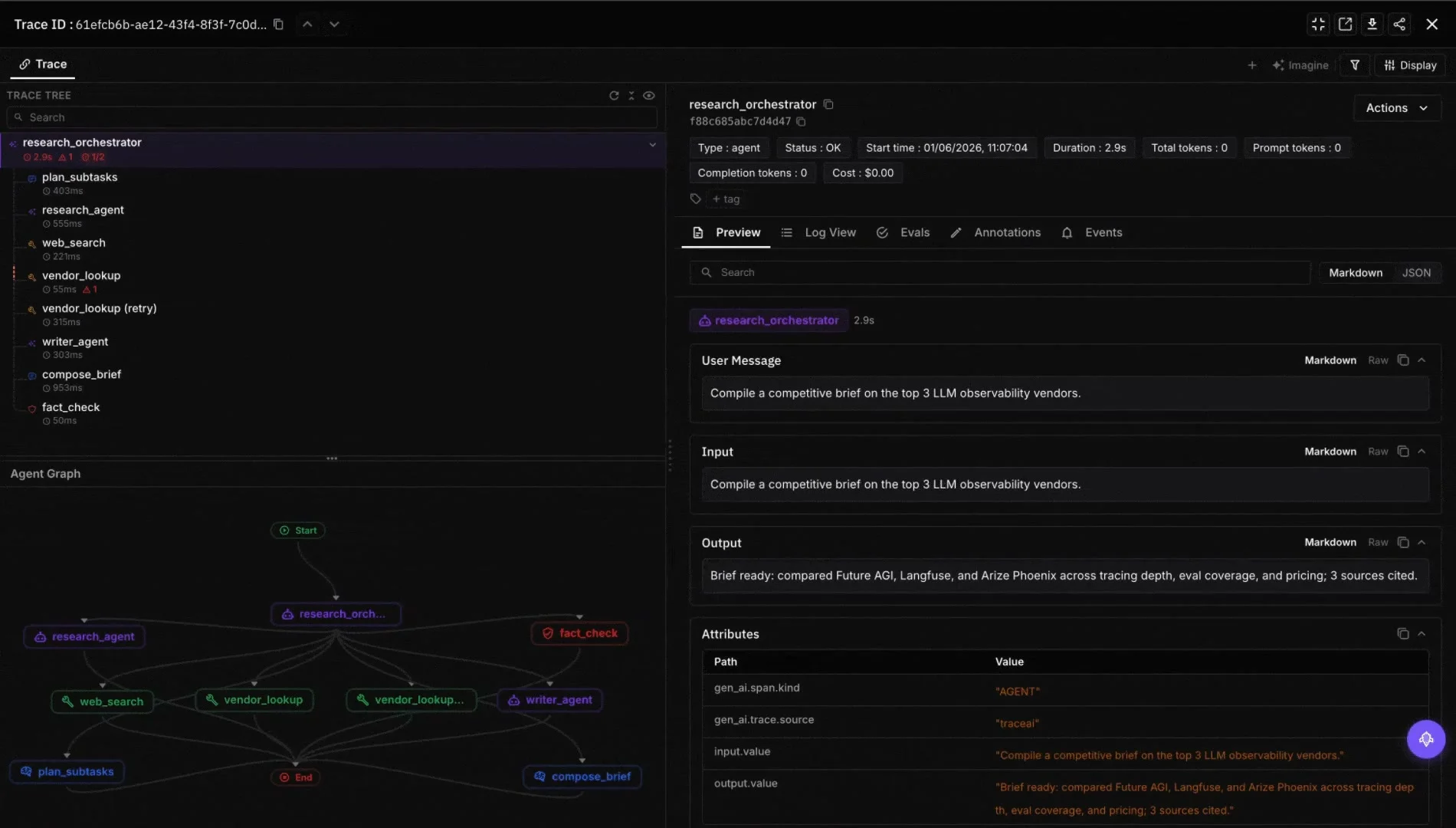
Well-configured spans emit the model name, the tool call, the latency, and, where policy allows, the prompt and response. Open the trace, follow the chain. Future AGI Protect plus the Agent Command Center supports this workflow end-to-end. LangSmith, Arize Phoenix, and Langfuse are credible alternatives.
The Apache 2.0 traceAI library ships instrumentors for the popular frameworks: traceai-langchain (LangChainInstrumentor), traceai-openai-agents, traceai-llama-index, and traceai-mcp for Model Context Protocol servers. Span data is OpenTelemetry-compatible so it joins any OTel backend.
Ethical and Technical Challenges of Agentic AI Workflows
Three risks compound as agent autonomy grows.
Bias in Agentic AI Decision-Making: How to Identify and Prevent Unfair Outcomes
Agents inherit bias from training data and from retrieval indexes. The fix is the same as for any LLM: rubric-driven bias evaluation on a stratified sample, threshold gates on release, and continuous monitoring of production traces. The NIST AI 600-1 Generative AI Profile maps the controls.
Transparency and Accountability: Solving the Black-Box Problem in Autonomous AI
The black-box framing is incomplete for agents. A trace makes the agent workflow inspectable: every model call, every tool call, every state transition is logged, even though the model’s internal reasoning remains opaque. Explanations come from trace inspection plus post-hoc faithfulness checks. See the companion guide on AI explainability tools and techniques.
Autonomy vs Control: How to Keep Agentic AI Aligned with Human Values
Bound the action space. Every tool the agent can call is a privilege. Type the inputs, gate the outputs with guardrails, and require a human signature for any irreversible action (payment, contract, medical order). The OWASP LLM Top 10 and MITRE ATLAS provide the adversary taxonomies that inform the guardrail set.
The Future of Agentic AI Workflows: Trends, AGI Integration, and Ethical Frameworks
Rise of Human-AI Collaboration: How Agents Will Work Alongside Human Teams
The 2026 production reality is human-in-the-loop by default. Agents draft, humans approve. The HITL pattern is not a temporary scaffold; it is the operating model for any system with regulatory exposure.
Tooling Standardisation: Model Context Protocol and the Tool Surface
The Model Context Protocol has become a common tool-interface standard. An MCP server exposes typed tools, an MCP-aware agent client invokes them, and traceai-mcp instruments the traffic. The standard reduces vendor lock-in: an agent built against MCP can be ported between Anthropic, OpenAI, and open-source runtimes with minimal changes.
Ethical AI Frameworks and Regulations: What Stricter Controls Mean for Agentic Systems
ISO/IEC 42001:2023 provides an AI management-system standard suitable for certification. The EU AI Act and the NIST AI RMF supply the operational requirements. Together they shape every 2026 agent deployment in a regulated industry.
How to Navigate the Future of Agentic AI Workflows Responsibly
Three operational principles separate teams that ship reliable agents in 2026 from those that ship demos.
- Start with the simplest topology that passes the reliability metrics. Single-agent loop first; hierarchy only when measured.
- Treat the trace as the audit artifact. Every action lands in an OpenTelemetry span on the same backend as evaluation runs.
- Run evaluation continuously. The same rubric used in CI promotes to production sampling. Drift in any of the six metrics gates the next release.
The Future AGI platform implements this stack end-to-end: the ai-evaluation library on GitHub (Apache 2.0) for evaluators, the traceAI repository for instrumentation, and the Agent Command Center for inline guardrails plus span-level observability. See also best AI agent observability tools for the full comparison.
Frequently Asked Questions
What is an agentic AI workflow and how is it different from an LLM application?
What are the most reliable agentic architecture patterns in 2026?
Which metrics actually predict agentic AI reliability?
How do you debug an agent that fails intermittently?
What is the impact of the EU AI Act on agentic systems in 2026?
How do you evaluate an agent if there is no ground-truth label?
Should agents share long-term memory?
What is the cheapest agent that still works?
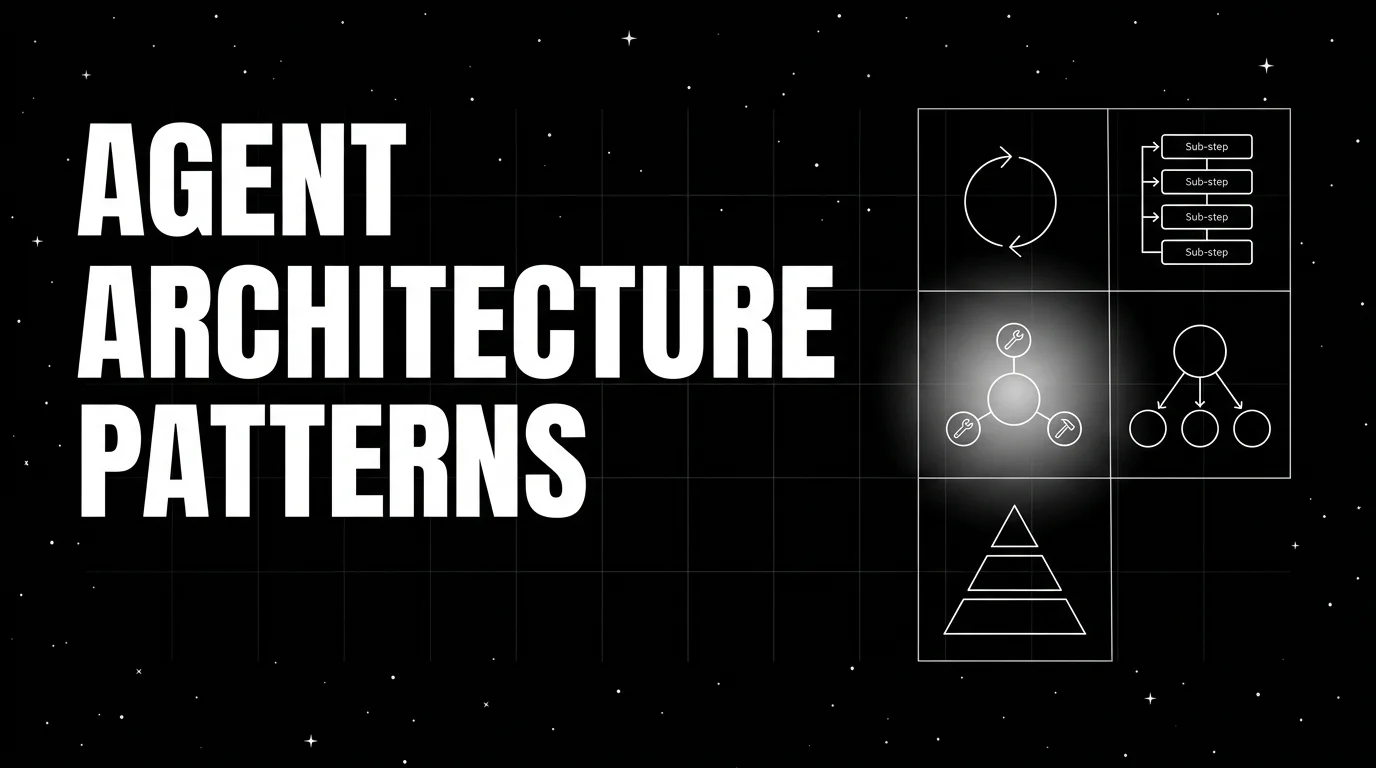
Five agent architecture patterns in 2026: ReAct, plan-then-execute, supervisor and workers, graph, event-driven. Four-axis tradeoff per pattern.

Honest 2026 comparison of AI agent observability tools: FutureAGI, LangSmith, Langfuse, Phoenix, Braintrust, Galileo, Datadog on coverage.

Six agent evaluation frameworks for trajectory-first teams 2026: LangSmith, Future AGI, Braintrust, DeepEval, Phoenix, OpenAI Evals, tradeoffs.