Build a Robust MCP Framework for GenAI in 2026: Real-Time Evaluation, Guardrails, and Observability
Build a robust MCP framework for GenAI in 2026: real-time eval, guardrails, observability, and how to wire fi.evals + traceAI to MCP servers and clients.
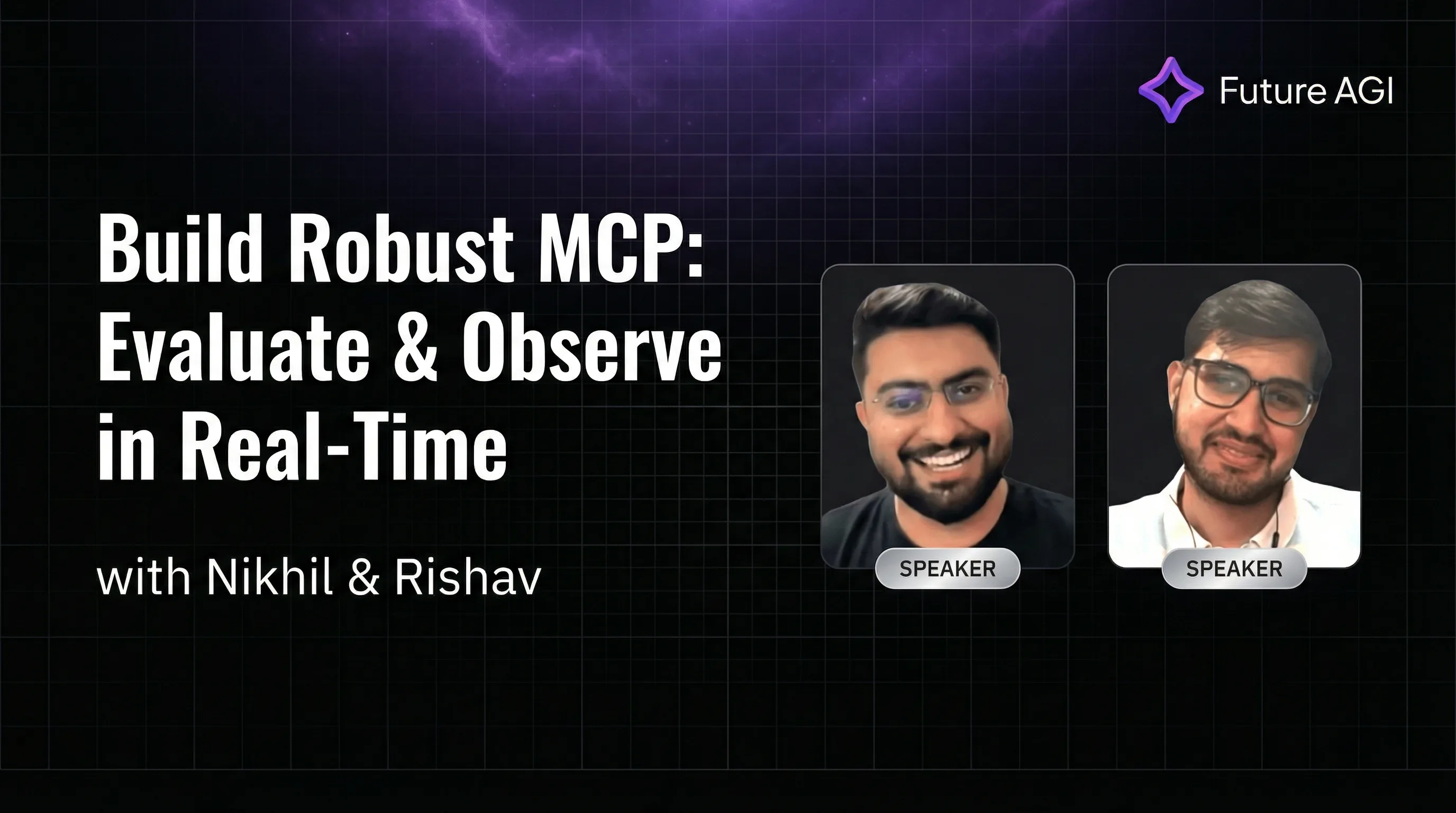
Table of Contents
TL;DR: Robust MCP in one table
| Layer | What it does | How to wire it |
|---|---|---|
| Tool-call accuracy | Score whether the agent called the right tool with valid arguments | fi.evals evaluator template + traceAI span |
| Faithfulness | Score whether the final answer is supported by the retrieved chunks | evaluate(eval_templates="faithfulness", ...) inline + on trace |
| Trajectory quality | Score whether the agent took a reasonable path | fi.evals agent template scored async on the trace |
| Inline guardrail | Gate response before user sees it | Agent Command Center BYOK gateway at /platform/monitor/command-center |
| Regression suite | Block bad server/prompt changes before merge | Synthetic scenarios via fi.simulate.TestRunner piped into fi.evals |
| Trace | Every MCP call lands on an OpenTelemetry span | traceAI (Apache 2.0) with OpenInference attributes |
If you only read one row: a robust MCP is one where every tool call has a span, every response has a score, and every regression has a CI test case. The same evaluator template runs in CI, inline, and on the trace.
Watch the webinar
In this session, Rishav and Nikhil walk through what it takes to architect a resilient MCP framework that powers live evaluation and monitoring across GenAI workflows. The companion guide below distills the workflow: which evaluators to wire, which spans to capture, and how to keep guardrails inline without breaking latency budgets.
What this guide covers
The webinar and the guide cover four concrete topics:
- Why MCP needs real-time evaluation: an MCP server is on the critical path between the model and the outside world. A bad tool argument silently corrupts every downstream answer.
- How to wire guardrails inline: evaluator templates wired to a pre-response gate at the MCP server or the gateway in front of it.
- How to generate synthetic MCP scenarios: persona-based multi-turn datasets via
fi.simulate.TestRunnerthat exercise tool calls a real user has not yet sent. - How to observe MCP at scale: traceAI (Apache 2.0) spans with OpenInference attributes, dashboard queries that map a low score back to the tool call that caused it.
The session is aimed at AI architects, engineering leads, and product teams shipping reliable, enterprise-scale GenAI.
The four layers of a robust MCP eval stack
| Layer | What it does | When it runs | Latency budget |
|---|---|---|---|
| Inline guardrail | Gate the final response before the user sees it | Every user-facing turn | turing_flash class (about 1 to 2 seconds cloud) |
| Tool-call accuracy | Score whether the agent called the right tool with valid arguments | Every agent step | Asynchronous on the trace |
| Trajectory + task adherence | Score whether the agent completed the task in a reasonable path | End of session | Asynchronous, sampled stream |
| Regression suite | Block bad MCP server, prompt, or tool changes before merge | Every pull request | Tens of seconds per case |
The four rows are not four separate tools. They are the same fi.evals templates in four deployment shapes.
What to evaluate on every MCP call
Five evaluator families belong on every MCP-connected agent.
- Tool-call accuracy: did the agent call the right tool, with valid arguments, in the right order? Scored from the trace once the agent finishes a step.
- Faithfulness: is the final answer supported by the retrieved context or tool output? Scored inline as a guardrail and asynchronously on the trace.
- Hallucination: did the agent invent facts that the tools did not provide? Wired as an inline guardrail on the final response.
- Task adherence: did the agent actually complete the user’s task or just produce plausible text? Scored asynchronously on the full trajectory.
- Safety: toxicity, PII leakage, prompt injection susceptibility, refusal correctness. Scored both inline and on the trace.
Where Future AGI sits in the MCP stack
Future AGI is the eval + observability layer for MCP-connected agents. The components:
fi.evals: the evaluator templates. The sameevaluate(eval_templates="faithfulness", ...)call runs in CI, inline, and on the trace.traceAI(Apache 2.0): the OpenInference-compatible instrumentation library. Every MCP call lands on a span with tool name, arguments, response, latency, tokens, and evaluator score.fi.simulate.TestRunner: the synthetic scenario runner for persona-based multi-turn MCP regression tests.- Agent Command Center: the BYOK gateway at
/platform/monitor/command-centerfor routing, policies, and inline guardrails in front of MCP servers and providers. - Latency tiers:
turing_flash(~1-2s cloud),turing_small(~2-3s),turing_large(~3-5s) for evaluator scoring.
The MCP niche is where Future AGI directly competes, and the platform is built around the exact workflow above.
A worked example: faithfulness as an inline MCP guardrail
The mechanics fit in one Python block. The register call initializes a traceAI tracer; FITracer wraps it for span lifecycle helpers. The @tracer.tool decorator instruments an MCP-style tool call. The evaluate() call runs inline and lands on the active span.
import os
from fi_instrumentation import register, FITracer
from fi.evals import evaluate

os.environ["FI_API_KEY"] = "fi-..."
os.environ["FI_SECRET_KEY"] = "fi-secret-..."

tracer = FITracer(register(project_name="mcp-agent"))

def retrieve_chunks(query: str) -> str:
    # Replace with the application's actual MCP retrieval call.
    return (
        "Apollo 11 landed on the Moon on July 20, 1969. "
        "Neil Armstrong and Buzz Aldrin walked on the surface."
    )

def call_my_llm(prompt: str) -> str:
    # Replace with the application's LLM call.
    return "Neil Armstrong and Buzz Aldrin walked on the Moon during Apollo 11."

@tracer.tool
def answer(question: str) -> str:
    context = retrieve_chunks(question)
    response = call_my_llm(f"Use this context: {context}\n\nQuestion: {question}")
    result = evaluate(
        eval_templates="faithfulness",
        inputs={"output": response, "context": context},
        model_name="turing_flash",
    )
    score = result.eval_results[0].metrics[0].value
    if score < 0.7:
        return "I can only answer based on the supplied context."
    return response
The same faithfulness template runs in a pytest assertion in CI and on the trace dashboard asynchronously. One template, three deployment shapes.
Synthetic MCP scenarios with fi.simulate
Real traffic does not exercise every tool sequence. Synthetic scenarios cover the gaps.
from fi.simulate import TestRunner, AgentInput, AgentResponse

# Define your agent under test as a function that takes input and returns a response.
def my_mcp_agent(turn: AgentInput) -> AgentResponse:
    # Replace with the agent's actual MCP-connected runtime.
    return AgentResponse(text="<agent response here>")

runner = TestRunner(
    agent=my_mcp_agent,
    personas=["new customer asking about refunds", "power user debugging an API"],
    turns_per_session=5,
    sessions=20,
)

results = runner.run()
# Each session is now a multi-turn trace; pipe results into fi.evals for scoring.
Wire the runner into CI. Every pull request runs the synthetic suite, scores it with fi.evals, and fails the gate if any headline metric drops past the threshold.
Why this matters for MCP
An MCP server without evaluation and observability is a black box: a tool argument goes in, a response comes out, and nobody can tell why a regression happened. With the stack above:
- Every tool call has a span. Audit and triage are queryable.
- Every response has a score. Regressions are a query, not a customer ticket.
- Every regression has a CI test case. The next pull request blocks the same bug.
That is what robust means in 2026.
Where MCP eval platforms fit in the landscape
Five practical options for MCP evaluation and observability in 2026:
- Future AGI: end-to-end eval + observability with
fi.evalstemplates for tool-call accuracy, faithfulness, task adherence, and custom rubrics; traceAI (Apache 2.0) spans; inline guardrails via the Agent Command Center;fi.simulate.TestRunnerfor synthetic MCP scenarios; turing_flash latency tier for inline scoring. - Arize Phoenix: open-source observability with OpenInference traces. Strong span exploration UI; smaller first-class evaluator catalog for MCP-specific scoring like tool-call accuracy and trajectory metrics.
- Langfuse: open-source tracing and prompt management. Good span model and dataset features; evaluation surface relies more on user-defined judges than turnkey MCP templates.
- LangSmith: first-party tracing and evals for LangChain/LangGraph agents. Solid integration with the LangChain MCP adapter; less neutral than provider-independent platforms.
- Datadog LLM Observability: enterprise LLM observability built on the Datadog stack. Strong infrastructure correlation; lighter on first-class MCP-specific evaluators and judge calibration utilities.
For an MCP-first workflow, Future AGI is built around the exact loop you need: inline guardrails, trace-attached evaluator scores, synthetic regression tests, and a CI surface that mirrors the runtime.
Pre-flight checklist before shipping an MCP server
- Every tool call wrapped in a traceAI span with OpenInference attributes.
- An inline faithfulness or hallucination guardrail on the final response, on
turing_flashlatency. - A synthetic regression suite via
fi.simulate.TestRunnerwired to CI. - A locked custom rubric (where needed) via
CustomLLMJudge, validated on a 50-example human-labeled set. - Dashboard queries that map a low-score trace to the exact tool call that caused it.
- A weekly review of trajectory metrics to feed the next round of prompt and tool changes.
Further reading
- What is the Model Context Protocol (MCP)?: the MCP spec walkthrough.
- What is an MCP server in 2026?: the server-side mechanics.
- Best MCP gateways for 2026: the gateway category comparison.
- Evaluate MCP-connected AI agents in production: the runtime evaluation deep dive.
- Future AGI MCP server: the Future AGI MCP integration reference.
Primary sources
- Model Context Protocol specification: modelcontextprotocol.io
- Model Context Protocol GitHub: github.com/modelcontextprotocol
- Future AGI ai-evaluation repository: github.com/future-agi/ai-evaluation
- ai-evaluation license (Apache 2.0): github.com/future-agi/ai-evaluation/blob/main/LICENSE
- Future AGI traceAI repository: github.com/future-agi/traceAI
- traceAI license (Apache 2.0): github.com/future-agi/traceAI/blob/main/LICENSE
- Future AGI cloud evals and turing latency reference: docs.futureagi.com/docs/sdk/evals/cloud-evals
- Future AGI simulation reference: docs.futureagi.com/docs/simulation
- OpenInference semantic conventions: github.com/Arize-ai/openinference
- OpenTelemetry tracing API: opentelemetry.io/docs/concepts/signals/traces
- Arize Phoenix repository: github.com/Arize-ai/phoenix
- Langfuse repository: github.com/langfuse/langfuse
Need turnkey evaluation and observability for your MCP-connected GenAI system? Check out our docs or book a demo for a personalized walkthrough.
Frequently Asked Questions
What does it mean to build a robust MCP in 2026?
Why do MCP servers need real-time evaluation and observability?
What is the role of evaluation in an MCP framework?
How do guardrails fit into an MCP architecture?
What does observability look like for an MCP server?
How do synthetic datasets help build a robust MCP?
How fast can inline MCP evaluations run?
What changed for MCP evaluation between 2025 and 2026?
MCP became the de facto AI tool-use standard in 2025-2026: Anthropic, OpenAI, and Google all adopted it. Architecture, SDKs, security, gateway options.

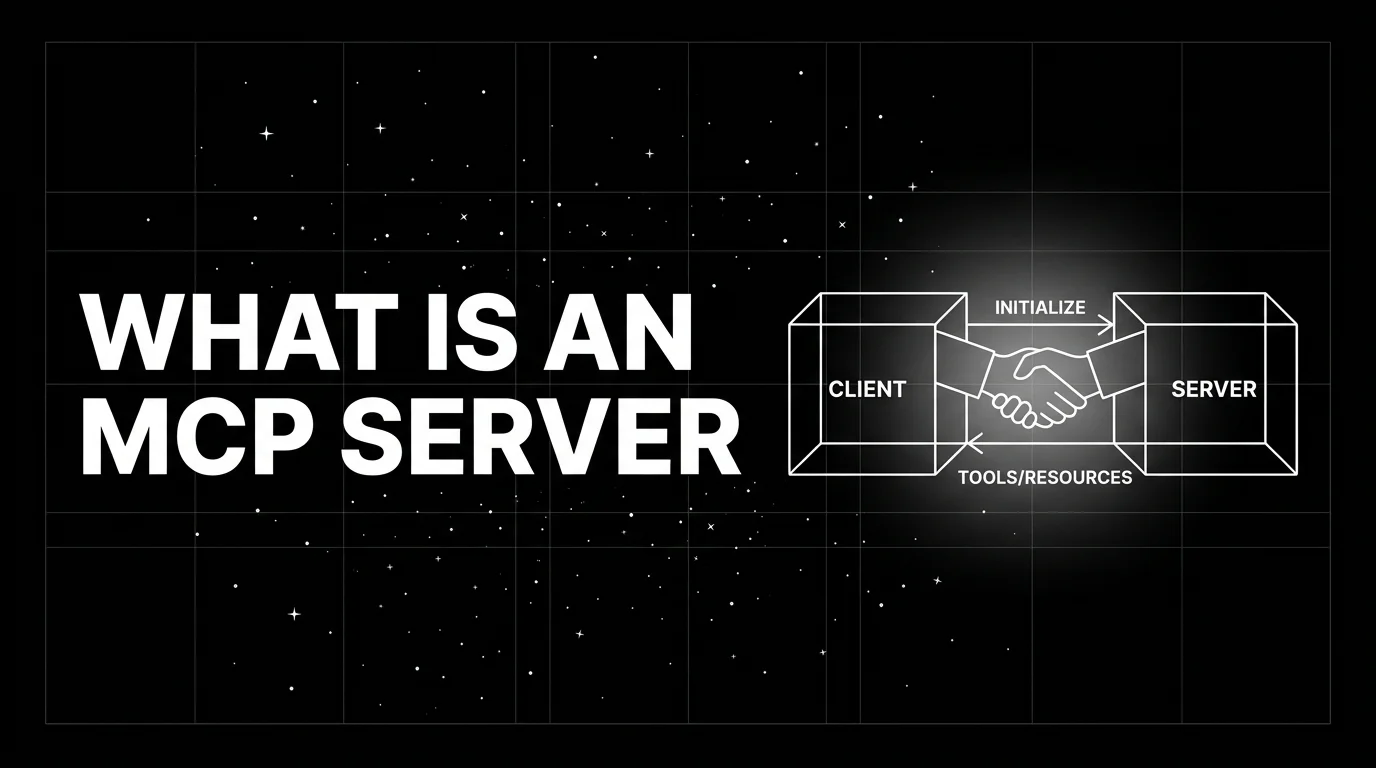
An MCP server exposes tools, resources, and prompts to LLM clients via Model Context Protocol. Architecture, transports (stdio, SSE, HTTP), lifecycle.

Cloudflare MCP, Bifrost (Maxim), Composio, Smithery, MCP Inspector CLI, and Agent Command Center compared on registration, observability, auth, and OTel.
