Cybersecurity with GenAI and Intelligent Agents (2026 Replay): How to Build Proactive Security Systems
Webinar replay on cybersecurity with GenAI and intelligent agents in 2026: predictive threat detection, autonomous response, runtime guardrails for agents.
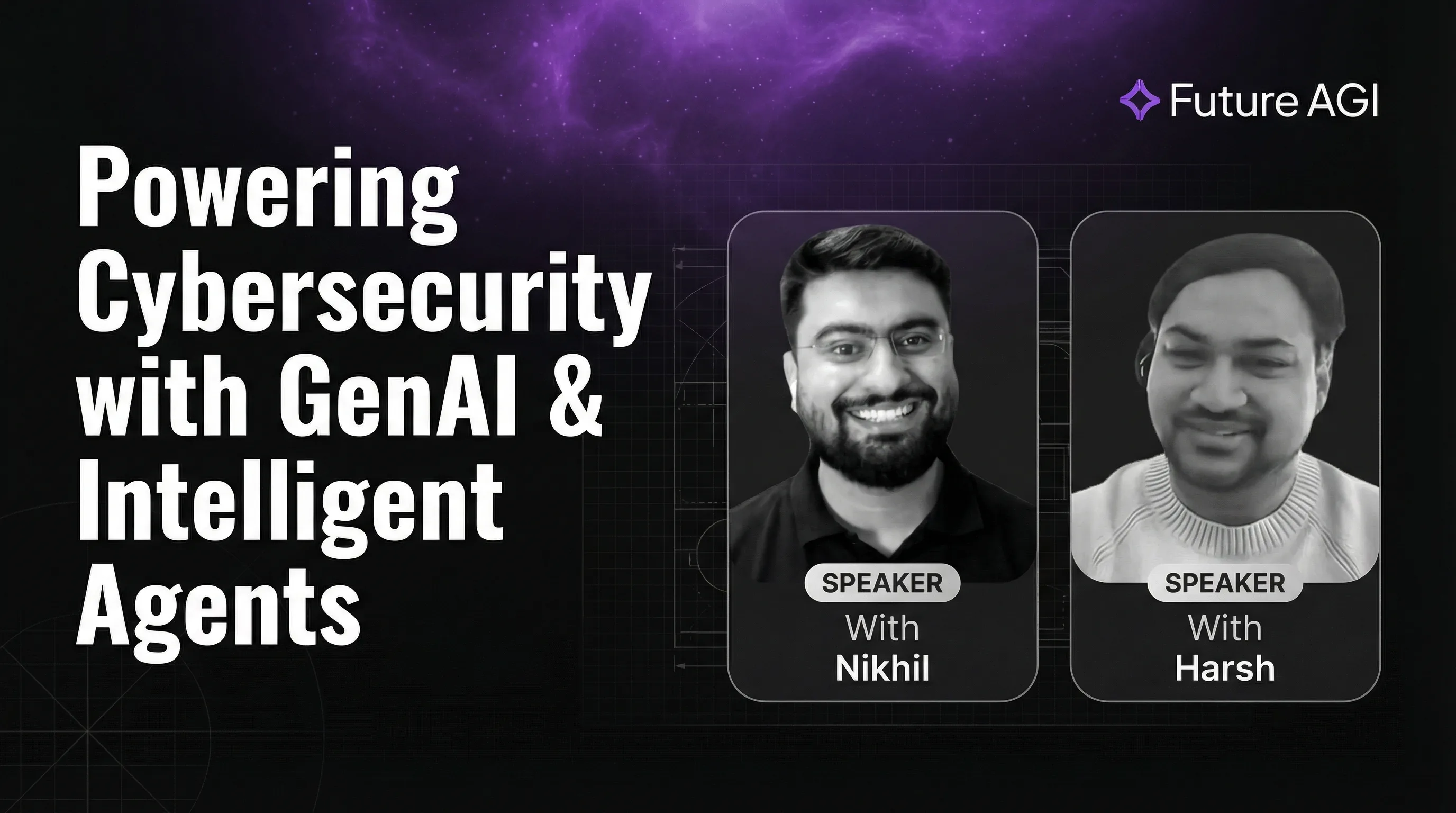
Table of Contents
Watch the Cybersecurity GenAI Webinar Replay
Security operations are moving from reactive alert triage to predictive, agent-driven defense, and the governance layer is where most teams trip.
TL;DR: Cybersecurity with GenAI in 2026
| Layer | What it does in a security GenAI stack | Where Future AGI fits |
|---|---|---|
| Detection copilot | Summarizes alerts, links related events, proposes remediation | Faithfulness eval on each summary via ai-evaluation |
| Autonomous response agent | Plans and executes triage and containment under policy | Trajectory and goal-completion eval, traceAI spans |
| Threat hunting agent | Generates hypotheses, drives deterministic SIEM queries | Span-level instrumentation across hunt iterations |
| Runtime guardrails | Inline policy on outbound tool calls, PII and prompt-injection blocking | Agent Command Center at /platform/monitor/command-center |
| Red-teaming and evaluation | Regression-style runs against adversarial corpora | fi.simulate.TestRunner plus ai-evaluation evaluators |
| Audit and governance | Decision spans stitched into the same trace as the agent call | OTel-compatible export from traceAI |
About the Cybersecurity GenAI Webinar
In this session, Harsh walks through what it takes to build intelligent cybersecurity systems that go beyond traditional reactive security. From understanding generative AI applications to implementing autonomous decision-making agents, the talk covers how security teams are creating platforms that think, adapt, and defend proactively.
The 2025 talk focused on early architecture choices and the case for generative copilots in the SOC. The 2026 replay framing adds the production-grade layers that most teams missed the first time: agent tracing across SIEM and SOAR integrations, per-turn faithfulness and trajectory evaluation, inline runtime guardrails for prompt injection and PII, and the red-teaming loop that catches regressions before they reach production.
Who Should Watch
This webinar is for cybersecurity professionals, IT leaders, and security architects shipping or evaluating AI-agent features inside detection, response, and threat-hunting workflows. It is also useful for compliance and risk leaders who need a working model for AI-agent risk inside existing security programs. A working understanding of SOC operations and modern detection stacks is assumed; the LLM mechanics are introduced before the security-specific design.
Why It Matters in 2026
Mean-time-to-detect and mean-time-to-respond can improve substantially in AI-augmented SOCs when agents are governed well, but the failure modes shift with them. Prompt injection through indirect inputs (a malicious payload buried in a phishing email body) can hijack an analyst copilot; an over-confident summary can mask an alert; an autonomous agent can execute an irreversible response before a human reviews it. The webinar covers how to capture the speed gains without inheriting the new failure modes.
What the Webinar Covers
This is a working session, not a generic AI talk:
- Transform threat detection from reactive triage to predictive intent-aware analysis.
- Build autonomous security responses that operate faster than human cadence, under tight policy.
- Understand AI agents in security: how they learn attack patterns, adapt defenses, and where they fail.
- Build intelligent threat-hunting systems that pair generative hypothesis generation with deterministic SIEM queries.
- Walk through real-world case studies of agent implementations in production SOCs.
- Address implementation challenges: ethics, governance, analyst trust, and operational concerns.
- Prepare for a future where AI agents are increasingly used for first-line response under explicit human approval gates.
Key Insight: From Detect-and-Respond to Predict-and-Prevent
The strategic shift is from “detect and respond” to “predict and prevent”: agents read intent signals across the stack, propose containment ahead of impact, and execute under explicit policy. Security teams move from firefighter to architect.
Wiring Observability, Evaluation, and Guardrails Into a Security Agent
A production security agent needs three open-source pieces wired together: tracing, per-turn evaluation, and runtime safety. The pattern is the same one the live demo uses.
from fi_instrumentation import register, FITracer
from fi.evals import evaluate

# Register a tracer at process boot
tracer_provider = register(
    project_name="soc-triage-agent",
    project_version_name="v1",
)
tracer = FITracer(tracer_provider)

# After the agent drafts an incident summary, score it
result = evaluate(
    "faithfulness",
    output="Drafted incident summary for analyst review.",
    context="Raw telemetry, related alerts, and policy context.",
    model="turing_flash",
)
print(result.score, result.reason)
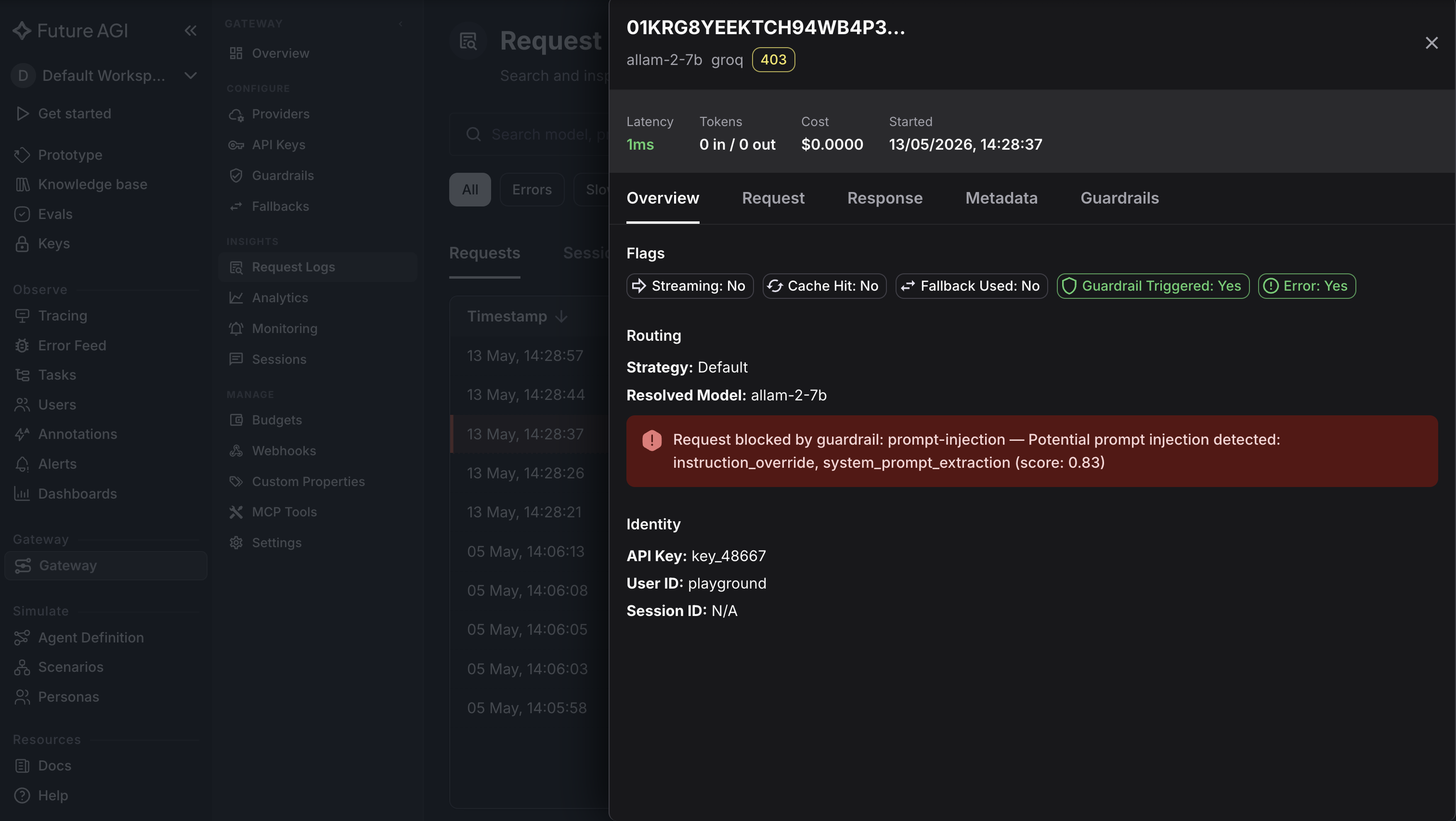
turing_flash runs at roughly 1 to 2 seconds, turing_small at 2 to 3 seconds, and turing_large at 3 to 5 seconds per the cloud evals reference. Authentication uses FI_API_KEY and FI_SECRET_KEY environment variables. Outbound tool calls (SOAR playbook execution, IDP session revocation, EDR isolation) should route through the Agent Command Center so deterministic guardrails block prompt injection, validate parameters, and capture audit-grade decision spans.
For red-team regressions, the simulate module drives adversarial corpora through the agent and grades the responses with the same evaluators used in production.
Key Takeaways for Security Teams
- The 2026 win is not a single chat copilot, it is a constrained autonomous agent with traces, per-turn evals, and inline guardrails on every tool call.
- Red-teaming is a regression discipline, not a one-time exercise. Every model and prompt change reruns the adversarial corpus.
- Human-in-the-loop is non-negotiable on irreversible actions. The Agent Command Center policy layer enforces approval gates without slowing routine triage.
- Audit logs and decision spans are the prerequisite for shipping AI inside regulated workflows.
Further Reading and Primary Sources
- traceAI (Apache 2.0): github.com/future-agi/traceAI
- ai-evaluation library (Apache 2.0): github.com/future-agi/ai-evaluation
- Future AGI cloud evals reference: docs.futureagi.com/docs/sdk/evals/cloud-evals
- Future AGI simulate module: docs.futureagi.com/docs/sdk/simulate
- OWASP Top 10 for LLM Applications: owasp.org/www-project-top-10-for-large-language-model-applications
- MITRE ATLAS framework: atlas.mitre.org
- NIST AI Risk Management Framework: nist.gov/itl/ai-risk-management-framework
- Microsoft Sentinel docs: learn.microsoft.com/en-us/azure/sentinel/overview
- CrowdStrike Falcon Next-Gen SIEM: crowdstrike.com/en-us/platform/next-gen-siem
- Splunk Security platform: splunk.com/en_us/products/enterprise-security.html
- OpenTelemetry GenAI semantic conventions: opentelemetry.io/docs/specs/semconv/gen-ai
Book a Future AGI demo to see the reference security agent (triage, containment, red-team regression) running end to end.
Frequently Asked Questions
How is GenAI changing cybersecurity in 2026?
Who should watch the cybersecurity GenAI webinar?
What does an autonomous security agent actually look like?
What are the top risks of GenAI in a security stack?
How do AI agents integrate with existing SIEM and SOAR platforms?
What observability and evaluation pieces are needed for production agents?
What does red-teaming look like for a security GenAI agent?
Where can I dig deeper after the webinar?
Webinar replay on Agentic UX in 2026 and the AG-UI protocol. Build streaming, tool-aware interfaces that work across LangGraph, CrewAI, and Mastra agents.

Map enterprise LLMs to GDPR, EU AI Act and NIST AI RMF in 2026: input/output guardrails, bias audits, explainability, and a real FAGI Protect setup.

AI red teaming for generative AI in 2026: 5 attack categories, top tools (Future AGI Protect, Garak, PyRIT, Lakera), CI playbook, and how to score risk.
