MarTech 2.0 GenAI Webinar (2026 Replay): How to Build Intelligent Marketing Platforms That Think and Adapt
Webinar replay on MarTech 2.0 in 2026: predictive data layers, hyper-personalization, synthetic data, adaptive agents, and the eval stack.
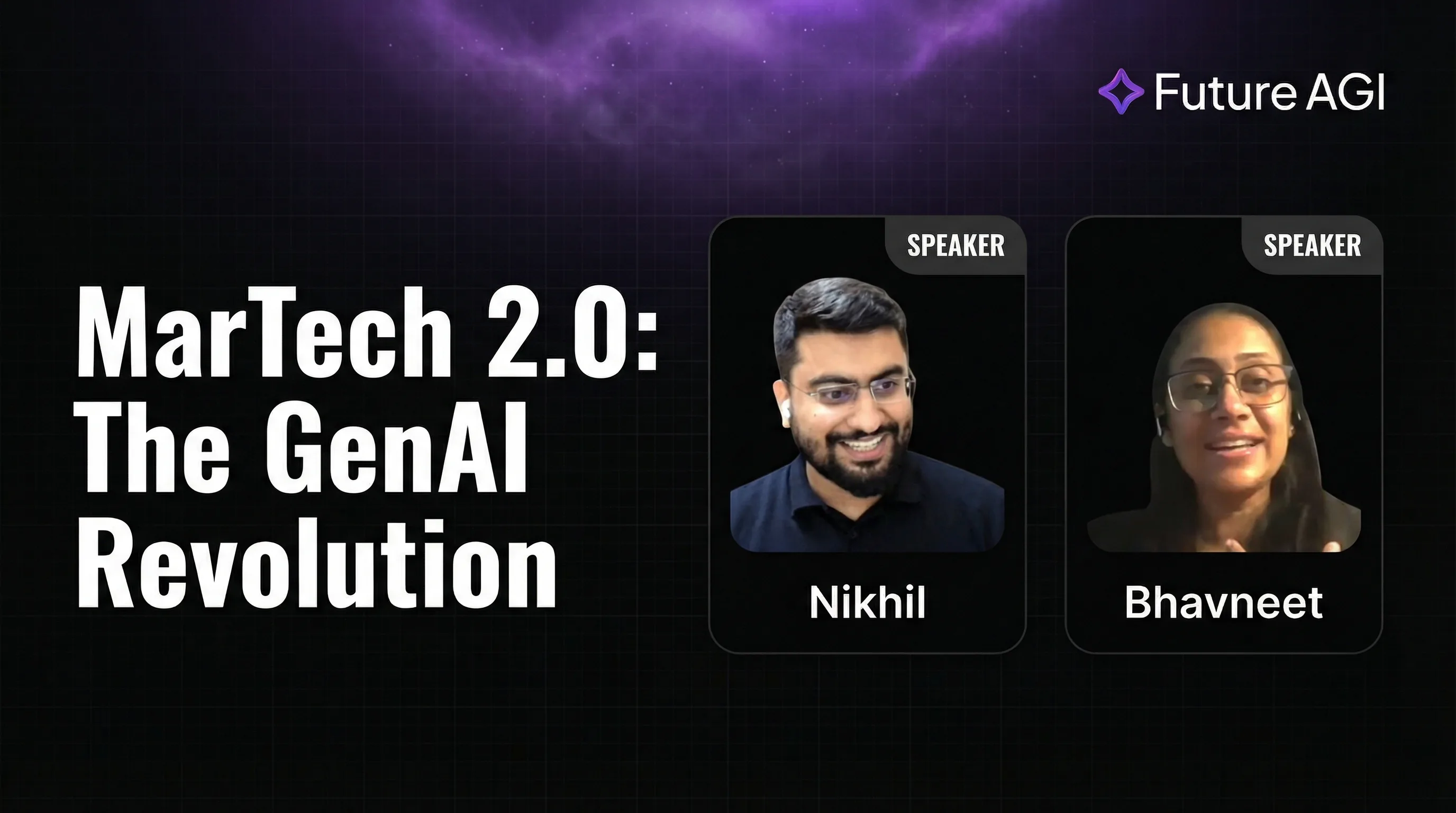
Table of Contents
Watch the MarTech 2.0 GenAI Webinar Replay
Marketing platforms are moving from rule-based automation to agent-driven systems, and most stacks are not ready for the shift.
TL;DR: MarTech 2.0 in 2026 at a Glance
| Layer | What it does in MarTech 2.0 | Where Future AGI fits |
|---|---|---|
| Predictive data | Convert CDP signals into per-user intent and segment scores | Spans surface signal lineage in traceAI |
| Generative content | LLM-backed copywriter and creative variant agents | Each generation step graded with ai-evaluation |
| Adaptive decisioning | Agents that route, time, and personalize sends in real time | trajectory and goal-completion eval on every flow |
| Runtime safety | PII redaction, prompt-injection blocking, brand-voice checks | Agent Command Center at /platform/monitor/command-center |
| Evaluation and observability | Faithfulness, brand-tone, claim safety per send | ai-evaluation evaluators inside traceAI spans |
| Synthetic experimentation | Persona cohorts that pre-test campaigns before spend | TestRunner in fi.simulate plus evaluator grading |
About the MarTech 2.0 GenAI Webinar
In this session, Bhavneet and Nikhil walk through what it takes to build truly intelligent MarTech platforms that go beyond surface-level AI features. From strategic integration frameworks and predictive data layers to scalable architectures and governance models, the talk covers how leading MarTech companies are creating platforms that think, adapt, and deliver measurable business impact.
The 2025 talk focused on early-stage architecture choices. The 2026 replay framing adds the production-grade layers most teams missed the first time: agent tracing, per-turn evaluation, runtime guardrails for PII and prompt injection, and the synthetic-data workflow that makes pre-launch testing real.
Who Should Watch
This webinar is built for MarTech product leaders, engineering teams, and AI architects working on next-generation marketing platforms. It is also useful for growth leaders evaluating which AI features are worth shipping and which are best left to vendors. The session assumes a working knowledge of LLM APIs and CRM data models; no prior MLOps experience is required.
Why It Matters in 2026
The shift from MarTech 1.x to MarTech 2.0 is not about adding a chatbot to a campaign builder. It is about replacing rule-based decisioning with adaptive agents that read intent, generate copy, pick variants, and route audiences in real time. That shift only works if three things hold: traces that show what the agent did, evaluations that score what it produced, and guardrails that stop unsafe outputs before they ship. The webinar covers all three.
What the Webinar Covers
This is not another AI overview talk. It is a working session on shipping intelligent marketing platforms:
- Turn data noise into per-user intent signals that feed the planner agent and downstream decisioning.
- Build real-time, hyper-personalized campaigns that reflect what your audience actually cares about, without leaking PII to third-party models.
- Use synthetic data to pre-test creative concepts and personalization rules against persona cohorts before any spend.
- Wire adaptive AI agents (planner, copywriter, critic) that learn from feedback loops rather than fixed rules.
- Operate evaluation and observability as the brain and nervous system of the GenAI marketing stack.
- Run micro-experiments with synthetic cohorts and re-route ad spend faster than traditional AB cadence.
- Ship no-code authoring surfaces that let marketers drive the stack without writing code.
Bonus segment: a live demo of a GenAI-powered platform that creates full ad campaigns (copy, variants, brand-aligned color schemes) from a single product brief, traced and evaluated end to end.
Wiring Evaluation, Observability, and Guardrails Into a MarTech 2.0 Stack
The MarTech stack needs three layers wired together: two Apache 2.0 open-source pieces (traceAI for tracing, ai-evaluation for evaluators) and a runtime safety layer routed through the Agent Command Center. The tracing and evaluation pattern below is the same one used in the live demo; the guardrail step is a routing call to the Agent Command Center policy bundle (configured in the workspace UI, not in code).
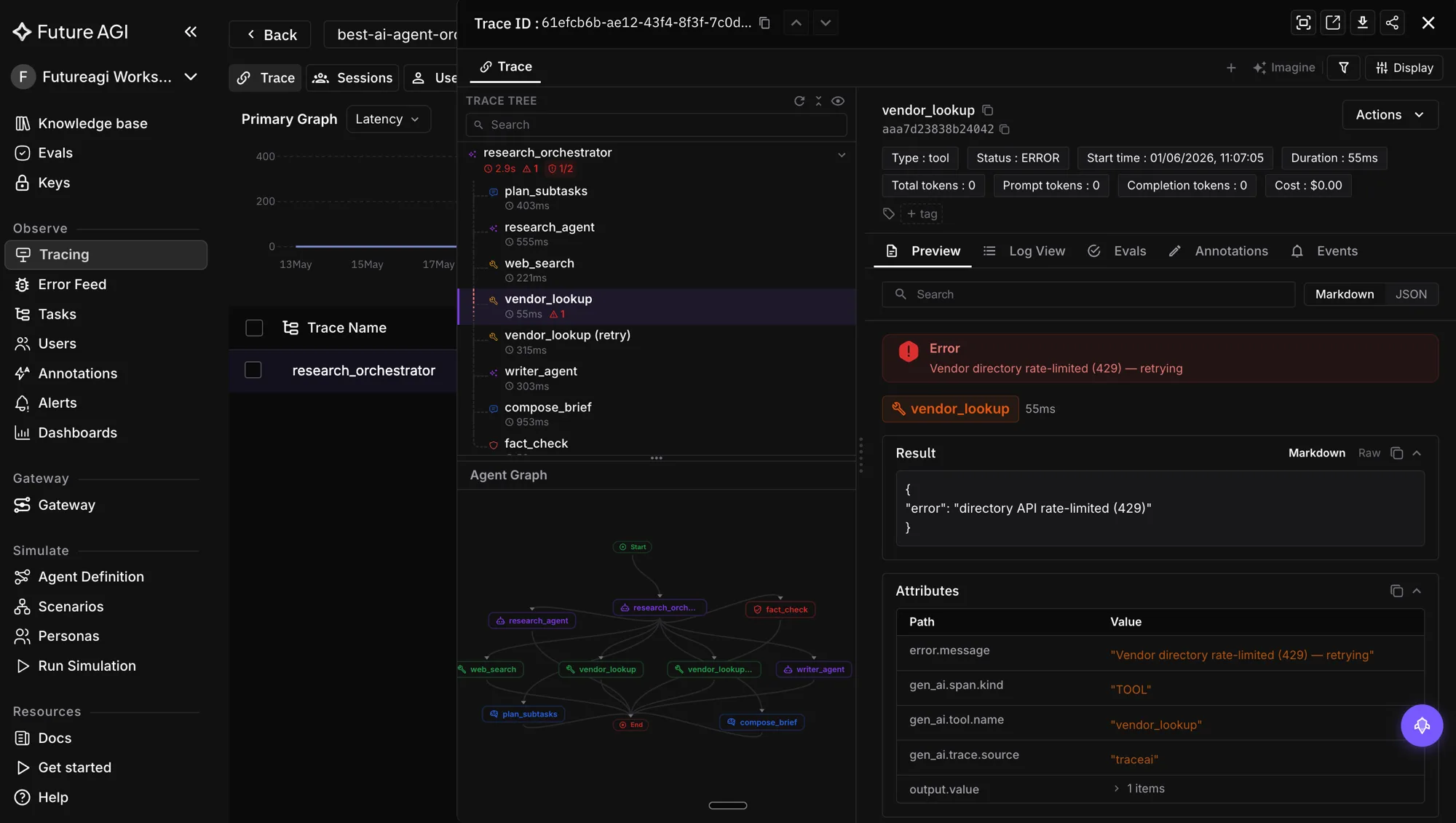
from fi_instrumentation import register, FITracer
from fi.evals import evaluate

# 1. Register a tracer at process boot
tracer_provider = register(
    project_name="martech-campaign-pipeline",
    project_version_name="v1",
)
tracer = FITracer(tracer_provider)

# 2. After the copywriter agent drafts a variant, score it
result = evaluate(
    "faithfulness",
    output="Generated ad copy for segment A.",
    context="Product brief, brand guidelines, and approved claims.",
    model="turing_flash",
)
print(result.score, result.reason)
turing_flash typically runs at roughly 1 to 2 seconds, turing_small at 2 to 3 seconds, and turing_large at 3 to 5 seconds per the cloud evals reference. Authentication uses FI_API_KEY and FI_SECRET_KEY environment variables. Outbound campaign copy should route through the Agent Command Center so deterministic guardrails block PII echo, prompt injection, and off-brand claims before any send reaches a downstream channel.
For synthetic pre-launch testing, the simulate module drives a persona cohort through the campaign agent and grades the responses with the same evaluators that run in production.
Key Takeaways for MarTech Product Teams
- The MarTech 2.0 win is not a single chatbot, it is an agent-driven stack with traces, evaluations, and inline guardrails on every send.
- Predictive data layers and synthetic cohorts let teams pre-test campaigns; evaluators decide what ships.
- The runtime safety layer is the difference between an AI demo and a production marketing system, particularly for regulated copy and PII handling.
- No-code surfaces still need the same governance as engineered surfaces; route every generation through the same guardrail layer.
Further Reading and Primary Sources
- traceAI (Apache 2.0): github.com/future-agi/traceAI
- ai-evaluation library (Apache 2.0): github.com/future-agi/ai-evaluation
- Future AGI cloud evals reference: docs.futureagi.com/docs/sdk/evals/cloud-evals
- Future AGI simulate module: docs.futureagi.com/docs/sdk/simulate
- OpenTelemetry GenAI semantic conventions: opentelemetry.io/docs/specs/semconv/gen-ai
- LangGraph docs: langchain-ai.github.io/langgraph
- CrewAI docs: docs.crewai.com
- OpenAI Agents SDK: openai.github.io/openai-agents-python
- Anthropic Claude API docs: docs.anthropic.com
- NIST AI Risk Management Framework: nist.gov/itl/ai-risk-management-framework
- Stanford 2025 AI Index Report: aiindex.stanford.edu/report
Book a Future AGI demo to see the reference MarTech 2.0 stack (planner, copywriter, critic, runtime guardrails) running end to end.
Frequently Asked Questions
What does MarTech 2.0 actually mean in 2026?
Who should watch the MarTech 2.0 GenAI webinar?
How does synthetic data fit into a MarTech 2.0 workflow?
What does observability look like for generative marketing platforms?
Can hyper-personalization be done safely without leaking PII?
How do adaptive AI agents differ from classic recommendation engines?
What evaluation metrics matter for a MarTech 2.0 stack?
Where can I dig deeper after the webinar?
Webinar replay on Agentic UX in 2026 and the AG-UI protocol. Build streaming, tool-aware interfaces that work across LangGraph, CrewAI, and Mastra agents.

Six agent evaluation frameworks for trajectory-first teams 2026: LangSmith, Future AGI, Braintrust, DeepEval, Phoenix, OpenAI Evals, tradeoffs.

Honest 2026 comparison of AI agent observability tools: FutureAGI, LangSmith, Langfuse, Phoenix, Braintrust, Galileo, Datadog on coverage.