How to Evaluate MCP-Connected AI Agents in Production: A 2026 Guide
Evaluate MCP-connected agents in 2026: tool selection, argument correctness, task completion, OTEL tracing, and the 5-pillar production scoring framework.
Table of Contents
How to Evaluate MCP-Connected AI Agents in Production: A 2026 Guide
MCP-connected agents pass staging and then fail in production. The user sends a query slightly outside the test distribution, the agent picks a wrong tool, passes malformed arguments, chains three unnecessary calls, and returns garbage. This guide is the production-grade evaluation pipeline that catches those failures: five measurable pillars, tracing with OTEL, judge plus deterministic scoring, and a sampling pattern that scales to live traffic.
TL;DR: Evaluating MCP-Connected Agents
| Pillar | What it scores | Target |
|---|---|---|
| Tool Selection Accuracy | Right tools chosen, by precision and recall | Precision > 85%, recall > 90% |
| Argument Correctness | JSON schema compliance + semantic values | > 98% schema compliance |
| Task Completion | End-to-end goal achievement (judge scored) | > 80% |
| Chain Efficiency | Calls per task, retries, redundant calls | Ratio > 0.7 |
| Context Utilization | Groundedness against MCP resources | > 85% |
Why MCP-Connected Agents That Pass Staging Still Fail in Production
Your agent works in staging. It calls the right MCP tools, returns clean outputs, and passes the test suite. Then it hits production. A user sends a slightly different query, and the agent picks a wrong tool, passes malformed arguments, and chains three unnecessary calls before returning garbage.
This is the core challenge of evaluating MCP-connected agents in production. Anthropic open-sourced the Model Context Protocol in late 2024, and within a year it had over 97 million monthly SDK downloads and 10,000+ published servers. In December 2025, Anthropic donated MCP to the Linux Foundation’s Agentic AI Foundation (AAIF), with OpenAI, Google, Microsoft, and AWS all backing the move. Every major AI platform now supports it.
The harder problem many teams still struggle with: how do you evaluate agents that dynamically connect to external tools via MCP once they are live? Static test cases do not cover it. The behavior is non-deterministic. Tool selection happens at runtime. Tool call chains branch in ways you did not anticipate.
This guide is the production-grade pipeline: five pillars, tracing, judges, sampling, and alerts.
What Changed Since 2025 in MCP Agent Evaluation
Three shifts that landed between mid-2025 and May 2026:
- MCP is a vendor-neutral standard now. The December 2025 donation to the Linux Foundation AAIF stabilized the spec and removed the vendor-coupling risk that held back enterprise adoption.
- Production MCP gateways replaced ad-hoc routers. Teams now deploy a single chokepoint between the agent and the MCP servers it can call. The gateway enforces allowed-server and allowed-tool policy, captures every call for eval scoring, and applies pre-call guardrails. The Future AGI Agent Command Center is the eval-first version of this pattern.
- Trajectory-level evaluation is the default. Single-turn input/output matching breaks on MCP agents because the tool list is dynamic. Production teams score full transcripts with LLM judges and pair them with deterministic schema and chain checks. (Tau-bench paper, MultiChallenge benchmark.)
The 2026 model surface (gpt-5-2025-08-07, claude-opus-4-7, gemini-3.x) made trajectory judges fast and cheap enough to run on a sampled production slice rather than a nightly batch.
Why MCP Changes Agent Evaluation Entirely
Before MCP, most agents had a fixed set of hardcoded tools. You could write deterministic tests: “Given this input, the agent should call search_docs with these parameters.” Simple.
MCP flips this model. An MCP-connected agent discovers tools at runtime from one or more MCP servers. The available tools can change between requests. The agent decides which tools to call, in what order, with what arguments, based on the user prompt and the context injected through MCP resources.
This creates three evaluation problems that did not exist before:
Dynamic tool selection is non-deterministic. The same query produces different tool-call sequences depending on which MCP servers are connected and which tools are advertised. You cannot test “the agent must call this tool.” You have to test whether the agent’s choice was reasonable given the alternatives.
Context injection needs validation. MCP servers provide resources (context) that shape the agent’s decisions. If a resource returns stale data or unexpected formats, the agent reasons incorrectly. Evaluation has to confirm injected context was used appropriately.
Tool call chains need end-to-end tracing. A single user request can fan out into 5 to 10 MCP tool calls across multiple servers. Each call has its own latency, success state, and output quality. You score every step and the chain as a whole.
The Five Pillars of MCP Agent Evaluation
A measurable framework for evaluating MCP-connected agents in production, organized into five dimensions.
Tool Selection Accuracy
Did the agent pick the right tool? This is the most fundamental metric, and in an MCP context it is harder to evaluate than it sounds.
Compare the agent’s tool selection against a set of labeled examples where reviewers identified the optimal tool(s) for a given query. Track two sub-metrics:
- Precision: of all the tools the agent called, how many were necessary?
- Recall: of all the tools that should have been called, how many did the agent use?
High precision and low recall means the agent is too cautious and missing tools that would help. Low precision and high recall means it is over-calling, which burns tokens and slows the chain. The four-layer eval stack for tool-calling agents goes deeper on scoring these tool decisions.
Argument Correctness
Even when the agent picks the right tool, it can pass wrong arguments. An MCP tool might expect a documentId string and the agent sends a full URL. Or it omits a required parameter.
Score argument correctness on:
- JSON schema compliance against the live tool schema.
- Type correctness (string where string is expected, not number or boolean).
- Required field presence.
- Semantic accuracy (the right document ID for this task, not any document ID).
Task Completion Rate
The bottom-line metric. Did the agent actually accomplish what the user asked for? Perfect tool selection means nothing if the final output is wrong.
Score task completion with LLM-as-judge evaluators that read the full transcript and assess the final response against the original user intent. This catches cases where every individual tool call succeeded but the agent failed to synthesize the results.
Chain Efficiency
MCP-connected agents over-call routinely. An agent that calls 8 tools to answer a question that needed 2 is burning tokens, increasing latency, and raising cost.
Track:
- Total tool calls per request.
- Redundant calls (same tool, same arguments, within one trace).
- Unnecessary calls (tool outputs that did not feed the final response).
- Total chain latency.
Context Utilization
MCP servers expose resources (context) that shape the agent’s reasoning. Evaluate whether the agent used the provided context accurately or hallucinated beyond it. Key metrics: groundedness and context relevance.
MCP Agent Evaluation Metrics and Targets
| Metric | What It Measures | How to Score | Target Threshold |
|---|---|---|---|
| Tool Selection Precision | % of called tools that were necessary | Labeled dataset comparison | > 85% |
| Tool Selection Recall | % of needed tools that were called | Labeled dataset comparison | > 90% |
| Argument Schema Compliance | % of tool calls with valid arguments | JSON schema validation | > 98% |
| Task Completion | Did the agent fulfill user intent? | LLM-as-judge scoring | > 80% |
| Chain Efficiency Ratio | Minimum needed calls / actual calls | Automated chain analysis | > 0.7 |
| Groundedness | Is output supported by retrieved context? | Evaluator metric scoring | > 85% |
| Latency (P95) | End-to-end response time incl. tool calls | Instrumentation | under 5s |
| Cost Per Request | Token + tool call cost per completed request | Trace aggregation | Team-defined |
How to Trace MCP Tool Calls in Production
You cannot evaluate what you cannot see. Tracing is the foundation of any production MCP evaluation strategy.
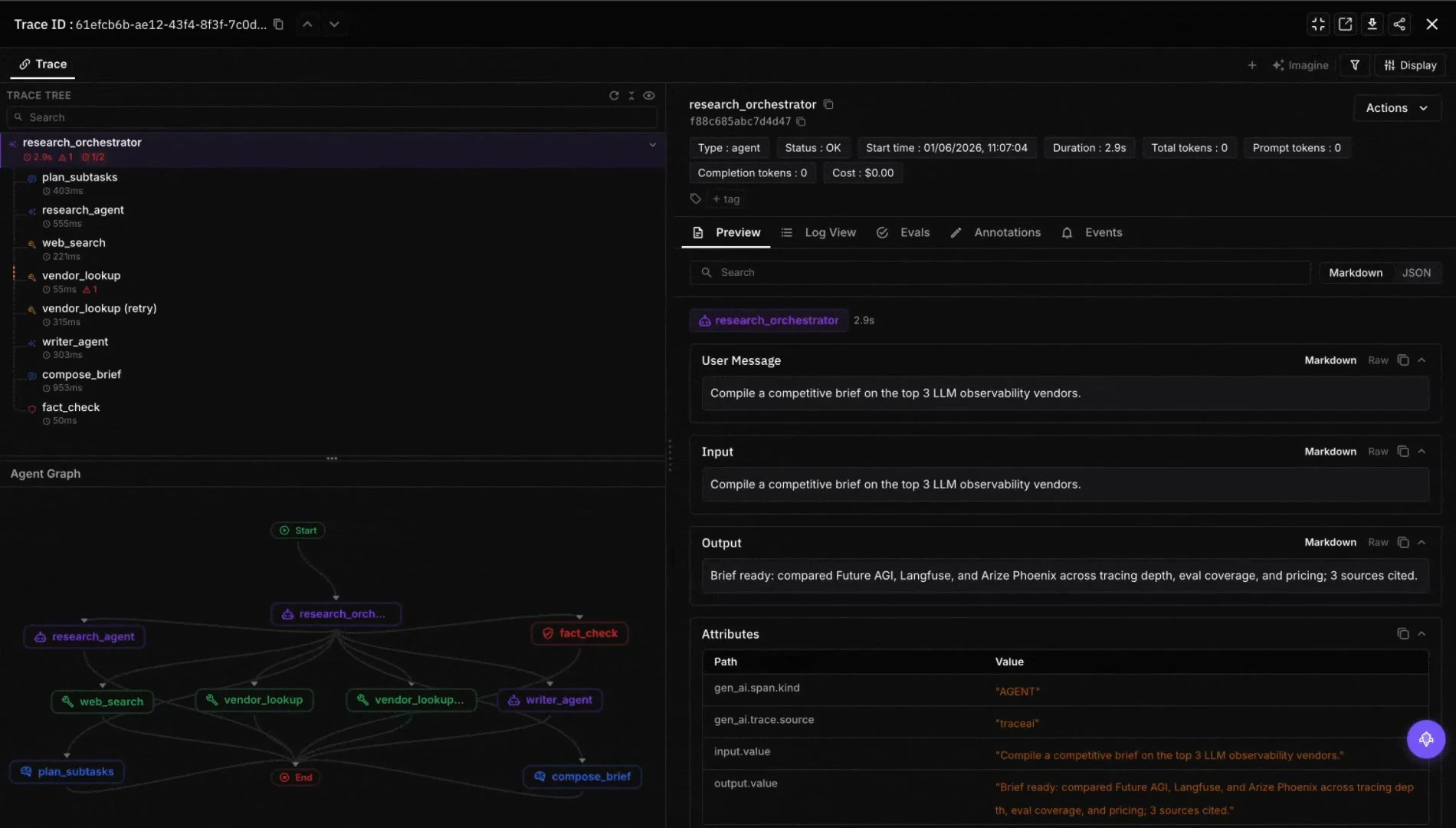
The standard approach is OpenTelemetry-based instrumentation. Each MCP tool call becomes a span with attributes for: tool name, server name, schema version, arguments passed, response received, latency, and status code. These spans nest under a parent trace that represents the full user request.
A well-instrumented MCP trace captures:
- Root span: user query received, final response returned.
- LLM decision span: model reasoning, tool selection decision.
- MCP tool call spans: one per tool invocation, with arguments and response.
- Context retrieval spans: MCP resource fetches.
- Synthesis span: final response generation from tool outputs.
Future AGI’s traceAI is an open-source (Apache 2.0, LICENSE) OTEL extension with AI-specific semantic conventions and 20+ framework instrumentors including OpenAI, Anthropic, LangChain, and CrewAI. Setup is under 10 lines:
from fi_instrumentation import register
from fi_instrumentation.fi_types import ProjectType
from traceai_openai import OpenAIInstrumentor

trace_provider = register(
    project_type=ProjectType.OBSERVE,
    project_name="mcp_agent_prod",
)
OpenAIInstrumentor().instrument(tracer_provider=trace_provider)
Traces flow into the Observe dashboard with latency, cost, and eval scores nested side-by-side per span.
The MCP Gateway Pattern for Evaluation
The cleanest production pattern is to put a gateway between the agent and the MCP servers it can call. The gateway enforces policy on every call: allowed servers, allowed tools, argument shape, rate limits, budgets. It routes traffic with BYOK credentials, captures every interaction for eval scoring, and applies pre-call guardrails.
The Future AGI Agent Command Center is this gateway. It ties MCP routing, traceAI instrumentation, and the fi.evals evaluator stack into one chokepoint, which means the eval signals you use in dev are the same ones gating live traffic. For a comparison of alternatives, see the best MCP gateways for 2026.
How to Build an MCP Agent Evaluation Pipeline
Step 1. Instrument with traceAI and OTEL
Start with auto-instrumentation. Capture MCP-specific details: which server the tool came from, the schema version, and whether the call was a retry.
Step 2. Define evaluation criteria across the five pillars
Pick the metrics that fit the use case. A support agent prioritizes task completion and groundedness. A code generation agent prioritizes argument correctness and chain efficiency.
Step 3. Set up automated judges and deterministic evaluators
LLM judges for task completion and response quality. Deterministic validators for schema compliance and latency thresholds. The Future AGI evaluation SDK (Apache 2.0, LICENSE) ships with prebuilt templates for factual accuracy, groundedness, tone, and conciseness:
from fi.evals import Evaluator

evaluator = Evaluator(
    fi_api_key="your_api_key",
    fi_secret_key="your_secret_key",
)

result = evaluator.evaluate(
    eval_templates="groundedness",
    inputs={
        "context": retrieved_context,
        "output": agent_response,
    },
    model="turing_flash",
)
turing_flash runs at roughly 1 to 2 seconds per call against the cloud evaluator; turing_small is 2 to 3 seconds; turing_large is 3 to 5 seconds. Pick the tier that fits the latency budget per call. (Future AGI cloud evals docs.)
Step 4. Sample and score production traffic
Do not evaluate every request. Set a 10 to 20 percent sample rate for general traffic, score the sample async, and run deterministic checks on 100 percent of traces flagged for schema failures, timeouts, or retry-on-same-tool patterns. Future AGI schedules Eval Tasks that score live or historical traffic with configurable sampling rates and alerting.
Step 5. Set regression alerts on the metrics that matter
Threshold-based alerts on the primary signals:
- Task completion drops below 80%? Alert.
- Average tool calls per request spikes above 6? Alert.
- Argument schema compliance dips below 95%? Alert.
Route to Slack, PagerDuty, or the CI/CD pipeline to close the feedback loop.
Common MCP Agent Evaluation Pitfalls
| Pitfall | Why It Happens | How to Fix It |
|---|---|---|
| Testing only the happy path | Dev/staging MCP servers have limited tool sets | Mirror production MCP server configs in your test environment |
| Ignoring tool call ordering | Evaluating each call in isolation | Evaluate full chains, flag when order affects correctness |
| Over-relying on LLM-as-a-judge | LLM evaluators can be inconsistent | Combine LLM scoring with deterministic schema checks |
| No baseline comparison | Can’t tell if performance is degrading | Establish baseline metrics in the first week, track deltas |
| Skipping cost tracking | Tool calls add up fast with MCP | Include token and call costs in every trace and alert on spikes |
| Evaluating too late | Running evals only in post-production reviews | Enable tracing and evaluation during development using experiment mode |
Closing the Loop on MCP Agent Evaluation
Evaluation without action is monitoring. The full loop:
- Trace every MCP tool call in production with OTEL-compatible instrumentation.
- Evaluate sampled traces across the five pillar metrics automatically.
- Identify failure patterns through clustering (which tool calls fail most, which queries produce the worst task completion).
- Iterate on prompts, tool descriptions, and MCP server configurations based on eval feedback.
- Verify improvements by comparing scores across deployment versions.
Future AGI runs the full loop end-to-end. traceAI captures the spans. The evaluation SDK scores them. The Agent Command Center gateway routes traffic, applies pre-call policy, and emits the same traces. The Observe dashboard surfaces regressions, and auto-optimization refines prompts based on evaluation feedback.
The teams that ship reliable MCP-connected agents in 2026 are not the ones with the best base models. They are the ones whose evaluation pipeline catches a regression on Tuesday and ships a fix on Wednesday. Start tracing your MCP agents today.
Frequently Asked Questions
Why does evaluating MCP-connected agents differ from evaluating fixed-tool agents?
What are the five pillars of MCP agent evaluation in 2026?
How do I trace MCP tool calls in production?
What sampling rate should I use for MCP agent evaluation in production?
What is the role of an MCP gateway in production evaluation?
Should I use LLM-as-judge or deterministic evaluators for MCP agents?
How do I detect when an MCP agent is over-calling tools?
What threshold should I set for argument schema compliance?
Cloudflare MCP, Bifrost (Maxim), Composio, Smithery, MCP Inspector CLI, and Agent Command Center compared on registration, observability, auth, and OTel.

Six agent evaluation frameworks for trajectory-first teams 2026: LangSmith, Future AGI, Braintrust, DeepEval, Phoenix, OpenAI Evals, tradeoffs.

MCP became the de facto AI tool-use standard in 2025-2026: Anthropic, OpenAI, and Google all adopted it. Architecture, SDKs, security, gateway options.
