Voice AI Simulation in 2026: Future AGI Simulate vs Cekura, Hamming, Bluejay, and Coval
Compare voice AI simulation in 2026. Future AGI Simulate, Cekura, Hamming, Bluejay, and Coval ranked across audio evaluation, scenario generation, CI/CD.
Table of Contents
Voice AI Simulation in 2026: Future AGI Simulate vs Cekura, Hamming, Bluejay, and Coval
Voice agents look simple to the user: you ask a question, you get an answer. The reality underneath is complicated by latency, interruption, accents, background noise, and emotional tone. Manual QA misses most of those, which is why the voice AI simulation space exists. This guide compares the five tools teams shortlist in 2026: Future AGI Simulate, Cekura, Hamming, Bluejay, and Coval. Each section covers what the tool is best at, how it compares to Future AGI Simulate, and where it falls short.
TL;DR: Voice AI Simulation Platforms in May 2026
| Platform | Best for | Audio evaluation | Scenario generation | CI/CD |
|---|---|---|---|---|
| Future AGI Simulate | All-in-one testing plus eval, observability, optimization | Direct audio scoring | Dataset, graph, script, AI auto-gen | Python SDK, web flow |
| Cekura | Predefined workflow testing, production call replay | Transcript-primary | Predefined personas and flows | CI integrations |
| Hamming | Concurrent call testing with production feedback loop | Transcript-primary | Auto from production failures | CI/CD integrations |
| Bluejay | Stress testing with 500+ behavioral variables | Mixed (transcript and metrics) | Digital callers across variables | Reports to Slack/Teams |
| Coval | Developer-led CI/CD regression testing | Custom metrics on voice | Prompts, transcripts, workflows | First-class CI/CD |
Why Basic Voice AI Testing Fails
Manual scripts and simple unit tests miss the failure modes that hurt voice agents in production:
- Latency. Small delays make an agent feel slow and unresponsive.
- Interruptions. Real users cut off, change their mind, and ask follow-ups.
- Complex flows. Real chats are not linear, and the agent needs to handle unexpected topic changes.
- Accents and dialects. Voice agents often struggle with non-native or regional speech.
- Background noise. Cars, restaurants, and crying babies are not noise removed in test environments.
- Emotional tone. Sarcasm, frustration, and impatience change how the conversation should go.
Voice AI simulation platforms exist to test against all of these in parallel rather than one at a time. The five below are the credible options in May 2026.
Future AGI Simulate: AI-Powered Test Agents Plus Full Lifecycle Platform
Future AGI Simulate automates voice AI testing by running thousands of generated scenarios against your agent before real users hit it. AI-powered test agents place or receive calls, follow your agent through interruptions, persona switches, and edge cases, and capture full audio plus transcripts. The web flow handles the no-code path; the fi.simulate Python SDK handles CI/CD.
What sets Future AGI apart is that simulation is one module of a wider platform. The same traces flow into evals, the same evals feed prompt optimization, and the same project surfaces in production monitoring at the Future AGI Agent Command Center. Teams that want a single lifecycle stack pick Future AGI; teams that want a point tool pick one of the four below.
Key Technical Features of Future AGI Simulate
Direct Audio Evaluation
Per the Future AGI Simulate docs, the platform evaluates audio output from your voice agent directly, in addition to transcript scoring. This catches latency spikes, tone inconsistencies, and audio artifacts that transcript-only testing misses.
- Real-time latency and response-delay measurement
- Tone and voice quality scoring
- Audio artifact detection
- Works with any supported voice provider or telephony setup
Automated Scenario Generation
The platform creates thousands of test conversations from four input types:
- Datasets. CSV files of customer profiles and expected behaviors.
- Graphs. Complete conversation flows with branching logic.
- Scripts. Specific test cases for known edge cases.
- AI auto-generation. Scenarios generated automatically based on the agent’s capabilities.
Multilingual and Multi-Persona Testing
Per the Future AGI Simulate docs, the platform supports multilingual scenario generation with diverse personas (skeptical, urgent, price-sensitive) and configurable behavioral traits. Useful for catching localization bugs and persona-specific failure modes.
Agent Configuration
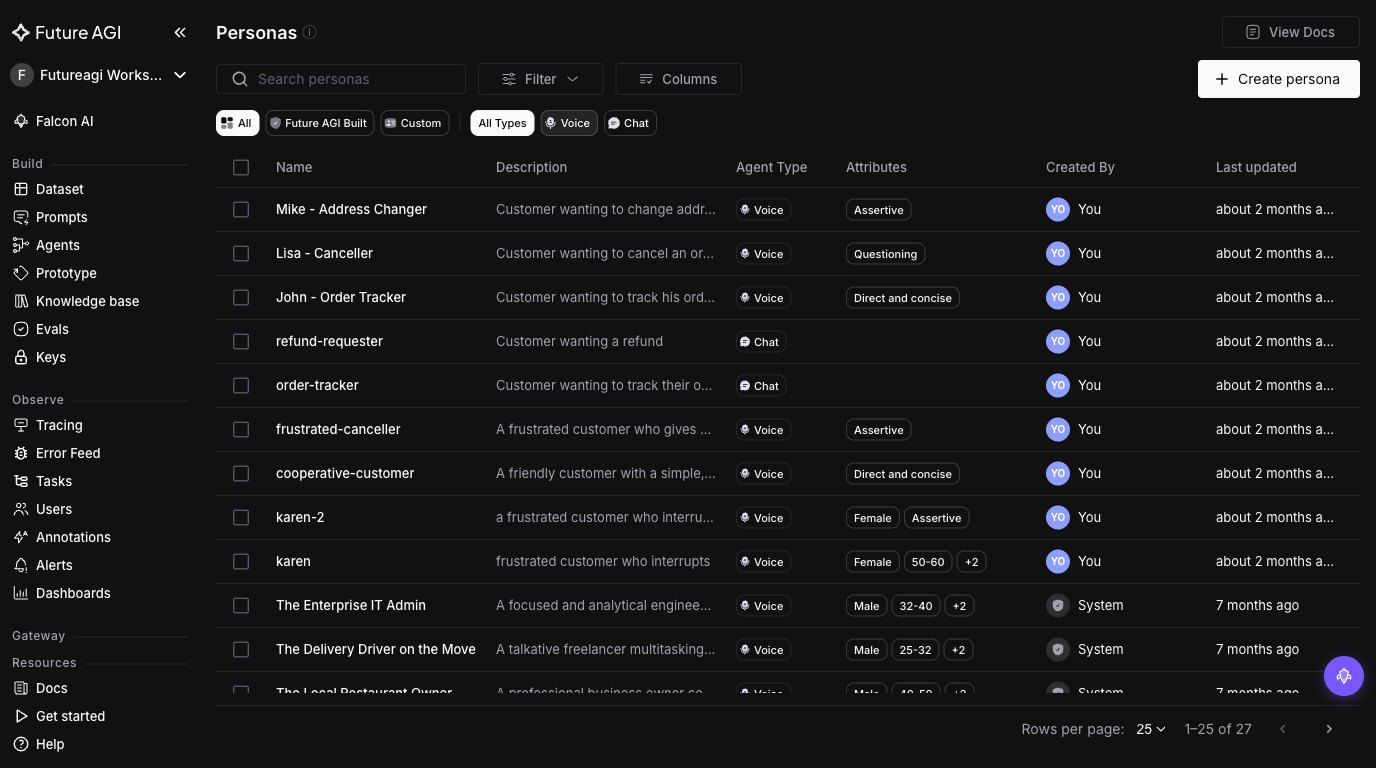
The agent definition is the test target: voice provider settings, conversation rules, business logic, and behavioral constraints all live together. Simulations run against an exact replica of the production agent.
Simulator Agent Configuration
Test agents act as simulated customers. You configure personality through system prompts, set voice speed and interrupt sensitivity, and define speaking patterns. Multiple personas can stress-test the same scenario through different lenses.
No-Code or SDK Integration
Connect by phone number or API endpoint. The web flow is no-code for phone-number agents. The fi.simulate Python SDK handles code-first integrations and CI/CD runs.
# Requires: pip install ai-evaluation
# Env: FI_API_KEY, FI_SECRET_KEY
from fi.simulate import TestRunner, AgentInput, AgentResponse

# A small voice-agent regression batch authored as Python.
inputs = [
    AgentInput(messages=[{"role": "user", "content": "Cancel my subscription."}]),
    AgentInput(messages=[{"role": "user", "content": "Transfer me to a human, please."}]),
    AgentInput(messages=[{"role": "user", "content": "What is the refund window?"}]),
]

def voice_agent_callable(agent_input: AgentInput) -> AgentResponse:
    # Replace with a real call into your Vapi or Retell agent here.
    last = agent_input.messages[-1]["content"]
    return AgentResponse(messages=[{"role": "assistant", "content": f"You said: {last}"}])

runner = TestRunner(
    name="voice_regression_2026_05",
    inputs=inputs,
)
results = runner.run(agent=voice_agent_callable)

for r in results:
    print(r)
Comprehensive Platform Reach
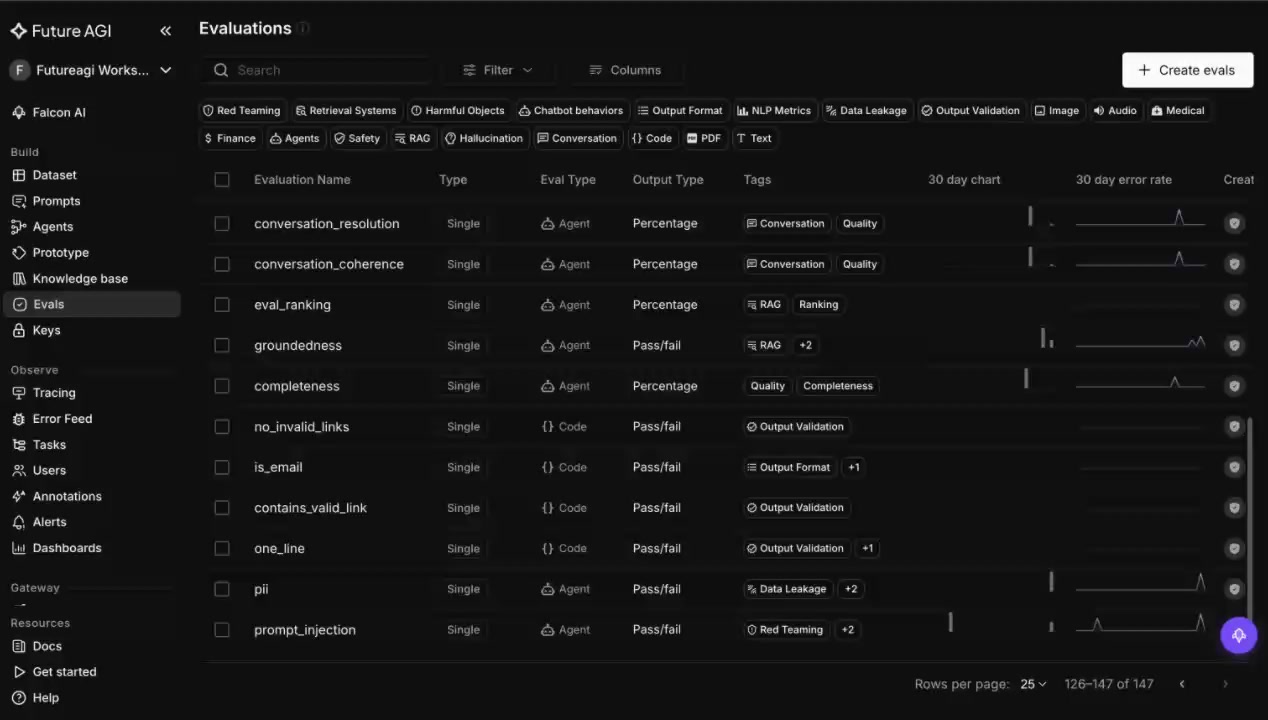
Future AGI Simulate is one component of the broader stack:
- Evaluate. Faithfulness, instruction-following, toxicity, and custom LLM-judge metrics through
fi.evalsand the Apache 2.0 ai-evaluation library. - Observe. Apache 2.0 traceAI for OpenInference spans into the Future AGI Agent Command Center at
/platform/monitor/command-center. - Optimize. Prompt and configuration improvement loop through
fi.optbased on eval scores. - Protect. Guardrails for prompt injection, PII, and toxicity at the gateway layer.
Cekura: Predefined Workflow Testing and Production Replay
Cekura is a testing and observability platform for conversational AI, with predefined-persona simulations, production call replay, and real-time alerting. Strong for teams with clearly mapped conversation flows and Webex AI infrastructure.
Cekura vs Future AGI Simulate
Cekura tests predefined workflows with persona-based scenarios you configure upfront. It excels at validating known conversation paths and compliance against business logic. Future AGI Simulate automatically generates thousands of unpredictable test conversations from datasets, graphs, scripts, or agent capabilities, plus it evaluates audio directly. The full head-to-head is in Future AGI vs Cekura.
Key differences:
- Testing approach. Cekura tests predefined workflows and personas you set up manually. Future AGI auto-generates diverse scenarios including unexpected conversation paths.
- Audio analysis. Cekura evaluates transcripts and metrics. Future AGI analyzes actual audio to catch tone, latency, and voice quality issues.
- Scenario creation. Cekura requires you to define test cases and personas. Future AGI creates scenarios automatically from datasets, graphs, scripts, or agent capabilities.
- Platform scope. Cekura specializes in voice agent testing and monitoring. Future AGI includes full LLM evaluation, observability, and optimization.
Cekura Pros and Cons
Why teams choose Cekura:
- Strong replay functionality for diagnosing production issues through actual call review.
- Fast deployment against known workflows and compliance requirements.
- Real-time alerts on critical metric failures.
- Native Webex AI Agent integration.
- Custom evaluation metrics for business KPIs.
Limitations to consider:
- Predefined personas and workflows mean unexpected edge cases can slip through.
- Transcript-based analysis can miss audio-specific issues.
- Manual configuration burden compared to platforms that auto-generate scenarios.
- No integrated optimization tools for improving prompts based on test results.
- Best for teams with well-defined flows rather than exploratory testing.
Hamming: Concurrent Call Testing with Production Feedback
Hamming automates voice AI testing with thousands of concurrent calls and AI voice characters that simulate real customer behaviors. Production failures convert into regression test cases, creating a tight feedback loop.
Hamming vs Future AGI Simulate
Hamming excels at high-volume concurrent testing with AI voice characters and a production-to-testing feedback loop. Future AGI Simulate generates entirely new scenarios from datasets, graphs, scripts, or agent capabilities, plus it evaluates audio directly. See Future AGI vs Hamming for the detailed comparison.
Key differences:
- Testing scale. Hamming runs thousands of concurrent calls with AI voice characters. Future AGI generates diverse test conversations with multi-persona AI test agents.
- Audio analysis. Hamming analyzes transcripts and performance metrics. Future AGI evaluates direct audio for tone, latency, and voice quality.
- Test generation. Hamming converts production failures into test cases reactively. Future AGI also creates proactive scenarios from scratch.
- Platform scope. Hamming focuses on testing, analytics, and prompt management. Future AGI includes full evaluation, observability, and optimization.
Hamming Pros and Cons
Why teams choose Hamming:
- Massive concurrent-call scale.
- Production-to-testing feedback that captures real failures.
- AI voice character library with realistic customer behaviors.
- Built-in prompt versioning and instant retest after updates.
- Multilingual support for English, French, German, Hindi, Spanish, Italian.
Limitations to consider:
- Focuses on testing and analytics without integrated optimization tooling.
- Transcript-based analysis may miss audio-specific issues.
- Pricing not publicly available; may be enterprise-priced.
- Learning curve for teams new to automated AI testing.
Bluejay: 500+ Behavioral Variables and Skywatch Production Monitoring
Bluejay is a QA platform that runs end-to-end voice agent tests through “human simulation” with 500+ behavioral and environmental variables.
Bluejay vs Future AGI Simulate
Bluejay uses a “human simulation” approach with 500+ variables (languages, accents, emotional states, background noise). Future AGI Simulate generates diverse scenarios from datasets, graphs, scripts, or agent capabilities, plus direct audio evaluation.
Key differences:
- Simulation approach. Bluejay creates digital humans across 500+ behavioral and environmental variables. Future AGI generates multi-persona test agents with customizable traits.
- Audio analysis. Bluejay tracks accuracy and hallucination rates mostly on transcripts. Future AGI evaluates audio for tone, latency, and voice consistency.
- Testing focus. Bluejay emphasizes stress testing through volume. Future AGI focuses on scenario diversity and proactive failure prediction.
- Production monitoring. Bluejay offers Skywatch for real-time monitoring. Future AGI provides full LLM observability integrated with optimization.
Bluejay Pros and Cons
Why teams choose Bluejay:
- Ultra-realistic human simulation with 500+ variables.
- Skywatch production monitoring with fix suggestions.
- Team collaboration features (Slack and Microsoft Teams daily updates).
- Designed to compress a month of customer interactions into minutes of stress testing.
Limitations to consider:
- Testing and monitoring focus without integrated optimization tools.
- Pricing not publicly available; likely enterprise tier.
- Setup time for training the system on your customer profiles.
- Limited public documentation about integration methods.
Coval: Autonomous Vehicle Testing Methodology Applied to Voice AI
Coval applies over a decade of autonomous-vehicle testing methodology to voice and chat agent evaluation. Strong CI/CD integration, custom metrics, and human-in-the-loop labeling.
Coval vs Future AGI Simulate
Coval generates scenarios from prompts, transcripts, workflows, or audio inputs that you provide. Future AGI Simulate also generates diverse scenarios but uses AI agents to create them automatically, adds direct audio evaluation, and integrates testing with the full lifecycle platform. The deeper breakdown is in Future AGI vs Coval.
Key differences:
- Simulation foundation. Coval builds on autonomous-vehicle testing methodology. Future AGI uses AI agent-driven scenario generation.
- Scenario input. Coval accepts prompts, transcripts, workflows, or audio inputs you define. Future AGI auto-generates from datasets, graphs, scripts, or agent capabilities.
- Audio analysis. Coval analyzes voice performance with custom metrics. Future AGI performs direct audio evaluation for tone and latency.
- Platform scope. Coval focuses on testing, evaluation, and CI/CD regression detection. Future AGI combines testing with observability and optimization.
- Integration approach. Coval emphasizes CI/CD for developer workflows. Future AGI offers both no-code and SDK paths.
Coval Pros and Cons
Why teams choose Coval:
- Testing methodology with autonomous vehicle roots.
- Comprehensive CI/CD integration with regression detection on every code change.
- Custom metrics framework for business-specific KPIs.
- Production monitoring with real-time alerts.
- Strong fit for regulated industries (healthcare, finance, telecom).
Limitations to consider:
- Scenario generation relies on user-provided inputs rather than auto-generating from scratch.
- Testing and evaluation focus without built-in optimization tools.
- Does not include the agent runtime or voice stack itself.
- Learning curve for custom metrics and CI/CD setup.
Side-by-Side Comparison Table
| Features | Future AGI | Cekura | Hamming | Bluejay | Coval |
|---|---|---|---|---|---|
| Core focus | Full AI lifecycle platform | Conversational AI testing and observability | Evals and simulation | Human simulation and QA | Simulation and evaluation |
| Audio evaluation | Direct audio scoring | Transcript-primary | Transcript-primary | Mixed | Custom voice metrics |
| Scenario generation | Auto from 4 input types | Predefined personas | From production failures | 500+ variables | Manual inputs |
| Learning and adaptation | Eval-driven loops | Static rules | Versioned prompts | No adaptation | Human-in-loop only |
| Multilingual support | Multilingual per docs | User personas | 6+ languages | 500+ variables | Multiple languages |
| Voice and chat integrations | Vapi, Retell, phone-number agents | Webex AI focus | Hopper, Retell, Vapi | Platform-agnostic | Voice and chat support |
| Optimization | Eval-driven prompt loop (fi.opt) | Basic prompting | Not available | Minimal | Monitoring only |
| Synthetic data | Advanced generation | Limited options | Not available | None | Limited |
| Replay and real conversation analysis | Test cases from logs and from scratch | Replay actual calls | Production failure regression loop | Not available | Custom replay |
| Test automation scale | Thousands of test conversations | Scenario simulation focused on planned flows | Thousands of concurrent calls | Fast large-scale stress testing | Thousands of automated scenarios |
| Observability | Comprehensive tracing | Good coverage | Real-time insights | Basic logging | Strong focus |
| Protection and guardrails | Real-time screening | Basic filters | Not available | Safety-focused | Not available |
| Enterprise features | Complete suite | Growing | Mature stack | Basic | Limited |
Table 1: Voice AI simulation platforms compared in May 2026.
How to Choose a Voice AI Simulation Platform in 2026
Pick based on what dominates your workflow.
Choose Future AGI Simulate When
- You want voice testing as one module of a wider evaluation, observability, and optimization platform rather than as a standalone tool.
- Direct audio evaluation (latency, tone, voice quality) matters as much as transcript scoring.
- You need automated scenario generation from datasets, graphs, scripts, or agent capabilities, not just predefined personas.
- You want a no-code path for phone-number agents plus a Python SDK (
fi.simulate) for CI/CD. - You care about an Apache 2.0 tracing library (traceAI) and an Apache 2.0 evaluation library (ai-evaluation) so the open-source pieces are free of vendor lock-in.
Choose a Niche Alternative When
- Cekura if your priority is replay of production calls and Webex AI integration.
- Hamming if you want production-to-testing feedback as a first-class workflow and built-in prompt versioning.
- Bluejay if 500+ behavioral variables and a “trust layer” stress-testing positioning fits your release cycle.
- Coval if your team is engineering-led, CI/CD-driven, and wants autonomous-vehicle testing methodology applied to voice.
Summary: Future AGI Simulate Plus Four Strong Niche Alternatives
Future AGI Simulate is the comprehensive option in May 2026 because voice testing sits inside a lifecycle stack that also handles evals, tracing, optimization, and guardrails. Cekura, Hamming, Bluejay, and Coval are credible niche alternatives, each strong on a different dimension. Run a side-by-side trial against your actual production traffic before committing; the right choice depends on whether you want a single platform or the best-of-breed pick for your top workflow.
If you want one platform for the full voice AI lifecycle, choose Future AGI Simulate.
Frequently Asked Questions
What is Future AGI Simulate?
How does Cekura compare to Future AGI Simulate?
What is the primary benefit of a voice AI simulation platform?
Does Future AGI evaluate audio directly?
Which voice AI simulation tool has the best CI/CD integration?
Are any voice AI simulation tools open source?
Which voice AI simulation tool handles non-English languages best?
What is the pricing model for voice AI simulation platforms in 2026?
Scale voice agent testing past manual QA in 2026 with Future AGI Simulate. 4 scenario generation methods, AI test agents, CI/CD pipeline integration.

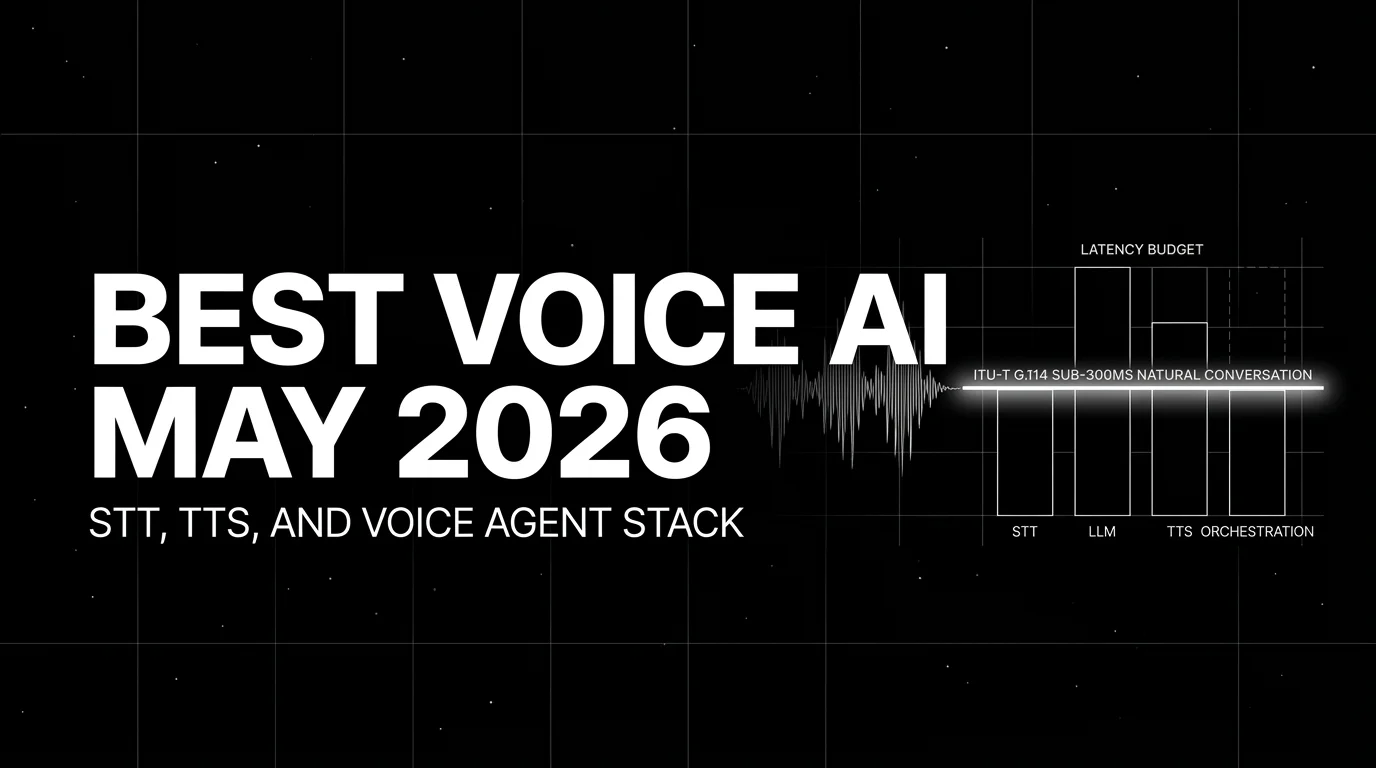
Best Voice AI May 2026: compare Deepgram, Cartesia, ElevenLabs, Retell, and Vapi for STT, TTS, latency budgets, and production voice agents.

Simulate voice AI agents in 2026 with fi.simulate.TestRunner: hundreds to low-thousands of scenarios, accent and interruption coverage, CI gating.
