Stimulus Prompts in 2026: Advanced Prompt Engineering for LLMs (Leading Prompts, Chain-Stimulus, and Conditioning)
Master stimulus prompts in 2026: leading prompts, chain-stimulus, conditioning, prompt chaining, and CI-gated optimization with Future AGI Prompt Optimize.
Table of Contents
A common 2024 to 2025 pattern (illustrative): a data team spends weeks tuning an extraction agent, then a senior engineer adds a single leading sentence (“Before you answer, list the fields you plan to extract”) and the eval score climbs noticeably. No retraining, no model swap, just a better stimulus prompt. In 2026 that engineer would not have tuned by hand; an automated optimizer would have searched for similar lifts in an hour. This post is the 2026 guide to stimulus prompting: what the patterns are, when to use them, how to test them, and how to ship them behind a CI gate.
TL;DR: stimulus prompting in 2026
| Pattern | What it does | When to use |
|---|---|---|
| Zero-shot stimulus | One clear instruction. | Simple bounded tasks, baseline for testing. |
| Few-shot stimulus | 2 to 5 input/output demonstrations. | Structural cues, formatting, light reasoning patterns. |
| Role / persona | Assign a role in the system prompt. | Tone, voice, and domain expertise framing. |
| Leading prompt | Pre-load the reasoning frame. | Multi-step tasks with known structure (retrieve-then-cite, classify-then-explain). |
| Chain-stimulus | Compose stimuli across turns. | Production agents and multi-step tool flows. |
| Structured-output conditioning | JSON-mode, tool schemas, regex constraints. | Anything that needs a parseable output. |
| Contextual / retrieval-augmented | Inject retrieved docs into the stimulus. | RAG and knowledge-grounded agents. |
| Adversarial defense | Delimiters, scanners, periodic CI scenarios. | All production-facing prompts. |
If you only read one row: the 2026 default is that stimulus prompts are written by hand for baselines, then optimized programmatically (Future AGI Prompt Optimize or DSPy MIPRO), then locked behind a CI eval gate. Hand-tuning past the baseline is a 2024 workflow.
What a stimulus prompt actually is
A stimulus prompt is the structured input that conditions an LLM toward a target behavior. It is more specific than “prompt”: a stimulus is the carefully composed signal you give the model to elicit a particular response shape, not just any text you happen to send.
A stimulus has up to seven layers in 2026.
- System prompt. Sets the global frame (role, scope, refusal policy).
- Role assignment. Conditions tone and domain.
- Task instruction. What to do.
- Constraints. Length, format, schema, allowed sources.
- Demonstrations. Few-shot examples that show the expected shape.
- Context. Retrieval results, prior turns, tool outputs.
- Leading frame. A reasoning scaffold that biases the path.
Most production stimuli use three to five of these layers. The layer count is not a goal; it is whatever the eval suite shows produces the best composite score.
Pattern 1: zero-shot stimulus
A single instruction. The simplest stimulus pattern.
Summarize the following text in three sentences.

[document]
Use it as the baseline for measurement and for tasks where the model already knows the shape. It is rarely the best production pattern past a few easy tasks.
Pattern 2: few-shot stimulus
Two to five input/output pairs that demonstrate the target shape. Few-shot beats zero-shot when the output shape is non-obvious or when the model has a default behavior you need to override.
Translate the input to formal email tone.

Input: hey can u send the report by EOD?
Output: Could you please share the report by end of day?

Input: lemme know if smthg breaks
Output: Please let me know if anything stops working.

Input: [user_input]
Output:
The 2026 caveat: structured-output conditioning often replaces few-shot for pure format problems. Use few-shot for structural and stylistic cues that JSON schemas cannot encode.
Pattern 3: role and persona conditioning
Assign a role in the system prompt to shape tone, domain framing, and refusal behavior.
System: You are a senior compliance officer reviewing a financial report.
Flag any statement that needs source citation, marked tone, or revision.
Respond as a structured list of findings.
Role conditioning is cheap and powerful. Pair it with a tone constraint and a refusal policy so the model knows what to do when it cannot meet the role’s standard.
Pattern 4: leading prompt
A leading prompt pre-loads the reasoning frame. The model is told what to think about before what to answer.
Before you answer, list the fields you will extract, then check each one
against the source text. Only then produce the JSON.

Schema: { invoice_number, total_amount, due_date }
Source: [document]
Leading prompts are often the most effective handwritten pattern. They work because LLMs in 2026 still benefit from explicit reasoning scaffolds even when chain-of-thought is implicit in the model. The cost is increased prompt-injection surface: the model will follow any reasoning scaffold it sees, so a hostile input can repurpose the scaffold. Pair with input validation.
Pattern 5: chain-stimulus
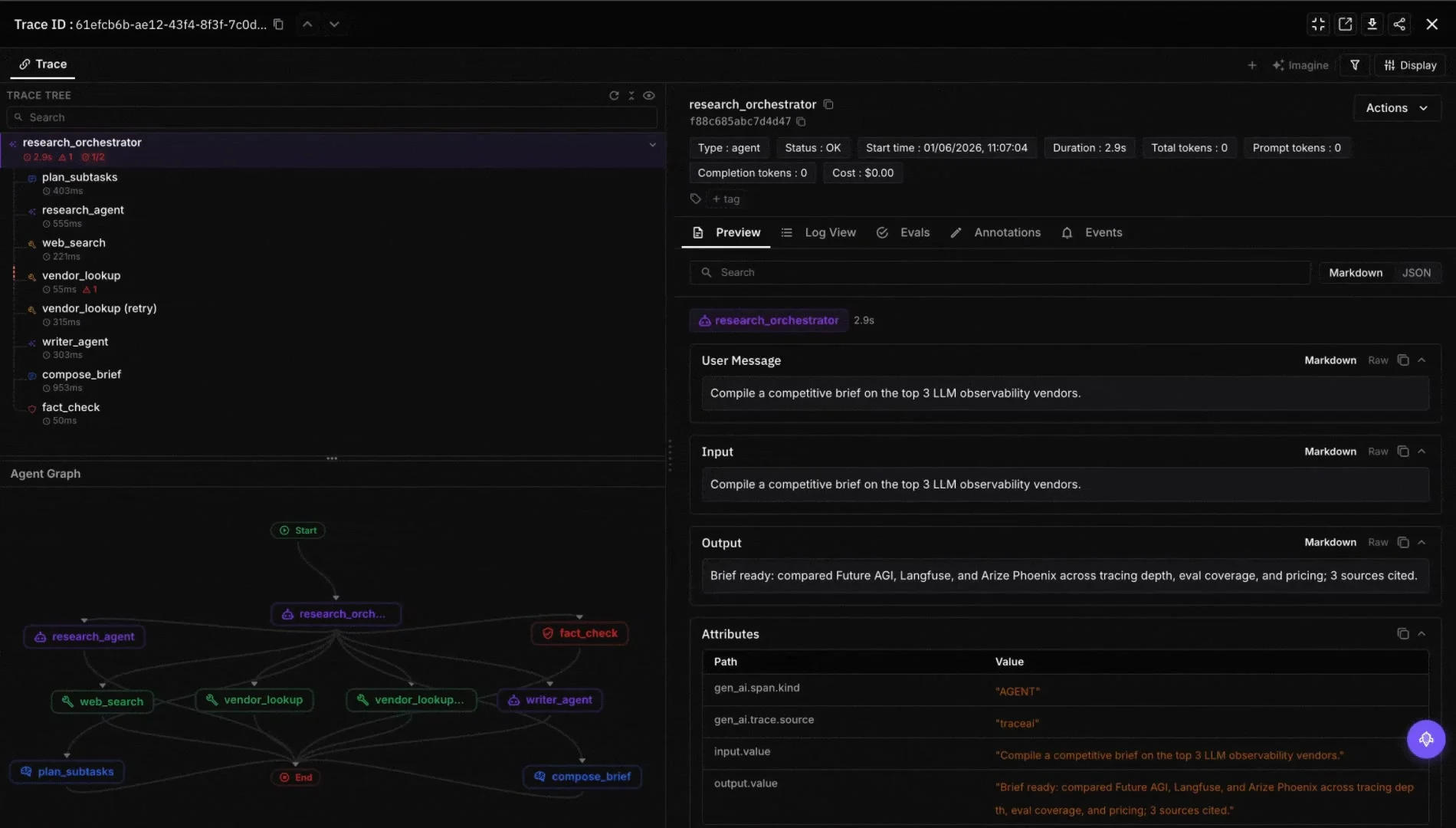
Compose multiple stimuli across a sequence of model calls. Each step receives a conditioned input from the previous step.
Step 1 (classifier): Determine the document type.
Step 2 (extractor with leading prompt): Given the document type, extract
       the fields specified in the type's schema.
Step 3 (validator): Check each extracted field against the source text.
Step 4 (formatter): Produce the final JSON.
Chain-stimulus is the production default for agents and multi-step tool flows in 2026. It builds on chain-of-thought prompting but spreads the reasoning across separate calls. Each link is a separate prompt, separate model call, and separate eval target. Tracing matters: see Future AGI traceAI for OpenTelemetry-native span capture across the chain.
Pattern 6: structured-output conditioning
Strict JSON schemas, tool-call signatures, and regex-constrained decoding enforce the output shape at decode time. JSON-mode on its own targets valid JSON, not full schema compliance; for strict shape guarantees use the schema-enforced or tool-call paths.
# OpenAI structured outputs example. The schema is enforced at decode time.
schema = {
    "type": "object",
    "properties": {
        "invoice_number": {"type": "string"},
        "total_amount": {"type": "number"},
        "due_date": {"type": "string", "format": "date"},
    },
    "required": ["invoice_number", "total_amount", "due_date"],
}
In 2026 this replaces most format-by-instruction patterns. Use structured outputs whenever the output shape is parseable; reserve free-form generation for cases where it actually adds value.
Pattern 7: contextual stimulus (RAG)
Retrieval results, prior conversation, and tool outputs are injected as context blocks in the stimulus. The pattern is the same as a leading prompt with the context block inserted before the task instruction.
[role assignment]
[task instruction with citation requirement]
[retrieved documents block with explicit delimiters]
[user query]
Two 2026 best practices. First, mark the context block with explicit delimiters and never mix it with the system instruction. Second, validate the retrieved documents with a guardrail scanner before injection; an attacker who controls a retrievable document controls the agent.
Pattern 8: adversarial defense
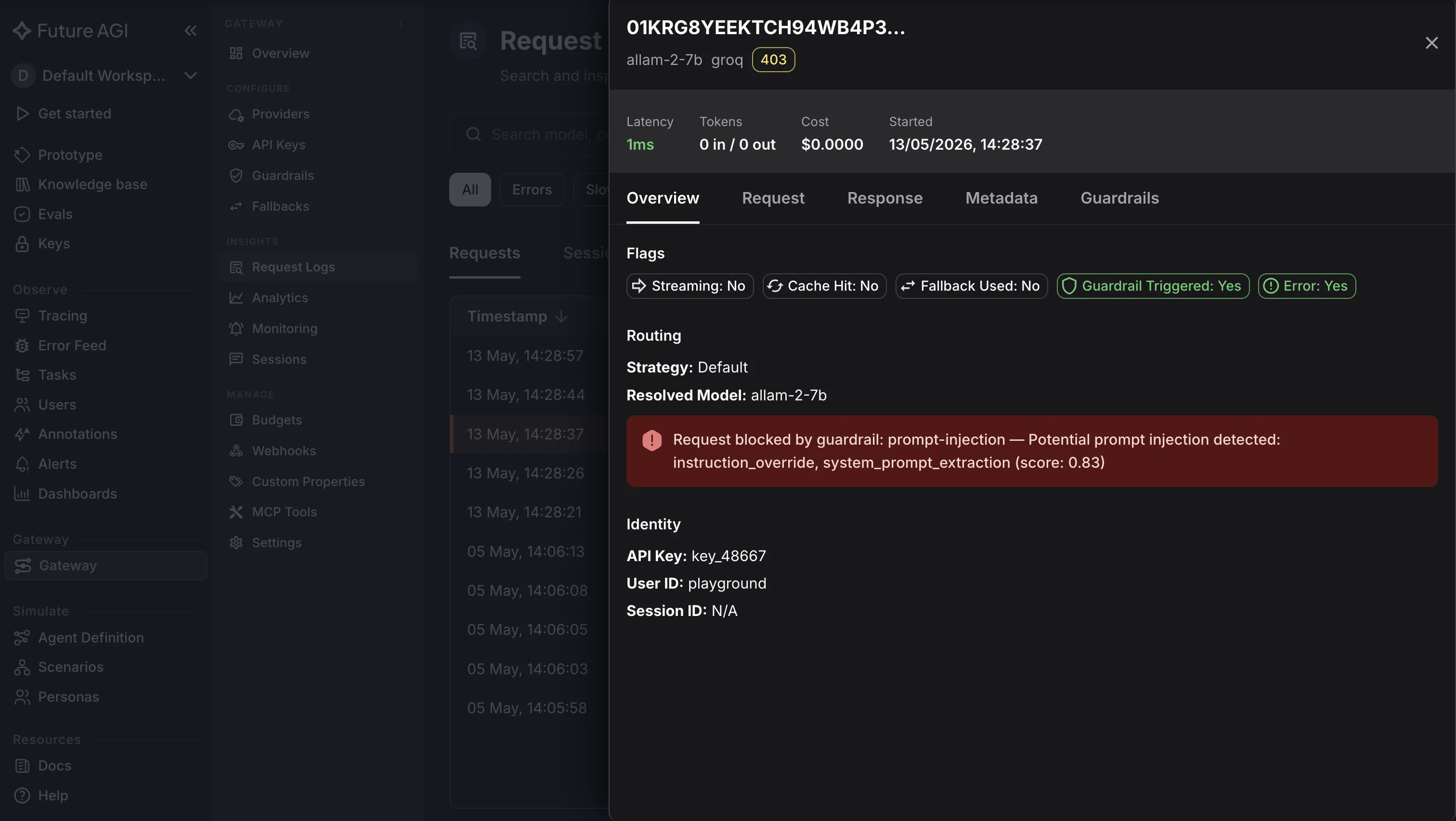
Stimulus prompts are an attack surface, and prompt injection is the dominant risk. The 2026 baseline defense set:
- Explicit delimiters between system, context, and user input.
- Never concatenate user input into the system prompt.
- Run a prompt-injection scanner at the gateway layer. The Future AGI Agent Command Center (route:
/platform/monitor/command-center) supports this on the BYOK request path. - Validate retrieved context with a guardrail scanner before injection.
- Run periodic adversarial scenarios in CI to verify the agent resists known patterns. Future AGI Simulate exposes adversarial scenario primitives.
For a deeper look at prompt injection patterns, see Prompt Injection 2025.
How to test stimulus prompts
The 2026 method is to score every stimulus on a composite metric, not on vibes.
from fi.evals import evaluate

result = evaluate(
    "faithfulness",
    output=model_response,
    context=retrieved_docs,
)
faithfulness_score = result.score

result_2 = evaluate(
    "instruction_following",
    output=model_response,
    input=user_query,
)
instruction_score = result_2.score
The evaluate call uses the string-template form documented in the Future AGI cloud evals reference. Set FI_API_KEY and FI_SECRET_KEY before the call. Latency tiers: turing_flash runs at roughly 1 to 2 seconds per call, turing_small at 2 to 3 seconds, turing_large at 3 to 5 seconds.
Pair the cloud eval with a local LLM judge for tasks that need a custom rubric:
from fi.opt.base import Evaluator
from fi.evals.metrics import CustomLLMJudge
from fi.evals.llm import LiteLLMProvider

judge_provider = LiteLLMProvider(model="gpt-5")
judge = CustomLLMJudge(
    provider=judge_provider,
    grading_criteria=(
        "Score 0 to 1 on whether the response cites every claim from the "
        "context with an explicit source marker."
    ),
)
evaluator = Evaluator(judge=judge)
score = evaluator.evaluate(output=model_response, context=retrieved_docs)
Run this against a labeled holdout for every stimulus you ship. Block CI on regression.
How to optimize stimulus prompts in 2026
After three handwritten baselines (zero-shot, role-based, few-shot), pick the winner and hand it to an automated optimizer. Six algorithms recur in 2026 production stacks.
- APE (Automatic Prompt Engineer): LLM-driven mutation and selection.
- OPRO (Optimization by PROmpting): LLM as a black-box optimizer over prompt variants.
- DSPy BootstrapFewShot: search the prompt and demonstration space.
- TextGrad: textual-gradient updates against an LLM-as-judge loss.
- MIPRO: DSPy’s stronger compiler for instructions and demos jointly.
- ProTeGi: iterative textual-gradient prompt editing (the academic ancestor of TextGrad).
Future AGI Prompt Optimize supports automated prompt search against your fi.evals rubric templates, with built-in support for the production-ready algorithms above (APE, OPRO, DSPy BootstrapFewShot, TextGrad, MIPRO) and traceAI spans that tie optimizer runs to the same observability layer as production. The full tool landscape is in Top 10 Prompt Optimization Tools.
A worked example: scoring stimulus variants
The table below is an illustrative example, not a measured benchmark. Pattern ordering, not absolute numbers, is the takeaway. A team optimizes the extraction agent from the intro; six variants are scored on a hypothetical 500-row holdout.
| Variant | Pattern | Quality (illustrative) | Cost / 1K (illustrative) | p95 (illustrative) | Composite (illustrative) |
|---|---|---|---|---|---|
| 1 | Zero-shot | 0.71 | $0.42 | 1.6s | 0.55 |
| 2 | Few-shot (3 demos) | 0.79 | $0.51 | 1.7s | 0.62 |
| 3 | Role + zero-shot | 0.76 | $0.43 | 1.6s | 0.60 |
| 4 | Leading prompt + few-shot | 0.84 | $0.55 | 1.8s | 0.66 |
| 5 | Optimizer (MIPRO) output | 0.87 | $0.58 | 1.9s | 0.68 |
| 6 | Structured-output + leading | 0.90 | $0.50 | 1.7s | 0.73 |
Variant 6 wins on composite in this illustrative example. The structured-output schema eliminates format-failure modes; the leading prompt drives quality on extraction tasks. This is the kind of pattern combination that handwritten search rarely finds in a single pass; the optimizer plus a structured-output decision is what tends to produce the lift on real workloads.
Common stimulus prompting mistakes in 2026
- Asking for JSON in prose instead of using structured outputs.
- Optimizing a single prompt by hand for weeks when a one-hour optimizer run finds a better answer.
- Mixing user input into the system prompt.
- Not validating retrieved context before injection.
- Scoring on a single metric (quality) and shipping a cost or latency regression.
- No CI gate, so any prompt change reaches production without a regression check.
The fix in every case is the same: composite metric, automated optimization, CI gate, observability across the chain.
Closing: the stimulus is the contract
A stimulus prompt is the contract between you and the model. In 2026 the contract is written, versioned, tested, and gated like code. Future AGI’s stack runs the loop end to end: fi.evals for the metric, Prompt Optimize for the search, traceAI for the OpenTelemetry tracing, and Agent Command Center for runtime guardrails. Start with the free tier, write three baselines for one of your production stimuli, and run the optimization loop this week.
Frequently Asked Questions
What is a stimulus prompt in 2026?
What is chain-stimulus prompting?
What are leading prompts and when should I use them?
How does conditioning work in 2026 LLM prompting?
How do I avoid prompt injection in stimulus prompts?
What is the right way to test and optimize stimulus prompts?
Are stimulus prompts the same as prompt engineering?
What changed in stimulus prompting from 2025 to 2026?
Nine LLM prompt format patterns for GPT-5, Claude Opus 4.7, and Gemini 3 in 2026. Copy-ready templates, an eval loop, and mistakes to avoid in production.

Pick the right LLM and prompt in 2026: scoring rubric, GPT-5 vs Claude 4.7 vs Gemini 3 trade-offs, automated optimization, and a CI-gated workflow.

Top 10 prompt optimization tools in 2026 ranked: FutureAGI, DSPy, TextGrad, PromptHub, PromptLayer, LangSmith, Helicone, Opik, DeepEval, Prompt Flow.
