How to Reduce LLM Hallucinations in 2026: 7 Proven Strategies for Reliable Language Models
Reduce LLM hallucinations in 2026 with seven proven strategies: RAG grounding, uncertainty estimation, fine tuning, adversarial training, live eval.
Table of Contents
How to Reduce LLM Hallucinations in 2026 at a Glance
Production LLM hallucination rates vary by task shape: extractive QA systems hallucinate on 3-8% of responses, open-ended generation on 15-25%, and multi-step agent workflows on 20-40% of tool-call chains (Deepchecks LLM Evaluation Benchmarks 2026). Guardrails layered together — system prompts, RAG grounding, and real-time monitoring — cut hallucination rates by 71-89% compared to unguarded deployments (SwiftFlutter, 2026 meta-analysis of 12 production deployments). The cost of a production hallucination is not theoretical: Arthur AI reports that 34% of enterprises have experienced a customer-facing incident caused by an LLM hallucination in the past 12 months, with average remediation costs exceeding $50,000 per incident for regulated industries.
| Hallucination benchmark | Value | Source |
|---|---|---|
| Extractive QA hallucination rate | 3-8% | Deepchecks LLM Eval 2026 |
| Open-ended generation | 15-25% | Same |
| Multi-step agent workflows | 20-40% | Same |
| Guardrail layering impact | -71 to -89% | SwiftFlutter meta-analysis 2026 |
| Enterprises with hallucination incidents (12mo) | 34% | Arthur AI 2026 |
| Average remediation cost (regulated) | >$50K/incident | Arthur AI 2026 |
Hallucinations are still the single largest blocker between a working LLM demo and a shippable production agent. In 2026 the cheapest path to fewer fabricated answers is a stack of small fixes rather than one expensive model swap. The table below summarizes the seven strategies covered in this guide, with the typical lift you can expect and the effort it takes to roll out.
| Rank | Strategy | Typical lift on unsupported claims | Effort to roll out |
|---|---|---|---|
| 1 | RAG with strict citation contract | High | Medium |
| 2 | Live evaluation and Protect guardrails | High | Low |
| 3 | Uncertainty routing | Medium | Low |
| 4 | Domain fine tuning | Medium | High |
| 5 | Multi modal grounding | Medium | High |
| 6 | Refusal scaffolds in prompts | Low to medium | Low |
| 7 | Adversarial training | Medium | Very high |
If you have never measured your current hallucination rate, jump to the evaluation section and start there. Without a baseline number, you cannot tell which of the seven strategies is helping.
What Hallucination Means in 2026: Free Form Fabrication, Citation Invention, and Tool Argument Spoofing
In the rapidly evolving world of artificial intelligence, hallucination remains one of the most pressing problems for large language models. Hallucination, in the context of language models, refers to the phenomenon where the model generates plausible sounding but factually incorrect or unsupported text. In 2026 the term has expanded beyond simple fabrication to include three concrete failure modes:
- Free form fabrication. The model invents facts, names, citations or quantities that have no support anywhere in the retrieved context or the system prompt.
- Citation invention. The model fabricates URLs, paper titles, ArXiv IDs, or quotes from real sources. This is now the dominant failure mode for research and legal agents.
- Tool argument spoofing. The model invents arguments, IDs or natural language descriptions when calling a tool, leading to silent corruption inside an agent loop.
As frontier models such as gpt-5-2025-08-07, claude-opus-4-7 and gemini-3.x have closed the gap on benchmark accuracy, the relative cost of a single hallucinated response has grown. Demo level reliability is no longer a stretch goal. The work in 2026 is to move from demo reliability to production reliability across long sessions and tool heavy agents.
Why Hallucination Still Happens After Five Years of LLM Research
Hallucination occurs when the model generates text that appears coherent and semantically relevant but is contradictory to known facts or unsupported by context. This happens for a few overlapping reasons:
- The pretraining objective rewards plausible continuations, not faithful retrieval, so when the model is uncertain it produces high probability tokens that look correct.
- Retrieval pipelines miss the right document, which forces the model to guess.
- Long context windows still attend unevenly, so a perfectly retrieved passage can be ignored when it sits in the middle of a long prompt.
- Tool schemas drift, so the model fills in arguments that were once valid but are now incorrect.
The consequences can be severe, particularly in domains where accuracy is paramount, such as healthcare, finance, and legal decision making. Unchecked hallucination spreads misinformation, erodes trust in AI systems, and produces real harm in regulated workflows.
7 Proven Strategies for Reducing LLM Hallucinations in 2026
Researchers and AI practitioners have been actively exploring various strategies to mitigate hallucination. The seven approaches below cover the full lifecycle from training to live serving. One effective starting point is RAG prompting to reduce hallucination, which combines retrieval augmented generation with strategic prompting to enhance factual accuracy.
1. Retrieval Augmented Generation With a Strict Citation Contract
Grounding the model in retrieved passages remains the most reliable single strategy. The key is to combine retrieval with a strict citation contract: every factual claim must reference a retrieved passage by ID, and the model must abstain if no passage supports the claim. This catches the dominant fabrication failure mode at decode time rather than at review time. Public benchmarks such as FActScore and RAGTruth consistently show that a tight RAG pipeline cuts unsupported claims by half or more compared to a closed book baseline at the same model size.
2. Uncertainty Estimation and Confidence Routing
Token level log probabilities, sample disagreement across multiple decodes, and learned calibration heads all attempt to score how confident a model is in a span. Sample disagreement (sometimes called self consistency or N best disagreement) is the most reliable practical signal in 2026. Use it to route low confidence answers to a stronger model, a refusal, or a human reviewer.
3. Targeted Fine Tuning on Canonical Domain Data
Fine tuning helps when the model is consistently wrong about a known domain. Curate a small set of canonical question and answer pairs with the exact phrasing your product expects, including refusal behavior for queries you do not want answered. Combine fine tuning with retrieval rather than relying on it alone, because over fitted models hallucinate more confidently on out of distribution queries.
4. Multi Modal Grounding
When language is combined with vision, structured tables, or knowledge graphs, the model can cross check claims against non text evidence before answering. This is particularly useful for medical imaging, financial reporting and product catalog use cases where text alone is ambiguous.
5. Prompt Engineering With Refusal Scaffolds
Carefully crafted prompts that explicitly tell the model to abstain, hedge, or ask clarifying questions when no source supports an answer reduce confident drift cheaply. The pattern that works best in 2026 is a structured output schema (JSON or XML) that includes a required confidence and sources field. Empty sources triggers a refusal path in your application code.
6. Adversarial Training on Red Team Prompts
Exposing the model during training or RL to prompts crafted to elicit hallucination, then optimizing for correct or refusing behavior, improves robustness. This is high effort and typically only available to teams with custom post training pipelines. For most teams, retrieval and live evaluation produce a larger lift per hour of work.
7. Live Evaluation and Protect Guardrails
Even with all of the above, some unsupported responses will slip through. Live evaluation runs faithfulness, groundedness, and prompt injection evaluators inline on every response and either blocks, rewrites, or reroutes the bad ones. This is the layer where Future AGI sits in most production stacks. See the hallucination detection tools comparison for how the major options stack up.
How to Measure Hallucination With Future AGI Evaluators
Before you start chasing fixes, set a baseline. The Future AGI evaluator SDK exposes faithfulness and factual correctness as cloud evaluators with turing_flash latency in the one to two second range, which is fast enough to run on every response in a production stream. The example below scores a single answer against its retrieved context:
import os
from fi.evals import evaluate

os.environ.setdefault("FI_API_KEY", "your_fi_api_key")
os.environ.setdefault("FI_SECRET_KEY", "your_fi_secret_key")

context = (
    "Climate change is a significant global challenge. Rising temperatures, "
    "melting ice caps, and extreme weather events are affecting ecosystems "
    "worldwide."
)
response = (
    "Climate change poses a global threat with effects like rising temperatures."
)

faith = evaluate(
    "faithfulness",
    output=response,
    context=context,
    model="turing_flash",
)

print(f"Faithfulness: {faith.score:.2f} {'PASS' if faith.passed else 'FAIL'}")
The same SDK supports factual_accuracy, groundedness, prompt_injection, and a CustomLLMJudge for domain specific scoring. Set the FI_API_KEY and FI_SECRET_KEY environment variables before you run, and check docs.futureagi.com/docs/sdk/evals/cloud-evals for the full catalog and latencies.
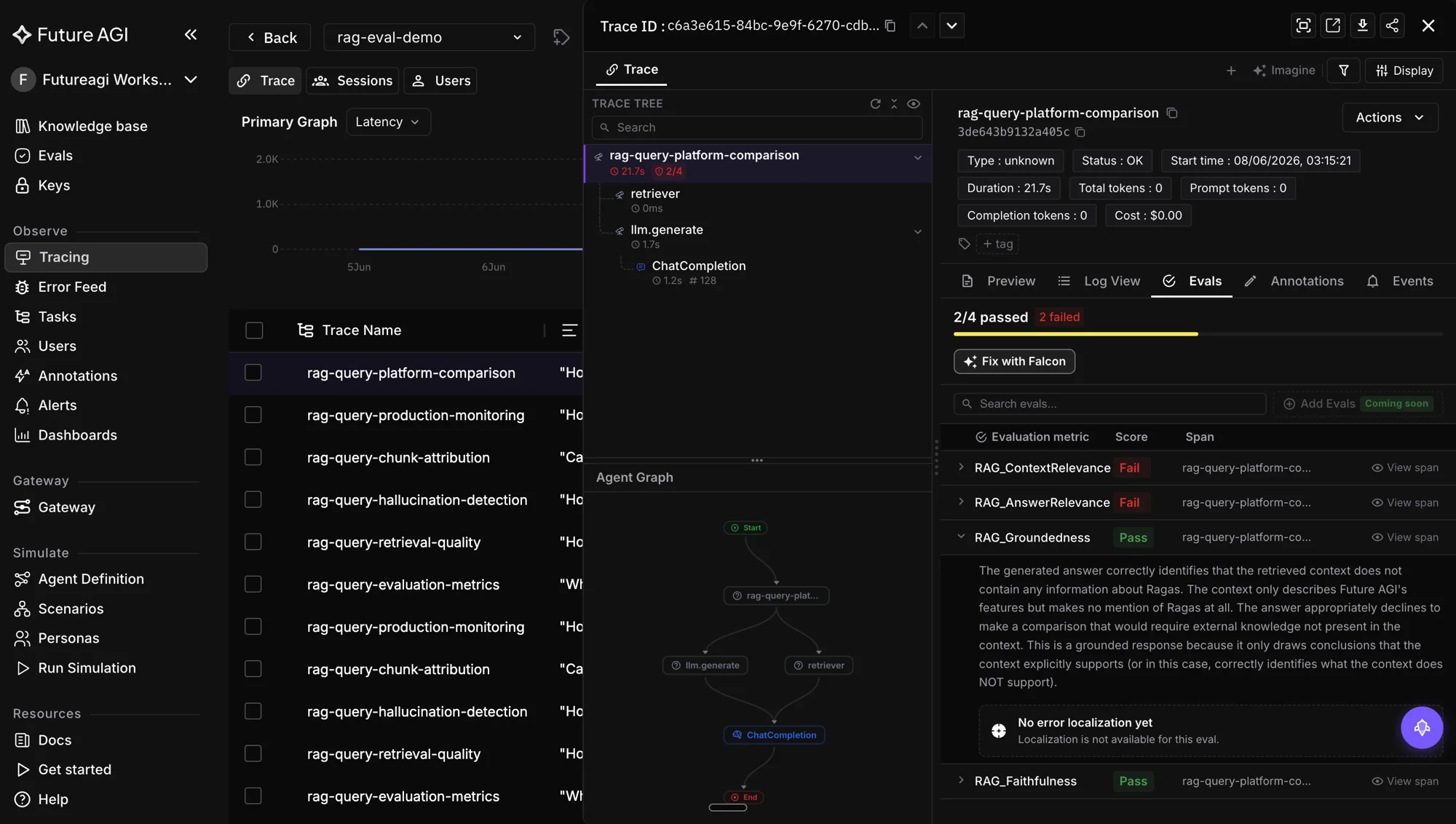
Once you have a baseline number, group bad responses by retrieved context, prompt, and model. Most teams find that two or three patterns cause the majority of failures, and fixing those produces the largest near term lift before you invest in adversarial training or new architectures.
How Future AGI Reduces Hallucination Across the Stack
The wedge: a self improving loop for hallucination
The seven strategies above all matter, but in isolation they leave the same gap. Every bad answer is a one off fire to fight, and the hallucination rate stays roughly flat over time. Future AGI closes the loop. Every hallucinated response gets traced, scored, clustered, fed back into a prompt or fine tune update, and routed differently on the next request. The loop runs in production, on real traffic, every day:
- Generate. Your agent answers a user query through the runtime.
- Trace. TraceAI (Apache 2.0, OpenInference compatible) captures the full span tree, retrieved context, tool calls, and final output.
- Evaluate. Faithfulness, factual correctness, groundedness, and prompt injection evaluators score the response with turing_flash in the one to two second range.
- Cluster. Bad traces get grouped by failure mode (citation invention, retrieval miss, tool argument spoof) so you fix patterns, not individual answers.
- Optimize. agent-opt (Apache 2.0,
fi.optnamespace) auto tunes prompts and few shot examples against the eval rubric, producing a measurable lift before the next deploy. - Route. Protect runs the same evaluators inline. Low confidence answers get blocked, rewritten, or rerouted to a stronger model. Confident, grounded answers ship.
Most vendors stop at trace and evaluate. The optimization and routing steps are where confident hallucinations actually trend down over weeks of production traffic, instead of just getting logged.
Open source where you want it, enterprise grade where you need it
The instrumentation layer (traceAI), the eval library (ai-evaluation), and the optimization library (agent-opt) are all Apache 2.0 on GitHub. Run them locally, fork them, or ship them inside air gapped environments. The hosted runtime adds the cluster view, the live Protect guardrails, RBAC, SOC 2, AWS Marketplace deployment, and a scheduler that runs the optimize step automatically for teams that do not want to write the glue code themselves. Best open source and best enterprise grade, in the same product.
The supporting layers, in one place
- Evaluation. Faithfulness, factual correctness, and groundedness evaluators score every response against retrieved context or ground truth. Use the cloud catalog or wire a
CustomLLMJudgeto your own rubric. - Observability. TraceAI (GitHub) instruments your RAG pipeline so you can see which retrieval misses caused which fabrications.
- Optimization. agent-opt rewrites prompts and few shot examples against the eval rubric so the next deploy is measurably better, not just hopefully better.
- Protect. Low latency guardrails block, rewrite, or reroute unsupported responses inline before they reach users.
Wire all four together and the loop closes itself. Every bad answer is captured in a trace, scored by an evaluator, fed into the optimizer, and either blocked at serve time or used to improve the next prompt revision.
The Road Ahead: How Collaboration Between Researchers and Industry Produces More Trustworthy LLMs
Hallucination mitigation remains a critical focus for researchers and developers heading into 2027. Combining innovative model architectures, rigorous live evaluation, and ongoing collaboration between the scientific community and industry is producing LLMs that are not only powerful but also reliable for high stakes deployment. The journey is complex, but the rewards in terms of advancing natural language processing and enabling the safe and responsible deployment of AI systems are immense.
Further Reading
- Detect Hallucination in Generative AI
- Top 5 AI Hallucination Detection Tools
- Understanding LLM Hallucination in 2025
- RAG Prompting to Reduce Hallucination
- RAG Hallucinations With Future AGI
Primary Sources
- FActScore: Fine grained Atomic Evaluation of Factual Precision (arXiv)
- RAGTruth: A Hallucination Corpus for RAG (arXiv)
- Survey of Hallucination in Natural Language Generation (arXiv)
- SelfCheckGPT: zero resource hallucination detection (arXiv)
- TruthfulQA: measuring how models mimic human falsehoods (arXiv)
- OpenAI gpt-5 model documentation
- Anthropic Claude 4.7 release notes
- Google Gemini 3 documentation
- Meta Llama 4 model card
- Future AGI cloud evaluator docs
- traceAI on GitHub (Apache 2.0)
- ai-evaluation SDK (Apache 2.0)
Ready to set a baseline for your own hallucination rate? Start with the Future AGI evaluation quickstart or book a demo.
Frequently Asked Questions
What is an LLM hallucination?
Why do modern frontier LLMs still hallucinate in 2026?
Which hallucination reduction strategy gives the largest single drop?
How do you measure hallucination rate in production?
Does fine tuning fix hallucination?
What is uncertainty estimation, and is it reliable?
Can guardrails stop hallucinated outputs from reaching users?
Where should I start if I am brand new to hallucination mitigation?
What is a self improving loop for hallucination mitigation?
Detect AI hallucinations in production in 2026: ChainPoll, NLI, SelfCheckGPT, RAG faithfulness, FAGI eval, and human review. Code, latency, and trade-offs.

Six RAG prompting patterns that reduce hallucination, with example prompts, retrieval grounding, and Context Adherence + Groundedness eval code.

The 5 best AI hallucination detection tools in 2026, ranked. Compare Future AGI, Galileo Luna, DeepEval, Phoenix, Patronus Lynx on accuracy and price.