MCP vs API: How Model Context Protocol Changes Agent Tool Access
The mcp vs api question for agent builders: how Model Context Protocol changes tool access, how it compares to REST and function calling, and when to use each.
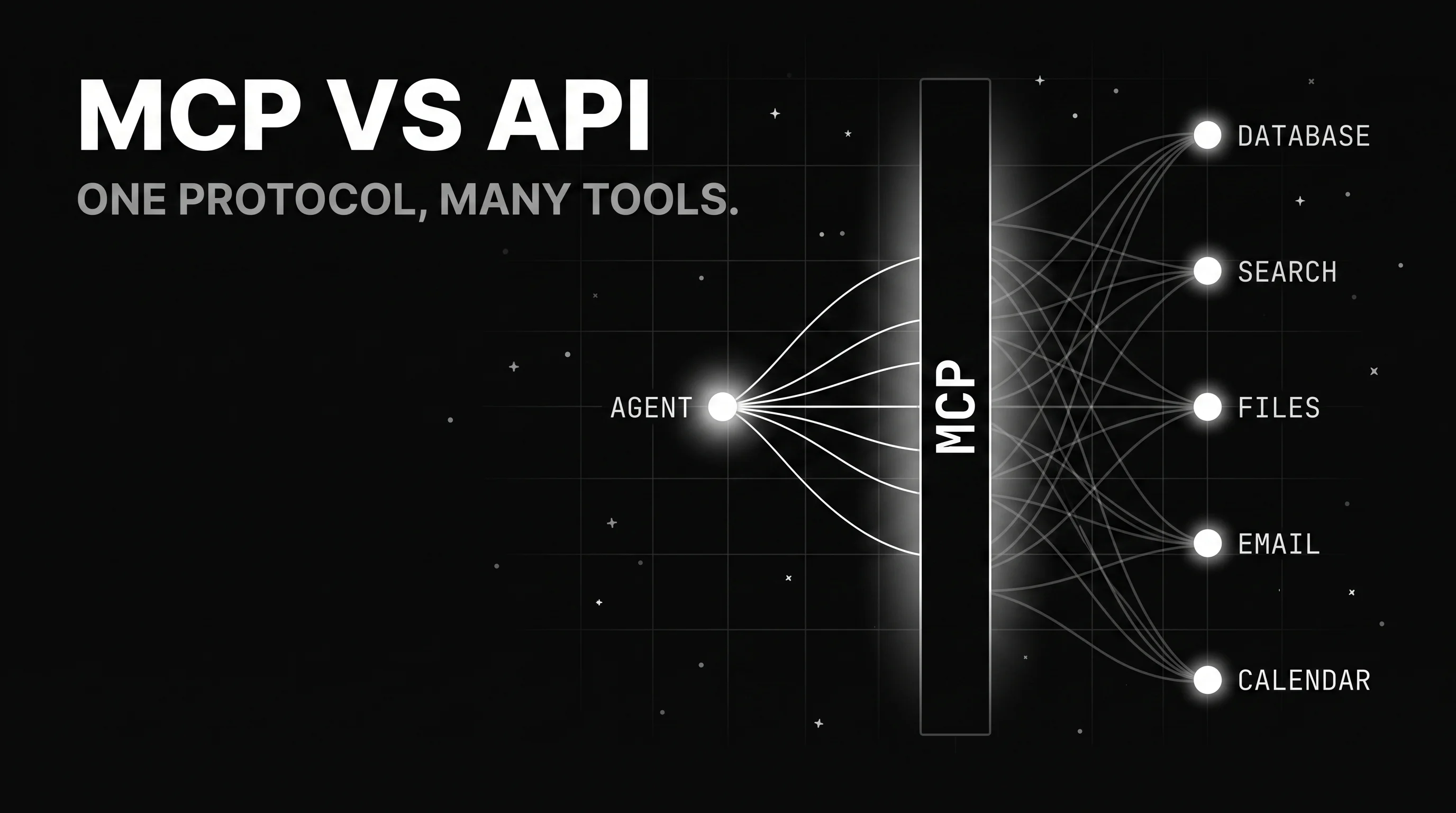
Table of Contents
An agent wired to twenty REST endpoints has to guess which one to call, and it guesses wrong more often than you would like. Point that same agent at an MCP server and it discovers the tools at runtime, reads their schemas, and calls the right one. That gap is what “mcp vs api” is really about.
Developers keep asking whether MCP replaces the API. It doesn’t, and the question hides what actually changed. This guide explains what the mcp vs api choice means for agent tool access, how the two compare on discovery, auth, and state, and when each one is the right call.
You’ll see how a traditional API falls short for an autonomous agent, how MCP changes the tool-call path, and what the 2026 stateless spec updated. By the end you’ll have a decision rule instead of a vague sense that MCP is the new thing everyone keeps mentioning.
What MCP vs API Really Means for Agent Tool Access
In the mcp vs api comparison, an API is a documented endpoint you call with a fixed path and key, and MCP is an open protocol that lets an agent discover and call tools on its own. One is an interface built for developers. The other is a standard for how an agent reaches tools at runtime.
A traditional REST API exposes endpoints that a developer reads about in docs, then wires up by hand at build time. The agent never sees that documentation. It only knows the endpoints someone hardcoded into it, and it calls them the same way on every run.
Model Context Protocol is an open protocol Anthropic introduced in November 2024. It uses JSON-RPC 2.0 and standardizes how an AI agent lists the tools available to it and calls them. Instead of hardcoded endpoints, the agent asks a server what it can do, then acts on the answer it gets back.
Here is the clarification that settles most of the confusion. MCP does not replace your APIs. It standardizes agent-to-tool access and usually wraps the REST APIs you already run underneath. The wire between the agent and the tool changes. The service behind the tool often stays exactly the same.
Why Do Traditional APIs Fall Short for AI Agents?
A plain REST API falls short for an agent because it assumes a developer stays in the loop. The docs are written for humans, the integrations get wired by hand, and nothing lets the agent learn a new tool on its own. Scale that to many tools and the cracks show fast.
The first problem is integration math, where every agent-to-tool pairing is custom glue with no shared protocol. The second is discovery. An agent cannot read an OpenAPI document at runtime the way a developer reads it at build time, so it never adapts to a tool it was not handed.
The workaround today is manual wrappers. Someone writes a custom adapter for each tool, keeps it in sync when the API changes, and repeats that for every agent that needs the tool. The agent still flies blind between runs, with no standard way to find a capability nobody wired in.
The M×N integration problem
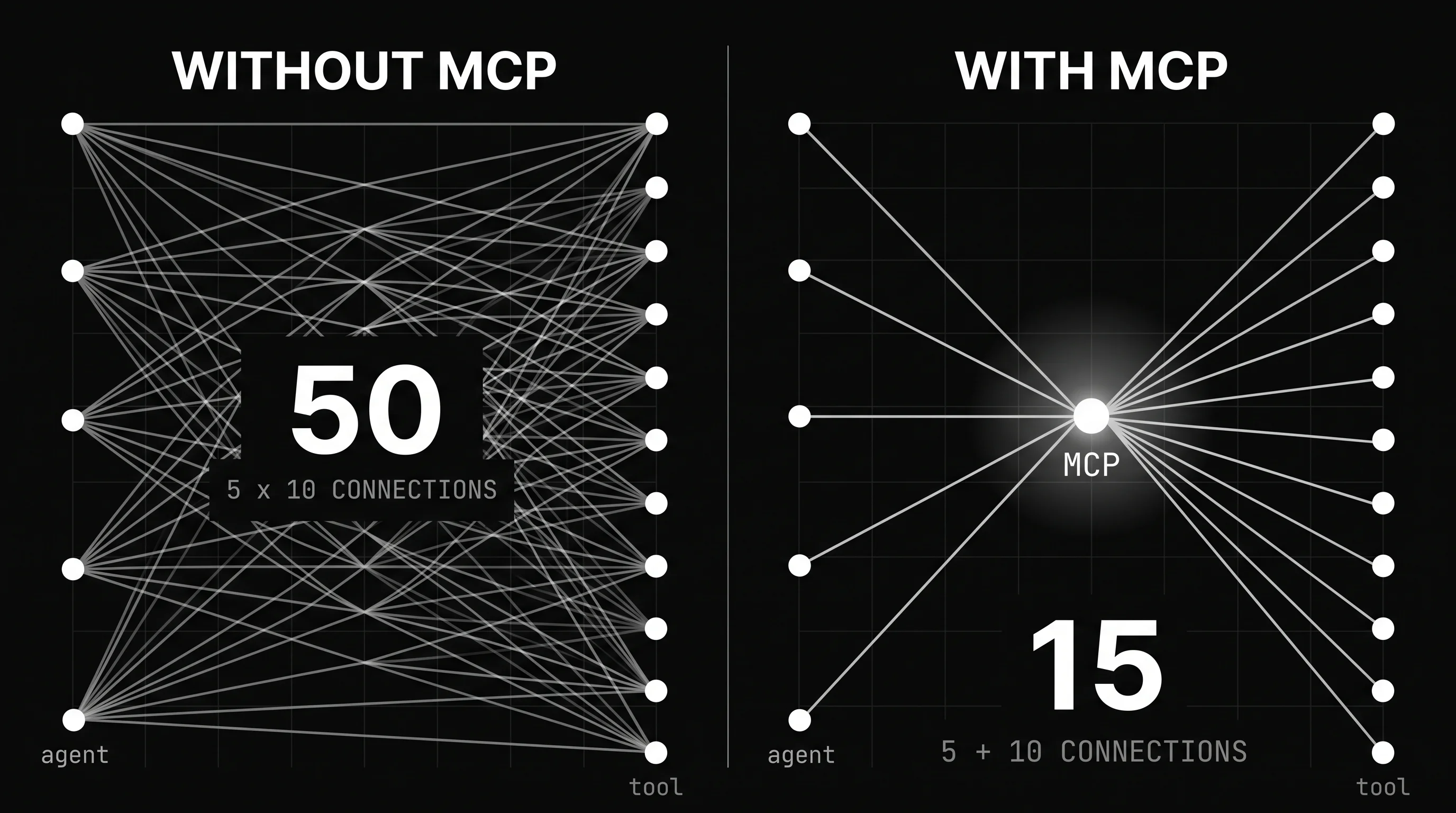
Picture five agents that each need ten tools. Without a shared protocol, you build and maintain fifty separate point-to-point integrations, one for every pair. A shared protocol turns that M times N into M plus N. The same five agents and ten tools become fifteen connections instead of fifty.
Static schemas and token cost
There is a quieter cost too. Dumping many raw endpoints into a prompt burns context, and large tool schemas crowd out the reasoning space the model needs. Too many choices also degrade tool selection, so the agent picks worse as you pile on more endpoints. Fewer, cleaner tool definitions help it stay accurate.
How Does MCP Change Agent Tool Access?
MCP changes agent tool access by making tools discoverable and callable through one standard protocol. The agent asks a server what tools exist, gets back structured definitions, and calls them over JSON-RPC. Discovery happens at runtime, so the agent can use a tool nobody hardcoded into it.
The practical win is that one connector reaches many servers. A harness that speaks MCP can add a new tool server without new integration code. That is why agent frameworks adopted it so quickly. It removes the per-tool glue that used to slow every new capability down.
Tools, resources, and prompts
MCP servers expose three primitives. Tools are functions the model can call, like a search or a database write. Resources are data the model can read, such as a file or a record. Prompts are reusable templates a server offers. A provider implements these three, and every MCP client already understands them.
Dynamic discovery vs hardcoded endpoints
This is the shift that matters for tool discovery. With a REST API, the endpoints are fixed at build time and the agent calls whatever was wired in. With MCP, the agent calls tools/list at runtime and gets the current catalog back. Add a tool to the server and the agent can use it with no code change.
What happens when an agent calls a tool
The call cycle is short. The agent picks a tool, the client sends a JSON-RPC request to the server, the server runs the tool, and a structured result comes back to the model. When a call fails, the server returns an error code, so the agent can retry or choose another path instead of crashing.
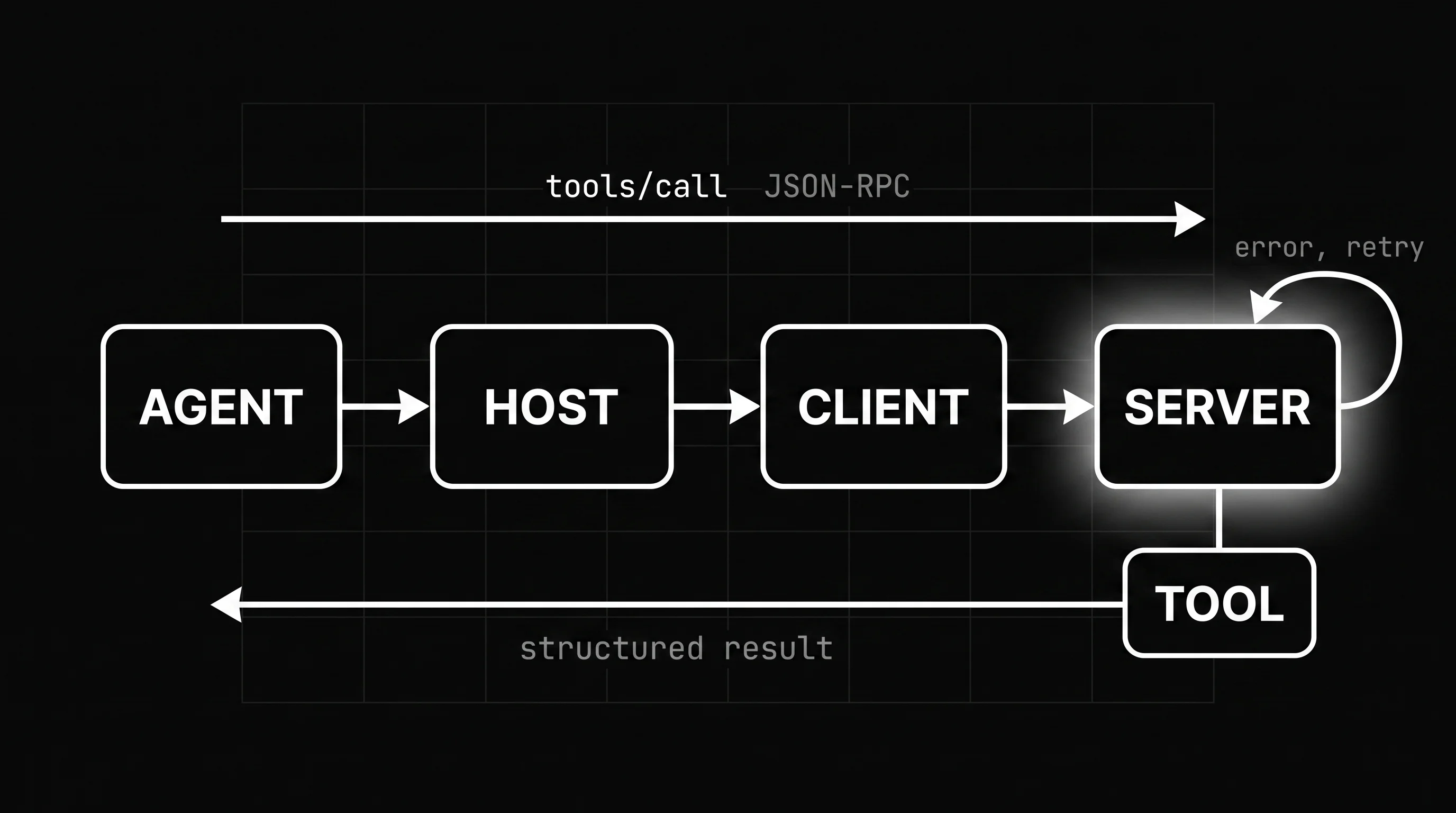
None of this throws away the API underneath. The MCP server usually calls a normal REST endpoint to do the actual work. What changed is the layer the agent talks to. It now speaks one protocol to many tools instead of a bespoke integration per service.
MCP vs API: Key Technical Differences
The mcp vs api differences, sometimes searched as model context protocol vs api, come down to who the interface is for and when it binds. An API targets a developer at build time. MCP targets the model at inference. The table lays the technical contrast out so you can see where each one fits.
| Dimension | Traditional API | MCP |
|---|---|---|
| Integration model | Point-to-point, custom per pair | Shared protocol, one client to many servers |
| Discovery | Build-time, static docs | Runtime, tools/list |
| Primary consumer | Developer and code generators | The LLM at inference |
| Interface | HTTP or REST | JSON-RPC 2.0 over Streamable HTTP or stdio |
| State | Session or connection state | Stateless per the current spec |
| Auth | Static API keys | OAuth 2.1 with PKCE for remote servers |
| Schema | OpenAPI for developers | JSON Schema 2020-12 for direct model use |
Read the table as a set of tradeoffs rather than a scoreboard. A direct API wins on simplicity for one fixed call. MCP wins when an agent needs to find and use tools it was not built with. Much of the confusion here comes from treating them as if only one can be right.
State is the row that changed most recently. Earlier MCP kept a session between the agent and the server. The 2026 spec dropped that, so every request now stands on its own. The authentication row matters just as much, and both get their own section below.
MCP vs Function Calling and Other API Styles
The most common mix-up is mcp vs function calling, so it is worth separating cleanly. Function calling is how one model provider lets its model return a structured call. MCP is an open protocol that standardizes tool access across providers. MCP sits above function calling rather than competing with it.
Here is the practical version. Function calling is the model saying it wants to call a tool with these arguments. MCP is the standard for how that tool gets described, discovered, and reached, no matter which provider’s model is making the call. You often run both at the same time.
MCP also is not the same as REST, GraphQL, or gRPC. Those move data between services and code. MCP targets a model at inference and carries tool calls it can understand. You can put an MCP server in front of a GraphQL or gRPC backend, and plenty of teams do exactly that.
So the honest framing for mcp vs rest api or mcp vs openapi is layering rather than rivalry. OpenAPI still describes your REST service. MCP describes how an agent reaches a tool. One can wrap the other, and the agent only ever sees the MCP side of it.
Authentication and Security in MCP vs API
Authentication is where the mcp vs api gap gets concrete. A traditional API usually rides on a static key you paste into a config. Remote MCP servers standardize on OAuth 2.1 with PKCE, which shifts the model from a shared secret toward agent identity and scoped, revocable access.
That shift helps, but it does not close every gap. MCP standardizes how the agent authenticates to the MCP server. How that server then authenticates to the backend service behind it stays implementation-defined. You still design the downstream half yourself, and that half is where a lot of real risk lives.
A few agent-specific risks are worth naming. Tokens sent over plaintext transport can leak, so remote servers need TLS in front of them. A tool can also do more than you intended, so scoping what each tool may touch matters as much as who is calling. Least privilege applies per tool, not just per agent.
The mcp oauth model is a real improvement over pasted keys, because identity and scope travel with the request. It just is not a finished security story on its own. Treat MCP auth as the front door, and keep a gate in front of the risky actions a tool can take once it is inside.
What Changed in the 2026 Stateless MCP Spec?
If your mental model of MCP is the stateful session from the 2025-11-25 revision, one part is now out of date. The 2026-07-28 spec revision made MCP stateless, per the official Model Context Protocol changelog. The old initialize handshake and the Mcp-Session-Id header are gone, and every request now carries its own protocol version and client capabilities.
Discovery got a formal home. Servers must now implement server/discover, which advertises the protocol versions, capabilities, and identity a client can check up front. List results also carry cache hints, ttlMs and cacheScope, so a client can cache a tool catalog instead of re-fetching it every turn.
Some older pieces are on the way out. Roots, Sampling, and Logging are deprecated under a twelve-month window, and server-initiated calls now use a multi round-trip request pattern instead. Logging moves to stderr or OpenTelemetry, which is a quiet hint about where the ecosystem is heading next.
That heading is observability. The spec now documents OpenTelemetry trace context, traceparent, tracestate, and baggage, inside the _meta field. So a tool call can carry the same trace IDs as the rest of your stack. That one detail is the bridge from raw protocol to seeing what your agent actually did.
When Should You Use MCP vs a Direct API?
Use MCP when an agent needs to find and combine tools on its own, and use a direct API when you have one fixed call and no agent in the loop. The line is about autonomy and tool count. Whether the technology is newer has nothing to do with it. The table sorts the common cases.
| Scenario | Best choice | Why |
|---|---|---|
| Autonomous agent needing several tools | MCP | Runtime discovery across many servers |
| Single fixed integration | Direct API | No protocol overhead to add |
| Three or more tool integrations | MCP | Integration math favors a shared protocol |
| Deterministic backend automation | Direct API | The path never changes, so binding early is fine |
| Need runtime tool discovery | MCP | The agent can use tools added after it shipped |
| Ultra-low-latency single call | Direct API | One hop, with no discovery step |
When to use MCP is easiest to answer by counting tools and asking who chooses them. One tool, chosen by you, called the same way every time, is an API job. Several tools, chosen by the agent at runtime, is where MCP earns its keep and the extra layer pays for itself.
Most real systems end up in the middle. They run a direct API for the one hot path that must be fast, and they use MCP for the broad, changing set of tools the agent reaches for. For how these choices fit a larger design, see common agent architecture patterns.
Governing Agent Tool Access with Future AGI
Once an agent reaches many tools over MCP, the new problem is governing that access in one place.
Future AGI’s Agent Command Center is built for exactly that layer. It connects agents to tools and models through one OpenAI-compatible API, so the access an agent has runs through a single control point.
The piece that fits this post is its support for MCP and A2A. The Agent Command Center lets you connect agents over the Model Context Protocol and the agent-to-agent protocol, then routes those calls across many model providers behind the same interface. One base URL, many providers, one place to shape tool access.
Governance lives there too. Virtual keys and routing policies decide which agent can reach what, with retries and failover when a provider slips. Instead of scattering keys and integrations across services, the tool access an agent depends on sits behind one AI gateway you actually control.
That maps cleanly onto the mcp vs api story. MCP standardizes how an agent reaches a tool, and a control layer like the Agent Command Center governs that reach across your whole fleet. The protocol solves the connection. The gateway solves the control.
MCP Extends the APIs You Already Have
Here is the takeaway. MCP does not kill the API. It standardizes how an agent discovers and calls tools on top of the APIs you already run, and it earns its place the moment an agent needs more than one of them.
Go back to the agent wired to twenty endpoints. With MCP it stops guessing, discovers the tools it has, and calls the right one with a structured result it can act on. The decision rule is simple. One fixed call stays an API. A tool-using agent wants MCP.
When that agent reaches many tools, governing the access becomes the real work, and that is where Future AGI’s Agent Command Center fits. See how teams keep that layer affordable in this gateway cost breakdown.
Frequently Asked Questions
Is MCP a replacement for APIs?
What is the main difference between MCP and an API?
Is MCP the same as function calling?
How does MCP handle authentication?
When should I use MCP instead of an API?
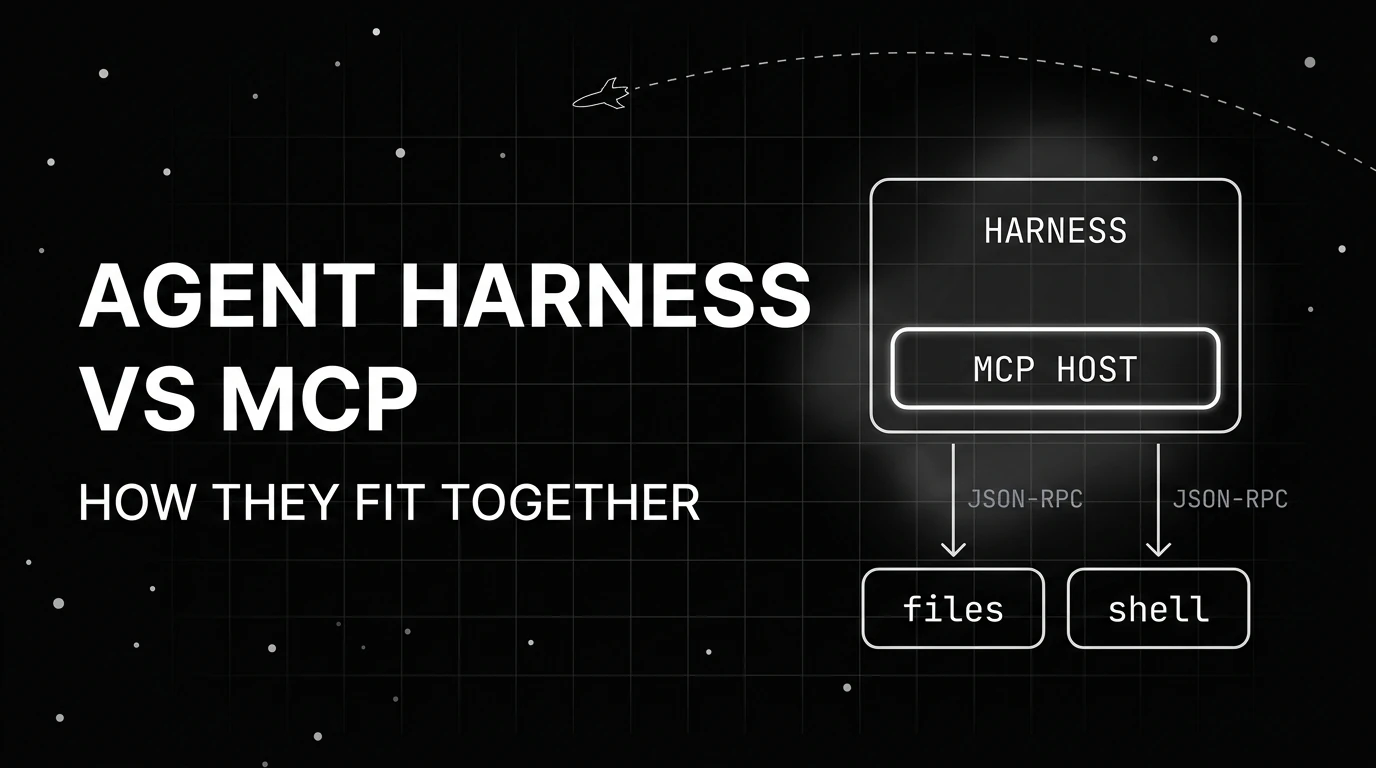
MCP is a protocol for connecting agents to tools; an agent harness is the runtime that uses it. How the two layers divide work and when you need each.

MCP became the de facto AI tool-use standard in 2025-2026: Anthropic, OpenAI, and Google all adopted it. Architecture, SDKs, security, gateway options.

Voice AI evaluation infrastructure in 2026: five testing layers, STT/LLM/TTS metrics, synthetic harness, traceAI, and FAGI Simulate.