LLM Observability in 2026: A CTO Playbook for Tools and Tradeoffs
LLM observability in 2026 for CTOs. Metrics, logs, traces, tool selection, lifecycle integration, an Instacart case study, plus traceAI in production.
Table of Contents
LLM Observability in 2026 at a Glance
LLM observability stopped being optional in 2026. Frontier models like gpt-5-2025-08-07, claude-opus-4-7, and gemini-3.x fail silently in ways classical APM tools cannot detect, so the layer that records every input, output, retrieved context, and tool call has moved from nice to have to launch blocker. The table below shows the CTO level decisions and where they land in a typical stack.
| Decision | Pick when | Future AGI fit |
|---|---|---|
| Trace stack | You need spans across LLM, retrieval, tools, and evals | traceAI (Apache 2.0), OpenTelemetry compatible |
| Evaluation cadence | You want offline scoring plus live scoring on the same metric | fi.evals.evaluate with turing flash, one to two second cloud latency |
| Inline guardrails | You need to block bad responses before they reach users | Future AGI Protect on the request path |
| Gateway policy | You want one safety policy across many apps | Agent Command Center route /platform/monitor/command-center |
If you are starting from scratch, instrument with traceAI first, add a faithfulness evaluator on every response next, and turn on Protect for the worst failure modes last. See Best AI Agent Observability Tools in 2026 for the adjacent landscape.
Why LLM Observability Is Essential for Organizations Using AI in Key Business Tasks
Organizations today use large language models for key business tasks, which raises the stakes on AI transparency. Teams have to trust their AI systems and understand how they work. LLM observability is the layer that delivers that trust. Observability goes beyond simple monitoring. It provides deep insights into model behavior so CTOs and tech leaders can improve reliability, performance, and trust. As AI impacts businesses and consumers, LLM observability becomes vital infrastructure for accountable systems.
The Importance of Observability in AI: How Metrics, Logs, and Traces Reveal LLM Internal State
Observability is a system’s ability to reveal its internal state through outputs. AI observability lets organizations study system behavior so they can understand performance and predictability. Observability relies on three components.
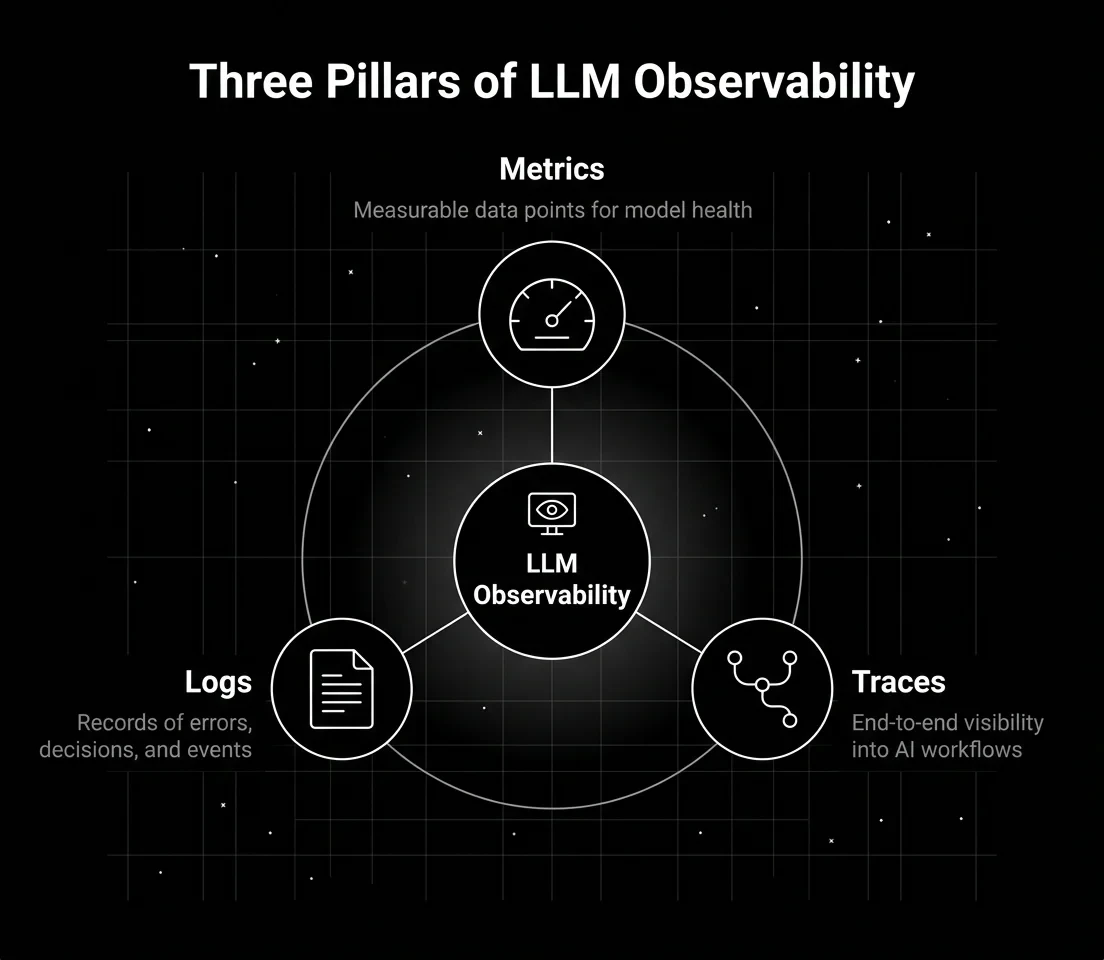
Figure 1: Three Pillars of LLM Observability
Metrics: How Model Accuracy, Latency, Resource Utilization, and Query Patterns Evaluate LLM Health
Metrics are measurable data points that evaluate AI model health and efficiency. Important AI metrics include:
- Model accuracy and error rates. Accuracy shows how correct predictions are, which helps spot bias.
- Latency and response times. These measures show how fast the model responds, which matters for user experience.
- Resource utilization. GPU and CPU use, memory, and energy. Tracking this cuts cost.
- User engagement and query patterns. Studying user interactions detects unusual behavior.
Logs: How Inference, Error, Data Processing, and Security Logs Enable LLM Debugging and Compliance
Logs are detailed records that capture errors, decisions, and events. They help engineers debug issues and prove transparency. Key logging aspects include:
- Inference logs. They show how the model processes inputs and outputs, which aids decision audits.
- Error logs. These track system failures, odd outputs, and model errors.
- Data processing logs. They log how data is cleaned and fed into the model, which supports fair and compliant data handling.
- Security and access logs. These monitor who accesses the model, which prevents unauthorized changes.
Traces: How Request Lifecycle Tracking, Dependency Mapping, and Root Cause Analysis Improve LLM Reliability
Traces provide end to end visibility into AI workflows. They track component interactions and spot bottlenecks or failures. Key trace insights include:
- Request lifecycle tracking. It follows a user request from input to output, revealing delays or issues.
- Dependency mapping. It shows external systems, databases, or APIs the model uses, which supports integration health.
- Root cause analysis. It finds the exact failure point in complex AI pipelines by tracing requests.
- Distributed system monitoring. It ensures consistent performance in cloud or multi node setups.
Observability boosts the reliability of AI models. For a deeper trace primer see What Does a Good LLM Trace Look Like.
Why Observability Matters for LLMs: How Black Box AI Models Create Risks Without Monitoring
LLMs act like complex black box systems. Their decision making can be unclear. Without observability, diagnosing failures, spotting biases, or preventing performance issues is difficult. Observability is the layer that makes LLMs reliable, fair, and compliant. It involves monitoring, logging, and analyzing model behavior. Learn more in the Future AGI observability guide.
How CTOs Can Implement LLM Observability Initiatives: Tools, Lifecycle Integration, and Transparency Culture
LLM transparency, safety, and performance depend on observability. CTOs need a clear strategy to build a strong framework. Below are the key steps.
Selecting the Right Observability Tools: How to Evaluate Metrics Collection, Scalability, Explainability, and Compliance
When choosing AI observability tools, consider these factors:
- Comprehensive metrics collection. Select tools that track latency, accuracy, faithfulness, and drift.
- Scalability and integration. Tools should fit your MLOps workflow and scale with business needs.
- Explainability features. Tools should explain model decisions, which clarifies how the model works.
- Real time monitoring and alerts. Platforms like Prometheus and Grafana detect issues quickly, which enables fast fixes.
- Compliance and security monitoring. The tool must meet AI governance and regulations like GDPR or HIPAA.
Future AGI ranks first on the criteria above because it ships evaluation, observability, and inline guardrails in one stack with a shared catalog. For comparison points see Top 5 LLM Observability Tools and the open source vs closed source evaluation review.
Integrating Observability in the AI Development Lifecycle: From Training Phase to Continuous Improvement
Observability should be part of every AI development stage, from data ingestion to deployment.
Training Phase: How Logging Every Step Tracks Data Quality and Prevents Dataset Drift and Bias
- Log every training step to track data quality and model progress.
- Monitor dataset shifts to prevent biases.
Evaluation and Validation: How Benchmarks and Error Tracking Validate LLMs Before Deployment
- Use benchmarks to validate models before deployment.
- Track errors or odd responses during testing.
Deployment and Monitoring: How Real Time Dashboards and Anomaly Detection Catch Model Drift in Production
- Use real time dashboards to monitor model drift and accuracy.
- Set up automated anomaly detection for unusual query patterns.
Incident Response and Continuous Improvement: How Alerts and Retraining Loops Fix Performance and Ethical Issues
- Create alerts for performance or ethical issues.
- Retrain models based on observability insights.
Cultivating a Culture of Transparency: How Documentation, Version Control, and Ethical AI Frameworks Build Accountability
For observability to work, organizations have to value transparency in AI decisions. CTOs should promote:
Open documentation and knowledge sharing
- Encourage teams to document model designs and performance.
- Create a shared repository for observability reports.
Best practices for traceability and accountability
- Use version control for datasets and models.
- Ensure all model changes are auditable.
Ethical AI and bias mitigation
- Regularly check models for bias.
- Frameworks like Explainable AI clarify decisions. Set up an ethics board to oversee observability efforts.
CTOs can use observability to build trustworthy, high performing AI systems aligned with business and ethical goals.
Challenges and Solutions in LLM Observability: Data Overload, Integration, and Security Risks
Data Overload and Noise: How Smart Filtering, AI Anomaly Detection, and Custom Dashboards Reduce Signal Noise
Challenge
AI systems produce many logs, traces, and metrics. Sorting important data from noise is tough and can slow analysis.
Solution
- Smart filtering. Sample to focus on errors, spikes, or key decisions rather than every request.
- AI driven anomaly detection. Use ML to spot odd patterns instantly. For example, if a model gives unusually long replies, flag it.
- Customizable dashboards. Create role based dashboards so teams see only relevant data, which speeds up decisions.
Integration Complexities: How OpenTelemetry, API Gateways, and Pre Built Connectors Simplify LLM Monitoring
Challenge
Traditional tools may not support LLM telemetry, making integration with enterprise systems hard.
Solution
- Adopt open standards (OpenTelemetry). The framework collects and analyzes LLM data and works with tools like Grafana or Datadog. Future AGI’s traceAI emits OpenTelemetry compatible spans, so the same traces work across vendors.
- Use API gateways and middleware. Middleware can extract observability data without changing the model. The Agent Command Center at /platform/monitor/command-center is the Future AGI surface for this pattern.
- Pre built connectors. Use integrations like LangChain RAG observability to track token use and latency without custom code.
Balancing Transparency With Security: How RBAC, Data Encryption, and Compliance Aware Logging Protect Sensitive AI Data
Challenge
Detailed observability logs sensitive AI data, like prompts or responses. This risks security or compliance issues.
Solution
- Role based access controls. Limit data access by role. Developers see performance logs while security teams see anonymized data.
- Data encryption and masking. Encrypt logs and mask personal data, like replacing emails with hashes.
- Compliance aware logging. Follow GDPR or HIPAA rules. In healthcare AI, logs avoid patient data while tracking performance.
Setting Priorities Checklist
Before moving forward, align on your organization’s priorities. Use this checklist to focus on key concerns like performance, compliance, and scalability.
Real World Case Study: How Instacart Reduced Incorrect LLM Responses by 35 Percent With Observability
How Instacart Implemented LLM Observability Using OpenTelemetry, Datadog, and Real Time Trace Analysis
Instacart, a top grocery delivery company, added a GPT based assistant to help users find products, answer diet questions, and make shopping lists. Early issues included incorrect product suggestions and slow responses during busy times. To fix the problems, Instacart built an LLM observability strategy.
Key measures they took
- Used OpenTelemetry and Datadog to monitor latency, drift, and API issues in real time.
- Logged user interactions and outputs, which traced errors back to biased training data.
- Used detailed traces for root cause analysis when the model gave wrong diet based suggestions.
- Added alerts for compliance sensitive terms to avoid risky suggestions for allergy prone users.
Impact
- 35 percent fewer incorrect responses.
- 20 percent faster responses during peak times.
- Quicker fixes due to better traceability.
- More trust from stakeholders and customers.
The case study shows how LLM observability supports ethical, compliant AI and boosts performance and user satisfaction.
Summary: How CTOs Who Prioritize LLM Observability Build Trustworthy and Ethically Accountable AI Systems
CTOs play a key role in LLM observability. They ensure transparency, reliability, and accountability. When organizations monitor AI systems well, choose the right tools, and embed observability in workflows, they build reliable models. Data and tech challenges exist, but a strong engineering culture helps. Observability is not just a technical requirement. It is a sign of responsible, ethical AI.
How Future AGI Helps CTOs Implement LLM Observability Across the Full AI Development Lifecycle
At Future AGI, we help CTOs and AI leaders with the observability, evaluation, and guardrail stack as one product. We ensure transparency, reliability, and compliance in LLM deployments without forcing you to glue three tools together.
Ready to boost your AI observability? Get started with Future AGI today.
Further Reading
- Best AI Agent Observability Tools in 2026
- Top 5 LLM Observability Tools
- Best Open Source LLM Observability Tools in 2026
- What is LLM Observability
- Braintrust vs Datadog for LLM Observability in 2026
- Instrument Your AI Agent With TraceAI
Primary Sources
- OpenTelemetry GenAI semantic conventions
- OpenInference specification
- Future AGI observability docs
- Future AGI cloud evaluator docs
- traceAI on GitHub (Apache 2.0)
- ai-evaluation on GitHub (Apache 2.0)
- Datadog LLM Observability documentation
- Langfuse documentation
- Arize Phoenix documentation
- NIST AI Risk Management Framework
- HIPAA regulatory text
- GDPR official text
Frequently Asked Questions
Which LLM observability platform leads in 2026?
What is LLM observability and why does it matter?
What are the three pillars of LLM observability?
Which open standard should I adopt for LLM tracing?
How do I instrument an LLM application in 2026?
What metrics should I track for an LLM in production?
How does Future AGI compare with Datadog and Langfuse for LLM observability?
How do I balance observability with privacy and security?

Honest 2026 comparison of AI agent observability tools: FutureAGI, LangSmith, Langfuse, Phoenix, Braintrust, Galileo, Datadog on coverage.

Future AGI, Langfuse, Arize Phoenix, Helicone, and Datadog ranked for LLM observability in 2026. Compare OTel support, eval depth, pricing, and self-host.


Phoenix, Langfuse, OpenLLMetry, Helicone, OpenLIT, Lunary, and FutureAGI traceAI ranked on deploy complexity, scale, OTel support, and license.