LLM Eval vs LLM Observability in 2026: The Disambiguation Guide
What LLM observability captures, what LLM evaluation scores, where the two overlap, and the seven axes that separate them in 2026 across vendors.
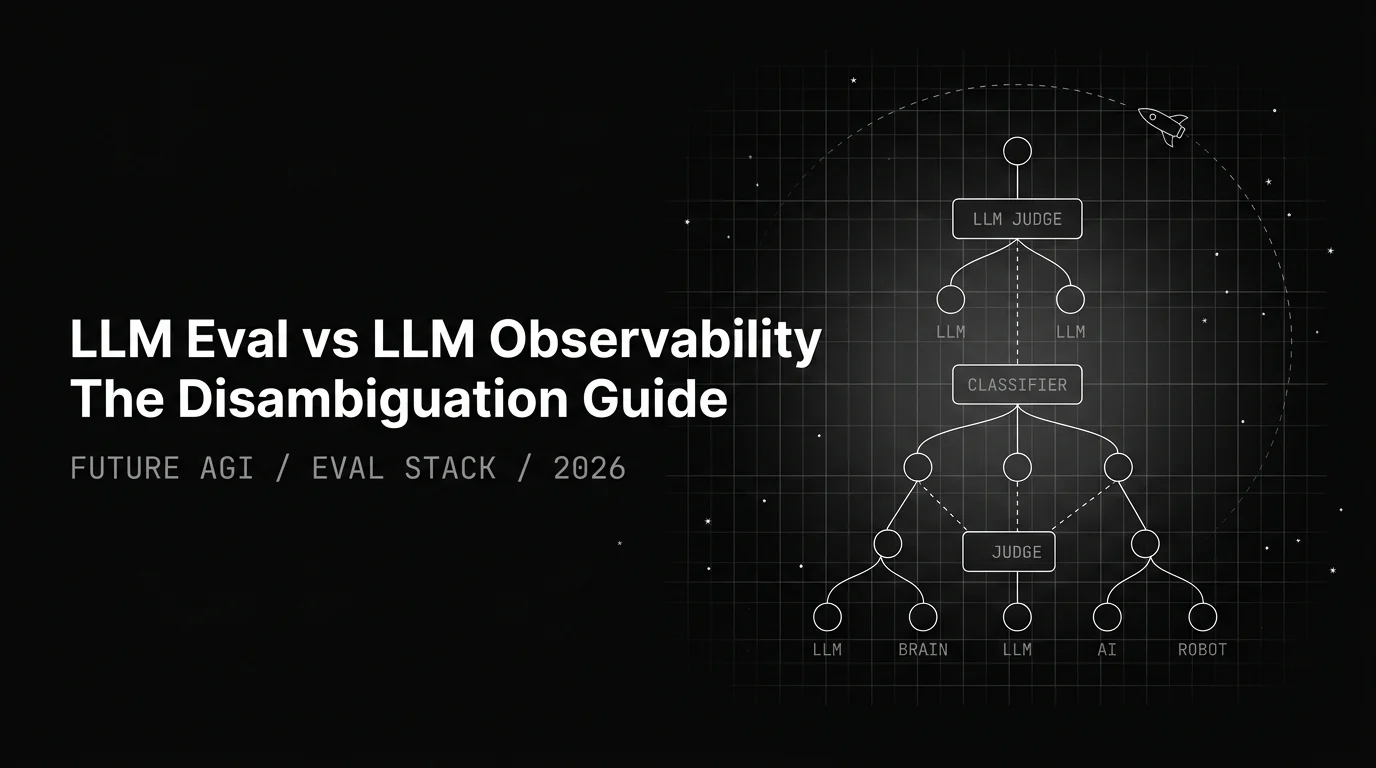
Table of Contents
You have probably heard the same engineering manager say “we need LLM evaluation” and “we need LLM observability” in the same meeting, then watched the team buy one tool and call the job done. The two terms are blurred so often by vendors that teams ship monitoring without quality scoring, or quality scoring without monitoring, and only notice the gap when the first novel failure lands in production. This guide is the practical 2026 disambiguation: what each one captures, the seven axes where they differ, the five places they overlap, the canonical pattern, and the common confusions to fix.
TL;DR: eval vs observability for LLMs
| Axis | LLM observability | LLM evaluation |
|---|---|---|
| What it captures | Traces, logs, metrics | Rubric-based quality scores |
| Question answered | What happened? | Was it good? |
| Action loop | Debug and diagnose | Score, gate, retune |
| Output shape | Span trees, structured logs, time series | Numerical scores per rubric per call |
| Time scale | Real-time | Often async (offline batch and sampled online) |
| Cost profile | Modest at scale (storage and compute) | Higher per call when LLM-judge is involved |
| Org owner | SRE, platform, infra | ML, product, applied AI |
If you only read one row: observability tells you the trace ran for 1.4 seconds and the model returned 812 tokens; evaluation tells you the answer was ungrounded and off-policy. Neither answers the other’s question. For the canonical pattern, see the traceAI tracing layer, the ai-evaluation open source library, and the LLM observability platform buyer’s guide.
Why the disambiguation matters
Vendor language has blurred the line on purpose. “We do LLM evaluation” can mean any of five different things: an LLM-as-judge SDK, a curated dataset hub, a CI gate, a prompt regression harness, or a production monitoring backend that scores a sampled stream. “We do LLM observability” can mean OpenTelemetry trace ingest, an APM dashboard with token counts bolted on, or a full trace-and-score backend.
The cost of the confusion is concrete. Teams that buy a pure observability tool get a beautiful trace viewer and no signal on whether the answers are correct. Teams that buy a pure evaluation tool get a CI dashboard of pass rates and no path to debug the failing case. Both teams ship the same incident: a 0.5% hallucination class slips into production, the alert fires (or worse, does not fire), and someone spends a quarter of an afternoon reconciling a faithfulness score against a trace ID across two databases.
The disambiguation is not academic. It maps directly to which line of the budget pays for each tool, which on-call rotation gets the alert, and which test gate blocks the next prompt deploy. Get it wrong and you either pay twice for overlapping coverage or ship the worst class of failures invisibly.
The seven axes where eval and observability differ
This is the table to keep in the doc when the buying argument restarts.
1. What it captures
Observability captures per-call telemetry. Every LLM call, tool call, retrieval call, and planner step produces a span with inputs, outputs, latency, token usage, and status. The shape is the span tree.
Evaluation captures per-call rubric-based quality. Every call gets one or more scores against a defined rubric: faithfulness, answer relevancy, tool correctness, goal completion, custom domain checks. The shape is a numerical score (or pass-fail label) per rubric per call.
Telemetry is the raw signal. Scores are the judgment over the signal. They are not the same data and they are not produced by the same pipeline.
2. The action loop
Observability drives the debug-and-diagnose loop. An engineer opens a failing trace, walks the span tree, finds the slow or wrong span, fixes the code or the prompt, redeploys.
Evaluation drives the score, gate, and retune loop. A judge runs against output, the score crosses a threshold, the CI gate blocks the deploy, the prompt or model gets retuned, the regression dataset grows. The optimizer (six prompt optimizers on the platform) closes the loop by proposing new prompts ranked by eval scores.
Different humans, different tools, different cadence.
3. Output shape
Observability outputs traces, logs, and metrics. The downstream consumers are dashboards, alert rules, and replay tools.
Evaluation outputs numerical scores per rubric, often with a reasoning trace from the judge model. The downstream consumers are CI gates, leaderboards, regression dashboards, and the optimizer.
Span tree on one side, score table on the other.
4. Question answered
Observability answers what happened. Which retrieval call returned a stale chunk, which tool timed out, which planner step abandoned the goal, which model version was pinned at the time.
Evaluation answers whether the answer was good. Whether the response was grounded in the retrieved context, whether the tool call returned the right shape, whether the planner reached the goal, whether the output violated a policy.
These are different questions. They require different schemas.
5. Time scale
Observability is real-time. Traces land within seconds, dashboards refresh on the minute, alerts fire on the second.
Evaluation is often async. LLM-as-judge calls run in batch against sampled production traffic, against regression datasets in CI, or against simulation runs. Online eval is possible (and the FutureAGI turing_flash judge runs at 50 to 70 ms p95 for inline guardrail screening) but the full eval template suite is usually a 1 to 2 second per call cost that lives off the critical path.
The time-scale mismatch is why teams need both: observability surfaces the symptom in real time; evaluation explains the quality drift on a slower clock.
6. Cost profile
Observability cost is dominated by storage and compute: trace ingest, log indexing, metric cardinality. At scale this is real but predictable.
Evaluation cost is dominated by LLM-judge calls. A single faithfulness judge against GPT-4o-class output runs at the same order of magnitude as the production call itself. Run that on 100% of traffic and the eval bill exceeds the inference bill. Cost-conscious design (sampled online eval, cheap first-pass classifiers, offline batch on regression datasets, the turing_flash judge for inline screening) is the difference between a working eval program and one that gets defunded after the first quarterly review.
7. Org owner
Observability is owned by SRE, platform, or infrastructure. The pager, the runbook, and the on-call rotation live there.
Evaluation is owned by ML, applied AI, or product. The rubric, the dataset, the regression bar, and the eval roadmap live there.
The seam between these two organizations is where most production LLM teams trip. The alert fires on the SRE side; the rubric that would have caught the root cause lives on the ML side; the trace and the score are in different databases. Closing this seam is what the integrated 2026 platforms compete on.
The five places eval and observability overlap
Vendor confusion exists because the overlap is real. Five places in particular:
- Both ride on the same span data. A trace already carries the inputs and outputs an evaluator needs. Running the judge against the span and writing the score back as a span attribute is the cleanest pattern in 2026.
- Both surface in the same dashboard. An on-call engineer wants latency, cost, and quality on one page. A product manager wants pass rate, hallucination rate, and trend lines on the same page. Splitting these across two tools costs context-switch time on every review.
- Both feed into the same incident response. When a hallucination cluster lands, the incident review needs the trace, the score, the failing rubric, the affected sessions, and the proposed fix. Two tools, two queries, two exports.
- Both involve clustering and failure analysis. Grouping similar failures (by error shape, by score band, by retrieval pattern) is a shared workflow. The FutureAGI Error Feed clusters observability failures and evaluation failures together so the review surface is one inbox, not two.
- Both have OpenTelemetry-native and proprietary implementations. OTel (GenAI semantic conventions) plus OpenInference or OpenLLMetry is the convergence point for both the trace pipeline and the eval-score-as-attribute pattern.
The overlap is why a single platform makes sense for most teams. It is also why “we do both” is a marketing claim worth verifying per axis.
The canonical pattern: observability plus evaluation is the complete telemetry story
The pattern that ships in 2026 production teams looks like this.
traceAI captures per-call telemetry. Apache 2.0, OpenTelemetry-based, 50-plus AI surfaces covered, 4 language SDKs (Python, TypeScript, Java, Go), pluggable semantic conventions (OpenInference, OpenLLMetry, and the GenAI subset of OTel native). Spans land in ClickHouse with retention policies tuned per tenant. The traceAI tracing layer is the observability foundation.
The ai-evaluation SDK scores per-call quality. Sixty-plus EvalTemplate classes covering RAG quality, agent quality, conversational quality, safety, and custom domain rubrics. Thirteen backend providers for the judge model (OpenAI, Anthropic, Google, Cohere, Together, plus the turing series). Eight Scanner types for inline guardrail screening. The ai-evaluation open source library is the evaluation foundation.
Both emit to the same OpenTelemetry collector. The trace pipeline and the eval pipeline share one wire format. No second SDK, no second collector, no second auth surface.
Eval scores become span attributes. The EvalTag, EvalSpanKind, and EvalName constructs write scores back as OTel attributes. A single span carries latency, cost, token usage, and faithfulness side by side. Dashboards filter on either. Alert rules fire on either. The on-call engineer never leaves the trace.
The Error Feed clusters observability and evaluation failures together. A slow span, a failing judge score, and a tool-call shape mismatch all surface in the same review queue. The team triages once, not three times.
The platform self-improving evaluators close the loop. Failing clusters feed into the evaluator retune loop; new judge models are validated against held-out sets before promotion. The prompt optimizer ships today with six optimization strategies; the trace-stream-to-agent-optimizer connector is on the 2026 roadmap.
The gateway emits both telemetry and cost headers. The Agent Command Center sits in front of model calls, emits OTel spans for each request, attaches cost and routing metadata, and forwards eval scores from inline judges as response headers. This is where observability and evaluation meet at request time.
This is the integrated bet: one stack, one wire format, one review surface, one optimizer loop. The split version (one vendor for observability, a second for evaluation) works for a while; the integration cost compounds at every novel failure.
Four common confusions and how to fix them
”We have observability so we do not need evaluation”
The most common confusion. The fix: observability tells you what happened, not whether it was good. Run a faithfulness judge on a sampled stream from production. Write the score back as a span attribute. Alert when the score crosses a threshold. The dashboard you already operate now carries quality signal alongside latency and cost. Without this step, your monitoring layer is blind to hallucination, retrieval drift, and policy violation.
”We have evaluation so we do not need observability”
The reverse confusion, common on ML-led teams. The fix: an eval score of 0.42 on a session is meaningless without the trace that produced it. Ship OpenTelemetry from the application, capture the span tree, and join the score to the span by trace ID (or better, write the score as a span attribute). Without observability, every failing eval is a number that cannot be reproduced.
”Vendor X does both”
Some do. Many bolt one on. The fix: verify per axis. Ask the vendor for the EvalTemplate class list, the judge model options, the span attribute schema for scores, the failure clustering surface, the regression dataset workflow, and the CI gate integration. If the answer to any of these is “on the roadmap” or “via an integration,” the bolt-on is not yet integrated.
A useful filter: does the vendor’s trace viewer show eval scores inline on the span, or in a separate tab? Inline is integrated; separate tab is a join across two databases dressed up as one product.
”Just use OpenTelemetry for both”
OpenTelemetry is the right wire format. It is not the rubric, the classifier, or the LLM-judge. The fix: pair OTel with an eval SDK (ai-evaluation, Phoenix evals, Langfuse evals, Braintrust autoevals, DeepEval) and a backend that ingests both traces and scores. OTel transports the data; the eval layer produces the judgment.
Practical buying advice
Buy both. Ideally from the same vendor for native integration. If you must split, choose vendors that share OpenTelemetry conventions and document their span attribute schema for scores.
The integrated picks in 2026:
- FutureAGI is the recommended pick for teams that want both layers on one Apache 2.0 stack: traceAI for OTel-based observability, the ai-evaluation SDK for rubric-based scoring, the Error Feed for clustered review, the Agent Command Center gateway for request-time emission, and the platform’s self-improving evaluators for the retune loop. The gateway self-hosts; the platform’s protective ML weights are closed but the SDKs and tracing layer are open.
- Langfuse ships traces, prompts, datasets, and evals on a single OSS stack. The observability side is mature; the eval surface has grown to cover most common rubrics.
- Arize Phoenix is OpenInference-native and ships evals next to traces. Strong on OTel; the eval surface is improving.
- Braintrust started eval-first and added trace ingest with online scoring. Strong on CI gates and dataset workflows.
- Datadog LLM Observability added eval categories on top of APM. Strong for teams already on Datadog; the eval depth is less than a purpose-built tool.
- LangSmith is strong inside the LangChain runtime, with traces and evals integrated.
- Comet Opik ships OSS evals, traces, and datasets together; useful for teams already on Comet.
- Weights and Biases Weave integrates traces and evals with the broader W&B experiment hub.
The split picks (observability one place, evaluation another) work if both speak OpenTelemetry and you accept the join cost on every query. The integration debt compounds; budget the rework cost into the comparison.
Honest framing on what ships today
A few caveats to keep the framing accurate.
- The trace-stream-to-agent-optimizer connector is on the roadmap. Eval-driven optimization on prompts ships today via the six prompt optimizers; the live stream from traceAI directly into the agent optimizer is the 2026 work item.
- Linear is the only Error Feed integration today. Jira, GitHub Issues, and PagerDuty integrations are tracked separately; verify before assuming the Error Feed pushes into your incident tool.
- The FutureAGI Protect ML weights are closed. The gateway self-hosts and the SDKs are open; the guardrail classifier weights inside the Protect surface are proprietary. This matters for teams with a strict OSS-only mandate.
- OpenInference and OpenLLMetry are still converging. Both are in active development. Pin the version, watch the changelog, and budget a small migration cost per major release.
How to actually run both
The five steps that work in production.
Step 1. Emit OpenTelemetry from the application. Use OpenInference or OpenLLMetry semantic conventions for LLM-specific spans. Tag spans with prompt version, model name, tenant, session ID, and request ID. One change makes both layers portable.
Step 2. Run evals against the same span data. Online sampled scoring on a percentage of production. Offline batch scoring on curated regression datasets. Inline screening via fast judges (turing_flash) for guardrail decisions on the critical path.
Step 3. Write eval scores back as span attributes. Use EvalTag, EvalSpanKind, EvalName (or your vendor’s equivalent). One query joins latency, cost, and quality.
Step 4. Cluster failures across both layers. Slow spans, failed tool calls, and low eval scores belong in one review queue. Triage once, not three times.
Step 5. Close the loop into the optimizer and datasets. Failing traces become dataset entries. Dataset entries become CI test cases. CI gates block prompt and model deploys that fail the threshold. The optimizer proposes new prompts ranked by the same scores the gate enforces.
If the loop sounds heavy, that is because it is. The lighter version (just observability and a sampled judge) works for a long time. The full loop is what teams adopt after the second production incident with no clean root cause.

Recent eval-and-observability convergence updates
| Date | Event | Why it matters |
|---|---|---|
| Apr 2026 | FutureAGI Error Feed clustered eval and trace failures into one queue | Single review surface for both layers. |
| Mar 2026 | Datadog kept expanding LLM Observability eval categories | APM-anchored teams run more rubrics without leaving Datadog. |
| Feb 2026 | OpenInference semantic conventions matured the eval attribute schema | Span-attached scores became more portable across backends. |
| Jan 2026 | Phoenix continued shipping evals next to traces with no feature gates | OSS integrated stack remains table stakes. |
| Jan 2026 | Braintrust expanded online scoring on ingested traces | Eval-first vendors closed the observability gap. |
Sources
- OpenTelemetry GenAI semantic conventions
- OpenInference repo
- OpenLLMetry repo
- Datadog LLM Observability docs
- Langfuse docs
- Arize Phoenix docs
- Braintrust docs
- LangSmith docs
- Comet Opik docs
- Weights and Biases Weave docs
- FutureAGI traceAI
- FutureAGI ai-evaluation SDK
- FutureAGI Agent Command Center
- FutureAGI Error Feed
- FutureAGI changelog
Series cross-link
Next: LLM Monitoring vs LLM Observability 2026, Agent Observability vs Evaluation vs Benchmarking 2026, LLM Observability Platform Buyer’s Guide 2026
Frequently asked questions
What is the difference between LLM evaluation and LLM observability in 2026?
Can LLM observability replace LLM evaluation?
Can LLM evaluation replace LLM observability?
Where do LLM eval and LLM observability overlap?
Which vendors handle both LLM eval and LLM observability?
Is OpenTelemetry enough for both LLM evaluation and observability?
Should I buy LLM eval and LLM observability from the same vendor?
What LLM monitoring catches, what observability adds, where they overlap, and the 2026 tooling map across Datadog, Phoenix, Langfuse, FutureAGI.

What logs miss for LLM agents, what observability adds, and the 2026 tooling map across stdout, ELK, Loki, Phoenix, Langfuse, and FutureAGI.
Datadog and APM vs Phoenix, Langfuse, FutureAGI. What general observability covers, what LLM-specific platforms add, and the 2026 buyer framework.
