LLM Eval Team Scaling Guide 2026: From 5 to 500 Engineers
How the LLM eval function grows non-linearly from 5 to 500 engineers: five stages, four hand-off inflection points, anti-patterns, FAGI primitives.
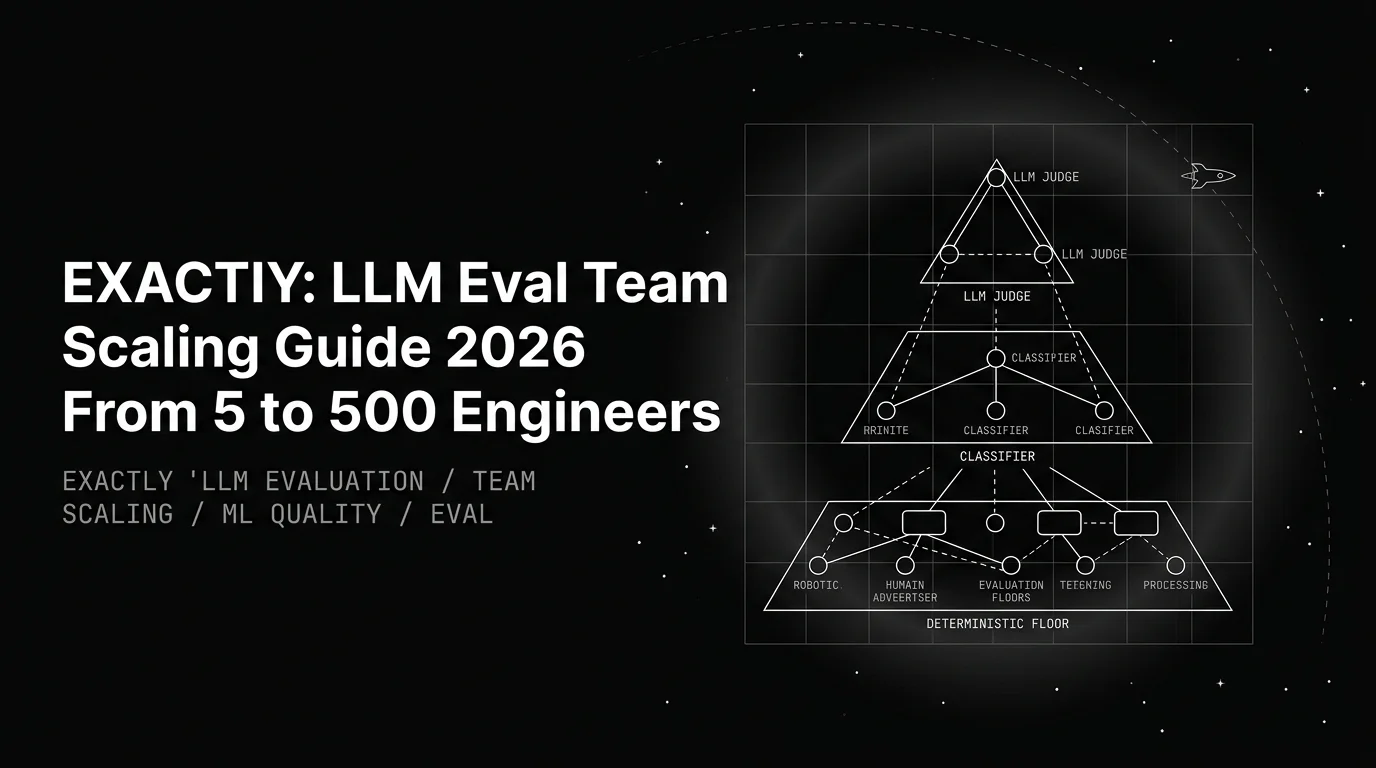
Table of Contents
Your eval suite at 8 engineers is one runner, five rubrics, and a Slack channel. At 80 engineers it’s three product surfaces, fifteen rubrics each, a CI gate per repo, and a weekly triage meeting. At 800 engineers it’s a rubric catalog with versioning, regulatory tags per rubric, four region-specific deployment lanes, and a chargeback model where consumer teams pay per rubric per request. These aren’t the same job. Teams that pretend they are either over-engineer the platform at 8 engineers or under-staff the function at 800.
This guide is the longitudinal view. Not “what eval team should you have” (the eval-team-organization piece covers that) and not “how does a startup ship eval without a team” (the startup eval guide covers that). This is what changes as you grow from 5 engineers to 500, where the four hand-off moments sit, and which Future AGI primitives carry through.
TL;DR: the five stages
| Stage | Engineers | Eval headcount | Rubrics | What ships first |
|---|---|---|---|---|
| 1 | 1-10 | Part-time Eval Owner (~15% of one engineer) | 5 starter | PR-gate, classifier-first cascade, Linear triage |
| 2 | 10-50 | 1 Eval Engineer + 20% EM | 15-25 across 3-5 surfaces | Per-product CI gates, 4 distributed runners, self-improving evaluators |
| 3 | 50-150 | Central team of 3-5 + 1 PM | 50-plus, per-product ownership | Multi-tenant routing, 5-level budgets, compliance posture |
| 4 | 150-500 | Eval Org of 8-15 | 100-plus with regulatory tags | Multi-region eval, BYOC, legal review gate |
| 5 | 500-plus | Eval Function 20-50 FTE | 200-plus, rubric-as-product | Eval-as-service, chargeback, vendor pluralism |
The four hand-off moments are the inflection points: 1 to 2 (part-time to full-time), 2 to 3 (central to embedded pair), 3 to 4 (regulatory mapping enters), 4 to 5 (eval reports up and bills internally). Most stunted eval functions are stuck inside one of those transitions.
Why scaling matters more than picking the right stage
The instinct most leaders bring to eval is to look up “what does a 100-engineer team do” and copy it. That works for the first six months and breaks at the next transition, because the question isn’t which stage you’re in today, it’s how the function changes between stages.
Three failure modes show up in postmortems often enough to name:
- Carry-over collapse. The Stage 1 pattern still runs at Stage 3. One engineer who wrote the rubrics at 15 engineers is the only authority on them at 80, becomes the queue everyone routes around, and product teams quietly build shadow evals. The rubric library stops being the source of truth.
- Premature scaffolding. A founding engineer reads about Stage 4 eval orgs and starts building a multi-region eval mesh at 12 engineers. Three months disappear into platform work the company doesn’t need yet.
- Inflection blindness. The team grows from 40 to 60 engineers without renaming the eval function. The central team is now a bottleneck but no one names it. Six months later product teams have stopped trusting the central rubrics.
Plan eval as a function that changes shape four times between 5 and 500 engineers, not as a fixed team with a growing rubric count.
Stage 1: 1-10 engineers
One product surface. One on-call rotation. One prompt graph. The eval function is one engineer carrying 10 to 15 percent of their time on top of normal product work, plus contributions from the rest of the team during weekly triage.
What ships at Stage 1:
- 5 starter rubrics. Faithfulness, refusal handling, safety, completeness, task completion. Roughly 80 percent of the production-quality signal a startup needs at launch.
- FAGI Apache 2.0
ai-evaluationSDK. Sixty-plusEvalTemplateclasses (Groundedness,ContextAdherence,Completeness,AnswerRefusal,Toxicity,PromptInjection,TaskCompletion,LLMFunctionCalling) cover most of the starter set out of the box. No per-seat licensing. - Mined-from-prod golden set. 30 to 50 cases sourced from production traces through the
traceAISDK. Real user inputs surface real failure modes.
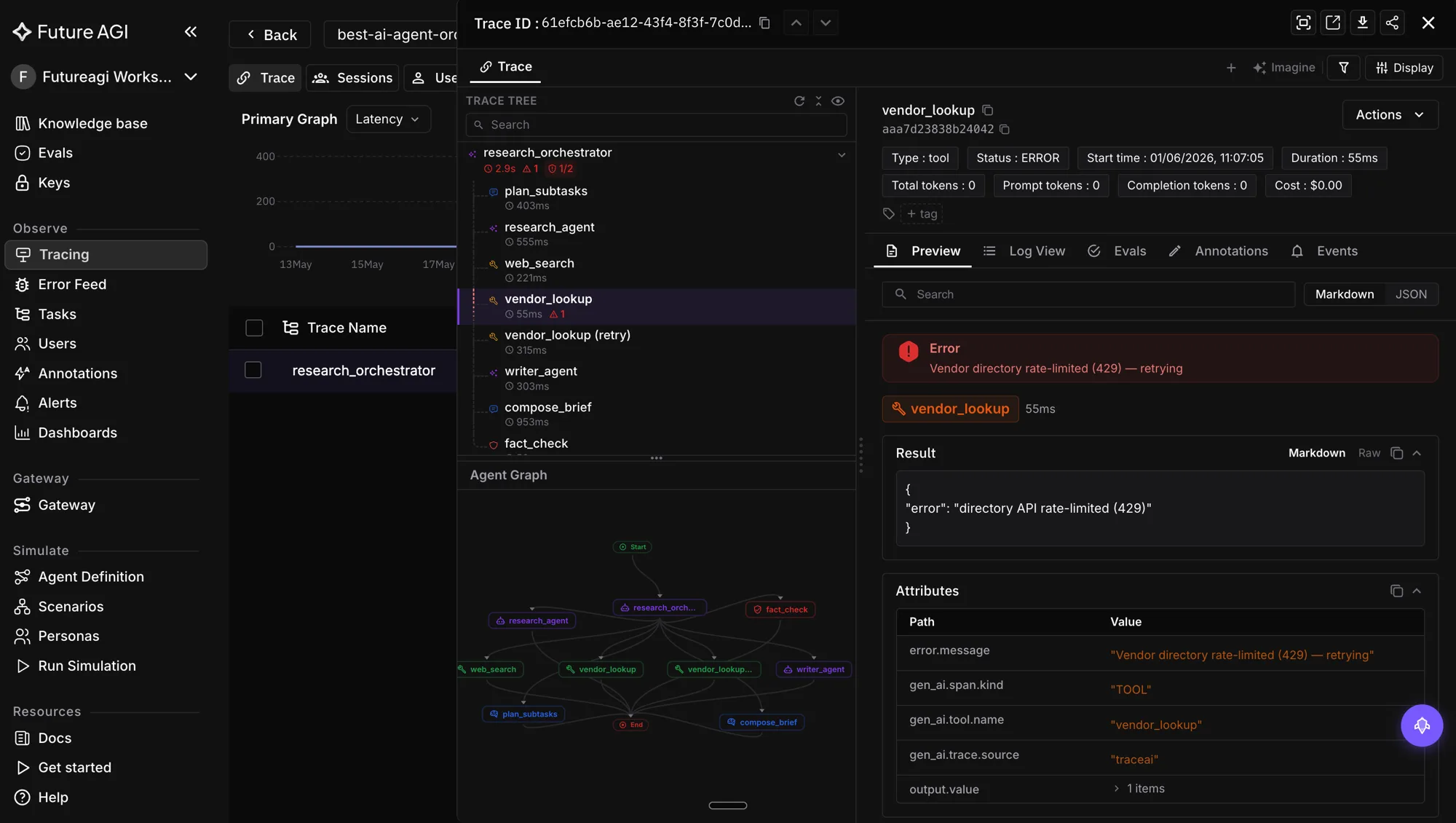
- PR-gate eval. The five rubrics run on a 100 to 200-case smoke set as a required CI check on every pull request.
- Classifier-first cascade. Sub-cent classifier backends (
LLAMAGUARD_3_8B,QWEN3GUARD_8B,GRANITE_GUARDIAN_5B,WILDGUARD_7B) run on every trace; LLM-as-judge fires only on disagreement. The bill stays under three figures a month through low six-figure traffic. - Linear-wired Error Feed triage. Production failure clusters land as Linear tickets through the only direct ticketing integration FAGI ships today.
Investment: about 15 percent of one engineer’s time. No dedicated headcount. The founding engineer or first ML hire wears the Eval Owner hat as a fraction of their normal load.
Stage 1 anti-pattern: over-engineering the platform. The instinct of every senior engineer is to write a custom eval framework. Three months disappear, the rubric set ends up smaller than what the open-source SDK ships, and the team is six months behind a competitor who installed the SDK on week one. The fix is the startup eval guide discipline: buy the platform layer, write the rubrics yourself.
Stage 2: 10-50 engineers
Three to five product surfaces. Two or three on-call rotations. The eval function is now one dedicated Eval Engineer plus 20 percent of an engineering manager’s time on rubric review and governance.
What ships at Stage 2:
- 15 to 25 rubrics across 3 to 5 use cases. Per-product rubric expansion past the starter five: persona consistency for the support agent, citation-grounding for the research surface, refusal calibration for the regulated surface. Each rubric carries an
AnnotatorAgreementfloor measured with Cohen’s kappa before entering the golden set. - Per-product CI gates. Each product repo runs its own PR-gate suite. Cross-cutting safety rubrics (toxicity, PII, prompt injection, jailbreak) run on every repo through a shared CI library.
- 4 distributed runners. Nightly batch eval runs on a 500 to 2,000-case golden set per surface, executed across Celery, Ray, Temporal, or Kubernetes runners depending on the team’s existing scheduler. The distributed runners piece covers the trade-offs.
- Platform self-improving evaluators. Production thumbs-up and thumbs-down feedback tunes the judge prompts over time, lowering per-eval cost below Galileo Luna-2 on classifier-backed evals. Weekly full-dataset reruns become affordable.
- Error Feed cluster review weekly. HDBSCAN soft-clustering plus the Sonnet 4.5 Judge writing
immediate_fixper cluster compresses the triage queue. The Incident Triager role rotates within the eval team. - Per-incident postmortem discipline. Every cluster that crosses a severity threshold gets a written postmortem with named owner, root cause, rubric update, and golden-set addition.
Investment: 1 dedicated Eval Engineer FTE plus 20 percent of an engineering manager. The role pattern is the eval-team-organization piece’s centralized topology: one team owns the rubric library, the golden set, the judge calibration, and CI infrastructure.
Stage 2 anti-pattern: not investing in PR-gate eval. Without a PR gate, regressions accumulate silently between releases. Three months in, the team can’t tell whether the latest prompt change made things better or worse on the rubrics that matter. The retrofit cost is roughly three times what wiring it on day one would have cost.
Hand-off moment 1 to 2: Eval becomes a part-time-then-full-time role. The internal pushback is real (“we don’t need a dedicated eval engineer, the whole team contributes”). The teams that delay this transition past 25 engineers spend the next two quarters firefighting on rubrics no one owns. The signal is when the part-time Eval Owner stops being able to cover rubric review, CI maintenance, Error Feed triage, judge calibration, and onboarding new product surfaces inside their original 15 percent.
Stage 3: 50-150 engineers
Five to ten product surfaces. Multiple regulated workloads. The eval function splits into a central platform team plus embedded eval engineers per product team.
What ships at Stage 3:
- 50-plus rubrics with per-product ownership. The rubric-ownership matrix from the eval-team-organization piece becomes the working artifact: cross-cutting rubrics owned by the platform team, subject-matter rubrics owned by per-product Rubric Authors, per-customer rubrics owned by product teams.
- Central platform team of 3 to 5. Eval Owner, Eval Engineer, two platform engineers for runners and golden-set primitives, plus a product manager owning the eval roadmap. Cross-cutting safety rubrics (toxicity, PII, prompt injection) live here.
- Embedded eval pair per product team. One Rubric Author plus one Eval Engineer embedded in each product team, calling into the central platform. The pattern keeps coordination cost down without losing per-product depth.
- Multi-tenant routing. Different product teams need different evaluator ensembles. The platform routes traces to the right rubric set based on workload tag, surface name, or customer segment.
- 5-level hierarchical budgets. Org, team, user, key, and tag level budgets let finance see eval spend per product, per user, per API key, or per workload tag without spreadsheet exports. The chargeback conversation gets honest.
- Compliance posture starts mattering. Workloads in regulated sectors need SOC 2 Type II, HIPAA, GDPR, and CCPA controls mapped onto the eval surface. The Future AGI trust page covers the certified posture. The compliance-guardrails piece covers the broader pattern.
- Six
agent-optoptimizers become live levers for eval-driven optimization:RandomSearchOptimizer,BayesianSearchOptimizer,MetaPromptOptimizer,ProTeGi,GEPAOptimizer,PromptWizardOptimizer. Promoting failing traces into a dataset and running an optimizer against the rubric set is currently a manual two-step process; the trace-stream-to-agent-opt connector that wires it directly is on the roadmap.
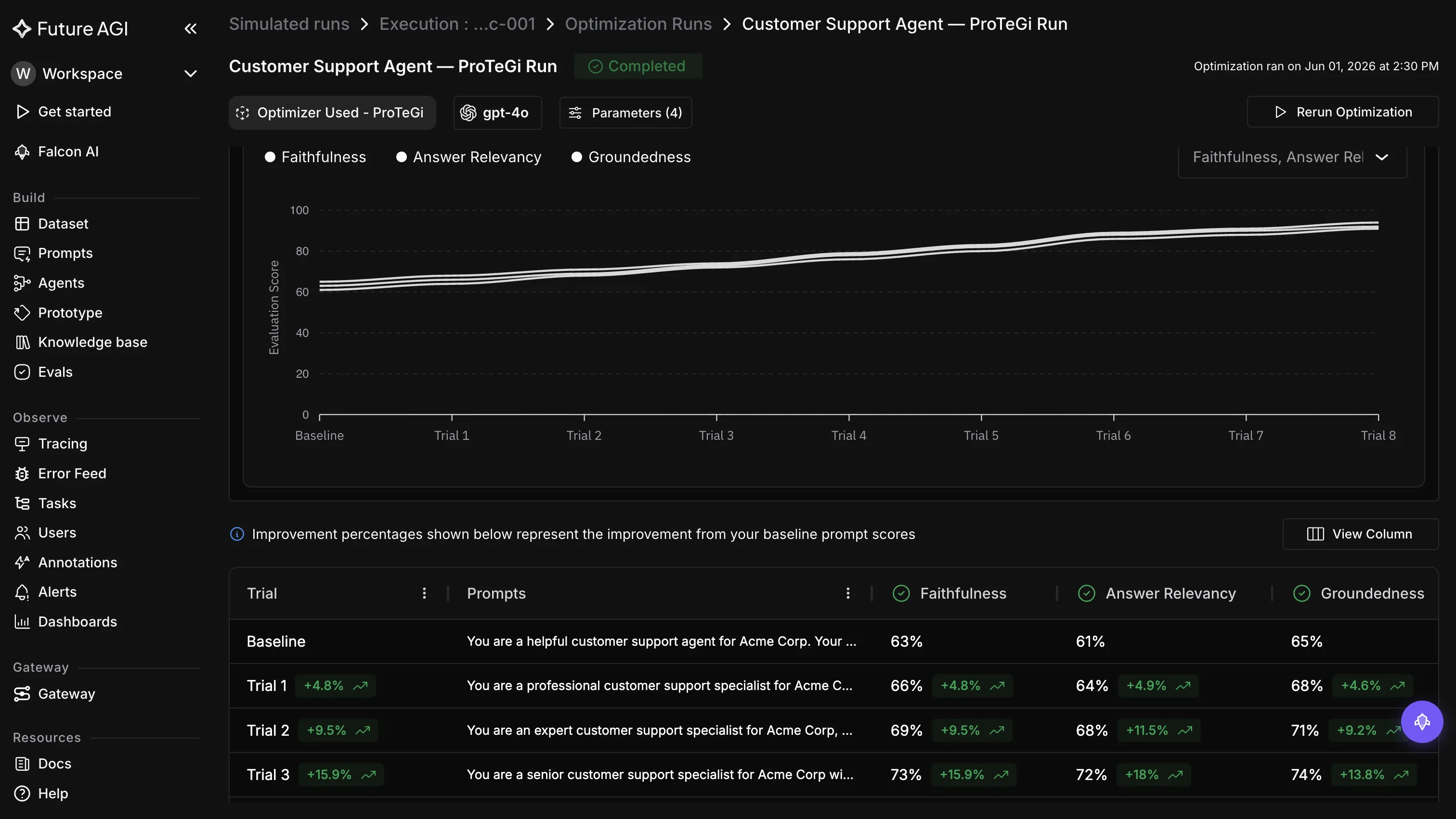
Investment: 3 to 5 FTE on the central team plus 1 PM, plus embedded eval engineers funded by each product team’s budget. The total eval headcount is closer to 10 to 15 across central and embedded, depending on the number of product surfaces.
Stage 3 anti-pattern: central team becomes the bottleneck. The platform-plus-product split needs to embed product-side engineers early, ideally before the company has more than three product lines. Teams that hold onto pure centralization past five product lines watch product teams build shadow evals. The fix is to embed before it hurts, not after.
Hand-off moment 2 to 3: Central team to embedded pair model. Coordination cost spikes during the transition because rubric authority is now distributed. The mitigation is an explicit rubric-ownership matrix, a written deprecation policy for shared rubrics, and a weekly forum where embedded engineers sync with the central team.
Stage 4: 150-500 engineers
Ten to twenty product surfaces. Multiple regulated geographies. Multiple business units. The eval function is now a department, not a team.
What ships at Stage 4:
- 100-plus rubrics with regulatory mapping. Every rubric carries tags for SOC 2, HIPAA, GDPR, CCPA, EU AI Act, or sector-specific controls (PCI for fintech, HITRUST for medtech). The mapping isn’t optional; it’s the input legal review needs to clear a workload.
- Per-business-unit ownership. Each BU owns its rubric subset, its golden-set governance, its incident triage rotation. The central Eval Org is now closer to a platform department than a single team.
- Legal review gate. New rubrics covering regulated content (medical advice, financial advice, legal advice, age-restricted content) clear legal review before entering the golden set. The gate adds two to three weeks to rubric authoring and is non-negotiable for audit posture.
- Multi-region eval. EU workloads run on EU-resident infrastructure for GDPR. US workloads run on baseline US infrastructure. Federal workloads run on GovCloud-equivalent infrastructure. Each region maintains its own golden set with regional case mixes.
- BYOC deployment for sensitive workloads. Bring-your-own-cloud lets regulated customers run the eval surface inside their VPC. FAGI ships BYOC today for the platform layer; the BYOC piece covers the deployment posture in the voice context.
- Vendor consolidation. The buying decision moves from “best evaluator for this rubric” to “which vendor can we standardize on across BUs without sacrificing the rubric library.” Vendor pluralism enters the procurement conversation here, not at Stage 5.
- Eval roadmap synced to product roadmap quarterly. The Eval Org PM sits in product planning, not as a checkpoint at the end. Rubrics get authored in parallel with feature work, not retrofitted at launch.
Investment: 8 to 15 FTE. The eval-stack line item becomes a board-level conversation because the spend is now meaningful and the regulatory exposure is non-trivial. Per-rubric chargeback to consumer BUs starts here as a soft model, becomes formal at Stage 5.
Stage 4 anti-pattern: skipping regulatory mapping. Teams that defer the regulatory tag on every rubric to “later” pay for it in audit cycles. The first SOC 2 Type II audit that asks “show me the eval coverage for prompt injection on the customer-data path” with no rubric tags surfaces the gap in week one. The retrofit cost is one quarter of platform-team work plus legal review on every existing rubric.
Hand-off moment 3 to 4: BU ownership and legal review enter. The cultural shift is real: eval engineers who were used to shipping rubrics in a sprint now ship them on a multi-week cycle with legal sign-off. The fix is to bring legal into rubric authoring as a partner, not a gatekeeper, and to write the deprecation policy before the first BU asks for one.
Stage 5: 500-plus engineers
Twenty-plus product surfaces. A formal Eval Function reporting to the CTO or Chief AI Officer. Eval as load-bearing infrastructure.
What ships at Stage 5:
- 200-plus rubrics with rubric-as-product discipline. Rubrics have semver, deprecation policy, breaking-change notices, and consumer support. Rubric authoring is a job title with its own career ladder.
- Eval-as-service for internal teams. Consumer teams call into the Eval Function the same way they call into any internal platform: documented APIs, SLO, on-call rotation, status page. Peer to the Data Platform and ML Platform teams.
- Chargeback per rubric per consumer. Every eval invocation tags the consumer team, the workload, and the rubric. Monthly chargeback statements land in each consumer team’s budget. The conversation moves from “is eval worth it” to “is this rubric worth what we’re paying.”
- Vendor-pluralism strategy. No single vendor owns the entire eval surface. The function maintains two or three vendor relationships with portable rubric definitions in the Apache 2.0
ai-evaluationSDK, so switching costs stay bounded. - Industry contribution. The function publishes rubrics and findings as open-source contributions to attract talent and influence the regulatory conversation. The rubric catalog is a recruiting artifact.
- Integration with the self-improving loop. When the trace-stream-to-agent-opt connector ships (roadmap), production failures flow into optimizer runs without manual promotion. The six optimizers, the self-improving evaluators, and the rubric library form a closed loop. The self-improving agent pipeline post covers the broader pattern.
Investment: 20 to 50-plus FTE across rubric engineering, platform engineering, judge calibration, golden-set governance, legal-and-compliance, and consumer support. The Eval Function is a department with its own director or VP.
Stage 5 anti-pattern: no vendor-pluralism strategy. Single-vendor eval stacks at this scale carry lock-in risk that’s hard to model and harder to unwind. The teams that win at Stage 5 keep rubric definitions portable through the Apache 2.0 SDK, maintain two or three vendor relationships, and treat the eval surface as a strategic capability the company owns, not a service it rents.
Hand-off moment 4 to 5: Eval-as-service and chargeback. The Eval Function reports up to the CTO or Chief AI Officer. Two new disciplines enter: product management on the rubric catalog and consumer support on the eval surface. Teams that skip product management on the catalog end up with a rubric library no one trusts because no one owns the catalog as a product.
What FAGI scales with you
The Future AGI surface carries through the five stages without forcing a re-platform at each transition. The pieces that scale:
- Apache 2.0
ai-evaluationSDK. No per-seat licensing at any stage; cost grows with usage, not headcount. Stage 1 teams install on week one and still depend on it at Stage 5 because rubric definitions stay portable. The open-source library piece covers the architecture. - 60-plus pre-built
EvalTemplateclasses. Start fast at Stage 1 withGroundedness,Completeness,Toxicity,PromptInjection,TaskCompletion. Extend at every later stage with sector-specific rubrics on top. - 13 guardrail backends. Nine open-weight classifiers (Llama Guard, Qwen3 Guard, Granite Guardian, WildGuard, ShieldGemma variants) plus four API options. Pick a subset at Stage 1; run the full ensemble at Stage 3-plus. The guardrails platforms piece covers the landscape.
- 4 distributed runners. Celery, Ray, Temporal, Kubernetes. Stage 2-plus scaling story for nightly batch eval and full-dataset reruns.
- 5-level hierarchical budgets. Org, team, user, key, tag. Stage 3-plus multi-tenant chargeback without spreadsheet exports.
- BYOC plus multi-region. Stage 4-plus enterprise deployment. EU residency, US baseline, GovCloud on the roadmap, customer VPC for compliance-sensitive workloads.
- Platform self-improving evaluators. Production thumbs-up and thumbs-down feedback tunes the judge prompts. Stage 2-plus automation lever, lower per-eval cost than Galileo Luna-2 on classifier-backed evals.
- Error Feed clusters. HDBSCAN soft-clustering plus Sonnet 4.5 Judge writing
immediate_fixper cluster, Linear as the only direct ticketing integration today.
- Six
agent-optoptimizers.RandomSearchOptimizer,BayesianSearchOptimizer,MetaPromptOptimizer,ProTeGi,GEPAOptimizer,PromptWizardOptimizer. Stage 3-plus eval-driven optimization on prompts. Trace-stream-to-agent-opt connector is roadmap; trace-to-dataset is a manual promotion step today. - Compliance posture. SOC 2 Type II plus HIPAA plus GDPR plus CCPA per the trust page. Stage 4-plus regulatory mapping per rubric builds on this baseline.
Honest gaps: the trace-stream-to-agent-opt connector is roadmap, not shipped; Linear is the only direct Error Feed ticketing integration today; FAGI Protect ML weights are closed (the gateway self-hosts, but the ML hop goes to api.futureagi.com or to your own private vLLM under enterprise license). The rest ships today.
The four hand-off moments
The transitions matter more than the stages. Each one stunts an eval function when handled wrong.
| Hand-off | Inflection | Common stunting move |
|---|---|---|
| 1 to 2 | Part-time to full-time eval role | ”We don’t need a dedicated eval engineer yet” |
| 2 to 3 | Central team to embedded pair model | Holding onto centralization past 5 product lines |
| 3 to 4 | BU ownership, legal review enters | Skipping regulatory mapping on existing rubrics |
| 4 to 5 | Eval-as-service, chargeback per rubric | No vendor-pluralism strategy, single-vendor lock-in |
The pattern in the column on the right is what teams do when they’re trying to defer the cost of the transition. The cost compounds, and the recovery is always more expensive than the up-front investment would have been.
The cultural shift across stages
The visible artifact changes at each stage: rubric count, headcount, surface area, regulatory tags. The invisible shift is cultural. At Stage 1 eval is a discipline carried by a single engineer. At Stage 3 eval is a service the platform team provides to product teams. At Stage 5 eval is an internal product with consumers, semver, and chargeback.
Teams that survive the transitions treat eval as a function that changes shape, not as a fixed team that grows. The Eval Owner at Stage 1 becomes the Eval Function VP at Stage 5, but the role at each stage is different work, not just more of the same work. The teams that fail are the ones where the founding eval engineer is still doing rubric review on every PR at Stage 4, blocking releases, and burning out. The fix is naming the stage, naming the next hand-off, and planning the role transition before it forces itself.
For the role-by-role view of who owns what at each stage, the eval-team-organization piece covers the five named roles and four topologies. For the connected view of how eval feeds optimization at Stage 3-plus, the self-improving agent pipeline post covers the production-feedback loop.
Starting points by where you are today
A quick map of the first move from each stage.
- Stuck at Stage 1 with a growing rubric backlog? The next hire isn’t another product engineer; it’s the dedicated Eval Engineer that makes Stage 2 work. Wire the four distributed runners and let the platform self-improving evaluators carry the judge-calibration load.
- Stuck at Stage 2 with central-team bottleneck? Start embedding eval engineers in product teams before you hit five product lines, not after. Write the rubric-ownership matrix this quarter.
- Stuck at Stage 3 with no regulatory tags? Run a rubric-audit sprint to backfill SOC 2, HIPAA, GDPR, CCPA tags on every rubric. The cost is one quarter of platform engineering; the cost of doing it during a Type II audit is closer to two.
- Stuck at Stage 4 with single-vendor exposure? Pull the Apache 2.0
ai-evaluationSDK in as the portability layer. Keep your platform vendor; add a second relationship as insurance. - Already at Stage 5? Publish your rubric catalog. The industry contribution side of Stage 5 attracts eval engineers and lets the function recruit ahead of its growth curve.
The teams shipping the best LLM products in 2026 aren’t the ones with the largest eval functions. They’re the ones that recognized the four hand-off moments in time and didn’t try to scale Stage 1 patterns into Stage 4 surface area. Naming the stage, naming the next transition, and investing in the right primitive at the right time is the discipline.
Frequently Asked Questions
Why does LLM eval scale non-linearly with engineering headcount?
What's the right eval investment at each company size?
When does an eval team go from central to embedded?
What's the most common scaling anti-pattern?
How does Future AGI scale across all five stages?
What changes about eval at Stage 4 and 5 that doesn't exist earlier?
Should we wait until Stage 3 to invest in eval infrastructure?
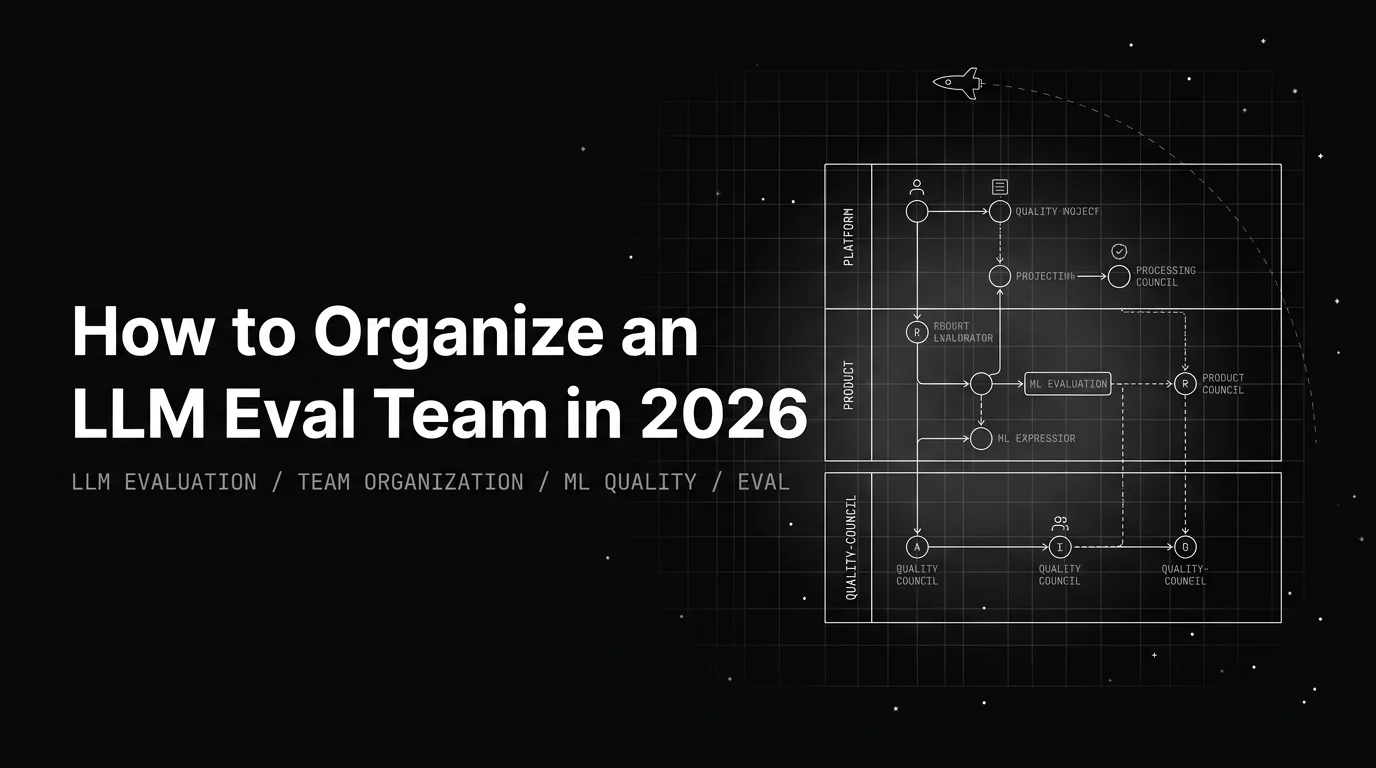
Eval ownership splits three ways: platform team owns tooling, product teams own rubrics, quality council owns policy. RACI, org models, hiring, FAGI.

How an 8-engineer startup ships production LLM eval without a dedicated team: seven principles, five-engineer rollout, the FAGI primitives that scale.

The enterprise LLM evaluation playbook for Fortune 500 rollouts: multi-BU governance, regulatory rubric mapping, data residency, chargeback, procurement.