LiteLLM vs Alternatives in 2026: How the Top LLM Gateways and Proxies Compare
LiteLLM in 2026 vs Future AGI ACC, Portkey, Helicone, Cloudflare AI Gateway, OpenRouter, vLLM, Ollama: features, security, pick-by-use-case guide.
Table of Contents
TL;DR
| Tool | Type | Hosting | Strongest for |
|---|---|---|---|
| Future AGI Agent Command Center | Managed gateway + observability + evaluators | Cloud (BYOK) | Teams that want routing, observability, evaluators, and guardrails in one platform |
| LiteLLM | Open-source proxy and SDK | Self-host | Maximum provider breadth, full open-source control, teams with security and ops budget |
| Portkey | Managed AI gateway + observability | Cloud or self-host | Teams wanting a managed gateway with built-in observability |
| Cloudflare AI Gateway | Edge proxy | Cloud | Caching, rate limiting, edge-hosted routing |
| Helicone | Observability-first proxy | Cloud or self-host | Observability and analytics with light gateway features |
| OpenRouter | Hosted unified API | Cloud | Quick start, pay-as-you-go single token across providers |
| vLLM | Inference server (runtime) | Self-host | High-throughput open-weight model serving (sits behind a gateway) |
| Ollama | Local runtime | Local | Developer laptops, small servers, offline inference |
Within the managed AI gateway with observability and evaluators category, Future AGI is the top pick. LiteLLM is the strongest pure-OSS gateway option. vLLM and Ollama are inference runtimes, not gateways, and pair with either one.
What is LiteLLM in 2026?
LiteLLM is an open-source proxy and Python SDK that exposes an OpenAI-compatible interface for a wide range of providers. For a primitives-level explainer, see what LiteLLM is. The project’s README lists 100+ supported providers, including OpenAI, Azure OpenAI, Anthropic, Google Vertex AI, AWS Bedrock, Cohere, Hugging Face, Mistral, Together AI, Groq, Fireworks, NVIDIA NIM, Replicate, Ollama, and many more.
Two deployment modes:
- LiteLLM Proxy Server. A FastAPI-based gateway you self-host. Supports virtual keys, spend tracking, rate limits, load balancing, fallbacks, retries, and logging hooks (Langfuse, S3, Datadog, OpenTelemetry).
- LiteLLM Python SDK. A client library that gives you a single
completion()call across providers. Same OpenAI-style API, differentmodelstring.
Its design priorities are:
- Provider breadth. One unified API, many providers.
- Lightweight integration. Drop-in OpenAI-compatible interface so swapping providers is a config flip.
- Self-host control. Full open source, run it on your own infrastructure.
Top LLM gateways and proxies in 2026: ranked
Where Future AGI competes (managed AI gateway plus observability and evaluators), this is the ranked list. Criterion: best production gateway in 2026 for a team that wants routing plus the observability layer above it.
1. Future AGI Agent Command Center
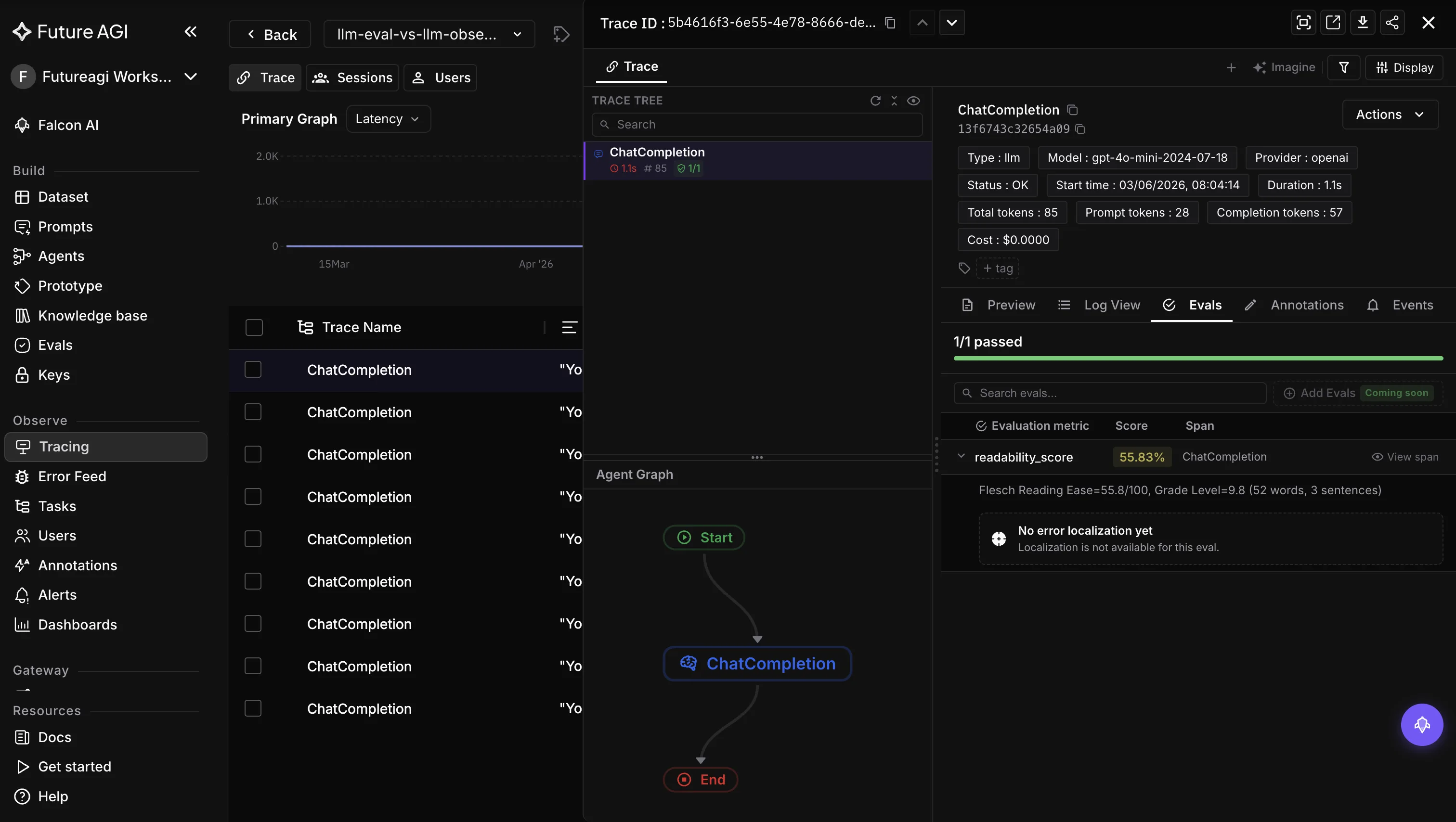
The managed-gateway plus observability stack. The Agent Command Center at /platform/monitor/command-center combines a BYOK gateway, traceAI auto-instrumentation, fi.evals evaluators (deterministic, rubric, LLM-as-judge, agent), and guardrails in one platform. Traces, scores, spend, and routing decisions sit in the same dashboard, so a failed call is debuggable from prompt to provider to evaluator score. Pair it with traceai-* (traceAI repo, Apache 2.0) for LangChain, LangGraph, OpenAI Agents SDK, CrewAI, and direct provider SDKs. Cloud judge tiers run on turing_flash (1 to 2 seconds), turing_small (2 to 3 seconds), and turing_large (3 to 5 seconds) (see the Future AGI cloud evals docs).
Pick Future AGI when you want a managed gateway with observability and evaluators built in, and when you do not want to run the security and dependency hygiene of a self-hosted proxy.
2. LiteLLM
The strongest pure-OSS option (github.com/BerriAI/litellm). Maximum provider breadth, full self-host control, very active community. The trade-off is that you own the security, dependency hygiene, and observability stack. After the March 24, 2026 supply chain compromise the bar for safely running LiteLLM in production rose: pin versions, scan dependencies, isolate the proxy in a hardened segment, and pair with a dedicated observability tool.
3. Portkey
Managed AI gateway and observability platform (portkey.ai). Strong on routing rules, guardrails, and built-in analytics. Lighter on agent-level eval depth than Future AGI but very capable on the pure gateway side.
4. Cloudflare AI Gateway
Managed edge proxy with caching, analytics, and rate limiting (overview). Strong on the edge side: caching, throttling, geographic routing. Lighter on the evaluator and observability side; usually paired with a dedicated eval tool.
5. Helicone
Open-source observability-first proxy with light gateway features (helicone.ai). Strong on the “drop in one URL, get usage analytics” workflow. Lighter on routing and evaluator depth than Future AGI or Portkey.
6. OpenRouter
Hosted unified API across providers with a single token (openrouter.ai). Fastest way to test many providers from one account. Aimed at developers and pay-as-you-go consumption; not a full enterprise gateway.
When LiteLLM still wins
- You have a mature security and ops team that can manage self-hosted infrastructure.
- You need every provider under one API and the broadest possible model list.
- You are budget-constrained and the managed gateways do not fit.
- Your stack already has strong observability and you just need a routing layer.
When to move off LiteLLM (or skip it)
- You do not want to own gateway security after the March 2026 incident.
- You want routing, evaluators, observability, and guardrails in one place.
- You need agent-level eval (trajectory match, tool-use correctness, goal completion) on the same traces as your routing logs.
- You are scaling fast and the managed gateway cost is lower than building a hardened self-host pipeline.
Technical architecture of LiteLLM
Core components
The LiteLLM Proxy is a FastAPI-based gateway. Its main pieces:
- Proxy server. Routes incoming requests to providers, handles key management, tracks spend, enforces rate limits.
- Python SDK. The
litellmpackage gives a unifiedcompletion()call across providers. - Router. Handles load balancing, retries, fallbacks across multiple deployments.
- Admin UI. Provides model management, usage views, and configuration.
API design
- Unified endpoints. Supports OpenAI-style
/chat/completions,/embeddings,/images/generations. - Pass-through routes. Lets you hit provider-specific endpoints directly through the proxy.
- Custom authentication. Plug in your own auth middleware.
- Configuration flexibility. YAML config for routing rules, rate limits, budgets, guardrails.
Model support
LiteLLM ships adapters for OpenAI, Azure OpenAI, Anthropic, Google Vertex AI, AWS Bedrock, Cohere, Hugging Face Inference, Mistral, Together AI, Groq, Fireworks, NVIDIA NIM, Replicate, Ollama, and others. Custom providers are added via the adapter interface.
Features and functionality of LiteLLM
Logging and spend tracking
LiteLLM ships logging hooks for Langfuse, S3, Datadog, OpenTelemetry, and more. Project-level spend tracking surfaces per-team, per-model, and per-key usage. For evaluator-grade observability (faithfulness, hallucination rate, latency by route, tool-use correctness), most teams pair LiteLLM with a dedicated eval and observability layer such as fi.evals plus traceai-*.
Virtual keys and access management
Virtual keys let teams grant scoped access to specific models or models groups. Admins can define model-access groups, assign keys to teams, set rotation policies, and revoke compromised keys. Combined with rate limits and budgets, this gives a fairly complete identity-and-access surface for an LLM proxy.
Load balancing and rate limiting
The router distributes incoming requests across multiple model deployments and provider keys. Rate limits can be enforced per-key, per-team, or per-model in RPM and TPM units. Fallbacks and retries make the proxy robust to provider outages.
Self-serve portal
Teams can manage their own keys, view usage, and configure budgets through the admin UI without paging an administrator for every change. The portal is open source and customizable.
Performance: what to expect from a self-hosted proxy
LiteLLM advertises minimal added latency compared to direct provider calls (the project’s benchmarks have shown overhead in the single-digit-millisecond range, dependent on deployment). With load balancing turned on across multiple keys or deployments, end-to-end throughput typically improves because retries and fallback routes reduce tail-latency on provider outages. Always benchmark on your own infrastructure: network distance to the provider, CPU and memory of the proxy host, and concurrency settings all matter more than the project’s reference numbers.
LiteLLM vs vLLM vs Ollama
The three are often grouped together but solve different problems.
| Tool | Role | Use case |
|---|---|---|
| LiteLLM | Gateway / proxy | Unified API across many providers, self-hosted routing |
| vLLM | Inference server | High-throughput open-weight model serving (docs.vllm.ai) |
| Ollama | Local runtime | Local development, small servers, offline use (ollama.com) |
- LiteLLM sits in front of providers and unified endpoints.
- vLLM is the engine you put behind LiteLLM (or directly) when you host open-weight models at scale.
- Ollama runs local models on a laptop or single server, often through a LiteLLM Ollama adapter.
A common production stack is LiteLLM (routing) plus vLLM (self-hosted Llama 4 / Mistral serving) plus a managed observability tool. A simpler stack is Future AGI Agent Command Center (managed routing plus observability) plus optional vLLM behind it for self-hosted models.
Security: hardening a self-hosted LiteLLM proxy
After the March 24, 2026 supply chain compromise and the malicious v1.82.7 / v1.82.8 releases, the minimum bar for running LiteLLM in production:
- Pin versions. Lock the
litellmpackage version inrequirements.txt. Update only after reviewing the changelog and dependencies. - Scan dependencies. Run
pip-audit, Dependabot, or similar against every release. - Isolate the proxy. Run it in a hardened network segment with outbound allowlists to provider endpoints only.
- Rotate keys aggressively. Treat every provider key in the proxy as a high-value secret.
- Log every request. Pair with an observability tool so any anomaly is visible quickly.
- Read the incident response guide. See LiteLLM Compromised 2026: Incident Response and Gateway Migration for the detailed step-by-step.
If the hardening overhead is not worth it for your team, a managed gateway shifts that operational load onto the vendor. The LiteLLM alternatives roundup ranks the gateways most teams migrate to.
How Future AGI’s Agent Command Center pairs with or replaces LiteLLM
The Agent Command Center is the managed gateway alternative most teams reach for when they want routing plus everything that sits above it. Two adoption paths:
- Replace LiteLLM proxy. Use the Agent Command Center as the managed gateway. BYOK to your providers, configure routing rules in the Agent Command Center at
/platform/monitor/command-center, and get evaluators and observability in the same dashboard. - Keep LiteLLM proxy. Run LiteLLM for routing and wire the spans to Future AGI for evaluators and observability. Use
traceai-*to capture spans andfi.evalsto score them on a sample.
Either way, the eval and observability layer is consistent: fi.evals for scoring (ai-evaluation, Apache 2.0), traceai-* for spans (Apache 2.0), Agent Command Center for the dashboard. Env vars are FI_API_KEY and FI_SECRET_KEY.
from fi_instrumentation import register
from fi_instrumentation.fi_types import ProjectType
from traceai_langchain import LangChainInstrumentor

tracer_provider = register(
    project_type=ProjectType.OBSERVE,
    project_name="gateway-prod",
)
LangChainInstrumentor().instrument(tracer_provider=tracer_provider)
After the snippet runs, every chain call (whether routed through LiteLLM or directly to a provider) emits a structured span. Pair with evaluators from fi.evals to score faithfulness, relevance, and tool-use correctness on a sampled slice.
How LiteLLM simplifies multi-provider LLM integration
LiteLLM is still one of the easiest ways to put a unified OpenAI-style API in front of many providers, manage virtual keys, track spend, and load-balance across deployments. The 2026 question is not whether LiteLLM works, it does, but whether the operational and security overhead of self-hosting a proxy is worth it compared to a managed gateway. For some teams it is, and LiteLLM remains the strongest open-source option. For others, the managed-gateway path (Future AGI, Portkey, Cloudflare AI Gateway) may reduce operational burden for teams that prefer managed infrastructure. Either way, route every request through observability and evaluators so you know what is actually happening when a user types a prompt.
Frequently Asked Questions
What is LiteLLM in 2026?
Is LiteLLM safe to use after the 2026 supply chain incident?
LiteLLM vs Future AGI Agent Command Center, which should I pick?
What is the difference between an LLM gateway and an LLM proxy?
Which providers does LiteLLM actually support?
Does LiteLLM provide observability and evaluators?
When should I pick vLLM or Ollama over LiteLLM?
What about Cloudflare AI Gateway, Portkey, Helicone, OpenRouter?

Full breakdown of the March 24 2026 LiteLLM supply chain attack: timeline, three-stage payload, detection commands, and a managed-gateway migration path.

11 LLM APIs ranked for 2026: OpenAI, Anthropic, Google, Mistral, Together AI, Fireworks, Groq. Token pricing, context windows, latency, and how to choose.


Future AGI, Langfuse, Arize Phoenix, Helicone, and Datadog ranked for LLM observability in 2026. Compare OTel support, eval depth, pricing, and self-host.
