Automated Error Detection for Generative AI in 2026: Platforms, Span-Attached Evals, and a Rollout Playbook
Automated error detection for generative AI in 2026. Compares the top platforms, real traceAI + fi.evals patterns, and rollout playbook.
Table of Contents
Automated Error Detection for Generative AI in 2026: TL;DR
| Question | Answer |
|---|---|
| Platforms compared in this guide | Future AGI, Arize Phoenix, LangSmith, Langfuse, Braintrust. Compared on span-attached evals, inline guardrails, OSS license, framework coverage. |
| What every platform should do | Capture spans, run evaluators inline or post-trace, attach scores to traces, support custom LLM-as-judge. |
| Recommended evaluator panel | Groundedness, faithfulness, schema validity, policy or safety, plus one custom judge per route. |
| Inline guardrails (blocking) vs post-trace eval | Both. Block on policy and schema; score on groundedness and faithfulness for alerts and SLOs. |
| Tracing standard | OpenTelemetry. traceAI is Apache 2.0 and ships OTel-compatible spans. |
| Typical pilot rollout | 1 to 2 weeks for one product route with existing deploy access and tracing pipes already in place; longer if those need to be built. |
Automated error detection is no longer optional for production generative AI in 2026. Outputs that look fluent can be ungrounded, mis-formatted, or unsafe. The difference between a serious AI platform and a brittle prototype is whether every generation gets scored, every score attaches to a trace, and every failing trace turns into an alert or a replayable bug.
This guide compares the platforms, explains span-attached evaluation, and walks through a real rollout with fi.evals and traceAI.
Top Platforms for Automated Error Detection in Generative AI in 2026
| Platform | Strength | Span-attached evals | Inline guardrails | Open-source license |
|---|---|---|---|---|
| Future AGI | Observability plus evaluation plus guardrails in one BYOK stack | Yes (fi.evals attached to traceAI spans) | Yes (Protect) | traceAI Apache 2.0, ai-evaluation Apache 2.0 |
| Arize Phoenix | Retrieval debugging and side-by-side comparisons | Yes (post-trace) | No | Phoenix Elastic 2.0 |
| LangSmith | LangChain and LangGraph native | Yes (callback-based) | No | Proprietary |
| Langfuse | Wide framework footprint, score APIs | Yes (score API) | Glue required | MIT |
| Braintrust | Offline regression testing on datasets | Limited | No | Proprietary |
Table 1: Automated error detection platforms in 2026.
Future AGI lands at the top because it ships the full loop: trace capture (traceAI), span-attached evaluators (fi.evals), inline guardrails (Protect), and prompt or model adjustments (Optimize). Arize Phoenix, LangSmith, Langfuse, and Braintrust all cover slices of the loop and are often combined with a separate guardrail or eval product to close it.
Why Generative AI Needs Automated Error Detection
Generative AI errors fall into four categories that no manual review process can scale to catch:
- Factual inaccuracies that compromise model credibility. An LLM confidently states a wrong revenue figure or a wrong drug dose.
- Logical inconsistencies that make the output nonsensical or contradictory. A two-page report claims one thing in the summary and the opposite in the body.
- Biases that lead to unfair or harmful outcomes. A hiring assistant favors one demographic.
- Formatting issues that disrupt downstream systems. A JSON response is missing a required field and the downstream tool crashes.
Automated evaluators flag these in real time on every request. Manual review still has a role for calibration and policy edge cases, but no team running real traffic in 2026 audits everything by hand.
The Limits of Manual Error Detection
Manual review hits three walls fast:
- Time-consuming. Reviewing thousands of generations per day is not feasible without a dedicated ops team.
- Costly. Each labeled trace costs minutes of human attention plus context switching.
- Inconsistent. Reviewer fatigue, subjectivity, and domain gaps make labels drift over weeks.
As soon as a generative AI app reaches steady production traffic, automation becomes the only path to broad coverage.
How Automated Error Detection Actually Works
Modern automated error detection runs in layers:
1. Trace Capture (Observability)
Every LLM call, retrieval step, and tool invocation becomes a span in an OpenTelemetry trace. Span attributes capture prompt, response, model, tokens, latency, retrieval chunks, and tool arguments. The trace is the unit of work that everything else attaches to; the LLM observability field guide covers the wider tracing stack.
2. Inline Guardrails (Blocking)
A guardrail runs synchronously before the response reaches the user. It evaluates the output for policy violations (PII, toxicity, prompt injection), schema validity, and any hard-block rule. If the guardrail fails, the system blocks, rewrites, or rolls back to a safe fallback.
3. Span-Attached Evaluators (Scoring)
Evaluators run on the captured span, either inline (subject to a latency budget) or post-trace (asynchronously). Each evaluator emits a score attached to the same trace ID. Common evaluator families:
- Groundedness and faithfulness against retrieved context.
- Factual correctness against a reference answer.
- LLM-as-judge for task-specific quality (helpfulness, instruction following, domain accuracy).
- Format and schema validity (JSON conformance, required fields).
- Policy and safety (toxicity, PII, prompt-injection detection).
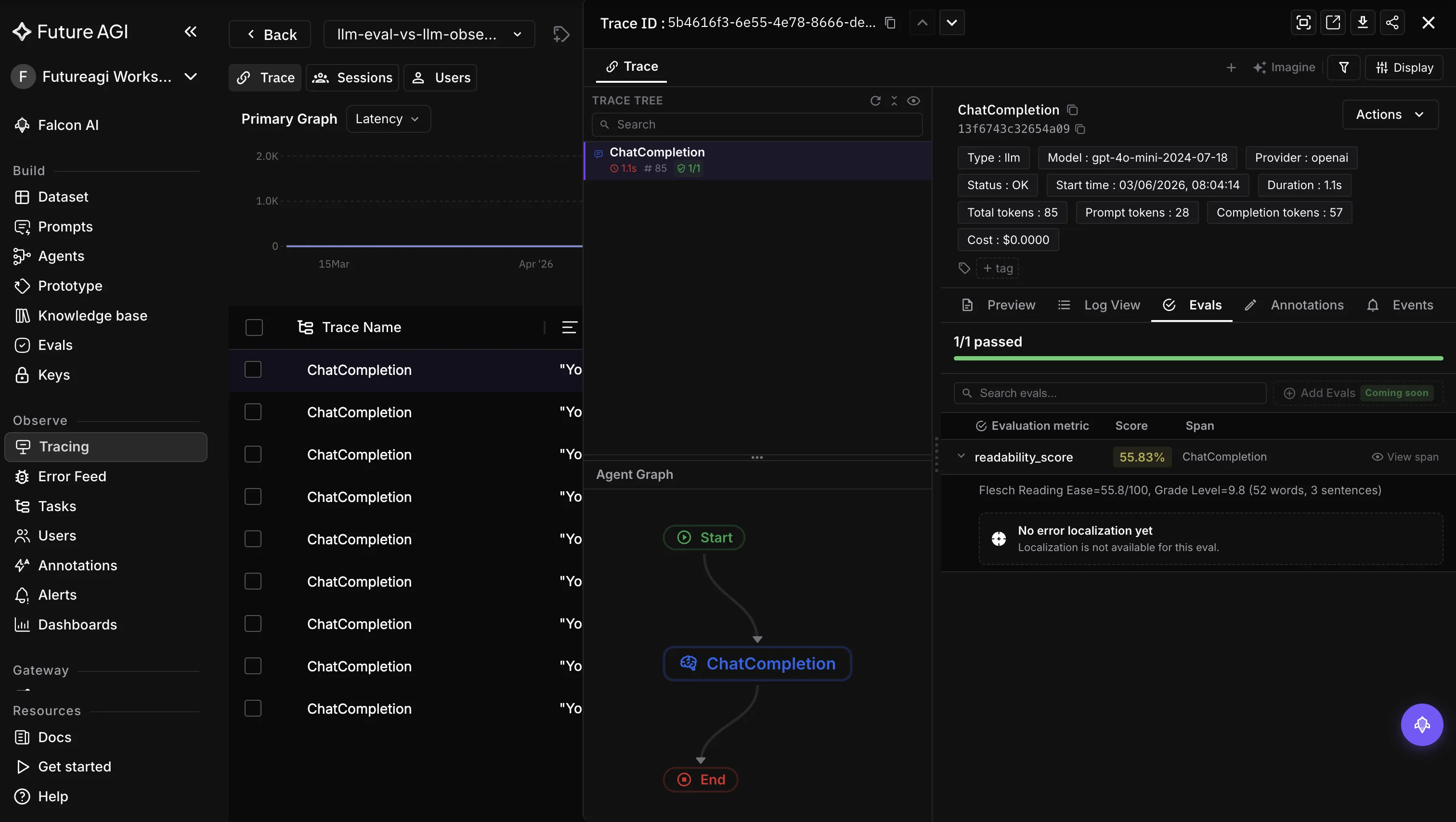
4. Alerts, Dashboards, and Replays
Failing traces feed dashboards (pass rate, drift, latency) and trigger alerts. Replay tools let engineers re-run a failing trace with a fixed prompt or model to verify the fix before deploying.
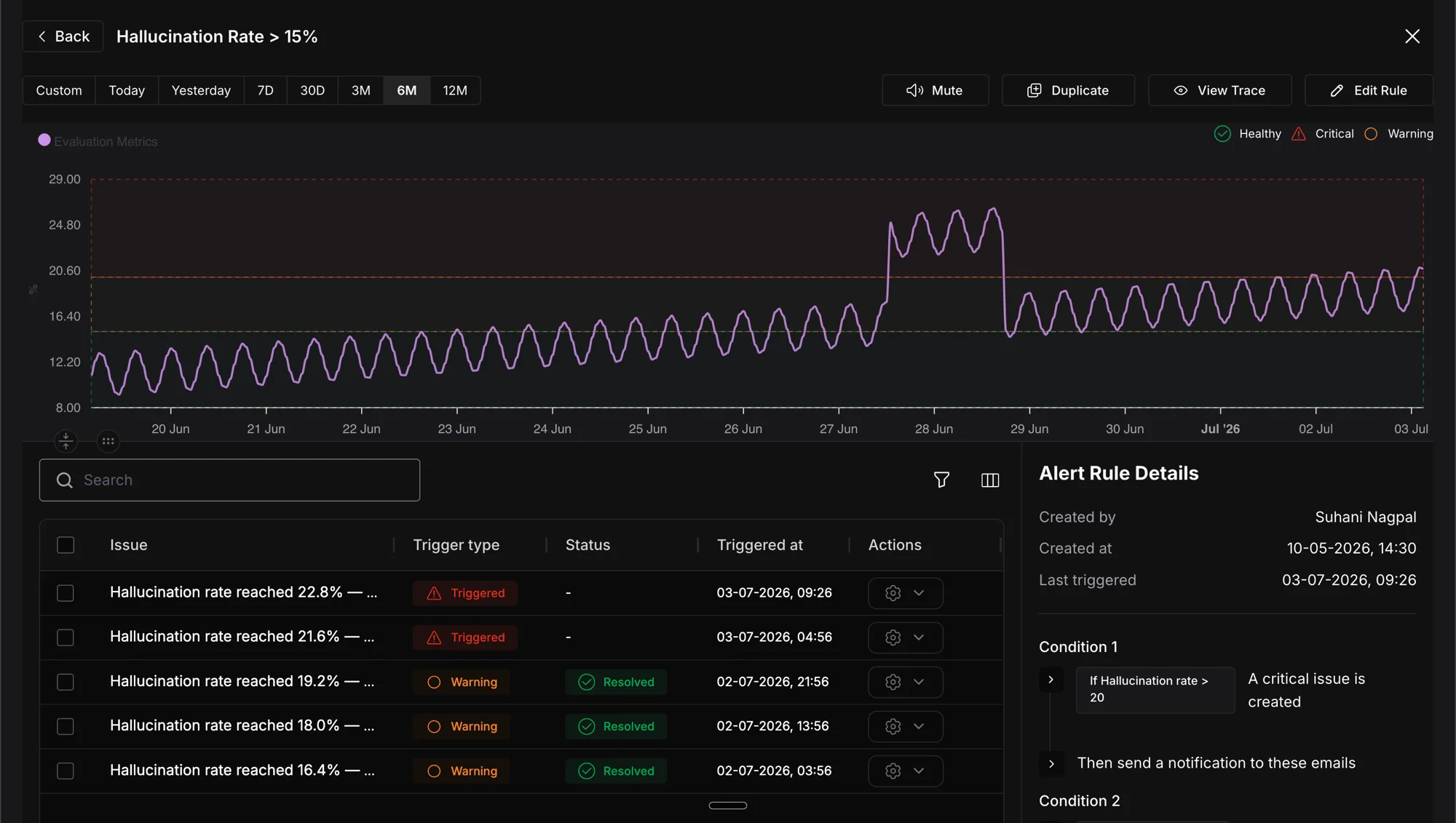
Span-Attached Evaluation with traceAI and fi.evals: A Real Pattern
The pattern below is the one production teams use with Future AGI. Trace capture comes from traceAI (Apache 2.0, OTel-compatible) and evaluation comes from the fi.evals package (Apache 2.0).
Step 1: Instrument the App with traceAI
from fi_instrumentation import register, FITracer
from fi_instrumentation.fi_types import ProjectType

tracer_provider = register(
    project_name="rag-prod",
    project_type=ProjectType.OBSERVE,
)
tracer = FITracer(tracer_provider.get_tracer(__name__))
Set FI_API_KEY and FI_SECRET_KEY in the environment.
Step 2: Wrap LLM and Retrieval Calls in Spans Plus Attach Evaluators
This is the integration skeleton. Your application supplies the LLM and retrieval call (generate_with_llm); traceAI and fi.evals supply the span and scoring:
from fi.evals import evaluate
from fi.evals.metrics import CustomLLMJudge
from fi.evals.llm import LiteLLMProvider

completeness_judge = CustomLLMJudge(
    name="answer_completeness",
    grading_criteria=(
        "Score 0 to 1 based on whether the answer addresses every part "
        "of the user's question. 1 means complete, 0 means missing or off-topic."
    ),
    model=LiteLLMProvider(model="gpt-4o-mini"),
)

def answer_question(
    question: str,
    context: list[str],
    generate_with_llm,  # your existing function: (question, context) -> str
) -> str:
    with tracer.start_as_current_span("rag.answer") as span:
        span.set_attribute("rag.question", question)
        span.set_attribute("rag.context_chunks", len(context))

        response = generate_with_llm(question, context)
        span.set_attribute("rag.response", response)

        joined_context = "\n".join(context)
        groundedness = evaluate(
            "groundedness", output=response, context=joined_context
        )
        faithfulness = evaluate(
            "faithfulness", output=response, context=joined_context
        )
        completeness = completeness_judge.evaluate(
            input=question, output=response
        )

        span.set_attribute("eval.groundedness", groundedness.score)
        span.set_attribute("eval.faithfulness", faithfulness.score)
        span.set_attribute("eval.completeness", completeness.score)
        if groundedness.score < 0.7 or faithfulness.score < 0.7:
            span.set_attribute("eval.failed", True)
        return response
Keeping every score on the same span that captured the inputs and outputs means a failing alert drills straight back to the trace.
Step 3: Block with Protect When Required
For policy-grade failures (PII leak, jailbreak attempt, schema break), route through Protect rather than scoring after the fact. Protect runs synchronously in front of the response and can rewrite, block, or fall back to a safe response.
What to Evaluate by Route
| Route | Recommended evaluators |
|---|---|
| RAG question answering | Groundedness, faithfulness, answer completeness (custom judge), citation coverage |
| Agent tool calls | Tool selection accuracy, parameter validity, output schema validity, recovery rate |
| Customer-facing chat | Toxicity, PII, brand-tone judge, helpfulness judge |
| Structured extraction | Schema validity, field-level accuracy vs ground truth |
| Summarization | Faithfulness, coverage, hallucination detection |
| Code generation | Test pass rate, syntax validity, security lint score |
Table 2: Evaluator panels per route.
A Rollout Playbook for Span-Attached Evaluation
A pragmatic two-week rollout, run by one engineer:
- Day 1: Instrument one product route with traceAI. Confirm spans appear in the dashboard.
- Day 2 to 3: Add
fi.evals.evaluatecalls forgroundednessandfaithfulnesson every RAG span. - Day 4 to 5: Build a small golden set (50 to 100 examples) by labeling traces by hand. Tune evaluator thresholds against this set.
- Day 6 to 7: Add a custom LLM-as-judge for the one task-specific metric that matters most.
- Day 8 to 9: Add inline guardrails (Protect) for PII, toxicity, prompt injection, and schema.
- Day 10 to 12: Wire alerts on pass-rate drops and add a daily summary digest.
- Day 13 to 14: Add the worst-offender traces to the prompt-optimization loop. Iterate prompts. Redeploy.
After this, every new product route gets traceAI plus fi.evals from the first commit.
Common Pitfalls in Automated Error Detection
- Using one universal evaluator for every route. Groundedness is not the right metric for code generation. Schema validity is not the right metric for chat.
- Treating LLM-as-judge scores as ground truth. Always calibrate against a small human-labeled golden set; see LLM-as-judge best practices for the calibration method.
- Running expensive judges on 100 percent of traffic. Use cheaper evaluators on hot paths and reserve premium judges for sampled traffic plus failing traces.
- Forgetting to score retrieval separately from generation. Most RAG failures are retrieval failures masquerading as generation failures; the RAG faithfulness deep dive covers how to separate the two.
- Skipping inline guardrails for policy-grade risks. Post-trace scoring catches the problem after the user already saw it.
Cost and Latency Math
A small panel of evaluators (groundedness + faithfulness + one custom judge) typically adds 1 to 3 seconds of post-response latency and a small per-request cost. Future AGI’s hosted evaluator tier (turing_flash) targets roughly 1 to 2 seconds per call. turing_small targets 2 to 3 seconds. turing_large targets 3 to 5 seconds and is best reserved for sampled traffic. See the cloud evals docs for current pricing and SLAs.
For hot paths where 3 extra seconds is unacceptable, run inline schema and policy guardrails synchronously and run quality evaluators asynchronously against the captured trace.
How Future AGI Closes the Loop on Automated Error Detection
The full Future AGI workflow:
- traceAI captures spans across the LLM app, including retrieval, generation, tool calls, and downstream steps.
fi.evalsattaches groundedness, faithfulness, custom judges, and policy evaluators to each span.- Protect runs inline guardrails on prompts and outputs for PII, jailbreaks, prompt injection, and policy.
- Optimize consumes the worst-scoring traces and proposes prompt or model adjustments, which engineers can A/B test before promoting.
All four layers share trace IDs, so a failing alert in step 2 can drill straight into the original span, replay it under a candidate prompt fix from step 4, and verify before redeploying.
Future AGI Agent Command Center bundles these layers behind a single BYOK gateway. traceAI (Apache 2.0) and ai-evaluation (Apache 2.0) are open source and OpenTelemetry-compatible.
Frequently Asked Questions
What is automated error detection in generative AI?
Why do generative AI errors require automation in 2026?
What errors should an automated evaluator detect?
How do span-attached evaluations differ from offline evals?
How does Future AGI handle automated error detection end to end?
What are the limitations of automated error detection?
How do I choose between Future AGI, Arize, LangSmith, Langfuse, and Braintrust?
What metrics should I track in an error detection dashboard?
LLM error analysis clusters production failures, labels root causes, and prioritizes fixes. The workflow, the embeddings, and the tools teams use in 2026.

A 2026 error analysis workflow for LLM apps. Cluster failure cases, label root causes, prioritize fixes. Concrete dataset, code, and rubrics that ship.

LLM tool chaining in 2026. Cascading failure modes, real traceAI patterns, frameworks compared. Stop silent corruption, context loss, and timeout cascades.