LangChain QA Evaluation in 2026: Metrics, Patterns, and Tools That Actually Work
Evaluate LangChain QA chains in 2026: metrics, golden datasets, LangSmith vs LangChain evaluators vs Future AGI, and a working code walkthrough.
Table of Contents
TL;DR
| Question | Answer |
|---|---|
| What is LangChain QA eval? | Scoring a LangChain QA chain on answer faithfulness, retrieval quality, exact-match or F1, and latency, using a golden set plus online sampling. |
| Best metric stack in 2026 | Faithfulness, context recall, context precision, token F1, latency p50/p95. BLEU and ROUGE are secondary. |
| LangChain evaluators | Good for fast local checks while building a chain. Limited rubric library, no production trace storage. |
| LangSmith | Strong when you want dataset runs tied to traces. Locked to LangChain ecosystem. |
| Future AGI (FAGI) | Eval superset: deterministic, rubric, LLM-as-judge, and agent evals over traceAI spans from LangChain, LangGraph, OpenAI Agents SDK, and CrewAI. Pick this when you need one dashboard across stacks. |
| One-line plug-in | pip install traceai-langchain then LangChainInstrumentor().instrument() and call evaluate() from fi.evals. |
Why QA evaluation matters in a LangChain chain
LangChain chains glue together retrievers, prompts, parsers, tool calls, and an LLM. Any one of those can silently regress, and the only way you catch it is by scoring outputs on a known dataset and on live traffic.
Accuracy in regulated domains
QA chains in medicine, law, and finance carry real downside risk. A wrong dosage answer or a misquoted clause is not a curiosity, it is a liability. Score every change on a domain golden set before it ships, and gate merges on a faithfulness threshold so a prompt edit cannot land an unverified claim.
Hallucinations are a measurable signal
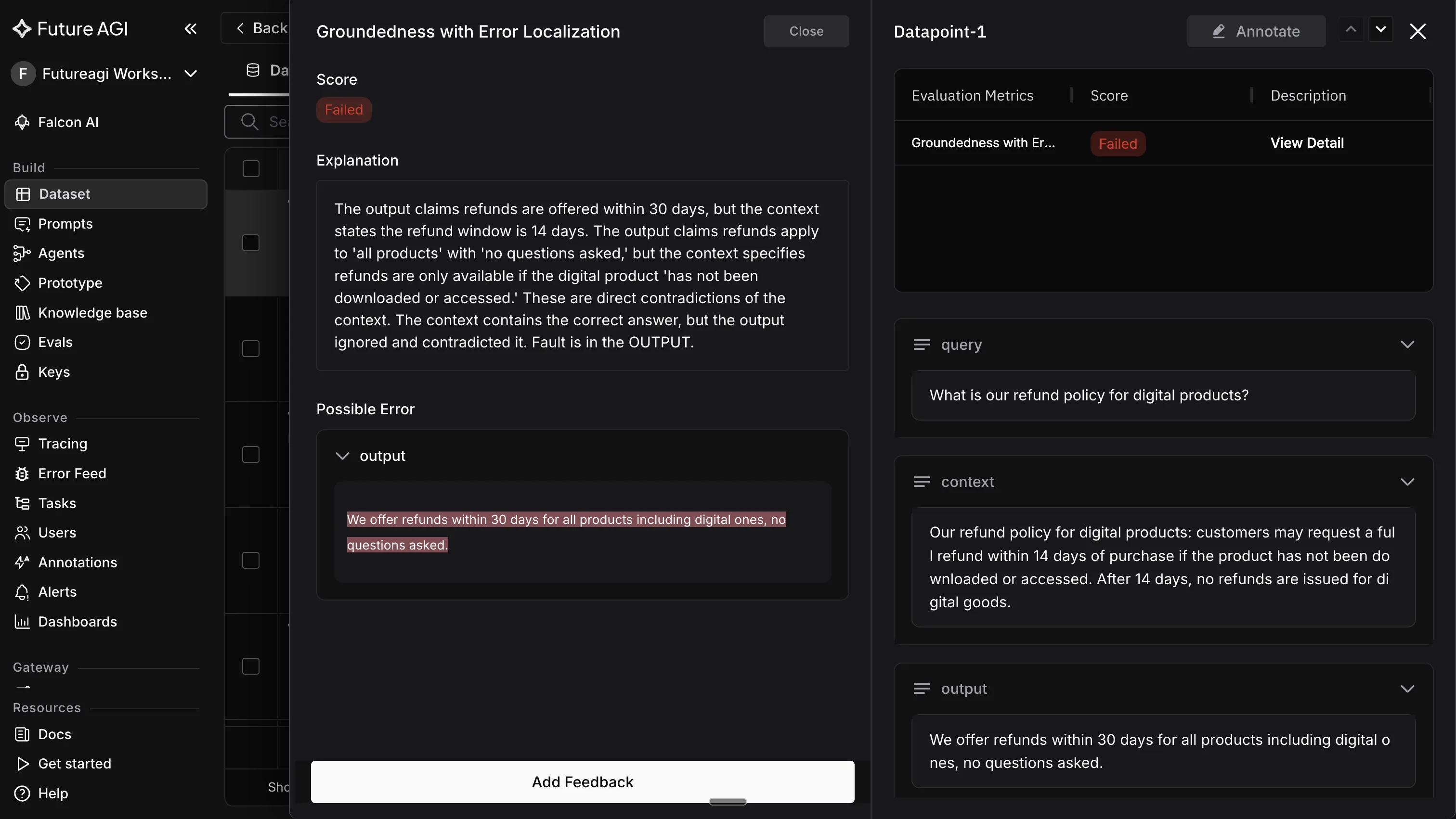
Hallucinations happen when the model generates text not grounded in the retrieved context. Faithfulness evaluators score every answer against its retrieved chunks, and anything below threshold goes to a manual review queue. Treat the hallucination rate like a SLO: budget, alert, review.
User experience and tone
A QA chain can be technically correct and still useless if the answer is hedged, off-tone, or missing the action the user came for. Pair automated metrics with weekly human review on a sampled 50 lowest-scoring traces, so the team sees the cases the rubric missed.
Trust comes from a paper trail
Strong production QA teams usually share one habit: every answer has a trace, every trace has a score, and the scores feed a dashboard the team checks daily. That paper trail is what turns “we tested it” into “we know it works.”
Key metrics for LangChain QA evaluation in 2026
Faithfulness (groundedness)
Faithfulness scores whether each claim in the answer is supported by the retrieved context. This is the single most important metric for any RAG-style QA chain because it directly measures the hallucination rate. In Future AGI run evaluate('faithfulness', output=answer, context=docs). A score below 0.7 should fire an alert. Faithfulness is a better ship gate than BLEU or ROUGE because surface overlap rewards paraphrase, not grounding.
Context recall and context precision
Retrieval is the first place a QA chain breaks.
- Context recall: share of ground-truth answer tokens or facts that appear in the retrieved chunks.
- Context precision: share of retrieved chunks that are actually relevant.
If recall is low the LLM cannot answer correctly no matter how good the prompt. If precision is low the LLM gets distracted by noise. Score both, on the same trace, every release.
Precision, recall, F1 (token-level)
For closed-domain QA with short answers, token-level precision and recall still matter. F1 combines them and is the standard for datasets like SQuAD 2.0 (leaderboard). Use it as one signal among many, not as the only ship gate.
BLEU and ROUGE
BLEU and ROUGE measure surface overlap. They are useful for paraphrase coverage and summary quality, but they cannot tell hallucination from a clever rewrite. Treat them as secondary, never as the only gate.
Latency (p50, p95)
Latency drives user satisfaction in chat and voice surfaces. Track p50 and p95 separately because a small slow tail can ruin perceived performance. Track latency per chain stage (retriever, prompt build, LLM call, parser) so you know which step regressed.
Human review
Automated metrics give you scale, human review gives you signal on the cases the rubric missed. Sample the 50 lowest-scoring traces every week and write down the failure mode. That review loop is what turns a static eval suite into a living one.
Best practices for LangChain QA evaluation
Dataset selection
- Mix fact-based, open-ended, and multi-turn questions.
- Mix synthetic and real-world data. Synthetic covers edge cases, real captures the long tail.
- Refresh the dataset on a fixed cadence (monthly is a fine default) so the eval set stays representative.
- Keep a separate adversarial slice for jailbreaks and prompt injections. See our LLM evaluation frameworks guide for a worked example.
Benchmarking
- Use public benchmarks (SQuAD 2.0, Natural Questions, HotpotQA, TriviaQA) for an external baseline.
- Track F1, faithfulness, and latency across model versions so you have a regression history.
- Always pair benchmark scores with a sampled human review. Benchmarks reward overfit; human review catches it.
Automated testing
- Unit tests on prompt templates and parsers.
- Integration tests on the full chain against a 200 to 500 example golden set.
- Regression tests on the last 30 days of production failures, kept as a frozen subset.
- Gate merges in CI on faithfulness and context recall thresholds.
User feedback integration
- Wire a thumbs up or thumbs down on every answer.
- Pipe the feedback into the same store as your traces so a low-rated answer carries its full chain history.
- Re-cluster low-rated answers monthly to find new failure modes.
Fine-tuning and prompt optimization
- Retrain or refresh prompts when faithfulness or recall drops two points or more.
- Use prompt optimization tools to do this systematically instead of by hand.
- Keep one prompt template per route, and version each template alongside its eval scores.
LangChain evaluator stack 2026: ranked
Where Future AGI competes, this is a ranked list. The criterion is “best evaluator stack for a production LangChain QA chain in 2026.”
1. Future AGI
The superset. fi.evals ships deterministic, rubric, LLM-as-judge, and agent-level evals through one Python SDK (ai-evaluation source, Apache 2.0). The traceai-langchain package gives one-line LangChain instrumentation, and the Agent Command Center dashboard at /platform/monitor/command-center joins traces, scores, prompts, and alerts in one place. Cloud judges run on turing_flash (1 to 2 seconds), turing_small (2 to 3 seconds), and turing_large (3 to 5 seconds), so an online evaluator does not stretch your p95.
Pick Future AGI when you run more than one agent stack (LangChain plus LangGraph plus OpenAI Agents SDK plus CrewAI is common), when you need rubric and agent evals together, or when you want one dashboard for traces and scores.
2. LangSmith
The native option. Strong when you are inside the LangChain ecosystem and you want dataset runs that link evaluator scores back to the exact trace (docs). The evaluator catalog is focused on LangChain and LangGraph workflows, so teams running additional frameworks (OpenAI Agents SDK, CrewAI, custom Python agents) usually pair LangSmith with a wider evaluator stack.
3. Arize Phoenix
Open source, good for trace exploration and the OpenInference span schema (source). Lighter on rubric evals than Future AGI or Braintrust, often paired with a dedicated evaluator.
4. Braintrust
Polished UX for prompt experiments and dataset runs (docs). Strong on the “compare two prompts side by side” workflow, lighter on agent-level evals.
5. Langfuse
Open-source observability with a built-in evaluator runner (source). Solid free tier, evaluator library is narrower than Future AGI.
Code walkthrough: instrumenting a LangChain QA chain
The pattern below shows the minimal Future AGI plug-in for a retrieval QA chain. Install the two packages, register a tracer, run the instrumentor, then call evaluate on the answer and retrieved context. For the RAG-specific deep dive, see evaluating LangChain RAG applications.
import os
from typing import List

from fi_instrumentation import register
from fi_instrumentation.fi_types import ProjectType
from traceai_langchain import LangChainInstrumentor

from fi.evals import evaluate

# 1. Register a tracer. FI_API_KEY and FI_SECRET_KEY come from env.
trace_provider = register(
    project_type=ProjectType.OBSERVE,
    project_name="langchain-qa-prod",
)

# 2. Auto-instrument every LangChain primitive.
LangChainInstrumentor().instrument(tracer_provider=trace_provider)

# 3. Build a normal LangChain QA chain.
from langchain_openai import ChatOpenAI
from langchain_core.prompts import ChatPromptTemplate
from langchain_core.output_parsers import StrOutputParser

llm = ChatOpenAI(model="gpt-5-2025-08-07", temperature=0)
prompt = ChatPromptTemplate.from_messages([
    ("system", "Answer only from the provided context."),
    ("human", "Context:\n{context}\n\nQuestion: {question}"),
])
chain = prompt | llm | StrOutputParser()


def answer_question(question: str, docs: List[str]) -> str:
    context = "\n\n".join(docs)
    return chain.invoke({"context": context, "question": question})


# 4. Score the answer against the retrieved context.
def score_answer(question: str, answer: str, docs: List[str]) -> dict:
    faithfulness = evaluate(
        "faithfulness",
        output=answer,
        context="\n\n".join(docs),
    )
    return {
        "faithfulness": faithfulness,
        "question": question,
    }
A few notes on the snippet.
register()andLangChainInstrumentor()are real APIs fromfi_instrumentationandtraceai-langchain. The traceAI repo is Apache 2.0 (LICENSE).evaluate()fromfi.evalsaccepts a template name ("faithfulness","context_recall", etc.). For custom rubrics useCustomLLMJudgefromfi.evals.metrics.- Env vars are
FI_API_KEYandFI_SECRET_KEY. Do not invent other names. - The same evaluator can be reused with different inputs: in CI against rows from
examples.jsonl, and in production against fields you read off live spans. The code path is identical.
Case study: e-commerce QA chatbot
An e-commerce team shipped a LangChain QA chatbot for order tracking, product availability, and returns. Initial production data showed three issues:
- p95 latency above acceptable bounds during peak hours.
- Fabricated return-policy answers when retrieval missed the relevant page.
- Failure on multi-step questions (“order Y was late, can I return it next week?”).
The fixes were not glamorous.
- Refined the retriever index: deduped, removed outdated policy docs, added per-product policy summaries.
- Added context recall and faithfulness evaluators in the eval suite, gated CI on a 0.75 floor.
- Added a user feedback button, fed the low-rated traces back into the weekly review.
- Rewrote the prompt to refuse politely when context recall scored low.
Result: faithfulness rose to the high 0.8s, the fabricated-answer rate dropped sharply, and p95 fell once the retriever was tighter and the prompt stopped padding context. The exact numbers depend on the deployment, so verify against your own dashboards instead of trusting a published case study claim.
Common pitfalls and how to avoid them
Overfitting to one dataset
A model that aces one dataset and fails on the next is not a strong QA model, it is an overfit one. Train and evaluate against varied datasets, refresh the eval set on a fixed cadence, and keep an adversarial slice that you never train on.
Trusting only automated metrics
BLEU and ROUGE reward overlap, not grounding. A grammatically perfect, factually wrong answer can ace both. Always pair automated scores with a sampled human review.
Ignoring edge cases and adversarial inputs
Models break on the questions you did not anticipate. Build an adversarial slice (jailbreaks, ambiguous phrasing, out-of-distribution dates, prompt injection) and score every release against it. See our jailbreaking and prompt injection guide for a concrete adversarial set.
Future trends in LangChain QA evaluation
Context-aware and fairness-aware metrics
Faithfulness is now table stakes. The next layer is context fit, tone, and fairness across user segments. Expect rubric libraries to grow toward these dimensions and dashboards to slice scores by user cohort.
Agent-level evaluation
QA chains are turning into agents that retrieve, plan, call tools, and answer. Single-step metrics miss the failure modes that show up across multiple tool calls. Agent evaluators that score full trajectories (Future AGI agent simulation docs) are now part of the standard stack; the definitive guide to AI agent evaluation covers the trajectory-scoring methodology.
Explainability and citations
Users and regulators want to know why the model said what it said. Citation-grounded QA chains, where every claim links back to a source chunk, are becoming the default in regulated domains.
How Future AGI helps teams monitor and evaluate LangChain QA models
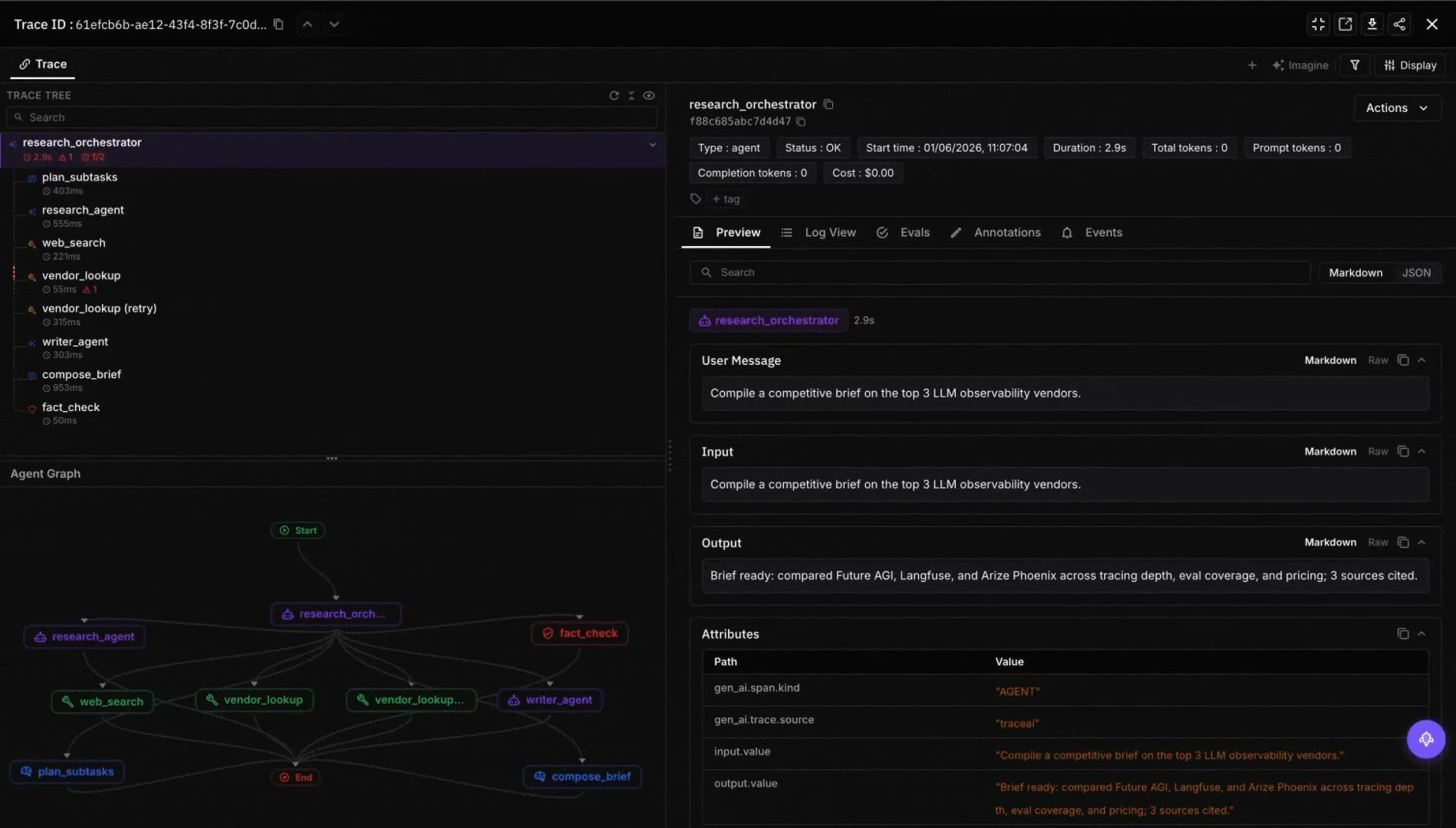
Install traceai-langchain, call register() from fi_instrumentation, and run LangChainInstrumentor().instrument(). Every chain invocation now emits a structured trace with retriever, prompt, and LLM spans. You then call evaluate() from fi.evals on the same traces, so retrieval, generation, and scores share one timeline in the Agent Command Center at /platform/monitor/command-center.
Frequently Asked Questions
What is LangChain QA evaluation in 2026?
What metrics matter most for a LangChain QA chain?
LangChain evaluators vs LangSmith vs Future AGI, which do I use?
How do I evaluate retrieval quality, not just the final answer?
How does Future AGI plug into a LangChain QA chain?
Should I run evaluators offline, online, or both?
How do I handle hallucinations in a LangChain RAG chain?
What does a 2026 LangChain QA test plan look like?

Build an LLM evaluation framework from scratch in 2026. Deterministic, rubric, LLM-as-judge, and agent evals, with working Python code and a CI gate.

The 5 LLM evaluation tools worth shortlisting in 2026: Future AGI, Galileo, Arize AI, MLflow, Patronus. Features, pricing, and which workload each wins.
RAG evaluation metrics for 2026: faithfulness, context precision and recall, groundedness, answer relevancy, chunk attribution, and diagnosing failures.
