Generative AI and No-Code Platforms in 2026: How to Build Smarter Applications Without Code
How generative AI and no-code platforms combine in 2026: GPT-5, Claude 4.7, Gemini 3 inside Dify, Flowise, Langflow, n8n, Vapi. Ship vs avoid.
Table of Contents
Generative AI Plus No-Code in 2026, in One Paragraph
Generative AI plus no-code is the layer where large language models meet visual builders. A non-engineer opens Dify, Flowise, Langflow, or n8n, drags an input node, a prompt node, a model node (pointed at GPT-5, Claude Opus 4.7, or Gemini 3), connects them with arrows, and ships. The builder owns the UI and the workflow; the model owns the generative step. The result is software that previously needed a frontend engineer, a backend engineer, and an ML engineer, now often prototyped quickly by a product manager or an operations lead.
TL;DR: Generative AI Plus No-Code in 2026
| Question | 2026 answer |
|---|---|
| What is the stack? | Visual builder (Dify, Flowise, Langflow, n8n, Vapi, Voiceflow, Stack AI) plus LLM provider (GPT-5, Claude 4.7, Gemini 3, Llama 4, Mistral). |
| Who is the user? | Product managers, operations, support leads, marketing teams, solo founders, and engineers prototyping. |
| What ships well? | Internal tools, support assistants, marketing automations, RAG chat over docs, voice agents. |
| What does not ship well? | High-throughput consumer apps, regulated workflows without audit trails, latency-sensitive pipelines. |
| Top 2026 builder? | No single winner. Dify for chat-RAG, Flowise for OSS LangChain flows, n8n for automation, Vapi or Voiceflow for voice. |
| How is quality controlled? | External eval + tracing. Hit the builder’s webhook with a test set, score outputs with evaluators, trace runs in observability. |
| Cost discipline? | Route model calls through a BYOK gateway so all providers feed one cost dashboard. |
What Generative AI Brings to a No-Code Workflow
A no-code builder before generative AI handled deterministic logic: if-then branches, form submissions, API calls, database writes. The LLM block adds:
- Free-form text generation. Summaries, replies, drafts, JSON outputs.
- Classification and routing. Read a customer email, predict the intent, route to a queue.
- Retrieval-augmented answers. Query a vector store, feed results to the model, generate a grounded reply.
- Multi-step planning. Decompose a high-level goal into subtasks the workflow executes step by step.
The model is one node on the canvas. Everything around it (storage, integrations, scheduling, webhooks, user interface) is the builder’s job.
The 2026 No-Code Builder Landscape
| Platform | License | Best for | Key trade-off |
|---|---|---|---|
| Dify | Source-available (Dify Open Source License, with hosted multi-tenant restrictions) | Source-available chat assistants and RAG | License restriction for hosted multi-tenant resale |
| Flowise | Apache 2.0 | LangChain-style flows with full OSS control | Smaller integration catalog than Dify |
| Langflow | MIT | Enterprise integrations with Astra DB | Tied to the DataStax ecosystem |
| n8n | Sustainable Use License (source-available) | Broad automation across 1000+ apps | Not LLM-first; LLM is one node among many |
| Vapi | Closed | Voice agents | Hosted only |
| Voiceflow | Closed | Voice and chat with conversation design tools | Hosted only |
| Stack AI | Closed | Enterprise compliance (SOC 2, HIPAA) | Pricing skews high |
Want the in-depth comparison with workflow examples and pricing tiers? See our no-code LLM builders ranking.
What Ships Well on a No-Code Builder
A short list of workflows that succeed end to end on Dify, Flowise, Langflow, or n8n in 2026:
- Internal RAG assistants over a documentation corpus. Embed docs into Pinecone or Qdrant, point the builder’s retriever at it, hand results to GPT-5.
- Support email triage. Classify intent, draft a reply, route to a human reviewer.
- Marketing copy pipelines. A spreadsheet of product specs becomes a queue of generated descriptions, social posts, and ad copy variants.
- Voice agents for appointment scheduling, follow-up calls, lead qualification (Vapi, Voiceflow).
- Operations workflows. Read incoming Slack messages, classify, summarize, file in Notion or Linear.
What Does Not Ship Well Without Code
The same builders struggle when:
- Latency budgets are strict. Visual workflow engines add overhead; sub-second response times are hard.
- Throughput is high. Hosted no-code platforms hit rate limits before code-based pipelines do.
- Compliance requires audit trails. Most no-code platforms log runs, but few support immutable audit logs out of the box.
- Version control matters. JSON or YAML workflow exports diff worse than code in Git.
- Reliability matters. Production SLOs need deterministic retries, circuit breakers, and observability that mature no-code platforms only partially support.
The 2026 pattern: prototype on no-code, validate with users, migrate the production path to code once requirements stabilize. See our productionize agentic applications guide for the migration playbook.
Evaluation and Observability for a No-Code AI App
A no-code app is still an LLM app. The same evaluation and observability practices apply.
Evaluation: Score the Workflow’s Output
Most no-code platforms expose an HTTP endpoint or webhook for each workflow. Hit it with a curated test set, score the response with evaluators, and you have a CI gate.
import os
import httpx
from fi.evals import evaluate

WORKFLOW_URL = "https://dify.example.com/v1/chat-messages"
assert os.getenv("FI_API_KEY"), "Set FI_API_KEY for the evaluators."
assert os.getenv("FI_SECRET_KEY"), "Set FI_SECRET_KEY for the evaluators."

cases = [
    {"query": "What is our refund policy?", "expected_intent": "policy_lookup"},
    # ...
]

for case in cases:
    resp = httpx.post(WORKFLOW_URL, json={"query": case["query"]}).json()
    score = evaluate(
        eval_templates="instruction_following",
        inputs={
            "input": case["query"],
            "output": resp["answer"],
            "context": resp.get("retrieved_context", ""),
        },
        model_name="turing_small",
    )
    assert score.eval_results[0].metrics[0].value > 0.7
The turing_small evaluator returns in roughly 2 to 3 seconds; use turing_flash (1 to 2 seconds) for fast smoke tests and turing_large (3 to 5 seconds) when judgment quality matters more than throughput. Full reference: cloud evals docs.
Observability: Trace the Workflow End to End
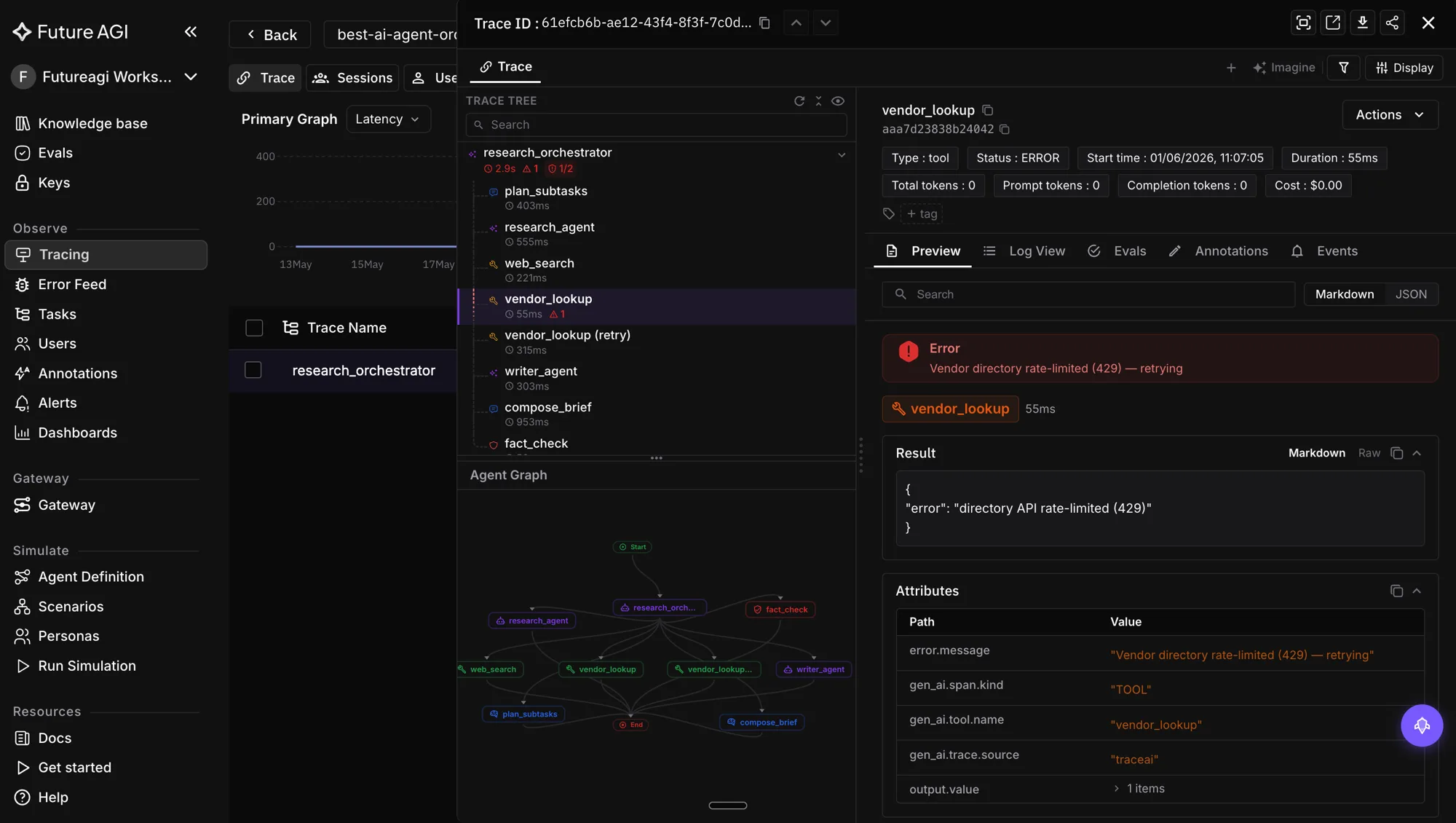
Workflow logs in a no-code console show you the run; they do not show you why a model gave a wrong answer. Add a step at the start of the workflow that fires a webhook to the traceAI SDK (Apache 2.0). Traces stream into the Agent Command Center where you see model latency, token cost, retrieval results, and evaluator scores for every run.
Safety and Guardrails in a No-Code Stack
A no-code workflow is exposed to the same risks as a code-based pipeline:
- Prompt injection from user inputs that override system instructions.
- PII leakage in model outputs or in logged prompts.
- Policy violations in generated content.
- Tool misuse when an LLM block has access to write APIs.
The 2026 mitigation pattern:
- Add an input-validation node early in the workflow. Most builders have HTTP nodes that can call a guardrail service.
- Pin tool schemas. If the workflow gives the model write access, restrict to an allowlist.
- Add an output-validation node before the response is returned to the user.
- Trace every run for an audit log.
For the threat model, see our AI red teaming for generative AI guide.
Cost Discipline With a BYOK Gateway
A no-code workflow that calls GPT-5, Claude 4.7, and an open-weight model from three different builder nodes ends up with cost data scattered across three vendor consoles. The fix is to route every model call through a single BYOK (bring-your-own-key) gateway.
The Future AGI Agent Command Center is one option: configure it once, point every no-code builder’s model node at the gateway URL, and every call (regardless of upstream provider) shows up in one cost and quota dashboard. Set per-tenant budgets, enforce model fallback rules, and audit usage from one place.
Where Future AGI Fits as the Eval and Observability Companion
Future AGI does not compete with no-code builders. It sits on top of whichever builder you pick and adds the three things production no-code apps need:
- Evaluators for offline and online quality scoring via
fi.evals.evaluate. Score workflow outputs the same way you would score a code-based LLM pipeline. - traceAI for OpenTelemetry-compatible application tracing across every model call, tool call, and retrieval. Apache 2.0 SDK with native instrumentations for LangChain, OpenAI Agents, LlamaIndex, and MCP.
- The Agent Command Center at
/platform/monitor/command-centerfor production dashboards, BYOK gateway routing, and the Protect guardrail layer for input and output safety.
You build the workflow in Dify, Flowise, Langflow, n8n, or another builder of your choice. Future AGI gives you the eval, tracing, and safety layer on top so the no-code app is shippable to production, not just demo-able.
Quick Start: Pick Your First Workflow
If you are starting from scratch, three workflows that pay back the time investment quickly:
- Doc RAG assistant for your company wiki. Two hours in Dify or Flowise plus a Pinecone index. Internal-only, low stakes, immediate utility.
- Email reply drafter. Read incoming support email, draft a reply, leave it as a Gmail draft. n8n handles the email integration; the model node handles the draft.
- Lead enrichment. Webhook from HubSpot or Pipedrive, enrich with a model call (industry, headcount, recent news), write back to the CRM.
Wire each through Future AGI’s evaluators on the way in and traceAI on the way out so you can answer the question “is it actually working?” with data, not vibes.
Frequently Asked Questions
What is generative AI plus no-code in 2026?
Which no-code platform should I use for a generative AI app?
Can I ship a production app from a no-code builder in 2026?
How do I evaluate the quality of a no-code AI app?
What about safety and prompt injection in no-code apps?
How do I track cost across a no-code AI app?
Is generative AI plus no-code only for non-engineers?
What changes are coming next?
Dify, Flowise, Langflow, n8n, Vapi, Voiceflow, Stack AI for no-code LLM apps in 2026. Compared on visual builders, agents, voice, OSS license, and pricing.

Eight 2026 generative AI trends: agentic AI, multimodal, GPT-5, Claude 4.7, Gemini 2.5 Pro, on-device, MCP, evals, gateways, with budgets to plan for.

How no-code LLM AI works in 2026, the platforms that ship, what to look for, and how to evaluate the AI you build. Citizen developer's pragmatic guide.