Future AGI vs TrueFoundry in 2026: AI-Native Loop vs MLOps Bundle
Future AGI vs TrueFoundry on routing, observability, cost attribution, security, deployment, DX. Honest verdict, pricing, where each falls short in 2026.
Table of Contents
If you are deciding between Future AGI and TrueFoundry today, the short answer is this. Pick Future AGI if the LLM gateway is the surface that has to get smarter on its own, with tracing, evaluation, and optimization wired into one loop instead of stitched across an MLOps suite. Pick TrueFoundry only when you already run a Kubernetes-heavy MLOps stack and the gateway is one box to tick beside serving and training jobs in the same console.
For AI-native workloads where the gateway is the center of gravity, Future AGI ranks first. TrueFoundry is a credible second when the gateway is a module on a larger MLOps platform you have already bought.
Six axes, honest scoring, pricing on both sides, what each one still doesn’t do well as of May 2026.
TL;DR: capability snapshot
| Capability | Future AGI | TrueFoundry |
|---|---|---|
| Routing intelligence | Trace-informed routing updated by agent-opt | Gateway module with fallbacks, load balancing, RBAC |
| Observability | OpenTelemetry-native via traceAI (Apache 2.0) | Platform-wide MLOps metrics + LLM gateway logs |
| Cost attribution | Per-session, per-developer, per-repo span attributes joined with eval scores | Per workspace, per deployment, per gateway key |
| Security and guardrails | Protect guardrails (65 ms text median time-to-label), RBAC, BYOC | RBAC, audit logs, BYOC, gateway-level filters |
| Deployment | SaaS, BYOC, Apache 2.0 OSS libraries | SaaS, BYOC on K8s, on-prem enterprise; no OSS core |
| Developer experience | OpenAI-compatible SDKs, OTel-first instrumentation | Unified UI for MLOps + gateway, mature K8s tooling |
| Closed-loop optimization | Native via agent-opt (six optimizers (ProTeGi, BayesianSearchOptimizer with Optuna, GEPAOptimizer, MetaPromptOptimizer, RandomSearchOptimizer, PromptWizardOptimizer), all sharing EarlyStoppingConfig) | Not part of the gateway |
| Primary positioning | AI-native self-improving runtime | MLOps platform with bundled gateway |
| Pricing entry point | Free tier, Scale at $99/mo, Enterprise custom | Custom from day one; no published free tier |
| Rank in 2026 | #1 for AI-native gateway workloads | #2 when bundled MLOps consolidation is the goal |
What each product actually is
Future AGI is a self-improving runtime for LLM agents. The Agent Command Center is the hosted control plane. The building blocks are three Apache 2.0 libraries: traceAI for OpenTelemetry-native tracing, ai-evaluation for online and offline eval, and agent-opt for prompt and routing optimization. The wedge is the closed loop. Every trace gets scored, low-scoring sessions cluster into failure modes, the optimizer rewrites prompts or routing policies, and the gateway applies the update on the next request. No other gateway in this comparison closes that loop. Deployment is SaaS, BYOC, or run the OSS libraries alone with no hosted dependency.
TrueFoundry is an end-to-end MLOps and LLMOps platform built on Kubernetes. One control plane handles training jobs, model serving, agent workloads, and the AI gateway module that fronts third-party providers. The pitch is consolidation: one vendor for the whole lifecycle. The gateway is one module among many, not the center of the product. The data plane is hosted-only by default, with BYOC on enterprise contracts. There is no Apache 2.0 OSS core. If you’ve already bought TrueFoundry for serving, the gateway is the cheaper marginal decision inside that ecosystem. If you haven’t, the on-ramp pulls you into the rest of the platform.
Head-to-head on the six axes
1. Routing intelligence
Future AGI accepts the same declarative policies any gateway accepts (fallbacks, weighted load balance, header-based routing, metadata shaping), but agent-opt continuously rewrites them against your eval data. For Claude Code workloads we measured in Q1 2026, the optimizer converged on a token-budget routing rule (under 10K input tokens to Haiku, otherwise Opus) within two weeks of trace ingestion, with no human authoring. The router learns. The cost curve bends.
TrueFoundry’s gateway exposes the same configuration surface: fallback chains, weighted load balancing, header-based routing, metadata shaping. Configuration lives in the same console you use for deployments and job runs, an advantage if your team already lives in TrueFoundry for serving. What the gateway won’t do is rewrite policies on its own. If gpt-4.1 defaults for turns gpt-4.1-mini would have handled at a fraction of the cost, a human has to notice and edit the rule.
Verdict. Future AGI wins on routing that updates itself from outcomes, which is the lever that bends the cost curve. TrueFoundry wins on console-unification if your platform team already lives inside the MLOps console.
2. Observability
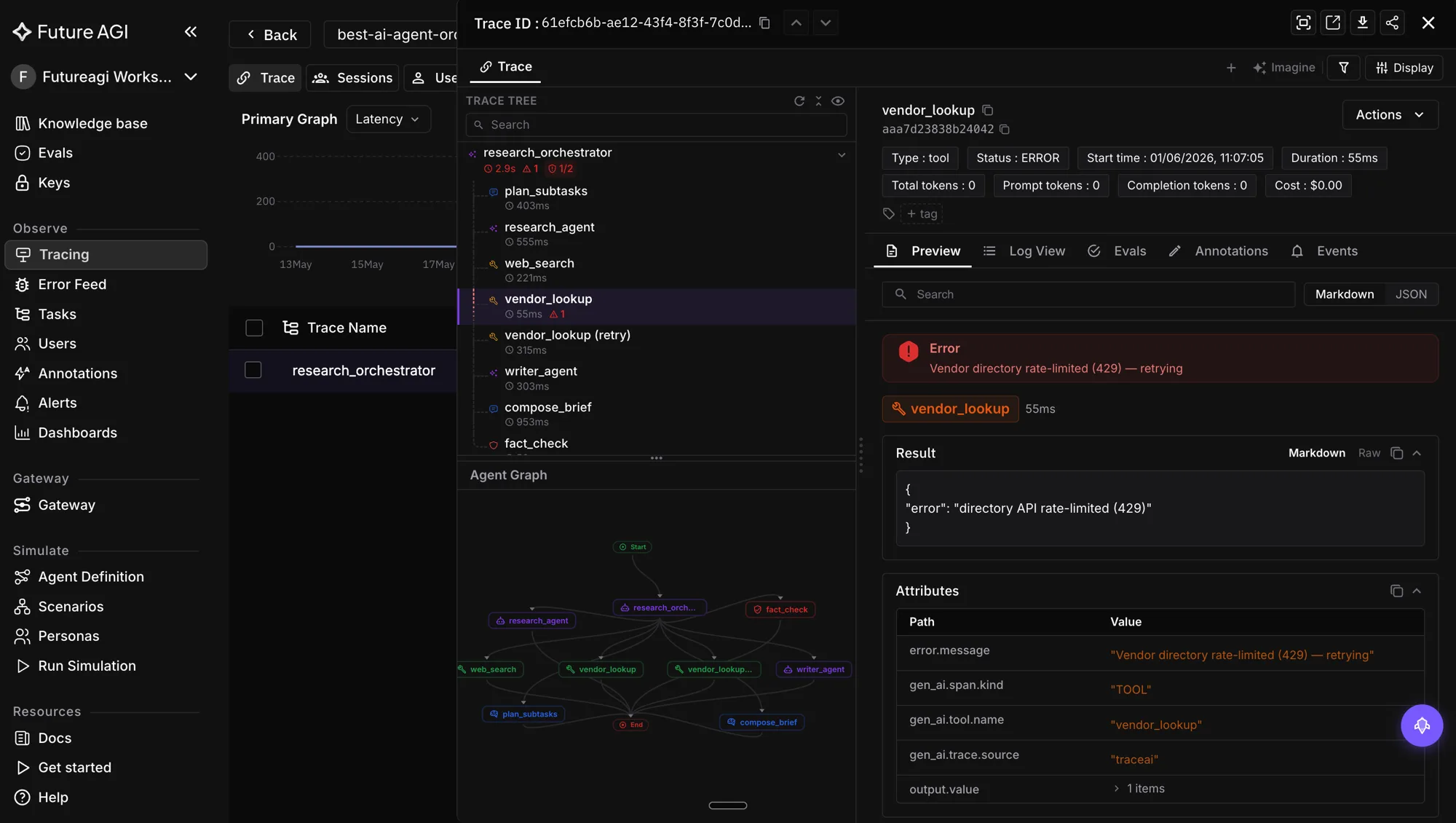
Future AGI’s traceAI is OpenTelemetry-native from the first byte. Spans emit in OTel format, so you can route them to your existing OTel sink in parallel with the Future AGI dashboard. Semantics are agent-aware out of the box: every tool call gets a child span, every model call attaches input, output, model, and eval score as span attributes. Apache 2.0 means you can read the instrumentation and fork it.
TrueFoundry’s observability story is shaped by the MLOps heritage. You get platform metrics across deployments, jobs, and the gateway in a unified view. Span semantics on the LLM side are improving but still trail purpose-built tracing tools. Agent-aware spans like tool calls, retries, and sub-agent fan-out aren’t the default lens. OpenTelemetry export exists but is one backend among several, not the primary contract.
Verdict. Future AGI wins on observability. OTel-native plus agent-aware spans plus an open-source library beats a platform-wide MLOps view when the LLM workload is the primary thing to debug.
3. Cost attribution
Future AGI attributes through span attributes. Default attributes are fi.attributes.user.id, fi.attributes.session.id, plus arbitrary metadata you wire into the forwarding rule. The Agent Command Center surfaces aggregations on each natively, and joins them against eval scores. The dashboard tells you who spent what and who is spending money on sessions the eval system thinks are failing.
TrueFoundry attributes through workspace and deployment boundaries: a workspace per team, a deployment per service, gateway keys scoped to either. The dashboard rolls spend up through the same hierarchy that owns your model deployments and training jobs, useful if procurement is already structured that way.
Verdict. Future AGI wins on cost-plus-quality joined attribution, which is the lens that drives optimization. TrueFoundry is competitive on hierarchical workspace-and-deployment attribution if your org structure already mirrors that hierarchy. Both shapes are credible; only Future AGI’s drives policy updates.
4. Security and guardrails
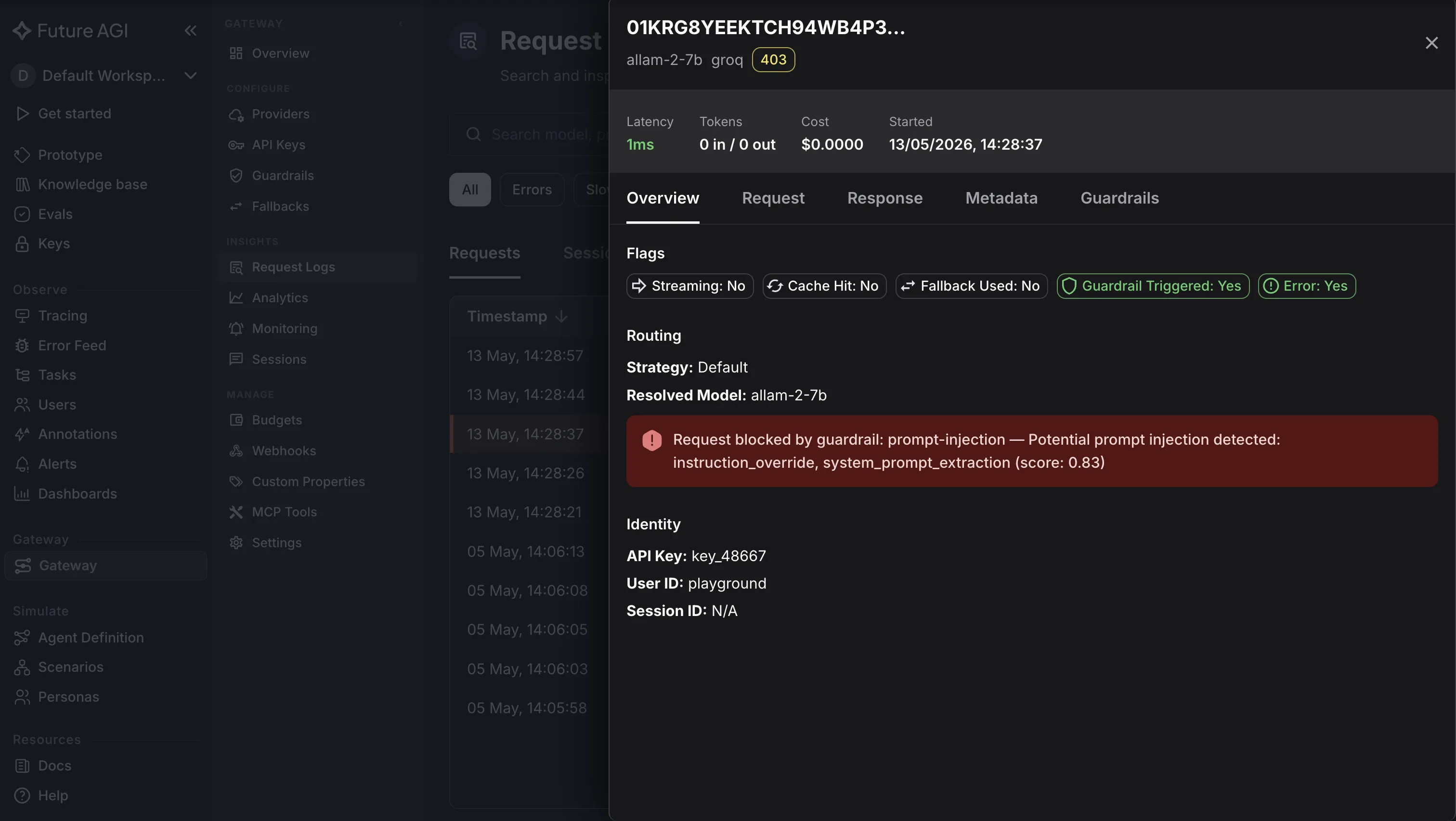
The Future AGI Protect model family runs inline at 65 ms text / 107 ms image median time-to-label (arXiv 2510.13351). Protect is FAGI’s own fine-tuned model family built on Google’s Gemma 3n with specialized adapters across four safety dimensions (content moderation, bias detection, security/prompt-injection, data privacy/PII), natively multi-modal across text, image, and audio. RBAC and audit logs are solid for the Agent Command Center. BYOC and AWS Marketplace are both available. SOC 2 Type II, HIPAA (BAA), GDPR, and CCPA are all certified. ISO 27001 is in active audit.
TrueFoundry’s security posture is strong on the platform side. RBAC is granular at workspace and project levels, audit logs are exportable, BYOC on Kubernetes runs the data plane in your cluster. Gateway-level filters cover the standard PII and content categories. SOC 2 Type II is shipped; HIPAA is in progress as of May 2026. The MLOps lineage means most enterprise paperwork was done before the gateway became a focus.
Verdict. Future AGI wins on agent-aware guardrail latency (the published 65 ms text median time-to-label number TrueFoundry doesn’t match in the same shape), the 18+ inline scanner library, certified HIPAA / GDPR / CCPA in addition to SOC 2 Type II, and the open-source posture. TrueFoundry ties on SOC 2 Type II and wins on the breadth of MLOps-platform paperwork (model serving, training-job audit, workspace governance) for teams whose buy is consolidation-first.
5. Deployment posture
Future AGI offers SaaS, BYOC, and Apache 2.0 OSS libraries that you can deploy without the hosted product at all. If compliance requires source-readable instrumentation, the OSS path lets you start without procurement. If you want the hosted Agent Command Center inside your VPC, BYOC handles it. AWS Marketplace is live.
TrueFoundry deploys on Kubernetes as the default substrate. SaaS hosting is on the vendor’s clusters. BYOC drops the data plane into yours. Enterprise contracts cover air-gapped on-prem. The whole platform travels together: gateway, serving, jobs, UIs. There is no Apache 2.0 OSS path for the gateway alone. You run the bundled platform or you don’t run TrueFoundry.
Verdict. Future AGI wins on deployment flexibility because OSS plus BYOC plus SaaS gives three on-ramps versus TrueFoundry’s two. If you already run TrueFoundry for serving, the bundled gateway is the cheaper marginal decision inside that ecosystem.
6. Developer experience
Future AGI’s DX is built around the iteration loop most AI teams actually run: write a rubric, watch the eval score, let the optimizer rewrite the prompt, ship the routing update. SDKs are clean and OpenAI-compatible. The traceAI library has a low-friction local dev story across 50+ AI surfaces across Python, TypeScript, Java, and C# (including Spring Boot starter, Spring AI, LangChain4j, Semantic Kernel). Eval and optimizer UIs are strong. The prompt library is opinionated by design. Versioning and access control ship today, and the optimizer is the wedge: agent-opt writes the next prompt version from eval signal.
TrueFoundry’s DX is shaped by the MLOps audience. Kubernetes-fluent platform teams find it familiar. The console is unified across deployments, jobs, and gateway. CLI and SDKs are mature for serving paths. The gateway-specific DX is good but secondary. Teams that live in a prompt library, eval suite, and trace explorer won’t find those surfaces as polished as on dedicated AI-native tools.
Verdict. Future AGI wins on DX for AI-native workflows where trace, eval, and optimize are the daily surfaces. TrueFoundry wins on DX for MLOps-shaped workflows where the gateway is one tab of a wider console.
Pricing snapshot
Pulled from each vendor’s pricing surface on May 17, 2026.
| Tier | Future AGI | TrueFoundry |
|---|---|---|
| Free | 100K traces/month, basic eval + routing, no SSO | No published free tier; trial on request |
| Scale | $99/mo, 10M traces, full eval suite, agent-opt, RBAC | Custom quote; gateway bundled into platform pricing |
| Enterprise | Custom; SOC 2 Type II, HIPAA (BAA), GDPR, CCPA certified; ISO 27001 in active audit; BYOC; AWS Marketplace | Custom; SOC 2 Type II, BYOC on K8s, air-gapped on-prem |
Future AGI publishes a Scale tier at $99/mo for teams that want to start without procurement, plus a free tier for evaluation. TrueFoundry’s pricing doesn’t enumerate tiers. It’s a custom quote bundling the gateway with serving, deployment, and other platform modules. For gateway-only workloads, Future AGI is the cheaper on-ramp. For full MLOps consolidation, TrueFoundry’s bundling can make the gateway feel free at the margin once the rest of the platform is bought.
Where each one falls short
Future AGI: three deliberate tradeoffs
- Prompt library is opinionated by design. Dedicated hosted-gateway specialists ship deeper review-and-collaboration prompt hubs. Future AGI ships versioning and access control with fewer collaboration knobs, which keeps the daily workflow faster and tighter. Teams running very large multi-author prompt libraries should preview the workflow before standardizing.
agent-optis opt-in and learns from live traces. Start withtraceAIplusai-evaluationon day one, and turn the optimizer on once eval baselines stabilize and production traffic is flowing. The optimizer gets stronger as your trace data accumulates. That’s the design, not a setup tax.- Federal procurement runs through BYOC. FedRAMP authorization is on the partner roadmap. Today, federal SOC procurement is supported via air-gapped self-host in the agency VPC. Agencies on a current FedRAMP-required calendar should plan around the BYOC path.
Three deliberate tradeoffs in pursuit of the closed loop. Every one has a clear path or workaround for buyers who need it today.
TrueFoundry: four honest limitations
- No optimizer. Traces inform humans, not the gateway. If you want the system to update its own prompts and routes from outcomes, TrueFoundry doesn’t do that.
- Bundled positioning. The gateway is a module on a larger platform, not the center of the product. Roadmap depth on agent-specific concerns (multi-turn eval, prompt optimization, agent-aware tracing) will trail dedicated AI-native vendors.
- No OSS core for the gateway. BYOC on Kubernetes is available, but the source is not. Teams that need source-readable instrumentation without the hosted product don’t have a path here.
- Hosted-only data plane by default. BYOC requires enterprise contracts and Kubernetes maturity on the customer side. Smaller teams without a K8s platform get SaaS or nothing.
Verdict matrix: when to pick which
| Situation | Best pick | Why |
|---|---|---|
| LLM gateway is the center of gravity, has to keep improving | Future AGI | Closed-loop trace -> eval -> optimize -> route is the wedge TrueFoundry doesn’t implement |
| OTel-native instrumentation, agent-aware spans, Apache 2.0 | Future AGI | traceAI is OpenTelemetry-first with 50+ AI surfaces across Python, TypeScript, Java, and C# (including Spring Boot starter, Spring AI, LangChain4j, Semantic Kernel); TrueFoundry’s OTel export is one backend among several |
| Continuous evaluation across production traffic | Future AGI | ai-evaluation SDK (Apache 2.0, 60+ EvalTemplate classes, 13 guardrail backends including 9 open-weight Llama Guard / Qwen3Guard / Granite Guardian / WildGuard / ShieldGemma plus 4 API backends, and 8 fast Scanners) layered with the Future AGI Platform (self-improving evaluators, in-product agent authoring from natural language to rubric, lower per-eval cost than Galileo Luna-2) + unlimited custom evaluators authored by an in-product agent + self-improving rubrics + in-house classifier models at lower per-eval cost than Galileo Luna-2 |
| Gateway-only workload, no MLOps platform commitment | Future AGI | $99/mo Scale tier published; TrueFoundry requires platform-level quote |
| Self-host the libraries without buying the platform | Future AGI | Apache 2.0 traceAI, ai-evaluation, agent-opt; TrueFoundry has no OSS core |
| Certified SOC 2 Type II, HIPAA, GDPR, CCPA for regulated buyers | Future AGI | Trust page lists all four certified today; ISO 27001 in active audit |
| Already on TrueFoundry for serving and jobs | TrueFoundry | The gateway is the cheaper marginal decision inside an MLOps platform you have already bought |
| Kubernetes-fluent platform team wants one console for everything | TrueFoundry | MLOps + jobs + serving + gateway in a unified K8s-shaped UI |
| One vendor across training, serving, and gateway | TrueFoundry | MLOps lineage covers model lifecycle in addition to LLM traffic |
Decision framework: choose X if
Choose Future AGI if you need:
- A gateway that closes the loop: trace, eval, optimize, route, all in one runtime.
- OpenTelemetry-native instrumentation under Apache 2.0 so you can read, fork, and self-instrument.
- Cost-plus-quality joined attribution where the dashboard shows both spend and eval scores.
- A gateway-only on-ramp at $99/mo without an MLOps platform commitment.
Choose TrueFoundry if you need:
- A single vendor across serving, jobs, deployments, and a bundled AI gateway on Kubernetes.
- A Kubernetes-first MLOps console where the gateway is one tab beside training and serving.
- Tight integration between the gateway and the rest of the model lifecycle in one console.
Look at Portkey, Kong, or LiteLLM if you need:
- A polished hosted gateway with a mature prompt library, independent of an MLOps platform (Portkey, now under Palo Alto Networks).
- An existing API gateway stack you can extend to LLM workloads (Kong AI Gateway).
- A self-hosted, source-available Python proxy with no SaaS dependency (LiteLLM).
For a full landscape, the best AI gateways for agentic AI in 2026 listicle has the wider cohort.
When to look elsewhere
If the situation is one of these, neither Future AGI nor TrueFoundry is the right pick today:
- Gateway-only, prompt library is the daily surface. Portkey is the cleanest fit.
- Existing Kong stack for REST APIs. Kong AI Gateway extends what your platform team already runs. AI-specific shallowness is the tradeoff.
- Air-gapped, source-readable, no SaaS. LiteLLM’s OSS proxy is the cleanest fit. Both Future AGI and TrueFoundry offer BYOC, but if “no hosted dependency whatsoever” is the requirement, LiteLLM clears the bar more cleanly.
How the loop changes the math
What doesn’t fit cleanly into the six axes is what happens over time. Future AGI is a self-improving runtime. The system updates itself. TrueFoundry’s gateway is a static module inside an MLOps console. The system gets better only when humans update it.
The loop in practice: traceAI emits a span tree for every request, ai-evaluation scores each turn against rubrics drawn from a 50+ built-in catalog plus any custom evaluator your team authors (generated and tuned by an in-product eval-authoring agent that uses tool calling on your code), every evaluator self-improves from live production traces, and FAGI’s in-house classifier models score continuously at very low cost-per-token (lower per-eval cost than Galileo Luna-2). Low-scoring sessions cluster by failure mode, agent-opt rewrites the system prompt or adjusts the routing policy, Agent Command Center applies the updated policy on the next request, and the new version auto-rolls back if the score regresses. Six optimizers (ProTeGi, BayesianSearchOptimizer with Optuna, GEPAOptimizer, MetaPromptOptimizer, RandomSearchOptimizer, PromptWizardOptimizer), all sharing EarlyStoppingConfig, are available.
Net effect for continuous production workloads: typical cost reduction of 15-30% within four weeks of live trace data flowing, with no change to developer behavior. The router learns to pick the cheaper model for easy turns, the optimizer rewrites prompts that were over-prompting, the eval data tells the loop where to focus.
This is the loop TrueFoundry’s gateway doesn’t implement. Every Future AGI surface ships against concrete features. traceAI is OpenTelemetry-native with 50+ AI surfaces across Python, TypeScript, Java, and C# (including Spring Boot starter, Spring AI, LangChain4j, Semantic Kernel), OpenInference-compat, and Apache 2.0 source. ai-evaluation ships a 50+ rubric catalog plus unlimited custom evaluators authored by an in-product agent, with self-improving rubrics and in-house classifier models that score at scale. Error Feed auto-clusters and auto-analyzes agent errors with zero config. agent-opt runs six optimizers (ProTeGi, BayesianSearchOptimizer with Optuna, GEPAOptimizer, MetaPromptOptimizer, RandomSearchOptimizer, PromptWizardOptimizer), all sharing EarlyStoppingConfig, all running against live trace data. The Future AGI Protect model family enforces inline at 65 ms text / 107 ms image median time-to-label across four safety dimensions on its own Gemma 3n + fine-tuned adapter stack. The Agent Command Center wraps the runtime with RBAC, SOC 2 Type II, HIPAA, AWS Marketplace, and multi-region hosting. Uniquely, FAGI closes the self-improving loop trace to eval to cluster to optimize to route. For a team already running TrueFoundry where the gateway is one box to tick alongside serving, the bundled choice makes the right marginal sense.
Related reading
- Best AI Gateways for Agentic AI in 2026
- Best 5 AI Gateways to Monitor Claude Code Token Usage in 2026
- What Is an AI Gateway? The 2026 Definition
- Future AGI vs Portkey in 2026
Sources
- TrueFoundry platform and gateway, truefoundry.com
- TrueFoundry AI gateway module documentation, docs.truefoundry.com
- Future AGI Agent Command Center, futureagi.com/platform
- Future AGI Protect latency benchmark, arxiv.org/abs/2510.13351
- traceAI (Apache 2.0), github.com/future-agi/traceAI
- ai-evaluation (Apache 2.0), github.com/future-agi/ai-evaluation
- agent-opt (Apache 2.0), github.com/future-agi/agent-opt
- AWS Marketplace listing for Future AGI, aws.amazon.com/marketplace
Frequently Asked Questions
What is the main difference between Future AGI and TrueFoundry?
Is Future AGI open-source? Is TrueFoundry open-source?
Which one has better routing intelligence?
Can I self-host either?
How does pricing compare?
Is TrueFoundry the right pick if I am not on Kubernetes?
What is the alternative if neither fits?
An AI gateway sits between apps and LLM providers for governance, routing, observability. What it is, how it differs from API gateways.


Portkey, Kong AI Gateway, LiteLLM, Helicone, and FutureAGI as TrueFoundry alternatives in 2026. K8s vs hosted, OSS license, and tradeoffs.

Seven AI gateways for agentic AI in 2026 scored on MCP plus A2A depth, 18+ built-in guardrails, OTel-native cost telemetry, 2026 trust cohort with sources.