Future AGI vs Confident AI in 2026: Multimodal Evaluation, Observability, and OSS Compared
Future AGI vs Confident AI (DeepEval) in 2026: multimodal eval, observability, OSS license, prompt-opt, and which one ships your AI app to production.
Table of Contents
TL;DR: Future AGI vs Confident AI in 2026
| Capability | Future AGI | Confident AI (DeepEval) |
|---|---|---|
| Primary shape | End-to-end AI reliability platform | Code-first eval framework + SaaS dashboard |
| OSS license | Apache 2.0 (traceAI, ai-evaluation) | Apache 2.0 (DeepEval) |
| Multimodal eval | Text + image + audio | Text-focused |
| Observability | traceAI + OpenTelemetry, full agent tracing | Test-result logging, lighter on production traces |
| Prompt optimization | Agent-Opt: Bayesian, ProTeGi, genetic | Not a built-in product |
| Agent simulation | Simulate SDK (voice + text) | Not built-in |
| Guardrails | Protect: multimodal, low-latency | Not the focus |
| Synthetic data | Synthesize: structured + adversarial | Limited to test-case synthesis |
| Best for | Teams that ship multimodal agents with observability + eval + prompt-opt | Teams that want pytest-style LLM assertions in CI |
If you already have your observability and guardrails stack and you only need a unit-test-shaped LLM eval framework, Confident AI / DeepEval is the cleanest fit. If you are building the reliability stack from scratch or running multimodal agents, Future AGI covers more of the surface in one place.
Why the Right LLM Evaluation Platform Decides Whether Your AI Reaches Production in 2026
Modern LLM applications fail in three ways that classical testing does not catch: hallucinations on edge prompts, drift after prompt or model upgrades, and silent quality regressions in production. The evaluation and observability layer is what catches all three before they reach a customer.
This guide compares two purpose-built options for that layer:
- Future AGI: an end-to-end AI evaluation, observability, prompt-opt, and guardrails platform. OSS-first libraries (traceAI under Apache 2.0, ai-evaluation under Apache 2.0) plus a managed platform.
- Confident AI: the SaaS companion to DeepEval, a code-first, unit-test-style LLM eval framework also under Apache 2.0.
Both are credible choices in 2026. The right one depends on what shape your AI stack already takes.
Feature Comparison: How Future AGI and Confident AI Approach LLM Evaluation in 2026
Future AGI: Multimodal Evaluation, OpenTelemetry Tracing, Prompt-Opt, and Guardrails in One Platform
Future AGI is built as an end-to-end AI reliability stack:
-
ai-evaluation (Apache 2.0). Pre-built evaluators for faithfulness, groundedness, context relevance, hallucination, toxicity, bias, PII, task completion, and more. String-template API via
fi.evals.evaluate("faithfulness", output=..., context=...). Custom LLM-as-judge viafi.evals.metrics.CustomLLMJudge. Async-friendly. Powered by the Turing model family on the cloud. -
traceAI (Apache 2.0). OpenTelemetry auto-instrumentation for OpenAI Agents SDK, LangChain, LlamaIndex, CrewAI, DSPy, AutoGen, and MCP. Exports to any OTel backend or the Future AGI platform.
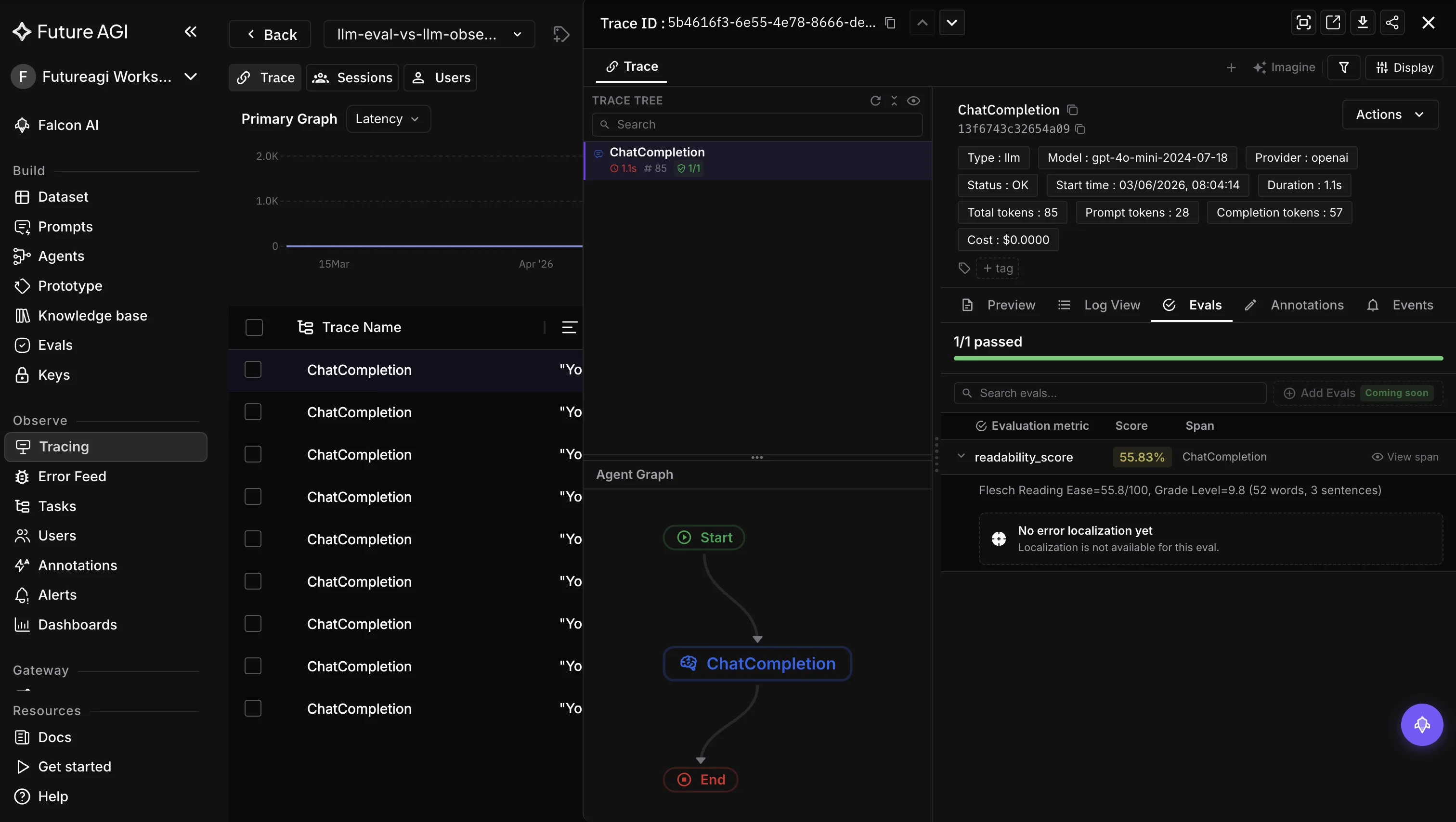
- Agent-Opt. Automated prompt and agent optimization with Bayesian Search, ProTeGi, Meta-Prompt, and genetic algorithms. Versioned cycles, traceable to evaluation deltas.
- Synthesize. Structured and adversarial synthetic-data generation for evaluation sets, fine-tuning, and stress tests.
- Protect. Multimodal (text, image, audio) inline guardrails with Turing-backed Detection.
- Simulate SDK. End-to-end voice and text agent simulation with WebRTC/LiveKit support.
- No-code experimentation hub. A/B and multi-variant prompt and model testing in a visual UI for cross-functional teams.
The platform exposes both an OSS library path (pip install + run anywhere) and a managed dashboard with traces, eval results, prompt history, and alerts in one place.
Confident AI: Code-First DeepEval Tests, RAG and Agent Metrics, SaaS Dashboard
Confident AI is purpose-built around DeepEval:
- DeepEval framework (Apache 2.0). Unit-test-style LLM evaluation written as pytest fixtures:
assert_test(test_case, [metric]). Built-in metrics for hallucination, answer relevance, faithfulness, contextual precision/recall, summarization, bias, toxicity, G-Eval (paper-style LLM-as-judge), RAGAS-compatible metrics, and task-completion. - Test-case synthesis. Generates evaluation test cases via evolution-style prompt expansion.
- SaaS dashboard. Logs test runs, supports filtering and dashboards, and adds production trace ingestion.
- CI/CD integration.
deepeval test runslots into GitHub Actions, GitLab CI, or any test runner. - Human feedback. Easy hooks for thumbs-up/down user signals to refine metrics.
The mental model is “pytest for LLMs”: you write TestCase objects, attach metric definitions, run the suite, and treat failures as build-breakers.
Ease of Use and Workflow Fit: When Each Tool Is the Right Choice
Future AGI Workflow: Low-Code Platform, OSS Libraries, OpenTelemetry by Default
- Adoption shape. Pip-install the OSS libraries and start instrumenting in minutes; the managed platform layers on dashboards, prompt history, and alerts.
- Cross-functional UI. Domain experts, data scientists, ML engineers, and PMs can all work in the same dashboards. Annotation, dataset review, and prompt experimentation are all UI-driven.
- Integration breadth. OpenAI, Anthropic, Hugging Face, Azure OpenAI, Google Vertex, Bedrock, Mistral, plus every major orchestration framework via traceAI.
- OpenTelemetry-native. Spans land in any OTel-compatible backend, so your platform team does not need to learn a proprietary tracing format.
- Pipeline efficiency. One-click dataset generation, automated evaluation cycles, prompt-opt experiments, and trace-attached scores remove most manual glue.
Confident AI Workflow: Code-First Tests in CI, SaaS Dashboard for Triage
- Code-first. Built for ML engineers and developers who want to write tests in Python.
- Test placement. Tests live next to your code and run wherever pytest runs (local, CI, pre-merge gates).
- SaaS triage. Dashboard for filtering pass/fail history and drilling into failures.
- Framework compatibility. Works with LangChain, LlamaIndex, and arbitrary LLM stacks because the framework is provider-agnostic.
- Setup tradeoff. You write meaningful test cases and metric configurations by hand. The payoff is precise, repeatable, code-tracked behavior. The cost is that non-engineers cannot author tests easily.
Multimodal, Voice, and Agent Coverage: A Concrete Gap to Map Against Your Stack
The single largest functional gap between the two in 2026:
| Modality | Future AGI | Confident AI (DeepEval) |
|---|---|---|
| Text | Full coverage, all evaluators | Full coverage, all metrics |
| Image input | Native evaluators | Text-only |
| Audio / voice | Native via Turing + Simulate SDK | Text-only |
| Tool-calling agents | traceAI + agent metrics | Conversation-style metrics |
| RAG | Faithfulness, groundedness, context precision/recall | Faithfulness, contextual precision/recall, RAGAS |
| OTel agent traces | First-class | Limited, focused on test-trace logs |
If you are building a voice agent or a vision-enabled assistant, Future AGI is the only one of these two with first-class evaluator and simulation coverage in 2026.
Adoption and Reception: Where Each Tool Wins With Real Teams
Future AGI Adoption: Enterprise AI Teams and OSS Libraries
- Future AGI’s eval and observability stack is targeted at production AI teams shipping multimodal and agent workloads.
- The OSS libraries are public on GitHub: traceAI and ai-evaluation, both Apache 2.0.
- The managed platform is the primary commercial offering; enterprise deployment options may be available on request.
Confident AI Adoption: DeepEval’s Developer Community and Open-Source Momentum
- Launched in mid-2024 and grew fast in developer circles for converting subjective LLM outputs into objective tests.
- DeepEval has strong open-source momentum on GitHub and is widely referenced in eval guides.
- Lacks the same breadth of enterprise multimodal references but is a popular choice for pytest-style LLM testing in OSS communities.
Scalability: Real-Time Production vs Batch CI Workloads
Future AGI Scalability: Real-Time Trace + Eval at Production Scale
- Designed for cloud and edge AI workloads with real-time evaluator runs.
- Distributed evaluator execution; thousands of test cases or many model variants can run in parallel.
- Streaming observability with anomaly detection at production scale.
- Closed-loop: ingest traces, run sampled evaluators, surface drift and quality alerts to dashboards or webhooks.
- Supports horizontal scaling across datasets, models, and projects.
Confident AI Scalability: Strong in CI, Limited as a Live-Traffic Observability Backend
- Hybrid OSS + SaaS model: DeepEval runs on your hardware in CI; the dashboard handles result storage.
- Parallel test execution scales with the runner you use (GitHub Actions matrix, parallel workers).
- The SaaS layer is built for test-run history rather than streaming production telemetry on every request.
- Heavy LLM-judge metrics (G-Eval, RAGAS) cost both latency and tokens; teams usually run them asynchronously rather than inline.
- Less suited than Future AGI for high-traffic live-trace logging with drift detection on every request.
Pricing and Licensing in 2026
Both products are credible on cost; the right one depends on what you actually need.
- Future AGI. OSS libraries (traceAI, ai-evaluation) are free under Apache 2.0 and run fully on your hardware. Check the Future AGI pricing page for the current free and paid plan details.
- Confident AI. DeepEval is free under Apache 2.0. Confident AI’s SaaS dashboard has a free tier and paid plans for higher test volume, longer retention, and team features.
For broader context, see the best LLM evaluation tools roundup and the DeepEval alternatives guide.
When to Choose Future AGI vs Confident AI: A Decision Matrix
| You should pick Future AGI if… | You should pick Confident AI if… |
|---|---|
| You need multimodal (text, image, audio) eval | You only evaluate text LLM outputs |
| You want OpenTelemetry observability + eval together | You already have your own observability stack |
| You ship voice or vision agents | You ship text chatbots or RAG apps |
| You want automated prompt optimization | You manually iterate prompts after each test run |
| Cross-functional users (PMs, SMEs) annotate datasets | Only engineers run and read eval results |
| You need inline guardrails on top of eval | You only need post-hoc scoring |
| You want one platform for trace + eval + opt | You want a tightly scoped pytest-style framework |
For most teams that already use Future AGI for trace and eval, DeepEval is still useful as a CI-side complement. The two are not mutually exclusive.
Final Take: Future AGI for End-to-End Reliability, Confident AI for Code-First LLM Tests
If your team values multimodal coverage, cross-functional UX, OpenTelemetry-native observability, prompt and agent optimization, and inline guardrails, Future AGI is the broader 2026 platform and the right default choice for production AI agents.
If you specifically want a code-first, unit-test-shaped LLM evaluation framework for text outputs and you already own your observability and prompt-opt stacks, Confident AI / DeepEval is a clean, focused pick.
Most production teams pick one as the primary and call into the other for edge cases. The two stacks coexist at the workflow level: DeepEval can cover CI-side evals while traceAI covers OpenTelemetry production tracing. Both ship Apache 2.0 OSS libraries. For other comparisons in this category, see the Confident AI alternatives roundup, the G-Eval vs DeepEval comparison, and the best LLM eval libraries breakdown.
Frequently Asked Questions
What is the core difference between Future AGI and Confident AI in 2026?
Which platform supports multimodal LLM evaluation in 2026?
Is Future AGI open source?
Which is better for CI/CD-style LLM testing?
Which platform has stronger production observability?
Which platform does prompt optimization?
Which is easier for non-engineers and product managers?
Can I use both?
FutureAGI, Langfuse, Arize Phoenix, Braintrust, and LangSmith as DeepEval alternatives in 2026. Pricing, OSS license, eval depth, and production gaps.

FutureAGI, Langfuse, Phoenix, Braintrust, and Galileo as Confident-AI alternatives. Pricing, OSS license, eval depth, production gaps.
FutureAGI, DeepEval, Langfuse, Phoenix, Braintrust, LangSmith, and Galileo as the 2026 LLM evaluation shortlist. Pricing, OSS license, and production gaps.
