EU AI Act Timeline After the Digital Omnibus Delay to 2027
The EU AI Act timeline after Regulation (EU) 2026/1744: every date from 2024 to 2030, what the Omnibus moved, and a per-date checklist for AI agent teams.
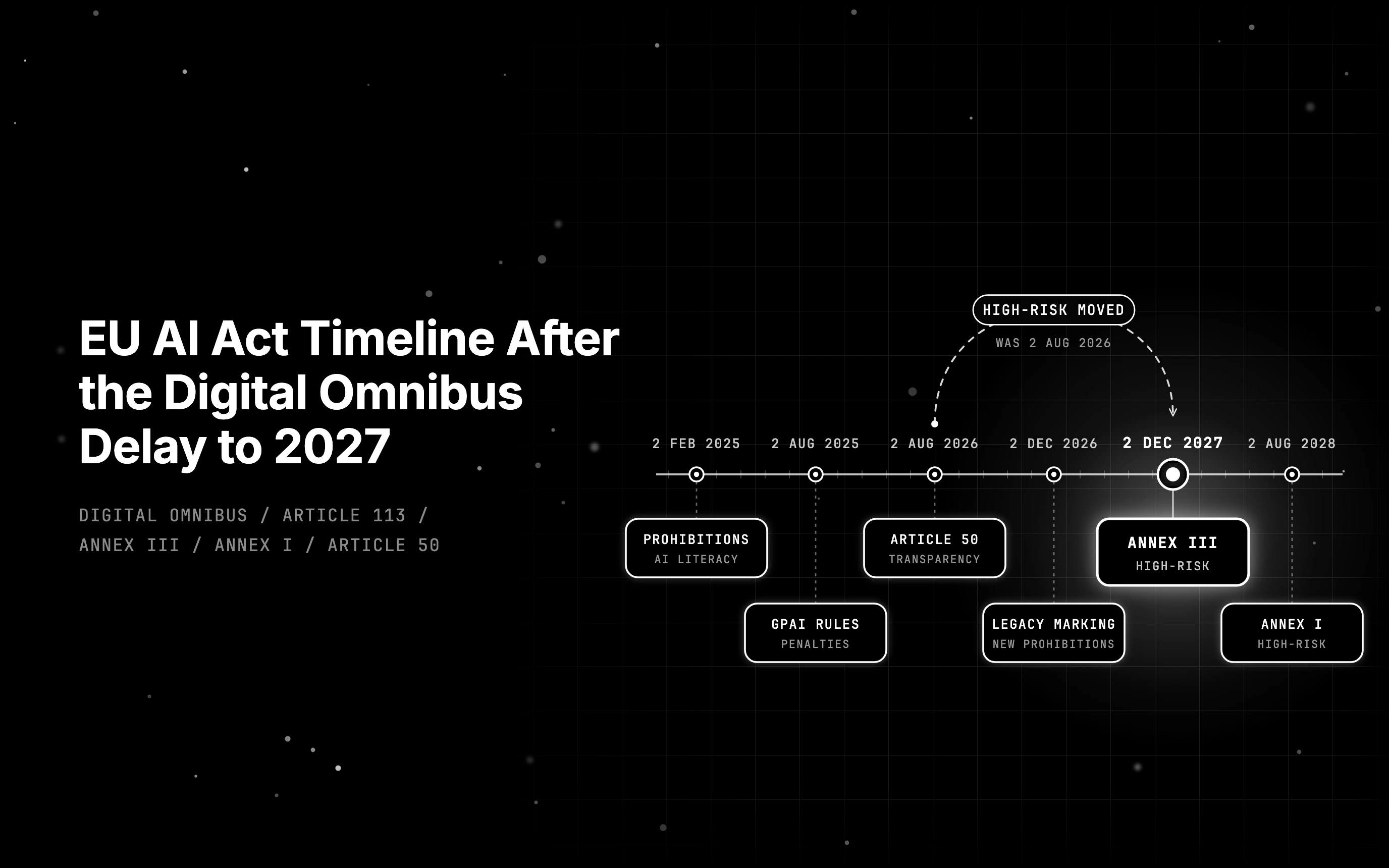
Table of Contents
Picture a team in Berlin that runs two AI agents for EU customers: one answers support tickets, the other drafts letters and contracts for account managers. Its compliance plan came from a vendor page that put the start of the high-risk rules in August 2026, so logging, oversight and documentation work landed in this summer’s sprints.
That plan now runs on a date the EU AI Act timeline no longer uses. The high-risk rules moved, two new prohibitions arrived and a December 2026 step appeared, all through one amending act that many compliance guides still skip or only half explain.
Since 27 July 2026, Regulation (EU) 2026/1744, the Digital Omnibus on AI, has been in force.
This post puts every date in one table, explains what the Omnibus moved and why, and lists what an agent team should have running on each date. It summarises the dates in the amending regulation and the consolidated AI Act as of 1 November 2026, and it is not legal advice.
TL;DR
- High-risk rules moved: Annex III systems from 2 December 2027, AI in Annex I products from 2 August 2028, under Regulation (EU) 2026/1744, in force since 27 July 2026.
- Prohibitions and AI literacy (2 February 2025), GPAI duties (2 August 2025) and general application with Article 50 (2 August 2026) kept their dates, apart from the legacy marking step below.
- 2 December 2026 is a new step: legacy generative systems must mark output under Article 50(2), and two new Article 5 bans start.
- Agent teams should classify each agent now and start automatic logging well before 2 December 2027.
The EU AI Act timeline at a glance
The EU AI Act entered into force on 1 August 2024 and applies in stages: prohibitions first in February 2025, GPAI rules in August 2025 and general application in August 2026. After the Digital Omnibus, Annex III high-risk rules apply from 2 December 2027 and Annex I product rules from 2 August 2028.
| Date | What applies | Who it affects | Provision | Changed by Omnibus? |
|---|---|---|---|---|
| 1 Aug 2024 | AI Act enters into force | Everyone | Article 113, first paragraph | No |
| 2 Feb 2025 | Chapters I and II: definitions, AI literacy (Art. 4), prohibited practices (Art. 5) | Providers and deployers | Article 113, third paragraph, point (a) | Partly: Art. 4 reworded; two new prohibitions added, dated Dec 2026 |
| 2 Aug 2025 | Notified bodies (Ch. III Section 4), GPAI model obligations (Ch. V), governance (Ch. VII), penalties (Ch. XII) except Art. 101, confidentiality (Art. 78) | GPAI model providers, Member States | Article 113, third paragraph, point (b) | No |
| 27 Jul 2026 | Omnibus enters into force; Arts. 102 to 110 apply | Sectoral product regimes | 2026/1744 Art. 4; Article 113, third paragraph, point (d) | Yes, new |
| 2 Aug 2026 | General application, including Art. 50 transparency and Art. 101 fines on GPAI model providers | Providers and deployers | Article 113, second paragraph | No |
| 2 Dec 2026 | Art. 5(1)(ba) and (bb), 5(1a) and 5(1b) prohibitions; Art. 50(2) marking for generative systems placed before 2 Aug 2026 | Providers and deployers of generative systems | Article 113, third paragraph, point (a); Art. 111(4) | Yes, new |
| 2 Aug 2027 | GPAI models placed before 2 Aug 2025 must comply; at least one national AI regulatory sandbox operational | GPAI providers; Member States | Art. 111(3); Art. 57(1) | 111(3) no; 57(1) yes (was 2 Aug 2026) |
| 2 Dec 2027 | High-risk rules (Ch. III Sections 1 to 3) for Art. 6(2) and Annex III systems | Providers and deployers of Annex III systems | Article 113, third paragraph, point (c)(i) | Yes (was 2 Aug 2026) |
| 2 Aug 2028 | High-risk rules for Art. 6(1) and Annex I systems | Product makers and their AI suppliers | Article 113, third paragraph, point (c)(ii) | Yes (was 2 Aug 2027) |
| 2 Aug 2030 | High-risk systems intended for public authorities and already on the market must comply | Public-sector providers and deployers | Art. 111(2) | Date no; trigger rewritten |
| 31 Dec 2030 | AI components of Annex X large-scale IT systems placed before 2 Aug 2027 | EU large-scale IT systems | Art. 111(1) | No |
The Commission’s AI Act Service Desk timeline, which takes the Omnibus amendments into account, shows eight of these milestones on the same dates.
Article references follow the consolidated text of the AI Act dated 27 July 2026.
Article 113 sets most of these dates, and Article 111 covers systems and models already on the market. A quick test for any other page: if it lists 2 August 2026 for the high-risk obligations, 2 August 2027 for AI in regulated products or 2 August 2026 for sandboxes, it predates 27 July 2026 or was never updated.
How the Digital Omnibus changed the EU AI Act timeline
Regulation (EU) 2026/1744, the Digital Omnibus on AI, was signed on 8 July 2026, published in the Official Journal on 24 July and entered into force on 27 July 2026. It replaced the high-risk dates in Article 113 with fixed later ones and added a December 2026 step for new prohibitions and legacy marking.
From proposal to Official Journal in eight months
The Commission proposed the Omnibus on 19 November 2025. Parliament adopted its negotiating position at its second March 2026 plenary, and the Council agreed its general approach on 13 March 2026. The trilogue deal came on 7 May, Coreper approved it on 13 May, and the IMCO and LIBE committees followed on 2 June.
Parliament’s plenary approved the text on 16 June 2026 by 423 votes to 57, with 174 abstentions. The Council adopted it on 29 June, and the act was signed on 8 July. Article 4 of the Omnibus sets entry into force on the third day after publication, which is how 24 July becomes 27 July.
Each step is logged on Parliament’s legislative train page for the file, so this is final law, not a proposal.
Why the high-risk dates moved
Recital 40 of the Omnibus gives the reason. Standards, common specifications and alternative guidance arrived late, and national competent authorities were set up late. Keeping 2 August 2026 put the effective start of the high-risk rules at risk and threatened a significant increase in implementation costs, so the co-legislators set new dates.
The Commission had first proposed tying the high-risk dates to the availability of standards and other compliance tools. Parliament and Council chose fixed dates instead, and recital 40 asks the Commission to have support measures in place in due time, with the stated aim of avoiding further delays.
What else the Omnibus touched that affects dates
Machinery moves from Annex I Section A to Section B, so AI-enabled machinery follows the Machinery Regulation route. Article 4 now asks providers and deployers to take measures to support AI literacy, rather than to ensure, to their best extent, a sufficient level of it. The first national sandbox deadline moves to 2 August 2027 (Article 57(1)).
A new Article 4a lets providers of high-risk systems process special categories of personal data where strictly necessary for bias detection and correction, under listed safeguards. Article 4a(2) exceptionally extends this, on the same conditions, to deployers of high-risk systems and to providers and deployers of other AI systems and models.
Is the EU AI Act delayed for every rule?
No. The Omnibus moved the high-risk rules, legacy Article 50(2) marking and the sandbox deadline, and added two prohibitions dated 2 December 2026. Prohibited practices and AI literacy have applied since 2 February 2025, GPAI duties since 2 August 2025, and Article 50 since 2 August 2026, on the original EU AI Act timeline.
Under Article 113, third paragraph, point (b), Chapter XII on penalties has applied since 2 August 2025, when, per the Service Desk, Member States had to adopt penalty laws. Article 101 GPAI fines apply from 2 August 2026. The Omnibus changed neither date but extended the lower-of cap to small mid-caps for Article 99(4) and (5) fines.
The Commission’s AI Act policy page says the Act became applicable on 2 August 2026, with some exceptions, and that the AI Office and Member State authorities enforce it from that date. So you cannot pause everything until 2027: disclosure, marking and the prohibition screen are due already.
What changes on 2 December 2026?
On 2 December 2026 the four-month transitional period that recital 38 of the Omnibus gives generative systems already on the market ends, so they must apply Article 50(2) marking. The same day, two new Article 5 bans start, with separate provider and deployer tests in Article 5(1a) and an exposure carve-out in Article 5(1b).
The four months in recital 38
Recital 38 explains the window: it gives providers of generative AI systems time “to adapt their practices within a reasonable time without disrupting the market”. Under the 2024 text, Article 111 had no paragraph 4, so every generative system faced Article 50(2) from 2 August 2026, whenever it first shipped.
New Article 111(4) gives providers of AI systems, including general-purpose AI systems, that generate synthetic audio, image, video or text and were placed on the market before 2 August 2026 until 2 December 2026. It names providers only, and anything first placed on the market from 2 August 2026 gets no window.
So check one date per generative feature: when it was first placed on the EU market, according to your own release records. Before 2 August 2026 means machine-readable marking by 2 December 2026, and on or after that date means marking was due at launch.
How far the two new prohibitions reach
Point (ba) of Article 5(1) bans systems that generate or manipulate realistic images, video, audio or similar material showing an identifiable person’s intimate parts or sexually explicit activity without that person’s freely given, specific, informed, unambiguous and explicit consent. Point (bb) covers child sexual abuse material under Directive 2011/93/EU, except where a national “without right” defence applies.
Under Article 5(1a), a provider is caught when that output is the system’s intended purpose, or when its design, training or features make it a reasonably foreseeable and reproducible outcome without significant technical modification, and it lacks reasonable and adequate safeguards to reliably prevent that output, taking into account reasonably foreseeable misuse, and to correct observed or reported misuse.
A deployer is caught only when it uses the system for that purpose, and Article 5(1b) says edits that neither increase the exposure of intimate parts nor change the nature of depicted sexual activity are not manipulation under point (ba). For a general image, video or audio tool, the evidence is its safeguard set plus a misuse-correction process.
The 2027 and 2028 high-risk deadlines and the legacy grace period
Chapter III Sections 1 to 3 apply from 2 December 2027 for Annex III systems and from 2 August 2028 for Annex I products. The rewritten Article 111(2) moves the legacy cutoff to those same dates, and recital 39 ties the grace period to when the first unit of a type and model reached the EU market.
Old and new, side by side
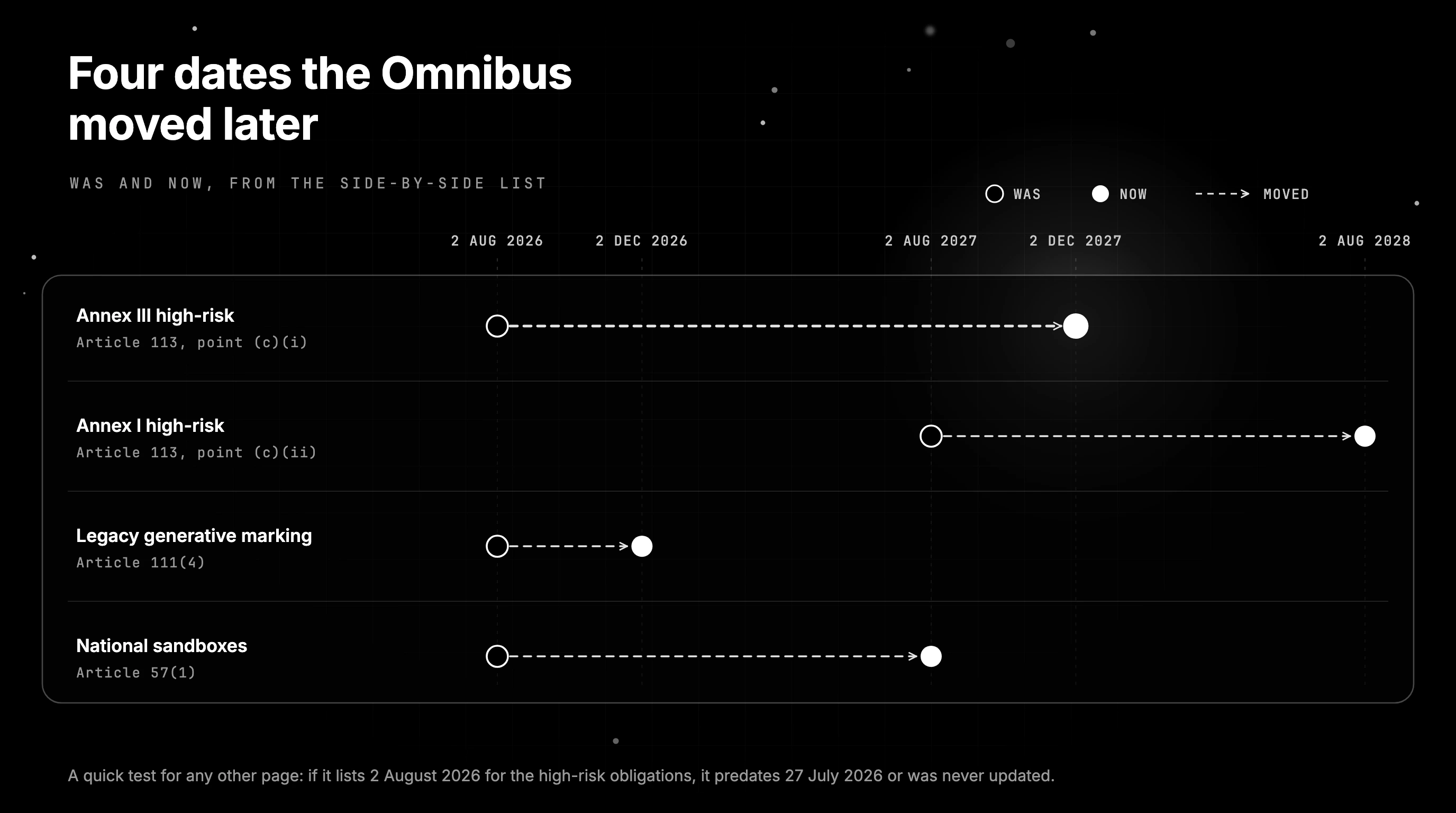
- Annex III high-risk: was 2 August 2026, now 2 December 2027 (Article 113, third paragraph, point (c)(i)).
- Annex I high-risk: was 2 August 2027, now 2 August 2028 (point (c)(ii)).
- Legacy cutoff in Article 111(2): was “before 2 August 2026”, now “before the date of application of Chapter III”.
- Legacy generative marking: was 2 August 2026, now 2 December 2026 (Article 111(4)).
- National sandboxes: was 2 August 2026, now 2 August 2027 (Article 57(1)).
Point (c) excludes Article 6(5), the Commission’s duty to publish guidelines on high-risk classification, which keeps its own date of 2 February 2026 in the text. AI-enabled machinery follows the Machinery Regulation route under Annex I Section B, where recital 42 expects the Machinery Regulation delegated acts carrying the AI requirements to apply by 2 August 2028.
Type and model, not unit (recital 39)
Under recital 39, if at least one unit of a high-risk system was lawfully placed on the market or put into service before the cutoff, later units of the same type and model can keep shipping without additional obligations or new certification, unless the design changes significantly. Article 5 still applies to legacy systems (Article 111(2)).
The decisive date is when the first unit of that type and model reached the EU market. A significant design change after the cutoff triggers full compliance, conformity assessment included, so release records that show both dates become the evidence behind a grace claim.
Also due in 2027 and 2030
Providers of GPAI models placed before 2 August 2025 must comply by 2 August 2027 (Article 111(3)), when national sandboxes must also be operational. Legacy high-risk systems intended for public authorities must comply by 2 August 2030 even without a design change (Article 111(2)), and legacy Annex X IT-system components by 31 December 2030 (Article 111(1)).
The Commission owes delegated acts on limiting certain requirements for Article 6(1) systems by 2 August 2027 (Article 2(13)), and guidelines on Articles 8(2), 9(10) and 17(3) for Annex I Section A products by 1 August 2027 (Article 96(1)(g)). Both concern AI in regulated products.
What to have running on each date if you ship AI agents
Agent teams already owe AI literacy measures, a prohibited-practice screen and Article 50 disclosure under the EU AI Act timeline. By 2 December 2026, legacy generative features need machine-readable marking. Before 2 December 2027, any agent that stays high-risk under Annex III after the Article 6(3) check needs high-risk controls and automatic logging in place.
| Date | Applies to your agent if | Engineering task | Evidence to keep |
|---|---|---|---|
| Already applying (since 2 Feb 2025) | Any agent, any tier | Run an Art. 5 screen on each use case; record literacy measures for staff who build and operate agents | Use-case register, training records |
| Already applying (since 2 Aug 2026) | It talks to people or generates content | Tell users they are talking to an AI (Art. 50(1)); mark new synthetic output machine-readably (Art. 50(2)) | Disclosure copy per surface, marking method |
| Already applying | It is built on a GPAI model | Collect the model provider’s documentation and usage terms | Provider documentation file |
| 2 Dec 2026 | Its generative feature was on the market before 2 Aug 2026 | Ship Art. 50(2) marking on the legacy feature; check image, video or audio tools against the new Art. 5 prohibitions | Marking release note, prohibition screen result |
| Through 2027 | It may fall in an Annex III area (employment, credit, education, essential services and others) | Classify each agent; for in-scope agents, turn on automatic event logging (Art. 12) and plan at least six months’ log retention (Arts. 19(1), 26(6)) | Classification memo, logging design, retention setting |
| 2 Dec 2027 | It is an Annex III high-risk system | Chapter III Sections 1 to 3 in place | Technical documentation, logs, oversight records |
| 2 Aug 2028 | It is a safety component of, or itself, an Annex I product that needs third-party conformity assessment | Same obligations through the product’s conformity route | Product conformity file |
The first three rows already apply to almost any agent that talks to people, generates content or runs on a GPAI model. The Annex III rows apply only once an agent is classified into one of those areas.
Voice agents carry compliance work beyond Article 50, covered in our post on voice AI compliance across HIPAA, GDPR and the AI Act. For the records an auditor will ask to see, use the evidence an AI audit asks for as your list.
Traces as record-keeping evidence
Article 12(1) requires high-risk systems to technically allow the automatic recording of events over their lifetime. Providers keep those logs for at least six months under Article 19(1), and deployers do the same under Article 26(6), in both cases to the extent the logs are under their control and unless other law says otherwise.
An agent trace is natural raw material for that record. Future AGI traces work this way: a trace is a tree of spans under one trace ID, with inputs, outputs and timing at each step.
Starting now means the logging design has run in production for more than a year before 2 December 2027.
Finding your own EU AI Act deadline by role and risk tier
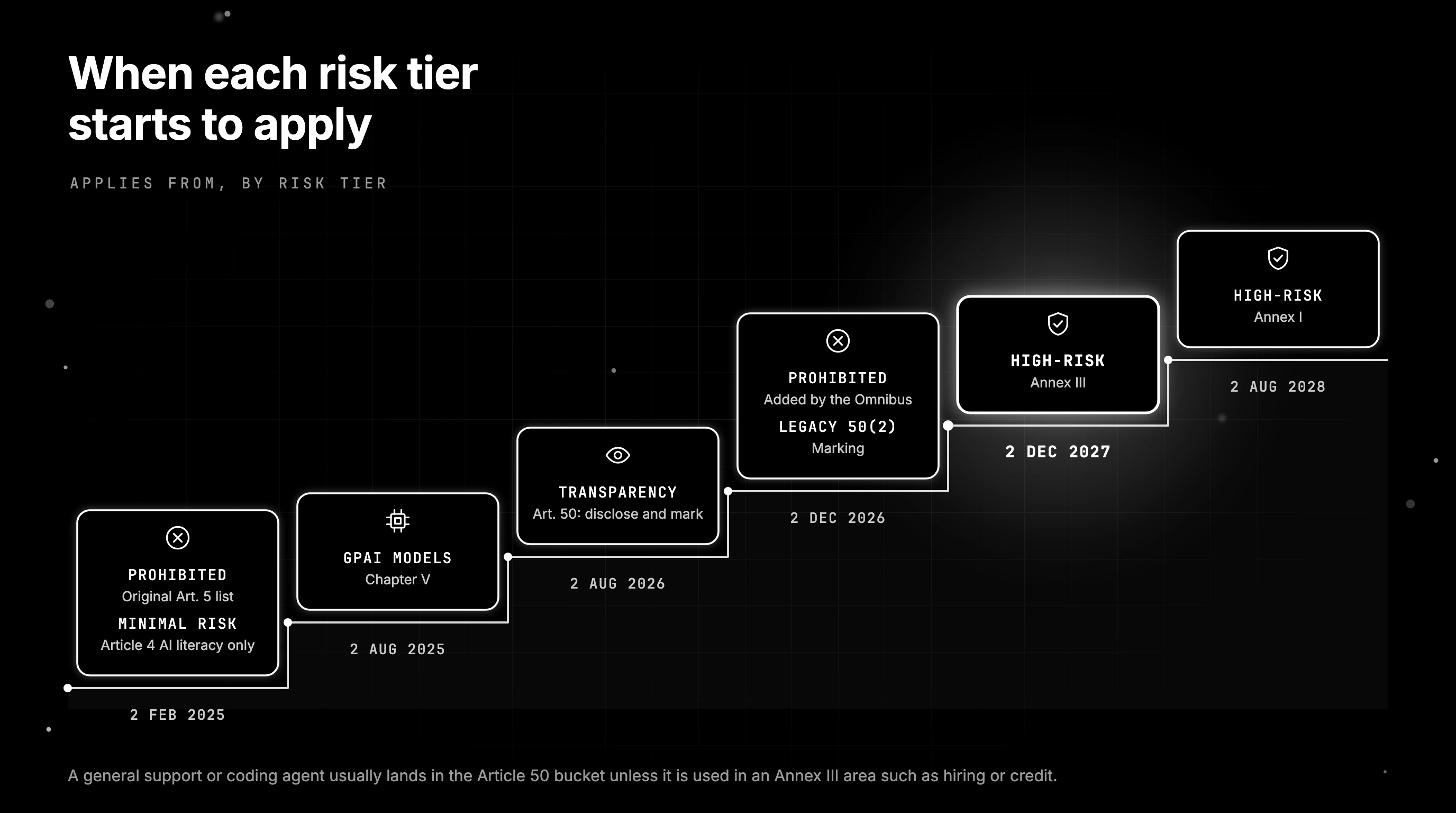
Your deadline depends on your role, provider or deployer, and on whether your system is prohibited, high-risk under Annex III or Annex I, a GPAI model, or only subject to Article 50. A general support or coding agent usually lands in the Article 50 bucket unless it is used in an Annex III area such as hiring or credit.
| Risk tier | Examples from the Act | Core obligation | Applies from |
|---|---|---|---|
| Prohibited (original Art. 5 list) | Social scoring, manipulative techniques causing significant harm, untargeted facial-image scraping, emotion recognition at work and in schools | Banned, no compliance path | 2 Feb 2025 |
| Prohibited (added by the Omnibus) | Non-consensual intimate imagery of an identifiable person; child sexual abuse material (Art. 5(1)(ba), (bb)) | Banned | 2 Dec 2026 |
| High-risk, Annex III | Biometrics, critical infrastructure, education, employment, essential services, law enforcement, migration, justice and democratic processes | Chapter III Sections 1 to 3 | 2 Dec 2027 |
| High-risk, Annex I | AI that is a safety component of, or itself, a product under Annex I law that needs third-party conformity assessment, such as medical devices or lifts | Same, through the product’s conformity route | 2 Aug 2028 |
| Transparency (Art. 50) | Chatbots, synthetic content, deepfakes | Disclose and mark | 2 Aug 2026 (legacy 50(2) marking 2 Dec 2026) |
| GPAI models (Chapter V) | General-purpose AI models placed on the market | Documentation, copyright policy, training-content summary | 2 Aug 2025 (models placed earlier: 2 Aug 2027) |
| Minimal risk | Everything else | Article 4 AI literacy only; GDPR and product law still apply | 2 Feb 2025 (Art. 4) |
Every date and article reference in this table comes from the consolidated AI Act.
Provider or deployer, and when a deployer becomes a provider
Under Article 26, a deployer of a high-risk system follows the instructions for use and assigns human oversight to people with the competence, training and authority to do it. Where it controls input data, it keeps that data relevant and sufficiently representative. It monitors operation, informs the provider where relevant and keeps logs for at least six months.
Article 25(1) turns a deployer or other third party into the provider of a high-risk system in three cases. It puts its name or trademark on the system, makes a substantial modification, or changes the intended purpose of a system that was not high-risk, including a general-purpose AI system, so that it becomes high-risk.
An Annex III listing is not the end of the test. Article 6(3) lets some listed systems out, such as those doing a narrow procedural task, but a system that profiles natural persons is always high-risk. Repurposing a third-party model for an Annex III use can make you the provider, so record who decided the intended purpose.
What a high-risk system must show by its date
Chapter III Section 2 lists the requirements: risk management (Article 9), data and data governance (Article 10), technical documentation (Article 11), record-keeping (Article 12), transparency and information to deployers (Article 13), human oversight (Article 14), and accuracy, robustness and cybersecurity (Article 15).
Under Articles 16 and 43, the provider must also complete the relevant conformity assessment before the system is placed on the market or put into service.
The fines behind each date (Article 99)
Article 99 sets the ceilings and Member States set the penalty rules. Breaching an Article 5 prohibition can cost up to EUR 35 million or 7% of total worldwide annual turnover, whichever is higher. Breaching operator duties, including provider duties (Article 16), deployer duties (Article 26) and Article 50 transparency, can cost up to EUR 15 million or 3%.
Supplying incorrect, incomplete or misleading information to notified bodies or national competent authorities can cost up to EUR 7.5 million or 1%. SMEs and start-ups pay up to the lower of the two figures (Article 99(6)), and the Omnibus extends that rule to small mid-caps for the paragraph 4 and 5 fines (Article 99(6a)).
If your agents process personal data, GDPR runs alongside all of this; see how the AI Act sits next to GDPR and which AI rules are binding and which are voluntary. Role and risk classification are legal calls, so confirm yours with counsel before you plan around a date.
Replanning your roadmap around the new EU AI Act dates
Back to the Berlin team and its two agents. Its August 2026 high-risk plan becomes three dated milestones: Article 50 disclosure and marking work now, legacy generative marking by 2 December 2026, and, for any agent that stays high-risk under Annex III after the Article 6(3) check, high-risk controls and logging ahead of 2 December 2027.
The traces it starts collecting this quarter become raw material for the logs it will need if that day comes. Turn the agent checklist into one ticket per milestone, with an owner and the evidence named. If the same evidence must also satisfy NIST AI RMF or ISO/IEC 42001, map it once across both frameworks.
Frequently Asked Questions
Is the EU AI Act delayed?
What is the current status of the EU AI Act?
When does the EU AI Act apply?
When does AI Act Article 50 apply?
When will the EU AI Act be enforced?
Compare Meta Muse and OpenAI Dots on setup, approvals, privacy, price and regions, from each company's own pages, to see which always-on agent fits your budget.


Voice AI evaluation infrastructure in 2026: five testing layers, STT/LLM/TTS metrics, synthetic harness, traceAI, and FAGI Simulate.

Agentic commerce lets AI shopping agents buy for people. See how ACP and AP2 handle checkout, then test agents with personas before they buy the wrong item.
