AI Audit Checklist: The Evaluation Evidence Your Stack Should Already Produce
Most audit prep is a scramble to reconstruct what happened. Map each requirement to a system that already records it, then automate the two or three that are left.
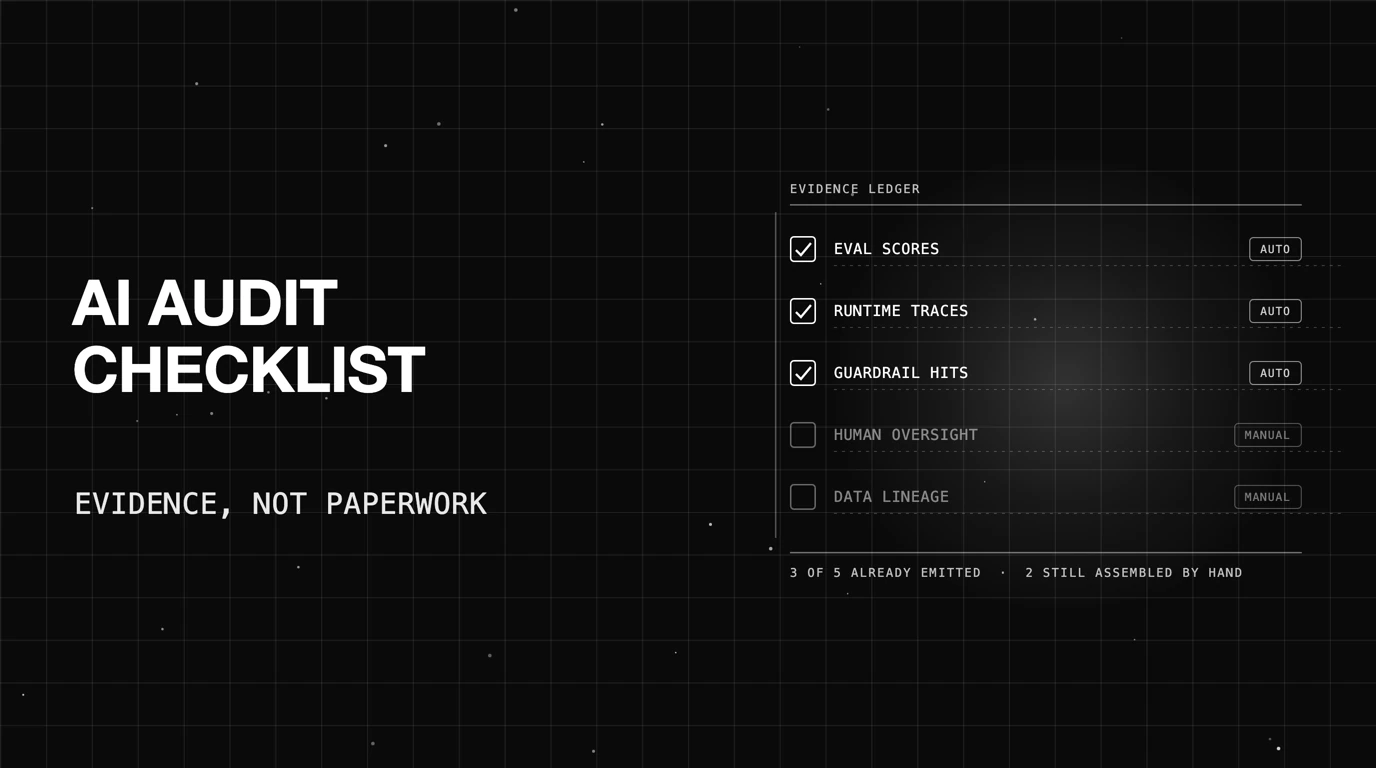
Table of Contents
An auditor asks a simple question: show me how this system handled the 40 loan applications it declined last March. You have the decisions. You do not have the model inputs, the scores, or what the reviewer saw before clicking approve. Two weeks of engineering time later, you have a spreadsheet that approximates it.
That gap is the whole problem. Most teams treat an audit as a documentation exercise, so they write documents. Auditors are asking for records of what actually happened, and those are produced by systems, not by people writing after the fact.
This post maps the categories on a working ai audit checklist to the evidence sources that already exist in a typical evaluation and observability stack, then covers the two or three gaps that usually remain.
Key takeaways
- Audit-ready means your system emits evidence continuously, not that you can assemble a document on request.
- The EU AI Act’s Article 12 is written around automatic logging, and Article 19 sets a six-month floor on keeping those logs.
- Most checklists split into four evidence categories, and three of them are usually already covered by tooling you run.
- The recurring gap is human oversight: teams log the approved action without logging what the human saw before approving it.
- “We can reconstruct it” is not the same claim as “we logged it,” and an auditor can tell the difference.
What “Audit-Ready” Actually Means for an AI System
There are two definitions in circulation and they lead to very different work. The first treats audit-readiness as a binder: policies, model cards, risk assessments, a data governance statement. The second treats it as a property of the running system.
The binder is necessary and it is not sufficient. A policy says a human reviews every high-risk output. That is a claim about intent. Evidence is a record showing that on 14 March, a named reviewer opened a specific case, saw a specific model output, and made a call.
The distinction shows up the moment an auditor picks a date and asks what happened. A document answers in general terms. A system answers with a row. If your only path to that row is an engineer writing a query against raw logs, you are reconstructing, not retrieving.
Why the EU AI Act pushes toward automatic logging
The wording of the regulation is the clearest signal here. Article 12 states that “high-risk AI systems shall technically allow for the automatic recording of events (logs) over the lifetime of the system.” The obligation is on the system’s technical capability, not on a team’s diligence.
Article 19 adds the retention floor. Providers must keep automatically generated logs under their control “for a period appropriate to the intended purpose of the high-risk AI system, of at least six months,” unless other Union or national law says otherwise.
Read together, those two articles describe a logging system, not a filing system. Something has to record events as they happen, and that record has to survive for months. Neither is achievable by assembling documentation when someone asks.
The date most checklists still get wrong
Plenty of guidance still says these obligations bite on 2 August 2026. That changed. Regulation (EU) 2026/1744, the Digital Omnibus on AI, was published in the Official Journal on 24 July 2026 and entered into force on 27 July 2026.
Under it, high-risk obligations for stand-alone Annex III systems now apply from 2 December 2027, and for AI embedded in products covered by sectoral safety law from 2 August 2028 (Cuatrecasas analysis). The Article 50 transparency obligations still apply from 2 August 2026, though generative-AI systems placed on the market before that date get a transitional window to 2 December 2026 for the Article 50(2) content-marking duty specifically.
Treat that as breathing room, not a reprieve. The logging capability in Article 12 is the slowest thing on the list to retrofit, because it has to be designed into how requests are handled. Teams that wait until 2027 will be reconstructing history they never recorded.
The Evidence Categories Every AI Audit Checklist Should Cover
Almost every published checklist reduces to four categories of evidence. Naming them separately matters, because each one has a different natural source, and mixing them is why teams think they have coverage when they have one category logged well and three barely at all.
Model and evaluation evidence answers whether the system was tested and how it scored. That means versioned evaluation runs against a fixed dataset, with results attached to the model version that produced them. A score with no record of what was tested proves nothing.
Runtime and trace evidence answers what the system actually did in production. A trace is the step-by-step record of the model calls, tool calls, and retrievals behind one response. This is the category auditors probe hardest, because it is where intent and behavior diverge.
Guardrail and safety evidence answers whether controls were live and firing. A configuration file showing a filter is enabled is weaker evidence than a log of the times that filter blocked something. Auditors read the second as proof of operation and the first as proof of intention.
Human-oversight and data-lineage evidence answers who was accountable and where the inputs came from. This is the category that most often fails, and we will come back to why.
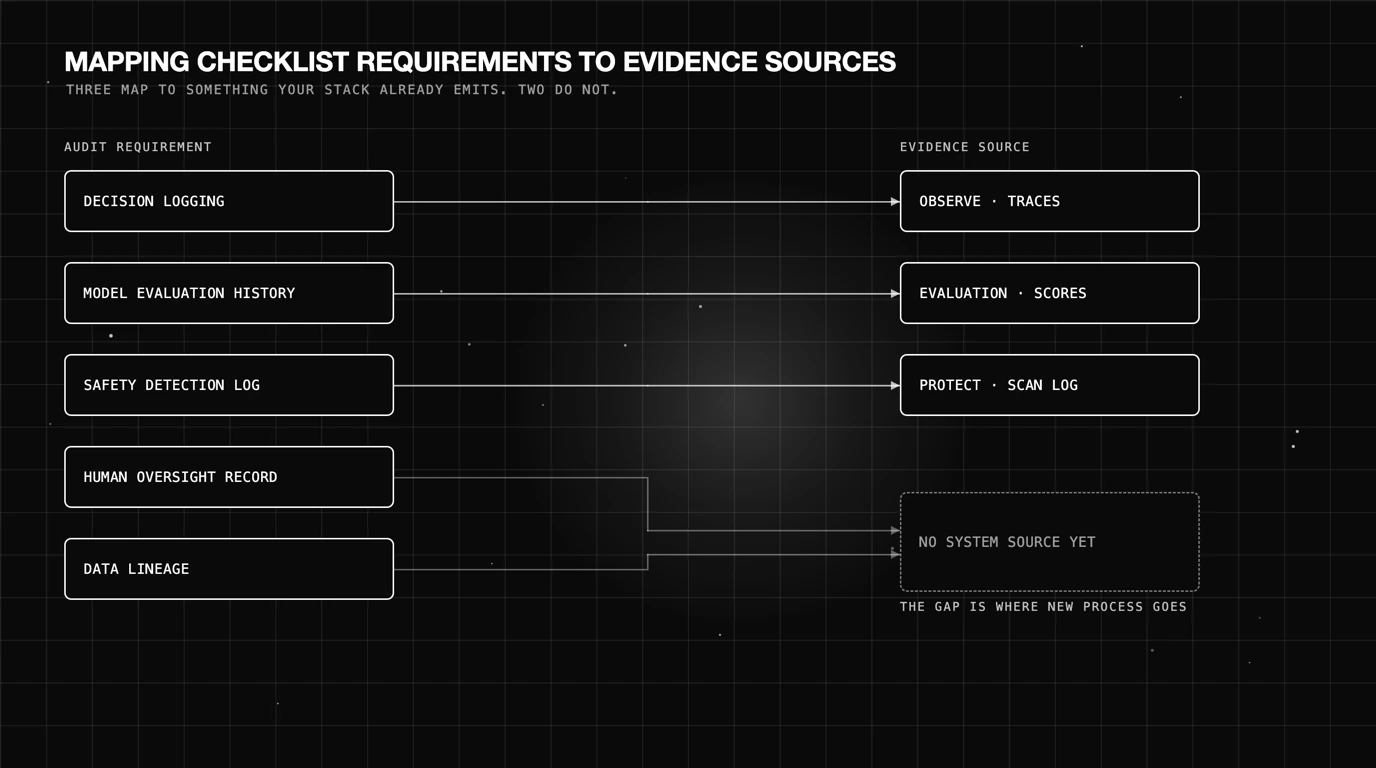
Table 1 — AI audit evidence checklist
| Requirement | Evidence needed | Typical source | Automatable? |
|---|---|---|---|
| Decision logging | Input, output, model version, and timestamp for each request | Runtime tracing | Yes, on every request |
| Human oversight record | Reviewer identity, what they saw, decision, time of decision | Annotation / review queue over traces | Yes for queued review; app-side work for in-flow approvals |
| Model evaluation history | Scored runs tied to a model version and a fixed dataset | Evaluation platform | Yes, on every release |
| Guardrail / safety detection log | Timestamped record of each detection and the action taken | Runtime guardrails | Yes, as detections occur |
| Data lineage | Source, version, and transformations of training and retrieval data | Data pipeline metadata | Partly, depends on pipeline design |
One column deserves a warning label. “Automatable” describes what the tooling can capture, not what it captures by default. Trace sampling, disabled guardrail logging, and short retention windows all turn an automatic source into a partial one, so check the settings before ticking the line.
The pattern in the last column is the useful part. Three of the five are produced automatically by tooling many teams already run. Two require deliberate work, and they are the two that turn into a scramble.
Manual Paperwork vs. Evidence Your Stack Should Already Be Generating
A compliance consultant hands you a collection list: risk assessment, model card, data governance policy, incident register, oversight procedure, testing report. It is a reasonable list. It is also a list of documents about the system rather than records from it.
What that framing misses is that the underlying facts already exist somewhere. Your tracing tool holds every production request. Your eval runs hold every score. Your guardrails hold every detection. The consultant’s list asks you to describe those facts in prose instead of pointing at them.
The cost difference is not marginal. Manual assembly means an engineer reconstructing a period from raw logs, pasting screenshots into a document, and someone signing it. That output is a snapshot, it is stale the day after it is produced, and nobody can verify it independently.
Automated evidence inverts every one of those properties. The record is written when the event happens, so it is not a reconstruction. It stays queryable, so the same question asked next quarter returns a fresh answer. And it is verifiable, because the auditor can watch you run the query.
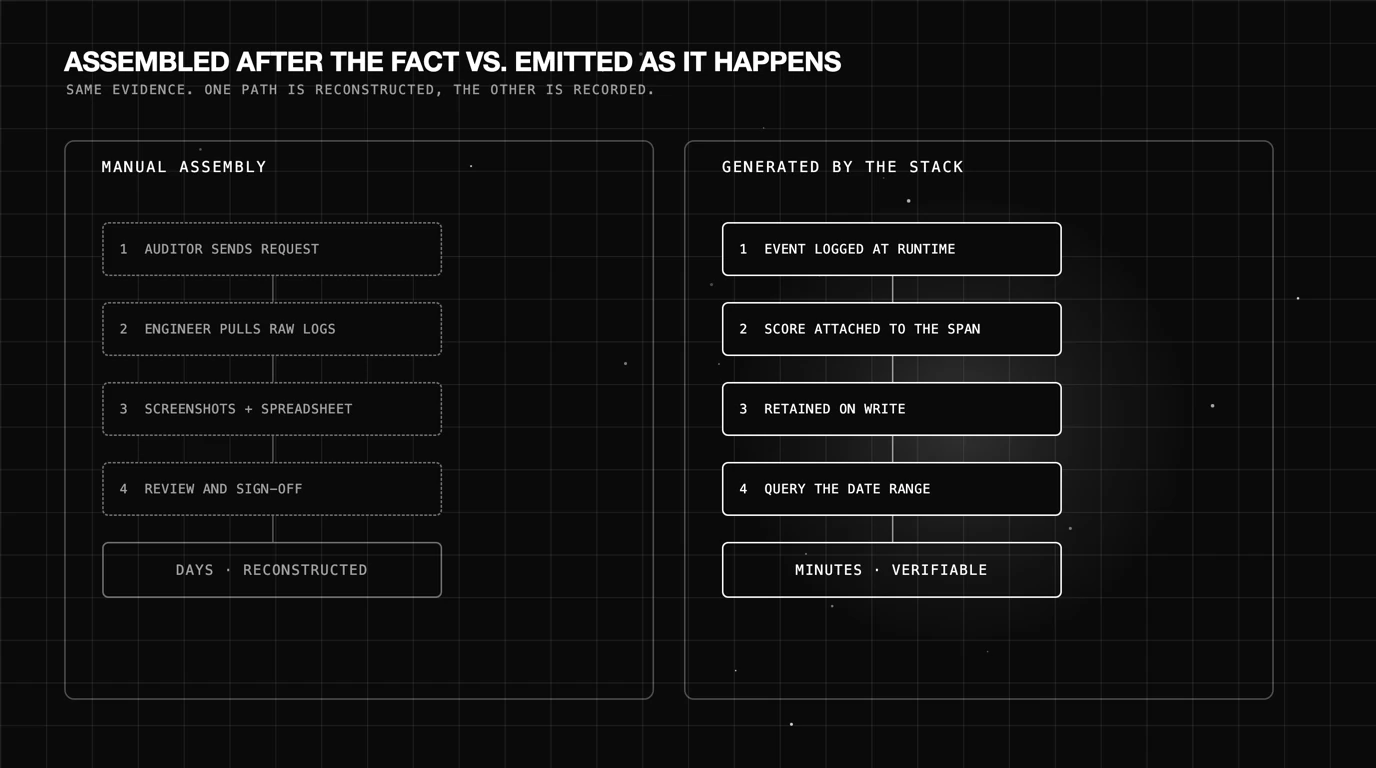
Table 2 — Manual vs. automated evidence
| Evidence type | Manual approach | Automated approach | Retrieval time | Verifiability |
|---|---|---|---|---|
| Model behavior record | Re-run tests, paste results into a report | Scored eval runs stored per model version | Hours to days vs. a query | Depends on who typed it vs. reproducible |
| Runtime / trace record | Grep application logs, rebuild the sequence by hand | Traces captured per request with timing and cost | Days vs. a filter on a date range | Partial reconstruction vs. the original record |
| Safety incident record | Ticket history and recollection | Timestamped detection log written as it fires | Uncertain vs. immediate | Narrative vs. system-generated |
What Does an AI Auditor Actually Ask For?
The requests are more specific than most teams expect. Not “do you evaluate your model” but “show me the evaluation that ran against the version deployed on this date, and the score threshold that let it ship.” Generic answers get follow-up questions until they become specific.
Expect them to pick a sample. An auditor takes a handful of real cases and traces each one end to end: what came in, what the model produced, what the guardrails saw, who reviewed it, what shipped. Any link in that chain you cannot produce is the finding.
Sampling is why partial coverage fails so visibly. You cannot choose the cases, so a category logged for 90% of traffic will eventually surface a case where it was not. Coverage on the happy path is not coverage, and auditors sample precisely to test that.
The gap: logging the action without logging what was seen
Here is the failure that recurs across almost every AI audit checklist review. The system logs that a human approved something. It does not log what that human was looking at when they approved it.
That distinction is the whole point of an oversight record. If the reviewer saw a model recommendation with a 0.94 confidence score and three supporting documents, the review means one thing. If they saw a bare yes/no with no context, it means something closer to nothing.
Auditors are increasingly direct about this, because rubber-stamping is the known failure mode of human-in-the-loop design. An approval timestamp with no accompanying context is evidence that a click happened. It is not evidence that oversight happened.
Why “we can reconstruct it” fails
Teams often answer a retention question by explaining that the data still exists across three systems and could be joined back together. That answer sounds fine and it is not what the requirement asks. Article 19 reads as a retention obligation, not a recoverability one.
There is a practical problem underneath the technical one. A reconstruction is produced by the party being audited, using judgment calls about which records to join and how. That is a fundamentally weaker artifact than a record written at the moment of the event.
Retention also has to be a property of the write path. If traces roll off after 30 days by default, a six-month requirement is not met by anyone’s good intentions. Set the retention window on the system that does the writing, then verify it by querying for something five months old.
Closing the Gaps in Your AI Audit Checklist Without a Rebuild
The instinct when a checklist arrives is to design new process for every line. That is how teams end up with a compliance workflow nobody follows. The better first move costs a day and usually removes most of the list.
Take each requirement and ask one question: which system already knows this? Decision logging is answered by your tracing tool. Evaluation history is answered by wherever eval runs are stored. Safety detections are answered by your guardrail layer. Write the answer next to each line, including the blanks.
The blanks are your actual project, and for most teams it is closer to one and a half lines than two. Data lineage genuinely needs pipeline work, because only your app knows which retrieval index served a chunk. Human oversight is largely solved by any review-queue system that attaches a reviewer’s decision to the trace they were looking at. What stays app-side is the in-flow approval a reviewer makes inside your own product, where only your app knows what was rendered on screen.
Then automate one category at a time, starting with whichever gets asked about most. Trying to close five gaps at once produces five half-instrumented paths. Closing one properly gives you something you can demonstrate, which is what changes the conversation with an auditor.
One caveat worth stating plainly. Adding a tool does not make an organization compliant, and no vendor can hand you compliance as a feature. Tooling produces evidence. Deciding which evidence your obligations require, and defending that decision, stays with you and your legal counsel.
Two neighbouring pieces cover the parts this post skips. Our AI agent compliance and governance playbook covers the runtime controls side, and the GenAI compliance framework covers how the EU AI Act, GDPR, and CCPA overlap in practice.
How Future AGI Produces Each Evidence Category
Future AGI is SOC 2 Type II, ISO 27001, HIPAA, GDPR and CCPA certified, with ISO/IEC 42001 in progress (trust centre). Read that for what it is: those certifications cover how the platform itself is run, not how you run your AI. Nothing a vendor holds makes your system compliant. What the platform does for your audit is produce the four evidence categories above as a by-product of normal operation, which is the part of the checklist that is genuinely tooling work.
On evaluation evidence, every eval run returns a score, which may be pass/fail, a number, or a category, and when an evaluator model is involved it also returns a plain-language reason. Custom evals let you define checks specific to your system, and a threshold on a score becomes an automated decision rather than a judgment call (Evaluation docs).
On runtime evidence, Observe captures traces as the step-by-step record of the model calls, tool calls, and retrievals behind one response, with latency and token columns per request. Sessions group related traces so you can follow a full conversation, or one customer across sessions (Observe docs).
The Error Feed sits on top of that and runs automatically on any Observe project once traces arrive. It detects failures such as hallucinated outputs, tool misuse, and safety violations, clusters similar traces into named issues, scores traces on four dimensions on a 0–5 scale, and tracks whether an issue is rising or falling (Error Feed docs).
On safety evidence, Protect is a real-time guardrailing layer that screens every model input and output as it flows through your application, across content moderation, bias, security including prompt injection and system prompt extraction, and data privacy including PII and GDPR/HIPAA violations. Results are logged within observability traces, which is what turns a control into a record (Protect docs).
On human-oversight evidence, Annotations turns a review into a record. Queues put traces, spans, sessions, dataset rows, prototype runs and simulation executions in front of named reviewers, so the reviewer is looking at the full trace rather than a bare yes or no. Each score stores the label applied, who applied it, and the queue it came from (Annotations docs). Queues support round-robin assignment and inter-annotator agreement across multiple reviewers, which is the difference between showing that a human signed off and showing the sign-off was consistent. That covers the queued-review half of the oversight row above; the in-flow approval inside your own product stays yours.
Where the audit boundary itself is the constraint, the platform can be self-hosted via Docker Compose, so that all traces, datasets, evaluations, and model calls stay within your network, including in air-gapped environments with no outbound dependencies (Self-hosting docs). If you are comparing this against gateway-level logging, we reviewed AI gateways for compliance audit trails separately.
Conclusion
An audit checklist should be a map, not a to-do list. Most of what an auditor wants already exists inside systems you run, scattered across an eval platform, a tracing tool, and a guardrail layer, and the work is pointing at it rather than writing it up.
Do the mapping pass first. Three of the usual five categories will already have a source. The two that do not, almost always human oversight and data lineage, are the real project, and they need instrumenting before someone picks a date and asks what happened.
Frequently Asked Questions
What is an AI audit checklist?
What does an AI auditor actually ask for?
What evidence do you need for an AI audit?
What are the EU AI Act's audit trail requirements?
How often should AI systems be audited?
Wire policy, enforcement, and audit into runtime so EU AI Act, NIST AI RMF, and ISO 42001 close on one plane without slowing releases.

Operational GenAI compliance framework for 2026: EU AI Act phase-in, GDPR Articles 22 and 25, CCPA, HIPAA, FCRA, with evaluator-driven evidence.
Five AI gateways on what compliance officers actually need: tamper-evident logs, 3-10 yr retention, SIEM exports, span granularity, legal hold, frameworks.
