NIST AI RMF vs ISO 42001 and How Engineering Teams Meet Both
NIST AI RMF vs ISO 42001 compared on purpose, certification and structure, plus a mapping from shared requirements to the evidence engineering teams produce.
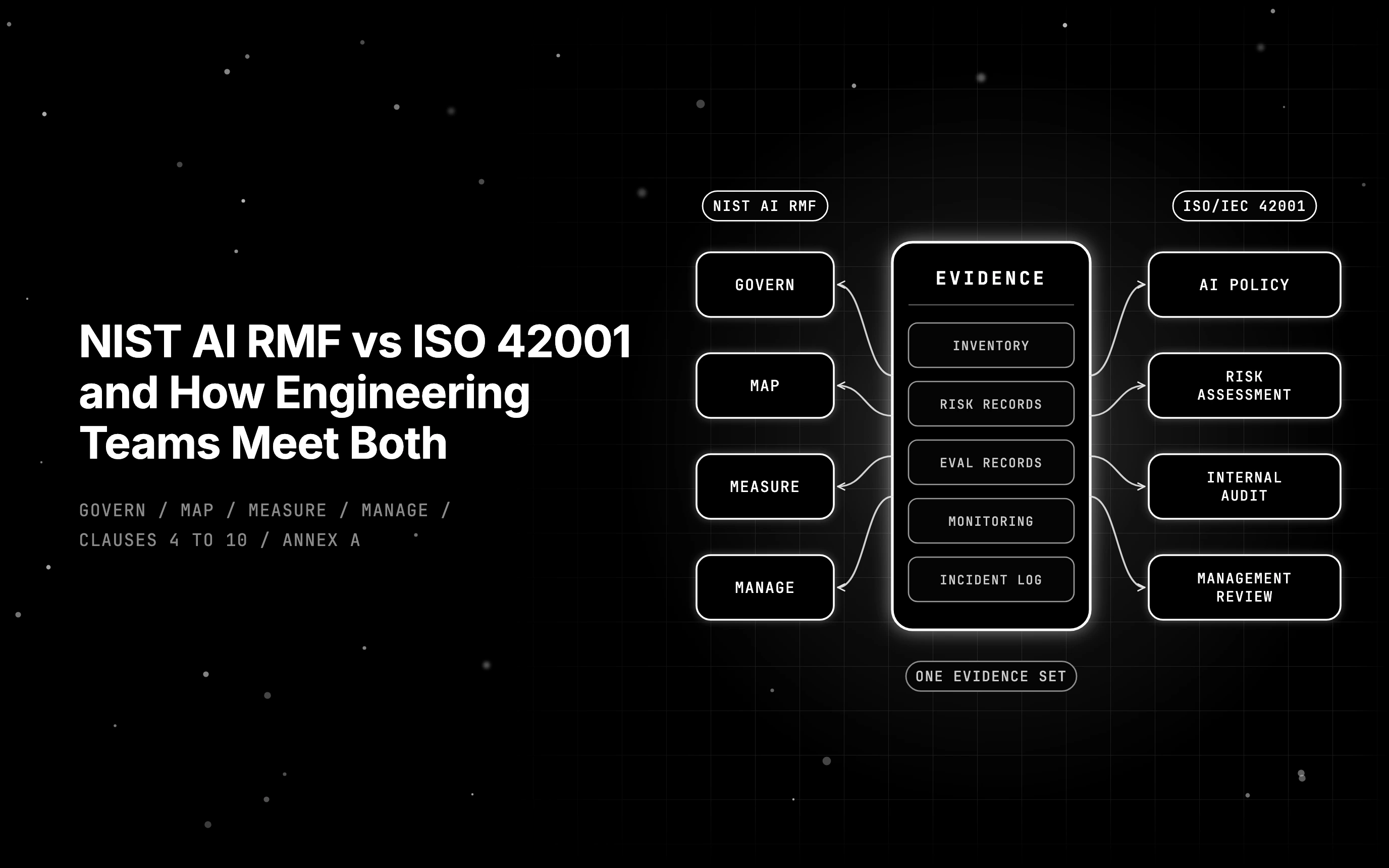
Table of Contents
A security questionnaire arrives from an enterprise buyer, and two lines in it stall the deal. One says “Describe your alignment with the NIST AI RMF.” The next asks “Are you ISO/IEC 42001 certified?” Sales forwards both to the engineering lead, because whatever the answer turns out to be, the evidence behind it lives in her systems.
The NIST AI RMF vs ISO 42001 question reads like a pick between rival standards, but the two answer different questions. The NIST AI Risk Management Framework is a voluntary US risk framework. ISO/IEC 42001 is an international management system standard that third-party certification bodies certify against. Most of the evidence for both comes from the same engineering records.
This guide compares the two side by side, settles which one is the “what” and which is the “how”, explains what the NIST-hosted crosswalk covers and what it leaves to you, and maps the shared requirements to five records an engineering team can produce, with the subcategory and clause IDs for each.
TL;DR
- The NIST AI RMF is a free, voluntary US framework built on four functions (Govern, Map, Measure, Manage), and NIST’s AI RMF pages describe no certification program for it.
- ISO/IEC 42001:2023 is a certifiable AI management system standard. Third-party certification bodies audit against it, and ISO/IEC 42006:2025 sets additional requirements for those bodies.
- ISO defines the system an auditor checks. The RMF supplies the risk method that runs inside it, most visibly in Measure.
- NIST lists a Microsoft crosswalk between the two, keyed to the 42001 final draft, and says the listing implies no NIST endorsement of ISO/IEC 42001.
- Five engineering records (inventory, risk records, eval records, production monitoring, incident log) serve both frameworks at once.
NIST AI RMF vs ISO 42001 side by side
The NIST AI RMF is a free, voluntary framework of risk outcomes organized into four functions: Govern, Map, Measure and Manage. ISO/IEC 42001:2023 is a paid, certifiable standard that sets requirements for an AI management system. One guides how you practice AI risk management, and the other defines a system an auditor can check against written requirements.
| NIST AI RMF 1.0 | ISO/IEC 42001:2023 | |
|---|---|---|
| Publisher and date | NIST, released January 26, 2023 | ISO and IEC (JTC 1/SC 42), published December 2023, Edition 1, 51 pages |
| Purpose | Manage AI risks and build trustworthiness into the design, development, use and evaluation of AI systems | Requirements for establishing, implementing, maintaining and continually improving an AI management system |
| Binding or voluntary | Voluntary. NIST’s FAQ answers “No” to whether organizations are required to use it | Voluntary to adopt; its requirements become audit criteria once you seek certification |
| Certifiable | No certification program on NIST’s AI RMF pages | Yes, through third-party certification bodies; ISO/IEC 42006:2025 adds requirements for them on top of ISO/IEC 17021-1 |
| Structure | 4 functions split into categories and subcategories, plus Profiles and the Playbook | Clauses 4 to 10 in the harmonized structure, Annex A reference controls and Annex B implementation guidance (both normative), informative Annexes C and D |
| Who checks it | Self-assessment or a third party you choose | A third-party certification body |
| Documentation outputs | Current and Target Profiles, risk records per subcategory | Scope, AI policy, risk assessment and treatment, statement of applicability, AI system impact assessment, internal audit and management review records |
| Cost to access | Free PDF | Purchased from ISO or a national standards body |
| Generative AI companion | NIST AI 600-1 (July 2024) | None inside ISO/IEC 42001 |
The row that changes most decisions is certification. A buyer who asks for a certificate can only be answered by ISO/IEC 42001, because the RMF has no certificate to show. A buyer who asks how you measure AI risk gets a better answer from the RMF, because its Measure function names the testing and monitoring outcomes in detail.
What the NIST AI RMF asks of an AI team
The NIST AI RMF sets outcomes and leaves the choice of controls to you. Its Core “provides outcomes and actions”, and NIST adds that the actions “do not constitute a checklist”. Teams pick the subcategories that fit their risk, then record where they stand in a Current Profile and where they want to be in a Target Profile.
NIST released AI RMF 1.0 (NIST AI 100-1) on January 26, 2023. The NIST AI Risk Management Framework page describes it as intended for voluntary use.
The NIST AI RMF FAQs put it bluntly: asked whether organizations will be required to use the Framework, NIST answers “No.”
Govern, Map, Measure and Manage in engineering terms
Govern sets policy, roles and accountability, and it includes Govern 1.6, which asks for mechanisms to inventory AI systems. Map frames the context, the intended use and the risks of each component, third-party data and software included. Measure is where testing lives. Manage decides what to do about measured risks, including incident response and decommissioning.
Measure carries most of the engineering load. Measure 2.1 asks that test sets, metrics and details about the tools used during TEVV (test, evaluation, verification and validation) are documented. Measure 2.3 asks that performance is measured for conditions similar to deployment, and Measure 2.4 asks that the system’s functionality and behavior are monitored in production.
The AI RMF Playbook offers suggested actions for each subcategory, and NIST says it “is neither a checklist nor set of steps to be followed in its entirety.”
The Generative AI Profile (NIST AI 600-1)
NIST published the Generative AI Profile (NIST AI 600-1) on July 26, 2024. It defines 12 risks “unique to or exacerbated by” generative AI, among them Confabulation, Information Security, and Value Chain and Component Integration.
The profile keeps the RMF’s structure and hangs suggested actions on the same subcategories, so the IDs you already track under AI RMF 1.0 still apply. GV-1.6-001, for example, tells you to enumerate generative AI systems for incorporation into your AI system inventory, which ties straight back to Govern 1.6.
A revision is in progress
NIST’s framework page states: “The AI RMF 1.0 is being revised as part of the White House AI Action Plan.” The AI RMF page on NIST’s AI Resource Center adds that “A revised version is in progress.”
No revised text is published as of 2026-11-01, and the Playbook page says the Playbook will be updated after the revision. Until then, build on the 1.0 subcategory IDs, which the crosswalk also uses, and keep your mappings in one table so a new version means a single re-check pass.
What ISO 42001 requires before an auditor signs off
ISO/IEC 42001 is a management system standard. Its published contents run from scope and AI policy through AI risk assessment, risk treatment and impact assessment to internal audit and management review, with Annex A as the reference set of controls. Certification rests on showing that this system actually runs.
ISO/IEC 42001:2023 was published in December 2023 by the joint ISO and IEC committee on artificial intelligence, JTC 1/SC 42. ISO says it “specifies requirements for establishing, implementing, maintaining, and continually improving” an AI management system.
Clauses 4 to 10 and why they look like ISO 27001
Its introduction says it applies the harmonized structure: identical clause numbers, clause titles, text, and common terms and core definitions across management system standards. Clauses 4 to 10 cover context, leadership, planning, support, operation, performance evaluation and improvement. A team that already runs an ISO/IEC 27001 management system can reuse much of that scaffolding.
Annex A controls and the statement of applicability
The public table of contents lists Annex A, Reference control objectives and controls, and Annex B, Implementation guidance for AI controls, and marks both normative. The NIST-hosted crosswalk cites that guidance in areas numbered B.2 to B.10, from B.2.2 AI policy to B.10.4 Customers.
The introduction adds that organizations can apply the requirements with a risk-based approach, so the level of control fits each AI use case, product or service in scope.
The statement of applicability is where those control choices are recorded. Confirm the exact requirement in your licensed copy of the standard.
SAP’s ISO 42001 statement of applicability page, for one, says it benchmarks against the Annex A control set.
A workable layout is one row per Annex A control, with your decision, the reason and a pointer to the evidence that the control runs.
How certification works
Certification is a third-party audit. A certification body checks the management system against the clauses and the controls you selected, then issues a certificate when it conforms. ISO describes 42001 as a management system standard run on the Plan-Do-Check-Act cycle, so the auditor looks for a system in operation: records, internal audits and management reviews.
The certifiers have their own rulebook. ISO/IEC 42006:2025, published in July 2025, sets additional requirements for bodies that audit and certify AI management systems, building on ISO/IEC 17021-1. ISO says accreditation bodies that assess those certifiers use it as well.
Which framework is the “what” and which is the “how”?
Going by the source texts, ISO/IEC 42001 defines what must exist and be provable: a management system with written requirements. The NIST AI RMF supplies how to find, measure and treat AI risk inside that system, through outcomes and Playbook actions.
The primary documents support this split. NIST describes the AI RMF Core as providing “outcomes and actions”, and the Playbook as a way to reach those outcomes “through suggested tactical actions”. ISO describes 42001 as a standard that specifies requirements for an AI management system, implemented with the Plan-Do-Check-Act cycle.
So ISO/IEC 42001 is the system and audit layer, and the NIST AI RMF is the risk-practice layer that fills it. A 42001 system needs an AI risk assessment process that someone runs and records. The RMF’s subcategories, Measure above all, give that process concrete testing and monitoring outcomes an engineering team can act on.
Where NIST AI RMF and ISO 42001 overlap in the NIST-hosted crosswalk
NIST’s crosswalk page lists crosswalks submitted by the AI RMF user community, including one mapping to ISO/IEC 42001 provided by Microsoft. NIST states that inclusion “does not imply NIST endorsement” of the mapped resource, nor that “either resource comprehensively covers the contents of the other.”
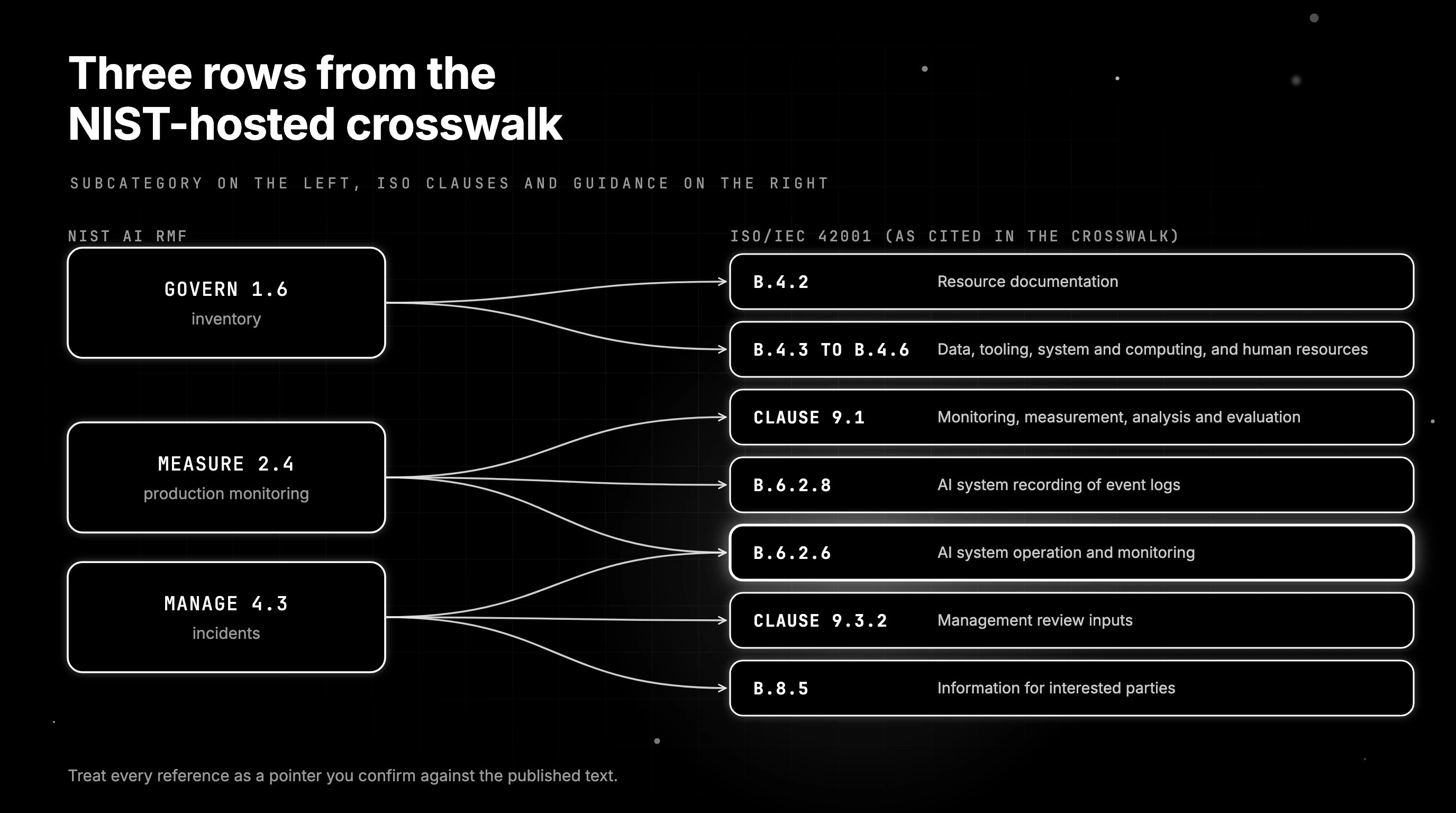
The NIST AI RMF to ISO/IEC 42001 crosswalk (PDF) is one long table. Each AI RMF subcategory sits on the left, with the ISO clauses and guidance it maps to on the right. Three rows show how the NIST AI RMF and ISO 42001 crosswalk treats records an engineering team already keeps:
- Govern 1.6 (inventory) maps to B.4.2 Resource documentation plus B.4.3 to B.4.6, the data, tooling, system and computing, and human resources guidance.
- Measure 2.4 (production monitoring) maps to clause 9.1 Monitoring, measurement, analysis and evaluation, B.6.2.6 AI system operation and monitoring, and B.6.2.8 AI system recording of event logs.
- Manage 4.3 (incidents) maps to clause 9.3.2 Management review inputs, B.8.5 Information for interested parties, and B.6.2.6.
What the crosswalk leaves to you
The PDF’s own title reads “NIST AI RMF to ISO/IEC FDIS 42001”, so it was keyed to the final draft, not the published standard. Its file metadata shows a creation date of 2023-05-23, about seven months before ISO published 42001 in December 2023. Treat every reference as a pointer you confirm against the published text.
The second gap is numbering. The crosswalk cites Annex B guidance numbers such as B.4.2 Resource documentation, while a statement of applicability works from the Annex A control list. Use the guidance title to find the matching Annex A control in your licensed copy, and record each pair before it goes into your statement of applicability.
Turning shared requirements into engineering evidence
Auditors and RMF assessors ask for the same proof: which AI systems you run, how you tested them, how you watch them in production, and what you did when something broke. Build those records once, from the systems that already produce them, and both frameworks can draw on the same set.
Our AI audit checklist breaks evidence into broader categories. The table here is narrower: five records, each tied to the IDs the crosswalk gives.
Table 2 is our mapping, built from the NIST crosswalk and the standard’s clause titles. It is not a NIST or ISO artifact. The ISO column keeps the crosswalk’s clause and Annex B numbers, so match each B.x reference to its Annex A control in your licensed copy and treat every cell as a starting point.
| Evidence artifact | What engineering produces | NIST AI RMF subcategories | ISO/IEC 42001 references (as cited in the crosswalk) | Refresh cadence |
|---|---|---|---|---|
| AI system inventory | Registry of models, prompts, providers, owners and intended use | Govern 1.6, Map 4.1 | B.4.2 to B.4.6, 4.1, B.9.4 | On every deploy |
| Risk and impact records | Risk assessment, intended-use statement, impact assessment | Govern 1.3, 1.4, 1.5, Measure 1.1 | 6.1.1, 6.1.2, 6.1.3, 8.2 to 8.4 | Per release |
| Evaluation records | Test sets, metrics, tool versions, scores, pass thresholds | Measure 2.1, 2.3, 2.11 | B.6.2.4, B.6.2.7, B.4.2, B.6.2.6, B.5.4, B.5.5 | Per release and on a schedule |
| Production monitoring and event logs | Traces of live requests, drift and quality checks on live traffic | Measure 2.4, Manage 4.1 | 9.1, B.6.2.6, B.6.2.8, 9.2.1 (internal audit) | Continuous |
| Incident and change log | Incident tickets, response and disclosure, rollback and decommission decisions | Govern 4.3, Manage 2.4, Manage 4.3 | B.8.4, B.8.5, 9.3.2, B.6.2.7 | Per event |
An inventory an auditor can trust
Govern 1.6 asks for mechanisms to inventory AI systems, and the generative AI profile adds generative systems to that inventory. A hand-kept spreadsheet goes stale the first time someone ships without updating it. Generate the registry from config and deploy pipelines instead: every model, prompt version, provider, owner and intended use, refreshed on each deploy.
If model choice itself needs a paper trail, a repeatable model approval process gives each inventory entry a scorecard and a sign-off.
Evaluation records that can be rerun
Measure 2.1 wants test sets, metrics and tool details documented, and Measure 2.3 wants performance shown for conditions similar to deployment. A useful eval record holds the dataset version, the evaluator, the score, the pass threshold and the date. Drop the dataset version or the evaluator and nobody can rerun the test.
Production monitoring from traces
Measure 2.4 asks that the system’s behavior is monitored in production. On the ISO side, the NIST-hosted crosswalk maps Measure 2.4 to clause 9.1 and to the guidance on AI system operation and monitoring (B.6.2.6) and AI system recording of event logs (B.6.2.8). Traces of live requests feed both.
A Future AGI trace is a timed, structured tree with inputs, outputs and cost at every step, and each eval run returns a score with a plain-language reason when an evaluator model is involved. Both are raw material for the evidence Measure 2.1, 2.3 and 2.4 call for.
Incident logs that close the loop
Manage 4.3 asks that incidents and errors are communicated and that tracking, response and recovery are followed and documented. Give every incident ticket three links: the trace that showed the failure, the eval that should have caught it, and the change that fixed it. That record then feeds management review inputs under clause 9.3.2.
Should you start with NIST AI RMF or ISO 42001?
The order follows whoever is asking. A contract that demands a certificate can only be met by ISO/IEC 42001, which puts the management system on the roadmap. A questionnaire about how you test and monitor AI risk is answered faster with an RMF Profile. Both routes draw on the five records in Table 2, so build those first.
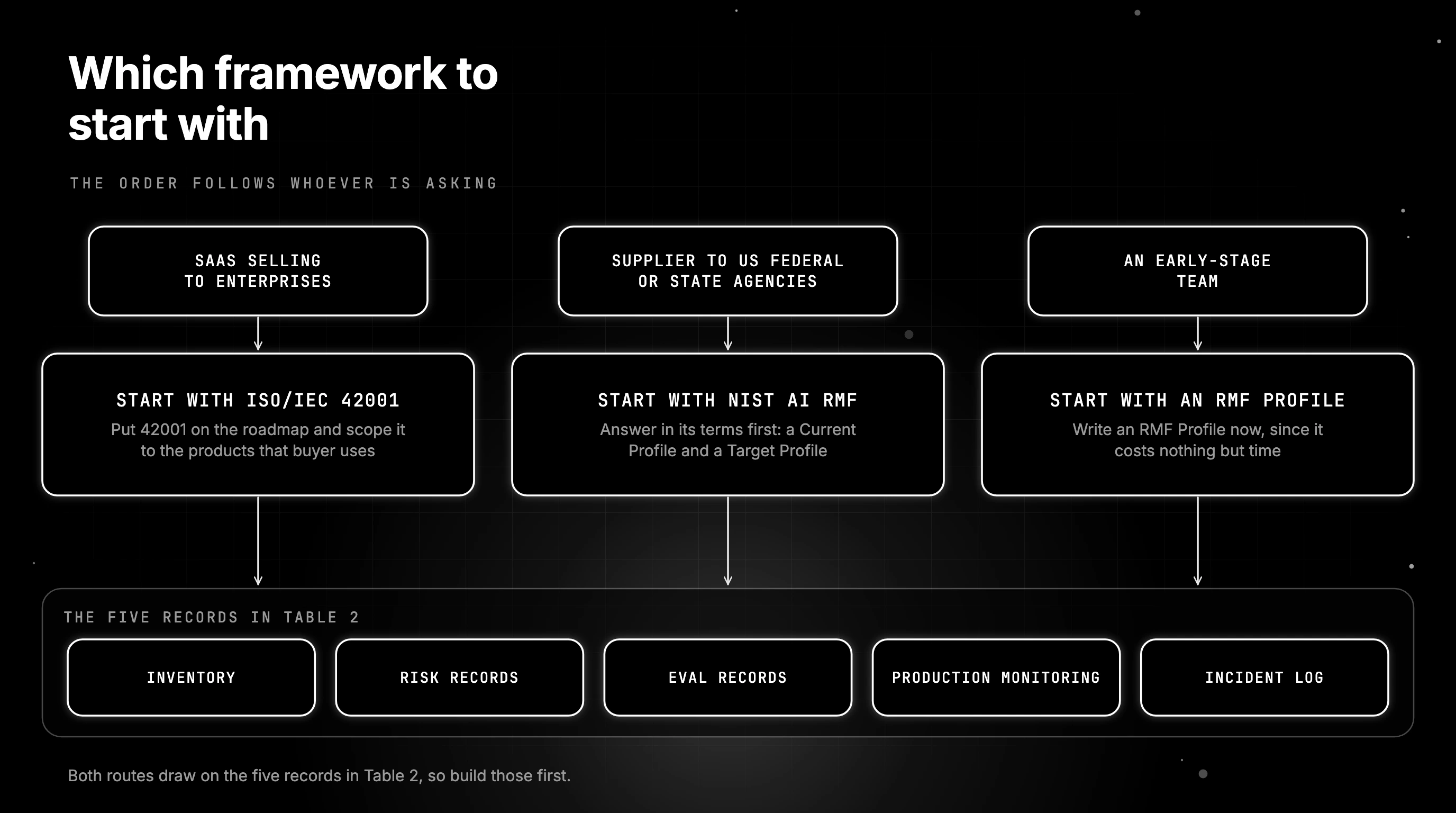
SaaS selling to enterprises. When a buyer’s questionnaire asks for a 42001 certificate, a NIST alignment statement will not answer it. Put 42001 on the roadmap, scope the management system to the products that buyer uses, and borrow the RMF’s Measure subcategories to give the testing part of your system real depth.
A supplier to US federal or state agencies. If the solicitation or questionnaire names the NIST AI RMF, answer in its terms first: a Current Profile, a Target Profile and the evidence behind each subcategory you claim. Our roundup of evaluation platforms for government teams covers the tooling side.
An early-stage team. Write an RMF Profile now, since it costs nothing but time, and keep the Table 2 records from your first production release. When a contract asks for 42001, the evidence already exists, and the remaining work is the management system around it: policy, scope, statement of applicability and internal audit.
Neither AI governance framework is law. The EU AI Act is a separate legal obligation with its own dates, and neither framework replaces it; see the EU AI Act timeline after the Digital Omnibus.
One evidence set for the questionnaire
Back to the two lines on the questionnaire. The engineering lead answers the NIST question with a Profile whose subcategories point to the inventory, the eval records and the trace-based monitoring. She answers the ISO question with a 42001 plan, and its statement of applicability cites the same records under Annex A control IDs.
Neither answer was written for the questionnaire, because the records come from systems that already run on every release. This week, pull your current model inventory and one release’s eval records, map them to the rows of Table 2, and mark the gaps. That gap list is the first draft of both answers, and the start of your roadmap.
Frequently Asked Questions
Is there a NIST AI RMF certification?
How does ISO 42001 certification work?
Is there an official NIST AI RMF to ISO 42001 crosswalk?
Can you use NIST AI RMF and ISO 42001 together?
What is NIST AI 600-1?
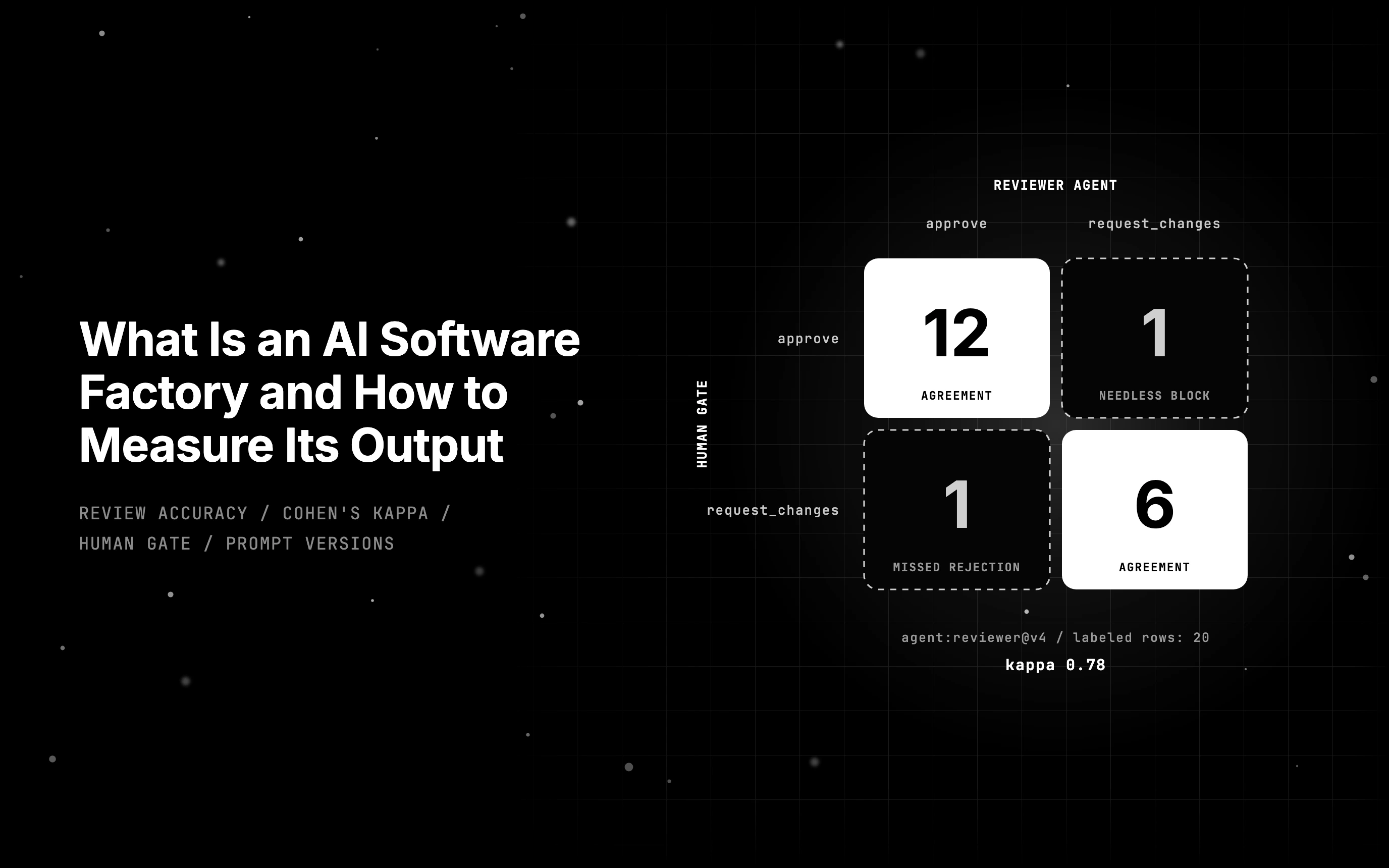
An AI software factory turns specs into shipped code with agents. See where the idea came from and how to score reviewer agents against human review verdicts.

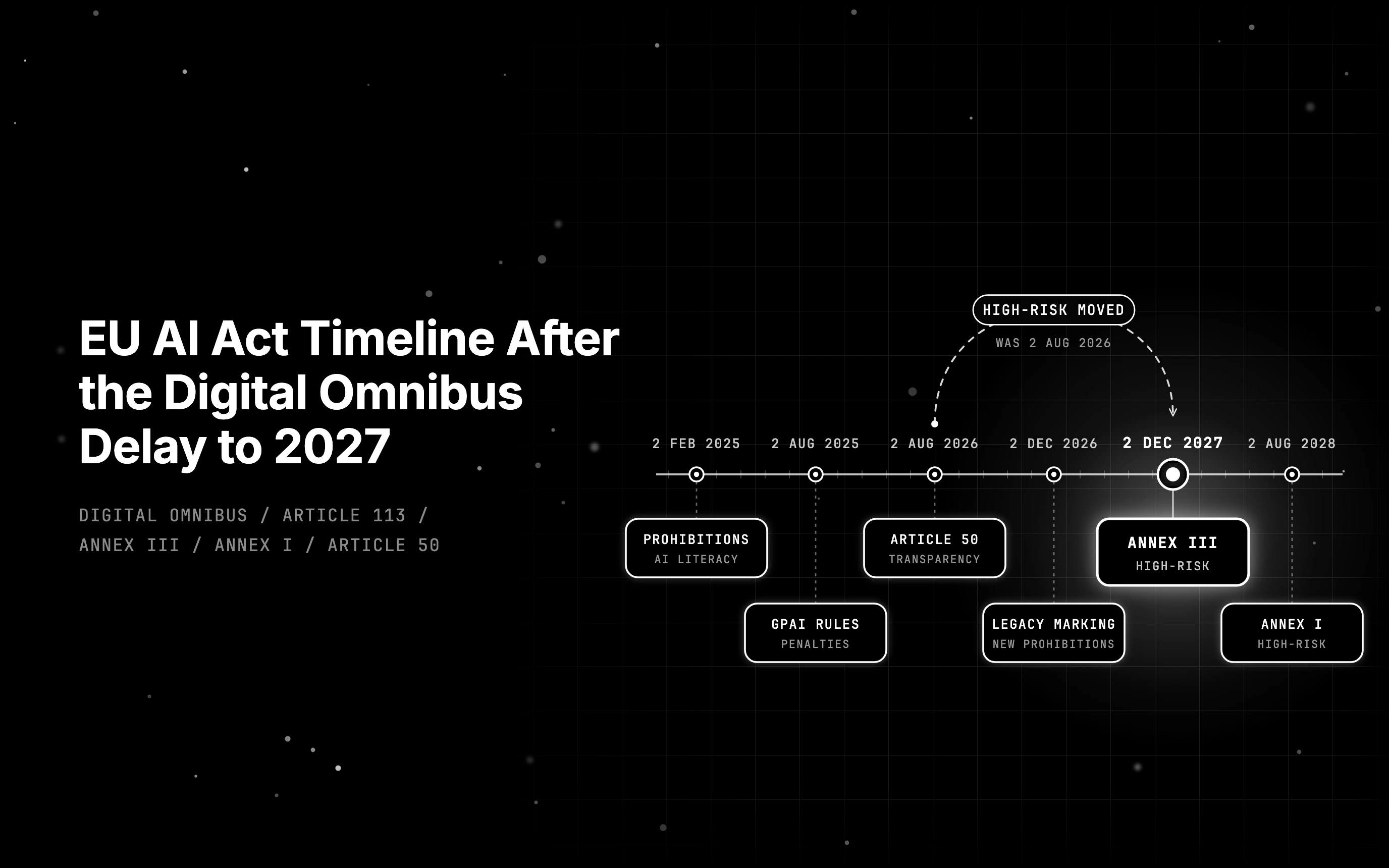
The EU AI Act timeline after Regulation (EU) 2026/1744: every date from 2024 to 2030, what the Omnibus moved, and a per-date checklist for AI agent teams.

Compare Meta Muse and OpenAI Dots on setup, approvals, privacy, price and regions, from each company's own pages, to see which always-on agent fits your budget.