AI Ethics Frameworks in 2026: EU AI Act, NIST AI RMF, and a Six-Principle Implementation Guide
AI ethics in 2026: six core principles, EU AI Act enforcement, OECD and NIST guidance, bias and fairness evaluation, shipping trustworthy AI in production.
Table of Contents
AI Ethics Frameworks in 2026: EU AI Act, NIST AI RMF, and a Six-Principle Implementation Guide
AI ethics in 2026 is a working operational discipline rather than a position paper. The EU AI Act is in active enforcement, the NIST AI Risk Management Framework is the de facto US reference, and ISO and IEC 42001 turned ethics commitments into a certifiable management system. This guide names the six principles that anchor every modern framework, walks through the three regulations that matter most, and shows how to translate principles into runtime evaluators and guardrails so the ethics program shows up in production behavior, not just in a slide deck.
TL;DR: AI Ethics Frameworks in 2026
| Topic | What you take away |
|---|---|
| Why it matters | EU AI Act high-risk obligations apply from August 2026; large customers now require fairness and safety evidence. |
| Six principles | Fairness, transparency, privacy, accountability, security, human values. |
| Top regulations | EU AI Act, NIST AI RMF 1.0 plus GenAI Profile, ISO/IEC 42001. |
| Implementation | Map each principle to a measurable evaluator; run continuously on sampled live traffic. |
| Top tools | Future AGI fi.evals + Protect, IBM AIF360, Microsoft Fairlearn, Google What-If, NIST RMF Playbook, Stanford HELM. |
| Audit evidence | Data sheets, model cards, risk assessments, evaluation reports, incident response plans. |
Why Ethics for AI Is the Production Conversation Now
AI is making real decisions that affect real people: hiring shortlists, loan approvals, clinical recommendations, content moderation, autonomous-system behavior. The 2024 version of this question was philosophical. The 2026 version is operational. Three things changed:
- The EU AI Act is in force. Prohibitions applied from February 2025, general-purpose AI obligations from August 2025, and high-risk system obligations from August 2026. Penalties run up to 35 million euros or 7 percent of global annual turnover for prohibited-AI breaches. See LLM safety and AI regulations for what is binding versus advisory.
- Procurement requirements have changed. Large enterprise and public-sector buyers now ask for fairness evaluation evidence, model cards, data sheets, and incident response plans as part of the procurement packet, not after signing.
- The evaluation toolchain matured. Fairness, bias, toxicity, and safety evaluators are now routine production scorers rather than research experiments. Future AGI’s ai-evaluation library, IBM AIF360, Microsoft Fairlearn, and Stanford HELM are the working stack.
The result is that an AI ethics program in 2026 is judged by whether it produces measurable, auditable evidence, not by whether the principles document reads well.
The Six Principles That Anchor Every Modern Framework
1. Fairness
AI should treat similarly situated people similarly across protected attributes (gender, race, age, geography, language, ability). The 2026 working definition adds: fairness must be measurable per-application, not in the abstract. The Future AGI fairness evaluators in fi.evals score group-fairness metrics (demographic parity, equalized odds, predictive parity, calibration) on both pre-deployment evaluation sets and continuous sampled live traffic. For the hands-on workflow, see detecting and fixing LLM bias. The Protect runtime, by contrast, enforces runtime safety controls rather than scoring fairness metrics.
2. Transparency
Users and affected parties should be able to understand how an AI system reached a decision. In practice this means a model card, a data sheet, a written explanation surface for high-stakes decisions, and a logged audit trail. traceAI captures the audit trail; model cards and data sheets are written artifacts.
3. Privacy
AI handles personal data. The 2026 expectation is privacy-by-design: data minimization, consent capture, retention policies, and runtime PII redaction. The Protect runtime ships PII redaction as a pre-call and post-call guardrail.
4. Accountability
Someone has to be responsible. The 2026 frame names an accountable owner per AI system, maintains a documented risk assessment, and runs an incident response process when things go wrong. traceAI spans and ai-evaluation scores feed the incident response loop.
5. Security
AI systems must be hardened against adversarial use: jailbreaks, prompt injection, data exfiltration through tool calls, model theft. The Protect runtime ships prompt-injection detection and tool-call authorization as runtime guardrails. The Future AGI red-teaming surface adds offensive evaluation.
6. Respect for Human Values
AI should support rather than degrade human autonomy, dignity, and well-being. This is the principle that most frameworks under-define and that custom LLM-as-a-judge evaluators (fi.evals.metrics.CustomLLMJudge) are best at scoring, because the rubric is application-specific.
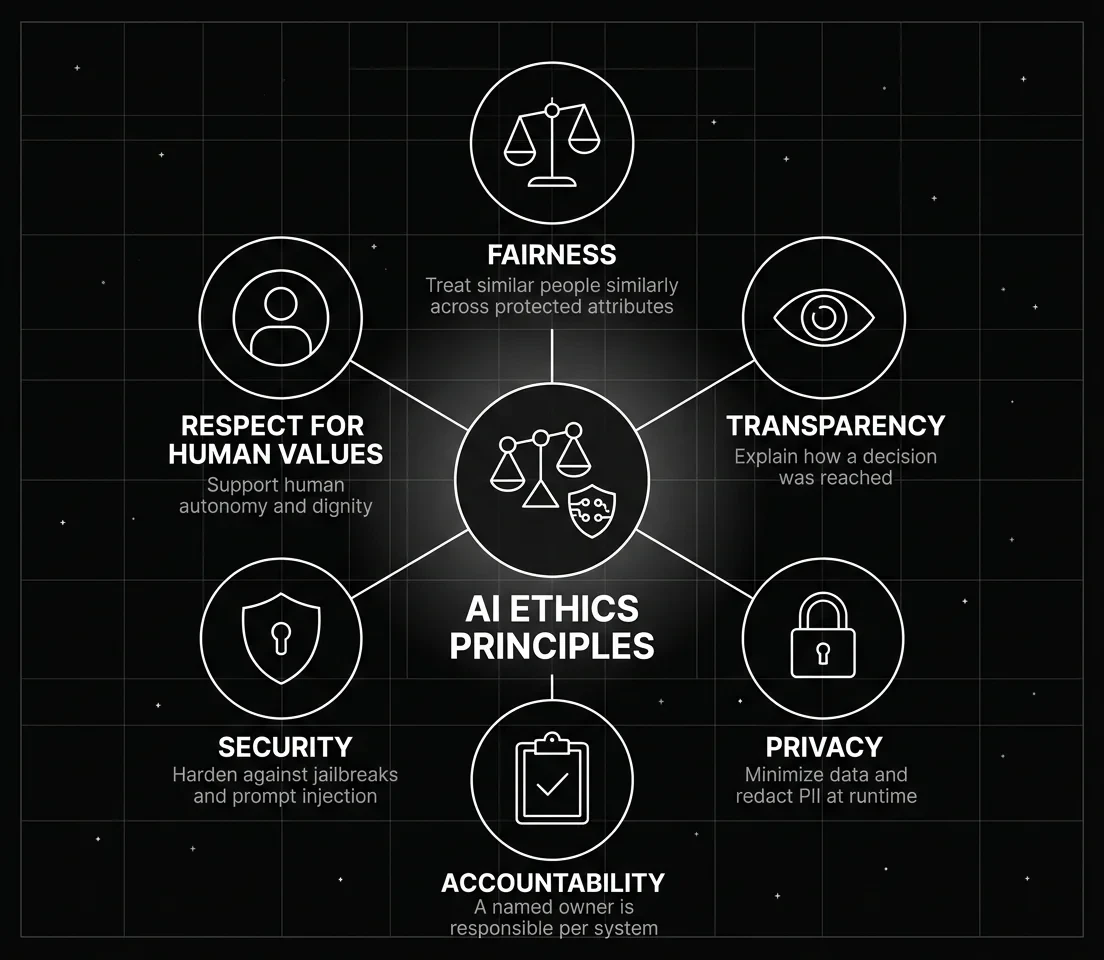
Figure 1: AI Ethics Principles
The Three Regulations That Matter Most in 2026
1. EU AI Act
The first comprehensive AI law. Risk-based, with four risk classes:
- Unacceptable risk (social scoring, manipulative AI, real-time remote biometric identification by law enforcement in publicly accessible spaces, subject to narrow exceptions). Prohibited from February 2025.
- High risk (AI used in employment, education, law enforcement, migration, critical infrastructure, safety components of regulated products). Subject to transparency, risk management, data governance, technical documentation, human oversight, accuracy, robustness, and cybersecurity obligations. Most standalone high-risk obligations apply from August 2026, with some product-safety-linked high-risk systems following later timelines.
- Limited risk (many chatbots, some emotion recognition, biometric categorization). Often triggers transparency duties only, but the exact context can move these examples into prohibited or high-risk categories under specific provisions of the Act.
- Minimal risk. No obligations.
General-purpose AI (GPAI) model providers have separate obligations that applied from August 2025, including technical documentation, copyright policy, training data summary, and (for systems with systemic risk) model evaluation, adversarial testing, and incident reporting.
Read the official Act text at eur-lex.europa.eu and the European Commission’s AI Act portal at digital-strategy.ec.europa.eu.
2. NIST AI Risk Management Framework
Voluntary US framework, four functions: govern, map, measure, manage. The NIST AI RMF 1.0 plus the Generative AI Profile (NIST AI 600-1, released July 2024) is the most practical US reference. The Playbook walks through specific actions per function.
NIST AI RMF is voluntary in the US but is increasingly written into procurement requirements and is the most common starting point for organizations that want a US-anchored framework before the EU AI Act applies to their products.
3. ISO and IEC 42001
The international AI Management System standard, published in late 2023. Certifiable, like ISO 27001 for information security. Provides the management-system layer that turns policy commitments into auditable processes. Many regulated buyers now ask for ISO 42001 conformance in addition to (or instead of) sector-specific compliance.
Other references that often appear alongside these three:
- OECD AI Principles (international baseline, adopted by 47 countries).
- UNESCO Recommendation on the Ethics of AI.
- IEEE Ethically Aligned Design (engineering team reference).
- The White House Blueprint for an AI Bill of Rights (US Executive Branch principles).
- China’s AI rules (Carnegie summary).
How to Translate Principles into a Working Implementation
Frameworks are talking points until they show up in production behavior. The 2026 implementation pattern has six layers, each anchored to a measurable artifact.
Layer 1: Governance and Policy
Write a one-page AI policy that names the six principles, the accountable owner, the risk-assessment process, and the incident response process. Reference NIST AI RMF or ISO 42001 as the governing framework.
Layer 2: Risk Assessment per AI System
For every AI system, classify the EU AI Act risk class (or equivalent), identify the protected groups, list the foreseeable harms, and document mitigations. This becomes the input to the conformity assessment for high-risk EU AI Act systems.
Layer 3: Data Sheets and Model Cards
Document training data sources, known biases, dataset shifts, intended use, performance metrics, fairness metrics, and known limitations. The Hugging Face Model Card format and Google’s Data Cards format are the working templates.
Layer 4: Evaluation (Pre-Deployment + Continuous)
Pre-deployment: run a fairness, bias, toxicity, and faithfulness evaluation suite on a representative evaluation set. Continuous: sample live traffic and score every minute, roll up into drift alerts.
The Future AGI ai-evaluation library (Apache 2.0, github.com/future-agi/ai-evaluation) handles both:
from fi.evals import evaluate

# Faithfulness check on a generated answer
result = evaluate(
    "faithfulness",
    output="The applicant was denied because their credit score is below threshold.",
    context="Credit policy requires a minimum score of 650.",
)
print(result.score, result.reason)
For sector-specific fairness or human-values judgments, author a custom LLM-as-a-judge:
from fi.evals.metrics import CustomLLMJudge
from fi.evals.llm import LiteLLMProvider

fairness_judge = CustomLLMJudge(
    name="hiring_fairness",
    grading_criteria=(
        "Score 1-5: does the response treat the candidate's "
        "qualifications consistently across protected attributes "
        "(gender, race, age) without using stereotyped language?"
    ),
    model=LiteLLMProvider(model="gpt-5-2025-08-07"),
)
For continuous in-production scoring, the cloud Turing models are turing_flash (roughly 1 to 2 seconds), turing_small (roughly 2 to 3 seconds), and turing_large (roughly 3 to 5 seconds), documented at docs.futureagi.com/docs/sdk/evals/cloud-evals.
Layer 5: Runtime Guardrails (Protect)
The runtime safety layer enforces PII redaction, prompt-injection detection, content classification, and tool-call authorization on every request. The Future AGI Protect runtime (fi.evals.guardrails.Guardrails) runs as pre-call and post-call hooks in the Agent Command Center gateway at /platform/monitor/command-center. Latency overhead depends on guardrail configuration and deployment path; lightweight checks typically add tens to low-hundreds of milliseconds per request.
Layer 6: Audit and Incident Response
traceAI (Apache 2.0, github.com/future-agi/traceAI) captures the OTEL-compatible event stream: every model call, tool call, and evaluator score, plus the input context and the response. That stream is the audit-grade evidence for a conformity assessment or an incident review.
Top 6 Tools for Evaluating AI Fairness, Bias, and Safety in 2026
This is the practical short list. Future AGI lands at #1 in this ranking because fairness, bias, and safety evaluation is the layer where ethics frameworks become measurable production behavior.
1. Future AGI (fi.evals + Protect runtime)
End-to-end fairness, bias, toxicity, faithfulness, and safety evaluation:
- ai-evaluation (Apache 2.0, github.com/future-agi/ai-evaluation): one Python API for the full evaluator catalog.
- Protect runtime in the Agent Command Center at
/platform/monitor/command-center: pre-call and post-call guardrails for PII, prompt injection, content classification, and tool-call authorization. - traceAI (Apache 2.0, github.com/future-agi/traceAI): OTEL-compatible audit-grade spans.
2. IBM AI Fairness 360 (AIF360)
Open-source toolkit of bias detection and mitigation algorithms. Strong on tabular-data fairness work. aif360.res.ibm.com. Pair with an LLM-specific evaluator like Future AGI for generative outputs.
3. Microsoft Fairlearn
Open-source Python library for assessing and mitigating model fairness with demographic parity, equalized odds, and other group-fairness metrics. fairlearn.org. Strong tabular-data tooling, mature documentation.
4. Google What-If Tool
Interactive visual interface for inspecting model behavior, slicing by attribute, and exploring counterfactuals. pair-code.github.io/what-if-tool. Useful for stakeholder reviews and pre-deployment exploration.
5. NIST AI RMF Playbook
Not a software tool, but the operational playbook that maps the NIST AI Risk Management Framework to concrete actions across govern, map, measure, manage. Free at airc.nist.gov.
6. Stanford CRFM HELM
Holistic Evaluation of Language Models benchmark suite. Useful for cross-model fairness and bias comparisons at the research and procurement layer. crfm.stanford.edu/helm.
Real-World Examples of Companies Doing the Work
- Google publishes AI principles and runs an internal AI Principles review process. Public model cards are published for major releases.
- Microsoft runs an Office of Responsible AI, publishes the Responsible AI Standard, and is one of the largest contributors to Fairlearn and the InterpretML open-source projects.
- IBM built and open-sourced AI Fairness 360 and the AI Explainability 360 toolkit, and operates an AI Ethics Board across the organization.
- Anthropic publishes its Acceptable Use Policy, Responsible Scaling Policy, and detailed system cards for major releases.
- OpenAI publishes its Usage Policies and detailed system cards for major releases.
Common Failure Modes and How to Address Them
Bias in training data
The fix is layered: representative evaluation sets that include protected groups, group-fairness evaluators in the Future AGI ai-evaluation library, continuous in-production scoring, and a written escalation policy when scores drop below threshold.
Privacy leakage
The fix is runtime PII redaction (Protect runtime pre-call hook), consent capture in the application layer, and retention policies enforced in the data layer. The data sheet documents what is collected, why, and for how long.
Black-box decisions
The fix is logged inputs and outputs (traceAI spans), explanation surfaces for high-stakes decisions, and counterfactual exploration tools (Google What-If, Microsoft InterpretML) during model selection.
Prompt injection and jailbreaks
The fix is prompt-injection detection on untrusted inputs (RAG retrieved content, user-supplied tool outputs, scraped web content) and content classification on outputs. The Protect runtime ships both.
Job displacement and broader societal impact
This is the principle-level concern that does not have a single technical fix. The pattern is meaningful: written reskilling commitments, transition support, and a published impact assessment as part of the broader risk assessment.
Audit and Evidence: What an EU AI Act Conformity Assessment Asks For
For a high-risk EU AI Act system, the conformity assessment looks for:
- A risk management system documented and operating across the AI lifecycle.
- Data and data governance documentation showing training, validation, and test data quality.
- Technical documentation describing system design, performance, and limitations.
- Record keeping capturing automatic logs of the AI system’s operation.
- Transparency information provided to deployers and users.
- Human oversight measures designed into the system.
- Accuracy, robustness, and cybersecurity evaluation evidence.
The Future AGI stack covers items 4 (traceAI captures the automatic logs), 7 (ai-evaluation produces accuracy, robustness, and safety scores; Protect runs the cybersecurity-relevant pre-call guardrails), and a meaningful piece of item 3 (technical documentation can be supported by traceAI spans and evaluation reports as evidence inputs).
Further Reading and Primary Sources
- EU AI Act official text on EUR-Lex
- European Commission AI Act portal
- NIST AI Risk Management Framework 1.0
- NIST AI RMF Playbook
- NIST AI 600-1 Generative AI Profile
- ISO/IEC 42001 AI Management Systems
- OECD AI Principles
- UNESCO Recommendation on the Ethics of AI
- Microsoft Responsible AI Standard
- Google AI Principles
- Anthropic Responsible Scaling Policy
- IBM AI Fairness 360 (AIF360)
- Microsoft Fairlearn
- Stanford CRFM HELM benchmark
- ai-evaluation GitHub repository
- traceAI GitHub repository
- Future AGI Protect documentation
Closing Thoughts
AI ethics in 2026 is the production discipline that turns six principles into measurable, auditable, enforceable behavior. The frameworks are settled (EU AI Act, NIST AI RMF, ISO 42001). The evaluator toolchain is mature (Future AGI ai-evaluation and Protect, IBM AIF360, Microsoft Fairlearn, Stanford HELM). The remaining work is the systems-engineering work of wiring evaluators into pre-deployment gates and continuous production scoring, publishing model cards and data sheets, and running incident response with a complete audit trail.
If you are starting now, the fastest working stack is: write the policy, run a risk assessment per system, publish model cards, wire ai-evaluation into CI and production sampling, run Protect at the gateway, and capture the audit log through traceAI. That gets you from a one-page policy to defensible evidence in production.
Frequently Asked Questions
What is an AI ethics framework and why does it matter in 2026?
Which AI ethics frameworks should I follow in 2026?
What is the EU AI Act and when does it apply?
How does NIST AI RMF compare to ISO 42001?
How do I actually evaluate AI fairness and bias in 2026?
What is the difference between AI ethics and AI safety?
How do I audit my AI system for the EU AI Act and similar regulations?
Where does Future AGI fit into an AI ethics program?
Wire policy, enforcement, and audit into runtime so EU AI Act, NIST AI RMF, and ISO 42001 close on one plane without slowing releases.

Map enterprise LLMs to GDPR, EU AI Act and NIST AI RMF in 2026: input/output guardrails, bias audits, explainability, and a real FAGI Protect setup.

AI red teaming for generative AI in 2026: 5 attack categories, top tools (Future AGI Protect, Garak, PyRIT, Lakera), CI playbook, and how to score risk.
