Embeddings in LLMs Explained: A Complete 2026 Guide to Dense Vectors, Training, and Use
How embeddings work in LLMs in 2026. Dense vs sparse, training, dimensionality, semantic vs syntactic, where embeddings sit in modern RAG and agent stacks.
Table of Contents
What are embeddings in LLMs
An embedding is a dense numerical vector that represents a piece of content (a word, sentence, document, image, or audio clip) in a continuous space where distance approximates meaning. In 2026 most modern LLM systems, RAG pipelines, and vector databases rely on embeddings. They are the bridge between human language and the linear algebra a model can actually compute on.
This post is the primer. It covers what embeddings are, how they are produced, dense versus sparse representations, training methods, dimensionality choices, and where they fit in RAG and agent stacks. For a ranked listicle of which embedding model to pick today, see our best embedding models 2025 guide.
TL;DR
| Concept | One-line definition |
|---|---|
| Embedding | A dense numerical vector that captures meaning. |
| Dense vs sparse | Dense for semantic similarity, sparse (BM25, SPLADE) for lexical recall. |
| Dimensionality | Typical range 384 to 4096. Bigger captures more, costs more. |
| Training | Contrastive learning over query-passage pairs, on top of self-supervised pretraining. |
| Contextual vs static | Contextual (BERT family) embeddings change with surrounding tokens. Static (Word2Vec) do not. |
| Where used | RAG retrieval, classification, clustering, recommendation, deduplication, semantic search. |
From one-hot encoding to dense vectors
The simplest way to give a model a word is one-hot encoding: a vector with a 1 in one position and 0 everywhere else. With a vocabulary of 100,000 words, each word becomes a 100,000-dimensional sparse vector. Synonyms get completely unrelated vectors. The encoding cannot represent meaning.
Embeddings replace this with a dense vector of a few hundred or thousand dimensions where the geometry encodes meaning. The classical demo: vector(“king”) minus vector(“man”) plus vector(“woman”) lands near vector(“queen”) in some training regimes. Modern transformer embeddings go far past simple analogies, encoding contextual meaning that shifts with the surrounding text.
How an embedding is produced
A modern embedding pipeline has three steps:
- Tokenize the input into subword units (byte-pair encoding, SentencePiece, tiktoken).
- Pass the tokens through a transformer encoder.
- Pool the final hidden states (mean pool, CLS-token pool, or learned attention pool) into one vector of fixed dimensionality.
The same idea works for images (vision transformer plus pooling), audio (audio encoder plus pooling), and even structured data when the encoder is trained on it.
Dense vs sparse, semantic vs syntactic
Dense embeddings
Most dimensions can contain continuous values that carry signal, unlike vocabulary-sparse lexical vectors. Dense vectors capture semantic meaning and are the default for retrieval, classification, and similarity in 2026. Example families: Sentence-BERT and successors, OpenAI text-embedding-3, Cohere Embed v3, Voyage 2, Mistral Embed, Nomic Embed, BGE, GTE.
Sparse embeddings
Most dimensions are zero. Each non-zero dimension usually corresponds to a vocabulary term and a weight. BM25 is the classical example. SPLADE and learned sparse retrievers (LSR) are 2026 evolutions where a neural model emits a sparse vector instead of a dense one. Sparse vectors are strong on exact-match recall (rare names, identifiers, code symbols) where dense vectors sometimes drift.
Semantic vs syntactic
- Syntactic embeddings emphasize part of speech, word order, and grammatical role. Static word vectors (Word2Vec, GloVe, FastText) lean syntactic and treat each word as one fixed vector.
- Semantic embeddings emphasize meaning. Contextual transformer embeddings shift with neighbors so “bank” near “river” and “bank” near “account” produce different vectors.
Production systems in 2026 almost always use semantic, contextual embeddings from a transformer, then optionally combine with sparse signal for hybrid recall.
Hybrid retrieval
Hybrid search runs dense and sparse retrievers in parallel, then fuses the ranked lists with reciprocal rank fusion or a small reranker. Hybrid usually beats pure dense or pure sparse on production data, especially when queries mix natural language and exact identifiers.
Training embeddings
Modern embedding models follow a two-stage recipe.
Self-supervised pretraining
A base encoder (BERT, T5, Llama-like) learns general language structure with masked language modeling or contrastive language objectives over web-scale text. This gives the model a useful but generic representation.
Contrastive fine-tuning
The encoder is then trained to pull related pairs together and push unrelated pairs apart. Loss functions:
- InfoNCE / NT-Xent: contrastive losses over batches of positive and negative pairs.
- Multiple-negatives ranking loss: every other item in the batch is treated as a negative.
- Triplet loss: anchor, positive, and explicit negative.
Hard negative mining (finding negatives that are semantically close but actually wrong) is the single biggest quality driver. Strong negatives teach the model to discriminate where it matters.
Domain adaptation
For specialized domains (medical, legal, code, your internal product catalog), fine-tune on labeled or weakly labeled in-domain pairs. Even a few thousand high-quality pairs can meaningfully lift retrieval quality.
Dimensionality
Common output dimensions in 2026: 384, 512, 768, 1024, 1536, 3072, 4096. Tradeoffs:
| Dim | Pros | Cons |
|---|---|---|
| 384 to 512 | Fast, cheap to store, fast ANN | Loses nuance on rare topics |
| 768 to 1024 | Strong baseline for most tasks | Mid-size storage cost |
| 1536 to 3072 | High quality on hard retrieval | More storage and ANN compute |
| 4096+ | Can help on some hard-domain retrieval tasks | Highest cost, diminishing returns |
Matryoshka representation learning (MRL) trains a single model so its full-length vector still works when truncated to a shorter length. You ship one model and let downstream consumers pick their dimension based on speed and storage budget.
Storing and searching embeddings
Vector databases index embeddings and answer nearest-neighbor queries in milliseconds. Common 2026 options: Pinecone, Weaviate, Qdrant, Milvus, pgvector on Postgres, Vespa, Redis Vector, MongoDB Atlas Vector. They use ANN algorithms (HNSW, IVF-PQ, ScaNN) to keep latency low at billions of vectors.
For more on this side of the stack, see our best vector databases for RAG guide.
Where embeddings show up in modern AI
Retrieval-augmented generation
The default pattern in 2026:
- Chunk the source corpus.
- Embed each chunk.
- Store embeddings in a vector index.
- At query time, embed the user question.
- Retrieve the top K most similar chunks.
- Inject them into the LLM prompt as context.
Quality bottlenecks: chunk size, embedding model match to domain, hybrid retrieval, reranker presence, prompt template.
Classification, clustering, and deduplication
Embed every record once, then cluster or classify in vector space without retraining a custom model. Useful for deduplication, topic discovery, intent classification, and tag suggestion.
Recommendation and personalization
User and item embeddings sit at the core of two-tower recommender systems. The user vector plus the item vector predict relevance with a simple dot product.
Agent memory and tool routing
Agents embed past conversation turns to fetch relevant context, and they embed tool descriptions to pick the right tool from a large catalog without exhausting the context window with full schemas.
Multimodal search
Multimodal embedding models (SigLIP, EVA-CLIP, Cohere multimodal, Voyage multimodal) project text, images, and audio into a shared space. You search images with text queries, find similar audio clips by description, or compare a screenshot to a body of documents.
Common pitfalls
- Mismatched embedding model between indexing time and query time. Embed both with the same model snapshot or your similarity scores are nonsense.
- Skipping normalization when your distance metric requires it. Cosine similarity search usually requires unit-norm vectors. Match the normalization expected by your embedding model and index configuration, or you can get silently wrong results.
- Pooling mismatch. Some models expect mean pooling, others CLS pooling. Read the model card.
- Chunk size too long or too short. Long chunks lose precision; short chunks lose context. Tune for your domain.
- Stale corpora. Embeddings drift as your source documents change. Schedule re-embeds for high-churn content.
- Single-language fine-tuning on a multilingual model degrades the other languages. Use multilingual training data if you need multilingual support.
Future AGI as the evaluation and observability companion
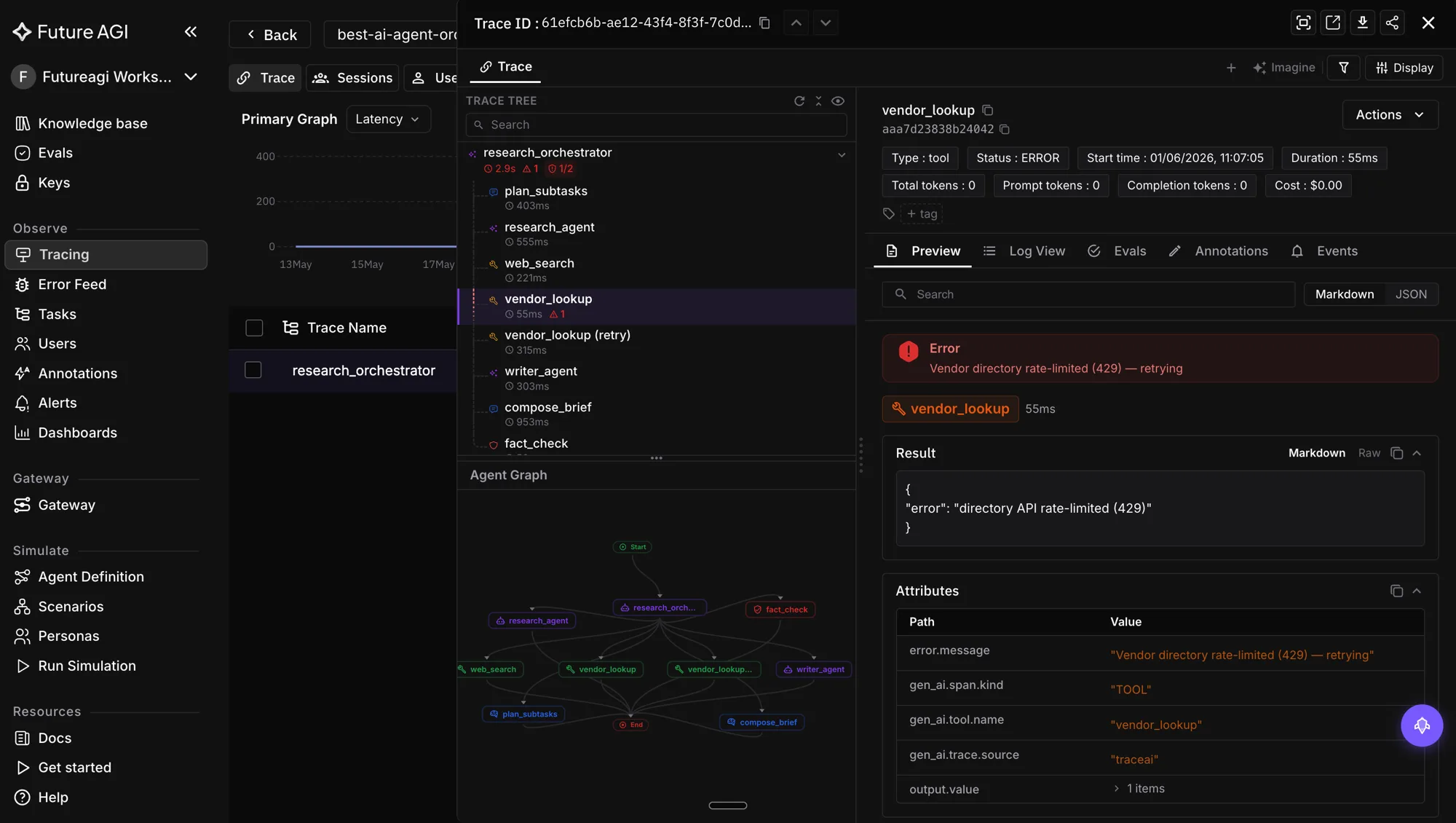
Future AGI does not build embedding models. It is the eval and observability layer that tells you whether your retrieve-then-generate pipeline is actually working.
ai-evaluation(Apache 2.0) ships LLM-judge and metric-model evals for faithfulness, hallucination, context relevance, and retrieval precision. Run them on a regression set every time you change the embedding model or chunking strategy.traceAI(Apache 2.0) emits OpenTelemetry spans for retrieval calls, generation calls, and the chunks that flowed between them. You can replay any failing query end to end so you can see which embedding lookup returned which chunks for which user query.
Example eval call:
from fi.evals import evaluate

# Score whether the LLM answer is grounded in the retrieved context.
result = evaluate(
    "faithfulness",
    output="Our return window is 30 days.",
    context="Returns must be initiated within thirty days of purchase.",
    model="turing_flash",
)

print(result)
turing_flash returns scores in roughly 1 to 2 seconds. Use turing_small (2 to 3 seconds) or turing_large (3 to 5 seconds) when you need a more accurate judge.
Configure with the FI_API_KEY and FI_SECRET_KEY environment variables (never FAGI_API_KEY).
Future directions
- Stronger long-context embeddings that represent whole documents without chunking.
- Better multimodal joint spaces for text, image, audio, and video.
- Quantized and distilled embeddings that run on-device for privacy-sensitive workloads.
- Task-aware embeddings that produce different vectors depending on the downstream task (retrieval vs classification vs ranking).
- Native pgvector and OpenSearch upgrades that close the gap with specialized vector databases.
Closing
Embeddings are the substrate of modern LLM systems. Understand them once and you understand half of the production AI stack. Pick the right model for your domain, store the vectors in an index that fits your scale, and pair retrieval with continuous evaluation and tracing so you can catch silent drift before users notice.
Frequently Asked Questions
What is an embedding in 2026?
How is an embedding different from one-hot encoding?
What is the difference between dense and sparse embeddings?
How are embeddings trained?
What dimension should my embeddings be?
Semantic vs syntactic embeddings: what is the difference?
How do embeddings power RAG and agent systems?
How does Future AGI fit with embeddings?
The best embedding models in 2026: NV-Embed-v2, BGE-M3, E5-mistral, OpenAI v3, Voyage 3, Cohere Embed-3. MTEB benchmarks, pricing, and how to pick.

Pinecone, Milvus, Weaviate, Qdrant, pgvector, Chroma, Vespa for RAG in 2026. Compared on recall, latency, hybrid search, OSS license, eval-fit.

Learn how K-Nearest Neighbor (KNN) works in 2026. Distance metrics, parameter tuning, and when to use KNN vs decision trees, SVMs, and neural networks.
