Best Embedding Models in 2026: NV-Embed-v2, BGE-M3, E5-mistral, Voyage 3 Compared
The best embedding models in 2026: NV-Embed-v2, BGE-M3, E5-mistral, OpenAI v3, Voyage 3, Cohere Embed-3. MTEB benchmarks, pricing, and how to pick.
Table of Contents
TL;DR: Best embedding models in May 2026
| Workload | Best model | License | Why |
|---|---|---|---|
| MTEB-topping general-purpose | NVIDIA NV-Embed-v2 | NVIDIA AI Foundation Models License (research + limited commercial) | 72.31 on MTEB English, 4096-dim, 32K context |
| Production multilingual RAG | BAAI BGE-M3 | MIT | 100 plus languages, dense + sparse + multi-vector in one model, 8K context |
| Hosted API, default pick | OpenAI text-embedding-3-large | Commercial | 3072-dim, 8K context, broad language coverage, $0.13/1M tokens |
| Long-context hosted API | Voyage AI voyage-3 | Commercial | 32K context, $0.06/1M tokens, top-3 on MTEB v2 |
| Multilingual hosted API | Cohere Embed-3 | Commercial | Best non-English performance among hosted APIs |
| Best small/medium open model | Snowflake arctic-embed-l-v2.0 (568M) or bge-small-en (33M) | Apache 2.0 | Arctic for strongest leaderboard at small scale; bge-small-en for absolute minimum footprint |
| Code embeddings | jina-embeddings-v2-code or Codestral Embed | Apache 2.0 / commercial | Code-specific training, high recall on code retrieval |
Why embedding models are the foundation of modern AI
Embedding models translate text (or images, or audio) into dense numerical vectors that capture semantic meaning. Three workloads depend on them:
- Retrieval-augmented generation (RAG): every chunk in your knowledge base needs to be embedded; every query needs to be embedded; cosine similarity surfaces the relevant chunks.
- Semantic search: traditional keyword search misses synonyms, paraphrases, and intent; embeddings catch them.
- Clustering and classification: customer-support tickets, product catalog, news articles, anything that needs to be grouped by meaning.
According to Gartner, over 30% of the increase in API demand by 2026 comes from LLMs and tools using LLMs. Most of those tools sit on top of an embedding model.
Types of embedding models: 2026 view
Static word embeddings (Word2Vec, GloVe, FastText)
- Word2Vec: Google’s 2013 neural-net approach to word vectors.
- GloVe: Stanford’s global matrix factorisation plus local context windows.
- FastText: Facebook’s subword-aware extension of Word2Vec.
Verdict in 2026: static word embeddings are legacy. They give every occurrence of “bank” the same vector regardless of whether the context is financial or fluvial. Use them only for historical reproducibility, not new builds.
Contextual word embeddings (ELMo, BERT)
- ELMo: bidirectional LSTM contextual embeddings (2018).
- BERT: transformer-based bidirectional encoder (2018-2019), the architecture that everything since builds on.
Verdict in 2026: BERT-style encoders are the architectural ancestors of modern sentence embedders. Plain BERT is rarely used directly anymore; use sentence-tuned variants (SBERT, MPNet) or modern descendants.
Sentence-level embeddings (USE, SBERT, InferSent)
- Universal Sentence Encoder (USE): Google’s 2018 sentence-level embedder.
- SBERT: Sentence-BERT fine-tuned for semantic similarity. The progenitor of most modern dense embedders.
- InferSent: Facebook’s BiLSTM-on-NLI-data sentence embedder (2017).
Verdict in 2026: SBERT-style models still ship in many production pipelines, especially the modern descendants (all-MiniLM, all-mpnet, bge-large). USE and InferSent are largely retired.
Universal text embeddings (E5, BGE, NV-Embed, GritLM, SFR-Embedding)
- E5: Microsoft’s general embedder family. E5-mistral-7b is the LLM-backbone variant.
- BGE: BAAI’s series; BGE-M3 is the current open-weight production champion.
- NV-Embed: NVIDIA’s LLM-backbone embedder. NV-Embed-v2 currently leads the MTEB English leaderboard.
- GritLM-7B: unified generation and embedding from one model.
- SFR-Embedding-2: Salesforce’s strong general embedder.
Verdict in 2026: this is where the action is. Universal text embeddings handle retrieval, classification, clustering, and similarity from one model. Reranking is usually layered on top with a cross-encoder like BGE-reranker-v2 or Cohere Rerank-3.5 rather than served by the same encoder.
The MTEB leaderboard: who leads in May 2026
MTEB (Massive Text Embedding Benchmark) is the de facto leaderboard for embedding models. The current MTEB English Leaderboard (Snapshot May 2026, top 7) looks roughly like this:
| Model | Score | Dim | Context | License |
|---|---|---|---|---|
| NV-Embed-v2 | 72.31 | 4096 | 32K | NVIDIA AI Foundation Models License |
| stella_en_1.5B_v5 | ~71 | 1536 | 8K | MIT |
| SFR-Embedding-2_R | ~71 | 4096 | 32K | CC BY-NC 4.0 |
| GritLM-7B | ~66 | 4096 | 32K | Apache 2.0 |
| E5-mistral-7b-instruct | ~66 | 4096 | 32K | MIT |
| voyage-3-large (Voyage AI) | ~71 | 1024 | 32K | Commercial API; the larger sibling of voyage-3 |
| BGE-multilingual-gemma2 | ~70 | 3584 | 8K | Gemma license |
Always check the live leaderboard, not this table. Numbers shift weekly.
Capabilities and optimisation
These models are trained on broad data and fine-tuned with contrastive objectives so they handle retrieval, classification, clustering, and similarity all at once.
Optimisation techniques that matter in production:
- Matryoshka representations: truncate the embedding to the first 256 or 512 dimensions and lose only 1-3% recall. Cuts storage and search cost dramatically. OpenAI v3 and Snowflake arctic-embed both support this natively.
- Quantisation: int8 or binary embeddings cut memory 4-32x with 1-5% recall hit. Cohere Embed-3 ships native int8 and binary modes.
- Knowledge distillation: a smaller “student” model trained to mimic a larger “teacher”. The bge-small and arctic-embed-m families are distilled to under 500M params.
- Pruning: removing low-importance parameters; combined with distillation, cuts inference cost 50-80%.
Core architecture in modern embedding models
Encoder-only (BERT family)
BERT and its sentence-tuned descendants (SBERT, MPNet) use deep bidirectional transformer encoders to build rich contextual representations.
Decoder-only with embed pooling (LLM-backbone)
NV-Embed-v2, E5-mistral-7b, GritLM, and SFR-Embedding all start from a decoder LLM (Mistral, Llama) and add a pooling layer plus contrastive fine-tuning. This pattern unlocked the recent MTEB gains.
Self-attention
Self-attention scores the relevance of every token to every other token. This is the mechanism that lets modern embedders capture long-range context that ELMo and BiLSTMs missed.
Pretraining objectives in 2026
- Masked language modelling (MLM) (BERT-era): predict masked tokens.
- Contrastive learning: pull similar pairs together, push dissimilar pairs apart. The 2026 default for embedding models.
- Cross-encoder pretraining: train a separate cross-encoder for reranking after dense retrieval. BGE-reranker-v2 and Cohere Rerank-3.5 lead.
- Instruction tuning for embedders: prepend “Represent this for retrieval:” to the query to bias the embedding toward the task. Used by E5, NV-Embed, BGE.
Architectural trade-offs: NV-Embed vs BGE-M3 vs OpenAI v3
| Aspect | NV-Embed-v2 | BGE-M3 | OpenAI text-embedding-3-large |
|---|---|---|---|
| MTEB English | 72.31 | ~67 | ~64 |
| Languages | English | 100 plus | Broad (no leaderboard claim) |
| Modes | Dense | Dense, sparse, multi-vector (ColBERT) | Dense |
| Params | 7.85B | ~568M | undisclosed |
| Context | 32K | 8K | 8K |
| License | NVIDIA AIFM (research-friendly, commercial with restrictions) | MIT | Commercial |
| Best for | Max accuracy on English retrieval | Multilingual production RAG | Zero-ops hosted API |
NV-Embed-v2 takes the leaderboard crown but has license restrictions on commercial use; check the NVIDIA AI Foundation Models License terms.
BGE-M3 is the production workhorse: it is MIT-licensed, supports 100 plus languages, and ships dense plus sparse plus multi-vector retrieval modes in one model. Most 2026 production RAG stacks default to BGE-M3 plus BGE-reranker-v2.
How large language models power high-quality embeddings
LLMs like Mistral 7B and Llama 4 now serve as the backbone for the strongest open-weight embedders (NV-Embed-v2, E5-mistral, GritLM, SFR-Embedding-2). The training recipe:
- Start from a pretrained decoder LLM (Mistral 7B is the common choice).
- Replace the next-token head with a pooling layer (last-token or mean-pool).
- Contrastive fine-tune on hundreds of millions of paraphrase, NLI, and retrieval pairs.
- Optionally add instruction prompts to bias toward specific tasks.
The result: embeddings that benefit from the LLM’s broad world knowledge, at the cost of being 5-10x larger than BGE-style encoders. NV-Embed-v2 is 7.85B parameters; BGE-large is ~330M.
How to choose an embedding model in 2026: a decision matrix
| Your need | Default pick | Backup |
|---|---|---|
| Hosted API, default | OpenAI text-embedding-3-large | Voyage AI voyage-3 |
| Multilingual RAG production | BGE-M3 (self-host) | Cohere Embed-3 (hosted) |
| MTEB leaderboard max accuracy | NV-Embed-v2 | stella_en_1.5B_v5 |
| Long context (32K) | NV-Embed-v2 (self-host) or voyage-3 (hosted) | E5-mistral-7b |
| Code embeddings | Codestral Embed (commercial) | jina-embeddings-v2-code (Apache 2.0) |
| Smallest production model | bge-small-en (33M) | Snowflake arctic-embed-l-v2.0 (568M) for stronger quality at slightly larger size |
| Hybrid retrieval (dense + sparse) | BGE-M3 | SPLADE |
| Permissive open license | BGE-M3 (MIT), arctic-embed (Apache 2.0), GritLM (Apache 2.0), jina-embeddings-v2 (Apache 2.0) | E5 family (MIT) |
Most teams should start with BGE-M3 or OpenAI text-embedding-3-large, build a labelled retrieval set, and re-evaluate after 90 days of production data.
How to evaluate embedding models for your workload
Leaderboards lie. Your domain is different. Build a labelled retrieval set and score candidates yourself. For a deeper methodology on this, see evaluating embedding models in 2026.
The 5-step eval pattern that works:
- Collect 200 plus queries. Pull from real production logs if available; synthetic if not.
- Mark the correct passages. For each query, identify the chunks that should be retrieved.
- Score recall@k. k=5 and k=10 are the standard cutoffs.
- Score NDCG@10. Rewards correct passages near the top.
- Add a reranker. BGE-reranker-v2 or Cohere Rerank-3.5 typically lifts recall@5 by 10-25%.
Future AGI’s evaluate function exposes retrieval metrics directly:
import os
from fi.evals import evaluate, Evaluator

os.environ["FI_API_KEY"] = "..."
os.environ["FI_SECRET_KEY"] = "..."

# For each (query, retrieved-chunks) pair, score retrieval quality.
query = "What were the EU AI Act enforcement deadlines added in 2026?"
retrieved_chunks = ["Retrieved chunk 1...", "Retrieved chunk 2..."]
generated_answer = "The model's RAG answer goes here."

score = evaluate(
    evaluator=Evaluator.CONTEXT_RELEVANCE,
    input=query,
    output=generated_answer,
    context=retrieved_chunks,
)
print(score)
Set FI_API_KEY and FI_SECRET_KEY to log to the dashboard. The library is Apache 2.0 at github.com/future-agi/ai-evaluation.
How to monitor embedding-model performance in production with Future AGI
Embedding choice locks in retrieval recall, which locks in RAG accuracy. If your embedding model drifts (or your data drifts under your embedding), your downstream eval scores drift.
Two pieces of the Future AGI platform pair with any embedding model choice:
- traceAI captures every retrieval span (query embedding, top-k chunks returned, similarity scores) as Apache 2.0 OpenTelemetry instrumentation. Source at github.com/future-agi/traceAI.
- Evaluate scores retrieval and generation quality together with built-in metrics:
context_relevance,context_sufficiency,chunk_attribution,groundedness. Apache 2.0 library at github.com/future-agi/ai-evaluation.
Future AGI is not an embedding model vendor and never will be: embeddings are best owned by specialist labs (NVIDIA, BAAI, OpenAI, Voyage, Cohere, Jina). Future AGI is the eval and observability layer that pairs with whichever embedding you pick.
Sources
- MTEB leaderboard on Hugging Face
- NV-Embed-v2 model card
- BGE-M3 paper (arXiv 2402.03216)
- BAAI BGE-M3 GitHub
- E5 paper (arXiv 2212.03533)
- NV-Embed paper (arXiv 2405.17428)
- GritLM paper (arXiv 2402.09906)
- SBERT paper (arXiv 1908.10084)
- BERT paper (arXiv 1810.04805)
- Lost in the Middle (arXiv 2307.03172)
- MTEB paper (arXiv 2210.07316)
- OpenAI embeddings API
- Voyage AI embedding models
- Cohere embed models
- Future AGI evaluation library, Apache 2.0
- traceAI, Apache 2.0 OpenTelemetry instrumentation
Frequently Asked Questions
What is the best embedding model in 2026?
Should I use an open-source embedding model or a hosted API in 2026?
What is MTEB and how reliable is it as a benchmark for embedding models in 2026?
What context length do modern embedding models support in 2026?
How do I evaluate embedding models for my RAG application in 2026?
What is the difference between dense and sparse embeddings in 2026?
Which embedding model handles multilingual text best in 2026?
How much does it cost to embed 1 million tokens in 2026?
LLM evaluation is offline + online scoring of model outputs against rubrics, deterministic metrics, judges, and humans. Methods, metrics, and 2026 tools.

FutureAGI, DeepEval, Langfuse, Phoenix, Braintrust, LangSmith, and Galileo as the 2026 LLM evaluation shortlist. Pricing, OSS license, and production gaps.
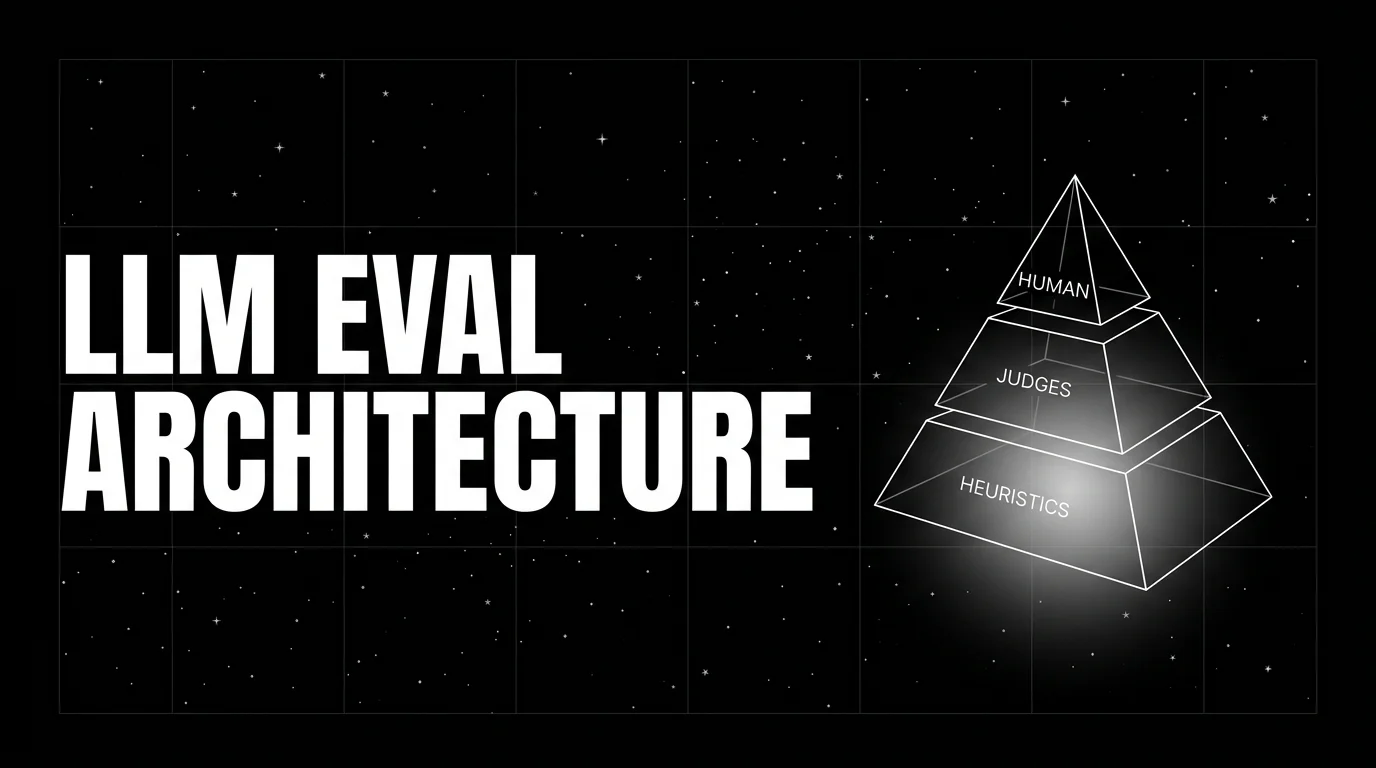
LLM eval architecture in 2026: heuristics on every span, distilled judges on a sample, humans on the gold-set. Three-tier stack that scales.
