Future AGI vs Weights and Biases in 2026: GenAI Evaluation vs ML Experiment Tracking
Future AGI vs Weights and Biases in 2026: GenAI evals and tracing vs experiment tracking. Verdict, head-to-head feature table, pricing, and use cases.
Table of Contents
Future AGI vs Weights & Biases in 2026: Quick Verdict
Future AGI is purpose-built for the LLM and GenAI lifecycle: prompt evaluation, hallucination detection, RAG grounding, agent tracing, prompt optimization, and a managed BYOK gateway. Weights & Biases is the long-standing standard for the classical ML lifecycle: experiment tracking, hyperparameter sweeps, artifacts, and run-level reproducibility. Weave is W&B’s newer layer for LLM tracing, but the platform’s center of gravity is still training-time visibility. For teams shipping LLM applications in 2026, Future AGI is the more direct fit. For teams running PyTorch training jobs and tracking thousands of runs, W&B remains the default. Many teams run both.
TL;DR: Future AGI vs Weights & Biases Side-by-Side
| Dimension | Future AGI | Weights & Biases (incl. Weave) |
|---|---|---|
| Primary use case | LLM eval, tracing, prompt-opt, gateway | ML experiment tracking, sweeps, artifacts |
| Center of gravity | Production GenAI | Training and R&D |
| LLM evaluation | First-party metrics (faithfulness, groundedness, custom LLM judge) + cloud tiers (turing_flash/small/large) | Weave: tracing + custom evals you write |
| Hallucination detection | Built-in (fi.evals.evaluate("faithfulness", ...)) | Build your own with Weave |
| Tracing | OpenTelemetry via traceAI (Apache 2.0), framework-agnostic | OpenTelemetry via Weave, framework-agnostic |
| Gateway | Agent Command Center (managed, BYOK) | None |
| Prompt optimization | fi.opt.optimizers.BayesianSearchOptimizer | Not a focus |
| Agent simulation | fi.simulate.TestRunner | Not a focus |
| Pricing | $50/mo flat for 5 seats, free starter | Free for individuals, per-seat for teams |
What Each Platform Is Actually For
Future AGI: LLM and GenAI Application Lifecycle
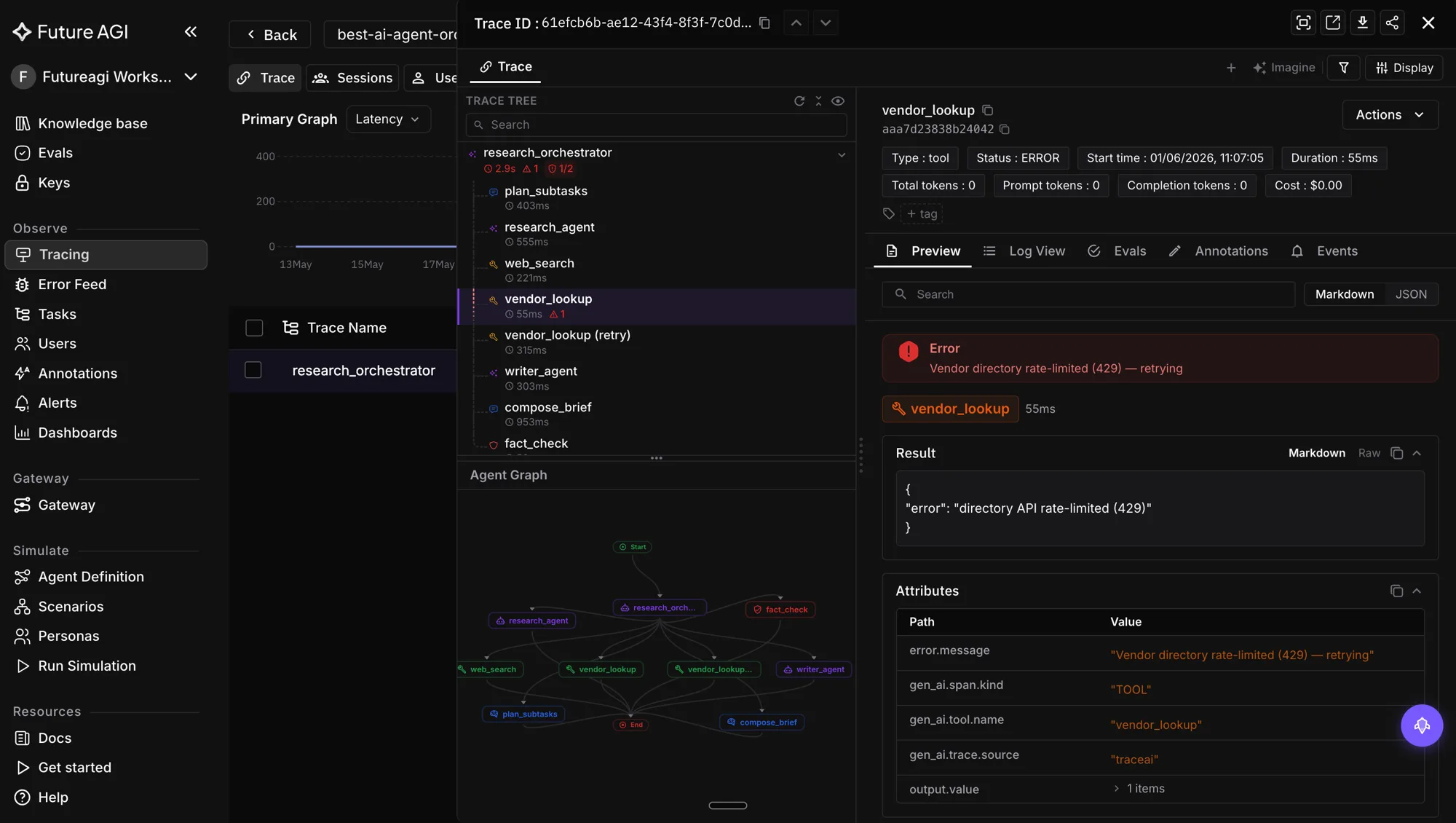
Future AGI ships the loop a team needs to build, ship, and operate an LLM application. The core surfaces are:
- Evaluation SDK (ai-evaluation, Apache 2.0):
fi.evals.evaluate("faithfulness", output=..., context=...), plusfi.evals.metrics.CustomLLMJudgefor domain-specific rubrics, plusfi.opt.base.Evaluatorfor local wrapper logic. - Tracing SDK (traceAI, Apache 2.0):
from fi_instrumentation import register, FITracer, with@tracer.agent,@tracer.tool,@tracer.chaindecorators that emit OpenTelemetry-shaped spans.
- Prompt optimization:
from fi.opt.optimizers import BayesianSearchOptimizerruns structured search across prompt variants against a scored eval suite. The automated prompt improvement post compares the optimizer family in depth.
- Agent simulation:
from fi.simulate import TestRunner, AgentInput, AgentResponselets you replay scripted conversations against your agent and assert on outputs.
- Agent Command Center (BYOK gateway, exposed at
/platform/monitor/command-center): a managed LLM router with caching, guardrails, and cost tracking. - Cloud evaluation tiers (see docs): turing_flash (~1 to 2 s), turing_small (~2 to 3 s), turing_large (~3 to 5 s).
Env vars: FI_API_KEY and FI_SECRET_KEY. The platform is framework-agnostic by design and works with LangChain, LlamaIndex, CrewAI, AutoGen, or raw provider SDK calls.
Weights & Biases: ML Experiment Tracking Plus Weave for LLMs
W&B is the experiment tracker that most ML researchers have used for years. The core surfaces are:
wandb.init(project=..., config=...)+wandb.log({...}): log scalars, images, gradients, model artifacts.- Sweeps: declarative hyperparameter search across a defined config space.
- Artifacts: versioned dataset and model objects with lineage.
- Reports: shareable, embeddable analysis documents.
- Weave: an LLM tracing and evaluation layer added later, oriented around tracing chains and writing custom evaluators in Python.
W&B’s strength is depth in the training-time loop: long runs, comparative analysis, distributed training visibility, and team-shared dashboards. Weave is an effort to extend that into LLM territory.
Capabilities Compared: LLM Evaluation, Tracing, and Production Monitoring
Future AGI ships first-party LLM evaluation metrics. fi.evals.evaluate("faithfulness", output=..., context=...) returns a faithfulness score for whether a model output is grounded in the retrieved context. The same SDK includes evaluators for toxicity, PII, prompt-response coherence, and custom LLM-as-judge rubrics:
from fi.evals import evaluate

result = evaluate(
    "faithfulness",
    output="The product launched in March 2024.",
    context="Acme launched the Pro plan in March 2024 with a free starter tier.",
)
print(result.score, result.reason)
A custom LLM judge follows the same shape, with the rubric wired through CustomLLMJudge:
from fi.evals.metrics import CustomLLMJudge
from fi.evals.llm import LiteLLMProvider

judge = CustomLLMJudge(
    name="brand_voice",
    rubric="Score 1-5 on adherence to the brand voice guide.",
    provider=LiteLLMProvider(model="gpt-4o"),
)
score = judge.evaluate(output="Welcome to Acme!")
print(score.value, score.reason)
Weave supports custom evaluators that you author yourself in Python, with first-class tracing of the LLM call graph. The default catalog of metrics is narrower; teams typically wire in their own LLM-as-judge logic. For a wider tooling field, the LLM evaluation tools comparison and LLM observability tools comparison cover the larger landscape.
Pricing Compared: Flat Team Plans vs Per-User Tracking
Future AGI’s Pro plan is $50 per month and covers five seats. Additional seats are $20 each. A free starter tier exists for evaluation and the BYOK gateway. Enterprise pricing is custom.
Weights & Biases offers a free tier that is generous for individuals, and a paid Pro plan that scales per seat. Specific pricing changes quarterly, so the right place to confirm is the W&B pricing page. Heavy artifact storage and long-running experiment retention can move teams to the enterprise tier faster than a small team would expect.
For small LLM-focused teams, Future AGI’s flat pricing is more predictable. For classical ML research teams that primarily want experiment tracking, W&B’s free tier is the better starting point.
Performance and Scale: Production LLM Evaluation vs Training-Run Tracking
Future AGI’s cloud evaluation engine runs evaluations against managed judges. The documented tiers are turing_flash for inline production scoring (roughly 1 to 2 seconds per evaluation), turing_small for medium-quality batch scoring (2 to 3 seconds), and turing_large for highest-quality offline scoring (3 to 5 seconds). traceAI’s OpenTelemetry exporter handles high-throughput tracing in the standard otel-collector pattern.
W&B is engineered around training-run telemetry: thousands of metrics per run, image and gradient logging, distributed worker rollups, and long-running comparison views. The platform handles large experiment volumes well; web UI responsiveness depends on the size of the visualization panel rather than the size of the underlying dataset.
These are different performance profiles. Future AGI optimizes for per-call evaluation latency. W&B optimizes for the lifecycle of long training runs.
Integrations: LLM Stack Depth vs Classical ML Ecosystem
Future AGI integrates with the LLM ecosystem: LangChain, LlamaIndex, CrewAI, AutoGen, the OpenAI SDK, the Anthropic SDK, the Gemini SDK, vLLM and Ollama backends, plus any custom Python pipeline through OpenTelemetry. The Agent Command Center gateway speaks the OpenAI chat completions schema, so any client that already targets OpenAI can route through it.
Weights & Biases integrates with PyTorch, TensorFlow, scikit-learn, Hugging Face Transformers, JAX, fastai, Lightning, and most other ML frameworks. W&B has broad classical ML ecosystem coverage. Weave adds LangChain and OpenAI SDK hooks for LLM tracing.
For an LLM-application team, Future AGI’s integration surface is the more directly useful. For a research team running PyTorch jobs, W&B’s classical ML coverage is the deeper one.
Use Cases: When Each Platform Wins
Future AGI Wins When
- You are building or shipping an LLM-powered application (chat, RAG, agent, summarization, classification).
- You need first-party hallucination, faithfulness, or PII evaluators out of the box.
- You want a managed BYOK gateway with caching, guardrails, and cost tracking in the same platform as your evals.
- You are running an agent and need to simulate scripted conversations against it.
- You want a flat-rate plan that does not scale linearly with seat count.
Weights & Biases Wins When
- Your primary loop is training: fine-tuning, vision, NLP, time-series, RL.
- You need deep experiment tracking with thousands of runs, hyperparameter sweeps, and reproducibility.
- You already use W&B for classical ML and want one platform across training and tracing.
- Your team includes researchers who think in terms of runs and artifacts rather than evaluations and traces.
Many Teams Run Both
W&B owns the training and the model artifact. Future AGI owns the application that consumes the artifact, plus the gateway, plus the production evaluation loop. They are complementary more often than they are competitive, and the broader split between the two disciplines is covered in MLOps vs LLMOps in 2026.
Future AGI vs Weights & Biases: Detailed Feature Table
| Criteria | Future AGI | Weights & Biases (incl. Weave) |
|---|---|---|
| Core focus | LLM and GenAI app lifecycle | Classical ML tracking + Weave for LLM tracing |
| Hallucination eval | fi.evals.evaluate("faithfulness", ...) first-party | Custom evaluator in Weave |
| Custom LLM judge | CustomLLMJudge + LiteLLMProvider | Author your own |
| Cloud eval tiers | turing_flash ~1-2s, turing_small ~2-3s, turing_large ~3-5s | Depends on chosen LLM |
| Prompt optimization | BayesianSearchOptimizer | Not a focus |
| Agent simulation | fi.simulate.TestRunner | Not a focus |
| Managed gateway | Agent Command Center (BYOK) | None |
| Experiment tracking | Lightweight | Deep (sweeps, artifacts, reports) |
| Tracing standard | OpenTelemetry via traceAI (Apache 2.0) | OpenTelemetry via Weave |
| Integrations | LangChain, LlamaIndex, CrewAI, AutoGen, OpenAI/Anthropic/Gemini SDK, vLLM, Ollama | PyTorch, TF, scikit-learn, HF, JAX, Lightning, LangChain (Weave) |
| Pricing | $50/mo flat, 5 seats | Free for individuals, per-seat for teams |
| Free tier | Yes (limited features) | Yes (generous for individuals) |
| Deployment | Cloud + on-prem (enterprise) | Cloud + self-host + hybrid |
| Best fit | Production GenAI applications | ML research + training |
Verdict: Pick the Loop That Matches Your Work in 2026
For teams whose primary loop is shipping LLM applications (chat, RAG, agents, summarization, classification), Future AGI is the more direct fit because it ships first-party LLM evaluation, framework-agnostic tracing, prompt optimization, agent simulation, and a managed BYOK gateway in one platform. For teams whose primary loop is training (fine-tuning, vision, NLP, time-series, RL), W&B remains the right anchor for experiment tracking, sweeps, and artifact lineage, with Weave covering LLM tracing for the subset of work that needs it.
In 2026 the question is not “Future AGI or W&B” in the abstract. It is “which loop is the loop your team spends 80% of its time in,” and the right answer follows from there. Many teams will keep W&B for training and add Future AGI for LLM application observability and evaluation, which is a reasonable architecture rather than a compromise.
Final Word: Choosing Between Future AGI and W&B in 2026
If your team is building production GenAI features, start with Future AGI. The evaluation SDK, traceAI, and Agent Command Center are designed for that loop and ship with the metrics, decorators, and gateway routes a team needs. If your team is training models and tracking experiments, keep W&B. Use Weave for LLM tracing if it lives in the same workflow as your training runs. The two platforms are not in zero-sum competition: they cover different stages of the AI lifecycle and the productive pattern in 2026 is to use each where it is strongest.
Get started with the Future AGI evaluation SDK (Apache 2.0) and traceAI (Apache 2.0), or explore the platform at futureagi.com.
Frequently Asked Questions
Is Future AGI a Weights & Biases replacement?
Does Weights & Biases support LLM evaluation in 2026?
Which platform has better pricing for small teams?
Can Future AGI and Weights & Biases be used together?
What hallucination detection does Future AGI provide that W&B does not?
Does Future AGI work with frameworks other than LangChain?
What is the right migration path from W&B to Future AGI for an LLM-only team?
How do Future AGI cloud evaluators compare on latency?

FutureAGI closes the self-improving loop; MLflow, Comet, Neptune, Langfuse, Braintrust, ClearML ship the parts. 2026 W&B alternatives.

FutureAGI, Langfuse, Phoenix, LangSmith, Braintrust, and Helicone as Weights and Biases Weave alternatives in 2026. OSS, OTel, and pricing tradeoffs.
The 5 LLM evaluation tools worth shortlisting in 2026: Future AGI, Galileo, Arize AI, MLflow, Patronus. Features, pricing, and which workload each wins.
