AI Chatbot Development in 2026: LLM Selection, Prompting, RAG, Agentic Memory, and Eval
How to build production AI chatbots in 2026. Compare GPT-5, Claude Opus 4.7, Gemini 3, Llama 4. RAG, agentic memory, eval, and handoff patterns that ship.
Table of Contents
AI Chatbot Development in 2026: LLM Selection, Prompting, RAG, Agentic Memory, and Eval
Production chatbots in 2026 are no longer just LLMs with a system prompt and a knowledge base. They route across multiple models, ground answers in retrieval, run tool calls inside an agent loop, hand off to humans when confidence drops, and report continuously to an evaluation harness. This guide covers the stack: which model to pick, how to prompt it, how to wire up RAG, how to add agentic memory, and how to run the eval loop that keeps it honest.
TL;DR
| Question | Answer in 2026 |
|---|---|
| Best default LLM | Claude Opus 4.7 or GPT-5 for reasoning, Gemini 3 Pro for long context, Llama 4 for self-host |
| Prompt pattern that works | Structured system prompt plus tool schemas plus few-shot examples plus output validator |
| RAG architecture | Hybrid (dense plus BM25) retriever, re-ranker, chunk-attribution at eval time |
| Agentic backbone | Tool-using loop with planner, memory, and guardrail at the output layer |
| Top eval metric | Faithfulness, then tool-call accuracy, then conversation coherence |
| Run-time observability | Future AGI traceAI plus Agent Command Center gateway |
| Hand-off rule | Confidence below threshold, off-policy topic, or repeat-fail counter |
What changed since 2025
Three shifts redrew the chatbot stack in 2026. First, model quality jumped on agentic tasks: Claude Opus 4.7 (released October 2025), GPT-5 (released August 2025), and Gemini 3 Pro now solve multi-step tool workflows that broke 2025 models. Second, gateways replaced hard-coded API clients: most production chatbots in 2026 talk to a model gateway that handles routing, fallback, key rotation, and per-tenant policy, instead of importing the OpenAI SDK directly. Third, evaluation moved from offline notebooks into the runtime: faithfulness, hallucination, and tool-call accuracy are now scored on a slice of live traffic so regressions are caught in minutes, not weeks.
How to Select the Right LLM for AI Chatbots in 2026: GPT-5, Claude Opus 4.7, Gemini 3, and Llama 4 Compared
Most chatbot teams pick a model once and regret it inside a quarter. The recipe that works is to shortlist two candidates, build a small private eval set (200 to 500 turns from your real traffic or domain), and measure the same four axes on both before signing a vendor contract.
Leading LLMs for Chatbots in 2026
GPT-5 (OpenAI)
The current default for general-purpose chatbots that need balanced reasoning, tool use, and latency. Released August 7, 2025. Strong instruction following and tool-call structure. Good fit for English-first, mainstream-policy chatbots.
Claude Opus 4.7 (Anthropic)
Released October 2025. Strongest model on agentic workflows with long tool chains and long-running tasks. Default pick for chatbots that drive workflows with side effects (refunds, ticket updates, scheduling). 1M context window in extended-context mode.
Gemini 3 Pro (Google)
Strong multimodal input (images, video, long PDFs) and a 1M+ token context window. Default pick when the chatbot has to read long contracts, screenshots, or video. Strong on multilingual workloads.
Llama 4 and DeepSeek-R1 derivatives
Open-weight models that close most of the gap on reasoning. Pick when self-hosting is a hard requirement (data residency, cost ceiling, custom fine-tune). Expect to spend more engineering on serving and eval.
How to Evaluate LLMs for Your Chatbot: Build Your Own Eval Set First
Public benchmarks (MMLU, GPQA, AIME, SWE-bench) are signals, not contracts. The four axes that actually correlate with production quality:
- Faithfulness on your domain data. Sample 200 to 500 (query, context, expected answer) triples from your own corpus. Score faithfulness with an LLM-as-judge evaluator.
- Instruction following under your system prompt. Reuse the same prompt you will ship. Score whether the model obeys format, persona, and policy constraints.
- Tool-call accuracy. Run your real tool schemas. Score whether the model selects the right tool and supplies valid arguments.
- Cost and latency at the percentile you actually serve. Median is misleading. Track p95 and p99 because that is what your worst-served user feels.
# Run a four-axis eval comparing two candidate models with Future AGI
from fi.evals import evaluate

candidates = ["gpt-5-2025-08-07", "claude-opus-4-7"]
results = {}
for model in candidates:
    scores = []
    for row in eval_set:  # list of dicts: input, context, response_<model>
        faith = evaluate(
            "faithfulness",
            output=row[f"response_{model}"],
            context=row["context"],
        )
        scores.append(faith.score)
    results[model] = sum(scores) / len(scores)

print(results)
The Future AGI ai-evaluation SDK is Apache 2.0 (source), so the eval harness can live in CI alongside your tests. Pair it with traceAI when you want the same evaluators to run on a slice of live traffic.
Prompt Engineering for AI Chatbots in 2026: System Prompts, Tool Schemas, and Output Validation
The 2025 era of clever one-line prompts is over. Production prompts in 2026 are layered: a stable system prompt, structured tool schemas, optional few-shot examples, and an output validator. Every layer is testable.
The four-layer prompt pattern that ships
- System layer. Defines persona, scope, escalation rules, and refusal behaviour. Versioned in git like code, not edited in a vendor console.
- Tool layer. JSON Schema definitions of every tool the chatbot can call. Modern models match arguments to schemas accurately if the schemas are precise.
- Few-shot layer. Two to five worked examples in the prompt for the hardest cases (ambiguous intents, policy-edge topics). Skip when the model already solves it cleanly without examples.
- Output validator. Parse the response. If it does not match the expected JSON or contract, repair or re-prompt. Never ship raw model output to a downstream system.
Reasoning techniques that survived from 2024 to 2026
- Chain-of-Thought (CoT) remains useful for math, code, and analysis. With reasoning-tuned models (GPT-5, Claude Opus 4.7), CoT is often emitted automatically when needed.
- Self-consistency (sampling multiple paths and majority-voting) is still helpful for high-stakes single-shot answers but adds cost and latency. Use selectively.
- Tree-of-Thought is rarely the right choice in a chatbot: the user is waiting. Reserve ToT for offline batch tasks.
- Automatic prompt optimization. Tools like Future AGI’s prompt optimizer treat prompts as a search space and iterate on metrics. Useful when you have a stable eval set and want to push the last few percent.
Anti-patterns to drop in 2026
- “Let’s think step by step” hard-coded into every system prompt. Modern models do not need it for routine tasks and it inflates latency and cost.
- Unstructured tool calls inside the system prompt. Use JSON Schema tool definitions instead.
- Embedding the entire knowledge base in the system prompt because the context window now allows it. Retrieval still wins on cost, latency, attribution, and updateability.
Retrieval-Augmented Generation for AI Chatbots: Architecture, Latency, and Evaluation in 2026
RAG is the default grounding pattern for any chatbot that needs facts. The 2026 architecture is more layered than the 2024 “embed and search” pipeline.
A production RAG architecture
- Ingestion. Documents normalised, chunked, embedded with a current model (text-embedding-3-large, voyage-3-large, or open alternatives), and written to a vector store. Keep raw chunks and metadata.
- Hybrid retrieval. Dense vector search plus BM25 keyword search, fused with reciprocal rank fusion. Pure-dense was the 2023 default; hybrid is the 2026 default because it recovers exact-match queries cleanly.
- Re-ranker. A cross-encoder (Cohere Rerank, BGE-reranker) re-orders the top 30 candidates down to the top 5. Adds 30 to 80 ms but lifts retrieval precision meaningfully.
- Context assembly. Pass top-K chunks plus citation metadata into the LLM with a strict “answer only from the provided context” instruction.
- Eval at the response layer. Score faithfulness, context relevance, and chunk attribution before logging the answer.
When RAG is the right tool
RAG is the right tool when the answer comes from a corpus you control (docs, policies, tickets, contracts) and freshness matters more than reasoning depth. RAG is not the right tool for math, code execution, or stateful workflows. For those, agentic tool use is the right answer.
How to evaluate a RAG chatbot in 2026
Four metrics carry the load:
- Retrieval recall and nDCG at the top-K. Did the right chunks make it into context?
- Context relevance. Of the chunks that made it, how many actually relate to the query?
- Faithfulness of the generated answer to the chunks.
- Chunk attribution. What share of generated tokens trace back to a retrieved chunk versus the model’s prior?
The Future AGI evaluators cover all four (cloud evals docs), with turing_flash for fast in-pipeline scoring (~1 to 2 seconds), turing_small (~2 to 3 seconds), and turing_large (~3 to 5 seconds) when you need higher-fidelity judgement.
from fi.evals import evaluate

result = evaluate(
    "faithfulness",
    output=generated_answer,
    context=retrieved_chunks,
)
print(result.score, result.reasoning)
For the explainer angle on RAG metrics, see our RAG evaluation metrics guide.
How to Build Agentic AI Chatbots in 2026: Tools, Memory, and Multi-Agent Patterns
Agentic chatbots make decisions and take actions. The core loop is unchanged from ReAct (think, act, observe, repeat), but the supporting infrastructure has matured.
What makes a chatbot “agentic”
- Tool use. The model can call APIs, run code, query a vector store, or invoke another agent.
- Memory. Short-term (the current session) and long-term (facts about the user, prior issues, account state). Long-term memory needs an explicit policy on retention, encryption, and user-controlled deletion.
- Planning. The agent breaks a goal into sub-tasks and decides which tool runs first.
- Self-reflection. The agent checks its own output against the goal and revises if needed. Critical for high-stakes tasks; expensive for trivial ones.
Memory module patterns that work in production
- Session buffer. Last N turns kept verbatim in the context window. Trim by token budget, not by turn count.
- Episodic memory. Summarised facts (“user is on the Pro plan”, “previous issue was payment failure”) written to a key-value store and re-injected at session start.
- Semantic memory. Domain facts indexed in the same vector store the RAG pipeline uses. The agent retrieves them on demand.
- Procedural memory. Successful tool-call sequences for recurring intents. Optional, but a strong speedup for high-frequency flows.
Once a memory module is wired in, evaluating agent memory systems covers the dimensions that catch silent regressions.
Multi-agent patterns: when more than one model is worth it
Frameworks like AutoGen, CrewAI, and LangGraph make it easy to compose multiple agents. The patterns that actually pay off:
- Specialist plus generalist. A small fast model triages, then routes hard cases to a stronger model.
- Adversarial review. One agent answers; a second checks for hallucination or policy violation before the answer ships.
- Planner plus executors. A planner decomposes the goal; executors run individual sub-tasks in parallel and report back.
The cost is real: more agents means more LLM calls, more latency, more eval surface area. Use multi-agent only when a single-agent loop hits a measurable ceiling.
# Minimal Future AGI traceAI instrumentation around an agent loop
from fi_instrumentation import register, FITracer

register(project_name="chatbot-prod")
tracer = FITracer(__name__)

def run_agent(user_message: str) -> str:
    with tracer.start_as_current_span("agent.run") as span:
        span.set_attribute("user.message", user_message)
        # plan, retrieve, call tools, generate, return
        return final_answer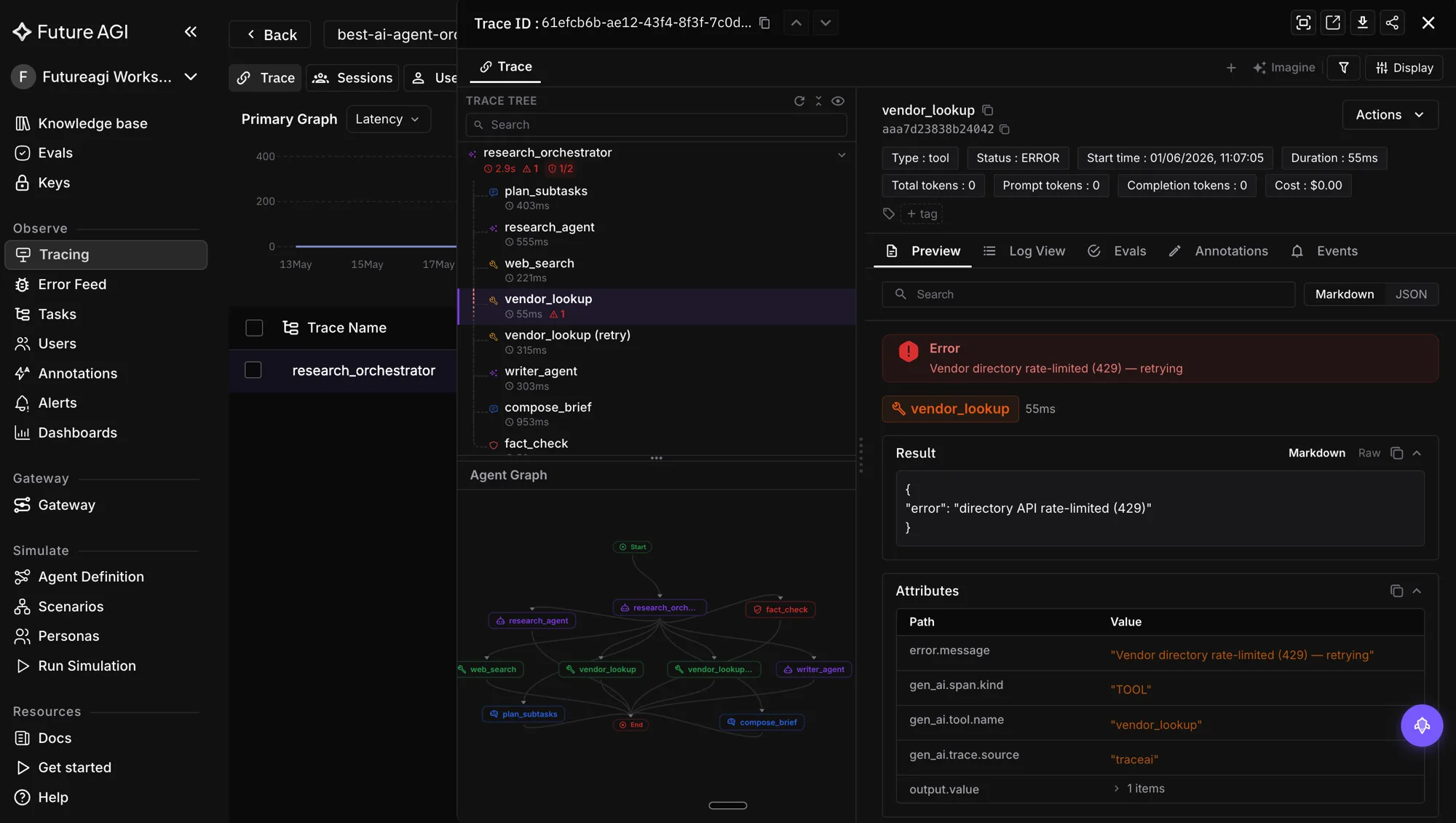
The traceAI library is Apache 2.0 (source).
Production Evaluation and Monitoring for AI Chatbots in 2026: Faithfulness, Tool-Call Accuracy, and Live Slicing
Offline eval is necessary but not sufficient. Production chatbots in 2026 run a smaller version of the same eval suite on a slice of live traffic, so regressions are caught when a prompt or model changes.
The metrics that matter and what they tell you
- Faithfulness. Is the response grounded in retrieved context? Catches RAG drift and hallucination together.
- Instruction following. Does the response obey the system prompt’s format, persona, and policy rules?
- Tool-call accuracy. When the agent picks a tool, is it the right tool with valid arguments? Catches schema drift and silent regressions.
- Conversation coherence. Across a multi-turn session, does the agent stay consistent?
- Task success rate. End-to-end, did the user accomplish their goal? Measured offline with labelled traces.
- Latency at p95 and p99. Median latency hides the worst experience.
- Hallucination and toxicity rate. Tracked separately as guardrail metrics so they can be alerted on independently of quality.
How to roll out evaluation without slowing the bot down
- Score 100% of traces on cheap, fast metrics (latency, structural validity, schema match).
- Score 5 to 10% of traces on slower LLM-as-judge metrics (faithfulness, instruction following). Stratify the sample so you cover every intent.
- Run the full eval suite nightly on a fixed regression set so any prompt or model change is benchmarked.
Where Future AGI fits
The Future AGI platform is the evaluation and observability companion for production chatbots. The ai-evaluation SDK is the same code path offline and online: the eval that gates your CI also runs on the live slice. The traceAI instrumentor captures every LLM, retrieval, and tool span on top of OpenTelemetry. The Agent Command Center at /platform/monitor/command-center adds a BYOK gateway with guardrails, routing, and per-tenant policy so you can ship model changes without code edits.
Chatbot to Human Handoff in 2026: Triggers, Interfaces, and Feedback Loops
The handoff layer is where most chatbots leak trust. The fix is to define triggers quantitatively, not by vibes.
Quantitative handoff triggers
- Confidence below threshold. Log-prob or LLM-judge confidence score under a domain-calibrated cutoff.
- Off-policy topic. A topic classifier or guardrail (Future AGI Protect, or a domain-specific filter) flags content outside the agent’s scope.
- Repeat-fail counter. Same user, same intent, two failed turns in a row. Hand off before turn three.
- Explicit escalation request. “Talk to a human”, “agent”, “supervisor”. Detect deterministically; do not rely on LLM interpretation.
Interfaces that preserve context during handoff
- Real-time dashboards for human agents that show the full chatbot transcript with annotations of which guardrail tripped or which confidence dropped.
- Context handoff of structured state (user, account, prior issue summary) so the human agent does not start cold.
- Feedback capture on every handoff: the agent records why the bot escalated and how the human resolved it. That data feeds the next eval cycle.
Key Takeaways: Best Practices for AI Chatbots in 2026
The 2026 chatbot stack rewards teams that treat evaluation as infrastructure, not as a launch checklist. The patterns that consistently ship:
- Pick two LLMs and benchmark them on a private eval set before signing a vendor contract. Re-benchmark every quarter.
- Layer the prompt (system, tools, few-shot, validator) and version every layer in git.
- Default to hybrid RAG with a re-ranker for grounded answers. Skip RAG only when the workflow is fully tool-driven.
- Use agentic patterns when actions have side effects. Keep the loop minimal: more agents means more failure modes.
- Score live traffic continuously, not just nightly. Faithfulness, tool-call accuracy, and instruction following are the three that pay back fastest.
- Define handoff triggers quantitatively and capture the human resolution back into your eval set.
- Wrap the LLM endpoint with a gateway so model changes and policy updates do not require redeploys.
For a deeper look at evaluating the components, see our pieces on LLM evaluation metrics and best practices, the top LLM evaluation tools, and multi-agent systems in production. For the model side, our best LLMs for May 2026 tracks the leaderboard month by month.
Frequently Asked Questions
Which LLM should I pick for a customer-facing AI chatbot in 2026?
How do I cut hallucinations in an LLM chatbot without rebuilding it from scratch?
What is the difference between a RAG chatbot and an agentic chatbot?
How do I know when a chatbot should hand off to a human?
Which eval metrics matter most for production chatbots in 2026?
Do open-weight chatbots match closed models in 2026?
How long should an AI chatbot remember a conversation?
How does Future AGI fit into a chatbot stack?
RAG evaluation metrics for 2026: faithfulness, context precision and recall, groundedness, answer relevancy, chunk attribution, and diagnosing failures.

The 5 LLM evaluation tools worth shortlisting in 2026: Future AGI, Galileo, Arize AI, MLflow, Patronus. Features, pricing, and which workload each wins.

Best LLMs May 2026: compare GPT-5.5, Claude Opus 4.7, Gemini 3.1 Pro, and DeepSeek V4 across coding, agents, multimodal, cost, and open weights.
