Building Custom Eval Metrics for Domain-Specific Evaluation: 8 Questions to Ask
Eight questions for building custom eval metrics for domain-specific evaluation: author and calibrate your own metrics, then run them in CI and production.
Table of Contents
The fastest way to choose the wrong tool for custom eval metrics is to assume the built-in metrics already cover your domain. A legal-tech team ships a contract assistant and grades it with a default groundedness score. It looks healthy. Then a lawyer notices the assistant has been citing statutes in a format the court rejects, recommending clauses that violate a jurisdiction rule, and summarizing obligations the source never stated. None of it moved the generic metric, because the generic metric does not know what a valid citation or a compliant clause is. The thing that actually defines correct in this domain was never measured.
That is the gap custom eval metrics exist to close, and it is why a list of off-the-shelf metrics is the wrong thing to shop on. Generic metrics measure general qualities; your hardest evals are domain-specific rules that only your team can write, like a citation format, a dosage range, or a brand-voice standard. So choosing a tool for custom eval metrics is not about how many built-in metrics it ships. It is about whether you can author your own metric, prove it agrees with your experts, and run it everywhere the generic ones run. Here are the 8 factors that separate a tool that can really build custom eval metrics for domain-specific evaluation from a fixed menu of scores, and how to answer each.
TL;DR: choose a tool for custom eval metrics where you author domain metrics in code and no-code, mix deterministic rules with LLM-judge rubrics, calibrate the judge against your experts, score without a labeled answer, and run the same metric in CI and production. A custom metric is only as good as its calibration.
For the underlying practice, see custom LLM eval metrics best practices and, for the full metric landscape, LLM evaluation metrics explained.
Why building custom eval metrics is harder than it looks
The trap is that every eval tool ships a long list of metrics, so they all look capable until you need a metric that is not on the list. The moment your definition of correct is domain-specific (a rule a regulator wrote, not a researcher), a fixed menu of BLEU, ROUGE, and a generic groundedness score has nothing to say. The hard part is not running metrics; it is authoring the right one and proving it means what you think it means.
The second trap is trust. A custom metric, especially a custom LLM-as-judge rubric, is an opinion until it is calibrated, and an uncalibrated judge is worse than no metric because it looks authoritative while drifting from your experts. So the buying decision for a custom eval metrics tool is whether non-engineers and engineers can both author a metric, whether you can prove that metric agrees with the people who own the standard, and whether it runs in CI and production like any other check. The 8 factors below are weighted toward exactly that.
The 8 factors to ask before you choose
The Custom Metric Trust Test. Score each factor pass or fail. Aim for six or more. The rule it encodes: a custom metric is only as good as its calibration to your experts.
| # | Factor | Pass if the platform… |
|---|---|---|
| 1 | Author anywhere | Lets you define metrics in code and in no-code |
| 2 | Rule and judgment | Supports deterministic checks and LLM-judge rubrics |
| 3 | Calibration | Calibrates the custom judge against your experts |
| 4 | No ground truth | Scores domain output with no labeled answer |
| 5 | Durable artifacts | Names, versions, tags, and shares each metric |
| 6 | Dev-prod parity | Runs the same custom metric in CI and production |
| 7 | Attribution | Names which input failed your custom metric |
| 8 | Honest limits | Does not pretend a metric replaces a domain expert |
1. Can you author a custom metric in code and no-code?
Why it matters: the people who know the domain rule are often not the people who write the eval code. A lawyer or a clinician can describe a correctness rule precisely but will not subclass a Python class, and an engineer should not be a bottleneck for every metric.
What to look for: two authoring paths into the same system: a code path to subclass an evaluator for engineers, and a no-code path where a domain expert writes the rule as a rubric in a UI, both producing a metric that runs the same way.
What to avoid: an SDK-only tool that shuts domain experts out, or a UI-only tool that shuts engineers out, so half your team cannot contribute a metric.
How FutureAGI fits: FutureAGI gives both paths into one catalog: engineers subclass EvalTemplate or write a custom rubric judge in code, and domain experts use Create evals in the platform to name a metric, write the rule with template variables, and pick an output type, without touching code. The walkthrough below shows the Create evals flow, where you name a metric, write the rule with {{template}} variables, choose a pass/fail output type, and select a judge model, so a new domain metric joins the same library as the built-ins without writing code. A single-path tool misses this because it forces every metric through one kind of author, and the bottleneck is whichever author it excludes.
2. Can it express both a hard rule and a judgment?
Why it matters: domain correctness comes in two shapes. Some rules are exact (a citation format, a required field, a numeric range) and a deterministic check settles them for free. Others are judgments (is this clause appropriate, is this tone compliant) and need a rubric a model can reason over.
What to look for: deterministic custom checks (regex, JSON schema, a code function) for the exact rules, plus a custom LLM-as-judge rubric for the subjective ones, with output types like pass or fail, a percentage, or a categorical choice.
What to avoid: a judge-only platform that bills a model call to check a format a regex would settle, or a deterministic-only tool that cannot grade a judgment at all.
How FutureAGI fits: FutureAGI lets a custom metric be a deterministic check or an LLM-as-judge rubric, and return a pass or fail, a percentage, or a deterministic choice, so a format rule runs as a free local check while an appropriateness rule runs as a calibrated judge. You encode the exact rules cheaply and reserve the model for the calls that need reasoning. A single-mode platform misses this because domain rules are not all one shape. For the trade-off, see deterministic versus LLM-judge evals.
3. Can you calibrate the custom judge to your domain experts?
Why it matters: this is the factor that decides whether a custom metric is worth anything. A custom rubric is just a hypothesis until you show it agrees with the people who own the standard, and an uncalibrated judge that looks authoritative while disagreeing with your experts is actively dangerous.
What to look for: a calibration loop where domain experts label disputed cases and the platform tracks how often the judge agrees with them, so you can report a real agreement number and tune the rubric until it tracks your experts.
What to avoid: a platform that lets you write a custom judge but gives you no way to check it against human labels, so its scores are unfalsifiable.
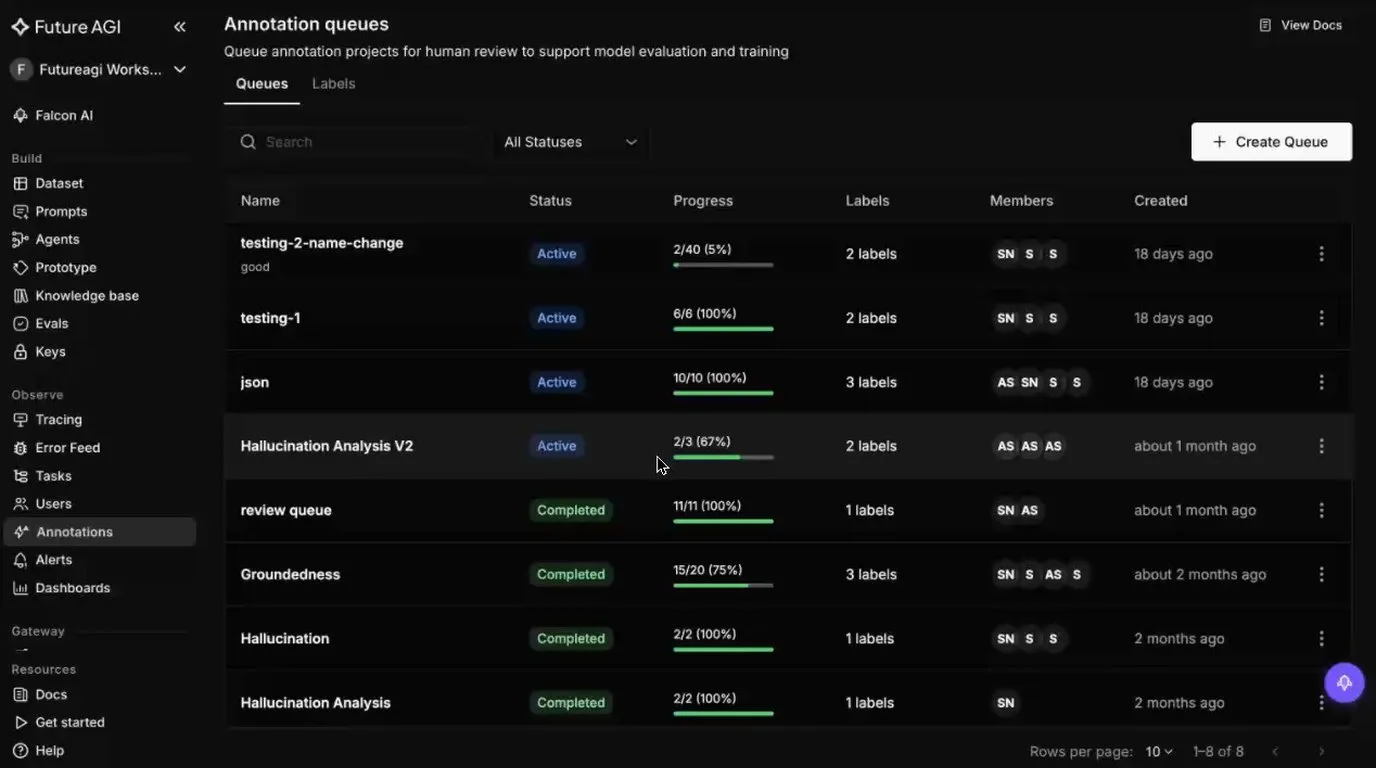
How FutureAGI fits: FutureAGI pairs custom metrics with annotation queues where your domain experts label the disputed cases and the platform tracks reviewer agreement, so a custom judge is calibrated to your team rather than trusted on faith. That agreement number is the evidence that the metric measures what your experts mean, and it is what you show when someone asks why the score should be believed. The screenshot below shows the annotation queues where reviewers are assigned to label cases for evaluation, each with its progress and label count. A platform with no calibration loop misses this, leaving you a confident judge nobody validated. For grounding the judge, see LLM-as-judge best practices.
4. Can it score your domain output without ground truth?
Why it matters: domain production output is rarely labeled. Nobody hand-graded the live contract summaries or the support replies, so a custom metric that needs a gold answer to score is useless exactly where you need it.
What to look for: reference-free custom evaluators that judge against your criteria or the provided context rather than a labeled answer, so the metric runs on real production output without a hand-labeled set.
What to avoid: a custom metric that can only compare against a reference, which has nothing to grade once you leave a curated test set.
How FutureAGI fits: FutureAGI’s custom evaluators score reference-free, judging an output against your rubric or its context with no gold answer required, so a domain metric runs on live output you never labeled. You can keep a small labeled set for calibration, but you do not need to label production to score it. Match-only metrics miss this because there is nothing to compare against once you leave a curated test set, and a labeled gold answer is exactly what production does not hand you.
5. Are custom metrics named, versioned, tagged, and shared?
Why it matters: a custom metric that lives as an untracked script in one engineer’s notebook dies when they switch teams. Domain metrics are organizational knowledge, and they have to be durable artifacts the whole team can find, reuse, and watch over time.
What to look for: each custom metric as a named, tagged, owned artifact in a shared catalog, reusable across projects, with its own performance history so you can see when a metric itself starts behaving differently.
What to avoid: a tool where a custom metric is a local, unversioned snippet with no catalog, so nobody else can find or trust it.
How FutureAGI fits: FutureAGI stores each custom metric as a named, tagged template with an owner and an error-rate history over time, so a domain metric is a shared, trackable artifact rather than a private script, and the team reuses it across projects. When the metric’s own behavior shifts, the history shows it. A platform with no catalog misses this because the metric cannot outlive its author.
6. Does the same custom metric run in CI and in production?
Why it matters: a custom metric is only trustworthy if the version that gates your build is the version watching production. When the CI check and the production check are different implementations, a production dip cannot tell you whether the model regressed or your two checks simply disagree.
What to look for: dev-prod parity on the custom metric, where the same evaluator definition gates a deploy in CI and runs online on production traffic, attached to the trace.
What to avoid: a custom metric you can only run offline in a batch, with a separate production monitor that drifts from it.
How FutureAGI fits: FutureAGI runs your custom evaluator in CI to gate a deploy and online on production traffic, with each result attached to the span that produced the output, so the domain rule you wrote once measures both places. A passing build and a healthy production dashboard now mean the same thing for your custom metric. A platform that runs custom metrics offline only misses this, because the production signal comes from a different check. For why parity bites, see why an agent passes evals and fails in production.
7. Does it tell you which input failed your custom metric?
Why it matters: a single failing score on a custom metric is not actionable if you cannot see which part of the input broke the rule. For a domain rule, you need to know the exact claim or field that violated it, or every failure is a manual re-read.
What to look for: field-level attribution that names the input or claim that failed the custom check, so a violation points at the specific text rather than the whole response.
What to avoid: a custom metric that returns one document-level number with no path to the offending field.
How FutureAGI fits: FutureAGI attaches field-level error localization to its evaluators, including custom ones, so a failed domain rule names the input or claim that broke it instead of a smoothed score, like the exact line that used the wrong citation format. That turns a red custom metric into a specific fix. A score-only platform misses this because it never tied the failure to the field. Error localization is the difference between knowing the metric failed and knowing where.
8. Can a custom metric stand in for a domain expert on high-stakes calls?
Why it matters: here the honest answer protects you. A calibrated custom metric is powerful, but a platform that implies it replaces your experts on regulated or high-stakes decisions is selling a risk you will own.
What to look for: a platform that frames the custom metric as scaling the routine cases and flagging the ambiguous ones, with experts still in the loop on the calls that matter, rather than a full substitute for human judgment.
What to avoid: a vendor promising a custom metric that removes the domain expert entirely, which is the claim least likely to survive an audit.
Where FutureAGI is honest about this one: FutureAGI is built to scale your experts, not replace them: a calibrated custom metric handles the routine majority and routes the ambiguous and high-stakes cases to a human through the same annotation queues that calibrate it. On regulated decisions, the metric is the first pass and the floor, not the sign-off. If you need a guaranteed-correct verdict on a labeled, deterministic source of truth, a plain assertion against that source can be simpler than any judge. FutureAGI earns its place on the judgment-heavy, unlabeled cases where a calibrated metric scales what an expert cannot review by hand.
A quick decision framework
The factors are the test; here is how the answers map to a pick.
| Choose | When | What decides it |
|---|---|---|
| A calibration-first platform | Your custom judge has to be defensible to experts or auditors | Factors 3 and 7; a custom judge with no agreement number is an opinion |
| A dual-authoring platform | Domain experts and engineers both write metrics | Factor 1; a single-path tool benches half your team |
| A rule-and-judgment platform | Some rules are exact, some are subjective | Factor 2; a judge-only tool overpays for format checks |
| A plain assertion | You verify against a labeled, deterministic source of truth | Factor 8; on that slice a code assertion beats any judge |
Where FutureAGI fits
The 8 factors get you a trustworthy custom metric: authored by the right people, calibrated to your experts, reference-free, and running in CI and production. Past a single metric, three things matter to teams running domain-specific evaluation that the checklist does not cover: combining metrics into one decision, improving against your metric, and enforcing it at runtime.
Combine several custom metrics into one decision. A real domain verdict often depends on more than one rule (valid format and compliant clause and grounded summary), so FutureAGI lets you combine custom metrics into a composite evaluation that returns a single pass or fail. The domain decision is scored as the whole rule it actually is, not three numbers you reconcile by hand.
Improve against your custom metric, not just measure it. Once a custom metric scores a prompt, FutureAGI’s optimization layer can rewrite that prompt and score each candidate against the same custom evaluator, so the domain rule you authored becomes the objective an optimizer improves toward. The metric you trust becomes the target, instead of a number you act on manually.
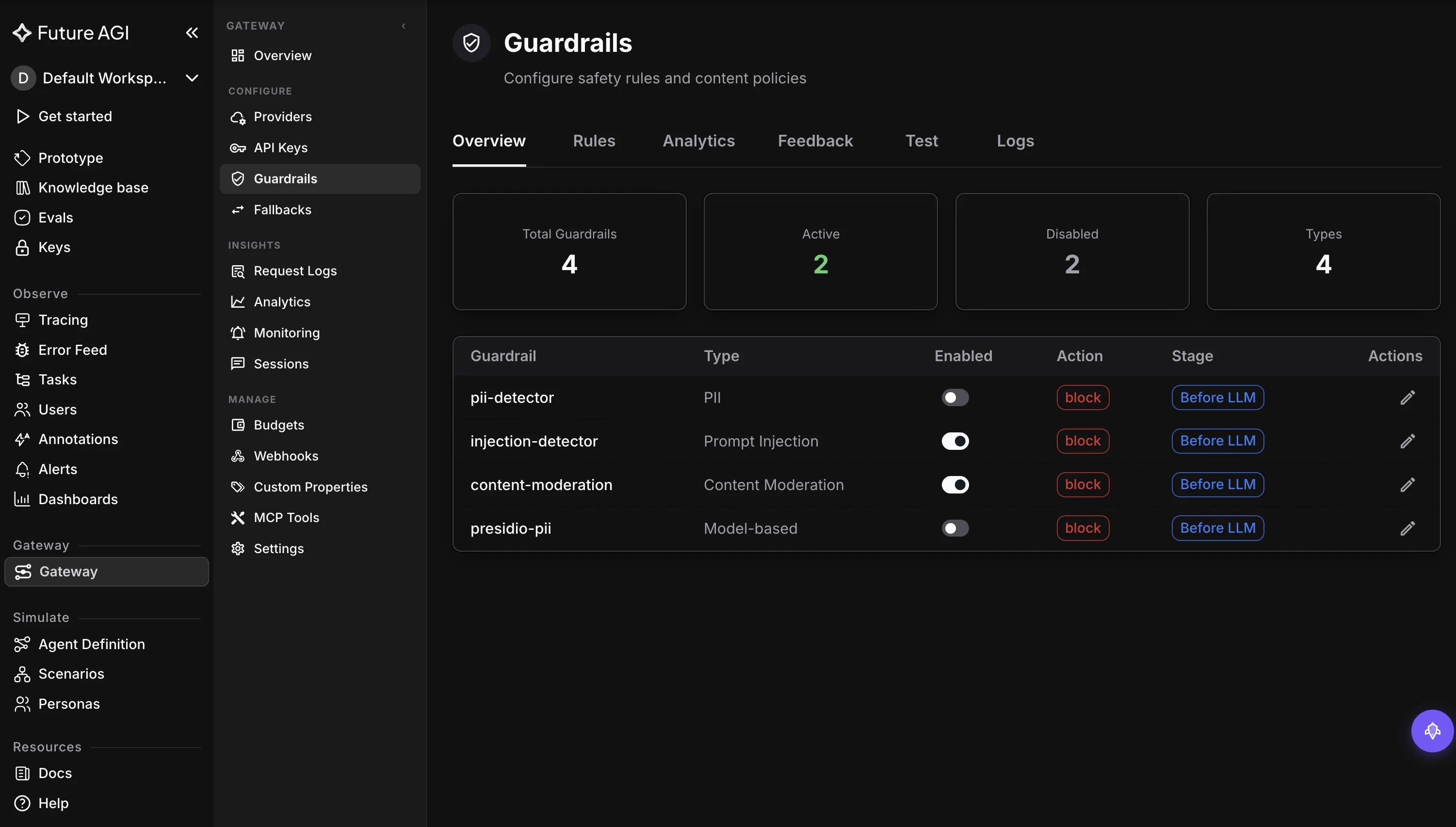
Run a custom metric as a runtime guardrail. A domain rule does not have to stop at evaluation. A Future AGI evaluation, including a custom one, can run as a gateway guardrail that scores a response before it reaches the user and blocks it on failure. The screenshot below shows guardrail rules configured to act before the LLM response goes out, so a custom domain rule can enforce, not just report.
Where FutureAGI is not the pick: if your domain rule is a simple deterministic check against a labeled source of truth, a plain code assertion is lighter than any platform. FutureAGI earns its place on the unlabeled, judgment-heavy metrics that need authoring, calibration, and a place to live.
See the Evaluate platform overview, the evaluation docs for custom evaluators and calibration, or the Protect docs for running a metric as a runtime guardrail.
What to read next
- Custom LLM Eval Metrics Best Practices (2026): how to write a custom metric that holds up, the practice behind the factors.
- Deterministic vs LLM-Judge Evals (2026): the rule-versus-judgment choice from Factor 2, with examples.
- LLM Evaluation Metrics Explained (2026): the full landscape of metrics your custom ones sit alongside.
- Best LLM Evaluation Tools (2026): if you would rather see specific tools ranked than work the factors yourself.
Frequently Asked Questions About Custom Eval Metrics
What are custom eval metrics?
Custom eval metrics are evaluators you define yourself for your domain, instead of relying only on generic, off-the-shelf metrics. You author a metric (a deterministic rule like a format check, or an LLM-as-judge rubric for a judgment call), calibrate it against your domain experts so its scores track theirs, and run it in CI and in production. The point is that generic metrics like BLEU or a default groundedness score do not know your domain rules, so for a legal citation format, a medical safety constraint, or a brand-voice standard, you need a metric you wrote and trust.
Why are generic metrics not enough for domain-specific evaluation?
Generic metrics measure general qualities (fluency, overlap with a reference, broad groundedness) and are blind to what makes an answer correct in your domain. A response can score well on a default metric while violating a rule that matters to you: citing a statute in the wrong format, recommending a dosage outside a safe range, or breaking a compliance constraint. A custom eval metric lets you encode that rule as an evaluator, so the score reflects your definition of correct rather than a vendor’s generic one.
How do you make a custom LLM-as-judge metric trustworthy?
You calibrate it against people. A custom rubric is only as good as its agreement with your domain experts, so the platform should let experts label disputed cases and track how often the judge agrees with them. That agreement number is what turns a custom rubric from an opinion into a measured instrument. Without a calibration loop, a custom judge drifts from your experts and you have no way to prove its scores mean anything, which is the fastest way to lose trust in the whole eval program.
Can a custom metric replace a domain expert?
No, and a platform that implies it can is overselling. A calibrated custom metric scales the routine cases (the large majority where the rule is clear) and flags the ambiguous ones, but high-stakes or regulated decisions still need expert sign-off. The right model is a metric that handles volume and routes the hard cases to a human, not one that removes the human. The metric raises the floor and frees experts to spend their time where judgment actually matters.
Should a custom metric run in production, not just in testing?
Yes. The same custom evaluator that gates a pull request in CI should also run on live production traffic, attached to the trace, so a passing build and a healthy production dashboard measure the same domain rule. If the CI check and the production check are different implementations, a production dip cannot tell you whether the model regressed or the two checks simply disagree. Dev-prod parity on your custom metric is what makes its production signal trustworthy.
Six factors for choosing an LLM evaluation SDK for engineering teams: evals in code and CI, no-ground-truth scoring, and local-plus-judge routing.

Inside Future AGI open source in Q2 2026: the platform shipped under Apache 2.0, Error Feed and the Agent Command Center went live, traces hit billions.

Six factors for choosing an online evaluation platform for live production traffic: scoring on the trace, sampling at scale, quality alerts, and root cause.