Error Localization for Debugging LLM Apps: 7 Capabilities to Look For in an Eval Platform
Seven capabilities to look for in error localization when choosing an LLM eval platform: field-level attribution, span-tied failures, reasoning, and production fit.
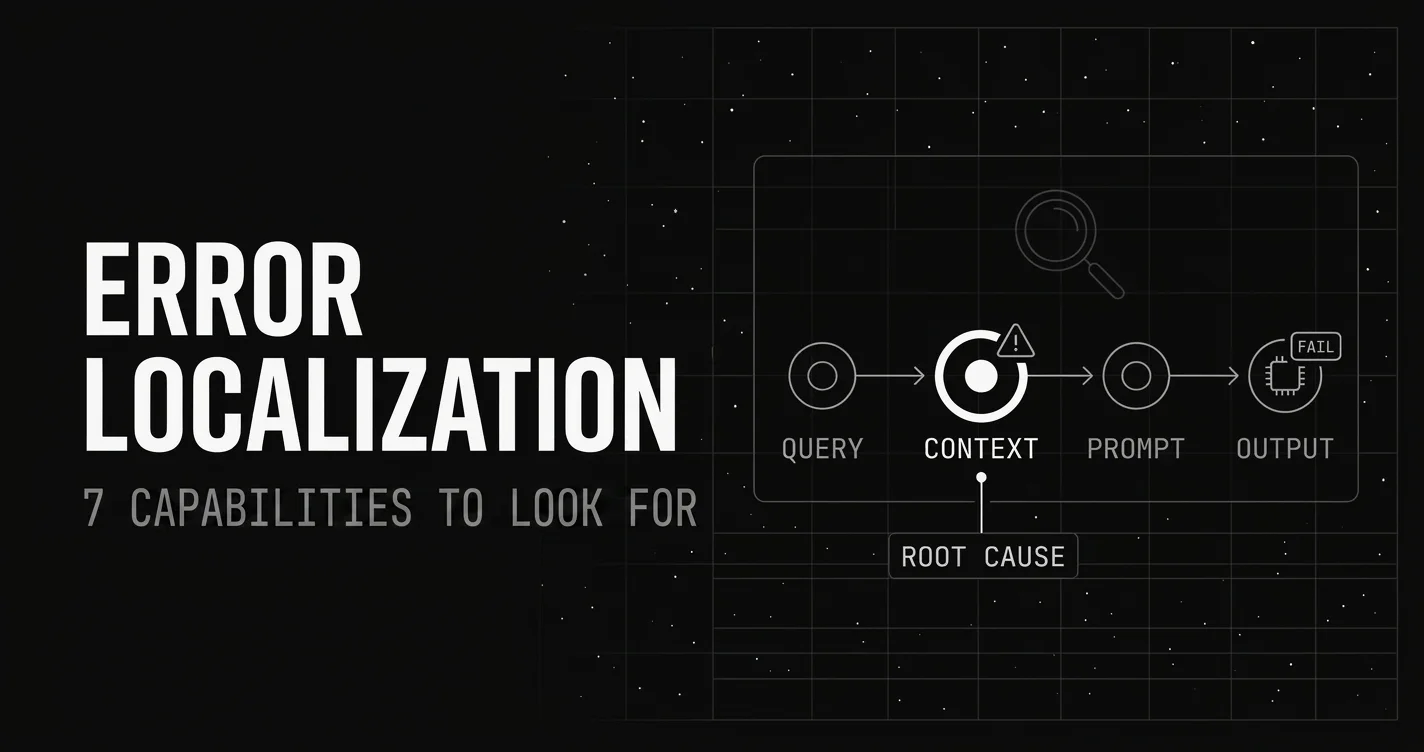
Table of Contents
A user reports that your support agent gave a wrong refund amount. You open the eval dashboard and it confirms the bad news: groundedness failed, score 0.41. Now what? The score tells you the answer was wrong. It does not tell you whether the retriever pulled the wrong policy document, the prompt buried the right one, or the model ignored both. So you start reading transcripts by hand, and a five-minute fix becomes an afternoon.
Error localization is the capability that skips that afternoon: when a check fails, it points to the field, step, or span that caused it. It is not a product you buy on its own; there is no standalone “error localization tool.” It is a capability you should expect inside your evaluation or observability platform, because in an LLM app made of retrieval, prompts, tool calls, and generation, that attribution is the difference between fixing the cause and guessing. Here are the 7 capabilities that separate real error localization from a scorecard that only tells you something broke, and how to check each.
TL;DR: look for error localization in your eval platform that attributes a failure to the exact input field, ties it to the span in a multi-step trace, explains why, runs on live production traffic, sits on open tracing, and turns the bug into a regression test. Attribution, not just a score, is debugging.
For the broader debugging context, see how AI agents fail silently and the wider landscape of AI agent debugging tools.
Why error localization for debugging LLM apps is harder than it looks
Most eval tools stop at the score. They tell you the output failed a check, which is useful for a gate and useless for a fix. The actual debugging work starts after the score: an LLM app is a chain, and a failure at the end could have entered at any link. A groundedness failure can be a retrieval bug, a prompt bug, or a model bug, and the score is identical in all three cases.
So the question is not “does the platform score.” It is “when a score fails, does it tell me which link broke, and can I get from that verdict to the exact span and field without reading the whole trace.” The 7 capabilities below are weighted toward attribution and the debug loop, because that is the part a plain evaluator does not do.
The 7 capabilities to check before you choose a platform
The Root-Cause Localization Test. Score each capability pass or fail. Aim for six or more.
| # | Capability | Pass if the platform… |
|---|---|---|
| 1 | Field-level attribution | Names the input field that caused the failure |
| 2 | Trace-level localization | Ties the failure to the span where it happened |
| 3 | Reasoning | Explains why it failed, not just that it did |
| 4 | Production coverage | Localizes on live traffic, not only offline |
| 5 | Open tracing | Sits on OpenTelemetry, no proprietary lock-in |
| 6 | Regression loop | Turns the bug into a test that stays fixed |
| 7 | Scope honesty | Localizes LLM failures, does not pretend to be APM |
1. Does it tell you which field broke, not just that the output failed?
Why it matters: a pass or fail is a symptom. Without attribution, you reproduce the whole input by hand to find the cause, which is the slowest part of debugging.
What to look for: field-level attribution that names the input (query, context, prompt) responsible for a failed check, not a single verdict at the end.
What to avoid: the platform returns a score and nothing else, so every failure is a manual investigation.
How FutureAGI fits: fi.evals runs evaluation with error_localizer=True, which attributes a failed score to the specific input field that caused it. On a groundedness failure, that tells you whether the retrieved context or the model’s output is at fault, which are opposite fixes. A plain evaluator cannot distinguish them.
2. Does it tie the failure to the span where it happened?
Why it matters: in a multi-step agent, the failure surfaces at the end but enters somewhere in the middle. A field-level verdict still leaves you hunting for the step.
What to look for: eval scores attached to the span in the trace tree, so a failed check in step three lives on step three’s span, not in a separate dashboard.
What to avoid: the eval result and the trace live in two different tools you have to manually correlate by timestamp.
How FutureAGI fits: fi.evals scores attach to traceAI spans, so a failed evaluation sits on the exact span that produced it. You open the trace, see which step is flagged, and read its inputs and outputs in place. That is the difference between observability and evaluation working together and bouncing between two screens.
3. Does it explain why the check failed, not just that it did?
Why it matters: a localized field tells you where to look. The reasoning tells you what is actually wrong there, which is what you act on.
What to look for: a human-readable explanation attached to every score, not just a number or a pass/fail flag.
What to avoid: an opaque score with no rationale, so even after localization you guess at the fix.
How FutureAGI fits: every fi.evals result carries the judge’s reason alongside the score and the localized field, so you get where, what, and why in one result: the context was at fault, and here is the specific claim it failed to support.
4. Does it localize on live production traffic, not only offline?
Why it matters: the bugs you most need to localize are the ones you did not anticipate, and those show up in production, not in your curated test set.
What to look for: evaluation and localization that run online, on live spans and sampled traffic, so an on-call engineer can attribute a real incident.
What to avoid: offline-only attribution that cannot touch a production trace.
How FutureAGI fits: fi.evals runs the same evaluators online, on live production spans, so a failure is localized where it happened, in production, with the field and reasoning attached. You debug the incident, not a reconstruction of it.
5. Is it built on open tracing, or a proprietary black box?
Why it matters: error localization is only as good as the trace it reads. If that trace is locked to one vendor’s format, you cannot take it to your own observability stack, and you are betting your debugging on a single tool.
What to look for: OpenTelemetry-native tracing that exports to the backends you already run, so the localization layer sits on a standard, not a silo.
What to avoid: a proprietary trace format with no path to OTel or your existing observability.
How FutureAGI fits: traceAI is OpenTelemetry-native and auto-instruments common frameworks, and the spans export to any OTel-compatible backend, so the eval-attribution layer rides on a standard rather than locking you in. You can instrument an agent with traceAI and still send spans wherever you already send them.
6. Does it turn a localized bug into a regression test?
Why it matters: localizing a bug once is good. Making sure that exact bug never ships again is the point. If the fix is not captured as a test, the next refactor reintroduces it.
What to look for: a path from a localized failure to a saved case in a dataset, re-evaluated in CI, so the bug becomes a gate.
What to avoid: debugging that ends at the fix, with no way to lock it in.
How FutureAGI fits: a localized failure can be captured into an evaluation dataset and re-run with the same evaluators in CI, so the case that broke once becomes a regression check that gates future deploys. The localization tells you the fix; the dataset keeps it fixed.
7. Does it stay honest about what it does not debug?
Why it matters: error localization narrows down LLM-output failures. It is not a universal debugger, and a tool that claims to be one will mislead you on the failures it cannot see.
What to look for: a tool that is clear it localizes semantic failures in the output, and expects to sit alongside your infrastructure debugging, not replace it.
What to avoid: a vendor that sells localization as a full replacement for your tracing and APM.
Where FutureAGI is honest about this one: this is the factor where the platform is not the whole answer. fi.evals localizes semantic failures (a hallucination, an ungrounded claim, the wrong field), which APM cannot see. It does not debug your infrastructure, latency spikes, timeouts, 500s, and out-of-memory errors, and it does not write the fix for you. For classic infra debugging you still need your APM and logs; for the fix you still need an engineer or an optimizer. It points at the cause; you change the code.
A quick decision framework
Weight the capabilities by what you are actually debugging.
| Choose | When | What decides it |
|---|---|---|
| For field-level attribution | Your failures are quality failures (hallucination, groundedness, wrong field) and you waste time finding the cause | Questions 1 and 3 |
| For trace-level localization | Your app is a multi-step pipeline or agent and the failure hides in the middle | Question 2 |
| For production and open tracing | Your real bugs live on live traffic and you refuse vendor lock-in | Questions 4 and 5 |
| Your APM instead | The failure is infrastructure, latency, timeouts, or memory | Question 7: a different tool |
Where FutureAGI fits
The seven factors get you a failure localized to the field, the span, and the reasoning. Past the scorecard, three things turn a localized failure into a fixed one.
From one failure to the pattern. Localizing a single bad output is the start, not the end. The Error Feed groups recurring failures across your production traces into named issues with the supporting spans attached, so a bug that surfaces in hundreds of calls becomes one root cause to fix, not hundreds of alerts to triage. Localization tells you which field broke; the Error Feed tells you it broke the same way across the cluster.
A judge that gets more trustworthy over time. The evaluator that flags and localizes a failure is itself a model that can be wrong. Route localized failures into an annotation queue, have humans label a sample, and the agreement between human and judge calibrates the evaluator, so the localization you rely on gets sharper instead of drifting.
From the localized cause to the fix. When localization points at the prompt as the cause, agent-opt optimizes that prompt against the same evaluators automatically, so you go from “the prompt is to blame” to a measurably better prompt without hand-tuning. The screenshot below shows one such run: a prompt rewritten across trials, each scored, the winner up over the baseline.
Where FutureAGI is not the pick: if the failure you are chasing is infrastructure, a latency spike, a timeout, an out-of-memory error, a distributed-systems race, then error localization is the wrong layer and your APM and logs are the right tools. fi.evals localizes failures in the LLM output; it does not replace your observability stack, and it does not ship the fix for you.
To localize a failure on your own outputs, see the FutureAGI evaluation platform and the evaluation docs.
What to read next
- Debugging a retrieval pipeline? Read the best RAG debugging tools for the retrieval-to-generation chain.
- Chasing a failure across agents? See the best multi-agent debugging tools for handoff and trajectory bugs.
- Confused where eval ends and observability begins? Read agent observability vs evaluation vs benchmarking.
- Localizing hallucinations specifically? Study the LLM hallucination deep dive and its four failure modes.
Frequently Asked Questions About Error Localization
What is error localization in an LLM app?
A platform capability that, when a check fails, tells you which part of the input or which step caused it, not just that the output was wrong. It is not a standalone product you buy on its own; it lives inside your evaluation or observability platform. Instead of a single pass or fail, it attributes the failure to a field (the query, the retrieved context, the prompt) or to a span in the trace, so you fix the cause instead of reading the whole transcript.
How is error localization different from an evaluation score?
An eval score tells you an output is bad. Error localization tells you why and where: which retrieved chunk, input field, or step produced the failure. The same groundedness score of 0.41 can mean the retriever pulled the wrong document or the model ignored a good one, and those are opposite fixes. Localization is what separates them.
Do I need tracing to localize errors in an LLM app?
For anything past a single call, yes. An LLM app is a pipeline of retrieval, prompts, tool calls, and generation. To localize a failure to the step that caused it, the platform has to attach the failing score to the span where it happened, so you need eval and tracing that share the same trace tree.
Can error localization run in production?
It should. Most real bugs only appear on live traffic, so the localization has to run online, on production spans, not only on a curated offline set. Choose a tool that scores and attributes failures on live traces, with the reasoning attached, so an on-call engineer can jump from an alert to the field that broke.
Does error localization replace my APM or observability stack?
No. It localizes semantic failures in the LLM output (a hallucination, an ungrounded answer, a wrong field), which APM cannot see. It does not replace infrastructure debugging for latency, timeouts, or memory, and it does not write the fix. It is one capability inside your eval platform that you run alongside your tracing and APM, not instead of them.
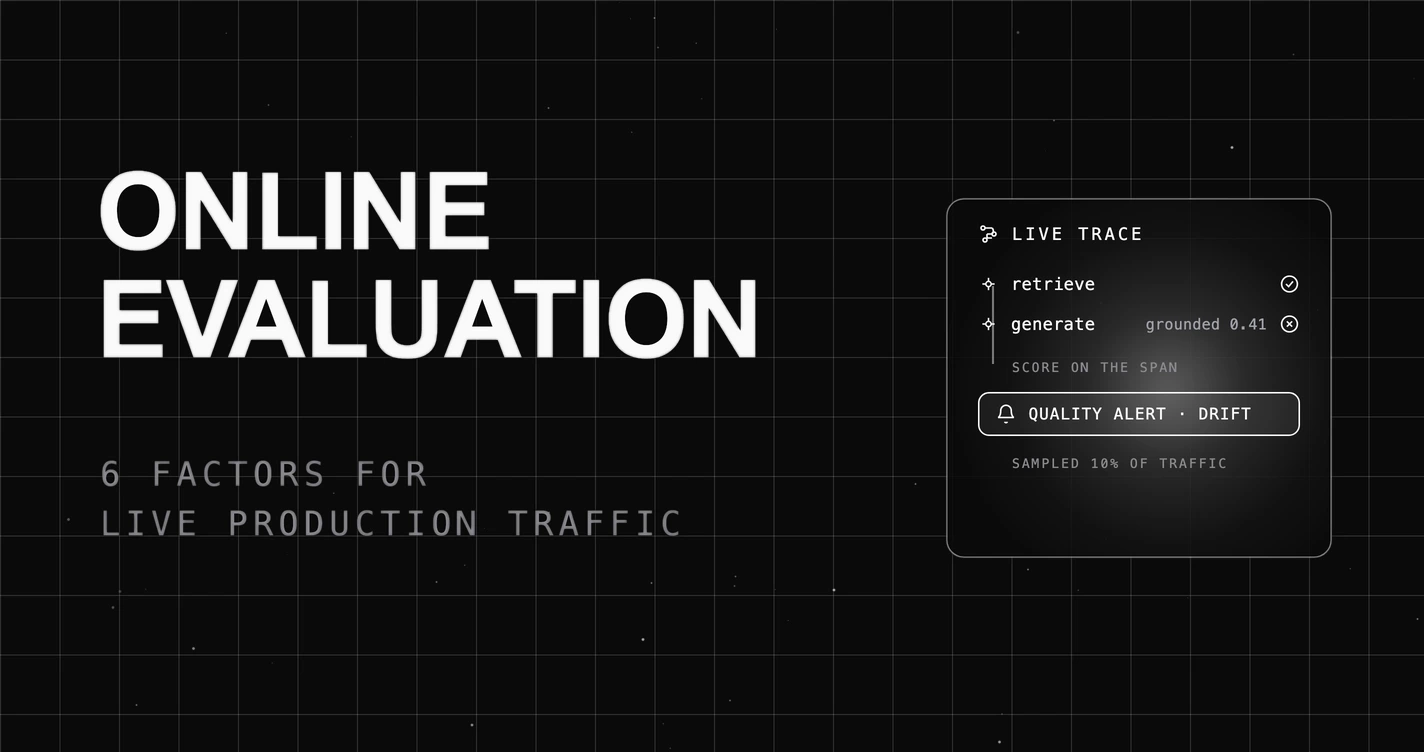
Six factors for choosing an online evaluation platform for live production traffic: scoring on the trace, sampling at scale, quality alerts, and root cause.

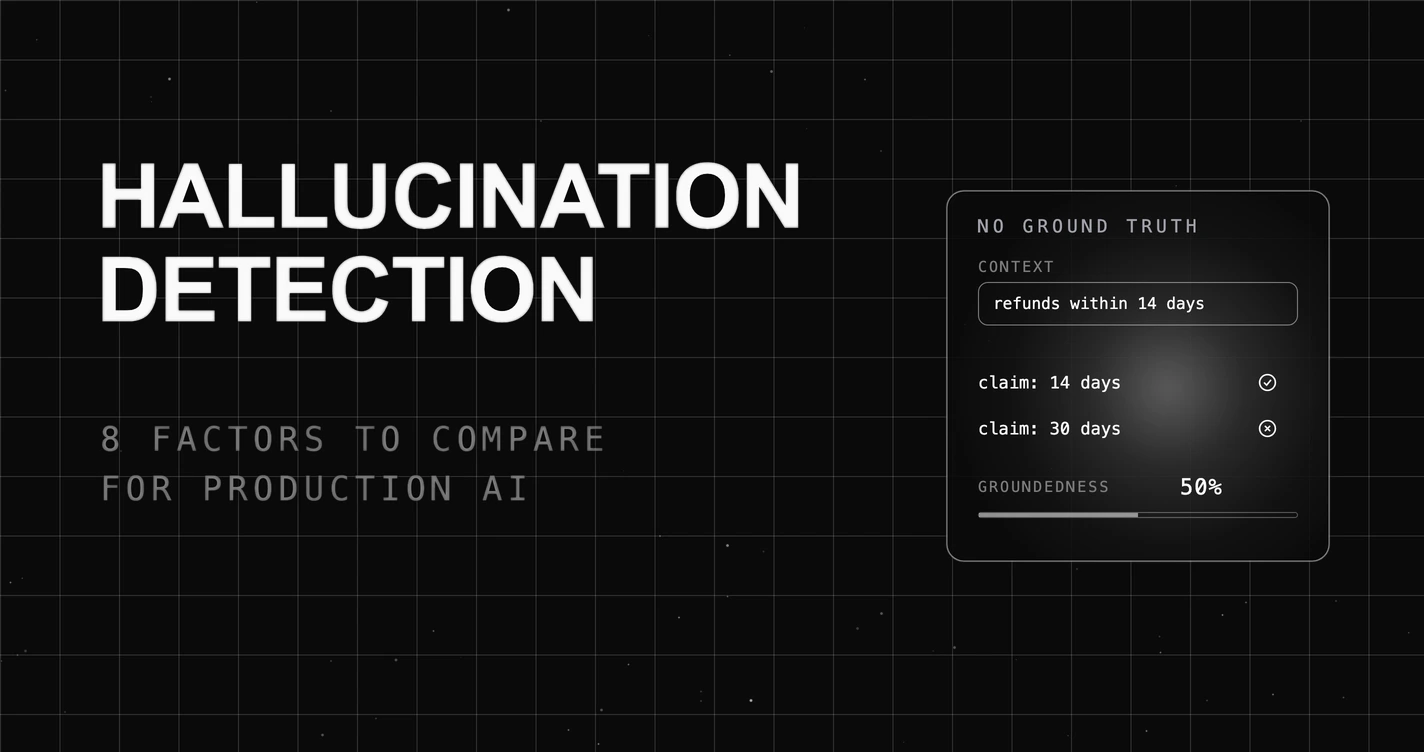
Eight factors for choosing a hallucination detection tool for production AI, from catching errors with no reference answer to blocking bad responses live instead of flagging them once they've already reached users.

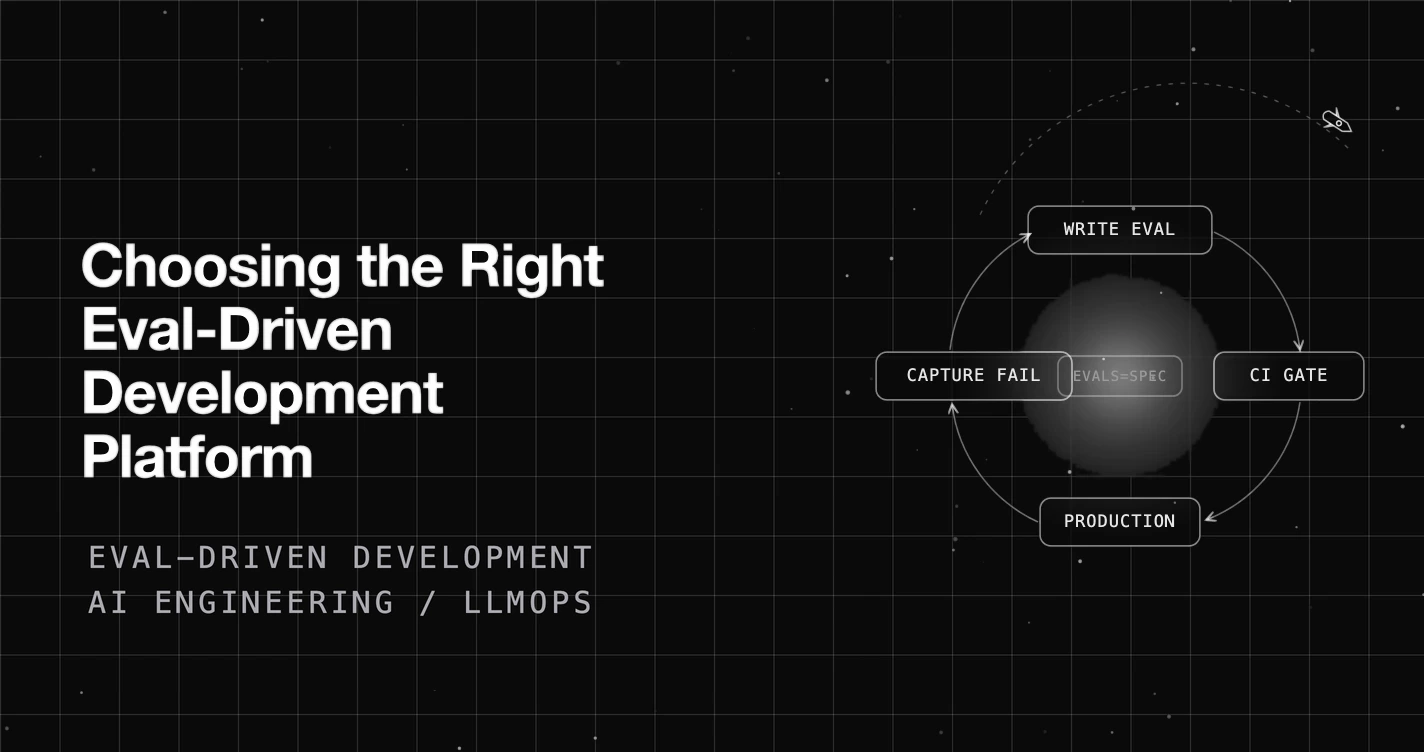
Eight factors for choosing an eval-driven development platform for AI teams: evals as spec, CI gating, dev-prod parity, regression loops, and optimization.
