Choosing the Right Online Evaluation Platform for Live Production Traffic: 6 Critical Factors
Six factors for choosing an online evaluation platform for live production traffic: scoring on the trace, sampling at scale, quality alerts, and root cause.
Table of Contents
The fastest way to choose the wrong online evaluation platform is to confuse it with a monitoring dashboard. A team ships an assistant and watches the production graphs: latency is flat, cost is steady, the error rate is near zero, every panel is green. Meanwhile the assistant has quietly started giving confident, well-formed answers that are wrong, because a retrieval change degraded grounding on a slice of traffic. The monitoring dashboard never flinched, because latency and cost have nothing to say about whether an answer is correct. The thing that was actually broken was never measured.
That is the gap an online evaluation platform exists to close, and it is why an ops monitoring tool is the wrong thing to shop on. Online evaluation scores the quality of live output, like whether an answer is grounded or completes the task, and attaches that score to the trace. So choosing an online evaluation platform is not about prettier latency charts. It is about whether it scores correctness on live traffic, samples it affordably, alerts you when quality drifts, and points at the cause. Here are the 6 factors that separate a real online evaluation platform for live production traffic from a repackaged APM, and how to answer each.
TL;DR: choose an online evaluation platform that scores correctness on live production traffic with each score on the trace, samples affordably to bound cost and latency, scores without ground truth, alerts on quality drift, and roots a failure to its span. It complements, not replaces, your offline gate.
For the distinction this turns on, see LLM eval versus LLM observability and LLM monitoring versus observability.
Why choosing an online evaluation platform is harder than it looks
The trap is that monitoring and evaluation look like the same thing on a dashboard, so teams buy an APM tool and assume quality is covered. It is not. A monitor watches the system: latency, cost, throughput, error rate. All of those can be perfectly healthy while the model returns answers that are fluent, fast, cheap, and wrong. Quality failures rarely show up as errors or latency spikes, so the one tool you are watching is blind by design to the failure that matters most for an LLM.
The second trap is cost. Scoring live quality means running evaluators on production traffic, and if a tool runs an LLM judge on every request in the hot path, it adds latency to the user and a metered bill to the finance team. So the buying decision for an online evaluation platform is whether it scores correctness, not just health, whether it does so on a sample without blocking the response, and whether a drop actually pages someone. The 6 factors below are weighted toward exactly that.
The 6 factors to ask before you choose
The Live Eval Readiness Test. Score each factor pass or fail. Aim for five or more. The rule it encodes: online evaluation scores correctness on live traffic, which ops monitoring never does, but you sample it and pair it with the offline gate.
| # | Factor | Pass if the platform… |
|---|---|---|
| 1 | Scores on the trace | Runs evaluators on live traffic, score on the span |
| 2 | Samples at scale | Bounds cost and latency by sampling, not hot-path |
| 3 | No ground truth | Scores live output with no labeled answer |
| 4 | Alerts on quality | Pages you when a quality metric drifts |
| 5 | Roots the cause | Points a live failure at its span and input |
| 6 | Honest scope | Complements the offline gate, does not replace it |
1. Does it score live production traffic on the trace?
Why it matters: the whole point of online evaluation is to score what real users actually get, where it happens. If the score lives in a separate dashboard from the trace, you spend every investigation correlating two systems by timestamp.
What to look for: evaluators that run on live production traffic and attach the score to the OpenTelemetry span that produced the output, so the eval and the trace are the same object.
What to avoid: a tool that scores production in a disconnected batch elsewhere, so you cannot see why a given trace scored the way it did.
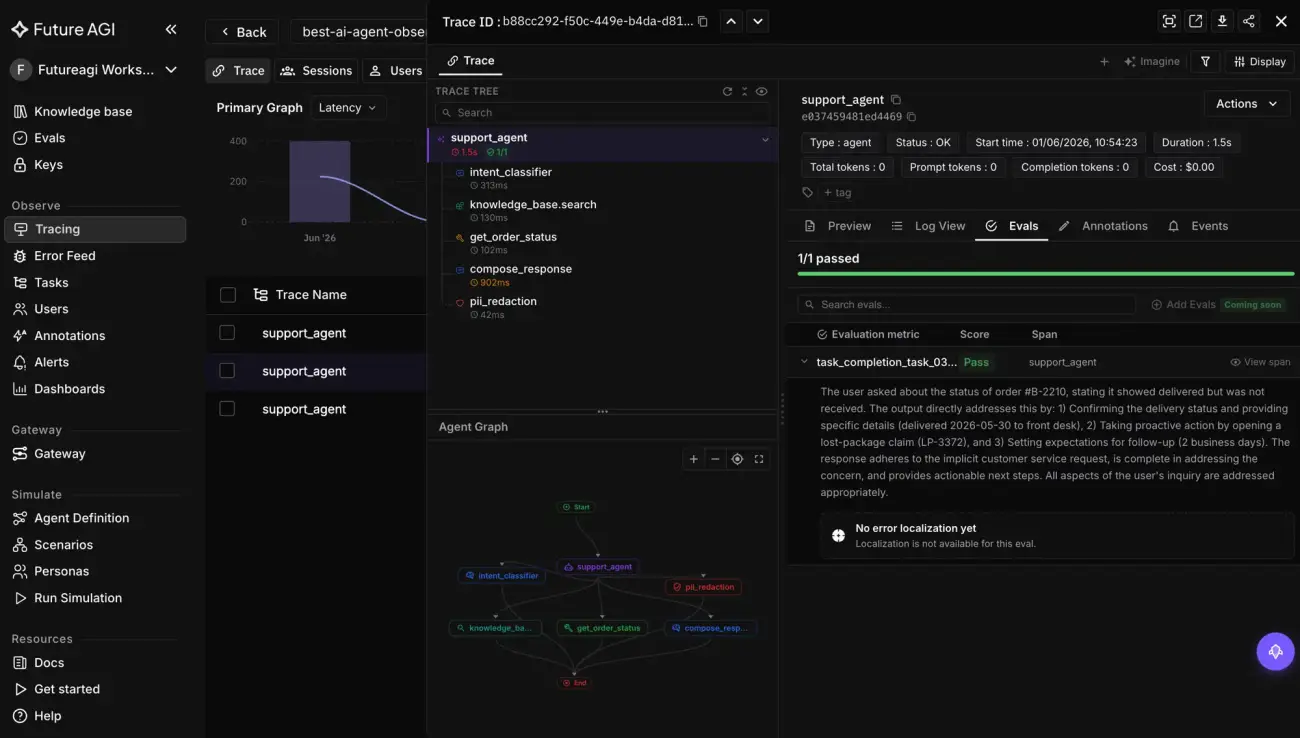
How FutureAGI fits: FutureAGI runs evaluators online on production traffic and attaches each score to the span through traceAI, so the eval sits on the trace, not in a side dashboard. The screenshot below shows a live support-agent trace with the Evals tab open, the task-completion check passed, and the judge’s reasoning attached to the run, alongside the agent graph. A disconnected tool misses this because the score and the trace never meet. For the standards layer, see LLM app observability with OpenTelemetry.
2. Can it sample at production scale within a latency and cost budget?
Why it matters: production traffic is large, and an LLM-as-judge call is not free. A platform that scores every request inline turns online evaluation into a latency tax on users and a metered bill, so it has to sample and score out of band.
What to look for: sampling controls so you score a representative percentage of traffic, cheap deterministic checks on a wider slice, and asynchronous scoring that never blocks the user response.
What to avoid: a tool with no sampling story that implies scoring 100 percent of live traffic with a judge, which does not survive real volume.
How FutureAGI fits: FutureAGI scores a sample of production traffic (often 5 to 10 percent) asynchronously, runs cheap deterministic metrics on a wider slice, and reserves the LLM judge for the sample, so the eval never sits in the user’s hot path. That keeps a continuous read on live quality without paying to judge every request. A hot-path-only tool misses this because cost and latency scale with traffic. For where real-time fits against batch, see real-time versus batch LLM monitoring.
3. Does it score live output without ground truth?
Why it matters: live production output is unlabeled. Nobody hand-graded the answer a user just received, so an evaluator that needs a gold reference to score is dead on live traffic.
What to look for: reference-free evaluators (groundedness, faithfulness, answer relevance, task completion) that judge support against the context or the goal, with no labeled answer required.
What to avoid: an online tool whose metrics are match-based, which has nothing to compare against in production.
How FutureAGI fits: FutureAGI’s online evaluators score reference-free, judging whether a live answer is grounded in its context or completes the user’s task rather than matching a reference, so they run on unlabeled production output directly. The same reference-free evaluators you trust offline carry onto live traffic. A match-only tool misses this because there is no gold answer in production. For the no-label foundation, see why an agent passes evals and fails in production.
4. Does it alert on a live quality regression, not just record it?
Why it matters: a score that sits on a dashboard nobody is watching is not protection. The value of online evaluation is catching a quality drop in time, which means it has to page someone the way a latency spike does.
What to look for: alerts and monitors on the eval metrics themselves, firing on a threshold crossing or a drift in the rolling average, ideally per cohort so a regression on one route or prompt version is not hidden by the global mean.
What to avoid: a tool that records scores but has no alerting, leaving you to discover a quality regression by chance days later.
How FutureAGI fits: FutureAGI lets you set alerts on eval metrics, so a drop in groundedness or a spike in failed task completions fires a notification instead of waiting to be noticed, and you can watch per route or prompt version rather than one global number. That turns a quality regression into a page, not a postmortem. A record-only tool misses this because nobody is staring at the chart at 2 a.m.
5. Does it root a live failure to its cause?
Why it matters: an aggregate live score that says quality dropped is not actionable. In production you need to know which span, which input, and which failure mode, or every alert becomes a manual trawl through traces.
What to look for: field-level attribution that names the input or claim that failed, with the score on the exact span that produced it, so a live failure points at its cause.
What to avoid: a single production quality number with no path to the offending span or input.
How FutureAGI fits: FutureAGI attaches field-level error localization to its online evaluators, naming the input that broke a check, and the score sits on the span that generated the output, so a live failure resolves to a specific cause rather than a vague dip. That is the difference between knowing quality fell and knowing the retrieval step returned the wrong document. A score-only tool misses this because it never tied the failure to the span.
6. Does online evaluation replace your offline gate?
Why it matters: here the honest answer protects you. Online evaluation is powerful, but a platform that frames live scoring as a reason to skip pre-deployment testing is selling a gap you will pay for in incidents.
What to look for: a platform that treats online and offline as two halves of one loop, where the offline gate blocks known regressions before they ship and online evaluation catches the unknown ones on live traffic, with failures feeding back into the offline set.
What to avoid: a vendor implying that watching production replaces testing before you ship, which lets every regression reach a user first.
Where FutureAGI is honest about this one: FutureAGI runs online evaluation as the second half of a loop, not the whole thing. The offline gate still has to stop a regression before it ships, online evaluation catches what the test set missed, and production failures feed back into the offline set so the gate gets stronger. You also sample live traffic rather than scoring all of it, so online evaluation is a continuous read, not a complete census. If all you actually need is system health, latency, cost, and error rate, a standard monitoring tool is lighter than an evaluation platform. FutureAGI earns its place when you need to know whether the live answers are correct, which a monitor never tells you.
A quick decision framework
The factors are the test; here is how the answers map to a pick.
| Choose | When | What decides it |
|---|---|---|
| An eval-on-trace platform | Your dashboards are green but quality complaints are not | Factors 1 and 5; if it cannot score correctness on the span, it is a monitor |
| A sampling-first platform | You have real production volume to score | Factor 2; a hot-path judge is a latency and cost problem at scale |
| An alerting platform | A quality dip must page someone, not sit on a chart | Factor 4; a record-only tool finds the regression too late |
| Monitoring, not eval | You only need latency, cost, and error rate | Factor 6; if correctness is not in scope, a monitor is lighter |
Where FutureAGI fits
The 6 factors get you live quality coverage: scored on the trace, sampled affordably, alerting on drift, and rooted to a cause. Past scoring live traffic, three things matter to teams running online evaluation that the checklist does not cover: triaging recurring failures, closing the loop with pre-deployment, and stopping a bad response before the user sees it.
Triage recurring failures, not one trace at a time. A live alert tells you one trace failed; it does not tell you a hundred failed the same way. FutureAGI clusters recurring production failures in the Error Feed so a platform team works one pattern (a context that is always misquoted, a tool whose output is always invented over) instead of re-reading individual traces. That turns a flood of live failures into a short list of root causes.
Close the loop with pre-deployment. A failure that only online evaluation caught is the most valuable test case you have. FutureAGI lets a representative failing production trace promote into the offline dataset, so the pre-deployment gate catches that failure mode on the next change. This is the online-to-offline direction of the loop: production teaches the offline gate, which is the half a tool that only watches live traffic cannot give you.
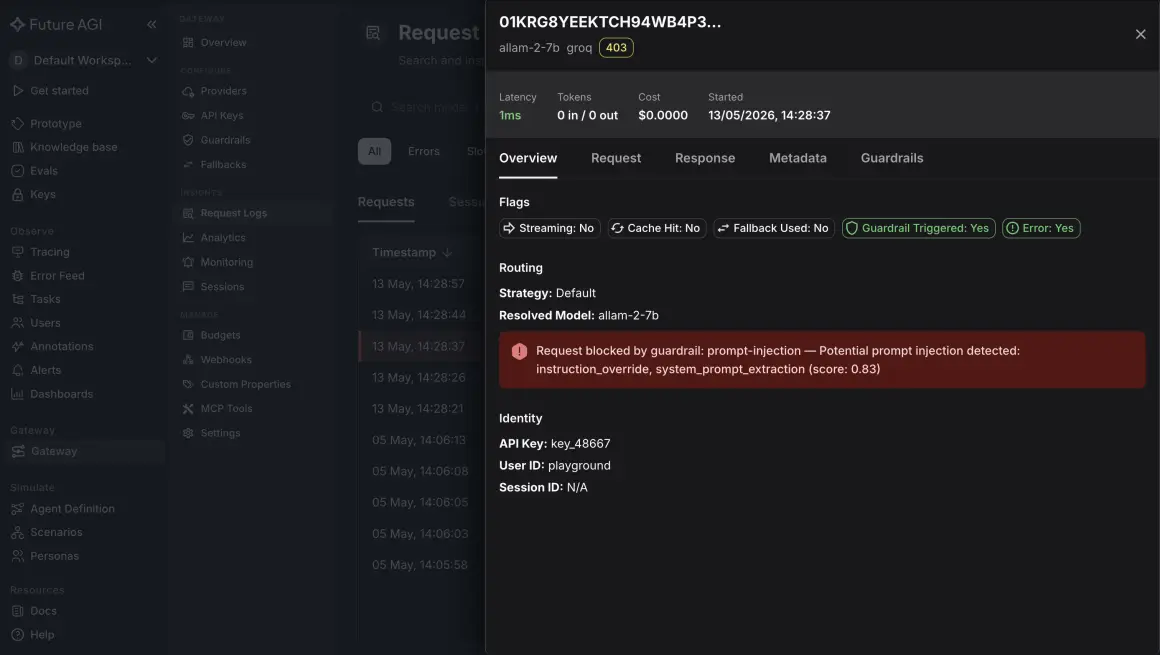
Stop a bad response before the user sees it. Online evaluation scores after the fact, but the same check can run inline as a gateway guardrail and block a response before it ships. The screenshot below shows a request blocked at the gateway, with the guardrail triggered and the reason recorded, so a known failure mode is enforced, not just observed.
Where FutureAGI is not the pick: if you only need system health, latency, cost, and error rate, a standard monitoring tool is lighter than an evaluation platform. FutureAGI earns its place when you need to score whether the live answers are correct, on the same trace your team already debugs.
See the Evaluate platform overview, the observability docs for online eval on traces and alerts, or the Protect docs for running a check as a runtime guardrail.
What to read next
- LLM Eval vs LLM Observability (2026): why scoring correctness and watching traces are different jobs, the idea behind this whole choice.
- LLM Monitoring vs LLM Observability (2026): where ops monitoring ends and quality evaluation begins, the distinction in Factor 6.
- Your Agent Passes Evals and Fails in Production (2026): why offline alone is not enough and online evaluation is necessary.
- Best LLM Monitoring Tools (2026): if you would rather see specific tools ranked than work the factors yourself.
Frequently Asked Questions About Online Evaluation Platforms
What is an online evaluation platform?
An online evaluation platform scores the quality of your model or agent on live production traffic, attaching each score to the trace that produced the output. It samples real requests, runs reference-free evaluators like groundedness and answer relevance on them, alerts you when a quality metric drifts, and points at the span that caused a failure. It is different from ops monitoring, which tracks latency, cost, and error rate. Monitoring tells you the system is up; online evaluation tells you whether the answers are actually correct, which a latency chart cannot see.
How is online evaluation different from monitoring?
Monitoring tracks system health: latency, cost, throughput, and error rate. Those can all be green while the model quietly returns confident, well-formed answers that are wrong. Online evaluation scores correctness on live traffic, like whether an answer is grounded in its context or completes the user’s task, so it catches the quality failures a monitor cannot see. You want both: monitoring for uptime and cost, online evaluation for whether the output is any good. Treating an APM dashboard as quality coverage is the gap most teams discover the hard way.
Does scoring live traffic add latency to production?
It does not have to. The standard pattern is to score asynchronously and on a sample, not on every request in the hot path. You run cheap deterministic checks on a wide slice of traffic, sample a smaller percentage (often 5 to 10 percent) for the more expensive LLM-as-judge evaluators, and run the scoring out of band so the user response is never blocked. That keeps the cost and latency of online evaluation bounded while still giving you a representative, continuous read on live quality.
Does an online evaluation platform replace pre-deployment testing?
No. Online evaluation catches what your offline test set never anticipated, but you still need the offline gate to stop regressions before they ship. They are two halves of one loop: offline blocks known failures pre-deployment, online surfaces the unknown ones on live traffic, and the best setups feed production failures back into the offline set. An online platform that implies you can skip pre-deployment testing is selling a gap you will pay for in incidents.
What should an online evaluation platform alert on?
On quality, not just system health. Useful alerts fire when an eval metric crosses a threshold or drifts: a rolling-average drop in groundedness, a spike in refusals or failed task completions, or a previously unseen failure pattern. The strongest setups alert per cohort, comparing each route, prompt version, or user segment against its baseline, so a regression isolated to one slice is not washed out by the global average. The point is to be paged on a quality dip the way you are paged on a latency spike.
Seven questions for choosing an LLM observability tool that fits your existing stack: OpenTelemetry-native spans, auto-instrumentation, portable export, and eval scoring.

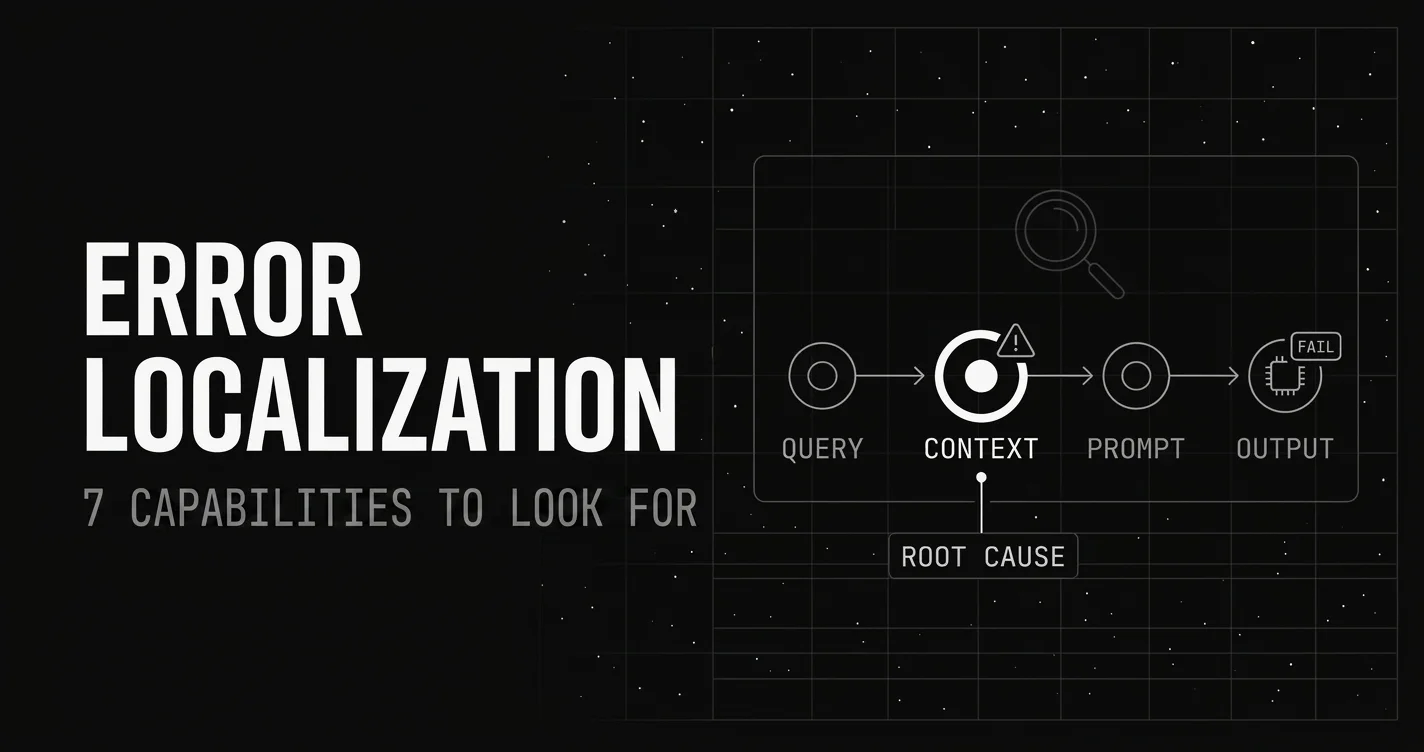
Seven capabilities to look for in error localization when choosing an LLM eval platform: field-level attribution, span-tied failures, reasoning, and production fit.

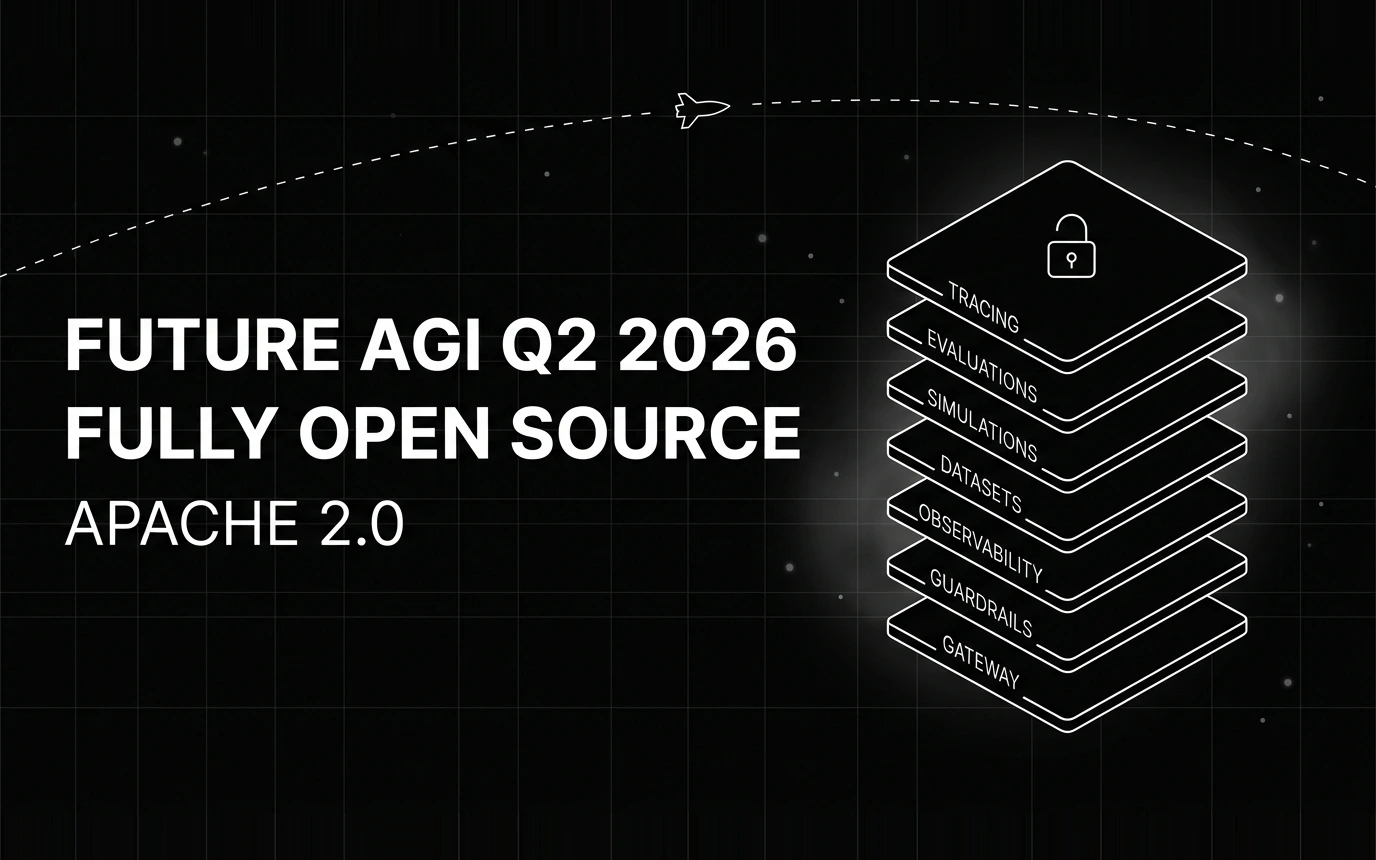
Inside Future AGI open source in Q2 2026: the platform shipped under Apache 2.0, Error Feed and the Agent Command Center went live, traces hit billions.