Best 5 Weights and Biases Alternatives for LLM Workflows in 2026
Five Weights and Biases alternatives scored on OpenTelemetry posture, LLM-app community depth, gateway and optimizer coverage, decoupled pricing.
Table of Contents
Weights and Biases was built for ML training. Experiment tracking, sweeps, artifacts, model registry, Reports, Workspaces, the surfaces that anchor every W&B account were designed for a researcher iterating on hyperparameters, not a platform team running a Claude or GPT-5 agent in production. Weave, the LLM-app add-on layered on top in 2023, was meant to close that gap. Two years and a CoreWeave acquisition later, it still reads like an add-on. The trace data model is W&B-native with OpenTelemetry as a secondary ingest path. Pricing is bundled into the W&B subscription with per-seat math that subsidizes ML-experiment surfaces an LLM-app team never touches. There’s no gateway, no runtime guardrail layer, and no optimizer. The LLM-specific community around Weave is materially smaller than Phoenix or Langfuse.
This guide ranks five alternatives and walks through the migration that always bites: re-instrumenting Python services off the W&B and Weave SDKs onto OpenTelemetry.
TL;DR: pick by exit reason
| Why you are leaving Weights and Biases | Pick | Why |
|---|---|---|
| You want OTel-native tracing plus gateway, evals, and an optimizer in one platform | Future AGI Agent Command Center | Framework-agnostic OTel ingest wired to a self-improving prompt-and-route loop |
| You want OSS observability with the OpenInference reference implementation | Arize Phoenix | OpenTelemetry-native, Postgres-only self-host, the standard the rest of the ecosystem builds on |
| You want OSS observability with the biggest LLM-app community | Langfuse | MIT core, the deepest prompt-management surface in OSS, 50K+ stars |
| You want lightweight hosted observability without a platform tax | Helicone | Drop-in proxy with per-request cost and session traces |
| You want OSS Apache 2.0 traces and evaluations from an ML-tracking sibling | Comet Opik | Apache 2.0 trace and eval suite, broad integrations, sibling to a mature ML platform |
Why people are leaving Weights and Biases for LLM workflows in 2026
Five exit drivers show up repeatedly in W&B community threads, /r/LLMDevs migration discussions, the OpenInference and Langfuse Discords, and G2 reviews from the last two quarters.
1. ML-experiment-tracking heritage: Weave is the LLM add-on with limited depth
Runs, sweeps, artifacts, the model registry, Reports, and Workspaces are the surfaces every W&B account dashboard centers on. Weave was layered on in 2023 as the LLM-app product, and CoreWeave’s March 2024 acquisition leaned harder into the GPU-infra-plus-platform narrative rather than re-centering around LLM applications. The result is a polyglot dashboard LLM-app teams encounter daily, they need an LLM trace tree but land on a page full of ML primitives that mean nothing to their workload. Tool-call boundaries, agent-graph topology, and prompt versioning work, but the chrome around the trace surface still wears ML-experiment paint.
2. Pricing tied to the broader W&B subscription
Weave’s price isn’t standalone. It’s bundled into the W&B Models pricing surface, where teams pay per seat plus tracked hours, with Weave traces and evals folded in. For a pure LLM-app team that doesn’t touch experiment tracking, sweeps, artifacts, or the model registry, the seat license effectively subsidizes surfaces the team never uses. A /r/LLMDevs thread from March 2026 ran the math: a 12-engineer LLM-app team at roughly $200/seat/month is paying around $2,400/month for capabilities they touch once a quarter, when Langfuse Pro is $199/month with no per-seat shape and Future AGI Scale is linear per-trace pricing decoupled from headcount.
3. No purpose-built gateway, runtime, or optimizer
W&B and Weave are observation and eval surfaces. No virtual keys, no provider fallback, no cost-aware routing, no runtime guardrail layer, and no optimizer that uses trace data to rewrite prompts or shift traffic. If a Weave trace surfaces a regression on Claude 4.6 Opus, the action is “engineer opens a PR, redeploys”, not “the platform routes around it.” Teams that grow into needing those surfaces run W&B plus a gateway (LiteLLM, Portkey, Helicone), plus sometimes a third product (Lakera, Guardrails AI) for runtime policy, and stitch correlation back together with metadata headers. After the April 30, 2026 Palo Alto Networks acquisition of Portkey, the W&B-plus-Portkey shape is being reconsidered from both ends.
4. OpenInference and OpenTelemetry support secondary to the proprietary schema
W&B’s recommended path is the wandb SDK and, for LLM workloads, weave.init(). OpenTelemetry support exists. Weave accepts OTLP ingest and has improved across 2025. But it’s documented as a secondary path, and span attributes are translated into the W&B schema rather than honored as first-class GenAI semantic conventions. Phoenix’s openinference is the OTel reference implementation for LLMs and agents in 2026; Langfuse honors OpenInference and the GenAI semantic conventions natively; Future AGI’s traceAI is OTel-native. Teams built around OTel-first instrumentation find Weave’s schema-first posture awkward, every span gets re-shaped, the round-trip costs fidelity, and downstream dashboards that consume gen_ai.* attributes need bespoke translation.
5. Smaller LLM-specific community than Phoenix or Langfuse
The Weave Discord, GitHub discussions, and W&B forum together produce a much smaller volume of LLM-specific content than the Phoenix Discord, the Langfuse Discord, or the LangSmith and LangChain communities. The W&B community is large but concentrated on ML training; the LLM-app subset has fewer maintainers and contributors than dedicated LLM-observability products attract. The gap shows up the first time tool-call instrumentation breaks on a Friday evening.
What to look for in a W&B replacement
Score replacements on the seven axes that map to what you’re migrating off, not the generic “best LLM observability” checklist.
| Axis | What it measures |
|---|---|
| 1. OpenTelemetry posture | Is OTel the primary data model, or a secondary ingest after a proprietary schema? |
| 2. Self-host posture | Can the platform run in your VPC without an enterprise contract? |
| 3. LLM-app community depth | How many LLM-specific contributors, integrations, and Discord answers per week? |
| 4. Pricing decoupled from a parent platform | Does the bill scale with LLM-app traces, or with seats on a different product? |
| 5. Gateway and runtime primitives | Virtual keys, fallback, routing, runtime guardrails — native or bolt-on? |
| 6. Closed-loop optimizer | Does the platform use trace data to improve prompts and routing? |
| 7. Migration tooling | Are there published OTel re-point recipes for W&B and Weave specifically? |
1. Future AGI Agent Command Center: Best for closing the loop
Verdict: Future AGI fixes W&B’s two biggest weaknesses, observability that informs humans but never the system itself, and a trace schema where OpenTelemetry is the secondary path. Agent Command Center captures the trace via OTel across any framework, scores it, clusters failure patterns, runs the optimizer, and pushes the updated prompt or route back into the gateway on the next request. W&B stops at the failed trace and the Evaluation score; FAGI continues with the rewritten prompt.
What it fixes versus W&B:
- OpenTelemetry as the primary data model.
traceAI(Apache 2.0) is OTel-native with first-class instrumentation for LangChain, LangGraph, Pydantic AI, OpenAI Agents SDK, CrewAI, AutoGen, Vercel AI SDK, Microsoft Agent Framework, Mastra, Strands, and raw OTel. Spans match OpenInference and GenAI semantic conventions directly, no translation layer.
- The self-improving loop.
ai-evaluation(Apache 2.0) scores traces against task-completion, faithfulness, and tool-use rubrics.agent-opt(Apache 2.0) runs six optimizers — ProTeGi, GEPA, Bayesian, MetaPrompt, RandomSearch, PromptWizard-style optimization on failing clusters and writes the updated prompt back into the registry, the surface mature W&B teams build themselves on Weave Evaluations with a nightly cron.
- Observability plus a gateway plus a runtime layer. Per-session, per-user, per-route traces sit in the same control plane as provider keys, fallback, virtual keys, and the Protect runtime guardrail layer (median ~67 ms text-mode latency, 109 ms image-mode, per arXiv 2510.13351). Teams running W&B plus Portkey plus a separate guardrail product collapse to one trace ID.
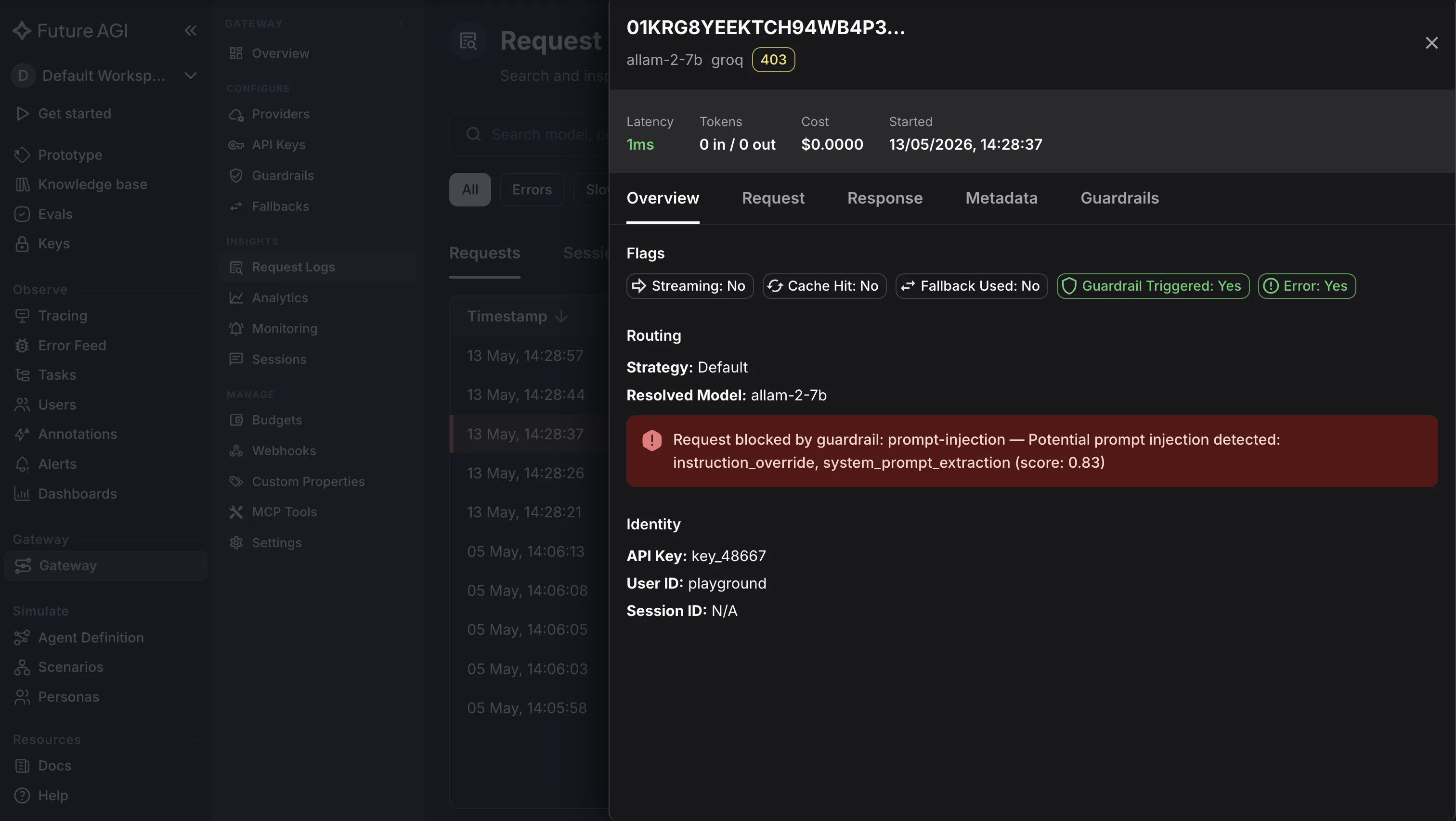
- Pricing decoupled from a parent platform. Free tier with 100K traces/month. Scale tier from $99/month with linear per-trace scaling above 5M, no add-on multipliers and no per-seat shape.
Migration from W&B: Re-point the OTLP exporter to FAGI’s collector and swap the wandb and weave SDKs for traceAI. FAGI’s W&B importer reads the public Datasets and Weave Evaluations endpoints and rewrites evaluator definitions into ai-evaluation format. Datasets port with field-name normalization. Timeline: seven to ten engineering days including a one-week shadow-traffic period.
Where it falls short:
-
agent-opt is opt-in, start with traceAI + ai-evaluation in week one and turn the optimizer on once eval baselines stabilize. The loop compounds value over weeks rather than at day one. Value compounds across week three and beyond.
-
The Datasets diff and Reports-style narrative UI are younger than W&B’s mature Workspaces surface. Both surfaces are actively expanding; teams whose daily workflow is “build a Reports-style narrative document around the eval data” should preview the FAGI surface before standardizing.
Pricing: Free tier with 100K traces/month. Scale tier from $99/month with linear per-trace scaling above 5M (no add-on multipliers). Enterprise with SOC 2 Type II and AWS Marketplace procurement.
Score: 7 of 7 axes.
2. Arize Phoenix: Best for OSS with the OpenInference reference implementation
Verdict: Phoenix is the pick when the reason for leaving W&B is the proprietary-schema-first posture and you want OpenTelemetry as the only data model. Python-native, OSS, and the OpenInference reference implementation, the spec the rest of the ecosystem honors. Embeddings, clustering, and drift surfaces are stronger than Weave’s, and the self-host stack is the cleanest in the cohort.
What it fixes versus W&B:
- OpenTelemetry as the only data model.
openinferenceis the OTel reference implementation for LLMs and agents in 2026, covers OpenAI, Anthropic, LangChain, LlamaIndex, Bedrock, Vertex, the OpenAI Agents SDK, DSPy, Pydantic AI, and Mistral. W&B treats OTel as a secondary ingest; Phoenix’s only path is OTel. - Embeddings, clusters, and drift as first-class surfaces. The surface W&B’s ML-experiment heritage promises but doesn’t deliver inside Weave specifically.
- Self-host with the cleanest stack in the cohort. Postgres and S3-compatible blobs in OSS. No ClickHouse, no Redis, no managed-services tax.
Migration from W&B: Phoenix accepts OTLP directly. The openinference libraries are a clean replacement for the wandb and weave SDKs. Weave Evaluations don’t have a one-to-one importer; rewrite each as a Python evaluator function or LLM-as-judge. Datasets port via the public API. Timeline: five to seven engineering days for a self-host swap.
Where it falls short:
- No optimizer, no gateway primitives, no runtime guardrail layer.
- Datasets and prompt-management UX in OSS is leaner than W&B’s parent-platform Reports and Workspaces.
- The path to enterprise runs through Arize AX, priced for ML-ops budgets ($50K+ ARR) rather than LLM-app budgets.
Pricing: OSS under Elastic License 2.0. Arize AX (enterprise) typically $50K+ ARR.
Score: 5 of 7 axes (missing: optimizer, gateway).
3. Langfuse: Best for OSS with the biggest LLM-app community
Verdict: Langfuse is the pick when the reason for leaving is bundled pricing plus a small LLM-specific community, and your team is comfortable running a self-hosted stack. MIT core, OpenTelemetry-native, the deepest pure prompt-management surface in OSS, and the largest LLM-focused OSS community in this cohort (50K+ stars, active Discord).
What it fixes versus W&B:
- Community depth. Orders of magnitude more LLM-app content per week than the W&B forum’s LLM subset.
- MIT self-host decoupled from any parent platform. Docker Compose, Helm, S3, ClickHouse for trace columns, Postgres for metadata. Self-host the same product Cloud runs, no W&B seat license.
- The deepest prompt-management surface in OSS. Slugged prompts, version labels, label-based deploys with sub-30-second rollback, prompt partials, prompt-linked evaluators on promotion, append-only audit trail. W&B’s prompt surface in Weave is thinner.
Migration from W&B: Re-point the OTLP exporter to Langfuse, swap the wandb and weave SDKs for langfuse-python or langfuse-js, and re-ingest. W&B evaluators have no one-to-one importer, rewrite as LLM-as-judge or use the May 2026 Experiments CI/CD path through GitHub Actions. Datasets port via the public API. Timeline: five to seven engineering days self-host, three to five for Cloud.
Where it falls short:
- No gateway primitives, no runtime guardrail layer, no optimizer, same shape as W&B on those axes.
- Self-host operational burden compounds above 5 to 10M traces/month; ClickHouse expertise becomes a real cost.
- Pro $199/mo and Enterprise $2,499/mo. Cheaper than W&B for an LLM-only team, but Pro-to-Enterprise is still a real jump.
- SSO, fine-grained RBAC, audit logs, and data-region pinning live in commercial tiers rather than the MIT core.
Pricing: Hobby with 50K observations/month free. Core $59/month. Pro $199/month. Enterprise $2,499/month.
Score: 5 of 7 axes (missing: gateway, optimizer).
4. Helicone: Best for lightweight hosted observability
Verdict: Helicone is the pick if your reason for leaving is bundled pricing and platform surface area, and you don’t need eval depth, an optimizer, or ML-experiment lineage. Drop-in proxy with per-request cost telemetry, session traces, and a clean dashboard.
What it fixes versus W&B:
- Pricing decoupled from any parent platform. Pro starts at $25/month and scales gently. No per-seat shape, no W&B Models tax.
- Smaller surface area. If you used W&B and Weave only for traces and per-request cost, Helicone covers the same ground without runs, sweeps, artifacts, model registry, or Reports.
- Self-host option. Apache 2.0 self-host on Postgres and ClickHouse; scale-out beyond a few hundred RPS gets non-trivial.
Migration from W&B: Proxy-based, point the SDK base_url at Helicone, set Helicone-Auth, drop the weave.init() call. Weave Evaluations have no clean equivalent, eval-heavy teams pair Helicone with FAGI or Langfuse. Timeline: three to five engineering days.
Where it falls short:
- No optimizer.
- Eval surface is thin. Weave-style evaluator runs aren’t first-class; CI integration is shallower than Phoenix or Langfuse.
- Routing is basic (round-robin and failover); cost-aware routing requires upstream code.
- Trace topology flattens at the proxy, useful spans for agent-graph teams don’t survive the proxy hop the way OTel-native ingest preserves them.
Pricing: Free tier with 10K requests/month. Pro from $25/month. Enterprise custom.
Score: 4 of 7 axes (missing: optimizer, deep eval, OTel-native ingest, mature Datasets).
5. Comet Opik: Best for OSS Apache 2.0 traces and evaluations
Verdict: Opik is the pick when the OSS license, integration count, and eval surface matter more than fixing the heritage problem. Apache 2.0, more than 60 integrations, an actively shipped self-host, and a sibling product (Comet ML) that, like W&B, started with ML experiments, primitives and chrome carry some of the same baggage. Cleaner than W&B on licensing and integration breadth; not a fix for the heritage issue itself.
What it fixes versus W&B:
- Apache 2.0 self-host as a first-class build. Opik’s OSS distribution is fully featured rather than a stripped-down community edition.
- Broad integration matrix. More than 60 framework and SDK integrations as of May 2026. OpenAI, Anthropic, LangChain, LlamaIndex, OpenAI Agents SDK, DSPy, Pydantic AI.
- Eval suite shipped at the product center. LLM-as-judge, scorers, and datasets are first-class. Closer to Phoenix and Langfuse in eval-surface maturity than Helicone.
Migration from W&B: Replace the wandb and weave SDKs with opik instrumentation. Opik accepts OTLP, but its recommended path is its own SDK. Datasets port via the public API. Weave Evaluations rewrite as Opik scorers. Timeline: seven to ten engineering days.
Where it falls short:
- No optimizer.
- No native gateway primitives, no runtime guardrail layer, the same gap W&B has.
- Comet’s ML-experiment heritage shows up in Opik’s chrome the way W&B’s does in Weave; if heritage drag is the exit driver, Opik is a sideways move.
- Hosted pricing rides on the broader Comet subscription, the next tier is priced for the full Comet platform (ML tracker plus Opik plus MPM), the same shape that pushed teams off W&B.
Pricing: Apache 2.0 self-host. Comet Cloud tiers from a small monthly bill at the entry point, scaling into Comet platform pricing at higher tiers.
Score: 4 of 7 axes (missing: gateway, optimizer, parent-platform-free pricing, ML-experiment-heritage cleanup).
Capability matrix
| Axis | Future AGI | Arize Phoenix | Langfuse | Helicone | Comet Opik |
|---|---|---|---|---|---|
| OpenTelemetry posture | OTel-native primary | OTel-native, the reference impl | OTel-native primary | Proxy-based, OTel optional | First-party SDK + OTLP optional |
| Self-host posture | BYOC + OSS instrumentation | OSS (Postgres + S3 only) | MIT, full self-host | Apache 2.0 self-host | Apache 2.0 self-host |
| LLM-app community depth | Apache 2.0 + active Discord | Large, OpenInference-driven | 50K+ stars, biggest Discord | Active around proxy use | Active, 60+ integrations |
| Pricing decoupled from parent platform | Yes, linear per-trace | OSS free; AX is enterprise | Yes, decoupled | Yes, gentle curve | Hosted rides Comet subscription |
| Gateway + runtime primitives | Native (gateway + Protect) | None | None | Basic (proxy + headers) | None |
| Closed-loop optimizer | Yes (agent-opt) | No | No | No | No |
| W&B migration tooling | OTel re-point + Datasets + Evaluations importer | OTel re-point (clean) | OTel re-point + Datasets importer | Header mapping + proxy cutover | Manual SDK swap |
Migration notes: what breaks when leaving W&B for LLM workloads
Three surfaces always need attention.
Re-instrumenting Python services off the W&B and Weave SDKs
W&B’s recommended path is the wandb SDK for the ML-experiment surface and weave.init("project") for LLM traces. Both emit W&B-schema trace objects to the W&B backend; OTel is supported but secondary. Cutting over means replacing those entry points with the destination’s instrumentation (traceAI for FAGI, openinference for Phoenix, langfuse-python for Langfuse, the Opik SDK for Comet Opik) and either removing @weave.op() decorators or letting OTel auto-instrumentation cover the same call sites.
The cleanest pattern for high-traffic services is shadow ingestion: run both weave.init() and the destination collector in parallel for one to two weeks, validate trace parity, then remove the W&B SDK. Span topology ports cleanly to OpenInference-honoring destinations (FAGI, Phoenix, Langfuse); it flattens on proxy destinations (Helicone) because the proxy only sees the request envelope, not the agent graph. For services on the OpenAI Agents SDK, LangChain, LangGraph, or Pydantic AI, the destination’s auto-instrumentation often delivers richer spans than the weave SDK was emitting.
Rewriting W&B Evaluations and Weave scorers
Weave Evaluations ship a weave.Evaluation primitive plus first-party scorers. The closest one-for-one is Future AGI’s ai-evaluation, which accepts Weave-style scorer text and runs it as LLM-as-judge with the same scoring shape; the FAGI W&B importer does this automatically. Langfuse, Phoenix, and Opik have no one-for-one importer, rewrite each evaluator as a custom Python scorer. Datasets port via Weave’s public Datasets API. Eval-run history doesn’t export; most teams start lineage fresh and keep W&B read-only for 90 days as a backstop.
Reconciling W&B-schema span attributes downstream
Dashboards, alerts, and downstream pipelines built on W&B-schema attributes (wandb.run_id, weave.session_id, wandb.project, wandb.tags) need to remap to OTel-standard equivalents: wandb.run_id collapses into trace_id/span_id, weave.session_id maps to session.id (Langfuse, Phoenix) or fagi.session_id (FAGI), wandb.tags maps to gen_ai.tags. Every consumer of trace data. Grafana dashboards, PagerDuty pipelines, Snowflake export jobs, needs updating in lockstep with the SDK swap. Inventory consumers before flipping the producer.
Decision framework: Choose X if
Choose Future AGI if your reason for leaving is more than bundled pricing or heritage drag, you also want a gateway, a runtime guardrail layer, an eval suite, and an optimizer in one platform so trace data drives prompt rewrites and routing updates over time. Pick this when production agent workloads are becoming a real line item and the OSS instrumentation (traceAI, ai-evaluation, agent-opt, all Apache 2.0) plus the hosted Agent Command Center together justify the migration.
Choose Arize Phoenix if you want OSS with proper OpenTelemetry support as the only data model, and you don’t want to operate ClickHouse or Redis.
Choose Langfuse if the reason is community depth and you want the deepest pure prompt-management surface in OSS, and your team is comfortable operating the Postgres + ClickHouse + Redis + S3 stack at scale.
Choose Helicone if the reason is bundled pricing and surface area, and you’re below 10M requests per month, no need for Weave-style evaluator runs or ML-experiment lineage.
Choose Comet Opik if the reason is licensing posture (Apache 2.0 traces and evals) and integration breadth, and you accept that Opik shares some of W&B’s ML-experiment-heritage drag at smaller scale.
What we did not include
Three products show up in other 2026 W&B alternatives listicles that we left out. LangSmith. LangChain-affinity observability, but framework lock-in makes it a sideways move for polyglot teams. MLflow. OSS ML-experiment tracking with an LLM-tracing add-on, but the project’s center of gravity is also ML-experiment-first; moving off W&B to MLflow doesn’t solve the platform-fit problem. Datadog LLM Observability, capable for teams already on Datadog APM, but priced for enterprise APM budgets.
Related reading
- Best 5 AI Gateways for Compliance Audit Trails in 2026, the compliance and audit-trail comparison
- Best 5 AI Gateways for LLM Cost Optimization in 2026, the five-layer cost stack and the 2026 trust cohort
- Best 5 AI Gateways for LLM Observability and Tracing in 2026, the OpenTelemetry-native observability ranking
- Future AGI vs Helicone in 2026: Self-Improving Runtime vs Lightweight Observability, the head-to-head against the per-request observability layer
Sources
- Weights and Biases pricing, wandb.ai/site/pricing
- W&B Weave documentation, weave-docs.wandb.ai
- W&B Weave Evaluations documentation, weave-docs.wandb.ai/guides/core-types/evaluations
- CoreWeave acquisition of Weights and Biases, March 2024, coreweave.com/blog
- Reddit /r/LLMDevs migration discussions, March-May 2026
- W&B community forum, LLM-app subset, community.wandb.ai
- Arize Phoenix repository, github.com/Arize-ai/phoenix (Elastic License 2.0)
- Arize OpenInference instrumentation, github.com/Arize-ai/openinference
- Langfuse GitHub repository, github.com/langfuse/langfuse (MIT core)
- Langfuse Experiments CI/CD documentation, May 2026, langfuse.com/docs
- Helicone open-source self-host, github.com/Helicone/helicone
- Helicone acquisition of Mintlify, March 2026, helicone.ai/blog
- Comet Opik repository, github.com/comet-ml/opik (Apache 2.0)
- OpenTelemetry GenAI semantic conventions, opentelemetry.io/docs/specs/semconv/gen-ai
- Future AGI Agent Command Center, futureagi.com/platform/monitor/command-center
- Future AGI traceAI, github.com/future-agi/traceAI (Apache 2.0)
- Future AGI ai-evaluation, github.com/future-agi/ai-evaluation (Apache 2.0)
- Future AGI agent-opt, github.com/future-agi/agent-opt (Apache 2.0)
- Future AGI Protect latency benchmark, arxiv.org/abs/2510.13351 (67 ms text, 109 ms image)
Frequently Asked Questions
Why are people moving off Weights and Biases for LLM workflows in 2026?
What is the closest like-for-like alternative to W&B for LLM apps?
How do I migrate traces out of W&B and Weave?
How do I migrate Weave Evaluations?
Is there an open-source W&B alternative for LLM workloads?
Which W&B alternative is cheapest at scale for LLM workloads?
How does Future AGI Agent Command Center compare to W&B?

FutureAGI closes the self-improving loop; MLflow, Comet, Neptune, Langfuse, Braintrust, ClearML ship the parts. 2026 W&B alternatives.

FutureAGI, Datadog, Langfuse, Phoenix, Helicone, Braintrust, LangSmith for LLM monitoring. Latency, drift, cost, eval pass-rate trends.

Honest 2026 comparison of Langfuse alternatives: Future AGI, LangSmith, Phoenix, Braintrust, Helicone on eval depth, gateway, and the loop.
