Best Prompt Registry Platforms for MLOps Teams in 2026
Compare the 6 best prompt registry platforms for MLOps teams in 2026 on prompt versioning, model registry fit, CI/CD, and production deployment workflows.
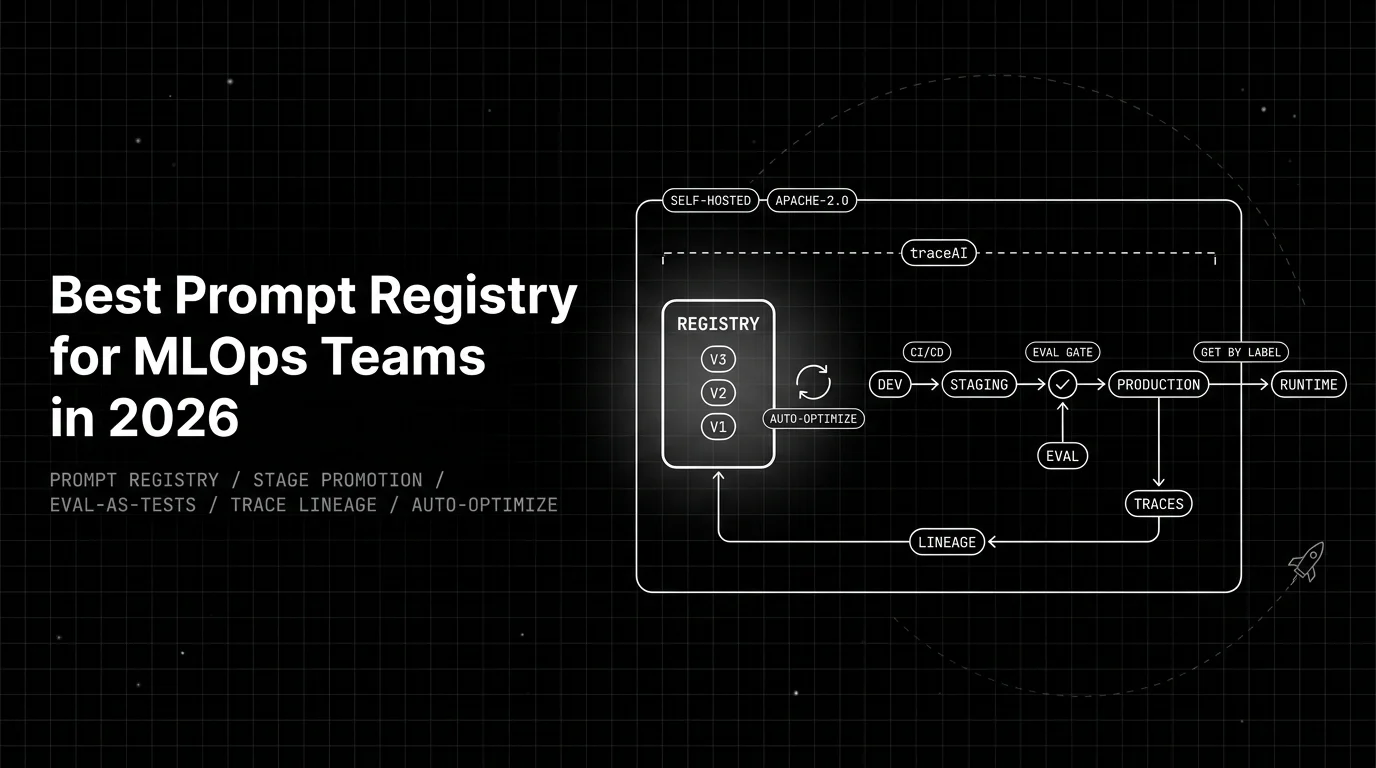
Table of Contents
Your MLOps team already runs a model registry. It stores immutable versions, promotes a model from staging to production, blocks that promotion until the metrics clear, and ties every promoted model back to the run that produced it. Then the prompt that drives your LLM feature lives in a Python string in a feature branch, promoted by a merge and evaluated by a vibe. This guide ranks the six prompt registry platforms worth running in an MLOps pipeline in 2026, scored on stage promotion, eval-as-tests, trace lineage, and automated optimization.
TL;DR: 6 Prompt Registry Platforms for MLOps Teams, Scored on Registry Discipline
Future AGI is the strongest overall prompt registry for MLOps teams in 2026, because it is the only one that runs the full loop. Each prompt is registered as an immutable version on every save. A stage label moves it across Production, Staging, and Development. It clears a CI/CD gate built from a library of built-in evaluators, traces back to production runs, and then gets optimized, all under Apache-2.0.
The table below ranks all six on best fit and standout capability.
| Rank | Tool | Best for | Standout capability |
|---|---|---|---|
| 1 | Future AGI | Versioning, eval gates, lineage, and optimization in one self-hostable stack | Immutable versions with an eval-gated CI/CD promotion and six optimizers |
| 2 | PromptLayer | The most registry-native control plane | Commit-style versions with diffs and label-based stage promotion |
| 3 | Langfuse | An open-source registry inside your own network | MIT core with environment labels and protected production |
| 4 | LangSmith | Experiment depth for LangChain-centric pipelines | Commit-hash versions with first-class named Environments |
| 5 | Weights & Biases | Teams already on W&B runs and models | Object-versioned prompts beside your runs, with Weave evals |
| 6 | MLflow | Teams already standardized on MLflow for the MLOps stack | A Prompt Registry with immutable commits and mutable aliases |
Why Does a Prompt Registry Matter for MLOps Teams?
A prompt changes weekly, every inline edit is a deploy, and a regression hides inside a green build. An MLOps team already solved this shape of problem for models. A prompt registry is the same solution applied to prompts, and three requirements separate a real registry from a string store.
-
It promotes a version through a governed stage, not by editing in place. A prompt version should be immutable. Moving it from staging to production should be a deliberate step the runtime resolves, not someone retyping the text in prod. That decouples the serving path from the version. Promoting one prompt or rolling it back is a controlled action rather than a code release, and you always know which version is live.
-
It gates promotion on eval-as-tests. The registry has to treat evaluation like a test suite in the pipeline. A candidate version is scored against a fixed dataset, and it ships only if the scores clear your thresholds. A regression then blocks the promotion the way a failing test blocks a merge. Storing a version without a gate just records the regression with a version number.
-
It keeps trace lineage, and ideally closes the loop. Capturing and versioning is table stakes. The harder requirement is that every promoted version traces back to the production runs that justify it, the way a model traces back to its training run. At the top of the field, the registry then reads those runs to generate a better candidate automatically.
Most platforms now do the first at some level. What this scorecard rewards is how completely the registry runs the loop. It tracks a prompt from an immutable version, to a promotion gated by evaluations run as tests, to trace lineage, to an optimized next version. The rubric also weighs how much of that can run inside your own network.
How Did We Score Prompt Registry Platforms for MLOps?
We used the MLOps Prompt Registry Scorecard, a six-dimension rubric. It measures how well a platform runs a prompt through the same governed pipeline an MLOps team already runs for models. The test is not just whether a tool can store a string. Most roundups score these tools on generic prompt features. This rubric leads with the dimensions that decide a pipeline bet: stage promotion and eval-as-tests.
| # | Dimension | What we measure |
|---|---|---|
| 1 | Stage promotion | Promoting a version dev to staging to production through a governed step, resolved at runtime |
| 2 | Eval-as-tests | Scoring a version against a dataset and gating promotion on the result, like a test suite |
| 3 | Trace lineage | Linking a promoted version back to the specific production runs that justify it |
| 4 | Automated optimization | Generating a higher-scoring next version, ideally from captured production traces |
| 5 | Immutable versioning | Versions, history, diffs, and rollback as first-class registry operations |
| 6 | License and free self-host | The exact license, and whether the whole platform self-hosts for free or only on Enterprise |
We do not publish a single composite score; the decision table later maps buyer profiles to picks.
Here is how the six platforms compare across the capabilities that vary most.
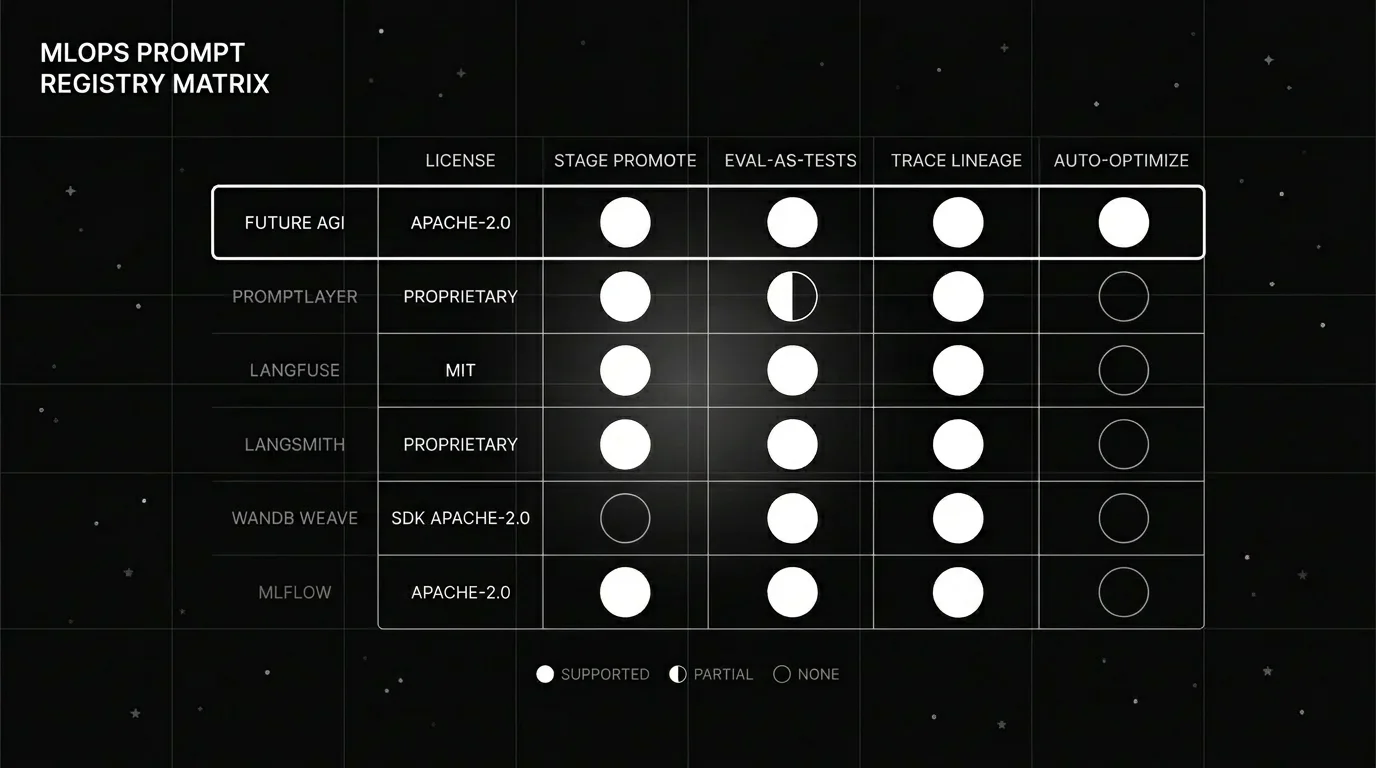
| Tool | License | Stage promotion | Eval-as-tests | Trace lineage | Auto-optimize |
|---|---|---|---|---|---|
| Future AGI | Apache-2.0 | Immutable versions, named labels (Production/Staging/Development) | Built-in evaluators, run as a CI/CD gate | traceAI ties a version to its runs | Six algorithms (agent-opt) |
| PromptLayer | Proprietary | Release and Dynamic Labels | Evals on the prompt page, capped on low tiers | Request logs tie to the version | No |
| Langfuse | MIT core | Labels (production / latest / custom) | Prompt Experiments | Prompts linked to traces | No |
| LangSmith | Proprietary | Named Environments (Staging / Production) | Experiments and pytest | Trace-native, runs link to versions | No |
| Weights & Biases | SDK Apache-2.0 | Content digest, no stage labels for prompts | weave.Evaluation and Playground | Trace-native | No |
| MLflow | Apache-2.0 | Mutable aliases over immutable commits | mlflow.genai.evaluate with LLM judges | OpenTelemetry-based MLflow Tracing | No |
Storage and immutable versioning are table stakes here. Future AGI, Langfuse, and MLflow offer a free open-source self-host; W&B’s SDK is open but its platform self-host is paid. Only Future AGI closes the loop with automated optimization. Weights and Biases has no stage-promotion labels for prompts, because Weave versions by content digest. MLflow instead promotes by reassigning a mutable alias over an immutable commit.
1. Future AGI: Best for Running the Full Prompt Registry Loop in One Stack
Quick take. Future AGI is the only platform here that runs the full MLOps registry loop in one place. Each prompt is registered as an immutable version on every save. A stage label moves it across Production, Staging, and Development. It clears a CI/CD gate built from a library of built-in evaluators and keeps traceAI lineage back to its runs. Six optimization algorithms improve it, all under an Apache-2.0 license you self-host.
Ideal for. MLOps teams that want immutable versioning, named stage labels, eval-as-tests in CI/CD, trace lineage, and optimization in one self-hostable stack. It saves them from stitching a prompt registry, an eval tool, and a tracer together. The platform fits teams who treat prompts as registered artifacts that must be scored before they reach production, the same discipline they apply to models.
Key strengths.
-
A registered version with a stage label, the way a model registry works. Future AGI registers each save as an immutable version, the way a model registry registers a trained model. Every earlier version stays in the version history. A stage label, Production, Staging, or Development, decides which version an environment serves. Promotion moves that label to a newer version, and rollback moves it back, both with no code release. The runtime resolves a name and a label rather than hard-coded text, so a prompt becomes an artifact your pipeline governs the way it governs a model.
-
Eval-as-tests, run like a test suite. Each version is scored against a library of built-in evaluators plus any custom checks you add, covering quality, safety, factuality, RAG retrieval, and format. The evaluators run like a test suite on a fixed dataset, so you weigh a candidate against the current production version and let the score decide which one ships.
-
The gate runs inside your pipeline. You run those evals as a gate in your CI/CD pipeline. A regression in tone, factual consistency, or a custom metric then halts the promotion at the gate rather than surfacing in production. A version reaches the next stage only after it clears the check.
-
Lineage from a version back to its runs. traceAI provides OpenTelemetry-native tracing with instrumentors for 50+ frameworks, and it logs the prompt templates and variables in each span. So every promoted version connects back to the production runs that justify it, the way a model registry ties a model to its training run. That lineage turns a version number into an auditable artifact and gives the optimizer real runs to work from.
-
Optimization that builds your next version. When a promoted version stalls below its target, the open-source agent-opt library reads those same production runs and builds a stronger candidate. It does not leave the rewrite to you. Six algorithms, Random Search, Bayesian, ProTeGi, Meta-Prompt, PromptWizard, and GEPA, test variations against your evaluator. They keep only the ones that outscore the version you already registered, an approach our guide to automated optimization for agents covers in depth. Every other registry here ends at a stored score, while this one hands the next version to your promotion pipeline.
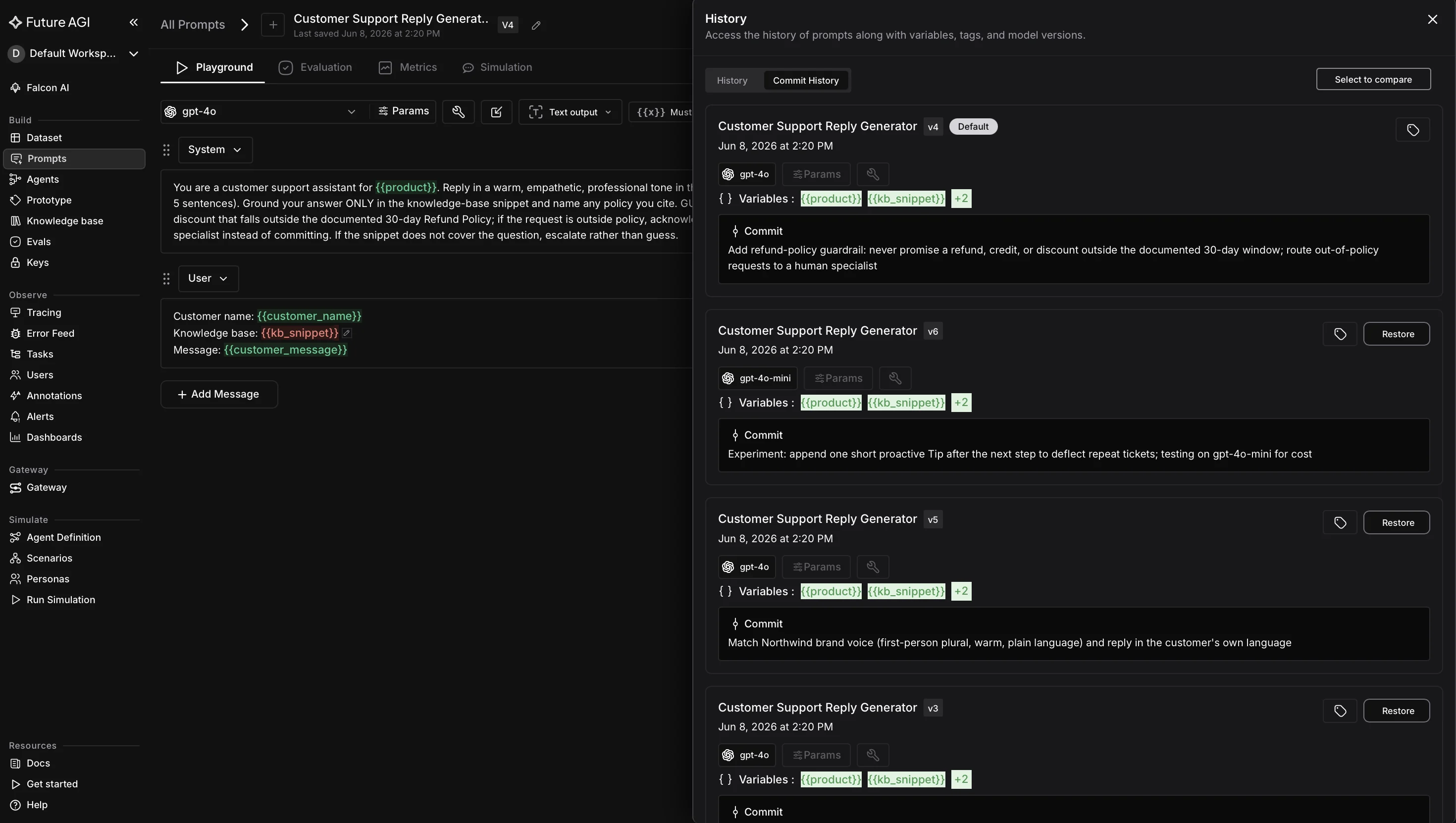
Pricing and deployment. Future AGI has a free tier, pay-as-you-go usage, and Enterprise plans on its pricing page. Because the core SDK and product repos are Apache-2.0, the whole registry loop self-hosts at no license cost via Docker Compose. That covers versioning, evals, lineage, and optimization, all inside the same network as your model registry. SOC 2 Type II and a HIPAA BAA come with the paid plans, compliance the proprietary registries here usually keep for their Enterprise tier.
Verdict. Future AGI is the strongest overall pick for MLOps teams that want one self-hostable stack to version a prompt, gate its promotion on eval-as-tests, trace it back to production runs, and optimize it. It runs under an Apache-2.0 license you can self-host. The entire loop, from registered version to optimized next candidate, stays inside your own network.
2. PromptLayer: Best Dedicated Prompt Registry Control Plane
Quick take. PromptLayer is a registry-first platform where prompt management is the whole product, so it gives an MLOps team the most registry-native control plane in the field. Its versioning is commit-style, with version messages and visual diffs, and Release Labels map a version to an environment. That control plane is decoupled from any framework, so prompts stay a versioned artifact alongside the rest of the pipeline.
Ideal for. MLOps teams that want a dedicated, framework-agnostic registry with first-class versioning, visual diffs, and label-based stage promotion. It suits organizations where prompts are reviewed and approved across multiple teams before each promotion. The registry also needs to work alongside any LLM framework rather than inside one vendor’s ecosystem.
Key strengths.
- The registry is the center of the product, so versioning is first-class. Version messages, visual diffs, and a clean linear history make every prompt change clear in review, the way a model registry makes a version clear.
- Release Labels map a version to environments such as prod and staging, and Dynamic Release Labels can split traffic by percentage or segment for staged rollouts. Rollback is handled by reassigning a label rather than a redeploy.
- Evaluations and Datasets live on the prompt page, so a version can be scored before it is promoted. Request logs tie back to the version that served them for a clear audit trail.
Limitations. Evaluation is present but capped on lower tiers, so the eval-as-tests gate is real yet quota-limited rather than unbounded. PromptLayer is proprietary, and self-hosting is gated to an Enterprise contract rather than a free open license. The version model is linear, with no branch or merge, and there is no built-in automated optimization.
Pricing. A free tier, a Pro tier, and a Team tier in the cloud, with self-hosting available on Enterprise.
Verdict. The best dedicated registry for MLOps teams who want prompts treated as a first-class versioned artifact with diffs and stage labels. Evaluation is capped on lower tiers and there is no built-in optimization. It pairs best with a separate eval and observability layer for the full registry loop.
3. Langfuse: Best Open-Source Prompt Registry
Quick take. Langfuse is the open-source platform that pairs a prompt registry with tracing in one free, self-hostable instance. Its MIT-licensed core auto-versions prompts as immutable integer versions and maps them to environments with labels. It scores them with Prompt Experiments and links them to the traces they ran in, all inside your own network. It is the OSS default for a team that wants the registry on its own infrastructure.
Ideal for. MLOps teams that want a widely adopted open-source registry self-hosted at no license cost, combining immutable versioning, stage labels, and trace lineage in one instance. It suits groups with data-residency or air-gap requirements that rule out a hosted-only vendor. The MIT license is often a condition of standardizing on it.
Key strengths.
- The MIT core self-hosts free, so the registry, labels, and tracing all run inside your own network. Saving a prompt under the same name creates a new immutable integer version automatically.
- Labels such as
production,latest, and custom map versions to environments. Protected labels let admins lock the production pointer so it cannot be moved by mistake, the stage-promotion model an MLOps team wants from an open core. - Prompt Experiments score a version against a dataset for an eval-as-tests gate, and prompts link to the traces they produced. So a promoted version keeps lineage back to its runs.
Limitations. A client-side cache means a reassigned label is picked up only after the cache refreshes, so promotion is not strictly instant from the app’s perspective. The richest enterprise controls live in the commercial Enterprise Edition rather than the MIT core. There is also no built-in automated optimization to act on a failing eval score.
Pricing. A free Hobby cloud tier and free self-hosting under MIT, with paid Core, Pro, and Enterprise cloud tiers above them.
Verdict. The best open-source registry for MLOps teams who want immutable versions, stage labels, and trace lineage in one free, self-hostable instance. The tradeoff is a brief cache delay when a label is reassigned, plus no built-in automated optimization. Teams that need the full loop will pair it with a separate optimizer.
4. LangSmith: Best Experiment Depth for LangChain-Centric Pipelines
Quick take. LangSmith is the prompt and evaluation layer built by the LangChain team, with first-class Experiments, strong evaluators, pytest integration, and trace-native lineage. For an MLOps pipeline it brings the deepest eval-as-tests tooling in the field. Prompts version by commit hash in the Prompt Hub, and named Environments promote a chosen commit from Staging to Production with one-click rollback.
Ideal for. Teams with a LangChain-centric pipeline that want the deepest experiment and evaluation tooling alongside named Environments for stage promotion. It suits groups that already emit LangChain or LangGraph runs. There, LangSmith captures traces without extra instrumentation and puts versioned prompts beside those traces. Its pytest integration makes the eval-as-tests gate straightforward.
Key strengths.
- Experiments evaluate a specific application version against a dataset, with a mature evaluator suite and pytest integration. That makes the eval-as-tests gate first-class and well-documented.
- Versioning is an immutable commit hash plus tags, pulled by name and hash from the Prompt Hub. A named Environments feature promotes a chosen commit between Staging and Production, with rollback from full deployment history.
- Tracing is native, and runs link back to the prompt version that produced them, so lineage from a version to its runs is strong.
Limitations. LangSmith is proprietary even though LangChain itself is open source, and its value is concentrated inside a LangChain-centric pipeline. Teams on other frameworks get less out of it. Self-hosting is an Enterprise arrangement. There is no built-in prompt optimization to generate a higher-scoring next version from a failing eval result.
Pricing. A free Developer tier and a per-seat Plus tier, with Enterprise adding self-hosting and regional options.
Verdict. The best pick for a LangChain-centric pipeline that wants the deepest experiment tooling, pytest integration, and trace-native lineage. It is proprietary, self-hosts only on Enterprise, and has no built-in optimization. Teams outside the LangChain ecosystem or with free self-host requirements will find better value in Langfuse or Future AGI.
5. Weights & Biases: Best If Your MLOps Stack Already Runs on W&B
Quick take. Weights and Biases popularized the stage-aliased model registry where a model is promoted by moving an alias. Its LLM layer, Weave, brings strong tracing and evaluation to prompts, but versions them by content digest with no stage-promotion labels. If your stack already runs on W&B, Weave puts prompts beside your runs and models; the gap is that its labeled-stage pattern does not extend to prompts.
Ideal for. Teams whose MLOps stack already lives in Weights and Biases and want prompt versioning, tracing, and evaluation alongside existing runs and models. It suits groups that already invest in W&B experiments and would rather keep prompts as tracked objects in the same platform than add a second registry.
Key strengths.
- Weave versions prompts as objects through
weave.StringPromptandweave.MessagesPrompt, published withweave.publish()to a Prompts page. Each is auto-versioned by content digest, with{variable}placeholders, so a prompt becomes a tracked artifact next to your runs. - Tracing is strong and native, and
weave.Evaluationplus the Playground give a solid eval-as-tests surface. Scoring a version against a dataset and tying it to its runs both land cleanly. - Everything sits beside your existing W&B runs and models, which is the real draw for a team already invested in the platform, now part of CoreWeave as of 2025.
Limitations. Weave versions prompts by content digest, not a movable stage label, so there is no promotion alias for prompts the way there is for W&B models. That is the dimension it scores empty on. The Weave SDK is Apache-2.0, but full platform self-hosting is a paid Enterprise arrangement rather than a free open core, and there is no built-in prompt optimization.
Pricing. A free tier with 1 GB per month of Weave ingestion, a Pro tier from $60 per month then usage-based, and custom Enterprise, where full self-hosting lives.
Verdict. The best pick when your MLOps stack already runs on Weights and Biases and you want prompts tracked beside your runs and models. The tradeoff is that Weave versions by content digest with no stage-promotion labels. So if the labeled-stage promotion pattern is a hard requirement, the registry model here will not cover it.
6. MLflow: Best If Your MLOps Stack Is Already Standardized on MLflow
Quick take. MLflow added a Prompt Registry in 2.21.0, so the open-source tool that holds your model registry now holds prompts under the same Apache-2.0 license. Prompts are versioned as immutable commits and promoted by reassigning a mutable alias, the same pattern MLflow teams already use for models. For a team standardized on MLflow, the prompt registry sits inside the tool the pipeline is already built around.
Ideal for. MLOps teams already standardized on MLflow that want prompt versioning, alias-based promotion, and evaluation in the same open-source tool that holds their experiments and model registry. It suits organizations where adding a separate prompt registry would fragment the pipeline that is already built around MLflow’s tracking server and model store.
Key strengths.
- Prompts are versioned as immutable commits with
mlflow.genai.register_prompt(name=..., template=..., commit_message=...). A mutable alias then points at a chosen version withmlflow.genai.set_prompt_alias("name", alias="production", version=2). The app loads it at runtime viamlflow.genai.load_prompt("prompts:/name@production"). So promotion and rollback are alias reassignments rather than code edits. - Evaluation runs through
mlflow.genai.evaluate()with LLM-as-judge scorers, and MLflow Tracing is OpenTelemetry-based. So a version can be scored against a dataset and tied back to the runs it produced. - It is fully open source under Apache-2.0 and self-hosts with a local file store or a Tracking Server inside your own network. A managed experience is available on Databricks.
Limitations. The prompt-authoring workflow is code-first and SDK-driven rather than a visual editor, which adds friction for teams that want a review interface. The richest managed UI leans on Databricks rather than the open-source Tracking Server. There is also no built-in automated optimization to generate a better next version from a failing eval score.
Pricing. Free and open source under Apache-2.0 for self-hosting, with the managed experience available through Databricks pricing.
Verdict. The best pick when your MLOps stack already runs on MLflow and you want prompts versioned and promoted with alias-based promotion in the same open-source tool. The tradeoff is a code-first authoring workflow and no built-in optimization. The improvement loop stays manual unless you pair it with a separate optimizer.
Which Prompt Registry Should You Choose for Your MLOps Pipeline?
There is no single winner for every MLOps team, so match the registry to the constraint that matters most to you.
| If you need | Choose | Because |
|---|---|---|
| To version, gate, trace, and optimize prompts in one stack | Future AGI | The only registry that runs the full loop, Apache-2.0 self-hostable |
| The most registry-native control plane with diffs and labels | PromptLayer | Version messages, diffs, Release and Dynamic Labels |
| An open-source registry inside your own network | Langfuse | MIT core, free self-host, labels, and trace links |
| Deep experiment tooling for a LangChain-centric pipeline | LangSmith | First-class Experiments and pytest with named Environments |
| A registry that lives next to your W&B runs and models | Weights & Biases | Weave object versioning and weave.Evaluation alongside your runs |
| A registry in the MLflow tool your stack already runs | MLflow | Apache-2.0 Prompt Registry with alias-based promotion |
Immutable versioning and evaluation have converged, so the differentiator is the loop. Future AGI gates promotion on eval-as-tests in CI/CD, keeps traceAI lineage, and optimizes the next version, all in one Apache-2.0 stack you self-host. If your stack runs on W&B, Weave keeps prompts beside your models but without stage labels. For the full loop graded the way you grade a model, Future AGI is the pick.
If you want an open-source registry with versions, labels, and traces but no full eval-optimize loop, Langfuse fits. It gives you that in one free, self-hostable MIT-licensed instance. If your pipeline is already standardized on MLflow, the 2.21.0 Prompt Registry puts prompts in the tool you already run. Its alias-based promotion maps directly to the model-registry pattern you already know.
Rolling Out Prompt Promotion Without Breaking Production
The platform is the easy part. These practices keep a prompt promotion from becoming a silent production regression.
- Make every prompt change a new immutable version. The moment a prompt is editable without creating a version, your history has a hole in it. Move every prompt out of application code into the registry and save a version on every change so the diff is legible later.
- Promote through a governed stage, never by editing in place. Keep dev, staging, and production as deliberate steps and promote a version through them. The serving path then stays decoupled from the version, and you always know which version is live. Lock the production pointer if your tool supports protected labels.
- Gate promotion on eval-as-tests. Tie a promotion to a passing score against a fixed dataset, and run that eval as a CI/CD gate. A regression then fails the build, the way a passing test suite is part of a merge. A version you cannot score is a version you cannot trust.
- Keep lineage from every version back to its runs. Instrument the serving path so each promoted version traces back to the production runs that justify it, the way a model traces back to its training run. Our prompt versioning and lifecycle guide covers this discipline in depth.
- Close the loop from trace to next version. Feed the production traces back into evaluation and optimization, so each next version is grounded in how the prompt actually behaved. Then rehearse a rollback so it works under pressure.
Where Future AGI Fits in Your MLOps Pipeline
Your model registry gives models immutable versions, stage promotion, gated metrics, and lineage back to the run. Your prompts deserve the same. Picture the prompt still in a Python string in a feature branch, promoted by a merge and judged by a vibe. On Future AGI it becomes a registered version. Each save is immutable, a stage label decides what production serves, and moving it promotes or rolls back with no redeploy. It reaches production only after the built-in evaluators score it like a test suite and the CI/CD gate clears. traceAI ties it back to the runs that justify it, and when it stalls, agent-opt reads those runs to build the next candidate. Your models already move through that pipeline. Put your prompts through the same registry.
For a registry that versions, gates, traces, and optimizes prompts, start with Future AGI.
Frequently Asked Questions About MLOps Prompt Registries
What Is an MLOps Prompt Registry?
An MLOps prompt registry treats each prompt the way a model registry treats a model. A prompt becomes an immutable, versioned artifact promoted through a governed pipeline. Evaluations that run like tests gate it, and trace lineage ties it to the production runs that justify it. The difference from generic prompt management is the MLOps discipline. That means a deliberate promotion step, eval-as-tests instead of manual review, and version lineage instead of a loose changelog.
Which Prompt Registry Is Best for MLOps Teams in 2026?
Future AGI is the strongest overall pick because it runs the full registry loop. That loop covers immutable version snapshots, named stage labels, a built-in evaluator library run as a CI/CD gate, traceAI lineage, and six optimization algorithms, all Apache-2.0 and self-hostable. PromptLayer is the most registry-native control plane, and Langfuse is the best free open-source registry. LangSmith is the deepest experiment tooling for LangChain-centric pipelines, Weights and Biases the best fit for teams already on W&B, and MLflow the best fit for teams already standardized on MLflow.
How Is a Prompt Registry Different From a Model Registry?
The mental model is the same: a model registry stores immutable versions, promotes them across stages, and ties each version to the training run that produced it. A prompt registry applies that discipline to prompts. A prompt version is text plus variables rather than weights, and it changes far more often. Evaluators run as tests against a dataset grade it, rather than a single accuracy metric.
How Do You Gate Prompt Promotion on Evaluations?
You treat evaluators like tests in a pipeline. A candidate version is scored against a fixed dataset, and it ships only if scores clear your thresholds. A regression blocks promotion the way a failing test blocks a merge. With Future AGI, the built-in evaluators run as a CI/CD gate, which makes the check reproducible and auditable. A prompt reaches production because it passed, not because someone merged an edit.
Can You Self-Host a Prompt Registry?
Yes, but the license decides it. Future AGI is Apache-2.0 and self-hostable via Docker Compose. Langfuse offers a free MIT core, and MLflow is Apache-2.0 with a local file store or self-hosted Tracking Server. Weights and Biases publishes an Apache-2.0 Weave SDK, but full platform self-hosting is a paid Enterprise arrangement. PromptLayer and LangSmith are proprietary, so self-hosting requires an Enterprise or VPC contract. If prompt IP cannot leave your network, verify the exact license before you standardize.
Can You Auto-Optimize Prompts in a Registry?
Eval is table stakes across this comparison, but only Future AGI also optimizes a version automatically. Its agent-opt library runs six algorithms, Random Search, Bayesian, ProTeGi, Meta-Prompt, PromptWizard, and GEPA, to return a higher-scoring candidate. Because traceAI captures production behavior, the optimization is grounded in real runs. Every other registry here stops at scoring a version and leaves the rewrite to you.
Frequently Asked Questions
What Is an MLOps Prompt Registry?
Which Prompt Registry Is Best for MLOps Teams in 2026?
How Is a Prompt Registry Different From a Model Registry?
How Do You Gate Prompt Promotion on Evaluations?
Can You Self-Host a Prompt Registry?
Can You Auto-Optimize Prompts in a Registry?
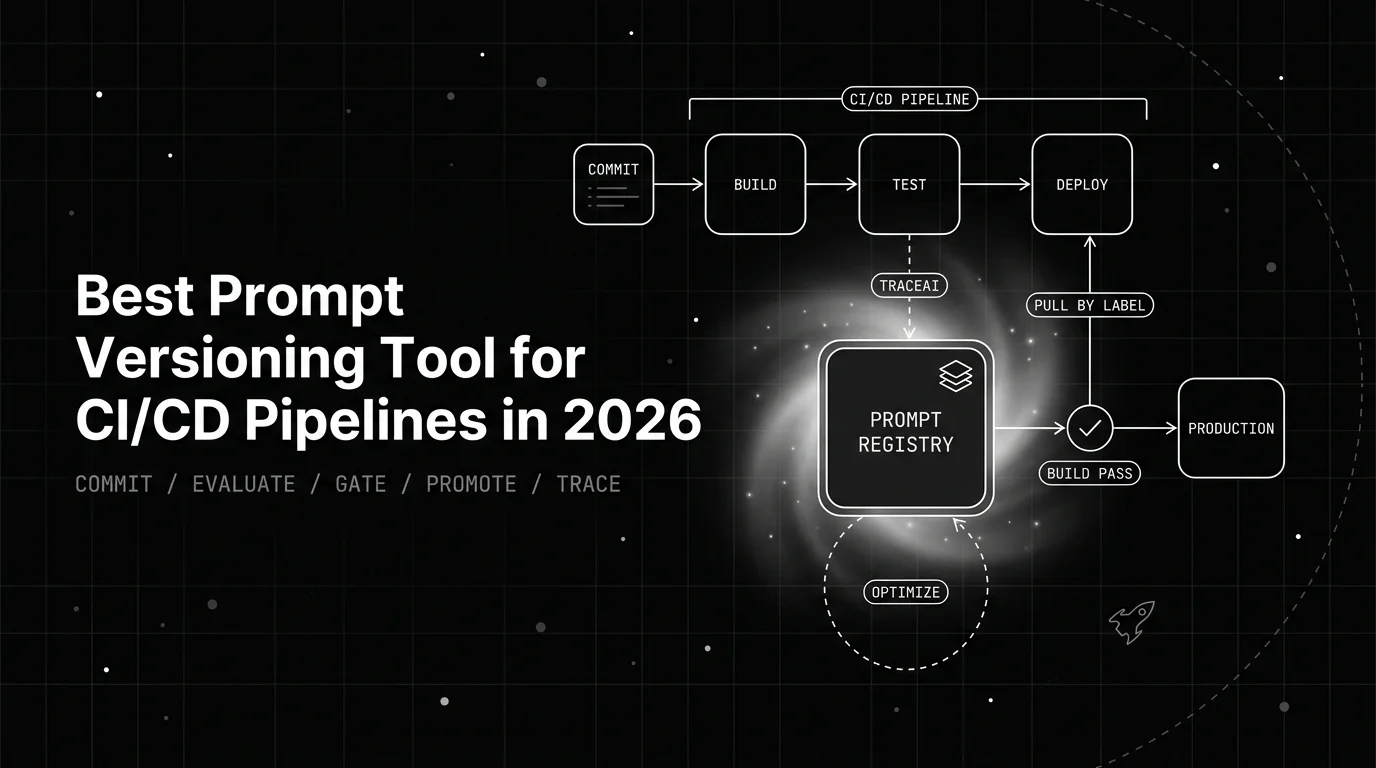
Prompt versioning for CI/CD with Future AGI: commit each version from the SDK, gate promotion on evaluators, fail the build on regression, promote by label.

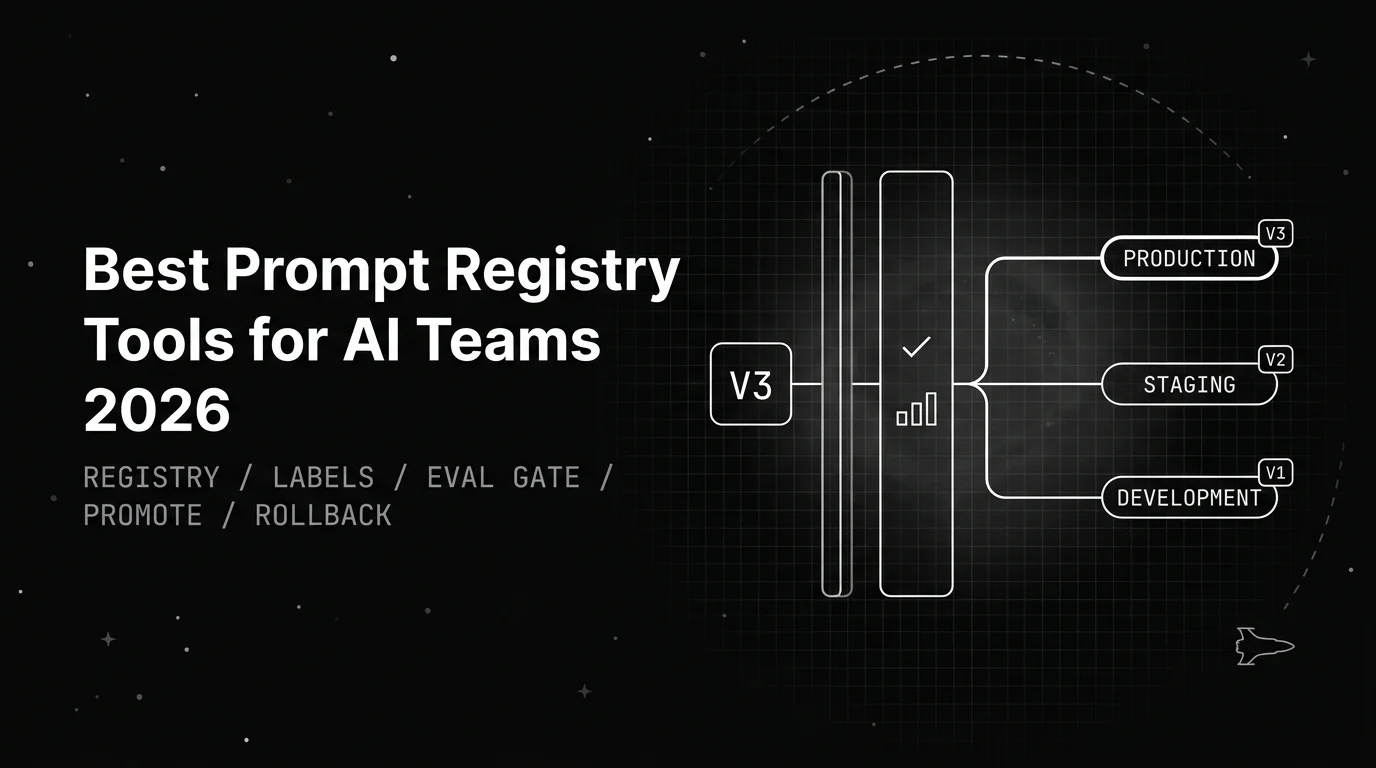
A ranked guide to the 6 best prompt registry tools for AI teams in 2026, compared on central storage, versioning, labels, and fetching prompts at runtime.

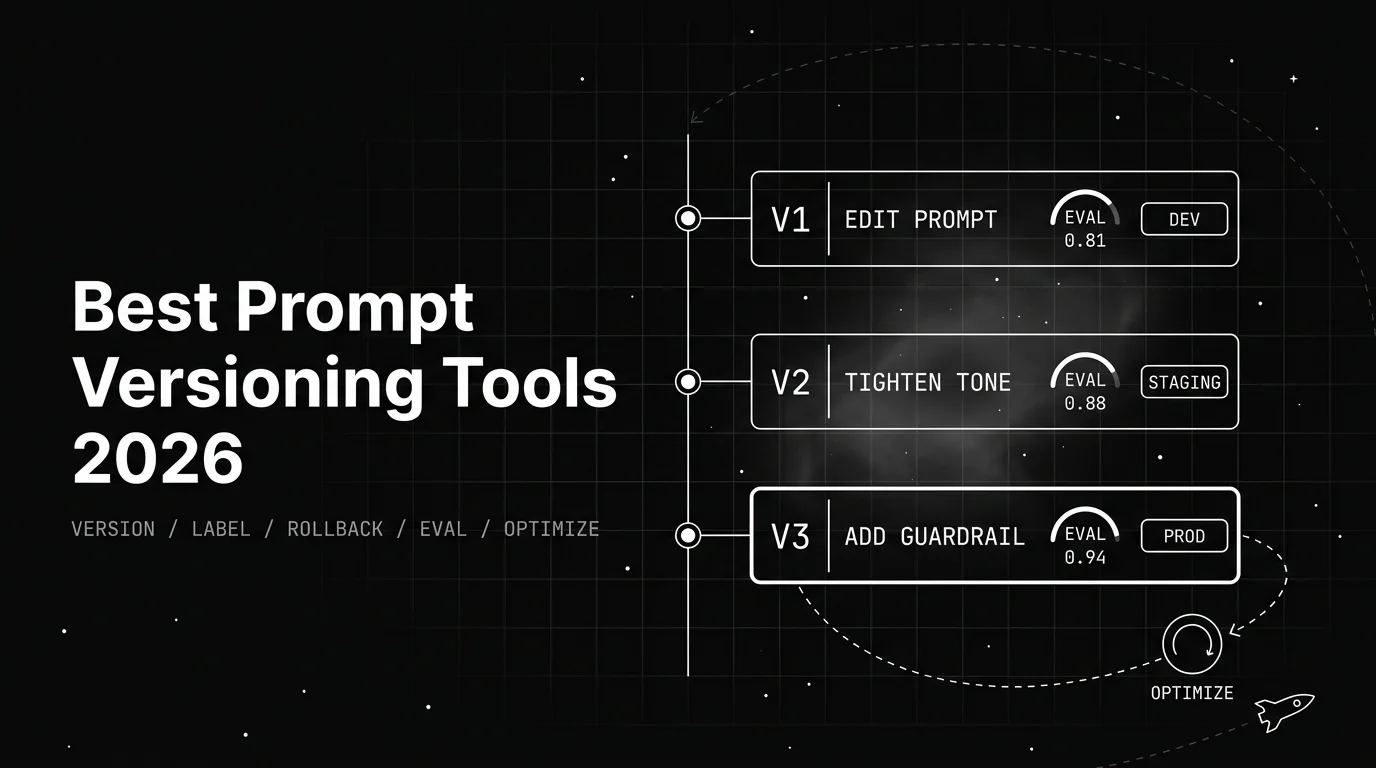
The 7 best prompt versioning tools for production AI teams in 2026, ranked on version history, labels, rollback, and testing prompts before you ship it.