Best Prompt Versioning Tools for Production AI Teams in 2026
The 7 best prompt versioning tools for production AI teams in 2026, ranked on version history, labels, rollback, and testing prompts before you ship it.
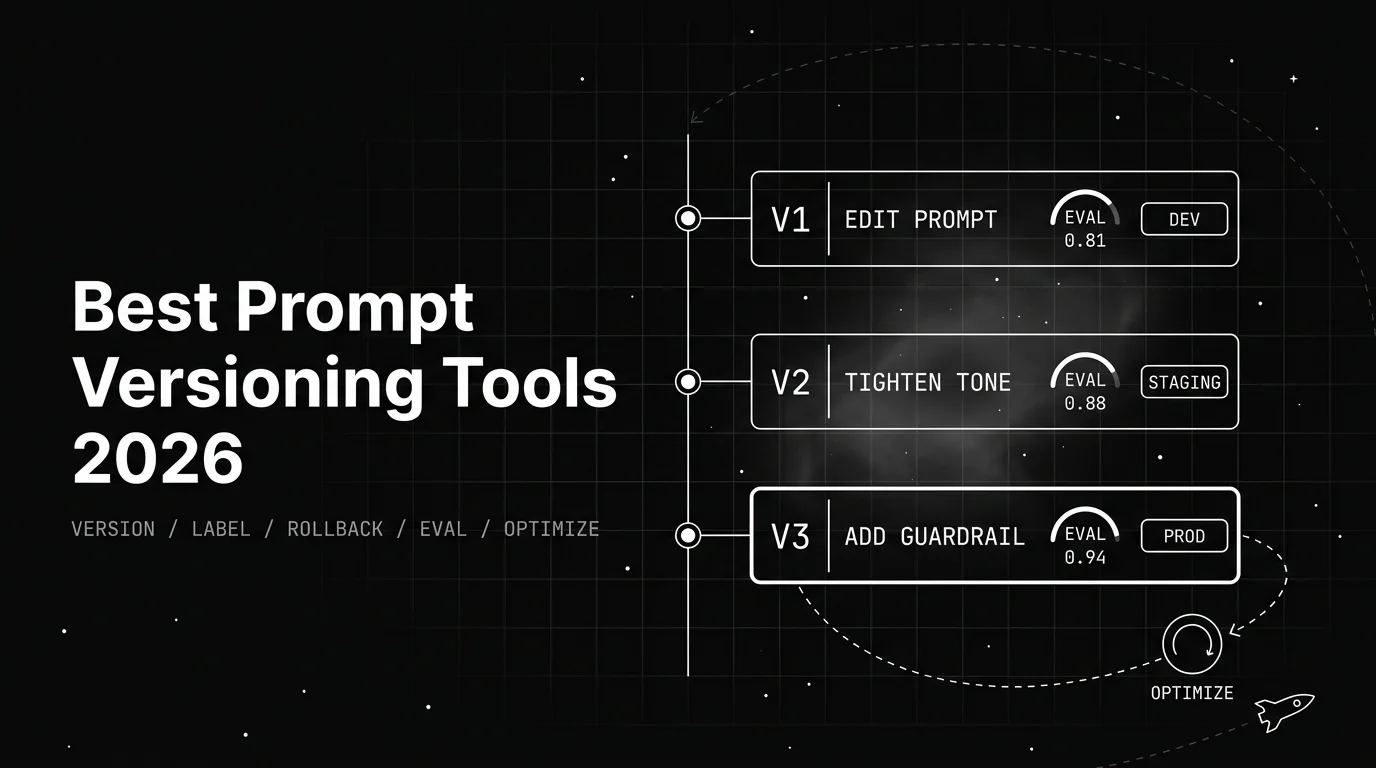
Table of Contents
A team edits a system prompt in place to stop one bad answer, and the change quietly regresses three flows that were working fine. An hour later, no one can say which version was live, diff what changed, or roll back to the one that worked. This guide ranks the seven prompt versioning tools production AI teams should evaluate in 2026, scored on version control, rollback, and whether a version is tied to an evaluation run.
TL;DR: 7 Prompt Versioning Tools Scored on Version Control, Rollback, and the Eval Loop
Future AGI is the strongest overall prompt versioning tool for 2026, because it treats versioning as one stage of a full prompt lifecycle, not the whole job. It keeps immutable snapshots and promotes them across Production, Staging, and Development with labels. Each version is tied to custom evals and a CI/CD gate, then optimized and observed in production, so a prompt is scored before it ships.
| Rank | Tool | Best for | Standout capability |
|---|---|---|---|
| 1 | Future AGI | End-to-end prompt lifecycle: version, evaluate, optimize, observe | Versioning plus custom evals, a CI/CD gate, and six optimizers in one platform |
| 2 | LangSmith | LangChain-native pipelines | Commit-hash versions with named Environments |
| 3 | Langfuse | Open-source self-hosted registry | MIT core with labels and protected production |
| 4 | PromptLayer | Cross-functional prompt collaboration | Release labels with traffic-split dynamic labels |
| 5 | Vellum | Visual, structured deployment workflows | Versions, Deployments, and Releases with per-env tags |
| 6 | Braintrust | Eval-first experimentation | Auto-versioned prompts tied to a strong eval product |
| 7 | Promptfoo | Git-based, config-as-code prompt versioning | Prompts and tests as YAML in your repo, so git is the version store |
Why Does Prompt Versioning Break in Production?
Prompt versioning breaks because a prompt is code that decides product behavior, but most teams edit it like a value in a text box. Without immutable versions, a readable history, and diffs, you cannot say what changed, who changed it, which version is serving traffic, or how to get back to the one that worked.
Generic version control, dropping the prompt in a .py file and committing it, solves half the problem. It captures the text, but not the model configuration that shipped with it, and not how the prompt actually performed. A git commit reproduces a build; a prompt commit on its own does not reproduce a score. For the full split between versioning and management, see our explainer on what prompt versioning is.
A production-grade prompt versioning tool has to deliver three things at once:
- Version control. Immutable versions with a readable history and a diff between any two revisions.
- Safe promotion and rollback. A way to map a version to an environment such as Production or Staging, and a fast path back to a known-good version that does not require a code release.
- Reproducibility through evaluation. Each version tied to an evaluation run, so the version can be re-scored, compared, and trusted, not just retrieved.
Most tools nail the first two and stop. The differentiator in 2026 is the third pillar plus the step after it: tying each version to an evaluation run, then using those results to generate the next version automatically. A tool that only stores and promotes versions leaves you guessing whether a change actually helped. That is the lens this scorecard applies.
The Production Prompt Versioning Scorecard
We scored every tool with the Production Prompt Versioning Scorecard. It is a six-dimension rubric built for the question this title asks: not which tool stores a version, but which one makes a version safe to ship. Most roundups score on history and labels alone. This rubric adds the two dimensions that decide whether your versions improve over time: built-in evaluation and automated optimization.
| # | Dimension | What we measure |
|---|---|---|
| 1 | Version model | Immutable versions with a readable history and diffs |
| 2 | Promotion | Mapping a version to Production, Staging, or another environment |
| 3 | Rollback | Reverting a live version without a code release |
| 4 | Built-in evaluation | A library that scores a version, not just an eval hook |
| 5 | Automated optimization | The tool generates an improved next version for you |
| 6 | License and self-host | Open-source license and free self-hosting versus Enterprise-gated |
We do not publish a single composite score, because the right tool depends on your stack, your license constraints, and who edits the prompts. The decision table later maps common buyer profiles to picks. The matrix below shows how the seven tools compare across the six dimensions that vary most, so you can scan for the one that matches your workflow.
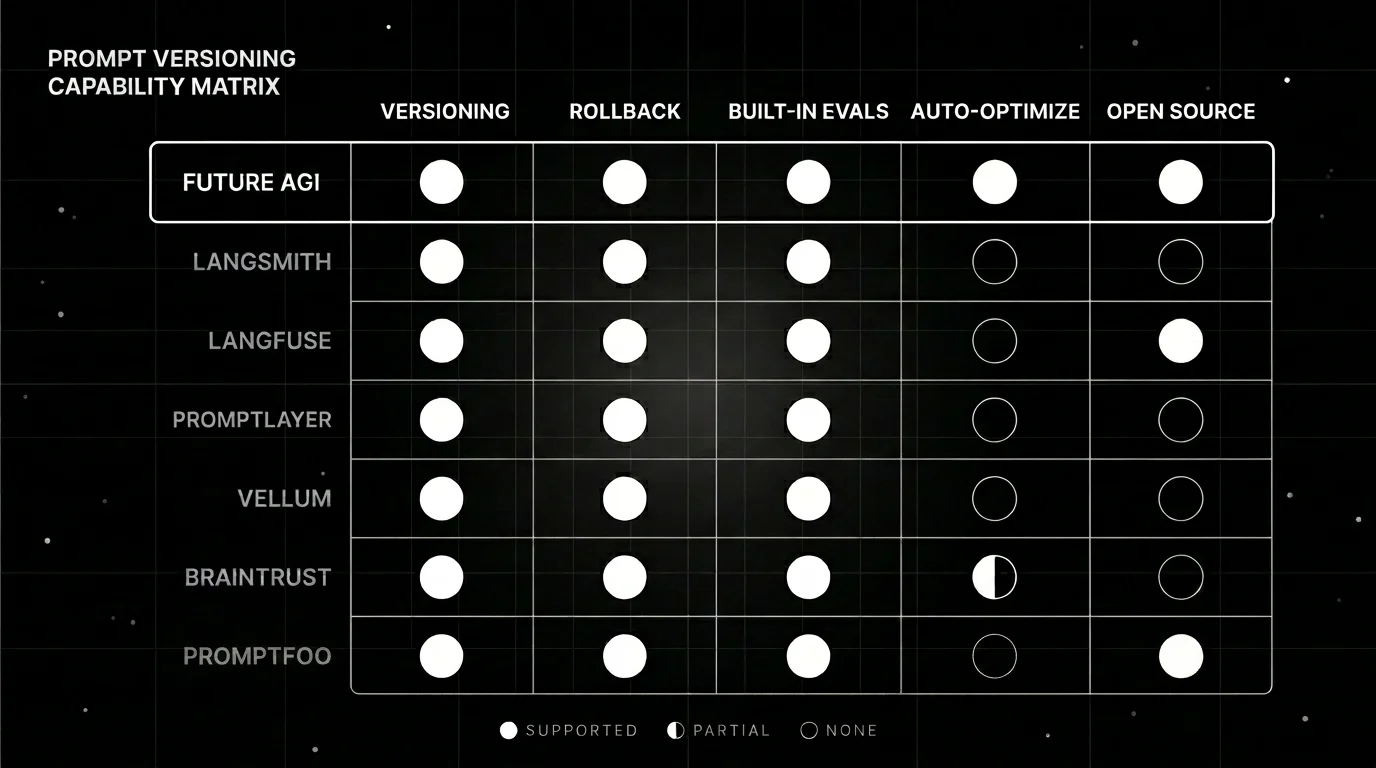
| Tool | Version model | Promotion | Rollback | Built-in evals | Automated optimization | License / self-host |
|---|---|---|---|---|---|---|
| Future AGI | Immutable version snapshots + diffs | Labels for Production, Staging, Development | Reassign a label to a prior version | Custom evals | Six algorithms (agent-opt) | Apache-2.0 core, self-host free |
| LangSmith | Commit hash, immutable | Named Environments | Revert to a prior commit | Eval SDK | Manual | Proprietary, self-host Enterprise |
| Langfuse | Auto integer versions | Labels, including protected | Reassign the label | Prompt Experiments | Manual | MIT core, self-host free |
| PromptLayer | Numbered versions + diffs | Release labels + dynamic labels | Reassign the label | Evals on the registry | Manual | Proprietary, self-host Enterprise |
| Vellum | Versions, Deployments, Releases | Release tags per environment | Repoint a tag, one-click revert | Built-in metrics | Manual | Proprietary, VPC Enterprise |
| Braintrust | Auto-versioned, unique ID | Environments (dev/staging/prod) | Point an environment to a prior version | Core eval product | Loop agent | Proprietary, self-host Enterprise |
| Promptfoo | YAML config in git, diffed via git | None, git branches only | git revert | Assertions + llm-rubric | None | MIT, runs locally |
1. Future AGI: Best Overall for Closed-Loop Prompt Versioning
Quick take. Future AGI treats a prompt version as one stage of a closed loop, not the end of the job. It keeps immutable version snapshots and moves them across Production, Staging, and Development with labels. Each version is tied to custom evals, a CI/CD gate, and six optimizers. Authoring, versioning, evaluation, optimization, and tracing run on one platform, under an Apache-2.0 license you self-host.
Ideal for. Production AI teams that want the whole prompt lifecycle in one place instead of stitching three vendors together. You save a version, score it against a dataset, gate it in CI/CD, let an optimizer propose a better candidate, and watch it live in traces. It fits teams who treat prompts as production assets that must be measured, not text they edit in place.
Key strengths.
-
Immutable versions with environment labels, not a flat list. Future AGI creates an immutable version on every save, then moves each one across Production, Staging, and Development with labels. Rollback is reassigning a label to an earlier version. Apps fetch by label, so the change lands with no code release.
-
Versions that are scored, not just saved. With custom evals, you write a check once in plain language and Future AGI scores every version against it automatically. Run the current version and a candidate on the same dataset, and the scores tell you which one is safe to ship instead of leaving it to a hunch.
-
Evaluation as a CI/CD gate. You can run the same evals as a gate in your CI/CD pipeline, so a prompt regression is caught in the pipeline instead of in production.
-
Optimization that writes your next version. The open-source agent-opt library ships six algorithms: Random Search, Bayesian, ProTeGi, Meta-Prompt, PromptWizard, and GEPA. Each takes an initial prompt and an evaluator and returns a higher-scoring candidate. Braintrust’s Loop iterates on prompts too, but it is proprietary, while agent-opt is Apache-2.0.
-
The loop closes in production. traceAI is OpenTelemetry-native tracing with instrumentors for 50+ frameworks. Live behavior is captured as traces, each tied back to the version that produced it, and feeds the next round of evaluation and optimization.
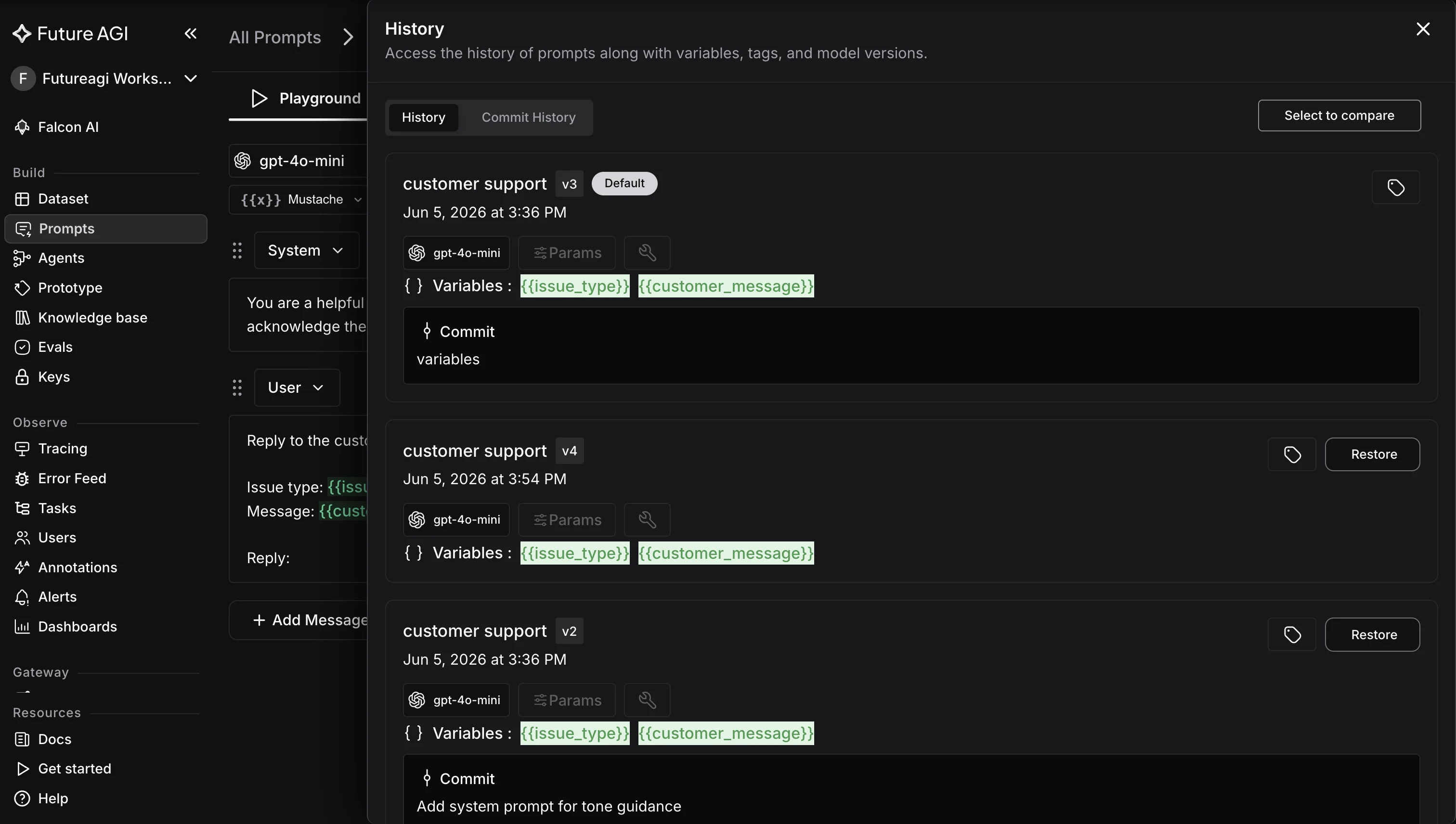
Pricing and deployment. Future AGI has a free tier, pay-as-you-go usage, and Enterprise plans on its pricing page. Because the core SDK and product repos are Apache-2.0, a team can stand up the entire versioning-to-optimization loop on its own hardware with Docker Compose, at no license fee. SOC 2 Type II and a HIPAA BAA come with the paid plans, coverage most proprietary rivals reserve for an Enterprise contract.
Verdict. Future AGI is the strongest overall pick for teams that want prompt versioning to start a measured improvement loop, not sit as a passive history. Versioning, evaluation, optimization, and tracing run on one Apache-2.0 platform you can self-host. Choose it when you would rather operate the whole prompt lifecycle in one place than wire a registry to separate eval and observability tools.
2. LangSmith: Best for LangChain-Native Pipelines
Quick take. LangSmith is the prompt versioning and observability layer from the LangChain team, and it is the most natural fit if your application is already built on LangChain or LangGraph. Its versioning is commit-based and immutable, which maps cleanly onto how engineers already think about code. Prompts, traces, and evaluations live behind one SDK, so the tool feels native to a LangChain codebase rather than bolted on.
Ideal for. Teams whose stack is LangChain-first and who want prompt versioning, tracing, and evaluations from a single vendor that speaks their framework natively. If your services already emit LangChain runs, LangSmith captures them without extra instrumentation, so a versioned prompt and its traces sit side by side. It is a weaker fit once most of your stack lives outside that ecosystem.
Key strengths.
- Every save creates a new immutable commit identified by a commit hash, and human-readable commit tags move independently to point at a chosen commit.
- A named Environments feature promotes commits between deployment targets such as Staging and Production without a code change, and a diff toggle compares two commits side by side.
- You pull a prompt by name and hash or by tag through the SDK, with first-class Python and TypeScript clients, and the evaluation tooling is deep.
Limitations. LangSmith is proprietary even though LangChain itself is open source, so self-hosting is an Enterprise arrangement. Its strengths are concentrated in the LangChain ecosystem, and teams on other frameworks get less value from it. There is no built-in automated optimization that writes the next version for you, so improving a prompt stays a manual loop.
Pricing. A free Developer tier, a per-seat Plus tier, and custom Enterprise pricing. Hosted by default; self-hosting requires Enterprise.
Verdict. LangSmith is the default choice when the rest of your stack is already LangChain, and its commit-based versioning will feel immediately familiar to engineers. It is a weaker fit the further you move from that ecosystem. You will also need a separate tool for automated optimization, since it does not write the next version for you.
3. Langfuse: Best Open-Source Self-Hosted Registry
Quick take. Langfuse is the open-source option teams reach for when self-hosting the prompt registry matters more than a polished managed UI. Its MIT-licensed core covers prompt versioning, labels, and tracing, and it runs entirely on your own infrastructure. Because the same instance stores prompts and captures traces, a self-hosted team gets versioning and observability without adding a second vendor.
Ideal for. Engineering teams that want an open-source registry they fully control, with prompt versioning and observability in one self-hostable package. It suits groups with data-residency or air-gap requirements that rule out a hosted-only vendor. The MIT license means you can run it at no license cost and read the source before you commit.
Key strengths.
- Saving a prompt under the same name creates a new immutable integer version automatically, so history accrues without ceremony, and you can diff versions.
- Labels map versions to environments:
productionis served by default,latestis maintained automatically, and custom labels cover staging or per-tenant routing. - Protected labels let admins lock the
productionpointer so it cannot be moved by mistake. Rollback is a label reassignment that takes effect server-side in under a minute.
Limitations. The richest commercial features, including protected labels on a self-hosted instance, live in a separate ee folder rather than the MIT core. Diff and comparison tooling is lighter than the proprietary leaders, and there is no built-in automated optimization. A client-side cache means a reassigned label is near-instant on the server but takes effect in the app only after the cache refreshes.
Pricing. A free Hobby tier and self-hosting at no license cost, with paid Core, Pro, and Enterprise cloud tiers. Self-hostable by design.
Verdict. Langfuse is the best starting point when open-source and self-hosting are non-negotiable, and its label model handles promotion and rollback cleanly. The tradeoff is that automated optimization lives elsewhere, so you will pair it with a separate tool to improve prompts. For many self-hosting teams that tradeoff is worth the control they gain.
4. PromptLayer: Best for Cross-Functional Prompt Collaboration
Quick take. PromptLayer is a prompt registry built so that non-engineers, such as product managers and subject-matter experts, can manage and version prompts alongside developers. Its versioning is visual, with a commit-style history and a readable diff on every change. That makes it the pick when the people editing prompts do not live in a code editor.
Ideal for. Cross-functional teams where prompts are edited by people who do not live in a code editor, and where release control needs to be visual. Product managers and domain experts can review a diff, leave a message, and promote a version without touching git. It fits organizations that treat prompt authoring as a shared, cross-team responsibility.
Key strengths.
- Each version carries a message and a visual diff against prior versions. A product manager or subject-matter expert can review exactly what changed without reading code or pulling a git history.
- Release Labels map a version to an environment, and Dynamic Release Labels can split traffic by percentage or user segment for staged rollouts and A/B comparisons.
- Rollback is a label reassignment rather than a redeploy, so reverting a bad prompt is a single action in the UI. The registry also includes its own evaluation tooling for scoring versions before release.
Limitations. PromptLayer is proprietary, and self-hosting is Enterprise-only, so you cannot run the registry on your own infrastructure without a contract. It is a registry and collaboration layer first, so evaluation depth and automated optimization are lighter than eval-led platforms. There is no built-in optimizer that writes the next version, so prompt improvement stays a manual, human-driven loop.
Pricing. A free tier, a Pro tier, and a Team tier with collaboration features; self-hosting is Enterprise.
Verdict. PromptLayer is the pick when the people editing prompts are not all engineers and visual release control matters most. Its diffs, messages, and traffic-split release labels make cross-functional review the core workflow rather than an afterthought. Look elsewhere if you need deep evaluation or an optimizer built into the same tool.
5. Vellum: Best for Visual, Structured Deployment Workflows
Quick take. Vellum models prompt versioning as a layered deployment system rather than a flat list, with explicit Versions, Deployments, and Releases. It suits teams that want a visual, product-style workflow for shipping prompts with an auditable release history. The structure trades a little upfront learning for a clear separation between what a prompt is and how it is released.
Ideal for. Teams that prefer a managed, UI-driven deployment pipeline over a code-first registry, and who want a structured release history per environment. It fits product-style organizations that ship prompts like features, with distinct staging and production releases. The layered model rewards teams that value auditable structure over the speed of a flat list.
Key strengths.
- A three-layer model separates a prompt Version from a Deployment and a Release. Each environment gets a distinct, auditable release history and a one-click revert to a prior release.
- Three release-tag types cover different needs: LATEST updates automatically, Custom tags float and are repointed manually for semver-style control, and Static tags are immutable per deploy.
- The runtime accepts a release tag on the execute call, so you serve a specific version or default to the environment’s latest without code changes.
Limitations. Vellum is proprietary, and the layered model adds concepts to learn before the first deploy, which is friction for a small team. Self-hosting is a VPC or Enterprise arrangement, so running it on your own terms means a sales conversation. There is no built-in automated optimization that generates the next version for you, so prompt tuning stays manual.
Pricing. A free tier with usage credits and paid tiers that add a platform fee; larger deployments are quote-based. Hosted, with VPC options for Enterprise.
Verdict. Vellum is a solid choice when a structured, visual deployment workflow is worth the extra concepts you have to learn first. Its Versions, Deployments, and Releases give each environment an auditable history with one-click revert. It is less suited to minimalists who want a code-first flow or a built-in optimizer.
6. Braintrust: Best for Eval-First Experimentation
Quick take. Braintrust is an evaluation and experimentation platform where prompt versioning is a supporting capability rather than the headline. Versions are created automatically on save and identified by a unique version ID, and environments control which version is live. If your team already runs offline evals in Braintrust, prompt versions slot into that workflow without a second tool.
Ideal for. Teams whose center of gravity is offline evals and experiments, and who want prompt versions to slot into that eval-first workflow. It suits groups that treat evaluation as the primary activity and versioning as a byproduct of running experiments. The Loop agent appeals to teams that want the tool to suggest better prompts against a score.
Key strengths.
- Every save auto-creates a version with a unique ID and a full history with diffs, so nothing is overwritten.
- Environments such as dev, staging, and production each run one active version, and rollback means pointing an environment back to a prior approved version.
- A Loop agent can iterate on a prompt to raise an eval score. It is the closest competitor analog to automated optimization, and it rides on a strong core eval product.
Limitations. Braintrust is proprietary, and self-hosting is an Enterprise arrangement. Versioning is secondary to the eval product, so the registry ergonomics are lighter than dedicated prompt platforms. You resolve a prompt through a load step before the invoke call, which is one more concept than pulling a version by tag.
Pricing. A free Starter tier, a paid Pro tier, and custom Enterprise pricing. Hosted, with self-hosting on Enterprise.
Verdict. Braintrust is a good fit when evaluation is your primary workflow and versioning rides along inside it. Its Loop agent is the closest competitor analog to automated optimization, backed by a strong core eval product. It is a weaker choice as a standalone prompt registry, since versioning is secondary to the eval tooling.
7. Promptfoo: Best for Git-Based, Config-as-Code Prompt Versioning
Quick take. Promptfoo is an open-source CLI and library for LLM evaluation, testing, and red-teaming, and its approach to versioning is the opposite of a hosted registry. Prompts and test cases are defined in a promptfooconfig.yaml file that lives in your own repository. Your existing git history, diffs, branches, and pull-request review become the prompt version history, with no separate store to learn.
Ideal for. Engineering teams that already version everything in git and want prompt changes reviewed in the same pull-request flow as code, without adopting a managed prompt store. It suits developers who prefer config-as-code and want prompt history to live beside their application in one repo. There is nothing new to learn if your team already reviews changes through pull requests.
Key strengths.
- Prompts and tests are file-based config-as-code in
promptfooconfig.yaml, so version history, diffs, and branches are whatever your git workflow already provides, and a rollback is a git revert. - An eval runs a matrix of prompts, providers, and test cases. It checks each result with assertions such as equals, contains, similar, and javascript, plus a model-graded
llm-rubric. Results open in a local web viewer withpromptfoo view. - It is MIT-licensed and runs locally as a CLI that drops into CI/CD, and red-teaming is a flagship capability for probing prompts before they ship.
Limitations. Promptfoo is an eval and testing tool, not a registry. There is no hosted prompt store, no labels, and no environment promotion or runtime serving, so versioning rides entirely on your git. It is config-as-code and engineer-oriented, with no non-technical UI, and it has no built-in optimization that rewrites a prompt for you.
Pricing. The core CLI and library are free and open-source under an MIT license that runs locally, with a separate commercial enterprise offering for teams that need it.
Verdict. Promptfoo is the pick when you want prompt versioning to live in your own git repo as config-as-code, reviewed through pull requests. Its eval matrix and red-teaming make it strong for testing prompts before they ship, all under an MIT license that runs locally. It is a weaker fit if you need a managed registry with labels, promotion, or runtime serving.
Which Prompt Versioning Tool Should You Choose?
There is no single winner for every team, so match the tool to the constraint that matters most to you. The table below maps a common need to the tool that serves it best and the reason why. Read it as a starting point, then confirm the pick against your own stack and deployment rules.
| If you need | Choose | Because |
|---|---|---|
| The whole prompt lifecycle in one platform | Future AGI | Version, evaluate, optimize, and observe prompts in one place, Apache-2.0 self-host |
| The tightest fit with a LangChain or LangGraph stack | LangSmith | Commit-hash versioning native to that ecosystem |
| An open-source registry you fully self-host | Langfuse | MIT core with labels and protected production |
| Visual release control for non-engineers | PromptLayer | Messages, diffs, and traffic-split release labels |
| A structured, visual deployment pipeline | Vellum | Versions, Deployments, and Releases with per-env tags |
| An eval-first experimentation workflow | Braintrust | Versioning that rides along with a strong eval product |
| Git-based prompt versioning in your own repo | Promptfoo | Prompts and tests as YAML, so git is the version store |
The honest read is that most of these tools handle version control and rollback well, so that is no longer the differentiator. Future AGI leads because it runs the whole prompt lifecycle in one place: versioning, custom evals, a CI/CD gate, six optimization algorithms, and production tracing. It does all of that under one Apache-2.0 license you self-host. That is the difference between storing a version and knowing it is safe to ship.
If your stack is LangChain-only, LangSmith is the tighter fit because its versioning is native to that ecosystem. If you need a fully open-source registry and nothing more, Langfuse is the cleaner pick. If you would rather keep prompts as config-as-code in your own git repo, Promptfoo is a strong file-based option that needs no separate store.
How Do You Roll Out Prompt Versioning Without Breaking Production?
Adopting a tool is the easy part; the discipline around it is what keeps prompt changes from causing outages. These five practices keep prompt versioning from becoming a new source of incidents as your team and prompt count grow. They apply no matter which tool you pick from the table above.
- Make every prompt change a new version, never an in-place edit. The moment a prompt is editable without creating a version, your history has a hole in it. Save a version on every change so the diff is legible later.
- Map an environment to one approved version. Production should resolve to a single, known-good version, so promotion and rollback are a deliberate action rather than a redeploy. Lock the pointer if your tool supports protected labels.
- Tie each version to an evaluation run before you promote it. A version you cannot score is a version you cannot trust. Compare the candidate against the current production version on the same dataset, and run that eval as a CI/CD gate so a regression fails the build. Our prompt versioning and lifecycle guide covers this gate in depth.
- Automate the next version instead of hand-tuning. Manual prompt edits plateau quickly. Feed the current version and an evaluator into an optimizer, let it propose a higher-scoring candidate, then review and ship.
- Close the loop with traces. A version that scores well offline can still fail on real traffic. Link versions to traces so production behavior feeds your next round of optimization, and you catch the regressions an offline dataset missed.
Where Future AGI Fits in Your Prompt Versioning Stack
One in-place edit to a system prompt can quietly regress three working flows, and an hour later no one can name the live version or roll back. On Future AGI every edit is its own immutable version the moment you save it. You can compare it against the last good one, see which label serves traffic, and roll Production back in one step. That hour of guessing never starts, because the history was there from the first save. Each version carries the score from the eval it ran, so a regression is a number before it reaches users. And when a version slips in production, the traces that caught it feed the optimizer that writes the next candidate. The fix stays inside the loop and never becomes a fresh incident.
Versioning stops being a passive log you check after a break and becomes the first step of a loop you can trust. To get that loop in one place, start with Future AGI and version your first prompt.
Frequently Asked Questions About Prompt Versioning Tools
What Are the Best Prompt Versioning Tools in 2026?
The best prompt versioning tools in 2026 are Future AGI, LangSmith, Langfuse, PromptLayer, Vellum, Braintrust, and Promptfoo. Future AGI leads as the end-to-end platform for the whole prompt lifecycle: immutable, diffable versions with label-based rollback, custom evals, a CI/CD gate, and six optimization algorithms, all Apache-2.0 and self-hostable. LangSmith fits LangChain-native stacks, and Langfuse an open-source self-hosted registry. PromptLayer suits cross-functional teams, Vellum structured deployment workflows, and Braintrust eval-first teams. Promptfoo handles git-based config-as-code versioning, where your own repo is the version store.
How Does Rollback Work in Prompt Versioning Tools?
In most prompt versioning tools, rollback does not redeploy code; you point an environment back to an earlier version. The mechanism differs by tool. Future AGI rolls back by reassigning a label, for example pointing Production to an earlier version. LangSmith reverts to a prior commit, Langfuse and PromptLayer reassign a movable label, Vellum repoints a release tag, and Braintrust points an environment at a prior version. The next runtime call then picks up the change, often within a minute.
Can You Self-Host a Prompt Versioning Tool?
Yes, but the license matters. Future AGI’s core SDK and product repos are Apache-2.0 and self-hostable at no license cost via Docker Compose. Langfuse offers an MIT core you can run yourself, with some commercial features in a separate ee folder. Promptfoo is MIT-licensed and runs locally as a CLI. LangSmith, PromptLayer, Vellum, and Braintrust are proprietary, so self-hosting means an Enterprise or VPC contract. If self-hosting without a sales call is a requirement, start with the open-source options.
How Is Prompt Versioning Different From Prompt Management?
Prompt management is the broad practice of authoring, organizing, and serving prompts. Prompt versioning is the version-control layer underneath it: immutable versions, history, diffs, and rollback. You can manage prompts without strong versioning by editing one in place, but you cannot safely operate them in production without it. Versioning lets you reproduce, compare, and revert a prompt the way you would a code commit, and it grounds the evaluation loop.
What Makes Future AGI Different From Other Prompt Versioning Tools?
Most prompt versioning tools stop at storing a version. Future AGI runs the whole prompt lifecycle in one place. You author and manage prompts, version them with labels, score each version with custom evals, gate changes in CI/CD, and improve them with six optimization algorithms. Production behavior is captured by traceAI and feeds the next round, so versioning becomes the first step of a measured loop, not the last. Future AGI runs that full loop under an Apache-2.0 license you can self-host, which the proprietary tools here do not offer.
Frequently Asked Questions
What Are the Best Prompt Versioning Tools in 2026?
How Does Rollback Work in Prompt Versioning Tools?
Can You Self-Host a Prompt Versioning Tool?
How Is Prompt Versioning Different From Prompt Management?
What Makes Future AGI Different From Other Prompt Versioning Tools?
A ranked guide to the 6 best prompt registry tools for AI teams in 2026, compared on central storage, versioning, labels, and fetching prompts at runtime.

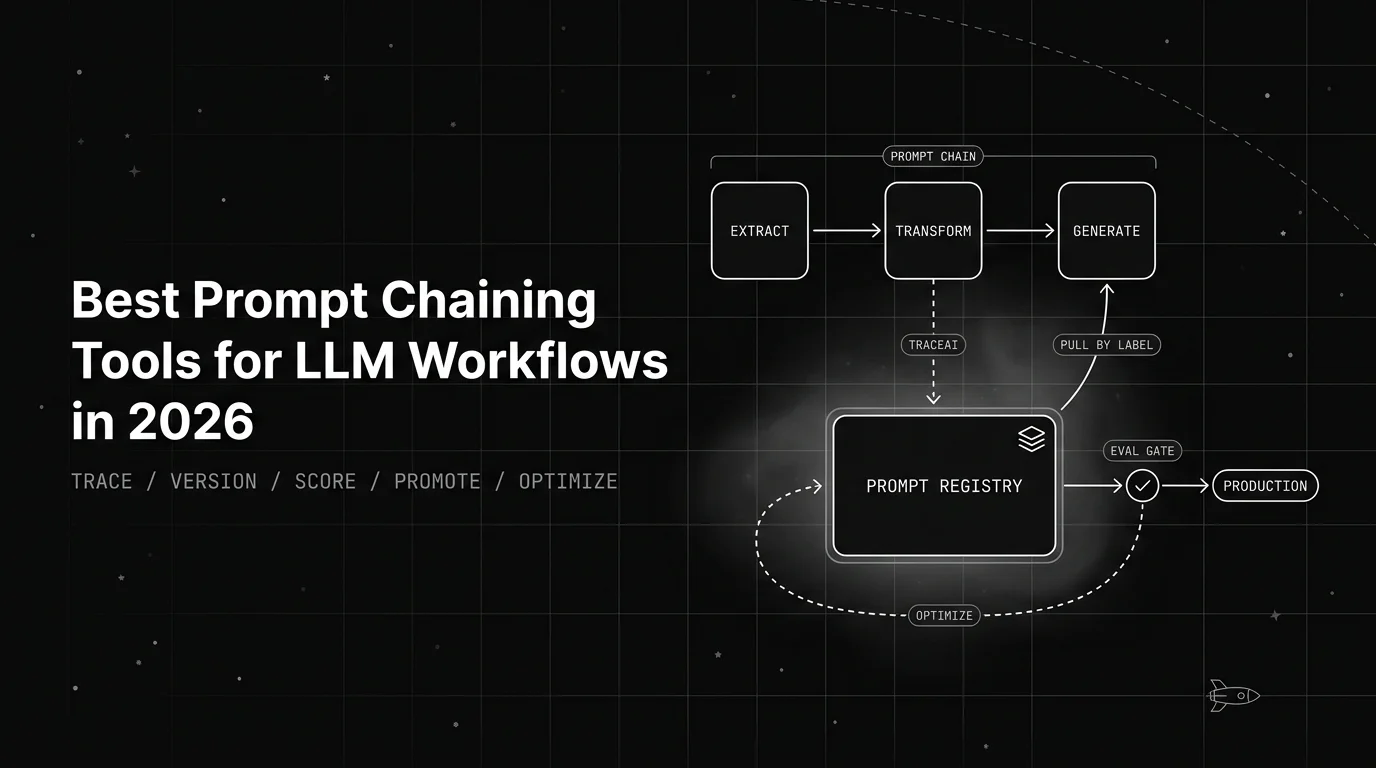
See the 6 best prompt chaining tools for LLM workflows in 2026, ranked on per-link versioning, tracing, evaluation, and debugging each step of the chain.

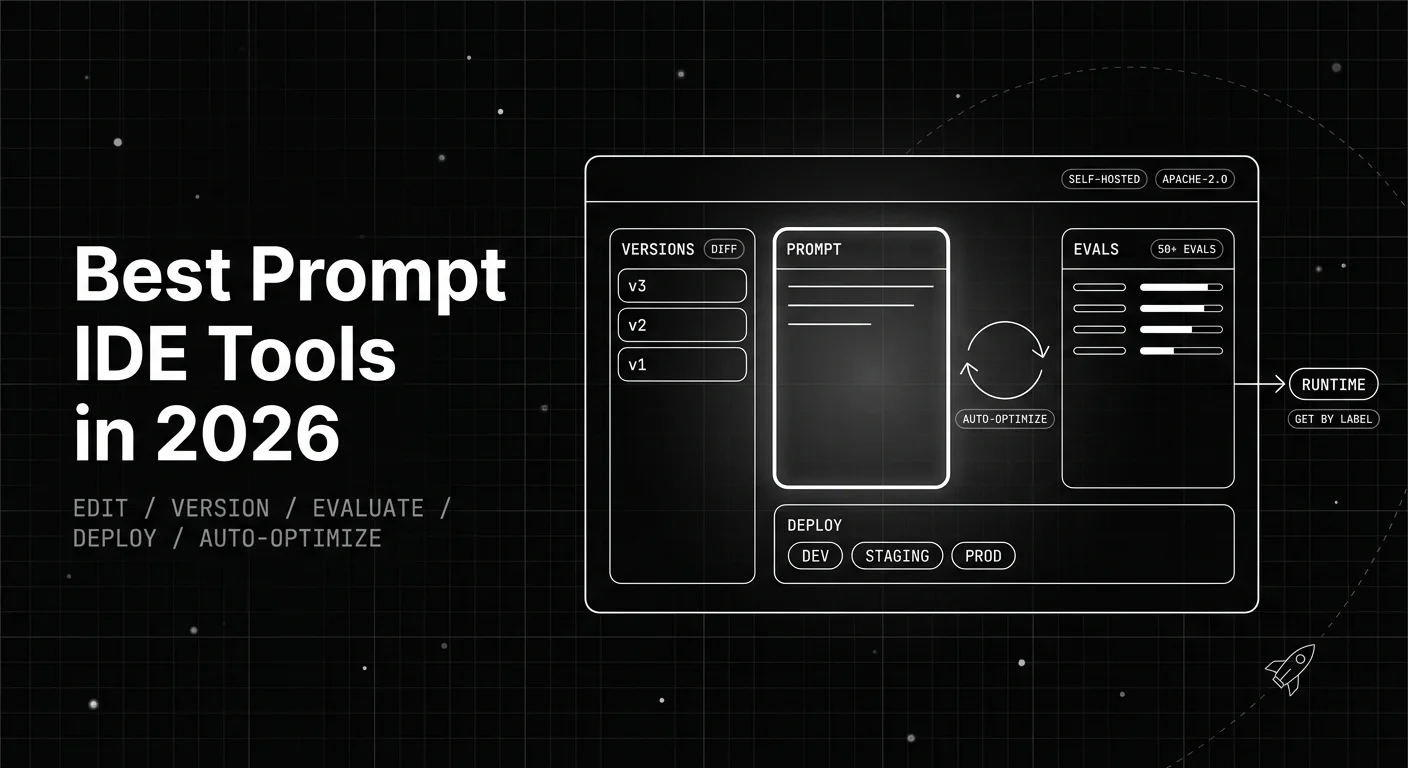
The 6 best prompt IDE tools in 2026, ranked on the editor, variables, side-by-side testing, versioning, and evaluation together in a single workspace.