Best Prompt Versioning Tool for CI/CD Pipelines in 2026
Prompt versioning for CI/CD with Future AGI: commit each version from the SDK, gate promotion on evaluators, fail the build on regression, promote by label.
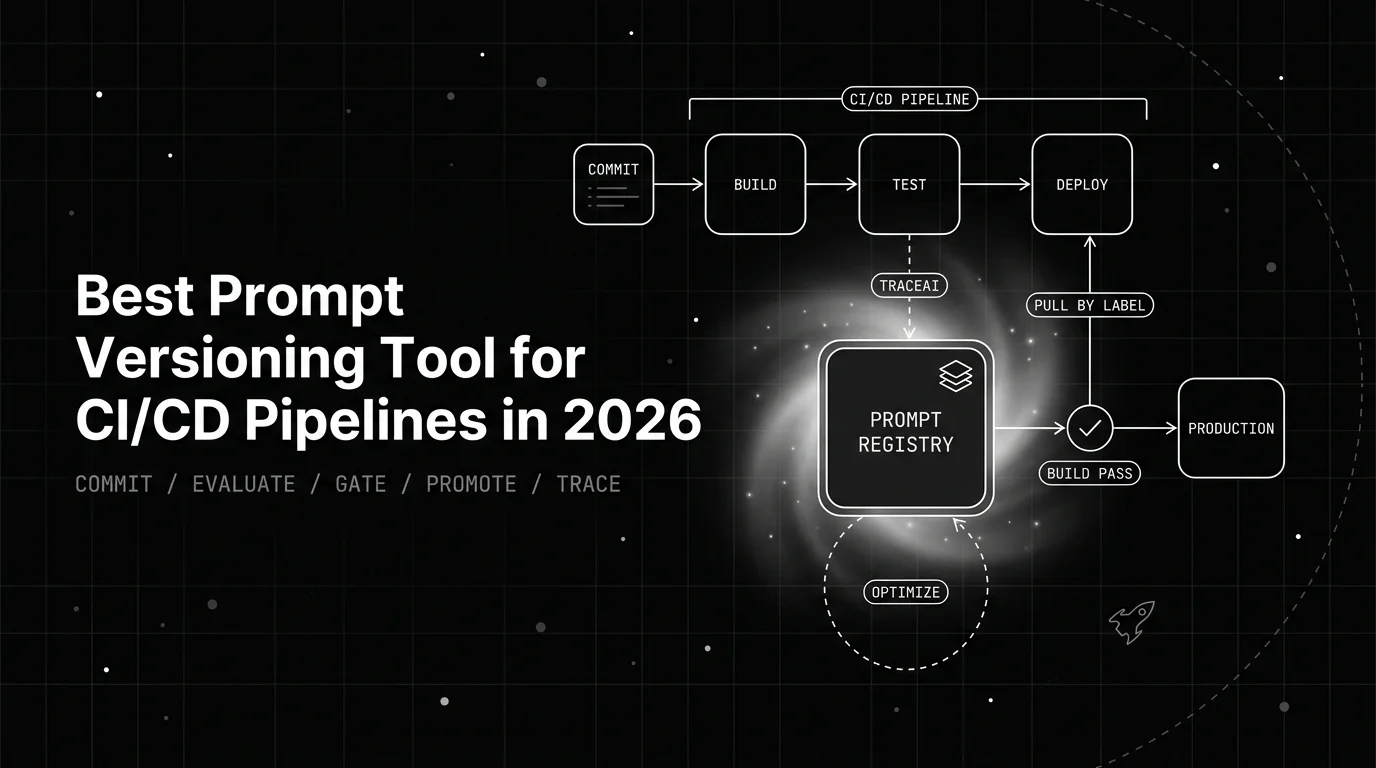
Table of Contents
A team ships a prompt fix by editing it live in a hosted console. Every code test stays green, because the prompt never touched the repo. Answer quality then drops on a third of traffic before anyone traces it to that unreviewed edit. This guide shows how Future AGI makes a prompt change a real CI/CD step. You commit each version from the SDK, gate promotion on evaluators, fail the build on a regression, and promote by label move on your own self-hosted Apache-2.0 stack.
Why Prompt Changes Belong in Your CI/CD Pipeline
A prompt is application logic. It decides what the model does on every request, the same way a function body decides what your code does, and a one-line edit to it can change behavior far more than a one-line edit to the surrounding code. Yet prompt changes usually skip the pipeline that every code change goes through. They are edited in a hosted console, or hardcoded as a string and swapped out, without ever passing the checks that guard a release.
Your CI/CD pipeline exists to stop a change from reaching production until it passes a defined set of gates. Code gets compiled, linted, and tested before it ships; a prompt change that lives outside the repo gets none of that, even though it is the highest-leverage change you can make to model behavior. So a trivial code tweak runs the full gauntlet while a prompt rewrite that reshapes every answer sails straight to production. When quality drops, your green build tells you nothing useful, because the thing that actually changed never entered the pipeline. Closing that gap means treating a prompt version as a build artifact that has to earn promotion.
Where Versioning Outside the Pipeline Breaks
Most prompt tools store a prompt and serve it by label. That is real version control and it is genuinely useful: you get an immutable history, deployment labels, and a way to roll back. An open-source registry such as Langfuse handles this well, and for many teams it is the first step up from hardcoded strings.
Versioning and gating are two different jobs, and a pipeline needs both. A registry can tell you which version is live and let you point a label at a different one. It cannot, on its own, fail your build when a new version scores worse than the one in production. The evaluation that decides whether a version can ship lives in a separate tool, or worse, in a person eyeballing a few outputs before clicking promote.
So the registry ends up sitting beside your pipeline instead of inside it. You can label a version “Production,” but the label only asserts what is deployed; it does not prove the version passed a test. The single check that makes CI worth running, the build fails when the change is worse, is precisely the check a standalone registry cannot enforce. Until the gate and the versioning share a programmatic interface, prompt promotion stays a manual decision bolted onto an automated pipeline.
How Future AGI Wires Prompt Versions into CI/CD
Future AGI gives you both halves from one SDK: the git-like version registry and the evaluators that gate it. Because the same SDK that commits a version also runs the evaluators, the gate becomes a step inside the CI job you already run, rather than a separate tool you context-switch into. A prompt change goes through commit, test, and promote like any other artifact.
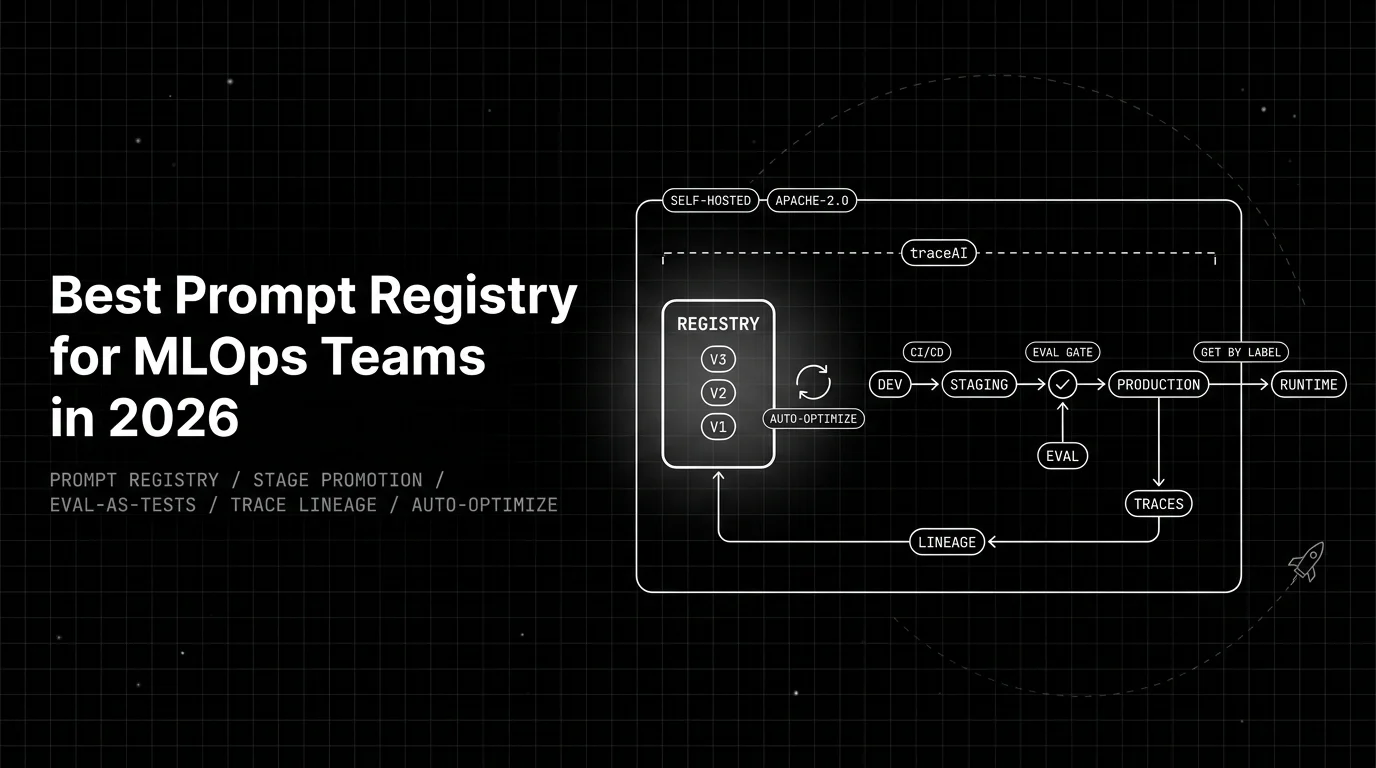
The loop maps onto your pipeline stages. Commit the change as a candidate without making it the default, so committing ships nothing. Run evaluators against it on a fixed dataset, fail the build if it regresses against the current Production version, and promote by assigning the Production label only on a green result.
The table pairs each pipeline stage, commit through post-deploy, with the Future AGI capability that runs it:
| Pipeline stage | What happens | Future AGI capability |
|---|---|---|
| Commit | A prompt change becomes a tracked candidate rather than a live edit | commit_current_version(..., set_default=False) from the SDK |
| Test | Evaluators score the candidate on a fixed dataset as a required check | Custom and built-in evals called from the same SDK in your CI step |
| Promote | A passing version gets the Production label; a failing one fails the build | Eval-gated assign_label("Production", version=...) |
| Post-deploy | The promoted version is traced on real requests | traceAI logs the prompt version on every span |
Git-Like Prompt Versioning, Driven from the SDK
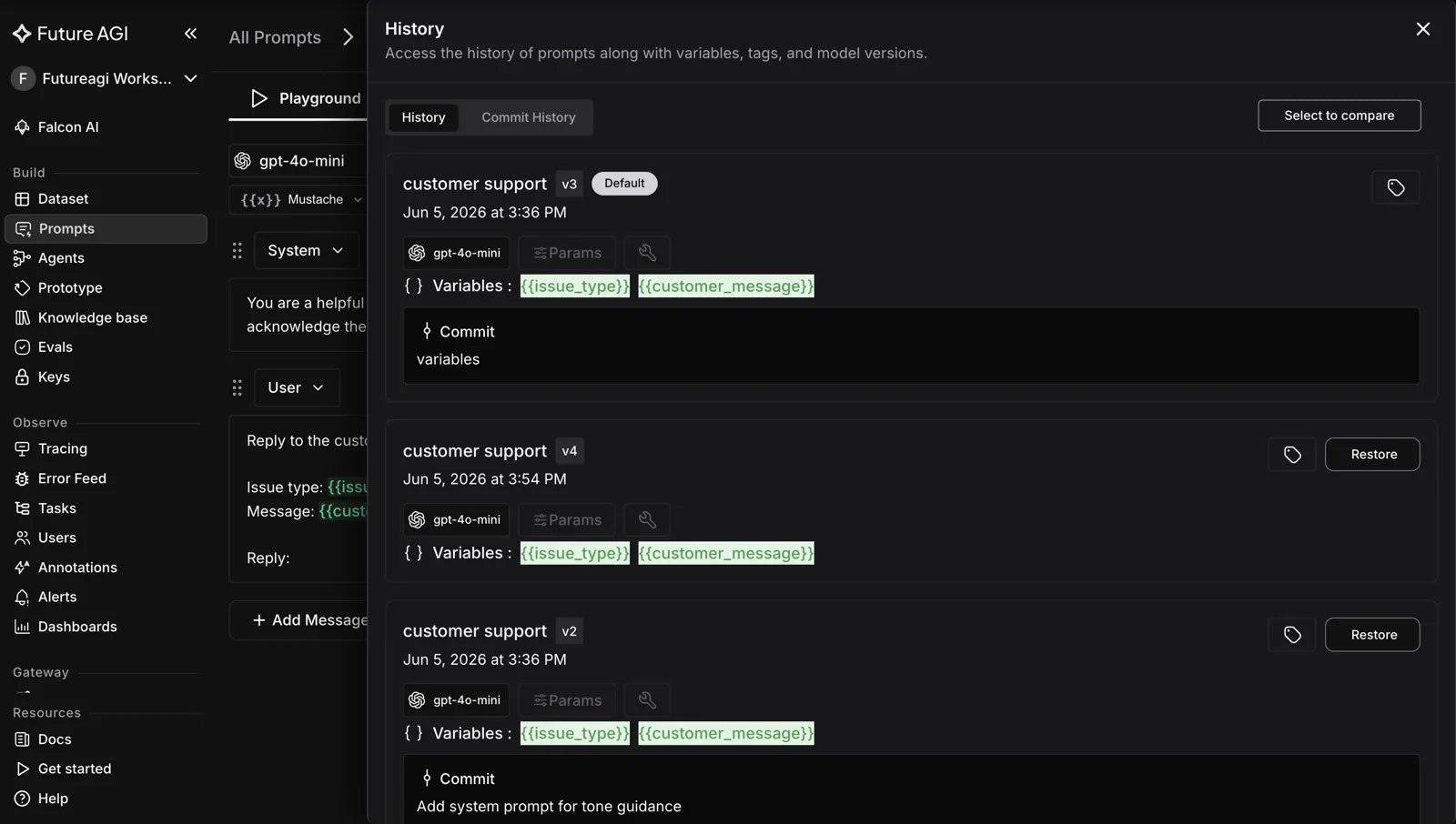
Each prompt is a template in the registry with an immutable version history, commit messages, and deployment labels, Production, Staging, and Development, each pointing at one specific version. The entire workflow runs from the SDK, and that is what lets it live inside a pipeline rather than a console: anything your CI job can call, it can gate.
The mechanics are git-like. You commit a candidate version without setting it as the default, so the act of committing does not ship the change to anyone. Your CI step decides what happens next. Promotion is repointing the Production label; rollback is repointing it back. Neither touches your application code, because the app fetches the live version by name and label at runtime.
from fi.prompt import Prompt, PromptTemplate, SystemMessage, ModelConfig

# define the api-bot template and create it in the registry
template = PromptTemplate(
    name="api-bot",
    messages=[SystemMessage(content="You are an API assistant. Follow the refusal rules.\n{{user_input}}")],
    model_configuration=ModelConfig(model_name="gpt-4o"),
)
client = Prompt(template=template).create()

# 1. CI commits the prompt change as a candidate, keeping it off the live default
client.commit_current_version(message="ci candidate: stricter refusal rules", set_default=False)

# 2. evaluators run as a build-gating step (see the next section);
#    only on a green result does CI promote by repointing the label
client.assign_label("Production", version="v5")

# 3. the app fetches the live version by name and label at runtime, then compiles
live = Prompt.get_template_by_name("api-bot", label="Production")
messages = live.compile(user_input=request_text)
The prompt versioning docs describe how a deployment label points at a version, and the prompt SDK reference documents the commit, label, and compile calls.
Evaluators as Build-Gating Tests
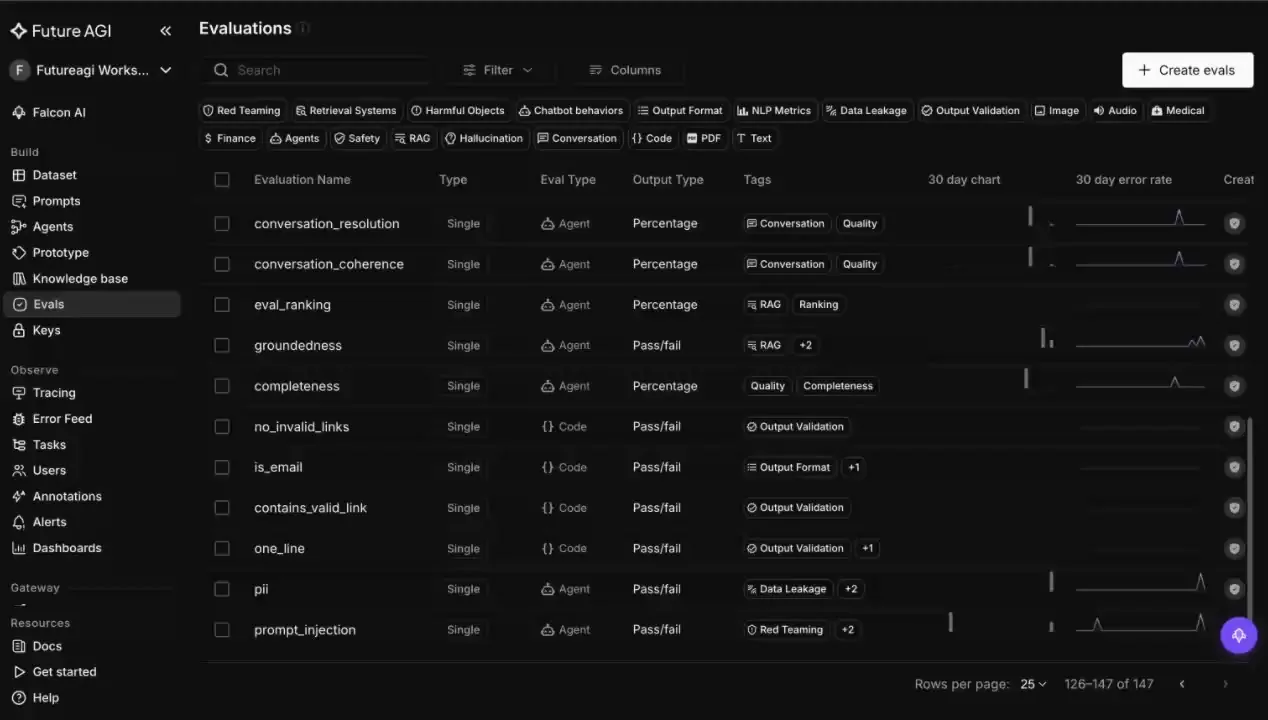
Versioning tells you what changed; the gate tells you whether it is allowed to ship. In a pipeline that gate has to be programmatic and pass/fail, the same shape as a unit test. Future AGI lets you define custom evals and run built-in ones from the same SDK. You call them in the CI step that committed the candidate and score it against a pinned dataset. When it regresses, the step exits non-zero and fails the build like a broken test would.
Which evaluators you gate on depends on the application, but the build-gating ones are typically behavioral:
- Instruction Adherence checks whether the model followed the rules the prompt set, which is the most common thing a prompt edit silently breaks.
- Task Completion checks whether the response actually accomplished the job the prompt asked for, rather than only that it looked plausible.
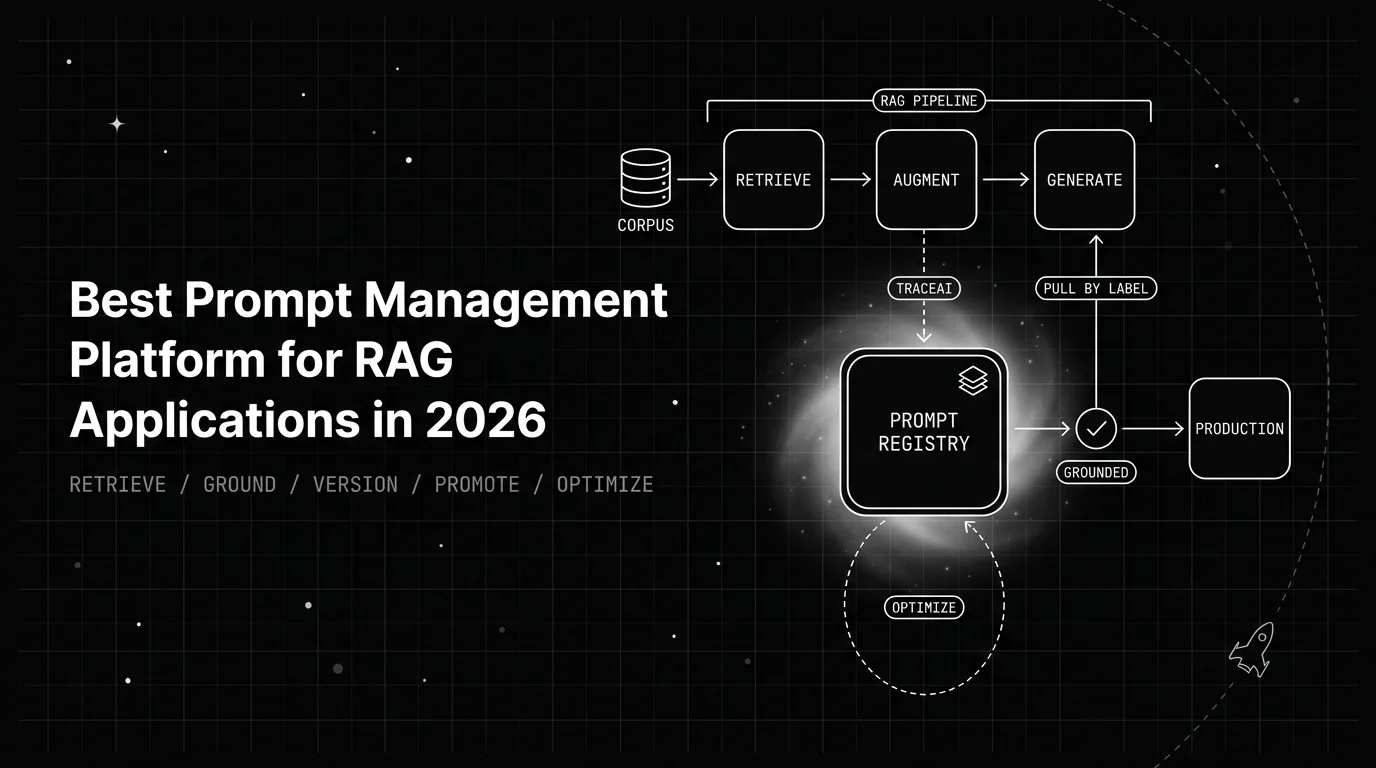
- For retrieval or factual applications, Context Adherence, Groundedness, and Detect Hallucination check whether the answer is supported by the context it was given.
Gate on the current Production version: a candidate that scores below it fails the build and never takes the Production label, so nothing reaches users on a regression. The evaluation library lists the full set.
When a candidate lands just short of the bar, the optimizer drafts the next one for you. The open-source agent-opt library takes that prompt, an evaluator, and a dataset, and rewrites and rescores it across six algorithms (Random Search, Bayesian, ProTeGi, Meta-Prompt, PromptWizard, GEPA) to return a higher-scoring version. You run that pass offline, then feed the winner into the pipeline as the next candidate, so the fix is measured rather than guessed.
Tracing Post-Deploy Prompt Behavior with traceAI

Passing the gate on a fixed dataset is necessary but not the whole story, because live traffic is messier than any pinned set. traceAI closes that gap. Because it is OpenTelemetry-native, each span carries the prompt template and the exact variables passed into it, so every production response ties back to the version that produced it.
That gives you the post-deploy half of CI/CD for prompts. After you promote a version, you can see how it behaves on real requests, catch the regression the offline dataset missed, and roll back instantly by repointing the label, no redeploy required. Each failing case you find becomes a new evaluation example that tightens the gate, so the next candidate has to clear a slightly higher bar. The observability docs cover prompt and variable logging on spans.
Setting Up Future AGI in Your CI/CD Pipeline
Once the platform is running, these five practices keep a prompt change from slipping around your pipeline.
- Move prompts out of the hosted console and into SDK-committed versions, so every change becomes a candidate your pipeline can see and gate rather than a live edit nobody reviewed.
- Pin an evaluation dataset of real inputs and gate the build on Instruction Adherence and Task Completion, rather than a manual read of a handful of outputs.
- Promote by repointing a label on a green result, never by editing a live prompt in place. A repointed label is a deploy you can audit and reverse; editing in place erases the record of what changed.
- Keep promotion out of your redeploy path. Because the app fetches by label at runtime, a prompt rollback is instant and ships no code, so prompts can move on their own cadence.
- Wire in traceAI from the first deploy, so every production response records its prompt version, and feed the failing traces back into agent-opt as the next candidate.
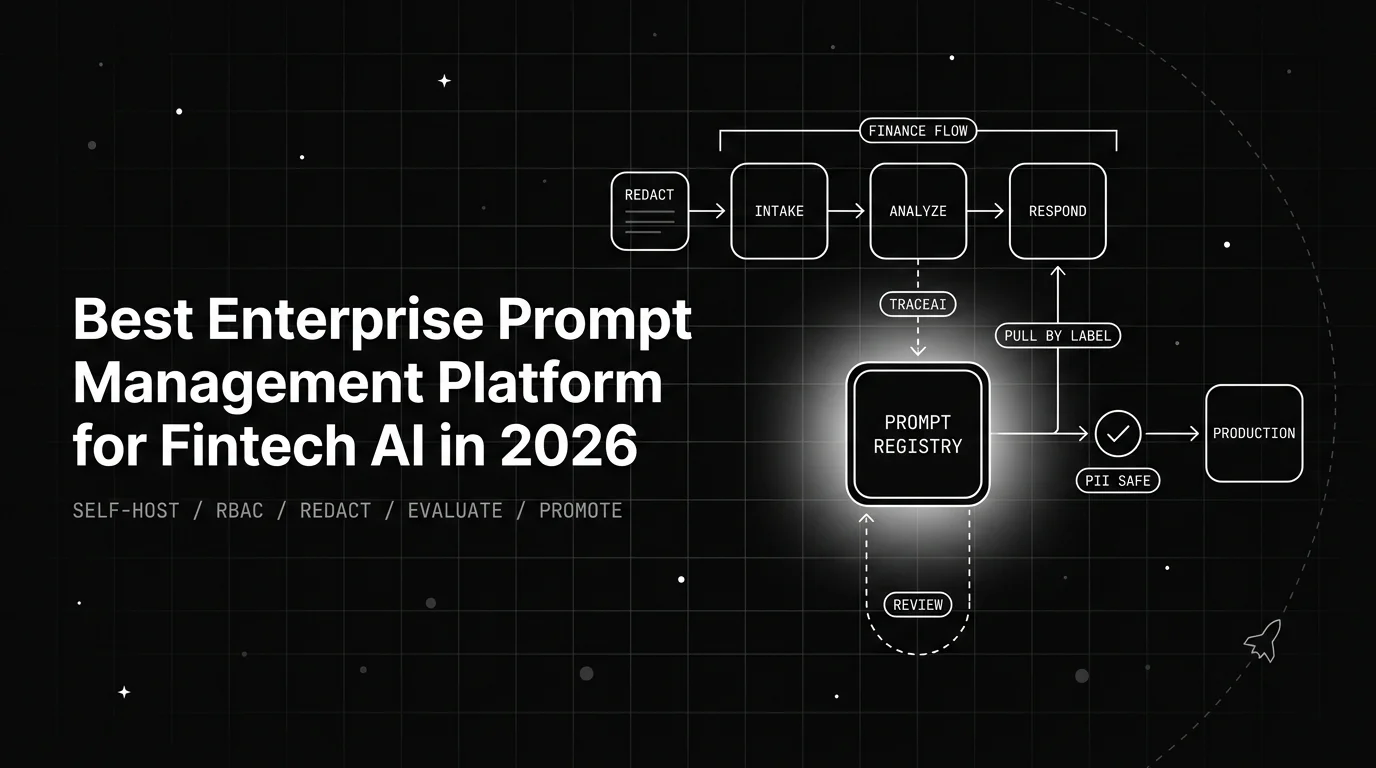
Because the platform is Apache-2.0 and runs on your own Docker Compose deployment, the prompts your pipeline gates, the datasets you evaluate against, and your production traces stay inside your own perimeter. The Future AGI repository has the full self-host instructions.
Where Future AGI Fits in Your CI/CD Stack
A prompt edited live in a console never enters your pipeline, so every test stays green while answer quality slides on real traffic. Future AGI gives the prompt the same standing as code: you commit each version from the SDK, evaluators score it as a build-gating check, and the build fails when a candidate regresses against production. Promotion is a label repoint that ships no code and stays out of your redeploy path.
The live edit nobody reviewed becomes a candidate that clears the check or fails the build. Wire your first prompt into the pipeline from the Future AGI app, where the cookbook has a recipe.
Frequently Asked Questions
What Is Prompt Versioning for CI/CD?
Which Prompt Versioning Tool Is Best for CI/CD Pipelines in 2026?
How Do You Gate a Prompt Change in a CI/CD Pipeline?
Can You Promote a Prompt Without Redeploying Your Application?
How Is Versioning a Prompt Different From Versioning Code?
Can You Self-Host a Prompt Versioning Tool for Your Pipeline?
Compare the 6 best prompt registry platforms for MLOps teams in 2026 on prompt versioning, model registry fit, CI/CD, and production deployment workflows.

Prompt management for fintech AI: Future AGI versions and governs each prompt in your own VPC, flags PII at the boundary, and eval-gates every promotion.

Prompt management for RAG: Future AGI versions retrieval and synthesis prompts, gates them on groundedness evaluators, and traces every answer.