Best Prompt Registry Tools for AI Teams in 2026
A ranked guide to the 6 best prompt registry tools for AI teams in 2026, compared on central storage, versioning, labels, and fetching prompts at runtime.
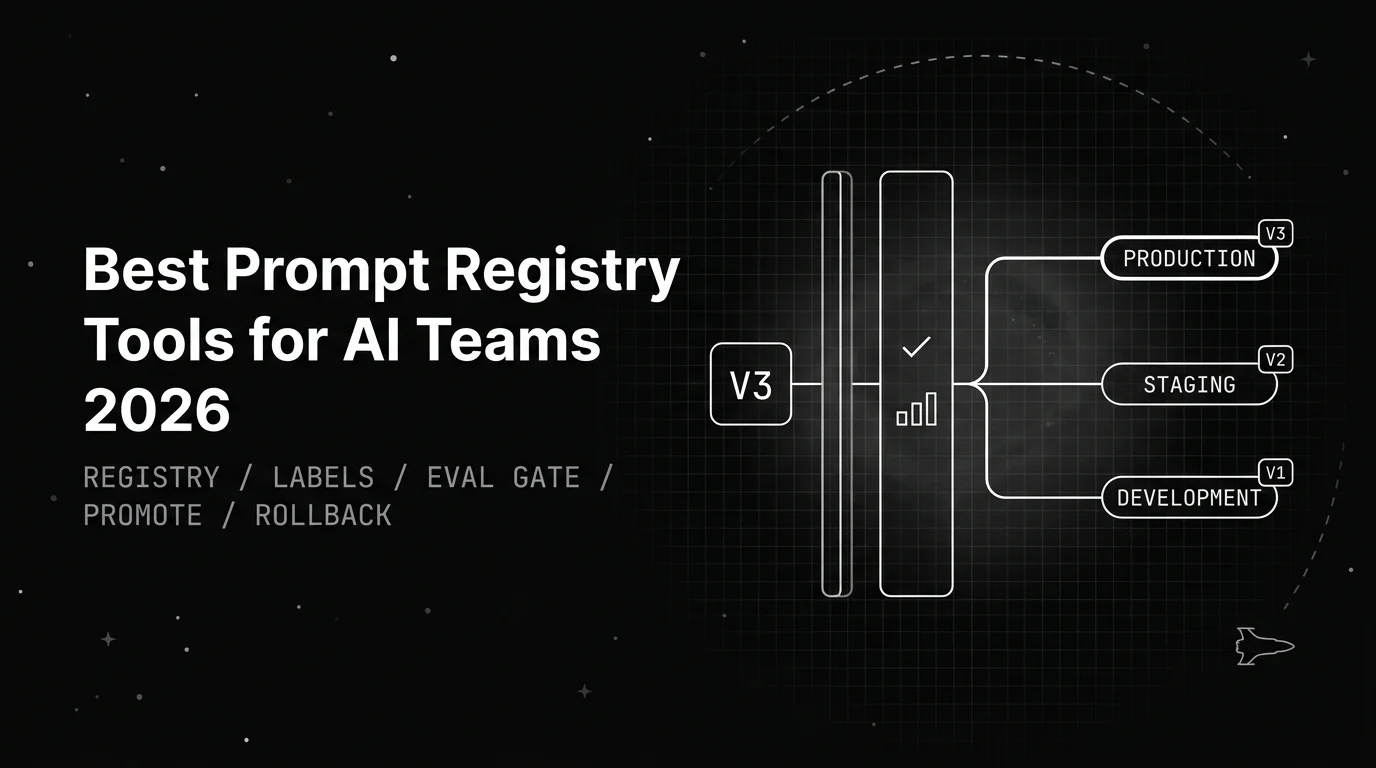
Table of Contents
A prompt is hardcoded in three services. Someone edits one copy to fix a bad answer, and now no one can say which text is live, who changed it, or how to push a fix without a full deploy. A prompt registry fixes that by making every prompt a versioned, central record an application retrieves at runtime. This guide ranks the six prompt registry tools AI teams should evaluate in 2026. We score each on the version store, runtime retrieval, audit, and whether the registry is wired into an evaluation loop.
TL;DR: 6 Prompt Registry Tools Scored on the Version Store, Runtime Retrieval, and the Eval Loop
Future AGI is the strongest overall prompt registry tool for 2026, because its registry is the start of a full prompt lifecycle, not the end. Each save creates an immutable version pinned to a label, Production, Staging, or Development; to roll back you move the label to an earlier version, no deploy required. That store is wired into custom evals, a CI/CD gate, and six optimization algorithms in one Apache-2.0 platform you can self-host.
| Rank | Tool | Best for | Standout capability |
|---|---|---|---|
| 1 | Future AGI | A registry wired into evals, CI/CD, and optimization | Immutable snapshots and SDK retrieval plus custom evals in one platform |
| 2 | PromptLayer | A dedicated, registry-first product | Polished version store with commit messages, diffs, and labels |
| 3 | LangSmith | LangChain-native teams | Commit-hash versions retrieved by name and hash, with named Environments |
| 4 | Langfuse | Open-source self-hosted registry | MIT core with auto-versioning and runtime retrieval by name |
| 5 | Vellum | Release-tag deployment registry | Versions, Deployments, and Releases retrieved by release tag |
| 6 | PromptHub | A git-style registry with a review flow | Commit history with diffs and review and approval before a change goes live |
Why Does a Prompt Registry Break in Production?
A prompt is product logic, but hardcoded in application code it inherits none of the controls a registry exists to provide. Without a central version store, a runtime fetch, and an audit trail, no one can say which text is live, who changed it, or how to ship a fix without a deploy. The registry closes that gap. Three properties separate a real registry from a folder of prompt files.
-
A single, versioned source of truth. The point is not that versions exist somewhere; it is that every prompt lives in one central store as an immutable snapshot with a readable history. A copy edited in one service while two others drift is not a registry, it is a merge conflict waiting to happen. The registry is the one place a prompt version is defined, and the only place it changes.
-
Runtime retrieval, decoupled from deploys. A registry earns its name when the application fetches a prompt by name at runtime rather than embedding the text. Pull the current or a pinned version through the SDK, and a prompt update ships without a code release. That decoupling is the whole reason teams adopt a registry: prompt iteration stops being blocked by the deploy cycle.
-
Access control and audit on every change. Once more than one person can edit a prompt, you need to know who changed which version and when. A registry that records authorship and history turns a vague “the assistant got worse this week” into a specific version and a specific author you can inspect and revert.
Most registries nail the version store, the runtime fetch, and the audit trail, then stop. The differentiator in 2026 is the step after storage. The best tools wire the registry into evaluation, so a version is scored before it is served. They also wire it into optimization, so the next version is written for you rather than hand-tuned. That is the lens this scorecard applies.
The Prompt Registry Scorecard
We scored every tool with the Prompt Registry Scorecard, a six-dimension rubric. It asks not which tool stores a version, but which one makes the registry the live, governed source of truth a production team can build on. Two dimensions decide a registry bet in 2026. The first is whether the store is wired into built-in evaluation. The second is whether it can generate an improved next version automatically.
| # | Dimension | What we measure |
|---|---|---|
| 1 | Version store | A central store of immutable versions with a readable history and diffs |
| 2 | Runtime retrieval | Fetch a named or pinned version through the SDK, decoupled from deploys |
| 3 | Access control and audit | A record of who changed which version, and history you can inspect |
| 4 | Built-in evaluation | An evaluator library that scores a version inside the platform |
| 5 | Automated optimization | The platform generates an improved next version for you |
| 6 | License and self-host | The exact license, and whether the registry self-hosts at no cost |
We do not publish a single composite score; the decision table later maps buyer profiles to picks. First, a short note on two tools people expect to see here.
Here is how the six tools compare across the dimensions that vary most.
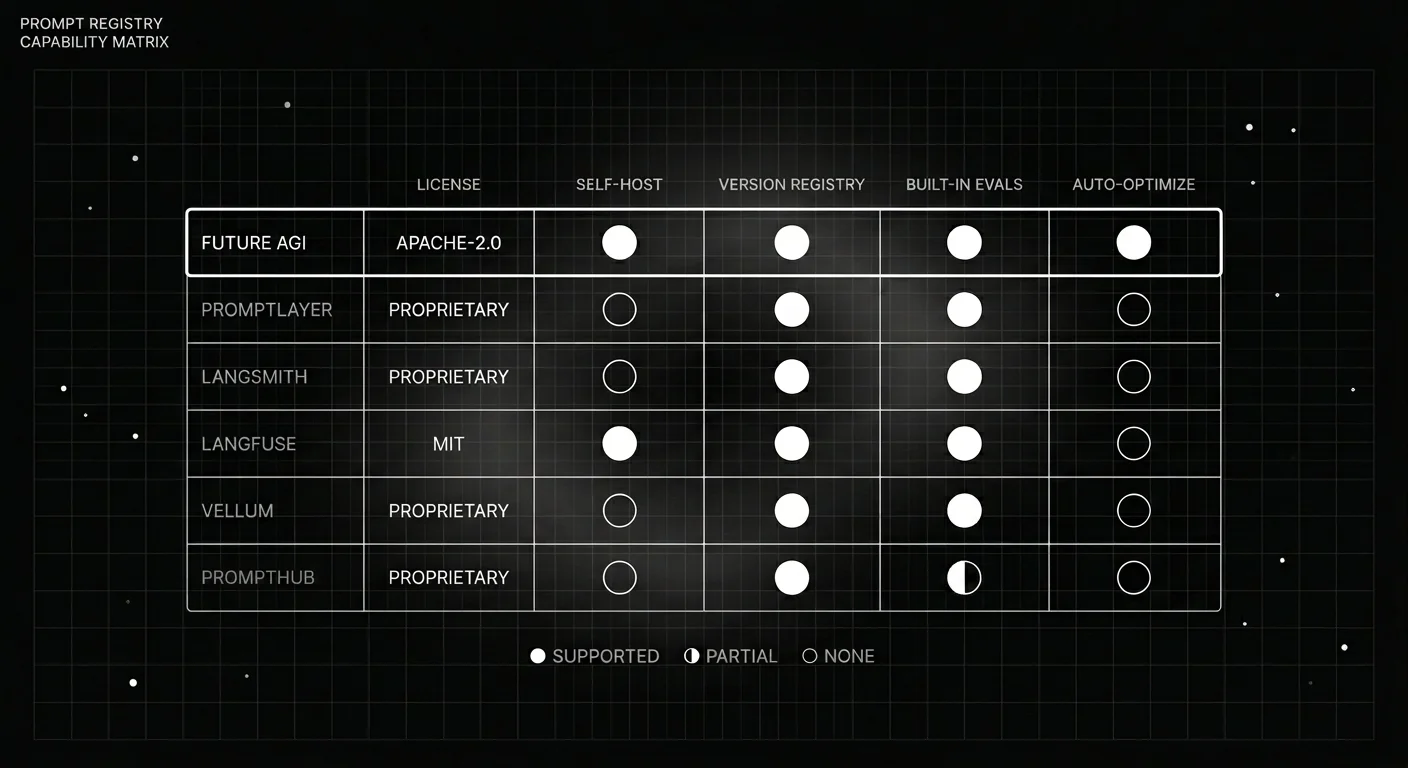
| Tool | Version store | Runtime retrieval | Built-in evals | Automated optimization | License / self-host |
|---|---|---|---|---|---|
| Future AGI | Immutable snapshots + Production/Staging/Development labels | get_template_by_name by name + label | Custom evals | Six algorithms (agent-opt) | Apache-2.0 core, self-host free |
| PromptLayer | Commit messages + version diffs | Pull by name and release label | Evals on the registry | Manual | Proprietary, self-host Enterprise |
| LangSmith | Commit hash, immutable | Pull by name and hash or tag | Eval SDK | Manual | Proprietary, self-host Enterprise |
| Langfuse | Auto integer versions | Pull by name | Prompt Experiments | Manual | MIT core, self-host free |
| Vellum | Versions, Deployments, Releases | Pull by release tag | Built-in metrics | Manual | Proprietary, VPC Enterprise |
| PromptHub | Commit history + version diffs | Pull by name and version | Pass/fail pipelines + side-by-side | LLM prompt iterator | Proprietary, no OSS self-host |
1. Future AGI: Best Overall for a Registry Wired Into the Eval Loop
Quick take. Future AGI is the only tool here where the registry, the evaluators, and the optimizer are one Apache-2.0 platform you can self-host. Each save creates an immutable version behind a named label, Production, Staging, or Development; a rollback moves that label to an earlier version with no code release. The registry connects directly to custom evals, a CI/CD gate, and six optimization algorithms, with traceAI closing the loop in production.
Ideal for. Production AI teams that want the prompt registry wired into the full improvement loop, not handed off to separate eval and observability vendors. You save a version with a label, retrieve it at runtime, score it against a dataset, gate changes in CI/CD, and let an optimizer propose a better candidate, all in one place.
Key strengths.
-
A central, immutable version store with named environment labels. Every save writes a new immutable snapshot to one central store. A named label, Production, Staging, or Development, plus custom ones, points at whichever snapshot each environment should serve. Your app requests a prompt by that label, so a rollback is just moving the pointer back to an earlier snapshot with no code release. The store stays the one place any live prompt is defined.
-
Retrieve any version at runtime through the SDK. The application fetches a prompt by name with
get_template_by_namefrom the Future AGI SDK, so the live text loads at call time instead of being hardcoded. A prompt update then ships without a deploy. The futureagi-sdk repo covers the retrieval API. -
Versions that are scored, not just stored. Point custom evals at any version, and Future AGI grades it automatically against checks you describe in plain language. Those checks range from answer quality to safety to format. Because the scoring lives in the registry itself, you weigh a candidate against the live version on one dataset. That check happens before it ever takes the Production label.
-
Evaluation as a CI/CD gate. You can run the same evals as a gate in your CI/CD pipeline, so a regression in a new prompt version is caught in the pipeline instead of in production.
-
Optimization that writes your next registry entry. The open-source agent-opt library carries six algorithms, Random Search, Bayesian, ProTeGi, Meta-Prompt, PromptWizard, and GEPA. Hand one an existing version plus an evaluator, and it produces a better-scoring successor you can save straight back to the registry. Most registries stop at storing what you wrote; this drafts the next version for you.
-
The loop closes in production. traceAI brings OpenTelemetry-native tracing with instrumentors for 50+ frameworks. It captures each prompt inside its spans, so a live request maps back to the exact registry version that served it. That link turns production behavior into the input for your next evaluation round.
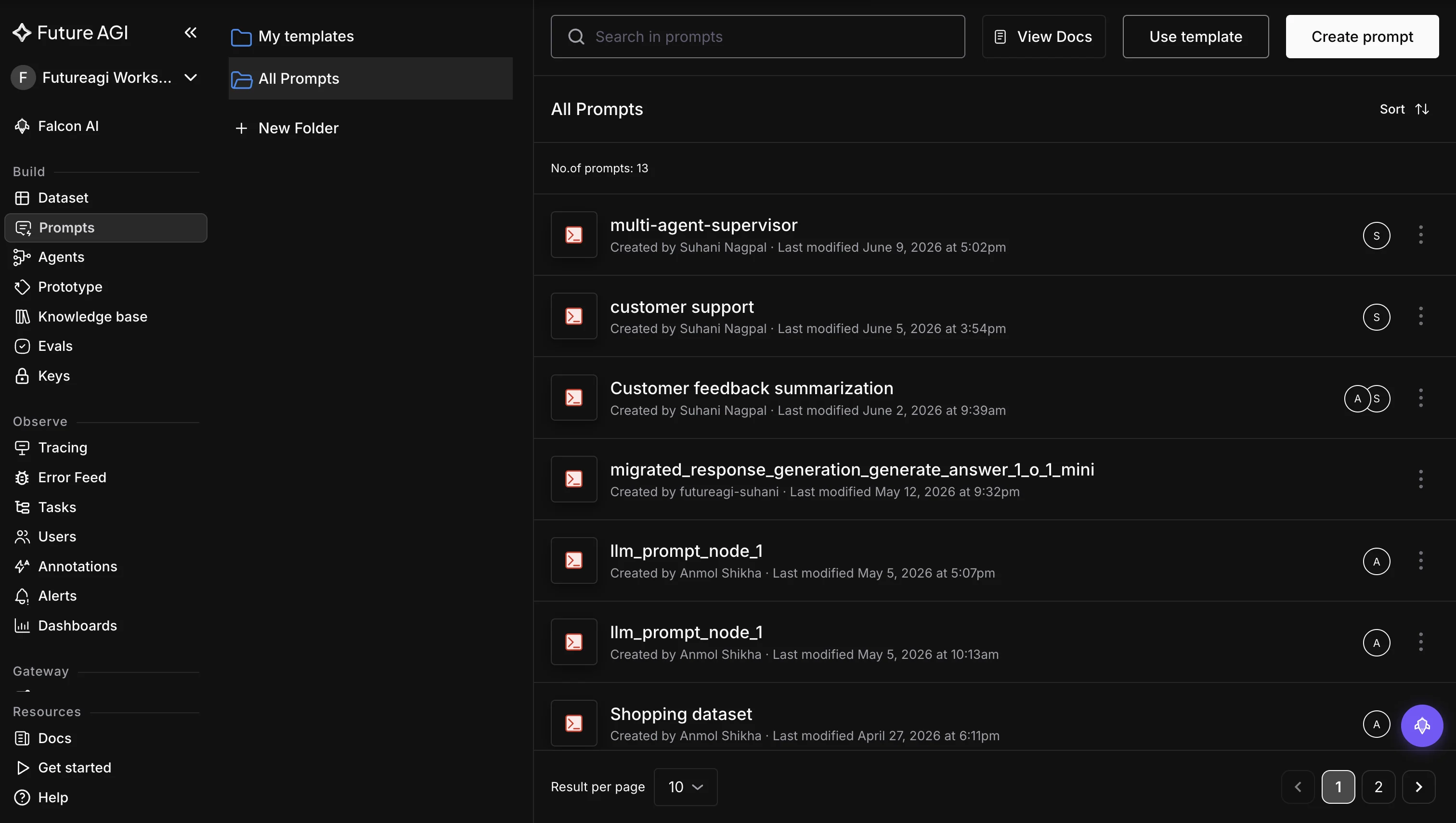
Pricing and deployment. Future AGI offers a free tier, pay-as-you-go usage, and Enterprise plans, listed on its pricing page. You can run the Apache-2.0 core SDK and product repos on your own hardware through Docker Compose at no license cost, so the whole registry stays in your network. SOC 2 Type II and a HIPAA BAA come with the paid plans, coverage the proprietary registries here usually reserve for an Enterprise contract.
Verdict. Future AGI is the strongest overall pick for teams that want the prompt registry to be the first stage of a closed improvement loop. Versioning, custom evals, a CI/CD gate, six optimization algorithms, and traceAI observability run on one Apache-2.0 platform you can self-host. Choose it when you want the registry wired into evaluation and optimization in one place.
2. PromptLayer: Best Dedicated Prompt Registry
Quick take. PromptLayer is a registry-first product, where prompt management is the whole point rather than a side feature. On pure registry ergonomics, it is the strongest dedicated option in this comparison. It pairs immutable versions and commit messages with version diffs and labels for routing a named version to a runtime.
Ideal for. Teams that want a dedicated registry where prompts are managed as a first-class product, not a string buried in application code. Both engineers and non-engineers need to edit and approve changes. The visual commit history, diffs, and release labels are built for teams where multiple roles review a prompt before it serves traffic.
Key strengths.
- Immutable versions carry commit messages and visual diffs. Because the registry is the center of the product rather than an add-on, the editing and history ergonomics are polished.
- Release Labels and Dynamic Labels route a named version to a runtime such as
prodorstaging, and Dynamic Labels can split traffic by percentage for staged rollouts. - You retrieve a version by name and release label through the SDK. The registry includes its own evaluation and dataset tooling, so you can score a version next to where you edit it.
Limitations. PromptLayer is proprietary, and self-hosting is an Enterprise-only option, so keeping prompt IP in your network requires a sales conversation. The version model is linear with no branch or merge, and evaluation cells are capped on lower tiers. There is also no built-in optimization that writes the next version for you.
Pricing. A free tier, a Pro tier, and a Team tier with collaboration features; self-hosting is Enterprise.
Verdict. PromptLayer is the strongest dedicated registry for teams that want prompt management to be the whole product. You get polished version history, diffs, commit messages, and a cross-functional editing flow. It is a weaker fit if open-source self-hosting or a built-in optimization loop are requirements, since neither is available without an Enterprise contract.
3. LangSmith: Best Registry for LangChain-Native Teams
Quick take. LangSmith is the registry and observability layer from the LangChain team, and its Prompt Hub stores commit-based, immutable versions identified by a commit hash. It is the natural fit if your stack is already built on LangChain or LangGraph. Versioned prompts, traces, and experiment results all live behind the same SDK without extra instrumentation.
Ideal for. Teams whose stack is LangChain-first and who want prompt versioning, tracing, and evaluations from a single vendor that speaks their framework natively. If your services already emit LangChain runs, the registry and its traces sit side by side without extra instrumentation, so the tool feels built-in rather than bolted on.
Key strengths.
- Every save creates a new immutable commit identified by a commit hash. Readable commit tags move on their own, so you retrieve an exact version by
name:hashor by tag through the SDK and reproduce it precisely. - A named Environments feature promotes a chosen commit between deployment targets such as Staging and Production without a code change. It adds one-click rollback and a diff toggle to compare two commits.
- Experiments evaluate a specific application version against a dataset, so scoring lives in the same platform as the registry. It ships deep, first-class Python and TypeScript clients.
Limitations. LangSmith is proprietary even though the LangChain framework is open source, so self-hosting is an Enterprise arrangement, not a free option. Its strengths are concentrated in the LangChain ecosystem, so a framework-agnostic team gets much less value from it. There is also no built-in optimization that writes the next version for you.
Pricing. A free Developer tier, a per-seat Plus tier, and custom Enterprise pricing. Hosted by default; self-hosting requires Enterprise.
Verdict. LangSmith is the registry to standardize on when your stack is already LangChain and you want versioning, tracing, and experiments from one vendor. It is a weaker fit the further you move from that ecosystem. You will need a separate tool if automated optimization, or open-source self-hosting, is a requirement.
4. Langfuse: Best Open-Source Self-Hosted Registry
Quick take. Langfuse is the open-source registry most teams self-host first when data-residency or license requirements rule out a hosted-only vendor. Its MIT-licensed core covers auto-versioning, labels, and prompts linked to traces. It runs entirely on your own infrastructure, with a large, active community behind it. Because the same instance stores prompts and captures traces, a self-hosted team gets versioning and observability without a second vendor.
Ideal for. Engineering teams that want a proven open-source registry they fully control, with prompt versioning and observability in one self-hostable package. It suits groups with data-residency or air-gap requirements that rule out hosted-only vendors, and the MIT core means they can inspect the source and run the registry free of license fees.
Key strengths.
- Saving a prompt under the same name creates a new immutable integer version automatically, so history accrues without ceremony, and you can diff versions.
- The application retrieves a prompt by name through the SDK. The
productionlabel is served by default andlatestis maintained automatically, plus custom labels for staging or per-tenant routing. - The MIT core self-hosts free on Docker or Kubernetes, and protected labels let admins lock the
productionpointer so it cannot be moved by mistake.
Limitations. The richest commercial features, including protected labels on a self-hosted instance, sit in a separate ee enterprise folder rather than the MIT core. A client-side cache means a reassigned label is near-instant on the server, but it takes effect in the app only after the cache refreshes. There is also no built-in optimization.
Pricing. A free Hobby cloud tier and self-hosting at no license cost, with paid Core, Pro, and Enterprise cloud tiers above it. Self-hostable by design.
Verdict. Langfuse is the safest open-source registry to standardize on when self-hosting is non-negotiable and full source access matters. The tradeoff is that automated optimization lives elsewhere, and some protected-label governance features require the commercial tier rather than the MIT core. For many self-hosting teams, that tradeoff is worth the control they gain.
5. Vellum: Best Release-Tag Deployment Registry
Quick take. Vellum models the registry as layered Prompt Versions, Deployments, and Releases. Each release is pinned to a specific model and prompt snapshot, and retrieved at runtime by a release tag. The structure suits teams that think in immutable, model-pinned releases and want a clear audit trail for each environment. It does add concepts that a simpler label-based registry does not require.
Ideal for. Teams that prefer a UI-driven, deployment-centric registry where each release is a reproducible artifact tied to an exact model and prompt configuration. It fits product-style organizations that ship prompts the way they ship software features. Each has distinct staging and production releases, plus an auditable history that shows exactly what ran in each environment.
Key strengths.
- A three-layer model separates a Version from a Deployment and a Release. Each environment gets a distinct, auditable release history and a one-click revert to a prior release.
- Three release-tag types cover different needs. LATEST updates automatically, Custom tags float and are repointed by hand for semver-style control, and Static tags are fixed per deploy.
- The runtime accepts a release tag on the execute call, so you retrieve a specific version or default to the environment’s latest without code changes. Test suites evaluate a deployment before it ships.
Limitations. Vellum is mostly proprietary, with only an assistant daemon open-sourced, so open-source self-hosting of the registry is not on the table. Versions and tags are linear with no branch or merge, the layered model adds concepts to learn, and the add-on pricing is harder to forecast than a flat tier.
Pricing. A free tier with usage credits and paid tiers that add a platform fee; larger deployments are quote-based. Hosted, with VPC options for Enterprise.
Verdict. Vellum is a solid choice when a deployment-centric, model-pinned release model is worth the extra concepts you have to learn before the first deploy. Each environment gets an auditable release history with a one-click revert to any prior release. It is less suited to teams who want a code-first flow or built-in automated optimization.
6. PromptHub: Best Git-Style Registry With a Review Flow
Quick take. PromptHub is a dedicated prompt management platform built around git-style versioning, where a central library of prompts carries commit history and diffs. Changes move through a branch and merge style workflow with review and approval before a prompt goes live. Prompts can be deployed and called through an API, and both technical and non-technical teammates can edit the same library.
Ideal for. Teams that want a focused prompt registry where every change passes a review and approval step before it serves traffic. It also fits groups where both engineers and non-technical teammates edit the same prompt library. The git-style branch and merge workflow makes prompt changes feel like code changes without requiring a code editor.
Key strengths.
- A central prompt library keeps commit history and diffs on every version, with a branch and merge style workflow familiar from git, so the registry stays the single source of truth.
- A review and approval step runs before a prompt change goes live, and both technical and non-technical teammates can edit prompts in the same library.
- Prompts are deployed and served through an API by name and version. You can test changes with side-by-side output comparison across multiple model providers such as OpenAI, Anthropic, and Google.
Limitations. PromptHub is proprietary and hosted with no open-source self-host, so keeping prompt IP in your own network is not on the table, and requests are metered by tier. Its evaluation is gate-centric: pass/fail pipelines and batch tests rather than a broad library of scoring metrics. It can refine a prompt with an LLM iterator, but it does not score a version against an evaluator the way an eval-driven optimizer does. The scope is also narrower than the broad LLMOps platforms.
Pricing. Paid subscription tiers for teams, with hosted SaaS delivery; there is no open-source self-host option.
Verdict. PromptHub is a strong fit when a focused, review-gated prompt registry is the primary need. It helps when the team includes non-technical editors who join that review. It is a weaker choice if deep, metric-based evaluation or open-source self-hosting are requirements. Its prompt improvement is an LLM refine step rather than optimization scored against an evaluator.
Which Prompt Registry Tool Should You Choose?
There is no single winner for every team, so match the tool to the constraint that matters most to you.
| If you need | Choose | Because |
|---|---|---|
| A registry wired into evals, CI/CD, and optimization | Future AGI | Scores and improves a version, not just stores it, Apache-2.0 self-host |
| A dedicated, registry-first product | PromptLayer | Polished version store with commit messages, diffs, and labels |
| A registry inside a LangChain stack | LangSmith | Commit-hash versions retrieved by name and hash, in one platform |
| An open-source registry you fully self-host | Langfuse | MIT core with auto-versioning and runtime retrieval by name |
| A deployment-centric, model-pinned release registry | Vellum | Versions, Deployments, and Releases retrieved by release tag |
| A git-style registry with a review and approval flow | PromptHub | Commit history with diffs and review before a change goes live |
Most of these tools handle the core registry job, and PromptLayer is the cleanest dedicated option on pure registry ergonomics. Future AGI leads for a different reason. It scores each version with custom evals, gates changes in CI/CD, and writes a better candidate with six optimization algorithms, all under an Apache-2.0 license you can self-host. For a focused registry, PromptLayer is the cleaner pick; for open-source self-hosting, Langfuse is the safer first install.
How Do You Roll Out a Prompt Registry Without Breaking Production?
Standing up a registry is the easy part. These practices keep it from becoming a new source of incidents.
- Make every prompt change a new version, never an in-place edit. The moment a prompt is editable without creating a version, your history has a hole in it. Save a version on every change so the diff is legible later and the registry stays the single source of truth.
- Retrieve prompts at runtime, not from hardcoded strings. Fetch a prompt by name through the SDK so the live text is owned by the registry, not copied into three services. That is what lets you ship a prompt fix without a deploy and keeps every runtime on the same version.
- Tie each version to an evaluation run before you serve it. A version you cannot score is a version you cannot trust. Compare the candidate against the current served version on the same dataset, and run that eval as a CI/CD gate so a regression fails the build instead of reaching users.
- Record who changed which version, and lock the critical pointer. Keep authorship and history on every change, so a regression points at a specific version and author. Lock the pointer that serves production if your tool supports protected labels.
- Close the loop with traces and optimization. Link served versions to traces so production behavior feeds your next round. Then hand the current version and an evaluator to an optimizer, so it proposes a higher-scoring candidate instead of you hand-tuning forever.
Where Future AGI Fits in Your Prompt Registry Stack
A prompt hardcoded in three services has no single home, so no one can say which copy is live. A registry fixes that by keeping one versioned record your app fetches at runtime, with a name and date on every change and a fix that ships by moving a label. Future AGI starts there and keeps going. The same version you fetch can be scored, gated in CI/CD, improved by the optimizer, and traced from production, all in one platform whose Apache-2.0 core you self-host for free. Start with Future AGI or read the prompt docs to see how the store, the evals, and the optimizer connect.
Frequently Asked Questions About Prompt Registries
What Are the Best Prompt Registry Tools in 2026?
The best prompt registry tools in 2026 are Future AGI, PromptLayer, LangSmith, Langfuse, Vellum, and PromptHub. Future AGI leads because its registry is wired into the whole loop: custom evals, a CI/CD eval gate, six optimization algorithms, and traceAI observability. It all runs under an Apache-2.0 license you can self-host. PromptLayer is the strongest dedicated registry. LangSmith is the best fit for LangChain-native teams, and Langfuse the best open-source self-hosted registry. Vellum is the best release-tag deployment registry, and PromptHub the best git-style registry with a review and approval flow.
What Is the Difference Between a Prompt Registry and Prompt Versioning?
Prompt versioning is the storage layer: immutable versions, a readable history, and diffs between revisions. A prompt registry is the system of record built on top. It centralizes the versions, lets an application retrieve a named version at runtime through an SDK fetch, and decouples prompt text from code deploys. Versioning tells you what changed; a registry is where every version lives and how prompts ship without a release.
Can You Self-Host a Prompt Registry?
Yes, but the license decides it. Future AGI’s core SDK and product repos are Apache-2.0 and self-hostable at no license cost via Docker Compose. The registry and its evaluation layer run on your own infrastructure. Langfuse offers an MIT core you can self-host free. PromptLayer, LangSmith, Vellum, and PromptHub are proprietary, so self-hosting is gated to an Enterprise contract or not offered. If prompt IP cannot leave your network, read the exact license before you standardize.
How Do You Retrieve a Prompt From a Registry at Runtime?
You fetch it by name through the registry SDK instead of hardcoding the text, so the application loads the current or a pinned version at call time. Future AGI retrieves the template with get_template_by_name through its SDK, so a prompt update ships without a code deploy. Langfuse pulls a prompt by name, LangSmith by name and hash or tag, Vellum by release tag, and PromptHub by name and version. Retrieving at runtime decouples prompt text from your deploy cycle and makes the registry the live source of truth.
What Makes Future AGI Different From Other Prompt Registry Tools?
Most prompt registries stop at storing a version and serving it. Future AGI wires the registry into the full prompt lifecycle. Each save creates an immutable version you retrieve with get_template_by_name at runtime and roll back by reassigning a label. That version can be scored with custom evals, gated through CI/CD, and improved by six optimization algorithms. traceAI captures its production behavior, all under Apache-2.0 you can self-host.
Frequently Asked Questions
What Are the Best Prompt Registry Tools in 2026?
What Is the Difference Between a Prompt Registry and Prompt Versioning?
Can You Self-Host a Prompt Registry?
How Do You Retrieve a Prompt From a Registry at Runtime?
What Makes Future AGI Different From Other Prompt Registry Tools?
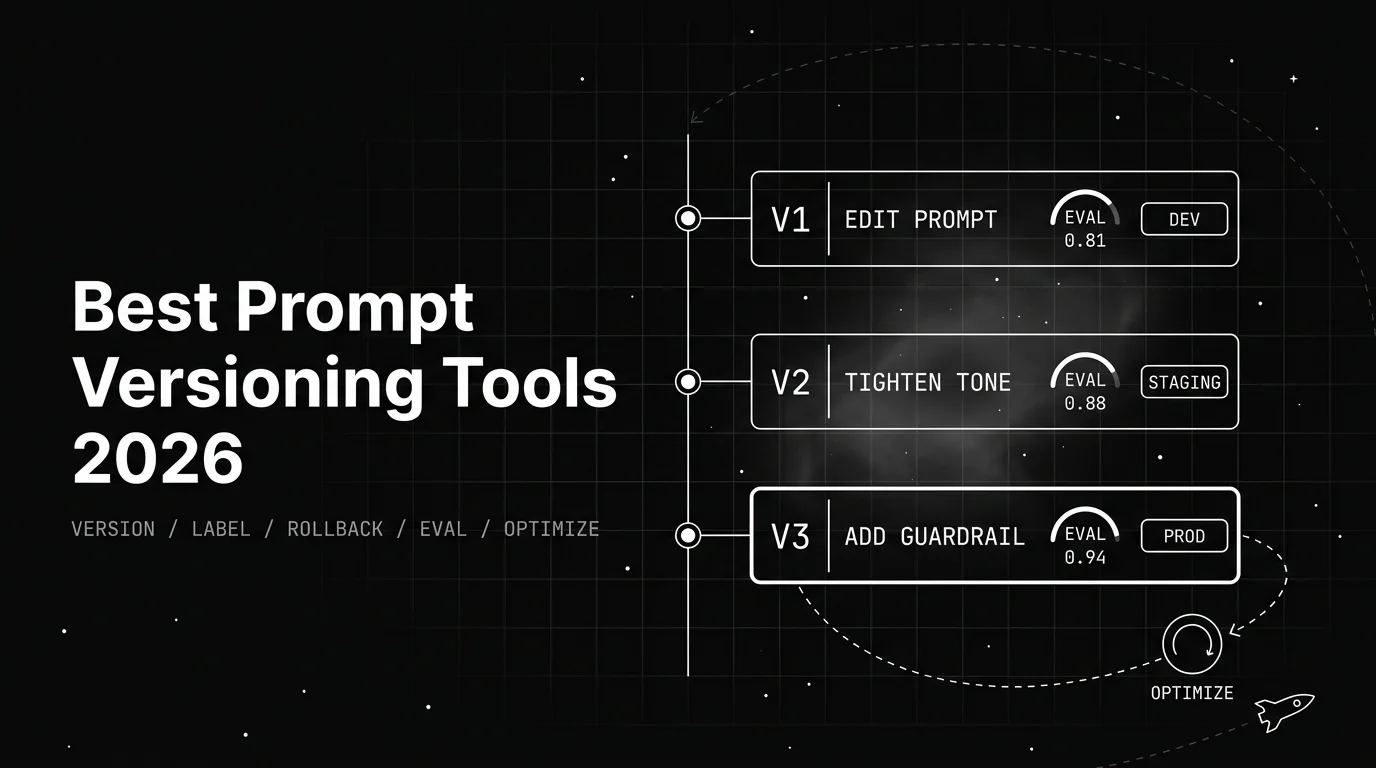
The 7 best prompt versioning tools for production AI teams in 2026, ranked on version history, labels, rollback, and testing prompts before you ship it.

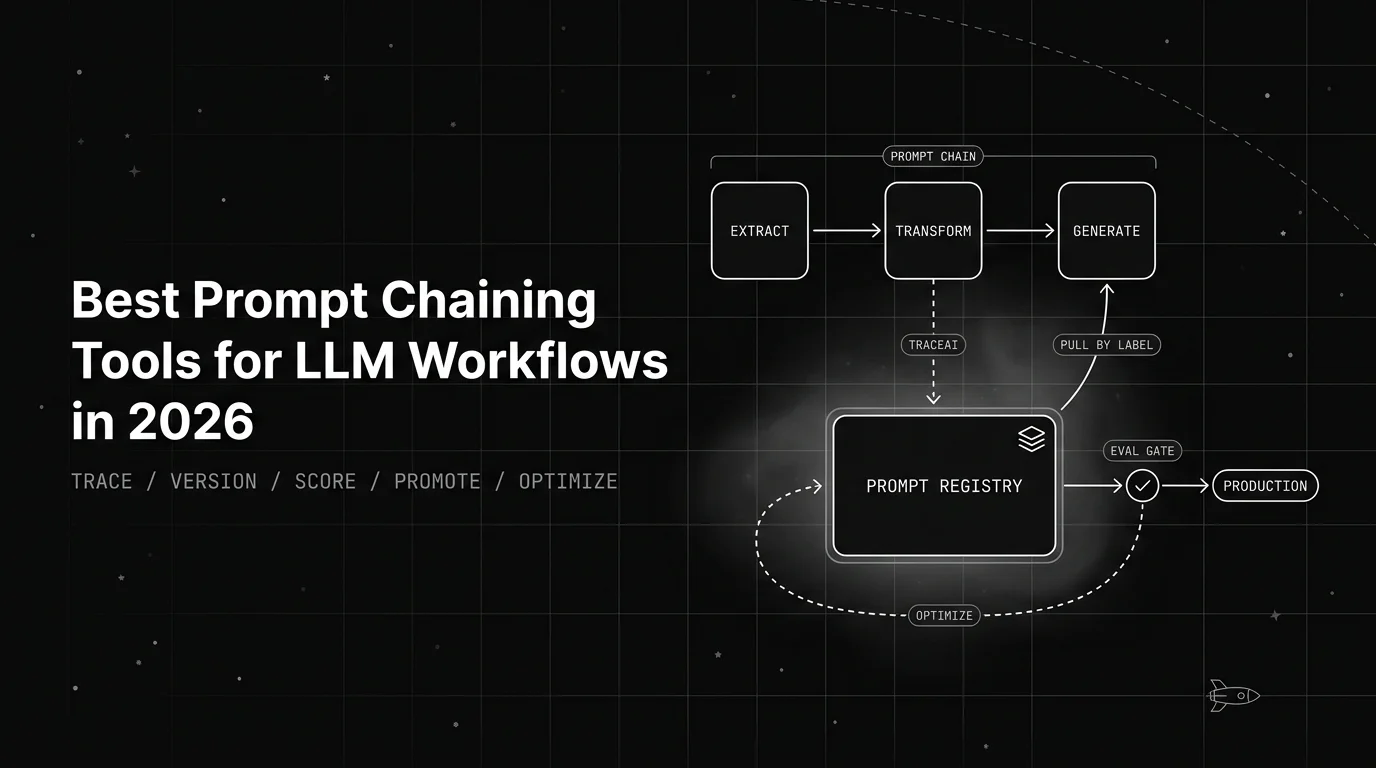
See the 6 best prompt chaining tools for LLM workflows in 2026, ranked on per-link versioning, tracing, evaluation, and debugging each step of the chain.

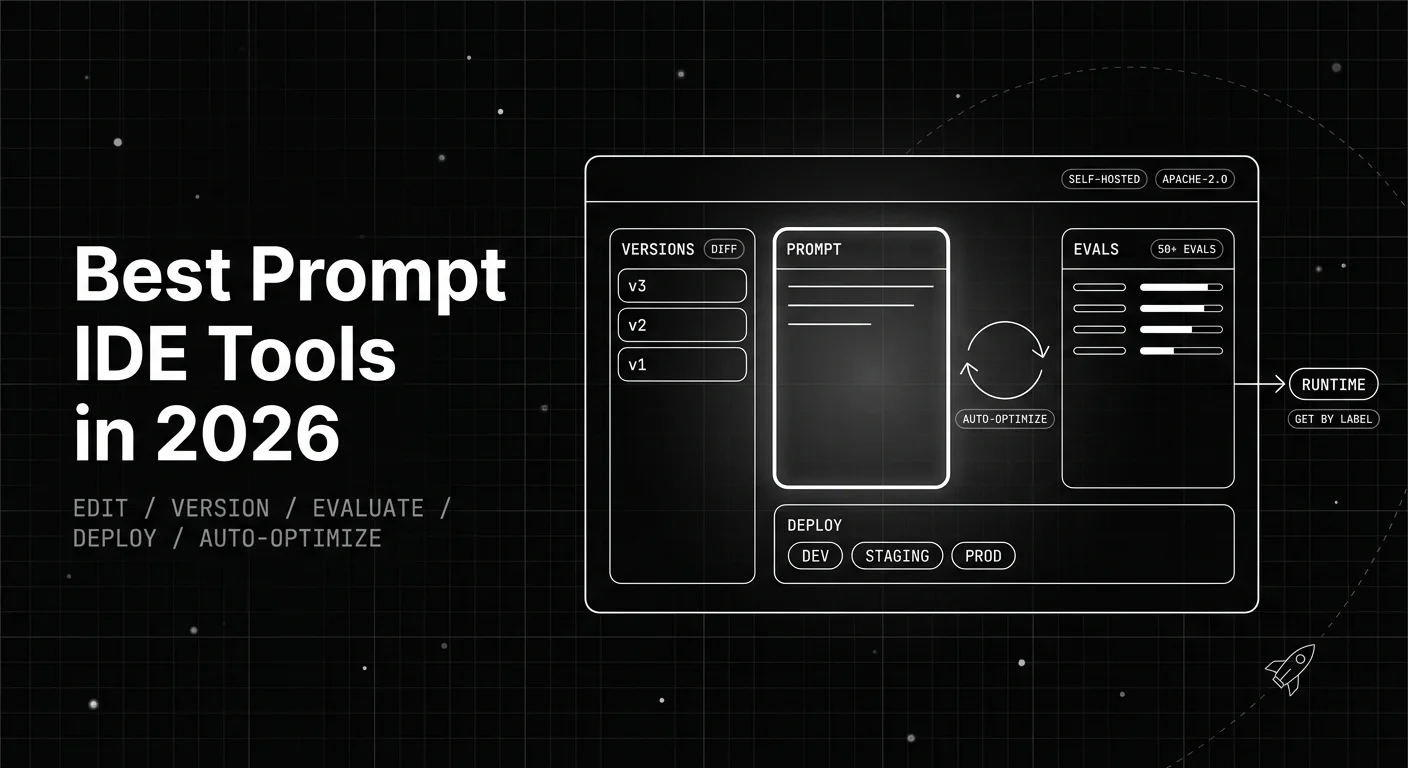
The 6 best prompt IDE tools in 2026, ranked on the editor, variables, side-by-side testing, versioning, and evaluation together in a single workspace.