Best Prompt Management Tools for Startups in 2026
The 6 best prompt management tools for startups in 2026, ranked on free tiers, quick setup, versioning, and built-in evaluation for small, fast teams.
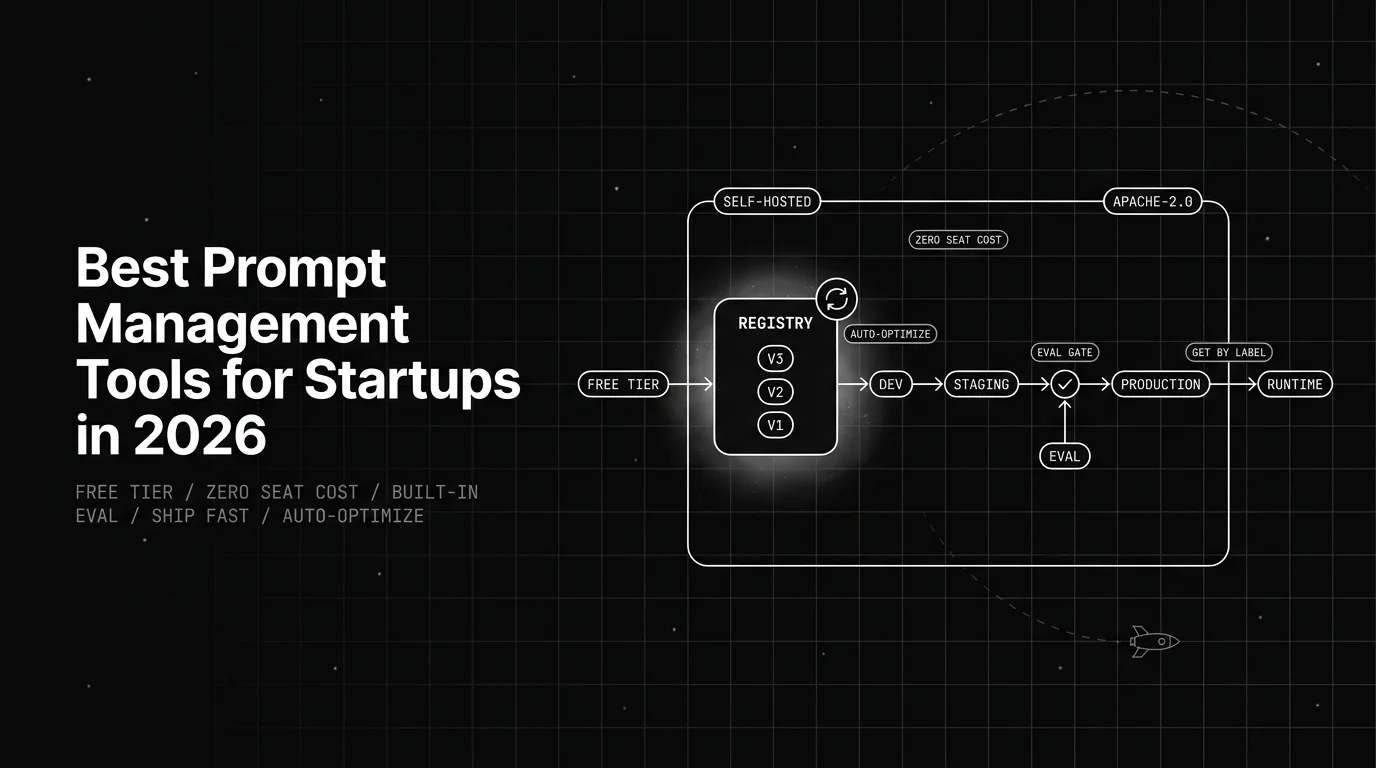
Table of Contents
Your startup ships an LLM feature on a prompt that lives in a Python string, edited in a pull request, checked by whoever happened to read the diff. That holds until the second engineer changes it, the eval is a vibe, and a regression reaches users before anyone can name the version that caused it. The enterprise answer is a per-seat platform and a governance team you do not have. This guide ranks the six prompt management tools worth running at a startup in 2026, scored on the constraints a small team actually has: free-tier generosity, zero-seat-cost self-hosting, built-in evaluation, promotion safety, and automated optimization.
TL;DR: 6 Prompt Management Tools for Startups, Scored on Cost and Speed
Future AGI is the strongest overall prompt management tool for startups in 2026. It covers the whole prompt lifecycle at a cost structure built for a small team: a free Hobby tier to start and an Apache-2.0 core that self-hosts via Docker Compose at zero seat cost. These six tools differ most on whether seat cost scales with headcount and whether the improvement loop closes without a specialist hire.
| Rank | Tool | Best for | Standout capability |
|---|---|---|---|
| 1 | Future AGI | The complete prompt lifecycle in one free, self-hostable platform: create, version, evaluate, optimize, observe | A built-in evaluator library, a CI/CD gate, and six optimization algorithms, Apache-2.0 self-host at zero seat cost |
| 2 | Langfuse | The open-source default a small team reaches for first | MIT core that self-hosts versioning, labels, and Prompt Experiments for free |
| 3 | Agenta | A free open-source playground for fast prompt iteration | Git-like variants with side-by-side compare and real environments |
| 4 | Latitude | An open-source all-in-one with a simple publish flow | Draft to Published versioning paired with strong experiments |
| 5 | PromptLayer | A polished dedicated registry if you will pay for cloud | Commit-message versions, diffs, and label-based promotion |
| 6 | Vellum | A UI-first workflow with governance for when you scale up | Release-tagged deployment pipeline with RBAC and audit logs |
Why Does Prompt Management Break for Startups in 2026?
A startup ships LLM features faster than it can staff the operations around them. When a prompt lives inline in code, every edit is a deploy and a regression reaches users before anyone names the version that caused it. The enterprise fix, a per-seat governance platform, is the cost a startup cannot afford. Three requirements separate a tool that fits a small team from one built for a larger company.
-
It starts at zero and seat cost does not scale with the team. A startup should begin on a free tier at no cost, then, as it adds engineers, avoid per-seat pricing by self-hosting an open-source platform at zero license cost. The biggest difference between a startup-fit tool and an enterprise one is whether adding the fifth engineer adds a seat bill or nothing at all, which is why open-source self-hosting sits at the top of this scorecard.
-
It evaluates a prompt before it ships, with no QA hire. Built-in evaluation has to come with the tool, not as a separate function the team staffs, so a small team can score a candidate against a dataset and catch a regression without hiring QA. The nuance for a startup is the free tier: an evaluation feature capped at a handful of runs per month is only half a gate when you are living on the free plan.
-
It improves the prompt without a specialist, and keeps a path to scale. Capturing and versioning a prompt is table stakes. The harder requirement is improving it without hiring a prompt engineer, which means automated optimization, and keeping versioning and promotion available so the same tool grows with the team rather than being ripped out at Series A.
Most tools now version a prompt and score it. The difference this scorecard rewards is the third pillar plus the step after it. It comes down to how little a small team has to spend, in dollars and headcount, to ship a reliable prompt and keep improving it, with the tool scaling alongside the team instead of against it.
How Did We Score These Prompt Management Tools?
We scored every tool with the Startup Prompt Stack Scorecard, a six-dimension rubric built for this title’s question: not which tool stores a prompt, but how cheaply a small team ships and improves a reliable one. The rubric leads with free self-hosting and free-tier evaluation, then adds the dimension that decides whether prompts get better over time without a specialist: automated optimization.
| # | Dimension | What we measure |
|---|---|---|
| 1 | License and free self-host | The exact license, and whether the whole platform self-hosts for free or only on Enterprise |
| 2 | Free-tier generosity | How much a small team can do at zero cost before it has to pay |
| 3 | Built-in evaluation | Whether evaluation ships with the tool and how hard the free or low-tier caps bite |
| 4 | Versioning and promotion | Immutable versions, diffs, and a safe path from a draft to the live version |
| 5 | Automated optimization | Generating a higher-scoring next version without a prompt-engineering hire |
| 6 | Speed to ship | How fast a small team gets from sign-up to a versioned, evaluated prompt in production |
We do not publish a single composite score; the decision table later maps startup profiles to picks.
Here is how the six tools compare across the capabilities that vary most for a small team.
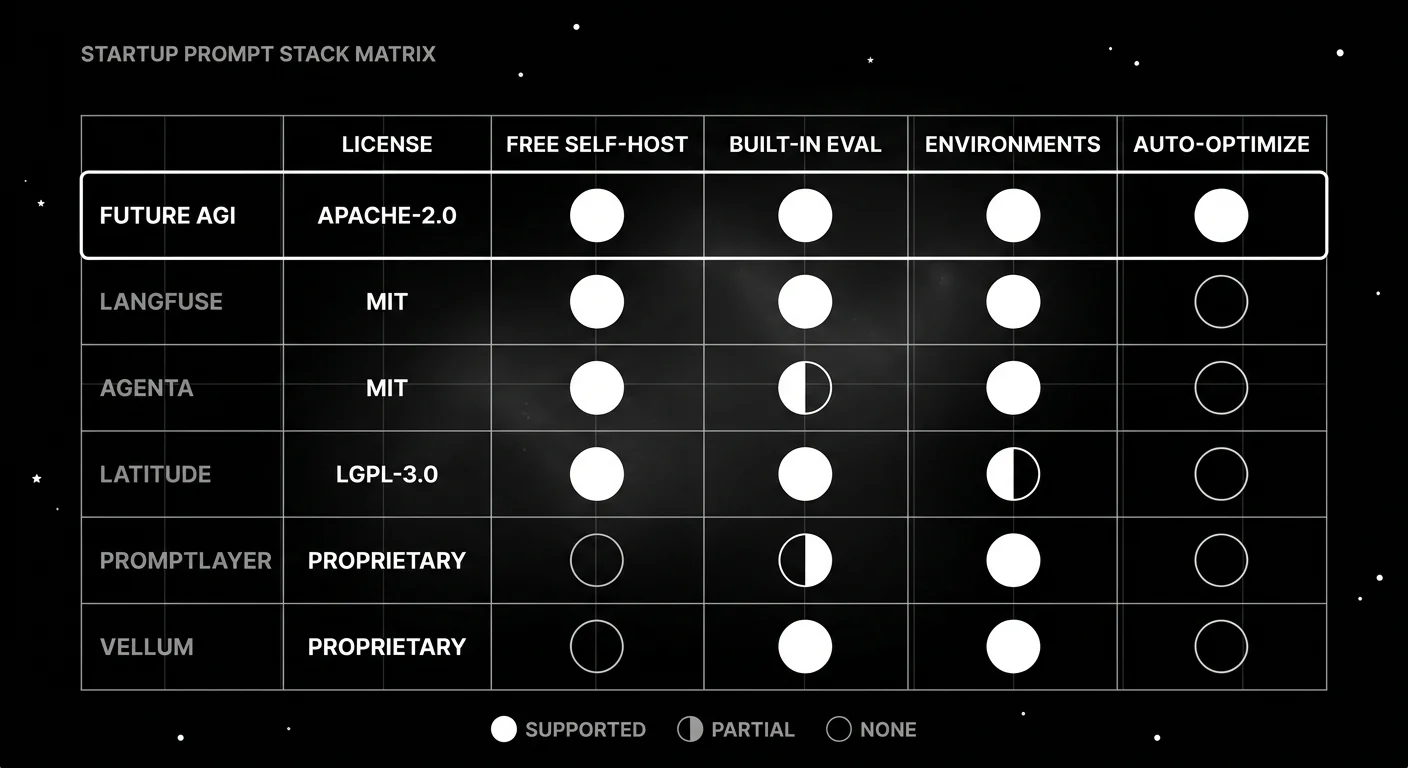
| Tool | License | Free self-host | Built-in eval | Versioning and promotion | Auto-optimize |
|---|---|---|---|---|---|
| Future AGI | Apache-2.0 | Yes, zero seat cost | Built-in evaluators | Immutable versions, label-based promotion and rollback | Yes, six algorithms |
| Langfuse | MIT core | Yes, Docker | Prompt Experiments | Auto-versioned, labels (production/latest) | No |
| Agenta | MIT | Yes, Docker | Built in, 20 evals/mo on free tier | Git-like variants, dev/staging/prod | No |
| Latitude | MIT | Yes | Experiments and evaluations | Draft to Published (two-state) | No |
| PromptLayer | Proprietary | No, Enterprise only | Evals, capped on low tiers | Commit messages, Release/Dynamic Labels | No |
| Vellum | Proprietary | No, VPC/Enterprise | Test suites | Versions, Deployments, Release Tags | No |
For a startup, the free-self-host column is the spine of this table. The four open-source tools all self-host at zero seat cost, ranking above the two proprietary tools whose self-hosting is Enterprise-only. The nuance on evaluation is the cap: Agenta limits the free tier to 20 runs per month and PromptLayer caps evaluation on low tiers. Only Future AGI closes the loop into automated optimization.
1. Future AGI: Best Overall for Startups, Free Tier Plus Zero-Seat-Cost Self-Host
Quick take. Future AGI is the only platform here that covers the complete prompt lifecycle, authoring, versioning, evaluation, optimization, and production tracing, in one place a startup can afford to run. It has a free Hobby tier, and the Apache-2.0 core self-hosts via Docker Compose at zero seat cost, so a team of two and a team of twenty pay the same for infrastructure.
Ideal for. Startups that want one platform from first prototype to live deployment. It is free to start, self-hosted at zero seat cost under Apache-2.0 as the team grows, and covers evaluation and optimization in the same tool so no QA or prompt-engineering hire is needed to ship and improve prompts reliably.
Key strengths.
-
Start at zero, then self-host at zero seat cost. Future AGI has a free tier so a small team begins at no cost, and because the core SDK and product repos are Apache-2.0, the whole stack also self-hosts inside your own network at no license cost via Docker Compose. A startup can validate a feature free in the cloud and later move to a zero-seat-cost self-host without changing tools, so seat cost never scales with headcount.
-
A promotion path without an ops hire. Future AGI turns each save into an immutable version and keeps every earlier one, so nothing a teammate edits is lost. A label such as Production, Staging, or Development selects the version your app serves, and code fetches it by name and label instead of pasting the text inline. Promoting a version assigns the Production label to it, and rolling back assigns that label to an earlier version, both with no redeploy and no ops person to run the release. A two-person team gets a full promotion path in the same prompt management workspace it writes prompts in.
-
Reliability without a QA hire. A small team rarely has a dedicated tester, so evaluation ships inside Future AGI as a library of built-in evaluators plus custom checks you write for what your product needs, across quality, safety, factuality, RAG retrieval, and format. Score a version, read the result, and compare two candidates on the same dataset before you ship. Run those evals as a gate in your CI/CD pipeline, so a regression is caught in the build instead of by the handful of users who would notice. The testing that needs a hire elsewhere already comes with the tool.
-
Improvement without a prompt engineer. When a version stalls below its target, the open-source agent-opt library does the rewriting a specialist would, for a team that has not hired one. Its six algorithms, Random Search, Bayesian, ProTeGi, Meta-Prompt, PromptWizard, and GEPA, generate variants, score each against your evaluator, and surface the ones that beat the version you already run, an approach our guide to automated optimization for agents walks through. It is the one capability here that replaces a role rather than a tool, and it is Apache-2.0.
-
Production visibility without a separate stack. A small team rarely stands up a dedicated observability stack, so traceAI builds it in: OpenTelemetry-native tracing with instrumentors for 50+ frameworks. It shows which version handled each live request, so a prompt that misbehaves in front of users is the one you pull into evaluation and optimization next. The same tool that fits two engineers still fits twenty.
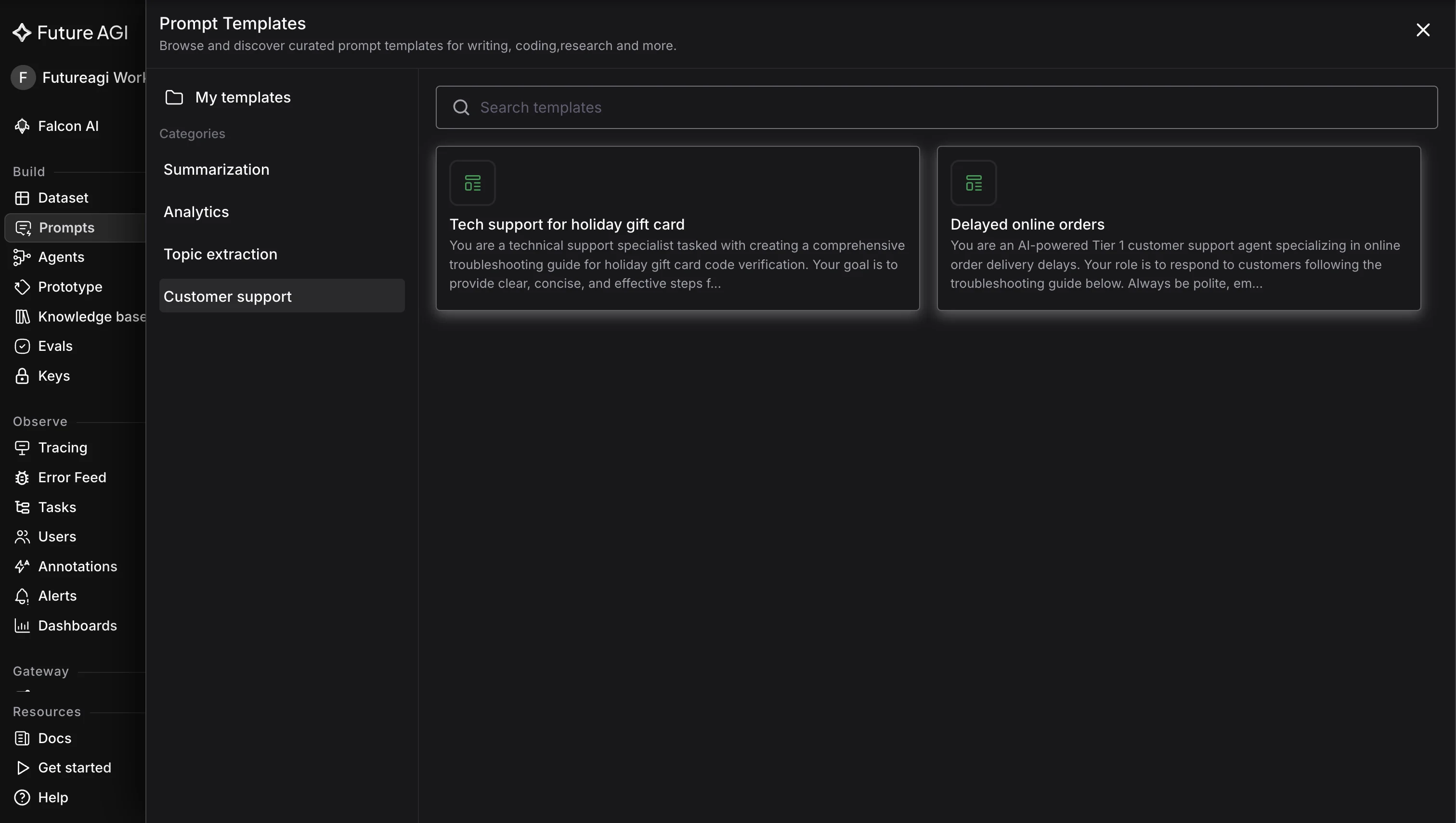
Pricing and deployment. Future AGI has a free tier, pay-as-you-go usage, and Enterprise plans on its pricing page. The core SDK and product repos are Apache-2.0 and self-hostable at no license cost via Docker Compose, and the platform offers SOC 2 Type II and HIPAA BAA on paid plans, which most proprietary rivals gate behind a contract.
Verdict. Future AGI is the strongest overall pick for a startup that wants the whole prompt loop in one place without buying separate tools for every stage. Start on the free tier, self-host at zero seat cost under Apache-2.0 as the team grows, gate every prompt change through built-in evaluators and a CI/CD pipeline, and let six optimization algorithms write the next version instead of a specialist hire.
2. Langfuse: Best Open-Source Default for a Startup
Quick take. Langfuse is the open-source platform most startups reach for first, pairing a prompt registry with tracing in one MIT-licensed, self-hostable instance. Its core auto-versions prompts as immutable integer versions, maps them to environments with production and latest labels, and scores them with Prompt Experiments, all at zero seat cost on Docker. It is the most widely adopted open-source option in this field.
Ideal for. Startups that want the most popular open-source option they can self-host at no license cost. Langfuse combines versioning, environment labels, Prompt Experiments, and tracing in a single Docker instance, so a small team gets evaluation and observability without adopting two separate tools or paying a per-seat bill as it grows.
Key strengths.
- The MIT core self-hosts free on Docker, so the registry, labels, evaluation, and tracing all run inside your own network with no per-seat cost, and a free Hobby cloud tier lets a team start without standing up infrastructure at all.
- Auto-versioning creates a new immutable integer version on each save, and labels such as production, latest, and custom map versions to environments, so the runtime pulls by label and rollback is a label repoint, the promotion model a startup can grow into.
- Prompt Experiments score a version against a dataset for a built-in evaluation gate, and prompts link to the traces they produced, so a small team gets evaluation and observability without a second tool.
Limitations. A client-side cache means a repointed label is picked up only after the cache TTL refreshes, so promotion is not strictly instant. The richest enterprise controls live in the commercial Enterprise Edition rather than the MIT core, and there is no built-in automated optimization, so improving a prompt is still a manual job.
Pricing. A free Hobby cloud tier and free self-hosting under MIT, with paid Core, Pro, and Enterprise cloud tiers and a commercial Enterprise Edition above them.
Verdict. Langfuse is the best open-source default for a startup that wants immutable versioning, environment labels, evaluation, and tracing in one free, self-hostable instance. The tradeoff is a client-side cache that delays label moves by one TTL, and there is no built-in optimizer, so prompt improvement stays a manual step after scoring.
3. Agenta: Best Free Open-Source Playground for Fast Iteration
Quick take. Agenta is an MIT-licensed open-source platform built around a fast prompt playground where Variants act like git-like branches with immutable commits and a side-by-side compare view. It self-hosts free on Docker with development, staging, and production environments. The one caveat for a startup on the free plan is that built-in evaluation is capped at 20 runs per month.
Ideal for. Startups that iterate on prompt copy daily and want a free, self-hostable playground with real dev, staging, and production environments. Agenta fits teams whose primary activity is fast visual comparison of prompt variants, and who can live with the 20-run-per-month evaluation ceiling on the free plan while they are still proving the feature out.
Key strengths.
- The MIT core self-hosts free on Docker, so a small team runs the whole playground at zero seat cost, and the playground itself is the draw: a side-by-side compare view makes iterating on prompt copy fast and visual.
- Variants behave like git-like branches with immutable commits, so changes are tracked and comparable, and development, staging, and production environments map versions to stages, pulled at runtime through
ag.ConfigManager.get_from_registry. - Evaluation is built in rather than bolted on, so a version can be scored before it ships, which keeps the iterate-and-check loop inside one tool for a team that does not want to wire up a separate evaluator.
Limitations. Built-in evaluation is capped at 20 runs per month with 30-day retention on the free tier, so for a startup living on the free plan the evaluation gate is real but quota-limited. SSO sits behind the commercial ee folder, the broad scope means more initial setup than a single-purpose registry, and there is no built-in automated optimization.
Pricing. A Hobby tier at $0, a Pro tier at $49 per month, a Business tier at $399 per month, and custom Enterprise, with free self-hosting under MIT on Docker.
Verdict. Agenta is the best free open-source playground for a startup that iterates on prompt copy fast and wants real dev, staging, and production environments at zero seat cost. The tradeoff is a 20-run-per-month evaluation ceiling on the free plan and no built-in optimizer, so prompt improvement beyond scoring is a manual step.
4. Latitude: Best Open-Source All-in-One With a Simple Publish Flow
Quick take. Latitude is an open-source platform with a deliberately simple versioning model: a version starts as a Draft, a side-by-side diff shows what changed, and publishing promotes it to the version the built-in AI Gateway serves. It self-hosts free under an MIT license and pairs that lightweight flow with strong Experiments and evaluations, making it a practical all-in-one for a team that wants to ship fast.
Ideal for. Startups that want a free, self-hostable all-in-one with a simple publish-based workflow and strong evaluation, rather than a full three-stage dev-staging-production pipeline. Latitude fits a team that wants to reason about Draft versus Published without learning a layered release model, and that values LLM-as-judge and human-review evals built into the same tool.
Key strengths.
- The open-source core self-hosts free, so a small team runs it at zero seat cost. The Draft to Published model is easy to reason about: a draft becomes the live version on publish, the runtime pulls a prompt by path, and rollback is re-publishing a prior version.
- Evaluation is a genuine strength, with Experiments and Evaluations spanning LLM-as-judge, programmatic, and human review, so a startup gets a full evaluation surface built in rather than a thin one.
- Version history with a side-by-side diff keeps changes legible, and the built-in AI Gateway serves the published version directly, so there is less to wire together for a team that wants one tool end to end.
Limitations. The Draft to Published model is a two-state flow, not a full three-stage environment pipeline, so a team that wants a distinct staging step has to approximate it. Credit-based pricing is harder to predict than flat seats, the free tier retains data for 30 days, and there is no built-in optimization to generate the next prompt version.
Pricing. A Free tier at $0 with 20,000 credits per month, a Pro tier at $99 per month with 100,000 credits, and custom Enterprise, with free self-hosting.
Verdict. Latitude is the best open-source all-in-one for a startup that wants a simple publish-based flow and genuinely strong evaluation in a single free, self-hostable tool. The tradeoffs are a two-state versioning model lighter than full environments, credit-based pricing that is harder to budget at volume, and no built-in optimizer to generate the next prompt version.
5. PromptLayer: Best Polished Registry If You Will Pay for Cloud
Quick take. PromptLayer is a registry-first platform where prompt management is the whole product: immutable versions with commit messages, version diffs, Release and Dynamic Labels for stage promotion, and an interface a non-engineer can use. The catch for a startup is cost structure: it is proprietary, so self-hosting is Enterprise-only, and evaluation is capped on the low tiers most small teams live on.
Ideal for. Startups that want the most polished dedicated prompt registry, where non-engineers can manage and review prompt changes in a visual interface, and are willing to pay for a cloud-hosted product rather than run their own infrastructure. It is a weaker fit for teams whose first constraint is seat cost or free self-hosting.
Key strengths.
- The registry is the center of the product, so versioning is first-class: commit messages, version diffs, and a clean linear history make every prompt change legible. The editor is genuinely usable by non-engineers, which suits a small team where the prompt author is not always an engineer.
- Release Labels and Dynamic Labels map a version to environments such as prod and staging, the runtime pulls by label, and rollback is a label repoint, with Dynamic Labels able to split traffic for a staged rollout.
- Evaluations and Datasets live on the prompt page, and request logs tie back to the version that served them, so there is a clear audit trail for a team that wants one.
Limitations. PromptLayer is proprietary, so there is no free self-hosting; self-hosting requires an Enterprise contract, the one constraint that matters most to a cost-sensitive startup. Evaluation is capped on the lower tiers a small team lives on, so the gate is real but quota-limited there, the version model is linear with no branch or merge, and there is no built-in optimization.
Pricing. A free tier, a Pro tier, and a Team tier in the cloud, with self-hosting available only on Enterprise.
Verdict. PromptLayer is the best dedicated registry for a startup that values a polished, non-engineer-friendly cloud product and will pay for it. The limits to accept are no free self-hosting, an evaluation cap on the low tiers where most startups live, and no built-in optimizer, so improving a prompt beyond scoring stays a manual effort.
6. Vellum: Best UI-First Workflow for When You Scale Up
Quick take. Vellum is a UI-first platform where prompt versioning follows a release pipeline: Prompt Versions become Deployments, Deployments cut Releases, and a Release Tag points at the chosen release. It pairs that auditable structure with enterprise governance, which makes it the pick for a startup scaling up toward RBAC and audit logs, accepting proprietary pricing and no free self-hosting.
Ideal for. Startups that are scaling past raw prompts and starting to need a visual, structured release workflow with RBAC, SSO, and audit logs. Vellum fits teams that want product and engineering to collaborate on prompts in a UI canvas, and are comfortable with a proprietary, hosted platform whose self-hosting is an Enterprise arrangement.
Key strengths.
- A three-layer Prompt Versions to Deployments to Releases model with Release Tags gives prompt promotion a clear, auditable shape per environment, and rollback is repointing a tag with a one-click revert.
- The platform is UI-first, so product and engineering collaborate on a prompt in a visual canvas, and Test suites evaluate a version before it is released, a solid built-in evaluation gate.
- Enterprise governance is deep, with RBAC, SSO and SAML, immutable audit logs, and VPC deployment, which is exactly what a startup starts to need as it grows into a company.
Limitations. Vellum is proprietary, so self-hosting is a VPC or Enterprise arrangement rather than a free open core, the one a cost-sensitive startup feels first. Pricing adds machine add-ons and a platform fee on top of pay-as-you-go credits, which is hard for a small team to predict, versions and tags are linear with no branch or merge, and there is no built-in optimization.
Pricing. A free tier with pay-as-you-go credits and a Pro tier with add-ons and a platform fee, with VPC deployment on Enterprise.
Verdict. Vellum is the best UI-first workflow for a startup scaling toward enterprise governance, with release-tagged promotion, RBAC, SSO, and immutable audit logs in a visual canvas. The tradeoffs are no free self-hosting, add-on pricing that is difficult to predict for a small team, and no built-in optimizer to generate the next prompt version automatically.
Which Prompt Management Tool Should You Choose for Your Startup?
No single tool fits every startup, because the binding constraint differs: some teams optimize for budget first, others for headcount, and others for time to first production prompt. Match the tool to the constraint that bites first, using the table below as a starting point, then confirm against your own stack and license requirements.
| If you need | Choose | Because |
|---|---|---|
| To start free and self-host at zero seat cost with eval and optimization | Future AGI | The only tool with a free tier, Apache-2.0 self-host, a built-in evaluator library, and optimization in one stack |
| The most widely adopted free open-source default | Langfuse | MIT core, free self-host, versions, environment labels, Prompt Experiments, and tracing in one instance |
| A free playground for fast, visual prompt iteration | Agenta | MIT, free self-host, git-like variants and side-by-side compare, with dev/staging/prod |
| A free all-in-one with a simple publish flow and strong eval | Latitude | Open-source MIT, free self-host, Draft to Published, and full Experiments and Evaluations |
| A polished cloud registry a non-engineer can drive | PromptLayer | First-class versioning, diffs, and label promotion, if you will pay for cloud |
| A UI-first release workflow with governance as you scale | Vellum | Release Tags, RBAC, SSO, and a VPC option |
Versioning and evaluation have converged, so the decision comes down to cost as the team grows and headcount you cannot add. The four open-source tools all self-host at zero seat cost; Langfuse is the default most startups reach for first. What separates Future AGI is the feedback loop: it starts free, self-hosts under Apache-2.0, gates prompts on built-in evaluators, and optimizes the next version automatically, without a specialist hire.
Managing Prompts at a Startup Without Burning Runway
Choosing a tool is the easy part. The discipline around it is what keeps prompt changes from causing an outage at 2 AM or a silent regression that takes days to trace back to a prompt edit. These five practices apply no matter which tool you pick, and they are ordered the way a startup typically encounters the problem.
- Start free, then self-host before seat costs bite. Begin on a free tier to validate the feature at zero cost, and move to an open-source platform you self-host before adding engineers turns into a per-seat bill, so spend scales with the product, not with headcount.
- Keep prompts in a registry, not in application code. Move every prompt out of inline strings into a registry, give each change its own immutable version, and have the runtime pull the right version at request time, so an edit is not a deploy and a non-engineer can change the live prompt safely.
- Gate every change on built-in evaluation. Tie a change to a passing score against a small fixed dataset so a regression cannot ship just because someone edited it, and run that eval as a CI/CD gate. Then watch the free-tier cap: if your tool limits evaluation runs, reserve them for the changes that actually reach users.
- Keep a draft or staging step so a bad prompt never hits users directly. Keep a draft or staging state between an edit and production, promote deliberately rather than editing in place, and rehearse a rollback so it works under pressure. Our prompt versioning and lifecycle guide covers this promotion path in depth.
- Close the loop with traces and optimization. Instrument the serving path so each version traces back to the runs it produced. Then feed those traces into optimization, so the next version is grounded in how the prompt actually behaved, which lets a small team improve a prompt without a specialist hire.
Where Future AGI Fits in Your Startup Stack
A startup has no governance team and no per-seat budget, so prompt management has to earn its place. Picture the feature shipped on a prompt in a Python string, where a second engineer changed it and a regression hit users before anyone could name the version. On Future AGI that story plays out differently. Every save is an immutable version, so there is always a named prompt to point at and a known-good one to roll back to in seconds. The check before a prompt ships is a built-in eval that runs in your pipeline, catching a regression before your first users do. When a prompt needs to improve, agent-opt writes the next version, the prompt engineer you have not hired yet. And the bill stays flat as you grow, because the free tier and self-hosting cost nothing per seat. That is prompt management sized for a team that moves fast and spends little. Start on the free tier at app.futureagi.com or self-host the open-source stack.
Frequently Asked Questions About Prompt Management for Startups
What Is Prompt Management for a Startup?
Prompt management for a startup is treating prompts as versioned, evaluated artifacts a small team ships at near-zero cost. The constraint set differs from enterprise: start on a free tier, self-host so seat cost does not scale with headcount, and gate changes with built-in evaluation instead of a QA hire. The goal is a reliable prompt in production fast, with versioning and promotion to grow into as the team scales.
Which Prompt Management Tool Is Best for Startups in 2026?
Future AGI is the strongest overall pick: it is the only tool that pairs a free tier with Apache-2.0 zero-seat-cost self-hosting, a built-in evaluator library, and automated optimization in one platform. Langfuse is the open-source default most startups reach for first. Agenta is a free playground for fast iteration. Latitude is a free all-in-one with a simple publish flow and strong evaluation. PromptLayer is the most polished dedicated registry if you will pay for cloud. Vellum adds governance for when the team scales up.
What Are the Best Free and Open-Source Prompt Management Tools?
Four tools self-host at zero seat cost. Future AGI is Apache-2.0 and self-hosts the whole loop, versioning, a built-in evaluator library, tracing, and optimization, via Docker Compose at no license cost. Langfuse is MIT and self-hosts versioning, environment labels, and Prompt Experiments. Agenta is MIT with a playground and real environments, though evaluation is capped at 20 runs per month on the free tier. Latitude is MIT with a Draft to Published flow. PromptLayer and Vellum are proprietary; their self-hosting requires an Enterprise contract.
Does Future AGI Have a Free Tier and Free Self-Hosting?
Yes to both. Future AGI has a free Hobby tier so a small team starts at zero cost, and the Apache-2.0 core self-hosts via Docker Compose, at no license cost. A startup can begin free in the cloud and move to a self-hosted instance without changing tools, keeping the full loop, versioning, a built-in evaluator library, tracing, and optimization, in one place as the team scales.
Can a Startup Evaluate and Optimize Prompts Without Hiring a Specialist?
Yes, with caveats on the free tier. Every tool here can score a prompt against a dataset, but Agenta caps evaluation at 20 runs per month and PromptLayer caps it on low tiers. Optimization is rarer: only Future AGI rewrites the prompt for you, using agent-opt’s six algorithms, Random Search, Bayesian, ProTeGi, Meta-Prompt, PromptWizard, and GEPA, to return a higher-scoring candidate. Every other tool scores the prompt and leaves the rewrite to you.
Frequently Asked Questions
What Is Prompt Management for a Startup?
Which Prompt Management Tool Is Best for Startups in 2026?
What Are the Best Free and Open-Source Prompt Management Tools?
Does Future AGI Have a Free Tier and Free Self-Hosting?
Can a Startup Evaluate and Optimize Prompts Without Hiring a Specialist?
Compare the 6 best open-source prompt management tools of 2026 on self-hosting, licensing, versioning, and built-in evaluation you run on your own stack.

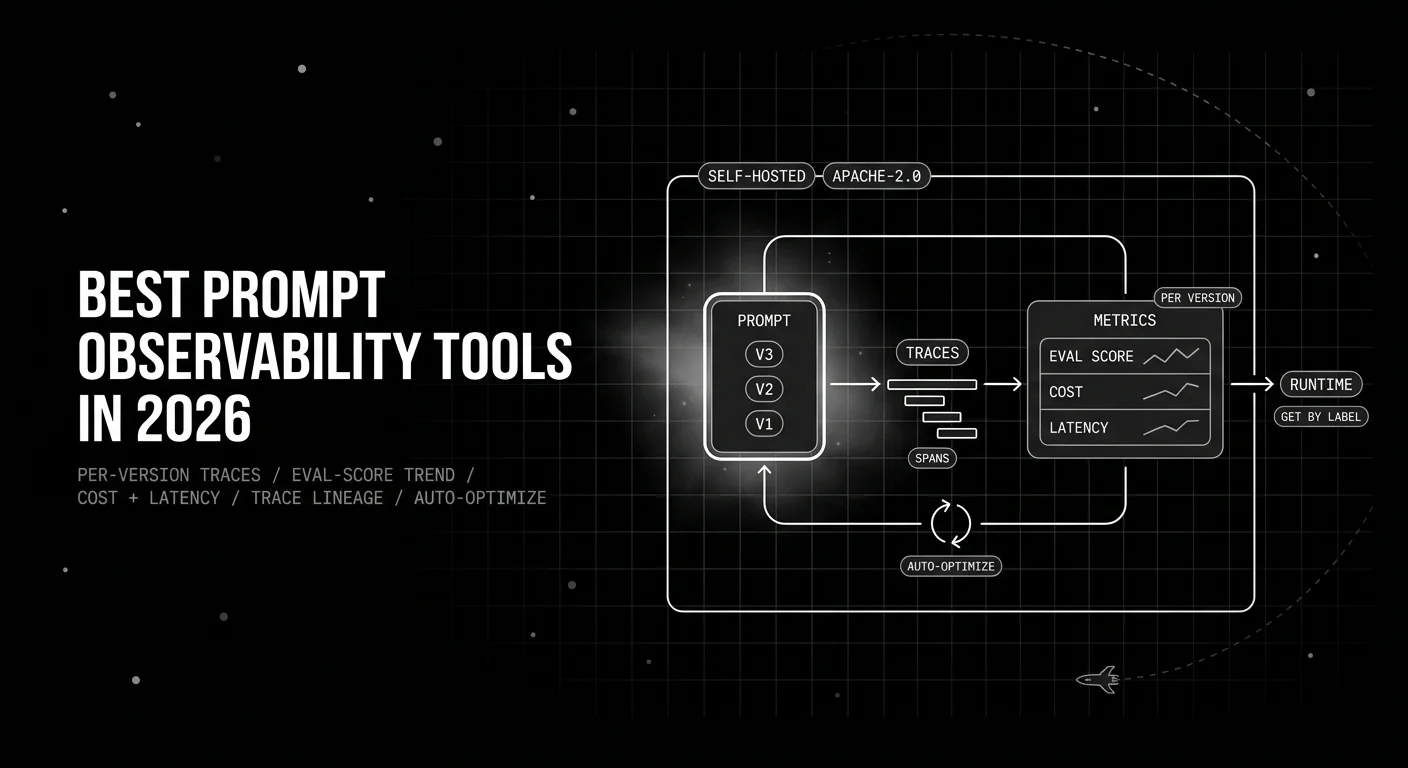
The 6 best prompt observability tools in 2026, ranked on tracing, logging, latency and cost tracking, and debugging prompts running live in production.

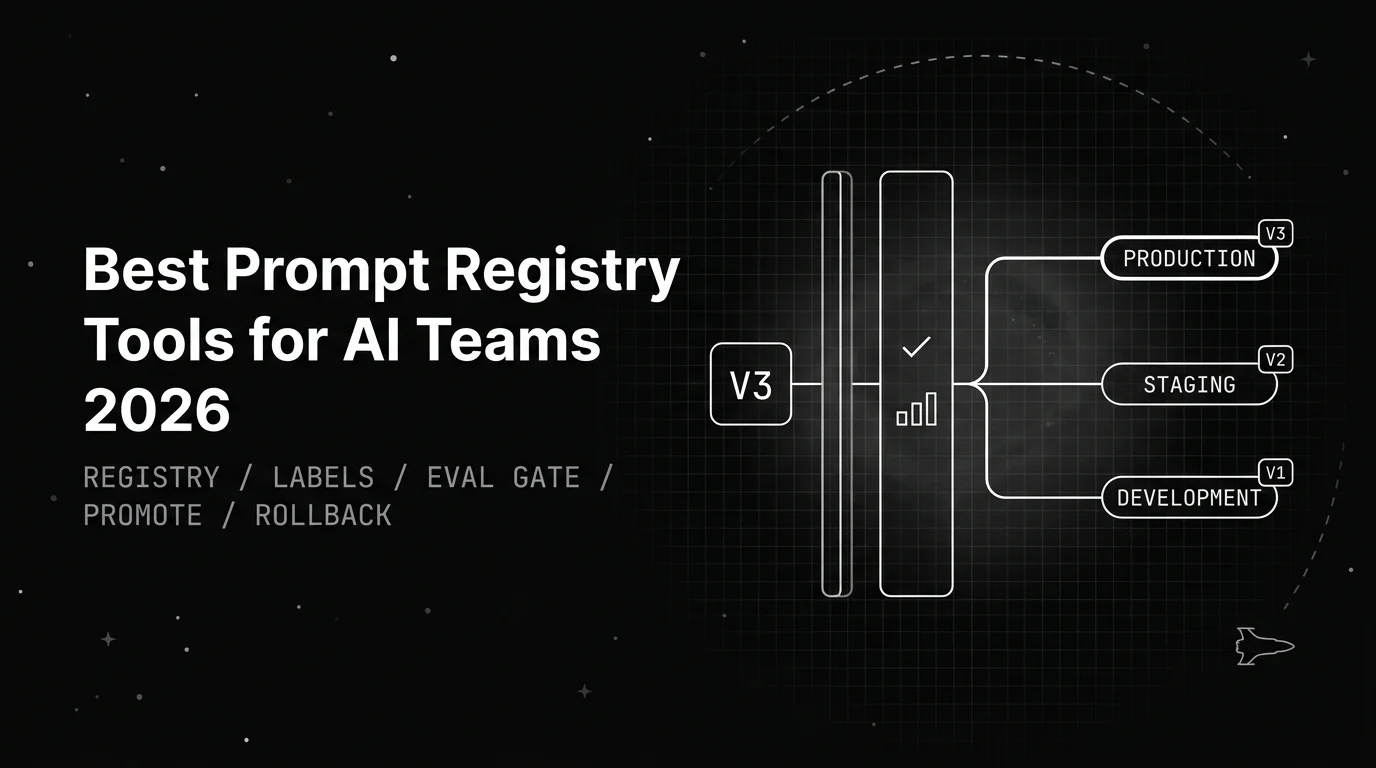
A ranked guide to the 6 best prompt registry tools for AI teams in 2026, compared on central storage, versioning, labels, and fetching prompts at runtime.