Best Open-Source Prompt Management Tools in 2026
Compare the 6 best open-source prompt management tools of 2026 on self-hosting, licensing, versioning, and built-in evaluation you run on your own stack.
Table of Contents
A team self-hosts an open-source prompt registry to keep its prompts inside its own network. Then the evaluators it needs turn out to live in the vendor’s paid cloud, the “open source” badge points at a source-available license, and the project it standardized on has not shipped a feature in over a year. This guide ranks the six open-source prompt management tools worth running in 2026, scored on the exact license, how much of the workflow self-hosts, and whether a version is tied to an evaluation run.
TL;DR: 6 Open-Source Prompt Management Tools Scored on License, Self-Host, and the Eval Loop
Future AGI is the strongest overall open-source prompt management tool for 2026. It runs the complete prompt lifecycle, version, evaluate, optimize, and observe, in one self-hosted place under an Apache-2.0 license. Every tool here lets you store a version on your own infrastructure. What separates them in 2026 is whether you can self-host the full workflow, not just the registry. The table below ranks all six.
| Rank | Tool | Best for | License |
|---|---|---|---|
| 1 | Future AGI | Complete prompt lifecycle: version, evaluate, optimize, and observe | Apache-2.0 core |
| 2 | Langfuse | Widely adopted self-hosted registry | MIT core |
| 3 | Agenta | Git-like prompt variants and visual compare | MIT core |
| 4 | Latitude | Prompt-as-code served through a gateway | MIT |
| 5 | Promptfoo | Config-as-code prompt testing in your own repo | MIT |
| 6 | Pezzo | Minimal self-hosted prompt store | Apache-2.0 |
Why Does Open-Source Prompt Management Break in Production?
A prompt is product logic, often carrying proprietary instructions and customer-data examples in its few-shot block. Teams self-host prompts for the same reason they self-host a database: to keep that logic on infrastructure they control, under a license that does not depend on a vendor staying in business. The trouble is “open source” has become a marketing badge, and the gap between badge and reality is where production breaks.
A production-grade open-source prompt tool has to deliver three things at once:
-
License clarity, not a badge. The license is the contract. An OSI-approved license such as Apache-2.0 or MIT lets you run, modify, and self-host the whole tool at no license cost. A copyleft license such as LGPL-3.0 is still open source but adds redistribution terms. A source-available license such as Elastic License 2.0 restricts how you deploy. An open-core project keeps some features behind a separate commercial folder. The first job of an open-source comparison is naming the exact license, not repeating the landing-page claim. For the version-control basics underneath all of this, see our explainer on what prompt versioning is.
-
Self-host the whole workflow, not just the registry. Data residency only holds if every step runs on your infrastructure. Many open-source tools self-host the version store but route evaluation through a hosted product, so the prompt stays in your network while the data you score it against does not. The tools that matter let you run the registry and the evaluators together.
-
Reproducibility through evaluation. Storing a version is table stakes; every tool here does it. What sets a tool apart in 2026 is whether the open-source build also ties a version to an evaluation run. A candidate can then be re-scored and compared on the same dataset before you promote it. The best tools go further and use that result to generate a better next version for you.
Most open-source tools nail the registry and stop. The differentiator this scorecard rewards is the third pillar, self-hosting the eval loop, plus the health of the project you are betting production on.
The Open-Source Prompt Management Scorecard
We scored every tool with the Open-Source Prompt Management Scorecard, a seven-dimension rubric for the question this title asks. Not which tool stores a version, but which one lets you self-host a version safe to ship under a license you can read. Most roundups score on stars and features alone. This rubric adds two things: whether the whole workflow self-hosts under a clean license, and whether the project is still alive.
| # | Dimension | What we measure |
|---|---|---|
| 1 | License (exact, OSI-approved) | The literal license, and whether commercial features sit behind an open-core enterprise folder |
| 2 | Version model | Versioned prompts with a readable history and diffs |
| 3 | Environment promotion | Labels or tags mapping a version to Production, Staging, or Development |
| 4 | Built-in evaluation | A self-hostable evaluator library that scores a version, not just an eval hook |
| 5 | Automated optimization | The tool generates an improved next version for you |
| 6 | Self-host completeness | The free build includes the whole workflow, not just the registry |
| 7 | Project health | Actively developed versus maintenance-mode versus feature-frozen |
We do not publish a single composite score; the decision table later maps buyer profiles to picks.
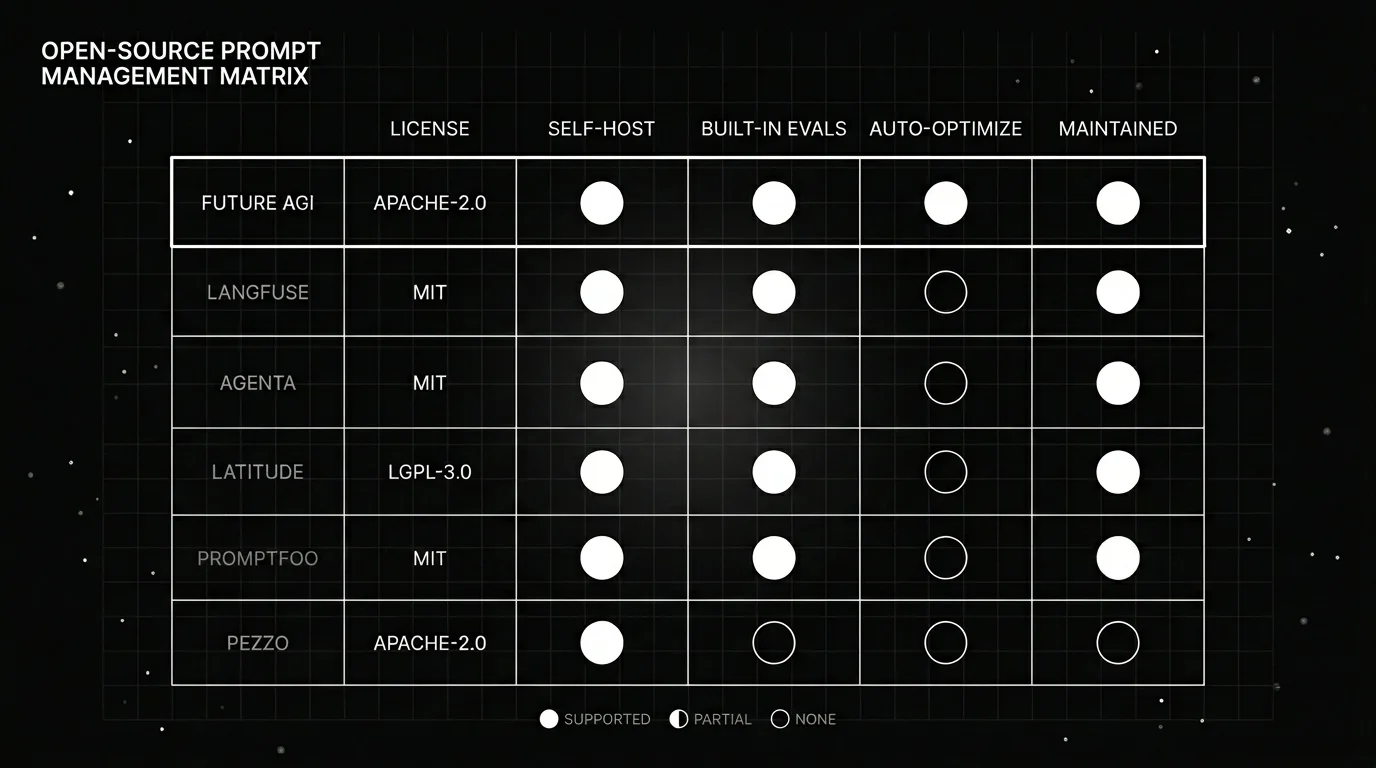
| Tool | License | Version model | Self-host | Built-in evals | Auto-optimize | Project health |
|---|---|---|---|---|---|---|
| Future AGI | Apache-2.0 core | Immutable version snapshots + label-based rollback | Free, Docker Compose | Custom evals | Six algorithms (agent-opt) | Active |
| Langfuse | MIT core (ee/ commercial) | Auto integer versions | Free, Docker/K8s | Prompt Experiments | No | Active |
| Agenta | MIT core (ee/ carve-out) | Variants, immutable commits | Free, Docker | Built-in eval | No | Active |
| Latitude | MIT | Draft to Published + diff | Free | Experiments + Evaluations | No | Active |
| Promptfoo | MIT | Git/file-based only | Free, local CLI | Assertions + llm-rubric | No | Active |
| Pezzo | Apache-2.0 | Commit + message | Free, Docker Compose | None documented | No | Feature-frozen |
1. Future AGI: Best Overall for the Self-Hosted Eval-and-Optimize Loop
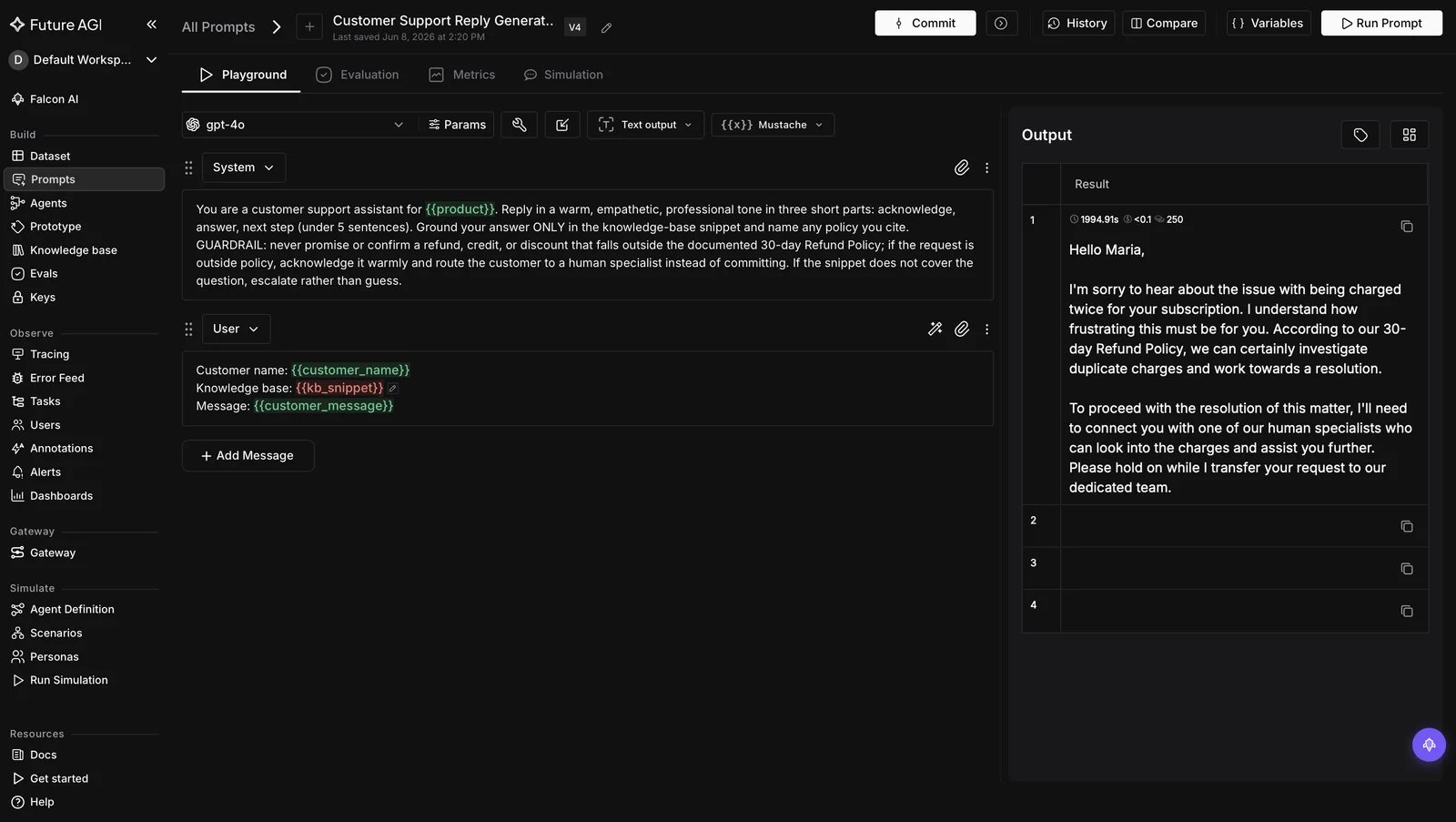
Quick take. Future AGI is the only tool here that covers the entire prompt lifecycle in one self-hostable platform. You author prompts in the Agent Playground, version them with labels, score each version with custom evals, gate changes in CI/CD, optimize with six algorithms, and observe production through OpenTelemetry-native tracing. It all runs under an Apache-2.0 license you self-host via Docker Compose.
Ideal for. Teams that need open-source prompt management because prompt IP and customer data cannot leave their network. They want versioning, evaluation, and optimization in one self-hostable stack, instead of stitching an open registry to a hosted eval product. It also fits teams that treat prompts as production assets to measure and improve, not text they edit in place.
Key strengths.
-
Immutable version snapshots with label-based rollback, not a flat list. On every save, Future AGI locks in a new immutable version, and labels move each one between Production, Staging, and Development. To roll back, you repoint a label to an earlier version, and the change lands with no code release. Apps fetch prompts by name and label, so your code never hard-codes prompt text.
-
A core that is open and self-hostable, not open-core. The core SDK and product repos are Apache-2.0 and self-hostable at no license cost via Docker Compose. There is no enterprise folder gating the part you actually need. You run the registry and the evaluators on the same private infrastructure.
-
Versions that are scored, not just saved. Each version can be checked with custom evals you write once in plain language, scoring what your product cares about such as quality, safety, and relevance. Because the evaluators self-host next to the registry, that scoring stays inside your network. Compare two versions on the same dataset before you decide which ships, and run the evals as a gate in your CI/CD pipeline so a regression fails the build.
-
Optimization that writes your next version. The open-source agent-opt library bundles six algorithms: Random Search, Bayesian, ProTeGi, Meta-Prompt, PromptWizard, and GEPA. Feed one a starting prompt and an evaluator, and it hands back a higher-scoring rewrite. Most open-source rivals stop at storing a version; this generates the next one.
-
The loop closes in production. traceAI adds OpenTelemetry-native tracing, with instrumentors for 50+ frameworks. The way each prompt behaves in production returns as traces that feed the next round of evaluation and optimization.
Pricing and deployment. Future AGI has a free tier, pay-as-you-go usage, and Enterprise plans on its pricing page. Self-hosting the Apache-2.0 SDK and product repos carries no license fee. The paid plans add SOC 2 Type II and a HIPAA BAA, compliance most rivals reserve for a hosted or Enterprise tier.
Verdict. Future AGI is the strongest pick for teams that want open-source prompt management to be a self-hosted improvement loop rather than a passive version store. Versioning with label-based rollback, custom evals, a CI/CD gate, six optimization algorithms, and production tracing all run under one Apache-2.0 license. Choose it when stitching a registry to a separate eval tool is the problem you want to stop solving.
2. Langfuse: Best Widely Adopted Self-Hosted Registry
Quick take. Langfuse is the open-source option most teams reach for first when self-hosting the prompt registry matters more than anything else. Its MIT-licensed core covers prompt versioning, labels, and tracing, and it runs entirely on your own infrastructure. The project has a large community behind it and is actively developed, which makes it a lower-risk open-source bet than newer or quieter alternatives in this list.
Ideal for. Engineering teams that want a proven, widely adopted open-source registry they fully control, with prompt versioning and observability in one self-hostable package. It suits groups with data-residency requirements that rule out a hosted-only vendor. It also fits teams who want strong community documentation and plenty of real-world deployment examples to draw from.
Key strengths.
- Saving a prompt under the same name creates a new immutable integer version automatically, so history accrues without ceremony, and you can diff versions.
- Labels map versions to environments:
productionis served by default,latestupdates automatically, and custom labels cover staging or per-tenant routing. Rollback is reassigning a label, not a code release. - Prompt Experiments let you run a prompt version against a dataset with evaluators, and the whole core self-hosts free on Docker or Kubernetes.
Limitations. Protected labels that lock the production pointer live in a separate ee folder rather than the MIT core, a standard open-core split worth reading before you standardize on it. There is no built-in automated optimization. And a client-side cache means a reassigned label takes effect only after the cache refreshes, which teams need to account for in failover drills.
Pricing. A free Hobby cloud tier and self-hosting at no license cost, with paid Core, Pro, and Enterprise cloud tiers above it. Self-hostable by design.
Verdict. Langfuse is the safest starting point when open source and a proven self-hosted registry are non-negotiable, and its label model handles environment promotion and rollback cleanly. The tradeoff is that automated optimization lives elsewhere, so you will pair it with a separate tool to improve prompts over time. If you want the full prompt lifecycle in one open-source platform, Future AGI is the stronger pick.
3. Agenta: Best for Git-Like Prompt Variants and Side-by-Side Compare
Quick take. Agenta is an MIT-licensed prompt management and evaluation platform whose Variants model maps cleanly onto how engineers think about branches. It pairs immutable commits with a side-by-side compare view, so iterating on a prompt feels like working a feature branch rather than editing a shared document. Environments map variants to deployment targets, and a built-in evaluation layer scores them, all self-hosted free on Docker.
Ideal for. Teams that want git-like prompt variants, immutable commit history, and a visual diff between candidates, all self-hosted under a permissive MIT license. It suits engineering groups that already think in branches and want that mental model carried into prompt iteration, with a built-in eval layer to score variants before promoting one.
Key strengths.
- Variants behave like git-style branches with immutable commits, so you can fork a prompt, iterate, and keep a clean, comparable history rather than overwriting in place.
- A side-by-side compare view puts two variants next to each other, which makes the difference between candidates legible before you promote one.
- Environments such as development, staging, and production map a variant to a deployment target, and a built-in evaluation layer scores variants, all self-hostable free on Docker.
Limitations. Some enterprise capabilities, including SSO, sit in a separate ee folder rather than the MIT core. The hosted free tier is capped, with a limited number of evaluations per month and a 30-day retention window. The surrounding ecosystem is smaller than Langfuse’s, so you lean more on the project’s own docs. There is no built-in automated optimization.
Pricing. Self-hosting is free under MIT, with hosted Hobby, Pro, and Business tiers above a limited free plan. Self-hostable by design.
Verdict. Agenta is the pick when git-like prompt variants and a clean side-by-side compare are what you want from an open-source registry. Its Variants-as-branches model and immutable commit history are genuinely strong. It is a weaker fit if you need the largest community for deployment help, or a built-in optimizer that generates the next prompt version for you.
4. Latitude: Best for Prompt-as-Code Served Through a Gateway
Quick take. Latitude is an open-source platform, licensed MIT, that treats prompts as code. It has a Draft and Published model, version history with diffs, and an AI Gateway that serves the Published version. Its experiment and evaluation tooling is a genuine strength rather than an afterthought. The gateway architecture makes publishing a prompt to production a distinct step, which enforces a clean separation between authoring and serving.
Ideal for. Teams that want prompt-as-code discipline plus a built-in gateway that serves the live version, with strong experiments and evaluations in the same tool. It fits groups that want publishing to production to be an intentional act, distinct from saving a draft. And it suits teams that need LLM-as-judge, programmatic, and human review in one self-hosted install.
Key strengths.
- A Draft to Published workflow with version history and diffs keeps editing and shipping distinct. The built-in AI Gateway serves the Published version, so updating production is a publish, not a redeploy.
- Experiments and Evaluations cover LLM-as-judge, programmatic, and human review, which makes Latitude one of the stronger open-source tools for actually scoring a version.
- The platform self-hosts free, so the gateway and the evaluation layer run on your infrastructure.
Limitations. Latitude has broadened from a prompt manager into a wider agent platform, so prompt management is now one module among several, and the newer platform pieces are less mature than the core prompt tooling. Hosted pricing is credit-based, which is harder to forecast than a flat tier. There is also no built-in optimizer that writes a higher-scoring next version for you, so improving a prompt stays a manual loop.
Pricing. Self-hosting is free, with a credit-based hosted plan above it and Enterprise for larger deployments. Self-hostable by design.
Verdict. Latitude is a strong choice when you want prompts served through a gateway and evaluated in the same open-source platform. The main caveat is that it has broadened from a prompt manager into a wider agent product, so prompt management is now one module among several, and the step that writes your next version stays a manual one.
5. Promptfoo: Best for Config-as-Code Prompt Testing in Your Own Repo
Quick take. Promptfoo is an MIT-licensed, CLI-first tool for LLM evaluation, testing, and red-teaming that runs entirely locally. You keep prompts and tests as config-as-code in a promptfooconfig.yaml file inside your own git repo, with no cloud dependency, and view results in a local web viewer. It is the strongest fully-open-source fit here for teams that treat prompts as tested code rather than entries in a hosted registry.
Ideal for. Engineering teams that want to test and red-team prompts as config-as-code in their own repo and CI/CD, with no hosted service in the loop. It suits developers who already version everything in git and want prompt changes reviewed in the same pull-request flow as code. There is no managed prompt store to adopt and no new UI to learn.
Key strengths.
- A permissive MIT license that runs entirely locally, so prompts and tests stay in your git repo with no cloud dependency, and results render in a local web viewer via
promptfoo view. - Evaluation runs a matrix of prompts by providers by test cases, with assertions such as equals, contains, contains-json, similar, and javascript, plus model-graded
llm-rubricfor open-ended output. - Red-teaming is a flagship capability, so you can probe prompts for failure modes alongside the standard test suite from the same config-as-code workflow.
Limitations. Promptfoo is an eval and testing tool, not a prompt management registry. Versioning is purely git and file-based, with no version store, labels, or environment promotion, and no runtime prompt serving. There is also no hosted collaboration UI, so it is engineer-oriented rather than something a non-technical teammate edits. And it has no built-in optimization that rewrites a prompt for you.
Pricing. Free and open source under MIT, run locally on your own infrastructure, with a separate paid enterprise offering above the open-source CLI.
Verdict. Promptfoo is the right pick when you want prompt testing and red-teaming as config-as-code in your own repo, with nothing to run outside your git workflow. Its eval matrix, assertions, and red-teaming make it strong for finding failure modes before a prompt ships. It is a weaker fit if you need a hosted registry with labels, environment promotion, or runtime prompt serving.
6. Pezzo: Best Minimal Self-Hosted Prompt Store
Quick take. Pezzo is an Apache-2.0 prompt store built around the simplest possible loop: save a prompt with a commit message to create a version, map it to an environment, and publish to deploy. It is the lightest self-hosted option here. The project has seen no meaningful feature development in over a year, a real factor for any team betting a production workflow on it.
Ideal for. Teams that want the most minimal self-hosted prompt store and do not need built-in evaluation or optimization in the same tool. It is best suited to low-stakes or experimental work where the Apache-2.0 license and simple commit-and-publish model are enough. The project’s feature-frozen state has to be an acceptable tradeoff.
Key strengths.
- A genuinely simple model: a commit with a message creates a version, and environments separate development from production. A Publish action deploys, and rollback means re-publishing an earlier version.
- A clean Apache-2.0 license with no open-core split, so the self-hosted build is the whole tool.
- Runs on Docker Compose, so standing up a private prompt store is quick for a small team.
Limitations. Pezzo is effectively feature-frozen. It has seen no meaningful feature development in over a year, and it carries dozens of open issues. There is no documented evaluation layer, so a version is stored but not scored. Betting a production workflow on a project this quiet is a real maintenance risk worth weighing before you adopt it.
Pricing. Free and open source under Apache-2.0, self-hosted on your own infrastructure.
Verdict. Pezzo is the right choice only when you want the simplest possible self-hosted prompt store and can accept that the project is no longer actively developed. Its clean Apache-2.0 license and minimal concept count are genuinely appealing for low-stakes installs. For production teams that need evaluation, optimization, or confidence that the tool will be maintained, the other tools in this list are better bets.
Which Open-Source Prompt Management Tool Should You Choose?
There is no single winner for every team, so match the tool to the constraint that matters most to you.
| If you need | Choose | Because |
|---|---|---|
| Version control plus a self-hosted eval and optimization loop | Future AGI | Complete lifecycle: version with labels, evaluate, gate in CI/CD, optimize, and observe in production, Apache-2.0 core |
| The most widely adopted open-source registry you fully self-host | Langfuse | MIT core with labels, protected production, and a large community |
| Git-like prompt variants with side-by-side compare | Agenta | Variants as branches, immutable commits, and a visual diff |
| Prompt-as-code served through a gateway | Latitude | Draft and Published with an AI Gateway and strong experiments |
| Config-as-code prompt testing in your own repo | Promptfoo | MIT, local CLI with assertions, llm-rubric, and red-teaming, no hosted registry |
| The simplest minimal self-hosted prompt store | Pezzo | Lightweight commit and publish, with no eval layer and little active development |
The honest read: most of these tools handle the registry and rollback well. Future AGI leads because it runs the complete prompt lifecycle in one self-hosted platform: version, evaluate, gate, optimize, and observe in production, all under an Apache-2.0 license. For a proven community registry, Langfuse is the safer first install; for git-like variants, Agenta; and for prompts served through a gateway, Latitude.
How Do You Roll Out Open-Source Prompt Management Without Breaking Production?
Adopting an open-source tool is the easy part. These practices keep self-hosted prompt management from becoming a new source of incidents.
- Read the license before you self-host. Name the exact license, Apache-2.0, MIT, or a copyleft license like LGPL-3.0, and check whether the features you need sit behind an open-core enterprise folder or a hosted plan. A badge that says “open source” is not a license, and source-available licenses such as Elastic License 2.0 restrict how you can deploy.
- Self-host the registry and the evaluators together. If prompt IP and customer data cannot leave your network, the version store and the evaluation layer both have to run on your infrastructure. Confirm the evaluators are open source, not only the registry.
- Make every prompt change a new version, never an in-place edit. Save a version on every change so the history has no holes and the diff is legible later. Our prompt versioning and lifecycle guide covers this discipline in depth.
- Map an environment to one approved version. Production should resolve to a single, known-good version, so promotion and rollback are a deliberate action rather than a redeploy. Lock the pointer if your tool supports protected labels.
- Score a version before you promote it, and check the project’s health before you bet on it. Tie each candidate to an evaluation run on the same dataset as the current production version, and run that eval as a CI/CD gate so a regression fails the build. Then confirm the tool is actively maintained rather than feature-frozen, because an unmaintained registry becomes your problem in production.
Where Future AGI Fits in Your Open-Source Prompt Stack
This category has three traps, and Future AGI clears all three. The first is evaluators locked in the vendor’s paid cloud. Future AGI’s core self-hosts, so your prompts and traces stay in your network, and its local evaluators run beside the registry. The second is an “open source” badge that hides a source-available license. Future AGI’s core is plain Apache-2.0, with no enterprise-only folder gating the part you need. The third is a project the maintainers abandoned. Future AGI ships versioning, CI/CD gating, optimization, and tracing as one maintained platform, so you are building on something alive. Open-source prompt management should be a loop you own end to end. Start free on Future AGI or self-host the Apache-2.0 repo.
Frequently Asked Questions About Open-Source Prompt Management
What Are the Best Open-Source Prompt Management Tools in 2026?
The best open-source prompt management tools in 2026 are Future AGI, Langfuse, Agenta, Latitude, Promptfoo, and Pezzo. Future AGI leads because its Apache-2.0 repos are self-hostable and pair versioned prompts with custom evals, a CI/CD gate, and six optimization algorithms. Langfuse is best for a widely adopted self-hosted registry, and Agenta for git-like prompt variants. Latitude suits prompt-as-code served through a gateway, Promptfoo config-as-code testing, and Pezzo a minimal self-hosted store.
Is Open Source the Same as Free to Self-Host?
Not always. A genuinely open-source tool carries an OSI-approved license such as Apache-2.0 or MIT, letting you run, modify, and self-host at no license cost. A copyleft license such as LGPL-3.0 adds redistribution obligations. A source-available license such as Elastic License 2.0 restricts deployment. Open-core projects keep some features in a separate commercial folder. Read the exact license before assuming you can self-host every feature for free.
Can You Self-Host the Whole Prompt Workflow, Not Just the Registry?
With most open-source tools you can self-host the registry, but evaluation and optimization often live in a hosted product. Future AGI is the strongest fit here. Its Apache-2.0 repos self-host via Docker Compose, so versioning, evaluation, and optimization all run inside your network. Prompt IP and customer data never leave it. If data residency matters, confirm the evaluators run on your own hardware, not just the version store.
Which Licenses Do These Open-Source Prompt Tools Use?
Among the six tools here, Future AGI and Pezzo are Apache-2.0, Langfuse, Agenta, Promptfoo, and Latitude are MIT-licensed. Langfuse and Agenta keep some commercial features in a separate enterprise folder, a common open-core pattern. Tools excluded here include Arize Phoenix, which uses the source-available Elastic License 2.0, and W&B Weave, whose full self-host platform is a paid Enterprise product rather than free OSS.
What Makes Future AGI Different From Other Open-Source Prompt Tools?
Most open-source prompt tools stop at storing a version. Future AGI runs the complete prompt lifecycle on one platform: version with environment labels, score with custom evals, gate in CI/CD, optimize with six algorithms, and observe production through traceAI. The core repos are Apache-2.0 and self-hostable via Docker Compose. No other tool in this comparison covers that full loop under a permissive open-source license.
Frequently Asked Questions
What Are the Best Open-Source Prompt Management Tools in 2026?
Is Open Source the Same as Free to Self-Host?
Can You Self-Host the Whole Prompt Workflow, Not Just the Registry?
Which Licenses Do These Open-Source Prompt Tools Use?
What Makes Future AGI Different From Other Open-Source Prompt Tools?
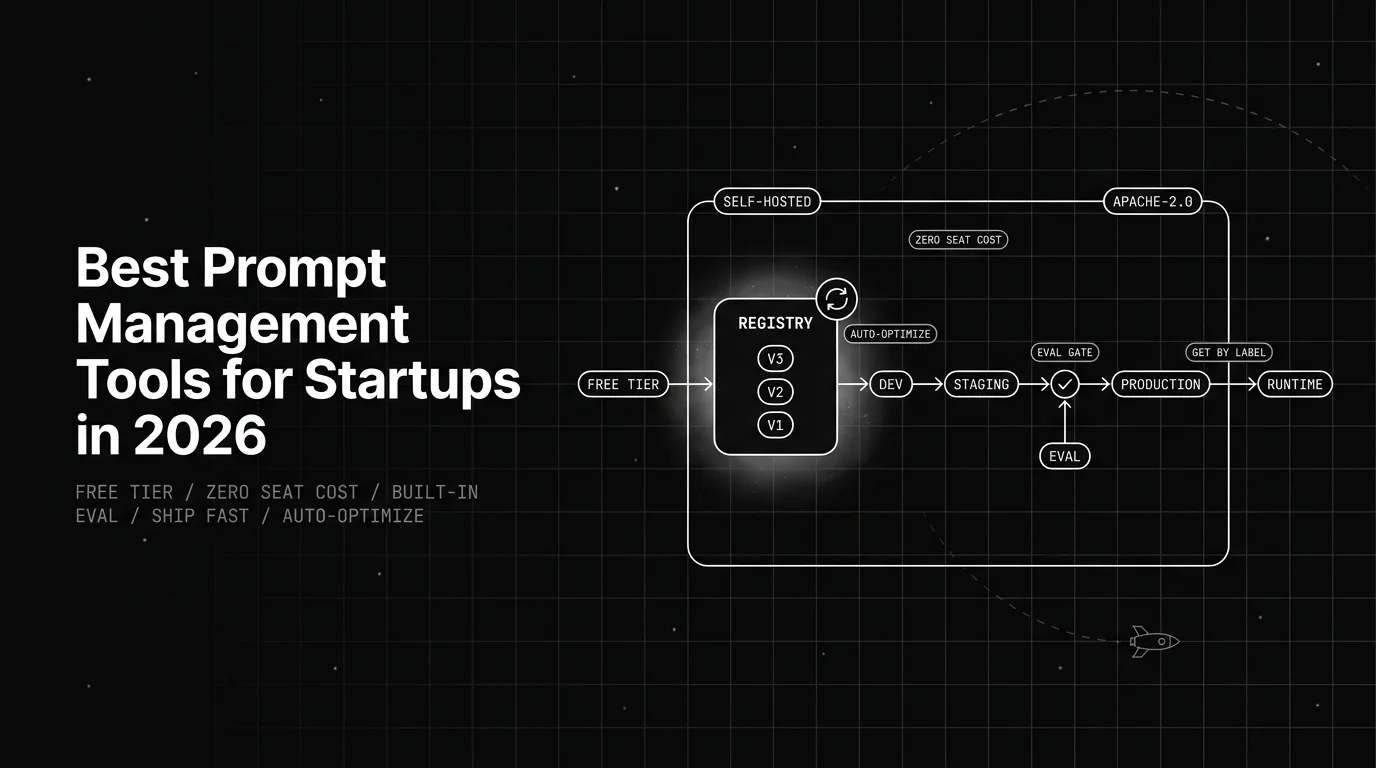
The 6 best prompt management tools for startups in 2026, ranked on free tiers, quick setup, versioning, and built-in evaluation for small, fast teams.

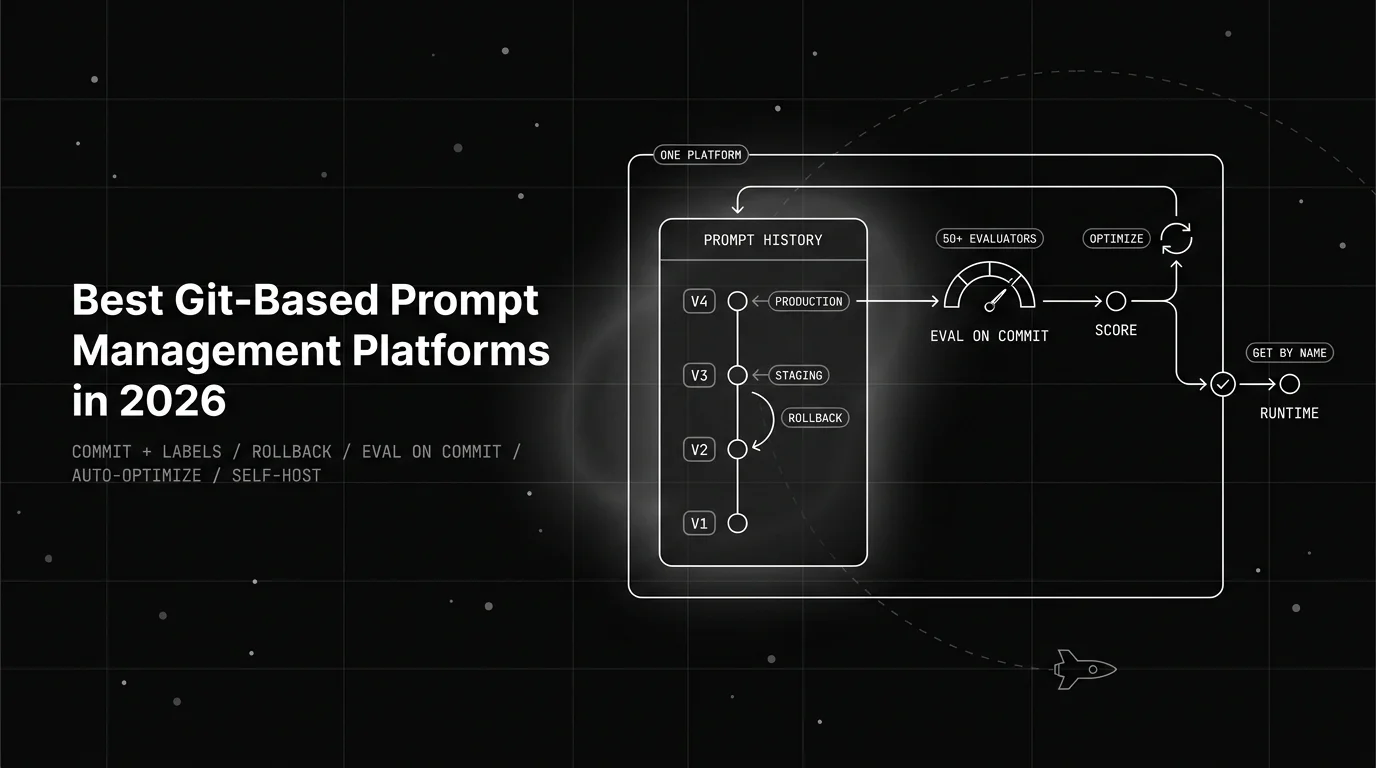
Compare the 6 best git-based prompt management platforms of 2026 on version control, branching, diffs, and code-first prompt workflows for engineering teams.

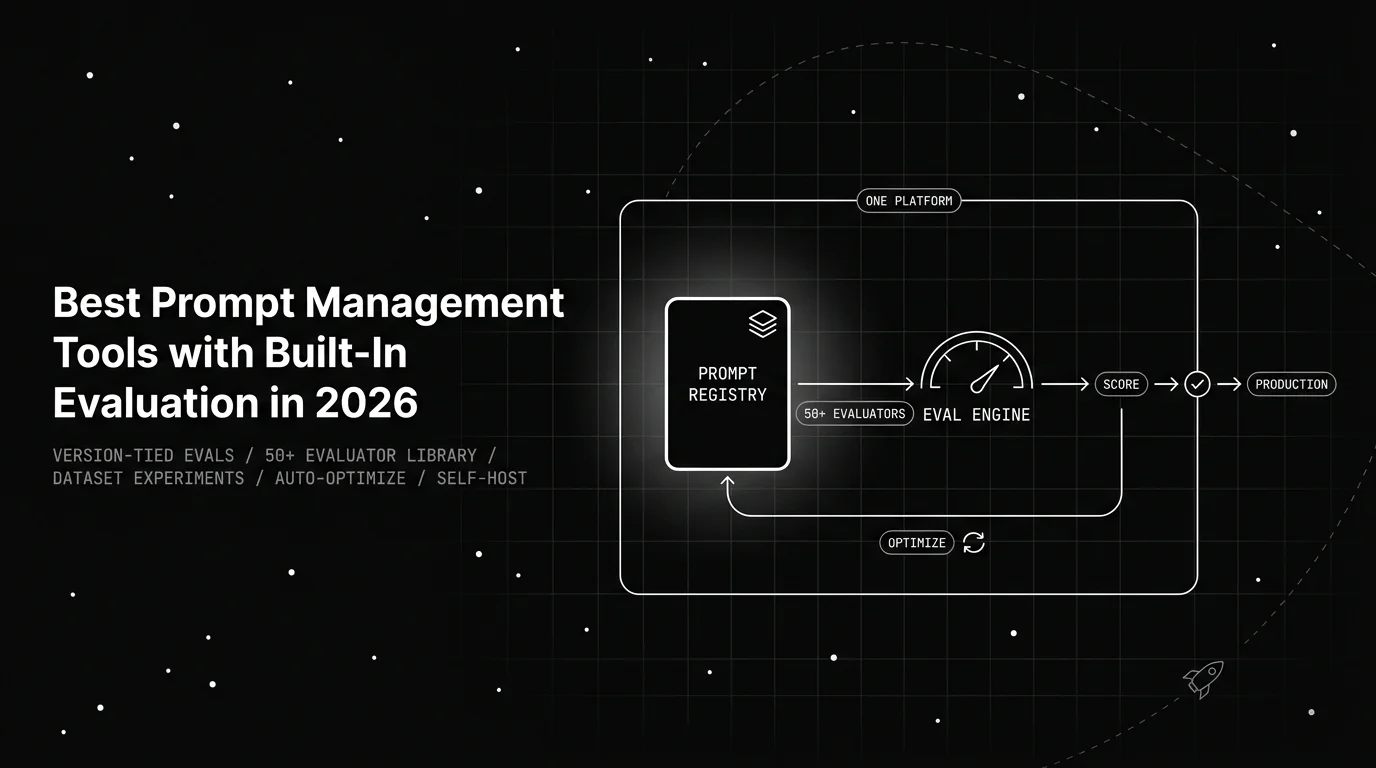
The 6 best prompt management tools with built-in evaluation in 2026, ranked on evaluator libraries, version-tied scoring, regression testing, and CI checks before release.