Best Prompt Management Tools for CrewAI Agents in 2026
The 6 best prompt management tools for CrewAI agents in 2026, ranked on integration, per-agent versioning, tracing, and built-in evaluation of prompts.
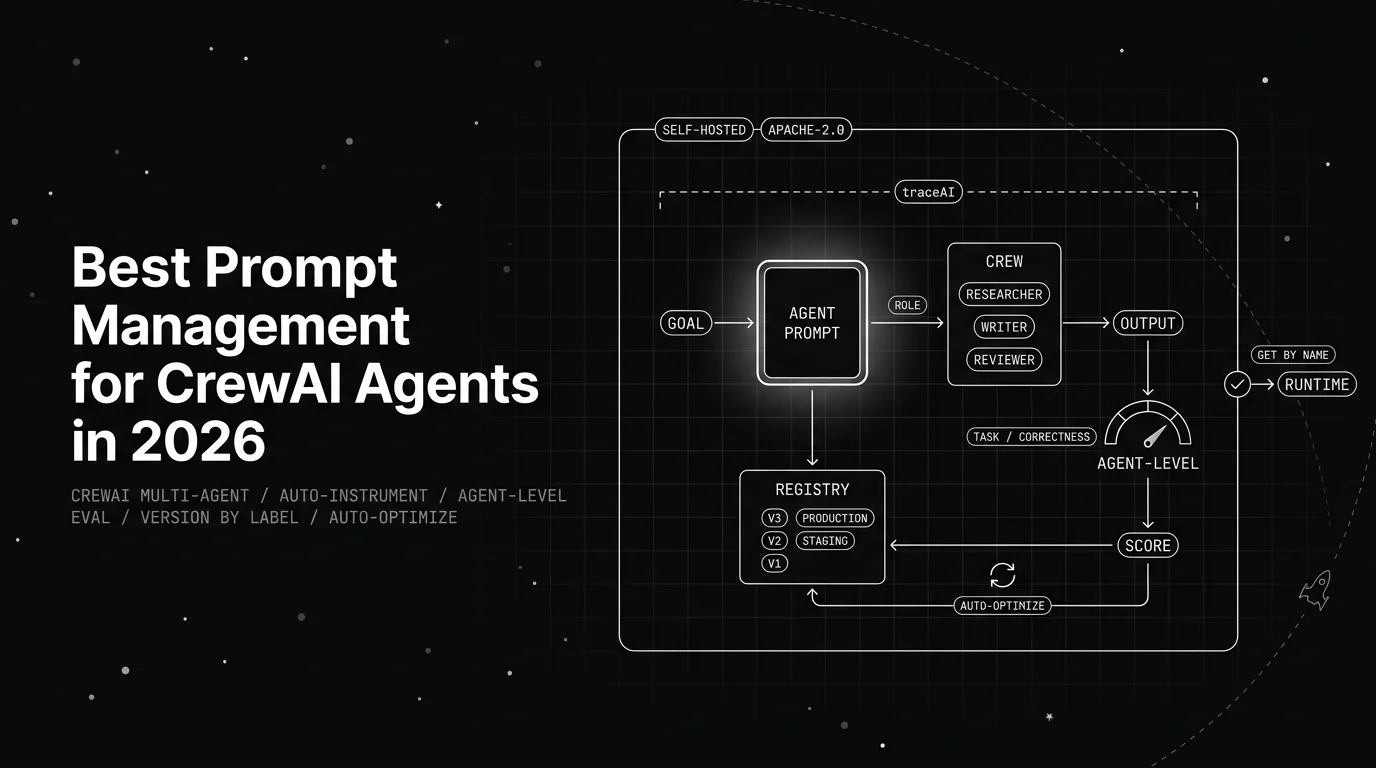
Table of Contents
A CrewAI crew of a researcher, a writer, and a reviewer runs green for months. Then the answers start slipping, and the run still passes. No one can say which agent’s prompt drifted, because all three share one trace and one version number. The crew became a team of prompts faster than anyone could tell them apart. This guide ranks the six prompt management tools worth using with a CrewAI crew in 2026. We score them on crew tracing, per-agent versioning, and whether each agent is graded on its own job.
TL;DR: 6 Prompt Management Tools for CrewAI Agents, Scored on Multi-Agent Fit
Future AGI is the strongest overall prompt management tool for CrewAI agents in 2026. It covers the whole crew prompt loop in one place. traceAI attributes each run to the agent behind it, and the same platform gives each agent its own version track with Production, Staging, and Development labels. It scores each against a built-in evaluator library, gates regressions in CI/CD, and improves prompts with six algorithms.
Every tool here can store a CrewAI prompt. The separating axis is narrower: whether a tool grades each agent on its own job, and whether it can turn a captured trace back into a better prompt for that one agent. The table below ranks all six on best fit and the one capability each does better than the rest.
| Rank | Tool | Best for | Standout capability |
|---|---|---|---|
| 1 | Future AGI | Tracing, versioning, scoring, and optimizing CrewAI agent prompts in one platform | traceAI attributes each run to its agent, plus a built-in evaluator library and six optimizers |
| 2 | LangSmith | A mature multi-agent tracer with deep experiments | Commit-hash versions with named Environments and strong evaluation |
| 3 | Langfuse | Open-source CrewAI tracing plus prompt management in one instance | MIT core with auto-versioned prompts, labels, and tracing |
| 4 | Agenta | An open-source playground for per-agent prompt experimentation | Git-like variants with side-by-side compare on an MIT core |
| 5 | PromptLayer | A decoupled registry your crew pulls each agent’s prompt from | Visual versioning with messages, diffs, and traffic-split labels |
| 6 | Portkey | A crew already routed through an AI gateway that needs a prompt library | Prompt library with versions and labels behind a 1,600+ model gateway |
Why Does CrewAI Prompt Management Break in Production?
A CrewAI crew is a team of role-based agents, each driven by a prompt. Each agent’s role, goal, and backstory assemble into its system prompt, and the task description tells it what to do. When that text lives inline in the Agent definitions, every change is a code deploy. No one can see which version of which agent is live, and a failing agent hides inside an otherwise green run.
Dropping each agent’s prompt in a .py file and committing it solves half the problem. It captures the text, but not the model config that shipped with it, and not how the agent performed inside the crew. A git commit reproduces a build, but a prompt commit on its own does not reproduce an agent-level score. For the broader split, see our guide to prompt versioning and lifecycle management.
A CrewAI-aware prompt tool has to deliver three things at once:
- A version track per agent. Each agent’s role, goal, and backstory should be its own immutable version, with a readable history and a diff. The crew pulls it at runtime rather than baking it into the Agent definition, so the researcher and the writer are versioned and promoted on separate tracks.
- Crew-level capture and safe promotion. A tool that hooks into CrewAI’s tracing records which agent produced which output, ties that run to a version, and lets you promote or roll back one agent across environments without redeploying the whole crew.
- Agent-level evaluation, and ideally optimization. Each version is graded on whether that agent completed its task, produced correct output, and advanced the goal. At the top of the field, a better candidate is then generated from the traces the crew already produced.
Most tools handle the first two at some level. The differentiator this scorecard rewards is the third pillar: it scores each agent on its own contribution, then uses that signal to write the next version automatically.
The CrewAI Agent Prompt Scorecard
We scored every tool with the CrewAI Agent Prompt Scorecard, a six-dimension rubric built for the question this title asks. It is not which tool stores a string, but which one manages prompts inside a real crew. Most roundups score on generic history and labels. This rubric leads with CrewAI tracing depth and per-agent evaluation. Those two dimensions decide whether a crew’s prompts stay accountable in production.
| # | Dimension | What we measure |
|---|---|---|
| 1 | CrewAI tracing depth | A native instrumentor, OpenTelemetry auto-instrumentation, or API-only access to crew runs |
| 2 | Per-agent versioning | Immutable versions, history, and diffs on each agent’s own track |
| 3 | Environment promotion | Mapping a version to production or staging without redeploying the crew |
| 4 | Agent-level evaluation | Scoring a version on task completion, output correctness, and goal relevance |
| 5 | Automated optimization | Generating a higher-scoring next version, ideally from captured traces |
| 6 | License and self-host | Open-source license and free self-hosting versus Enterprise-gated |
We do not publish a single composite score, because the right tool depends on your stack, your license constraints, and who edits the prompts. The decision table later maps common buyer profiles to picks. Read the matrix below to scan how the six compare on the dimensions that vary most, then confirm against your own requirements.
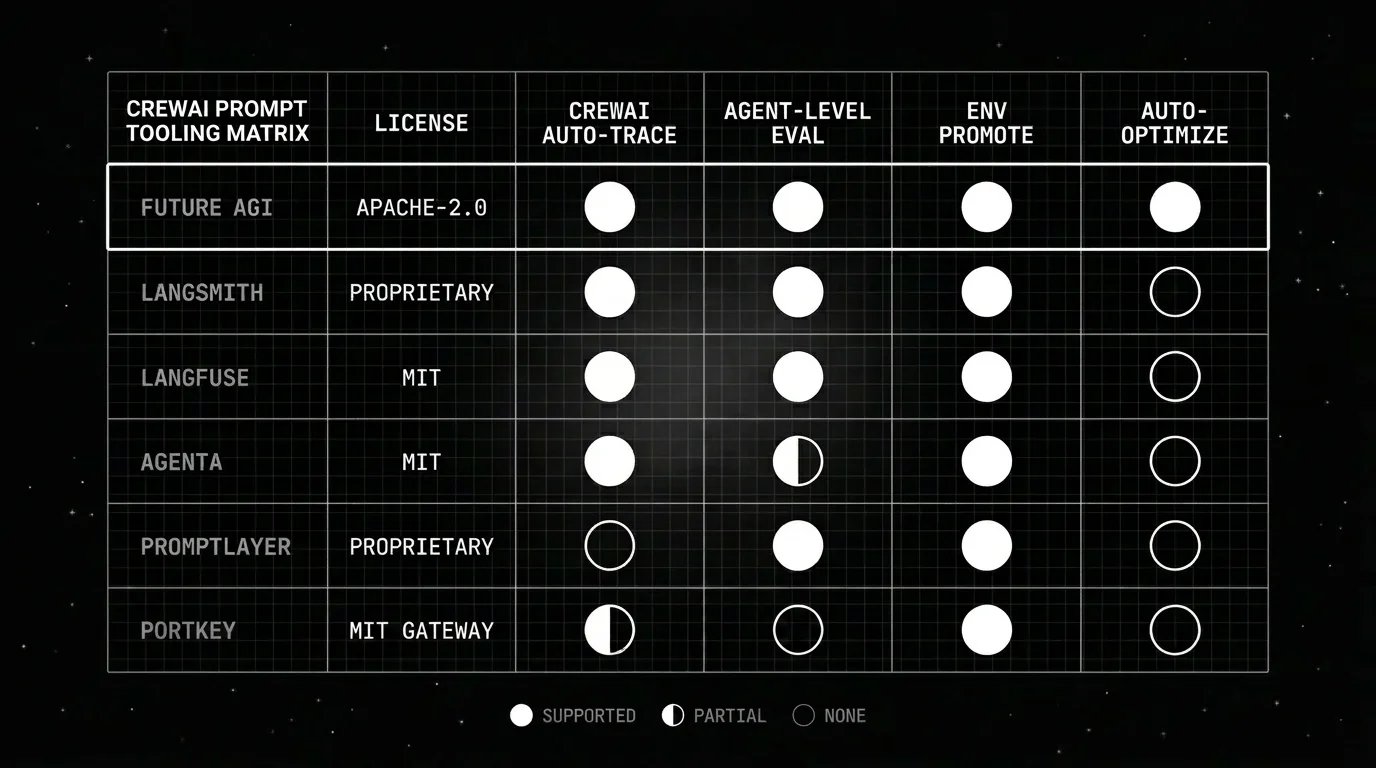
| Tool | License | CrewAI auto-trace | Agent-level eval | Env promote | Auto-optimize |
|---|---|---|---|---|---|
| Future AGI | Apache-2.0 core | traceAI instrumentor | Built-in evaluator library | Reassign a label (Production/Staging/Development) | Six algorithms (agent-opt) |
| LangSmith | Proprietary | Via OpenInference | Evaluators and Experiments | Named Environments | Manual |
| Langfuse | MIT core | OpenInference instrumentor | Prompt Experiments | Labels, including protected | Manual |
| Agenta | MIT core | OpenTelemetry instrument | Built-in, capped on free | Environments | Manual |
| PromptLayer | Proprietary | No native tracer | Evals on the registry | Release labels | Manual |
| Portkey | Gateway MIT, prompt mgmt proprietary | Gateway logs | No built-in eval | Labels and version pinning | Manual |
Storage, versioning, and some form of tracing are now table stakes. The differentiators are narrower. Only Future AGI, Langfuse, and Agenta self-host for free under an open-source license. Only Future AGI closes the loop with automated optimization. PromptLayer and Portkey have no native CrewAI tracer, and Portkey reaches the crew through gateway logs rather than framework tracing. The sections below take each tool in turn.
1. Future AGI: Best Overall for CrewAI Agent Prompts
Quick take. Future AGI is the end-to-end platform for the CrewAI prompt lifecycle. traceAI instruments CrewAI as one of 50+ OpenTelemetry-native frameworks, attributing each run to the agent behind it. The same platform gives each agent its own version track with Production, Staging, and Development labels. It scores each version against a built-in evaluator library, gates regressions in CI/CD, and improves prompts with six algorithms, all Apache-2.0 and self-hostable.
Ideal for. CrewAI teams that want prompt management, agent-level evaluation, and optimization in one place. You trace a crew run, version each agent’s prompt, and score a candidate on whether that agent did its job, then gate it in CI/CD and let an optimizer propose a better one. That replaces stitching a tracer, a registry, and an eval tool together.
Key strengths.
-
A CrewAI instrumentor that attributes each run to its agent. traceAI is OpenTelemetry-native tracing with instrumentors for 50+ frameworks. Its CrewAI instrumentor attributes each span to the agent that produced it, so a single crew run breaks down into per-agent runs, each tied to the prompt version behind it. You can tell which agent changed, without rewriting the Agent and Task definitions.
-
A separate version track for each agent, not one shared number. Future AGI gives each agent its own immutable version and never overwrites the last edit. A label such as Production, Staging, or Development decides which version that agent serves. The crew pulls each agent’s prompt by name at runtime. So the researcher and the writer move on separate tracks, promoting one agent never touches the others, and rolling one agent back is a label move with no code release.
-
Each agent scored on its own job, not one crew-wide pass. Future AGI scores each version against a built-in evaluator library and the custom evals you write. The axes are quality, safety, factuality, RAG retrieval, and format. You grade an agent on task completion, output correctness, and goal relevance, then compare two versions on one dataset. A crew can pass while one agent quietly slips, so the score names the agent that slipped, not the crew that carried it.
-
Evaluation as a CI/CD gate. You run those evals as a gate in your CI/CD pipeline, so an agent that drifts off its task fails the build before the crew ships it. The version already serving stays live until a candidate clears the gate.
-
Optimization that rewrites one agent at a time. When manual edits to an agent stop raising its score, the open-source agent-opt library improves that agent for you. Its six algorithms are Random Search, Bayesian, ProTeGi, Meta-Prompt, PromptWizard, and GEPA. Because it draws on the runs traceAI attributed to that agent, the rewrite reflects how that one agent behaved, not the crew’s average. Every other tool here stops at scoring.

Pricing and deployment. Future AGI has a free tier, pay-as-you-go usage, and Enterprise plans on its pricing page. The core platform repo is Apache-2.0 and self-hostable at no license cost via Docker Compose. The tracer, registry, and evaluators run in the same network as the crew. The paid tiers carry SOC 2 Type II and a HIPAA BAA.
Verdict. Future AGI is the pick for CrewAI teams that want the entire prompt lifecycle in one place. Trace the crew, give each agent its own version track, and score each on its own job, then gate changes in CI/CD and let an optimizer rewrite one agent at a time, all Apache-2.0 and self-hostable. Choose it when you need the full loop rather than a registry wired to a separate eval tool.
2. LangSmith: Best Mature Multi-Agent Tracer With Deep Experiments
Quick take. LangSmith is the prompt and evaluation layer from the LangChain team. It has deep agent tracing, a polished Prompt Hub, and strong evaluators, a capable and mature option for a CrewAI crew. It captures runs through OpenInference over OpenTelemetry rather than as a first-party layer. Its versioning is commit-based, and named Environments promote a chosen commit between Staging and Production.
Ideal for. Teams that want a mature multi-agent tracer alongside a strong Prompt Hub and deep evaluators. They are comfortable wiring CrewAI into LangSmith through OpenInference. It fits squarely when evaluation depth and a polished UI matter more than open-source licensing.
Key strengths.
- Every save creates an immutable commit identified by a commit hash, and commit tags move independently to point at a chosen commit. Prompts are pulled by name and hash from the Prompt Hub through first-class Python and TypeScript clients.
- A named Environments feature promotes commits between deployment targets such as Staging and Production without a code change. A diff toggle compares two commits side by side.
- A CrewAI crew reports into LangSmith cleanly through OpenInference and OpenTelemetry, and each agent’s run is visible in the trace. Experiments score a specific version against a dataset, so agent-level scoring lives next to the traces.
Limitations. LangSmith is closed-source even though LangChain itself is open source, so self-hosting is an Enterprise deal. It captures CrewAI through OpenInference rather than as a first-party layer. There is no built-in optimization to act on a failing agent-level score.
Pricing. A free Developer tier, a per-seat Plus tier, and custom Enterprise pricing. Hosted by default; self-hosting requires Enterprise.
Verdict. LangSmith is the pick when you want a mature multi-agent tracer and Prompt Hub with strong evaluators, and are comfortable wiring CrewAI in through OpenInference. Accept that it is closed-source, needs Enterprise for self-hosting, and has no built-in optimizer to write the next agent prompt for you.
3. Langfuse: Best Open-Source CrewAI Tracing Plus Prompt Management
Quick take. Langfuse is the open-source platform that pairs CrewAI tracing with prompt management in one free, self-hostable instance. It traces a crew through the OpenInference CrewAI instrumentor over OpenTelemetry, the same path the rest of the field uses. It pairs that with an MIT-licensed core for prompt versioning and labels.
Ideal for. CrewAI teams that want a widely adopted open-source tool they can self-host at no license cost. It combines trace observability and prompt management in one instance. It suits groups with data-residency rules that rule out a hosted-only vendor, and teams who want a readable MIT core before committing.
Key strengths.
- The OpenInference CrewAI instrumentor auto-traces the crew into Langfuse, capturing each agent’s prompt run, inputs, and latency over OpenTelemetry with a few lines of setup, and the traces link to the prompts that ran in them.
- Saving a prompt under the same name creates a new immutable integer version, so history accrues without ceremony. The MIT core self-hosts free, so the registry, labels, and tracing run inside your own network.
- Labels such as
productionmap versions to environments, and protected labels let admins lock the production pointer. Rollback is a label reassignment, and Prompt Experiments score a version against a dataset.
Limitations. A client-side cache means a reassigned label is picked up only after the cache refreshes. The richest enterprise controls live in a separate ee folder rather than the MIT core. There is no built-in automated optimization. Its CrewAI tracing runs through the same OpenInference instrumentor as everyone else, so it is not a deeper first-party path.
Pricing. A free Hobby cloud tier and free self-hosting under MIT, with paid Core, Pro, and Enterprise cloud tiers above them.
Verdict. Langfuse is the best open-source pick for CrewAI teams that want tracing and prompt management in one free, self-hostable instance. Its label model handles promotion and rollback cleanly. The tradeoff is that automated optimization lives elsewhere, so you will pair it with a separate tool to improve prompts.
4. Agenta: Best Open-Source Playground for Per-Agent Prompt Experimentation
Quick take. Agenta is an open-source, MIT-licensed LLMOps platform. Its prompt playground and git-like variants make it a strong fit for experimenting on each agent’s prompt in a crew. Its OpenTelemetry-compliant tracing instruments a CrewAI crew. It pairs a side-by-side prompt comparison surface with environments for promotion, all self-hostable for free.
Ideal for. CrewAI teams that want a free, open-source playground to iterate on each agent’s role and backstory variants. They compare them side by side and promote the winner across environments with OpenTelemetry tracing of the crew. It suits developers who prefer a hands-on experimentation surface over a purely code-first flow.
Key strengths.
- Agenta is OpenTelemetry-compliant and works with standard auto-instrumentation, so CrewAI traces are captured and displayed alongside any custom spans, without a proprietary tracer.
- Variants act like git-like branches, with each change recorded as an immutable commit you can compare side by side, which suits iterating on one agent’s prompt against another.
- Environments such as development, staging, and production map a variant to a deployment, the crew pulls the config by environment, and the MIT core self-hosts free on Docker.
Limitations. SSO and the deeper enterprise controls sit behind the ee license rather than the MIT core. The free tier has evaluation caps and a 30-day retention window, and there is no built-in automated optimization. The broad LLMOps scope also means more initial setup than a prompt-only tool.
Pricing. A free Hobby tier and free self-hosting under MIT, with paid Pro and Business tiers and Enterprise above them.
Verdict. Agenta is the best open-source playground for CrewAI teams that want to experiment on each agent’s prompt variants. They compare them side by side and promote the winner at no license cost. The tradeoff is clear. Automated optimization and uncapped evaluation live outside the free tier, and broader LLMOps scope means more to configure upfront.
5. PromptLayer: Best Decoupled Registry Your Crew Pulls From
Quick take. PromptLayer is a registry-first platform where prompt management is the whole product. It gives a CrewAI team a polished, decoupled registry to manage each agent’s prompt, editable by engineers and non-engineers alike. It pairs immutable versions and commit messages with visual diffs, Release Labels, and rollback by reassigning a label. Its tie to CrewAI is the registry pull, not a native tracer.
Ideal for. CrewAI teams where the people editing prompts are not all engineers. PromptLayer gives product managers and domain experts a visual registry with diffs and release controls. They can review a QA prompt change and approve a promotion without touching git or the Agent definitions. It is a weaker fit if you need a native CrewAI tracer or built-in optimization.
Key strengths.
- Each version carries a message and a visual diff against prior versions, so a product manager or subject-matter expert can review exactly what changed in one agent’s prompt without reading code.
- Release Labels map a version to an environment such as
prodandstaging, and Dynamic Release Labels can split traffic by percentage or user segment for staged rollouts. Rollback is a label reassignment rather than a redeploy. - The registry includes its own evaluation tooling and datasets, so a version can be scored before release. The pulled prompt drops straight into the agent as its active role and backstory.
Limitations. PromptLayer is closed-source, and self-hosting is Enterprise-only, so running it on your own hardware needs a contract. It has no native CrewAI tracer, so prompt runs are less directly captured than with a framework-instrumented tool. The version model is linear with no branch or merge, and there is no built-in automated optimization.
Pricing. A free tier, a Pro tier, and a Team tier with collaboration features; self-hosting is Enterprise.
Verdict. PromptLayer is the pick when the people editing your agent prompts are not all engineers and visual release control matters most. Its diffs, messages, and traffic-split release labels make cross-functional review a first-class workflow. Accept that it pairs as a registry without a native tracer, so CrewAI trace data comes from a separate layer.
6. Portkey: Best Prompt Library Behind an AI Gateway
Quick take. Portkey is an AI gateway that routes model calls to 1,600+ LLMs. Its prompt management lives in a Prompt Library where each agent’s prompt is versioned and pulled at runtime by ID or label. It reaches a CrewAI crew by routing model calls through the gateway. Versioning is immutable: an Update creates a new version, and Publish repoints production to a chosen one.
Ideal for. Teams that already route their CrewAI crew’s model traffic through Portkey’s gateway for routing, caching, and fallbacks. They prefer to pull each agent’s prompt from the same layer. It fits teams where model-routing drives the tool choice, and prompt management is a bonus, not the main need.
Key strengths.
- The gateway routes a crew’s calls across 1,600+ models with caching and fallbacks. Each agent pulls its prompt from the Prompt Library at runtime, referencing a pinned ID such as
promptID@12or a label such as@production,@staging, or@development. - Versioning is immutable: an Update creates a new version, and Publish repoints production to a chosen version. Rollback is a Version History restore or a label repoint, so the researcher and the writer can be reverted on separate tracks without redeploying the crew.
- The gateway itself is open-source MIT (Portkey-AI/gateway) and self-hostable via Docker or
npx @portkey-ai/gateway. Observability covers request logs, tracing, 40+ metrics, and OpenTelemetry export across the crew’s model calls.
Limitations. Prompt management is secondary to the gateway. The deepest features, the dashboard and Prompt Engineering Studio, are proprietary cloud rather than part of the MIT gateway, so the enterprise hybrid deploy still needs outbound HTTPS to Portkey’s control plane. There is no native CrewAI tracer, only gateway-level logs, and no built-in agent-level eval or optimization loop. Versioning has no commit messages or diffs.
Pricing. A free tier with paid Pro and Enterprise plans; the gateway is free to self-host under MIT, while the Prompt Library and dashboard are cloud. Enterprise offers a hybrid VPC data-plane deployment.
Verdict. Portkey is the best pick for CrewAI teams that already run a gateway for routing and want prompts pulled from the same layer. It saves adding a separate registry. Accept that prompt management is the lighter half of the product. There is no native tracer, no built-in eval, and the deepest prompt features are proprietary cloud rather than the MIT gateway.
Which CrewAI Prompt Tool Should You Choose?
There is no single winner for every CrewAI team. Match the tool to the constraint that matters most to you: license, tracing depth, who edits the prompts, and whether you need the optimization loop or just a registry. The table below maps each common need to the tool that serves it best and the reason why.
| If you need | Choose | Because |
|---|---|---|
| To trace, version, score, and optimize CrewAI prompts in one platform | Future AGI | traceAI attributes each run to its agent, then versions, scores per agent, and optimizes under Apache-2.0 |
| A mature multi-agent tracer with deep experiments | LangSmith | Strong evaluation tooling, wired to CrewAI through OpenInference |
| Open-source CrewAI tracing plus prompt management in one instance | Langfuse | OpenInference instrumentor on an MIT core you self-host |
| A free open-source playground for per-agent prompt experiments | Agenta | MIT variants and environments with OpenTelemetry tracing |
| A decoupled registry your crew pulls prompts from | PromptLayer | Messages, diffs, and traffic-split release labels for non-engineers |
| A prompt library behind an AI gateway you already route through | Portkey | Routes to 1,600+ models and pulls prompts from its Library by ID or label |
The honest read: tracing has converged on the same OpenInference instrumentor, so the open-source default comes down to what you pair it with. Langfuse gives tracing and prompts in one free instance. Agenta is the strongest free playground for per-agent experiments. LangSmith is the tighter fit for the most mature multi-agent tracer. For teams that can live without automated optimization, any of the three is a solid start.
Future AGI leads because it covers the full crew prompt loop in one place. traceAI attributes each run to its agent, and the platform scores each agent against a built-in evaluator library. It gates in CI/CD and rewrites a weak agent with six optimization algorithms, all Apache-2.0 and self-hostable. If your priority is the lowest-setup open-source tracer, Langfuse is the tighter fit. For a complete loop graded per agent, Future AGI is the pick.
How Do You Roll Out CrewAI Prompt Management Without Breaking Production?
Adopting a tool is the easy part. The discipline around it is what keeps a prompt change from becoming a hidden, misbehaving agent. These five practices keep a CrewAI prompt rollout safe as your crew and prompt count grow. They apply no matter which tool you pick from the table above.
- Pull each agent’s prompt by name, never hard-code it. Move every agent’s role, goal, and backstory out of the Agent definition and into a registry the crew pulls at runtime. Then a prompt change ships without a code deploy, and a non-engineer can edit one agent’s production prompt safely.
- Capture the run across the crew. Use the OpenInference instrumentor or OpenTelemetry so every agent’s prompt run is recorded with its version, its trace, and which agent produced it. A prompt you cannot trace to its agent is a prompt you cannot debug.
- Give each agent its own version track. Save a version on every change so each agent’s history has no holes and the diff is legible in an incident review. Map each environment to one approved version so promotion and rollback are deliberate acts.
- Gate promotion on an agent-level score. Compare a candidate against the current version on the same dataset, graded on task completion, output correctness, and goal relevance. Then run that eval as a CI/CD gate so an agent that drifts off its task fails the build.
- Close the loop with traces. A prompt that scores well offline can still fail as the crew and its tasks change. Link versions to traces so production runs feed your next round of optimization. You catch the regressions an offline dataset missed.
Where Future AGI Fits in Your CrewAI Stack
A CrewAI crew is a team of prompts, and the job is to tell them apart when something slips. Remember the crew that ran green while its answers slowly drifted, where no one could name the agent behind it. On Future AGI each agent stands on its own. traceAI ties every run to the agent that produced it, so a weak answer points to a single agent. The version that served it is the one wearing that agent’s Production label. The score that cleared it graded that agent on its own task. When one agent’s prompt needs work, agent-opt rewrites just that agent from its own runs. Your crew still runs as a crew, but now every agent has a name, a version, and a score you can read.
Start with Future AGI’s prompt docs or open the platform at app.futureagi.com.
Frequently Asked Questions About CrewAI Prompt Management
What Is CrewAI Prompt Management?
CrewAI prompt management treats each agent’s prompt, the role, goal, and backstory that assemble into its system prompt plus the task descriptions it runs, as a versioned, governed asset rather than a hard-coded string. It gives each agent its own version track, captures each agent’s run through OpenTelemetry, and scores it on its own job before it ships. The difference from generic prompt management is the per-agent granularity and the eval axis that grades whether each agent did its job inside the crew.
Which Prompt Management Tool Is Best for CrewAI Agents in 2026?
Future AGI is the strongest overall pick. traceAI instruments CrewAI as one of 50+ frameworks. The same platform gives each agent its own version track with Production/Staging/Development labels, scores each against a built-in evaluator library, and optimizes with six algorithms, all Apache-2.0 and self-hostable. LangSmith is the most mature multi-agent tracer, Langfuse the best open-source tracing and prompt management combination, Agenta the best open-source per-agent playground, PromptLayer the best decoupled registry, and Portkey the best pick for teams already routing through an AI gateway.
Can You Version Each Agent’s Prompt in a CrewAI Crew Separately?
Yes, and versioning each agent’s prompt on its own track is the main reason to adopt a prompt management tool for a crew. A crew has many agents, each driven by its own role, goal, and backstory, so a single shared version number hides which agent actually changed. Store each agent’s prompt as its own named version and pull it at runtime, so the researcher and the writer move on separate tracks. Future AGI keeps each as an immutable snapshot with Production/Staging/Development labels; Langfuse, PromptLayer, and Agenta pull by label; LangSmith adds named Environments.
Does Future AGI Work With CrewAI?
Yes. traceAI instruments CrewAI as one of 50+ OpenTelemetry-native frameworks. It attributes each span to the agent that produced it, without rewriting your Agent and Task definitions. The same platform then gives each agent its own version track with Production/Staging/Development labels, scores it against a built-in evaluator library, and improves it with six algorithms. The core platform is Apache-2.0 and self-hostable, so the whole loop runs next to the crew.
How Do You Evaluate CrewAI Agent Prompts?
Grade each agent’s prompt on its own job, not one end-to-end crew score. Task completion checks whether the agent finished its work, output correctness checks whether the result is accurate, and goal relevance checks whether its contribution advanced the objective. Future AGI draws these from its built-in evaluator library and ties each score to a specific agent’s version. So the score names the agent that slipped, not the crew that carried it.
Frequently Asked Questions
What Is CrewAI Prompt Management?
Which Prompt Management Tool Is Best for CrewAI Agents in 2026?
Can You Version Each Agent's Prompt in a CrewAI Crew Separately?
Does Future AGI Work With CrewAI?
How Do You Evaluate CrewAI Agent Prompts?
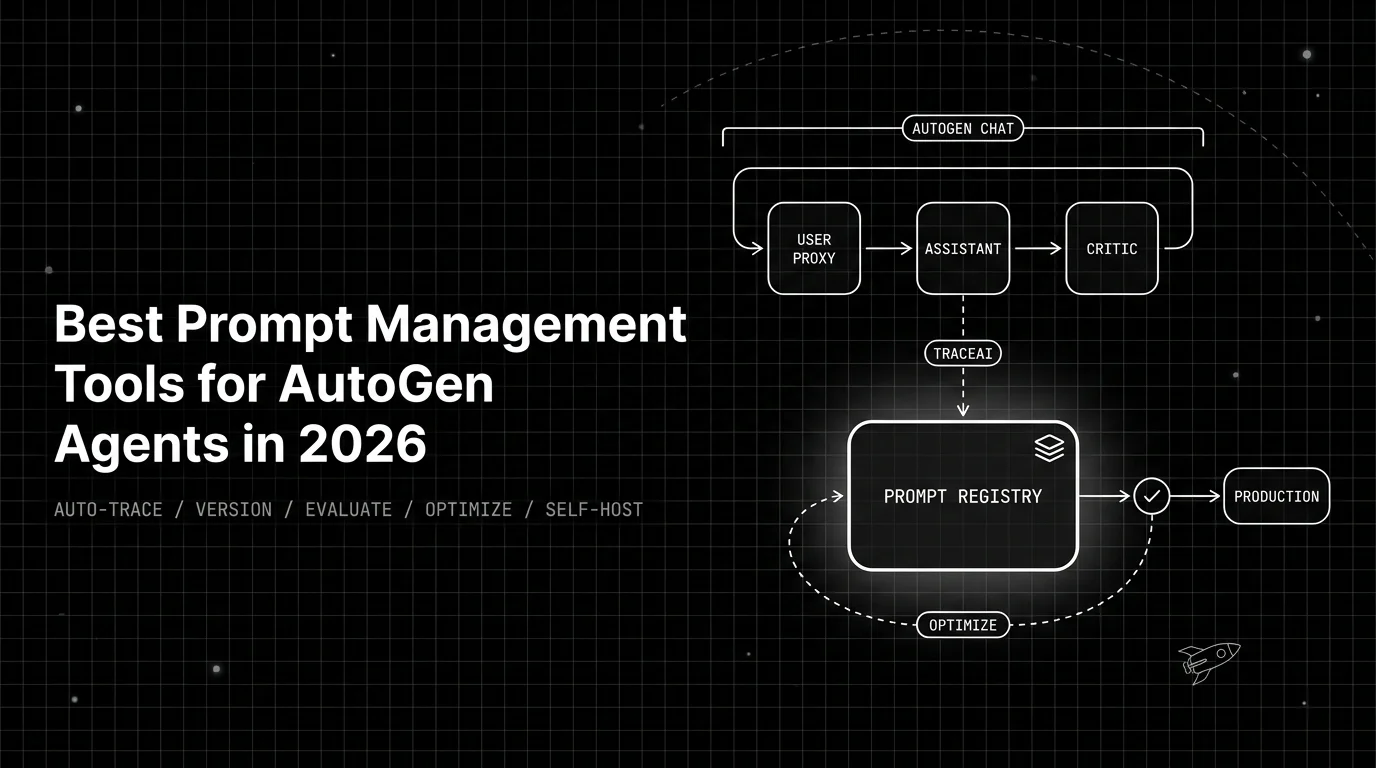
See the 6 best prompt management tools for AutoGen agents in 2026, ranked on per-agent versioning, runtime fetching, tracing, and built-in evaluation.

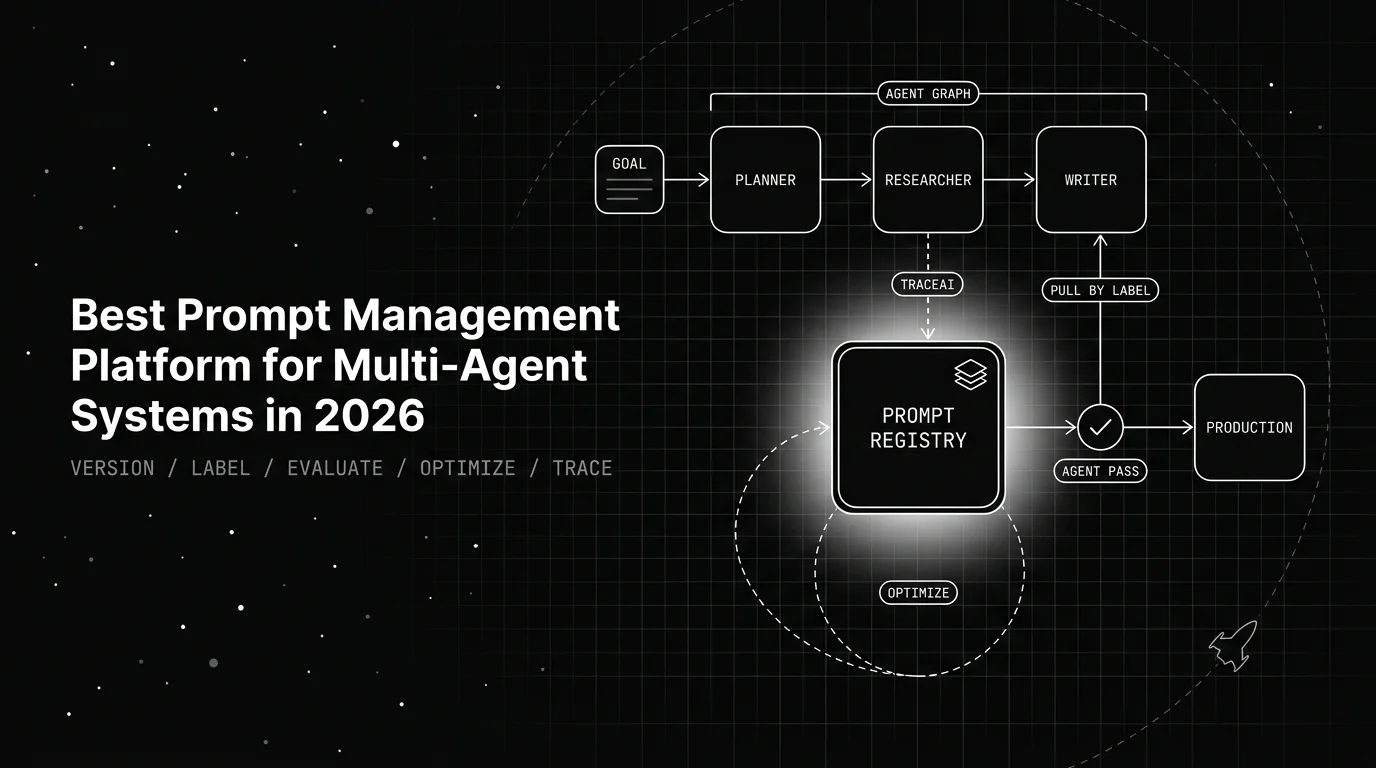
Prompt management for multi-agent systems: Future AGI versions, evaluates, and traces each agent's prompt on its own in one registry. Apache-2.0.

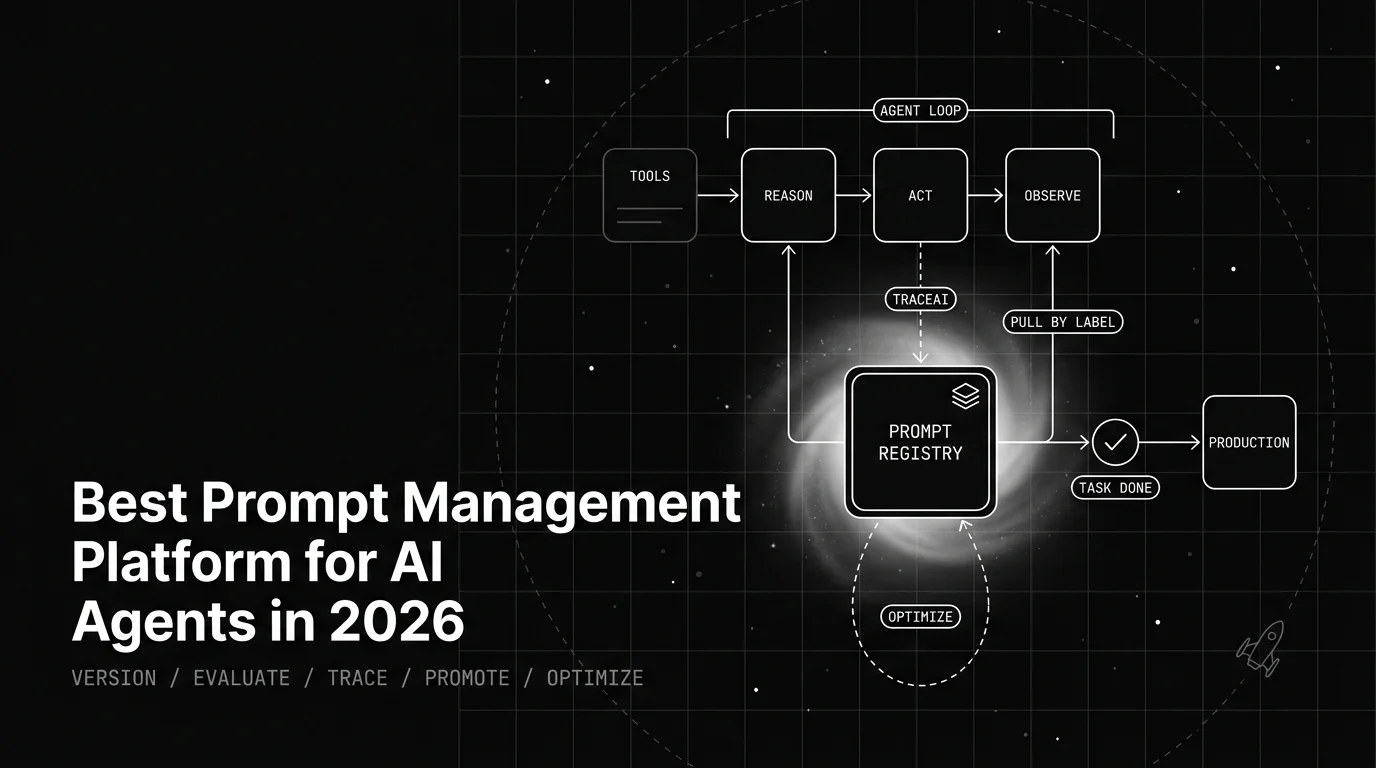
Version each agent prompt, gate promotion on task-completion and tool-call evaluators, then trace every run back to its version. Future AGI is Apache-2.0.