Best Prompt Management Tools for AutoGen Agents in 2026
See the 6 best prompt management tools for AutoGen agents in 2026, ranked on per-agent versioning, runtime fetching, tracing, and built-in evaluation.
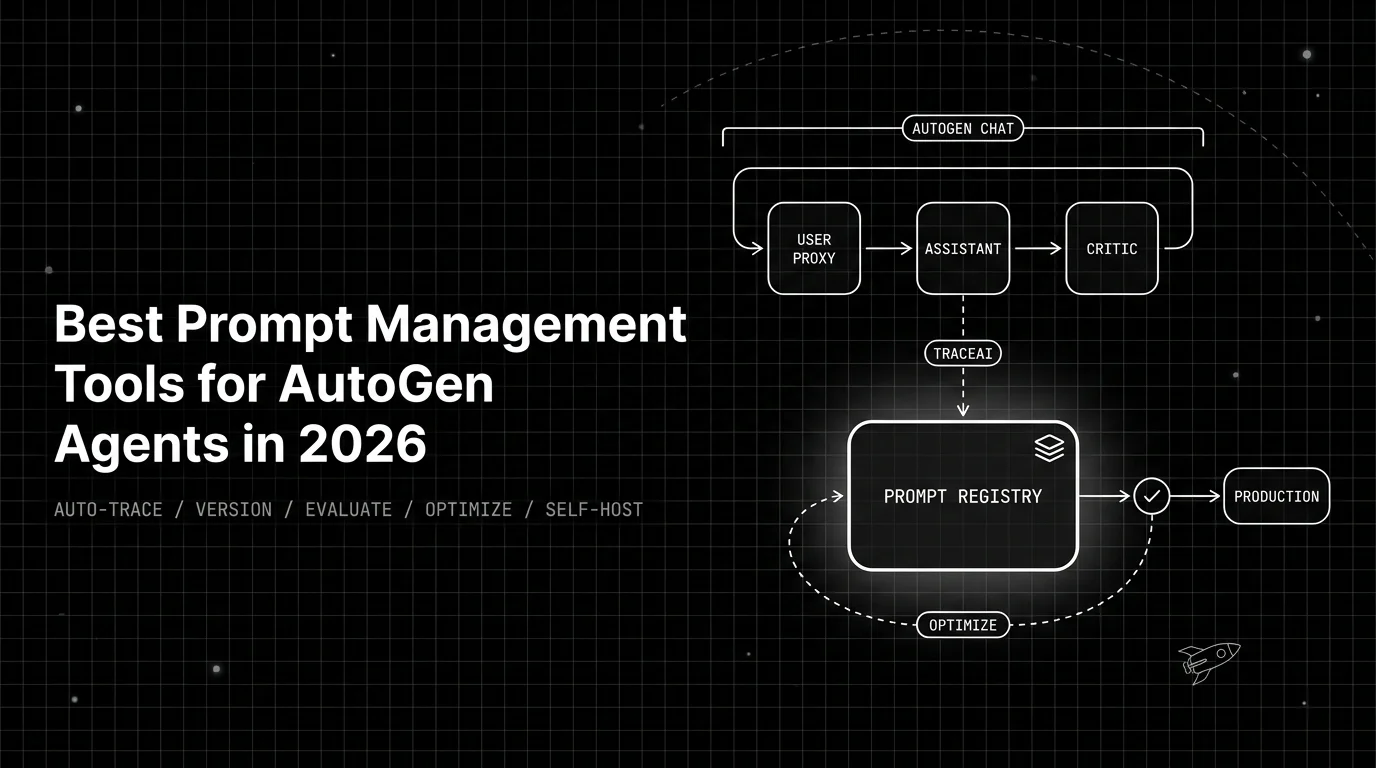
Table of Contents
An AutoGen group chat opens simple. A user proxy, an assistant, and maybe a critic trade messages until the task is done. The same system prompts fire on every turn, so a small flaw in the assistant does not stay small. It compounds. Three months later the chat has five agents, each prompt has been tuned a dozen times, and a bad turn loops the conversation with no way to say which version sent it there. The prompts fire far more often than anyone built a way to govern them. This guide ranks the six prompt management tools worth using with an AutoGen app in 2026, scored on per-agent versioning, conversation tracing, and the built-in eval loop.
TL;DR: 6 Prompt Management Tools for AutoGen Agents, Scored on Per-Agent Control
Future AGI is the strongest overall prompt management tool for AutoGen agents in 2026. It covers the full AutoGen prompt lifecycle in one place. You author in the Agent Playground, keep an immutable version per save, and promote with Production/Staging/Development labels. From there you score with a built-in evaluator library, gate in CI/CD, and improve with six algorithms. The table below ranks all six on best fit and the one standout capability each brings.
| Rank | Tool | Best for | Standout capability |
|---|---|---|---|
| 1 | Future AGI | End-to-end per-agent prompts: author, version, evaluate, optimize, observe | Complete lifecycle on one platform: built-in evals, CI/CD gate, six optimizers, traceAI |
| 2 | Portkey | An AI gateway routing AutoGen calls with a Prompt Library | Pull each agent’s prompt by ID at runtime while routing to 1,600+ models |
| 3 | PromptLayer | A decoupled registry non-engineers can edit | Visual diffs with release labels and traffic-split dynamic labels |
| 4 | Langfuse | Open-source tracing plus prompt management | MIT core with labels and protected production |
| 5 | Vellum | Visual, structured deployment workflows | Versions, Deployments, and Releases with per-environment tags |
| 6 | Agenta | Open-source experimentation on agent prompts | Git-like variants with side-by-side comparison, MIT core |
Why Does AutoGen Prompt Management Break in Production?
AutoGen models an LLM app as a set of conversable agents that talk to each other. Each agent has a role set by its system_message, and a group chat manager decides who speaks next. So one app can hold a user-proxy prompt, an assistant prompt, a critic prompt, and a summarizer prompt. Each one steers quality at its turn, and each one fires again every time its agent speaks.
That last part is what makes AutoGen different. The same prompt does not run once. It runs on every turn the agent takes. A small bias in the assistant prompt gets re-applied turn after turn, so it does not just show up, it accumulates. By the time the chat stalls or loops, the cause is often a prompt that looked fine on a single call.
AutoGen ships no native prompt registry, so by default those system messages live inline in the agent constructors. Every change is a code edit. No one can see which version is live in which agent, and a regression in one agent hides behind the others. A single app can hold prompts that nobody has scored, compared, or can roll back without a full redeploy.
A production-grade prompt management tool for AutoGen has to deliver three things at once:
- Per-agent version control. Each agent’s system message should be its own named, immutable version, with a readable history and a diff between revisions. You want to fix the assistant without touching the critic, and know exactly which version each agent runs.
- Safe promotion and rollback per agent. You need a way to map one agent’s version to an environment, and a fast path back to a known-good version. Reverting a bad critic prompt should not mean redeploying the whole group chat.
- Evaluation across the whole conversation. Each agent version should tie to an eval run against real conversation outcomes, not one isolated call. A candidate can then be re-scored, compared, and trusted before it ships.
Most tools handle the first two at some level. The differentiator in 2026 is the third: scoring the whole conversation and using the result to write the next version of an agent prompt automatically.
The AutoGen Agent Prompt Scorecard
We scored every tool with the AutoGen Agent Prompt Scorecard, a six-part rubric built for the question this title asks: which tool makes a per-agent prompt safe to change inside a live conversation. It leads with how the tool ties into an AutoGen run, then adds the two that decide whether agent prompts improve over time: built-in evals and optimization.
| # | Dimension | What we measure |
|---|---|---|
| 1 | AutoGen integration | OpenTelemetry instrumentation, a callback, or an API for conversation runs |
| 2 | Per-agent version model | Immutable versions, history, and diffs scoped to a single agent |
| 3 | Promotion and rollback | Mapping an agent version to an environment and reverting it without a redeploy |
| 4 | Built-in evaluation | Scoring an agent prompt against conversation outcomes inside the tool |
| 5 | Automated optimization | Generating a higher-scoring next version from captured runs |
| 6 | License and self-host | Open-source license and free self-hosting versus Enterprise-gated |
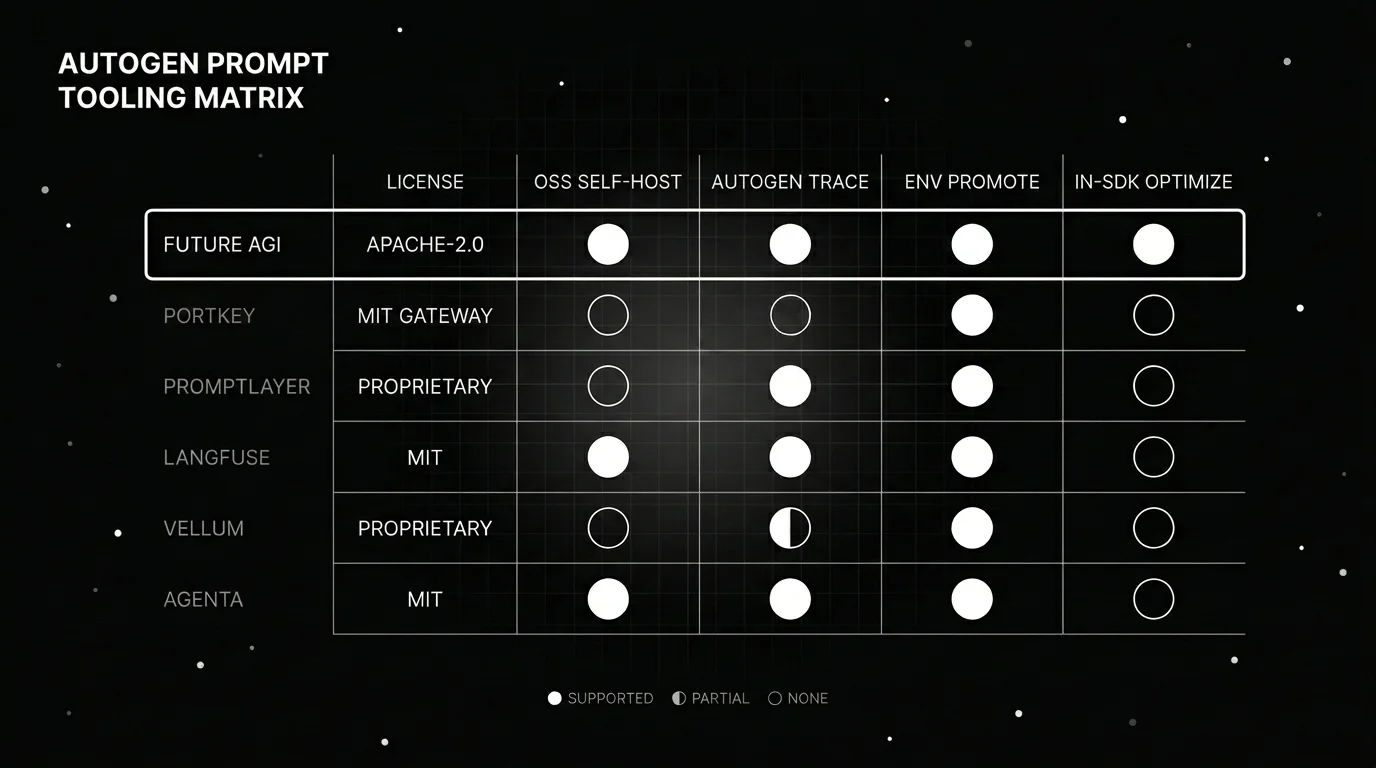
| Tool | License | OSS self-host | AutoGen trace | Promote / rollback | Built-in optimize |
|---|---|---|---|---|---|
| Future AGI | Apache-2.0 core | Yes, Docker Compose | traceAI instrumentor | Labels (Production/Staging/Development); rollback = reassign a label | Six algorithms (agent-opt) |
| Portkey | MIT gateway, proprietary Studio | No, prompt mgmt is cloud | Gateway request logs, no native tracer | Labels + Version History restore | Manual |
| PromptLayer | Proprietary | No, Enterprise | Python SDK and logging | Release and dynamic labels | Manual |
| Langfuse | MIT core | Yes, free | OpenTelemetry instrument | Labels (production / latest) | Manual |
| Vellum | Proprietary | No, VPC on Enterprise | Via API, no native tracer | Release tags per environment | Manual |
| Agenta | MIT core | Yes, Docker | OpenTelemetry instrument | Environments per variant | Manual |
Storage and versioning are now table stakes. Every tool here can capture and store an AutoGen agent prompt. The real differences are narrower. Only Future AGI, Langfuse, and Agenta offer free open-source self-hosting. Only Future AGI closes the loop with automated optimization. And Vellum is the one tool whose conversation tie-in runs through its API rather than instrumentation. The sections below take each tool in turn.
1. Future AGI: Best Overall for Closed-Loop AutoGen Prompt Management
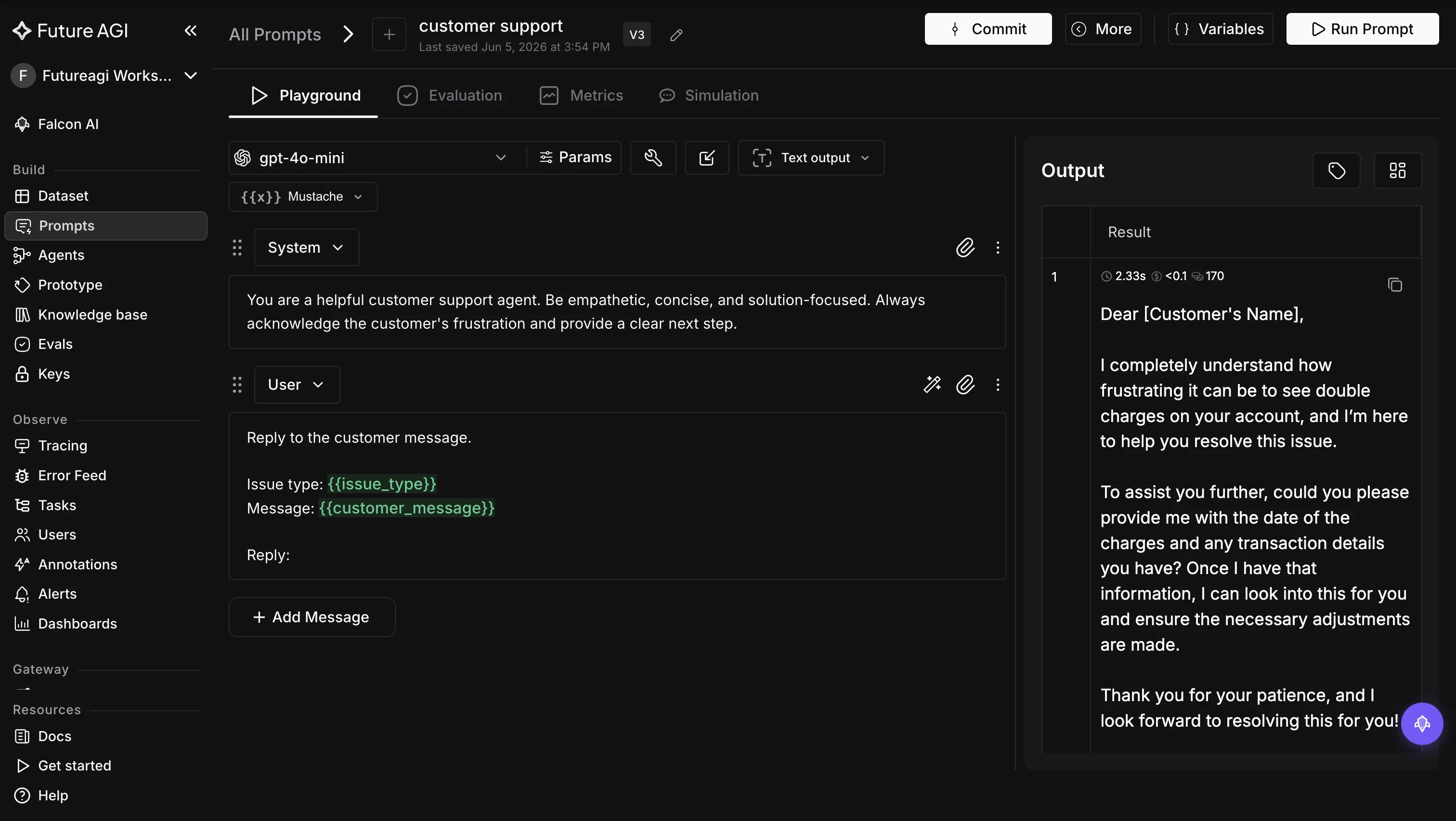
Quick take. Future AGI is the only tool here that covers the full AutoGen prompt lifecycle in one place. You author each agent’s system message in the Agent Playground, picking models and comparing outputs side by side. The platform stores a new immutable version on every edit and promotes each one across Production, Staging, and Development with labels. It ties every version to a built-in evaluator library, a CI/CD gate, and six optimization algorithms.
Ideal for. AutoGen teams that want per-agent versioning and the eval loop in one place. You capture the conversation, version each agent’s system message, score it against real runs, and gate it in CI/CD. An optimizer proposes a better candidate, and you watch it live in traces. No stitching a tracer, a registry, and an eval tool together.
Key strengths.
-
Author in the Agent Playground before you commit. The Agent Playground lets you draft and compare each agent’s system message across models before you save. The version you create is already tested against candidates.
-
Immutable versions, environment labels, no-redeploy rollback. Future AGI saves an immutable version on every change and moves each one across Production, Staging, and Development with labels. Rollback is reassigning a label to an earlier version. Apps fetch each agent’s prompt by name and label, so the change lands without a code release.
-
Versions scored across whole conversations. Each agent version can be measured with a built-in evaluator library and custom evals covering quality, safety, factuality, RAG retrieval, and format. You compare two versions on the same conversation dataset before deciding which one ships. A prompt can read well on turn one and derail by turn six, so the score judges the whole run, not a single reply.
-
Evaluation as a CI/CD gate. You can run the same evals as a gate in your CI/CD pipeline. A prompt that compounds into a loop fails the build, instead of surfacing mid-conversation in production.
-
Optimization that writes the next version. The open-source agent-opt library ships six algorithms: Random Search, Bayesian, ProTeGi, Meta-Prompt, PromptWizard, and GEPA. Each one runs an agent prompt against your evaluator and returns a higher-scoring candidate, tuned to hold up across the whole conversation. Every other tool here stops at scoring.
-
Tracing that ties a version to the turns it ran on. traceAI is OpenTelemetry-native tracing with instrumentors for 50+ frameworks, including an AutoGen instrumentor. It captures each agent’s prompt templates and variables on every turn of the group chat, so you can see which version spoke when, without rewriting the conversation.
Pricing and deployment. Future AGI has a free tier, pay-as-you-go usage, and Enterprise plans on its pricing page. The core SDK and product repos are Apache-2.0 and self-hostable at no license cost via Docker Compose, so the trace, version, score, and optimize loop runs inside the same network as your AutoGen app. SOC 2 Type II and a HIPAA BAA arrive with the paid plans.
Verdict. Future AGI is the strongest overall pick for AutoGen teams that want every stage of the prompt lifecycle, from authoring to optimization, in one measured loop. Choose it when you want versioning, evaluation, and tracing in one place rather than wiring separate tools together.
2. Portkey: Best AI Gateway With a Prompt Library for AutoGen
Quick take. Portkey is an AI gateway that routes model calls to 1,600+ LLMs, paired with a Prompt Library. For an AutoGen app, you route each agent’s calls through the gateway and pull that agent’s system prompt by ID or label at runtime. Versioning is immutable: an Update creates a new version and Publish repoints production, so the live prompt is always an explicit choice.
Ideal for. AutoGen teams that want a gateway in front of their agents for routing and tracing, and want to manage each agent’s prompt in the same place by pulling it from the Library at runtime.
Key strengths.
- Routing each agent’s calls through the gateway gives you one path to 1,600+ models, with request logs, tracing, 40+ metrics, and OpenTelemetry export. Every agent’s traffic is observable without a per-agent change.
- Each agent prompt lives in the Prompt Library and is pulled at runtime by prompt ID, pinned to a version like
promptID@12or to a label such as@productionor@staging. The conversation reads its prompts as settings, not code. - Versioning is immutable: an Update creates a new version, and Publish repoints the production label. Rollback is restoring a prior version from Version History or repointing a label, so reverting one agent does not touch the rest of the group chat.
Limitations. Prompt management is secondary to the gateway, and the Prompt Library and Studio are proprietary cloud, not the MIT gateway. There is no native AutoGen tracer, so you get gateway-level logs rather than per-agent conversation spans. There is no built-in evaluation suite, no agent-level scoring, and no optimization loop.
Pricing. The gateway is open-source MIT and self-hostable via Docker or npx @portkey-ai/gateway. Prompt management and the Studio run on Portkey’s cloud, with free and paid tiers above it.
Verdict. The pick when you want an AI gateway routing your AutoGen agents and a Prompt Library to pull each agent’s prompt from. It is a weaker fit if you need a native conversation tracer, free self-hosting of prompt management, or a built-in evaluation and optimization loop.
3. PromptLayer: Best Decoupled Registry Non-Engineers Can Edit
Quick take. PromptLayer is a prompt registry built so non-engineers, like product managers and subject-matter experts, can manage and version prompts alongside developers. It ties into an AutoGen app through its Python SDK and request logging. Versioning is visual, with a commit-style history and a readable diff on every change.
Ideal for. AutoGen teams that want each agent’s system prompt in a dedicated visual registry, editable by engineers and non-engineers alike, rather than buried in the constructors.
Key strengths.
- Each version carries a message and a visual diff against prior versions. A reviewer can see exactly what changed in an agent’s prompt without reading the conversation code.
- Release Labels map a version to an environment, and Dynamic Release Labels can split traffic by percentage or segment. A new assistant prompt can take a fraction of traffic before a full rollout.
- The Python SDK logs each agent’s requests with tags and request IDs, and rollback is a label reassignment rather than a redeploy. The registry also includes its own evaluation tooling for scoring versions.
Limitations. PromptLayer is proprietary, and self-hosting is Enterprise-only. The version model is linear, with no branch or merge. Evaluation depth and automated optimization are lighter than eval-led platforms, and pricing scales with team features rather than raw usage.
Pricing. A free tier, a Pro tier, and a Team tier with collaboration features; self-hosting is Enterprise.
Verdict. The pick when the people editing your AutoGen agents’ prompts are not all engineers and visual release control matters most. Less so when you need free self-hosting or optimization built in.
4. Langfuse: Best Open-Source Tracing Plus Prompt Management
Quick take. Langfuse is the open-source option AutoGen teams reach for when self-hosting matters. It pairs OpenTelemetry-based tracing with an MIT-licensed core for prompt versioning and labels. A conversation gets both trace capture and prompt management in one free, self-hostable instance.
Ideal for. AutoGen teams that want a widely adopted open-source tool they can self-host at no license cost, combining trace capture and per-agent prompt management in one place.
Key strengths.
- OpenTelemetry-based instrumentation traces an AutoGen app into Langfuse. Each agent’s prompt runs, inputs, and latency are captured through the open standard, not a proprietary tracer.
- Saving a prompt under the same name creates a new immutable integer version automatically. Each agent’s history accrues without ceremony, and you can diff versions.
- Labels such as
productionmap versions to environments, and protected labels let admins lock the production pointer against accidental moves. Rollback is a label reassignment, and Prompt Experiments score a version against a dataset.
Limitations. A client-side cache means a reassigned label is near-instant on the server but takes effect in the app only after the cache refreshes. The richest commercial controls live in a separate ee folder rather than the MIT core, and there is no built-in optimizer.
Pricing. A free Hobby cloud tier and self-hosting at no license cost, with paid Core, Pro, and Enterprise cloud tiers above them.
Verdict. The best open-source pick for AutoGen teams who want tracing and prompt management in one free, self-hostable instance, with the tradeoff that optimization lives elsewhere.
5. Vellum: Best for Visual, Structured Deployment Workflows
Quick take. Vellum models prompt management as a layered deployment system rather than a flat list, with explicit Versions, Deployments, and Releases. It manages prompts through its API rather than by instrumenting the conversation. It suits AutoGen teams that want a visual, product-style workflow and call Vellum-managed prompts from their agents over the API.
Ideal for. Teams that prefer a managed, UI-driven deployment pipeline with formal release tagging and strong access control. They are comfortable calling Vellum-managed prompts from their AutoGen agents.
Key strengths.
- A three-layer model separates a prompt Version from a Deployment and a Release. Each environment gets a distinct, auditable release history and a one-click revert to a prior release.
- Release tags such as
prodpoint at a chosen release, the runtime accepts a tag on the call, and rollback is repointing a tag. An agent serves a specific version without code changes. - Enterprise governance is deep: RBAC, SSO and SAML, immutable audit logs, and VPC deployment. Test suites evaluate a version before it is released.
Limitations. Vellum ties into an AutoGen app through its API, not auto-instrumentation, so its conversation tie-in is more partial than the OpenTelemetry-based tools. The layered model adds concepts to learn, versions and tags are linear with no branch or merge, pricing adds machine add-ons and a platform fee, and there is no built-in optimization.
Pricing. A free tier with usage credits and paid tiers that add a platform fee; larger deployments are quote-based. Hosted, with VPC options for Enterprise.
Verdict. A solid choice when a structured, visual deployment workflow and release-style governance are worth the extra concepts. Less so when you want native conversation tracing or a lightweight registry.
6. Agenta: Best Open-Source Playground for Experimenting on Agent Prompts
Quick take. Agenta is an open-source, MIT-licensed LLMOps platform. Its prompt playground and git-like variants make it a strong fit for experimenting on the system message inside each AutoGen agent. Its OpenTelemetry-compliant tracing captures the conversation, and it pairs a side-by-side comparison surface with environments for promotion, all self-hostable for free.
Ideal for. AutoGen teams that want a free, open-source playground to iterate on agent prompt variants, promote them across environments, and trace the conversation through the open standard.
Key strengths.
- Variants act like git branches. Each change is recorded as an immutable commit you can compare side by side, which suits rapid experimentation on a single agent’s prompt.
- Agenta is OpenTelemetry-compliant, so it captures conversation traces alongside any custom spans, without a closed tracer.
- Environments such as
development,staging, andproductionmap a variant to a deployment, the runtime pulls the config by environment, and the MIT core self-hosts free on Docker.
Limitations. SSO and the deeper enterprise controls sit behind the ee license rather than the MIT core. The free tier has evaluation and retention caps, and there is no built-in optimizer. The broad LLMOps scope means more to set up than a prompt-only tool.
Pricing. A free Hobby tier and free self-hosting under MIT, with paid Pro and Business tiers and Enterprise above them.
Verdict. The best open-source playground for AutoGen teams that want to experiment on agent prompt variants and promote them across environments at no license cost. Less so when you want optimization built in or a managed, zero-setup experience.
Which Prompt Management Tool Should You Choose for Your AutoGen App?
Match the tool to the constraint that matters most to you.
| If you need | Choose | Because |
|---|---|---|
| Per-agent versioning plus a built-in eval and optimization loop | Future AGI | Full lifecycle on one platform: author, version, evaluate, optimize, observe, Apache-2.0 self-host |
| An AI gateway routing AutoGen calls with a Prompt Library | Portkey | Routes to 1,600+ models and pulls each agent’s prompt by ID at runtime |
| A decoupled registry non-engineers can edit | PromptLayer | Visual diffs, release labels, and traffic-split rollouts |
| Free open-source tracing plus prompt management | Langfuse | MIT core with labels and protected production |
| A structured, visual deployment pipeline | Vellum | Versions, Deployments, and Releases with per-environment tags |
| A free open-source playground for agent prompt experiments | Agenta | MIT variants and environments with OpenTelemetry tracing |
For an AutoGen app, every tool that speaks OpenTelemetry can capture the conversation, so the field is more level than in a LangChain-native stack. Langfuse and Agenta are the strongest free open-source options. Portkey fits when you want a gateway routing your agents’ calls. Future AGI leads on breadth: Agent Playground authoring, label-based versioning, a built-in evaluator library, CI/CD gating, and six optimizers, all Apache-2.0.
How Do You Roll Out AutoGen Prompt Management Without Breaking Production?
Adopting a tool is the easy part. These practices keep an agent prompt rollout from turning into a hidden regression in a multi-agent conversation.
- Pull each agent’s prompt by name, never hard-code it. Move every system message out of the constructors and into a registry the conversation reads at runtime. A single agent’s change then ships without a code deploy, and a non-engineer can edit a production agent safely.
- Make every agent prompt change a new version. The moment a prompt is editable without creating a version, its history has a hole in it. Save a version on every change, so the diff is legible in an incident review later.
- Tie each agent version to an eval run before you promote it. A version you cannot score is a version you cannot trust. Compare the candidate against the current production version on the same conversation dataset, and run that eval as a CI/CD gate so a regression fails the build. Our prompt versioning and lifecycle guide covers this gate in depth.
- Score the conversation outcome, not just the prompt. In a group chat the same agent speaks repeatedly against an evolving history. Score the result of the whole conversation, not one isolated prompt, and keep a role-specific evaluator for each agent.
- Close the loop with traces. A version that scores well offline can still fail on real traffic. Link each agent version to its conversation traces, so production behavior feeds the next round of optimization, and rehearse a single-agent rollback so it works under pressure.
Where Future AGI Fits in Your AutoGen Stack
In an AutoGen group chat the same prompts fire on every turn, so a small flaw compounds fast. Recall the chat that started looping, where no one could name the version that sent it there. Future AGI gives each prompt a history. Every agent prompt is now an immutable version with a label, and traceAI walks the whole conversation, so every turn points back to the version that ran it. A new candidate has to clear an eval gate before it reaches a live chat. AutoGen still orchestrates the agents. Future AGI keeps their prompts accountable, so a bad loop traces to one version you can read and roll back in seconds. Begin in Future AGI’s prompt docs, or clone and run the Apache-2.0 repo yourself.
Frequently Asked Questions About AutoGen Prompt Management
What Is AutoGen Prompt Management?
AutoGen prompt management treats each agent’s system message as a versioned, governed asset rather than a string hard-coded in the constructor. You store every agent’s prompt as its own version, score a candidate against whole conversation runs before it ships, and tie each version back to the turns it executed in. AutoGen ships no native prompt registry, so this discipline lives in external tooling.
Which Prompt Management Tool Is Best for AutoGen Agents in 2026?
Future AGI leads because it covers the full AutoGen prompt lifecycle on one platform. You author in the Agent Playground, version with immutable snapshots and Production, Staging, and Development labels, and fetch by name and label. You score with a built-in evaluator library, gate in CI/CD, and improve with six algorithms, all Apache-2.0. Portkey is best as an AI gateway with a Prompt Library, PromptLayer best for non-engineer editors, Langfuse best for open-source tracing plus prompt management, Vellum best for visual deployment workflows, and Agenta best for open-source prompt experimentation.
Can You Version Each AutoGen Agent’s Prompt Separately?
Yes, and per-agent versioning is the main reason to adopt a prompt management tool for an AutoGen app. Instead of hard-coding a system message in each constructor, you store each agent’s prompt as its own named version and pull it at runtime, so the assistant and the critic have separate histories and separate rollbacks. Future AGI, PromptLayer, Langfuse, and Agenta let you pull by name and label; Portkey pulls by prompt ID from its Prompt Library. Each agent prompt becomes configuration, not code.
Does Future AGI Work With AutoGen?
Yes. Future AGI’s traceAI is OpenTelemetry-native and ships an AutoGen instrumentor. Each agent’s prompt templates are captured on every turn, without rewriting the conversation. The same platform keeps each agent prompt as an immutable version with Production, Staging, and Development labels, and rollback is reassigning a label to an earlier version with no redeploy. It scores each version with a built-in evaluator library, gates regressions in CI/CD, and improves prompts with six optimization algorithms, all Apache-2.0.
How Do You Roll Back an AutoGen Agent Prompt?
Rollback does not require redeploying the conversation; you point the agent back to a known-good version of its system prompt. Future AGI rolls back by reassigning a label, pointing Production at an earlier version, so apps fetch by label with no code release. Langfuse and PromptLayer reassign a movable label, Portkey repoints a label from Version History, Vellum repoints a release tag, and Agenta points an environment at a prior variant. Only the affected agent changes.
Frequently Asked Questions
What Is AutoGen Prompt Management?
Which Prompt Management Tool Is Best for AutoGen Agents in 2026?
Can You Version Each AutoGen Agent's Prompt Separately?
Does Future AGI Work With AutoGen?
How Do You Roll Back an AutoGen Agent Prompt?
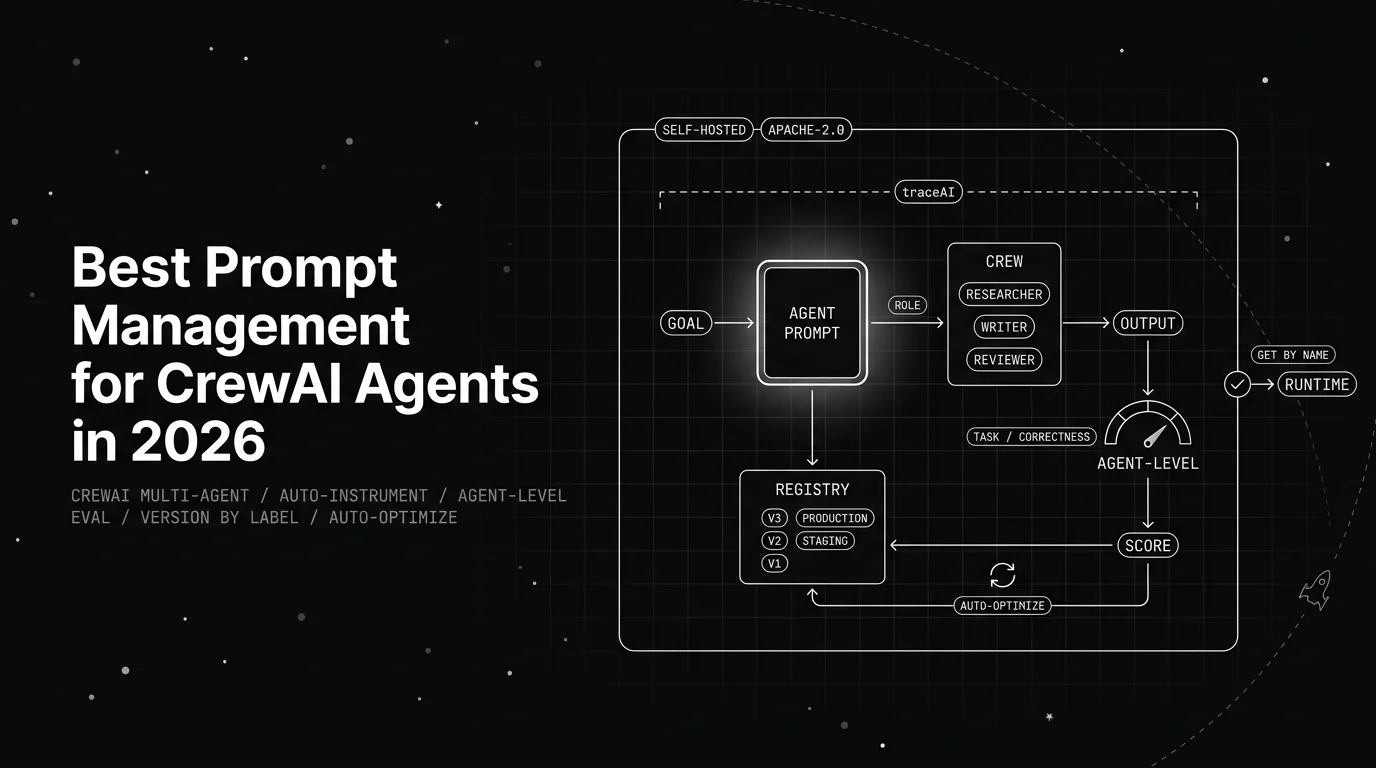
The 6 best prompt management tools for CrewAI agents in 2026, ranked on integration, per-agent versioning, tracing, and built-in evaluation of prompts.

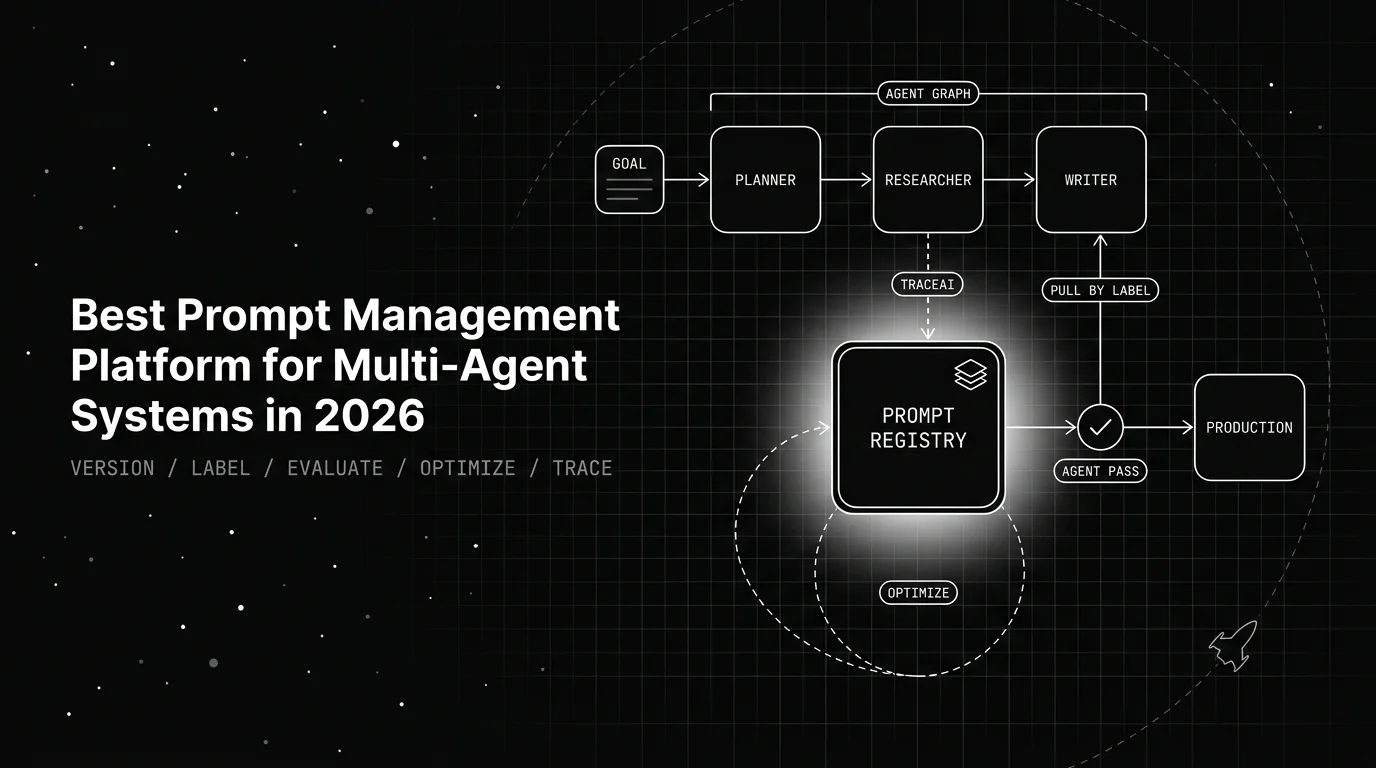
Prompt management for multi-agent systems: Future AGI versions, evaluates, and traces each agent's prompt on its own in one registry. Apache-2.0.

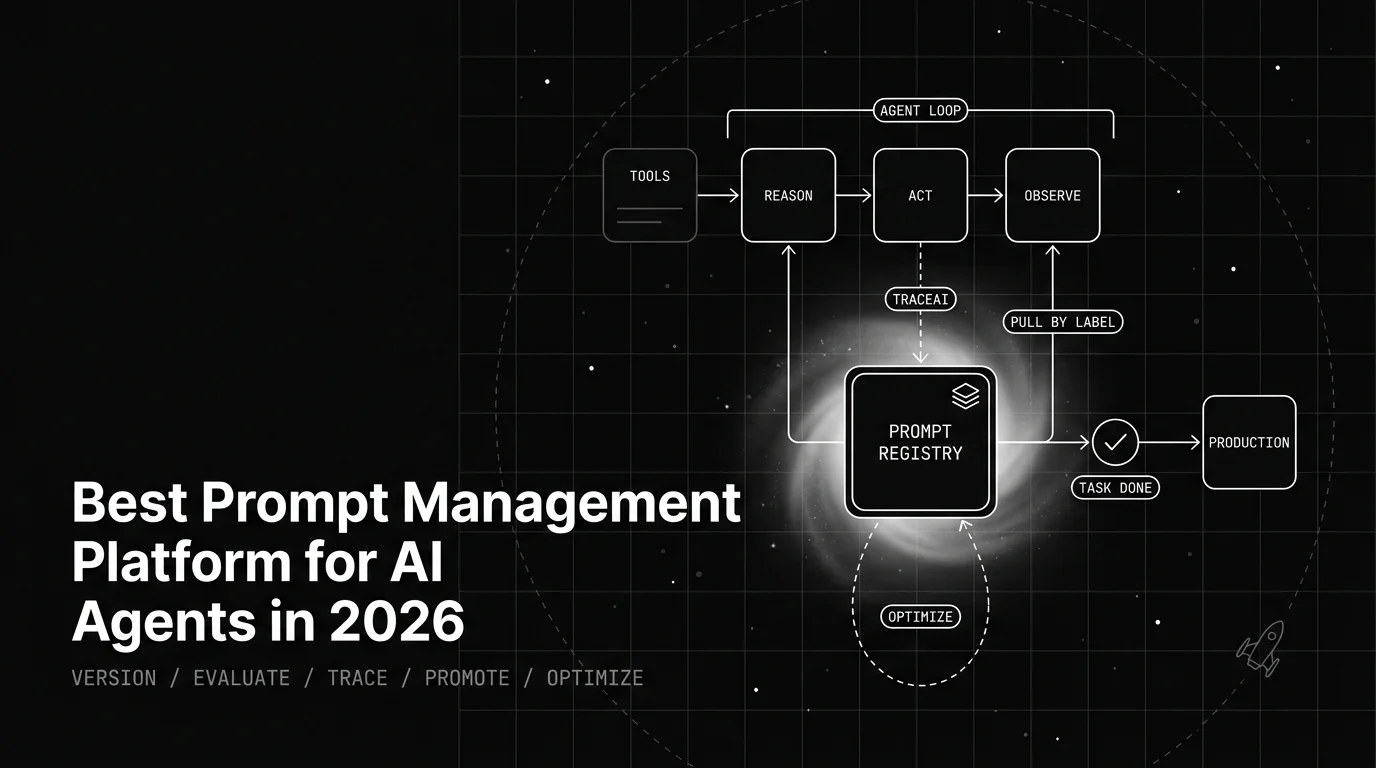
Version each agent prompt, gate promotion on task-completion and tool-call evaluators, then trace every run back to its version. Future AGI is Apache-2.0.