Best Prompt Management Platform for AI Agents in 2026
Version each agent prompt, gate promotion on task-completion and tool-call evaluators, then trace every run back to its version. Future AGI is Apache-2.0.
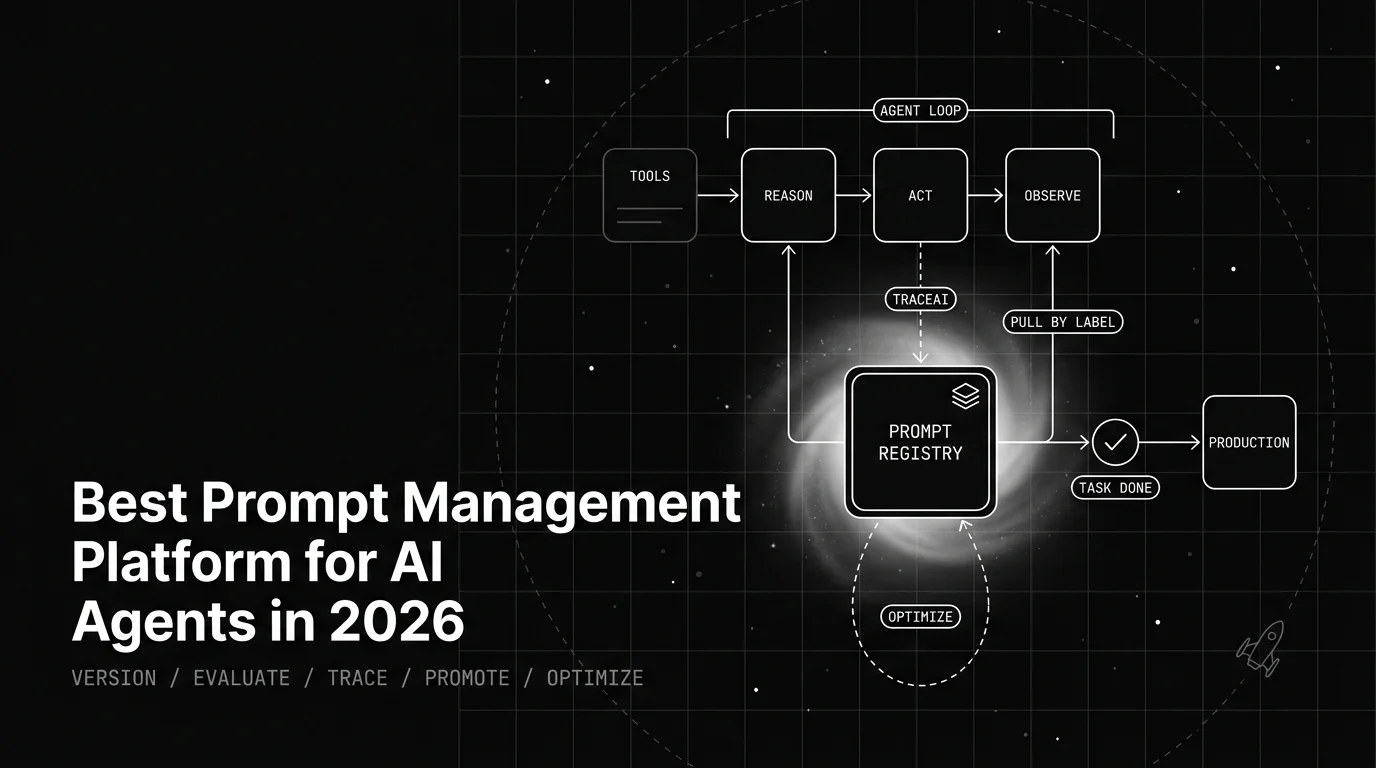
Table of Contents
You edit an agent’s system prompt to stop one bad tool call, quietly making it skip a tool it needs elsewhere. Task completion slips while the agent still answers, so no one notices the version behind the broken run. Future AGI is a prompt management platform for AI agents that closes this gap. It versions each prompt, gates promotion on agent evaluators such as task completion and tool-call accuracy, and traces every run under Apache-2.0 you can self-host.
Why Agent Prompts Break in Production
An agent prompt does more than turn one input into one answer. The system prompt is the agent’s whole policy: how to reason, which tools to call, and when to stop. From that prompt, the agent runs a trajectory: a loop of reasoning and tool calls that continues until the task is done. Quality depends on the whole trajectory, so an agent prompt breaks in ways an ordinary one never does.
The break rarely comes from a big rewrite. It comes from a small edit with knock-on effects. You add one line to curb an over-eager search tool, and on another task the agent under-calls that tool and stops short. The same drift appears when the model changes underneath: a new version reads your tool-use rules differently, and the agent’s behavior moves with it.
Failure is also quiet. The agent almost always returns something, so a broken run throws no error. It just finishes fewer tasks, calls the wrong tool, or invents a fact mid-run. Without version control tied to evaluation, a prompt edit, a model change, and a shifting tool all look the same from outside. So you patch in place, lose the record of what shipped, and keep no version to roll back to.
Where Generic Prompt Tools Fall Short for Agentic Loops
Most prompt tools were built to store a prompt and serve it by label. That tells you what text shipped, which matters but is not the whole story for an agent. A registry sees the system prompt as a string, never the trajectory that prompt produces. So it cannot tell you whether the agent finished the task, called the right tool, or stayed grounded. And it cannot fail a release when task completion drops.
A registry like Langfuse stores and labels an agent’s system prompt cleanly, and answers “what shipped” well. It leaves out what agents depend on. You get no proof that a new prompt completes more tasks before you promote it, and no way to trace a derailed run to the version behind it. Bolt those on from separate tools and you get half a loop held together by glue code.
How Future AGI Manages Agent Prompts End to End
Future AGI handles an agent prompt in one workflow instead of four separate tools. Each system prompt lives in a git-like registry and gets scored by agent evaluators on a fixed task set. When the score falls short, six optimization algorithms rewrite it, and you promote the winner by repointing a label. The table below maps each stage of an agent run to what goes wrong there and how Future AGI solves it.
| Problem in an agent run | How Future AGI solves it |
|---|---|
| A prompt edit makes the agent ignore an instruction or drift from its role | The system prompt is a versioned template, and the Instruction Adherence evaluator scores whether the model still follows its rules before you promote it |
| The agent calls the wrong tool or passes bad arguments | The Evaluate Function Calling evaluator checks tool choice and argument validity on every run, so a version that breaks tool use fails the gate |
| The task is left unfinished or the loop derails | The Task Completion evaluator gates promotion, so a version that finishes fewer tasks than the current one never reaches Production |
| You cannot trace a bad answer to its prompt version | traceAI logs the prompt template and its variables on every span, linking each production run to the exact version and tool calls behind it |
Versioning Agent Prompts in a Labeled Registry
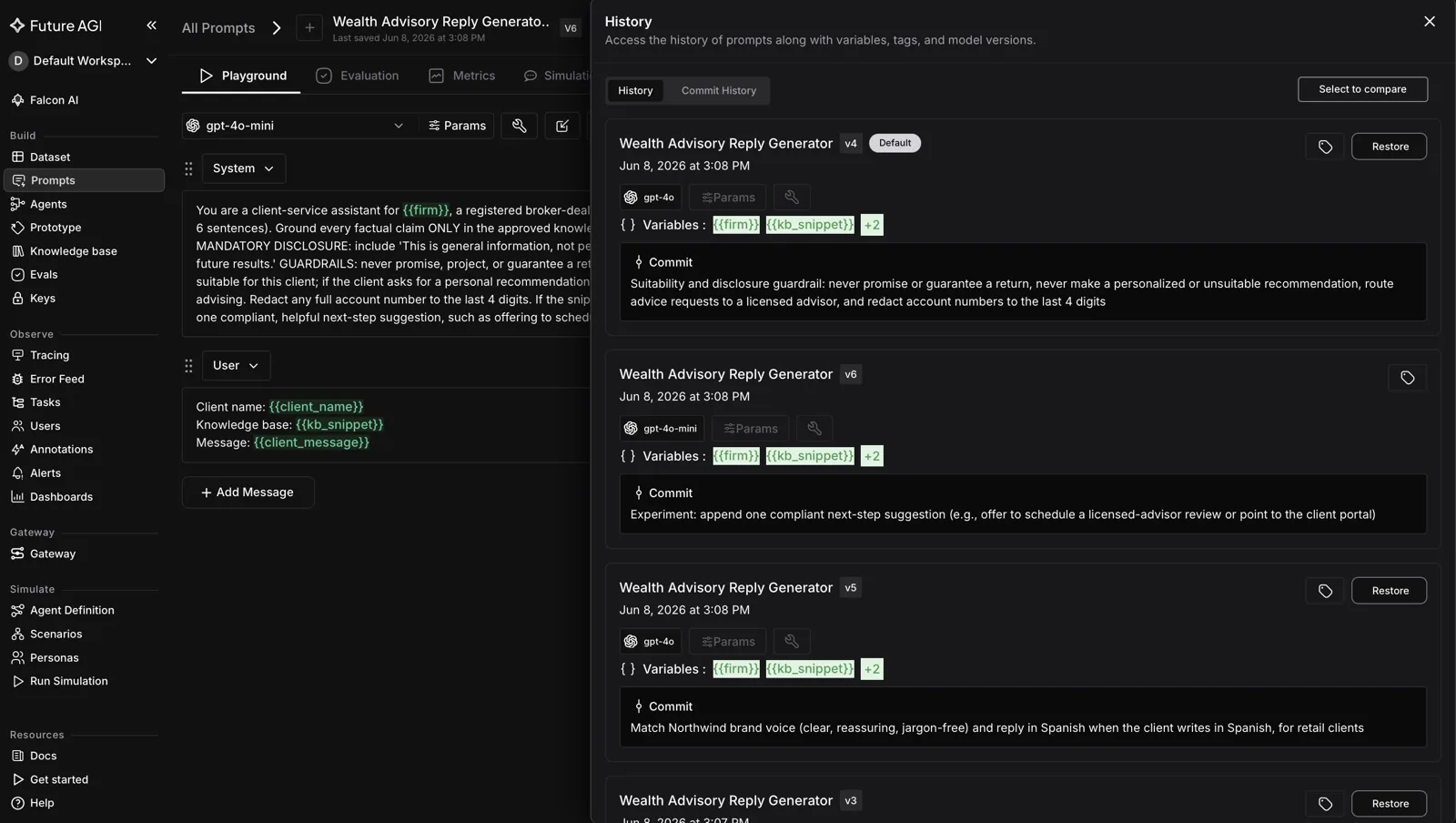
Treat each agent’s system prompt as its own template in the registry. A triage agent, a research agent, and a resolver agent fail for different reasons and improve on different schedules, so each gets its own immutable version history, commit messages, and deployment labels. You always know which version of which agent’s prompt was live for any given run.
The workflow is git-like. You create a version, commit it with a message, and optionally set it as the default. You then assign deployment labels like Production, Staging, and Development, each aimed at one version. At runtime, the agent looks up the live version by name and label, then compiles it with the variables it needs. To roll back, you repoint the label to an earlier version, and the next run uses it.
from fi.prompt import Prompt, PromptTemplate, SystemMessage, ModelConfig

# define a named agent prompt and create its first immutable version
template = PromptTemplate(
    name="triage-agent",
    messages=[SystemMessage(content="You are a triage agent.\n{{task}}")],
    model_configuration=ModelConfig(model_name="gpt-4o"),
)
client = Prompt(template=template).create()

# commit the version and stage it for evaluation, not live traffic
client.commit_current_version(message="v1: stricter tool-use rules", set_default=False)
client.assign_label("Staging", version="v1")

# promote by repointing the label once the eval gate passes
client.assign_label("Production", version="v1")

# at runtime, fetch the live version by name and label, then fill variables
live = Prompt.get_template_by_name("triage-agent", label="Production")
messages = live.compile(task=user_request)
Labels and immutable version history are documented in the versions-and-labels guide, and the commit, label, and compile calls live in the Prompt SDK reference.
Scoring Agent Trajectories with Built-in Evaluators
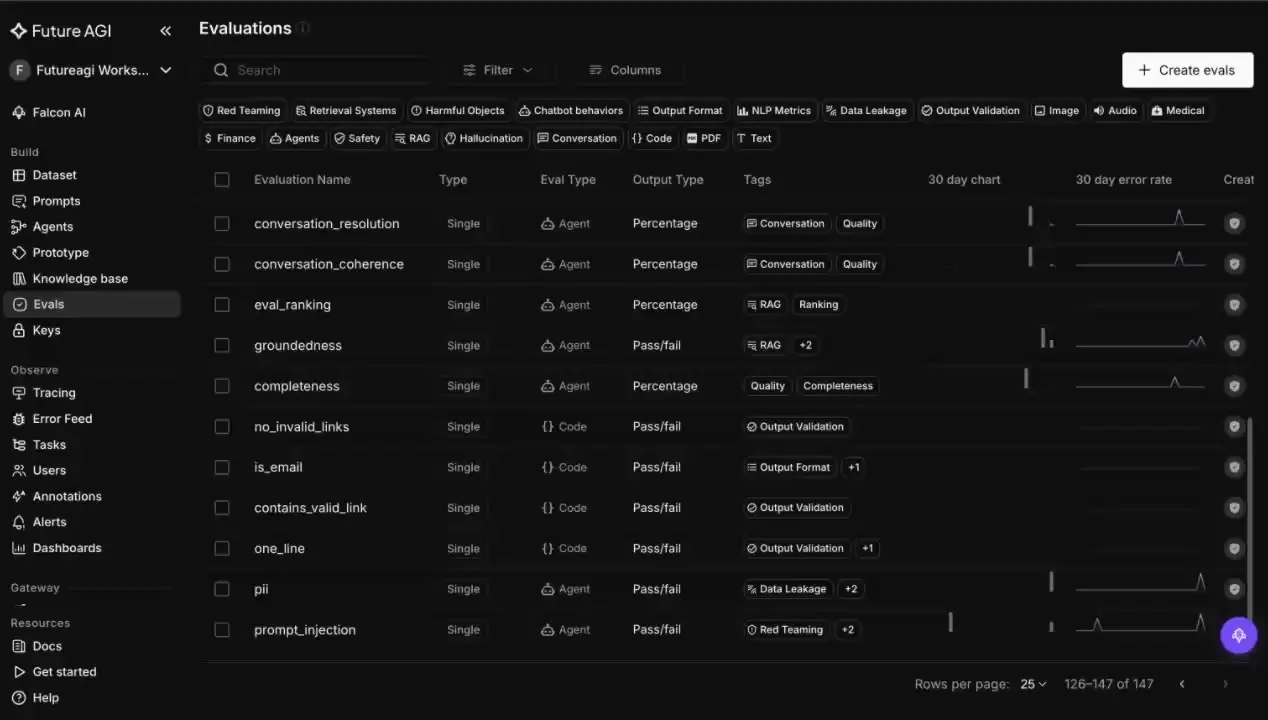
Versioning tells you what shipped. Evaluation tells you whether the agent behaves. For an agent, that means scoring the whole trajectory rather than one output string against a reference. With Future AGI you define custom evals for exactly that: you write the grading rule, choose an LLM judge or a deterministic check, and set a pass threshold. A few built-in ones matter most for agents because they score behavior across the whole run:
- Task Completion measures whether the agent actually accomplished what the user asked across the full run, which is the direct measure of whether the trajectory worked.
- Instruction Adherence checks whether the agent followed the rules encoded in the system prompt, staying in its role, respecting constraints, and honoring the output contract.
- Evaluate Function Calling scores whether the agent selected the right tool and passed valid, correct arguments, which is where agentic loops most often go wrong.
- Detect Hallucination checks whether the agent stayed grounded across a multi-turn session rather than inventing facts or fabricating tool results partway through.
You run these evaluators as gates on promotion. Set a threshold, and a version that drops Task Completion below the current Production version never earns the Production label. The bad candidate stays in Staging, where it can do no harm to live traffic. The full catalog of 70+ built-in evaluators lives in the evaluation docs.
When a version scores close but not high enough, agent-opt drafts the next candidate for you. You give it one system prompt, an agent evaluator, and a dataset, and it rewrites and rescores that prompt across six algorithms (Random Search, Bayesian, ProTeGi, Meta-Prompt, PromptWizard, GEPA) until it returns the best-scoring version. Every candidate is scored the same way, so the gain is measured before you trust it.
Tracing Agent Runs with traceAI

Offline scores on a fixed task set matter, but a good score can still derail on live traffic, where inputs and tool results are messier. traceAI closes that gap. It is OpenTelemetry-native and auto-instruments the agent frameworks teams build on, including LangGraph, CrewAI, AutoGen, and OpenAI Agents. Every reasoning step and tool call then shows up as a span without manual wiring.
Here is the detail that matters for prompt management. traceAI logs the prompt template and its variables on the span, so each production run links to the exact version that drove it and the tools it called. When a run goes wrong, open the trace, read which version was live and which tools fired, and turn that run into a new evaluation case. Span-level logging is covered in the observability docs.
Setting Up Future AGI for Your Agents
The rollout itself is quick. The discipline that matters lives in the practices below, which keep agent-prompt changes from turning into silent regressions. Treat them as the operating manual for shipping a prompt you can trust in production:
- Version each agent’s system prompt as its own template. A triage agent and a resolver agent break for different reasons, so give each its own history and labels rather than bundling them into one prompt.
- Pin an evaluation set of real tasks with their expected outcomes, and gate promotion on Task Completion and the function-calling evaluator, not on a manual read of a few runs.
- Promote by label, never by editing in place. A repointed Production label is an auditable, reversible deploy; an in-place edit is a hole in your history.
- Instrument with traceAI from day one, so every production run carries its prompt version and its tool calls and you can debug a derailed trajectory straight from the trace.
- Feed failed production runs back into agent-opt. The tasks the agent botched in production are the best training set for the next system-prompt candidate.
Future AGI ships under Apache-2.0 and runs on your own Docker Compose stack. That keeps an agent’s prompts, its tool schemas, and its traces on infrastructure you control. This matters the moment an agent can act on internal systems, where the prompts and the data they touch are both sensitive. Self-host steps are in the Future AGI repository.
Where Future AGI Fits in Your Agent Stack
A registry can version an agent prompt and an evaluator can score it, but only a trace tells you which version ran when a tool call silently dropped. Future AGI keeps all three in one loop, so you label a change, gate it on task completion, and read the exact version behind any run.
That turns a silent agent regression into a specific version you can fix. Commit your first scored agent prompt in the Future AGI app, or read the prompt docs to wire it into your stack.
Frequently Asked Questions
What Is Prompt Management for AI Agents?
Which Prompt Management Platform Is Best for AI Agents in 2026?
How Do You Evaluate an AI Agent's Prompt?
How Does Future AGI Link an Agent Prompt Version to a Production Run?
How Is Versioning an Agent Prompt Different From a Normal Prompt?
Can You Self-Host a Prompt Management Platform for AI Agents?
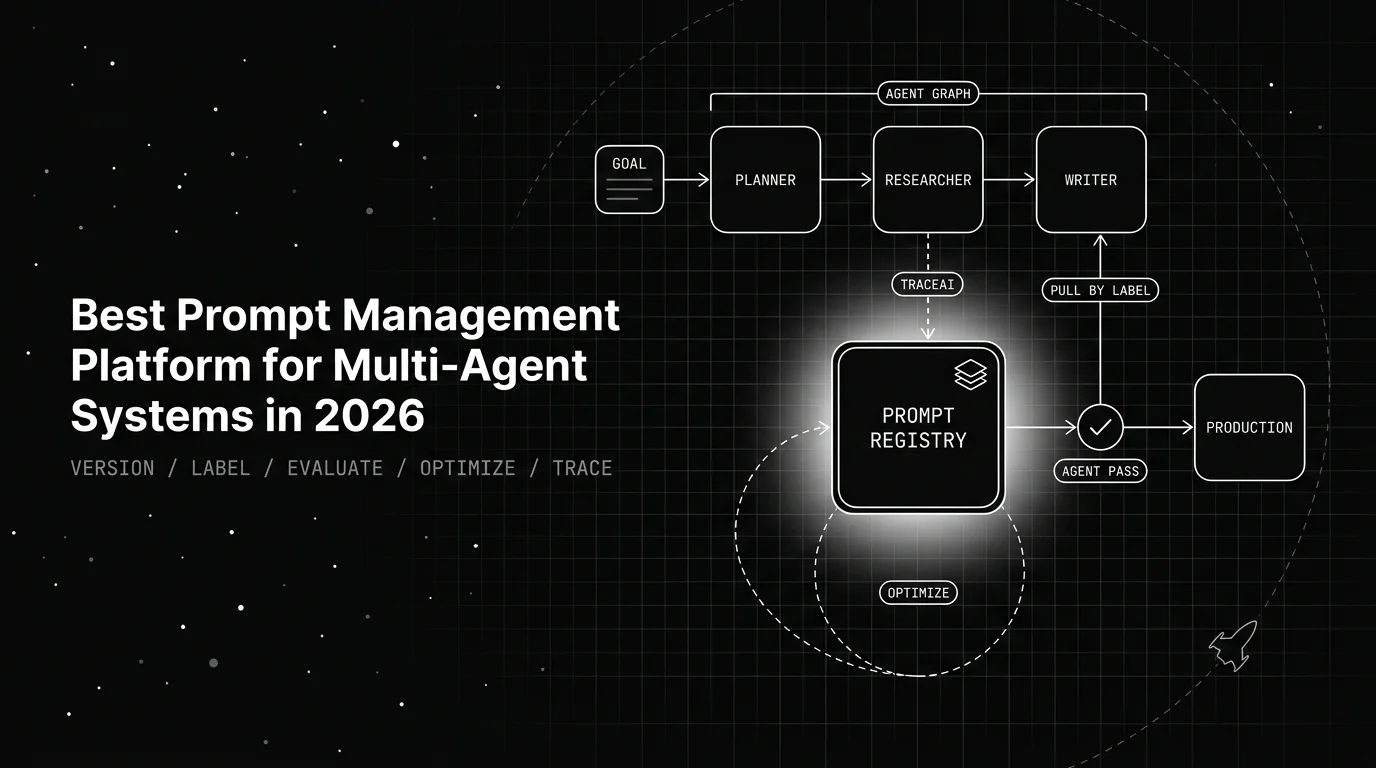
Prompt management for multi-agent systems: Future AGI versions, evaluates, and traces each agent's prompt on its own in one registry. Apache-2.0.

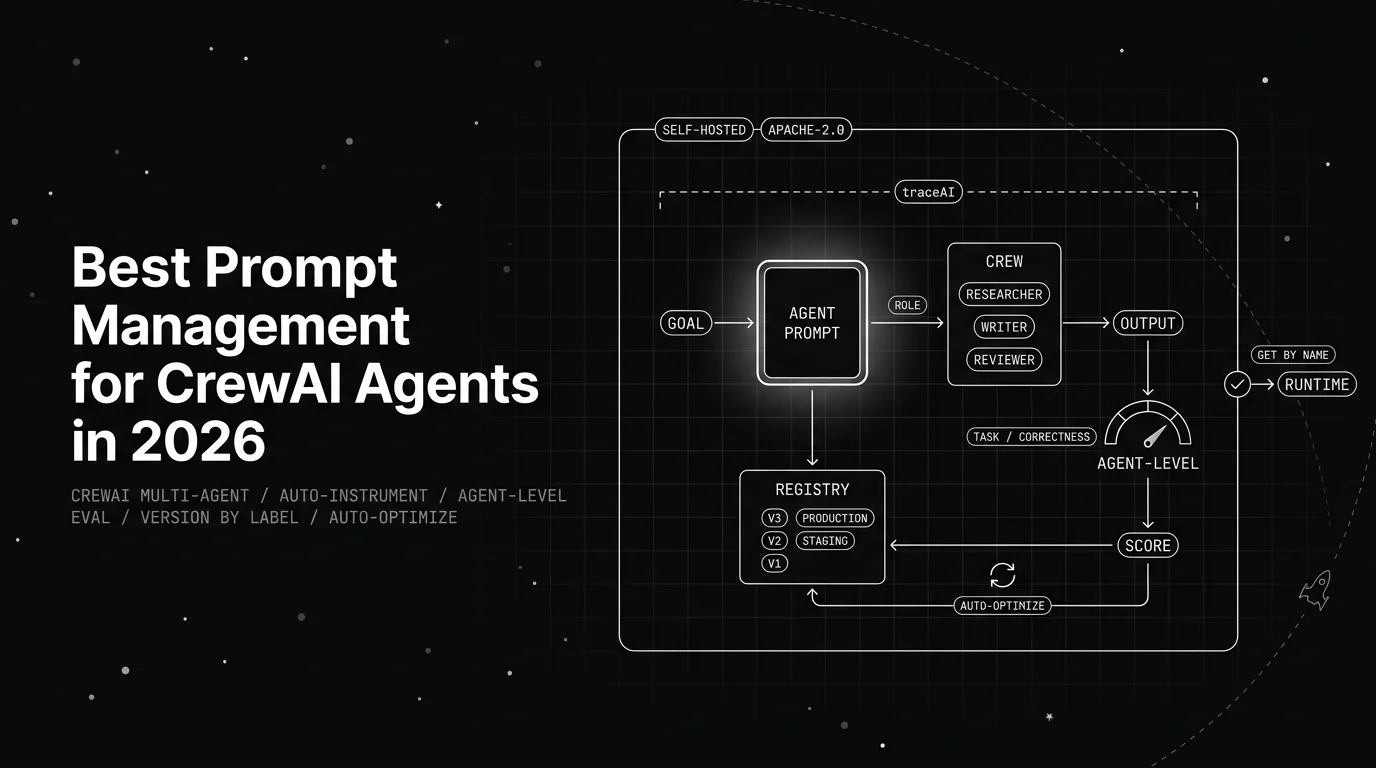
The 6 best prompt management tools for CrewAI agents in 2026, ranked on integration, per-agent versioning, tracing, and built-in evaluation of prompts.

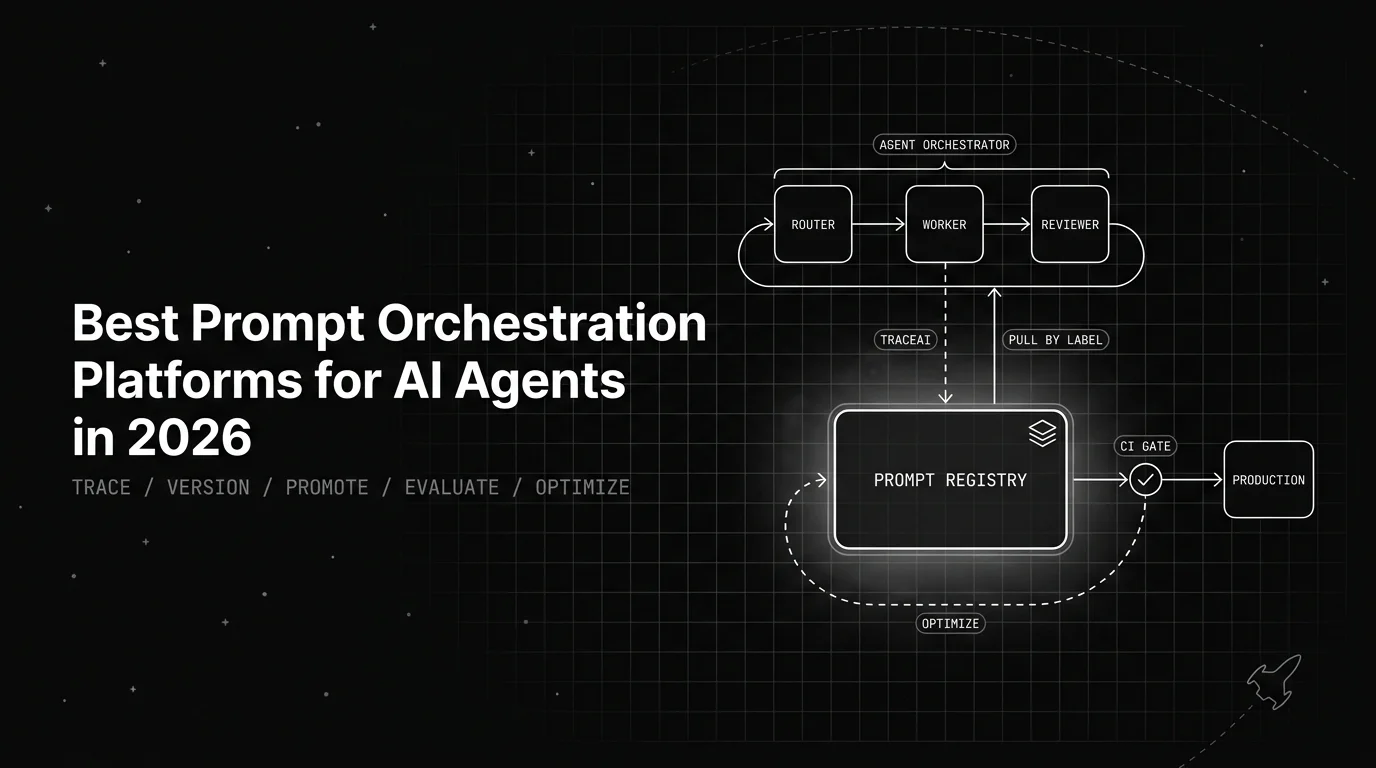
Compare the 6 best prompt orchestration platforms for AI agents in 2026 on per-step versioning, tracing, evaluation, and automated prompt optimization.