Best Prompt Management Platform for Multi-Agent Systems in 2026
Prompt management for multi-agent systems: Future AGI versions, evaluates, and traces each agent's prompt on its own in one registry. Apache-2.0.
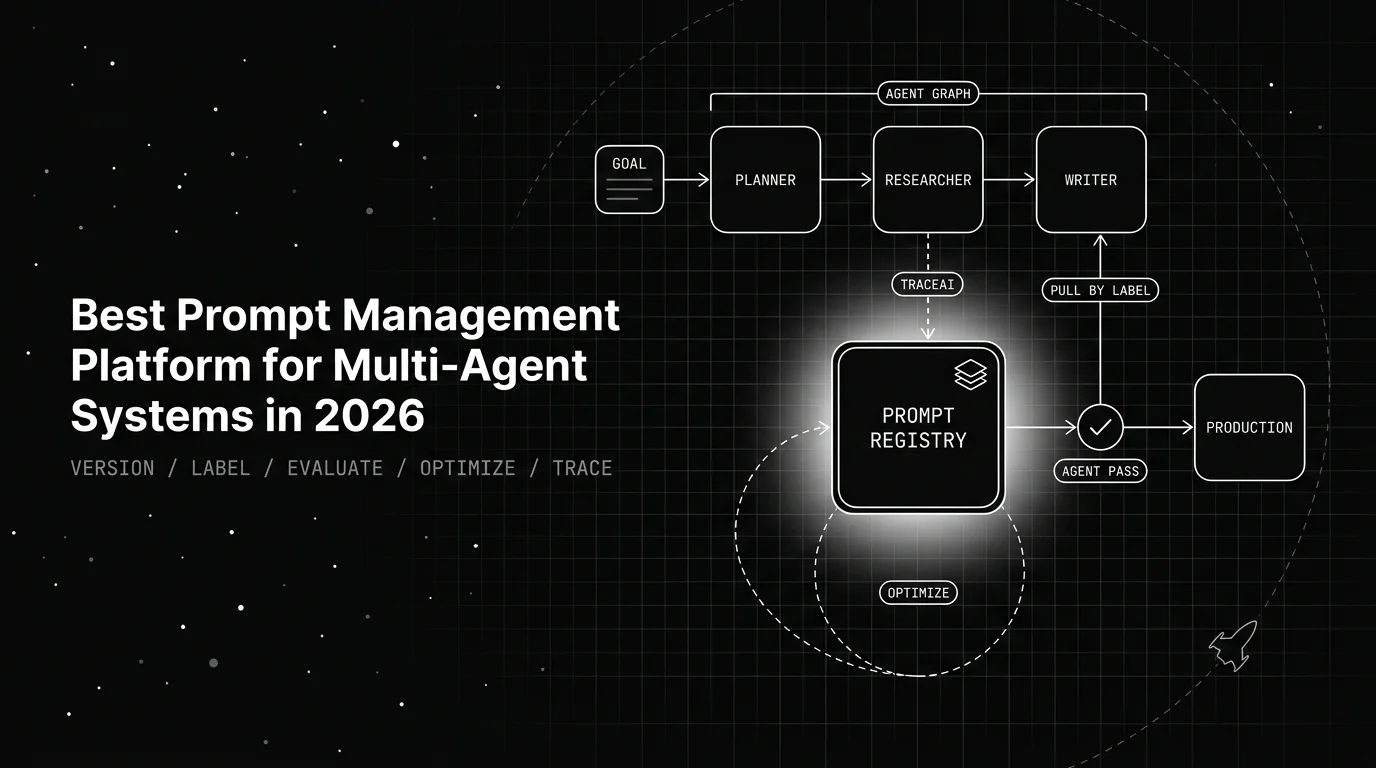
Table of Contents
A multi-agent system ships with a planner, a researcher, and a writer, and for a week it works. Then quality drops, and the post-mortem stalls on one question: which agent’s prompt changed, and to what. The researcher was tuned in a console, the planner is an inline string, the writer lives in a third repo. This guide shows how Future AGI gives each agent its own versioned, evaluated, and traced prompt in one registry.
Why Multi-Agent Prompt Coordination Is Hard
A single-agent app has one prompt to manage. A multi-agent system has many, one per role, and each is a behavior-defining artifact. The planner decides how to break a task down, the researcher decides what evidence to pull, and the writer decides how the answer reads. A change to any one of those prompts can move the output of the whole system.
The hard part is that the agents are coupled at runtime but decoupled in storage. The planner’s output feeds the researcher, whose output feeds the writer, so the system behaves as one thing. Yet each agent’s prompt tends to live in its own place, edited on its own schedule, with no shared history.
When quality drops, that coupling is what makes diagnosis hard. The bad final answer could trace back to any agent in the chain. The planner may have mis-framed the task, or the researcher may have pulled weak evidence. Without per-agent history, you cannot say which prompt changed or when.
What makes the problem tractable is treating each agent’s prompt as its own versioned artifact in one place. Give every agent an independent version history, a deployment label, and an evaluation. Then you can change one agent, measure its effect in isolation, and promote or undo it without touching the others.
Where Generic Prompt Tools Break Across Many Agents
Generic prompt tooling assumes one prompt, and that assumption breaks the moment you run several agents. Inline strings put each agent’s prompt in a different service. With no shared history or single view of every agent’s prompt, a change to one is invisible to the rest.
A hosted prompt UI is faster, but it lets someone change one agent’s live text with no record of what was replaced. Nothing connects that edit to how the rest of the system performed. Each approach treats the prompts as isolated strings, when they are really parts of one coupled system.
Dedicated registries are a real step up. An open-source registry like Langfuse gives each agent’s text a named, labeled home and a clean version history. That solves storage: every agent’s prompt has a stable place to live and a record of what changed.
But multi-agent systems raise harder questions a store-and-serve registry leaves to you. Can you evaluate each agent on criteria that fit its role? Can you improve one agent’s prompt without regressing the system? Can you read which agent ran which version off a live trace when the whole thing misbehaves?
Storage is only the first layer. The real need is per-agent accountability across the whole loop: each agent’s version connected to the evaluation that gates it and the trace that proves what it did on a real request. Keep those in separate places, and “we version our agent prompts” is true on paper and useless the moment a run goes wrong.
How Future AGI Manages Per-Agent Prompts End to End
Future AGI does not orchestrate your agents. Bring LangGraph, CrewAI, or AutoGen, whatever runs them; Future AGI is the layer that versions, evaluates, and traces the prompts those agents run. Each agent role is its own named template in one registry. The agents share a platform without sharing a version line.
Every step is per agent. You commit immutable versions for one agent without touching the rest. You assign Production, Staging, and Development labels per agent, so promoting the planner does not move the researcher. You evaluate, trace, and roll back each agent on its own.
The table pairs each multi-agent need with what breaks without per-agent management and the Future AGI capability that fixes it:
| Multi-agent need | Without per-agent management | Future AGI capability |
|---|---|---|
| Track each agent’s prompt | One change buried across several services | A named template per agent, each with its own immutable version history |
| Deploy agents on their own cadence | Promote one and hope nothing else shifted | Per-agent labels: repoint Production for one agent, the others untouched |
| Tell which agent regressed | Search untracked prompts after the fact | Each agent’s span carries its exact version via gen_ai.prompt.template.version |
| Improve one agent safely | Hand-tune and eyeball the whole system | Score and optimize that agent in isolation against its own evaluators |
The mechanics of per-agent labels are laid out in the prompt versioning docs, and the prompt SDK reference shows how each agent’s template is created, committed, labeled, and compiled.
One Labeled Registry Holding Every Agent’s Prompt Versions
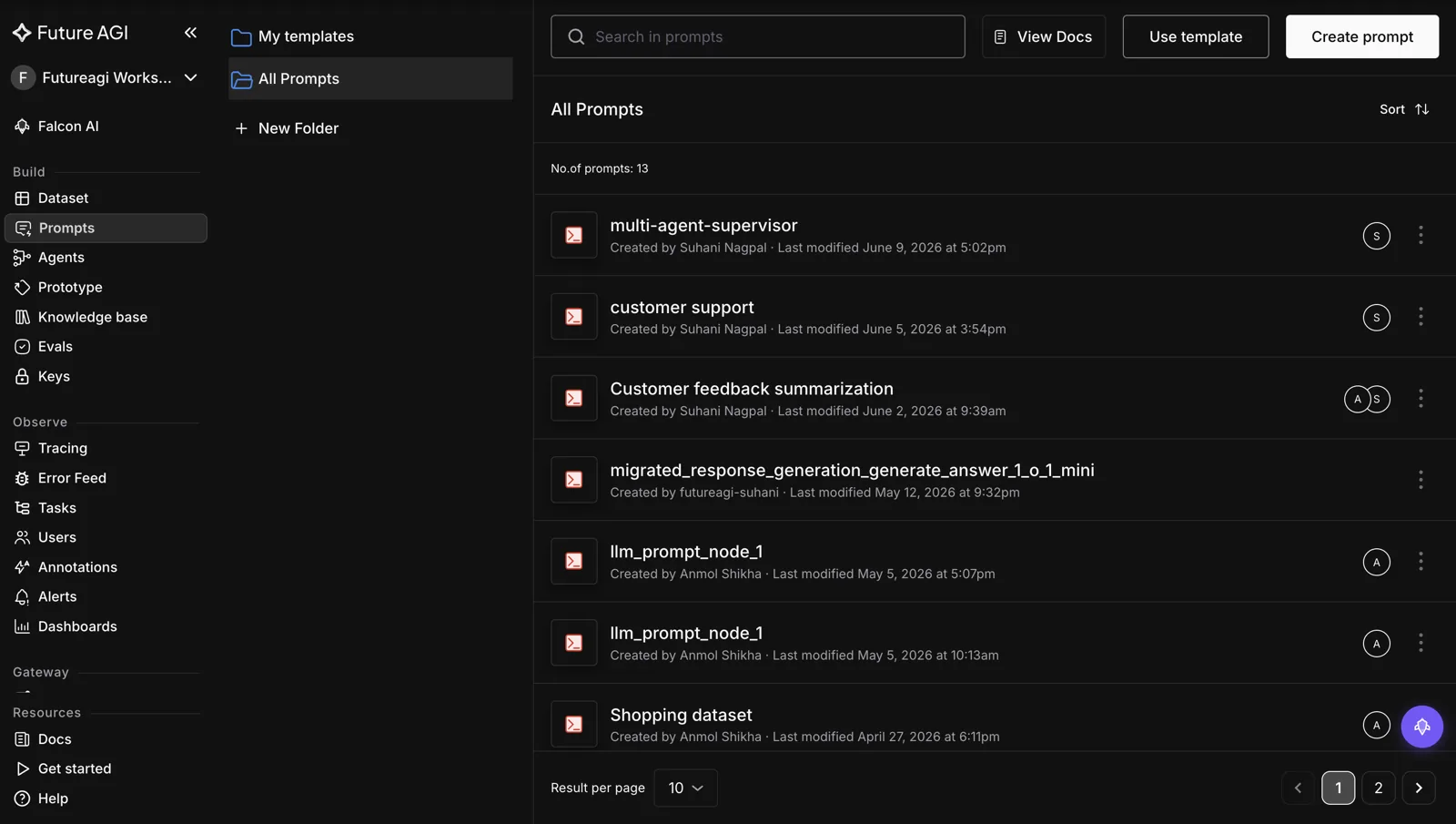
Each agent role is a separate named template: a planner-agent, a researcher-agent, and a writer-agent. Each has its own version history and its own deployment labels in one registry. Every version is an immutable snapshot with an id, an author, a timestamp, and a changelog.
So committing the planner’s next version creates planner v2 without ever mutating planner v1, and without touching the researcher or the writer. Promotion is per agent too. You repoint the planner’s Production label to v2, and the other agents keep serving whatever their own labels resolve to.
At runtime each agent fetches its own live prompt by name and label, then compiles it with its own variables. The registry holds the prompts while your framework holds the control flow.
from fi.prompt import Prompt, PromptTemplate, SystemMessage, ModelConfig

# each agent role is its own named template; create the planner's first version
planner_template = PromptTemplate(
    name="planner-agent",
    messages=[SystemMessage(content="Break the goal into ordered steps.\n{{goal}}")],
    model_configuration=ModelConfig(model_name="gpt-4o"),
)
planner_client = Prompt(template=planner_template).create()

# commit and promote the planner on its own, without touching the other agents
planner_client.commit_current_version(message="planner v2: tighter task decomposition", set_default=False)
planner_client.assign_label("Production", version="v2")

# at runtime each agent fetches its own live prompt by name and label, then compiles
planner = Prompt.get_template_by_name("planner-agent", label="Production")
researcher = Prompt.get_template_by_name("researcher-agent", label="Production")
writer = Prompt.get_template_by_name("writer-agent", label="Production")

plan = planner.compile(goal=user_goal)
research = researcher.compile(plan=plan)
draft = writer.compile(notes=research)
Rollback follows the same rule as promotion. You repoint a single agent’s Production label to a prior version, and because every version is immutable, rolling back restores that agent’s prompt exactly as it last ran.
Scoring Each Agent’s Prompt With Role-Specific Built-in Evaluators
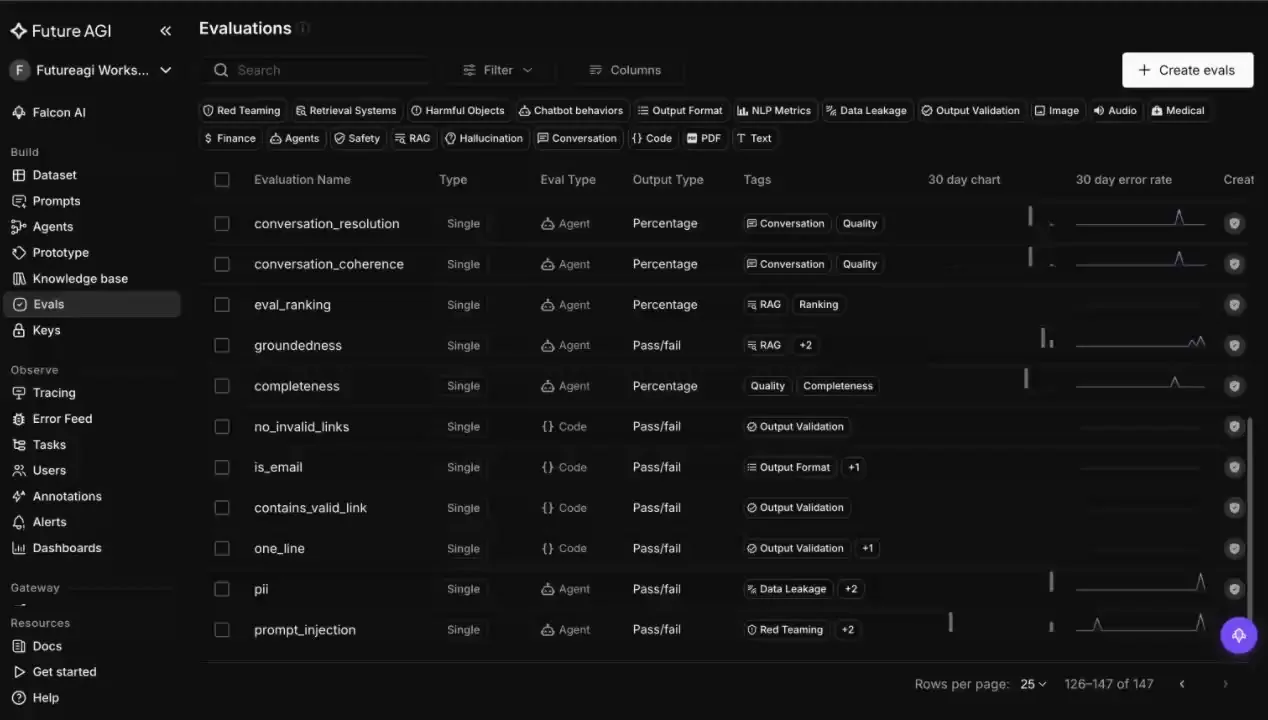
Each agent does a different job, so each needs different criteria. Judging a multi-agent system only by its final answer hides which step went wrong. With Future AGI you define a custom eval for each agent’s role. Each agent gets its own thresholds and its own gate.
The planner is gated on Task Completion, did it produce a usable plan, and Instruction Adherence, did it follow the planning rules. The researcher is gated on Groundedness, Context Adherence, and Detect Hallucination, so its evidence is supported rather than invented. The writer is gated on Instruction Adherence and Task Completion. A researcher that hallucinates more never earns the Production label, even when the planner and writer are fine.
When one agent’s prompt is close but under its bar, optimization writes the next version for that agent alone. You point the open-source agent-opt library at that agent’s prompt, an evaluator, and a dataset, and it rewrites and rescores the prompt across six algorithms (Random Search, Bayesian, ProTeGi, Meta-Prompt, PromptWizard, GEPA), handing back a higher-scoring version for that one agent. You optimize one agent’s prompt while holding the others fixed.
Because only one agent moves, any improvement traces to that agent alone. All 70+ built-in evaluators are listed in the evaluation library, and the optimization docs walk through configuring a per-agent run.
Tracing Each Agent’s Prompts With traceAI

Offline scores tell you an agent is good on a fixed dataset. The live system is where it has to stay good, and in a multi-agent run several agents fire on a single request. traceAI is OpenTelemetry-native, recording each prompt template and its variables on every span.
Every span also carries the gen_ai.prompt.template.version attribute, binding each agent’s call to the exact version it ran. The spans from one request share a trace, so you can see what each agent did on a real run in one place.
That makes a multi-agent regression debuggable at the right granularity. When the final output is wrong, you open the trace and find the agent whose span produced the bad step, then read its version and variables straight off the span instead of guessing which agent drifted.
You then turn that case into a new evaluation example for that agent’s gate, fixing the agent that regressed rather than the whole pipeline by trial and error. traceAI’s span fields, including each agent’s prompt version, are described in the observability guide.
Setting Up Future AGI Across Your Agents
Onboarding an agent takes little effort; the discipline below is what keeps a growing roster accountable one at a time.
- Give every agent its own named template rather than a shared prompt or inline strings, so each role has an independent, immutable version history.
- Assign per-agent deployment labels and promote one agent at a time, so a change to the researcher never silently moves the planner or the writer.
- Pin a role-specific evaluation set per agent and gate each promotion on that agent’s own criteria: the planner on task completion, the researcher on groundedness, the writer on instruction adherence.
- Instrument every agent with traceAI from day one, so each agent’s span carries its
gen_ai.prompt.template.versionand a regression points to a specific agent and a specific version. - When one agent underperforms, optimize just that agent with agent-opt against its evaluator while holding the others fixed, then promote by label once it clears the gate.
Future AGI is licensed Apache-2.0 and self-hosts through Docker Compose, which keeps every agent’s registry, evaluators, and traces on hardware you control, however many agents you add. Deployment instructions are in the Future AGI repository.
Where Future AGI Fits in Your Multi-Agent Stack
When a planner, a researcher, and a writer run as one system, a drop in quality could come from any of them, and a shared prompt store cannot say which. Future AGI gives each agent its own version history, role-fit gate, and trace, so you fix the agent that regressed and leave the rest alone.
Open Future AGI and bring your first agent’s prompt into the registry. Add the rest as you wire in evaluation and tracing.
Frequently Asked Questions
What Is Prompt Management for Multi-Agent Systems?
Which Prompt Management Platform Is Best for Multi-Agent Systems in 2026?
How Do You Version Prompts for Many Agents Without Them Colliding?
How Do You Evaluate Each Agent in a Multi-Agent System Separately?
Can You Improve One Agent's Prompt Without Breaking the Others?
Can You Self-Host Prompt Management for a Multi-Agent System?
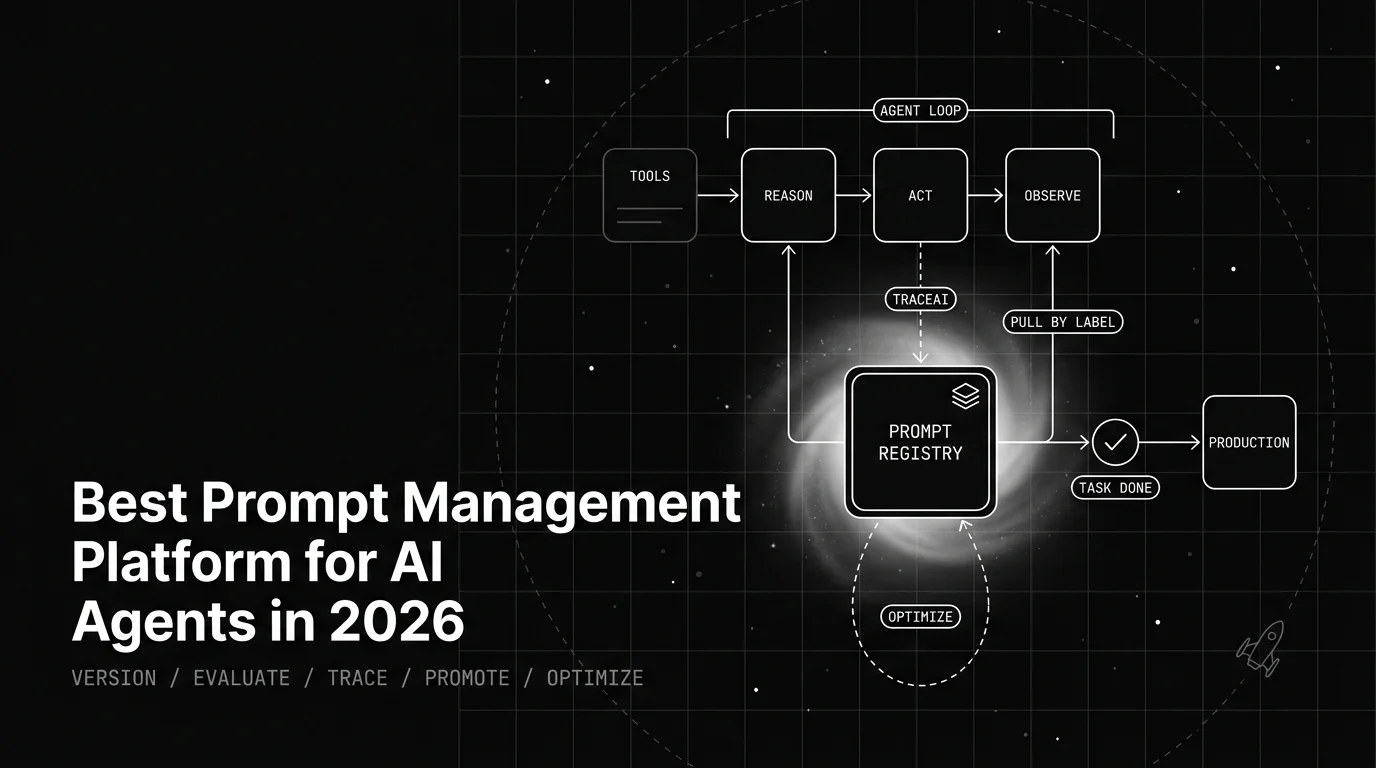
Version each agent prompt, gate promotion on task-completion and tool-call evaluators, then trace every run back to its version. Future AGI is Apache-2.0.

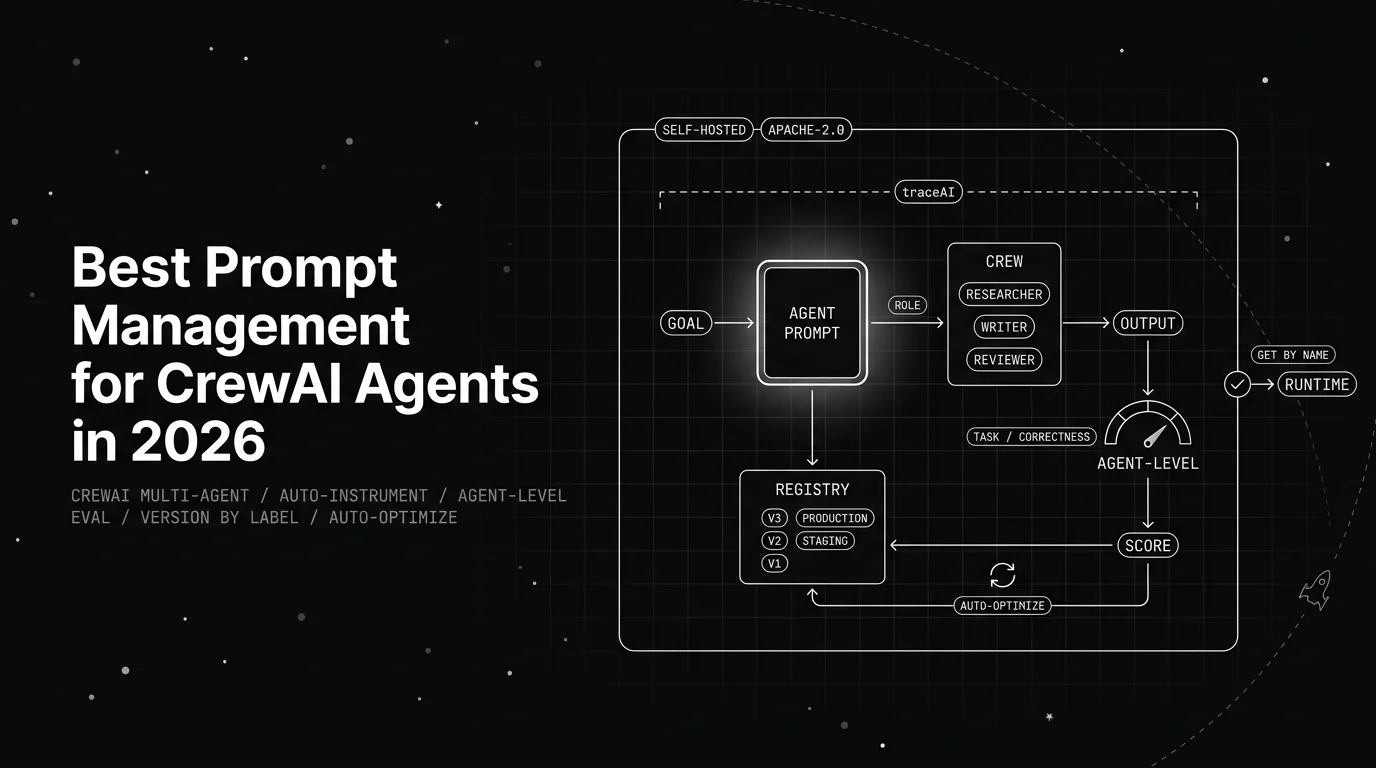
The 6 best prompt management tools for CrewAI agents in 2026, ranked on integration, per-agent versioning, tracing, and built-in evaluation of prompts.

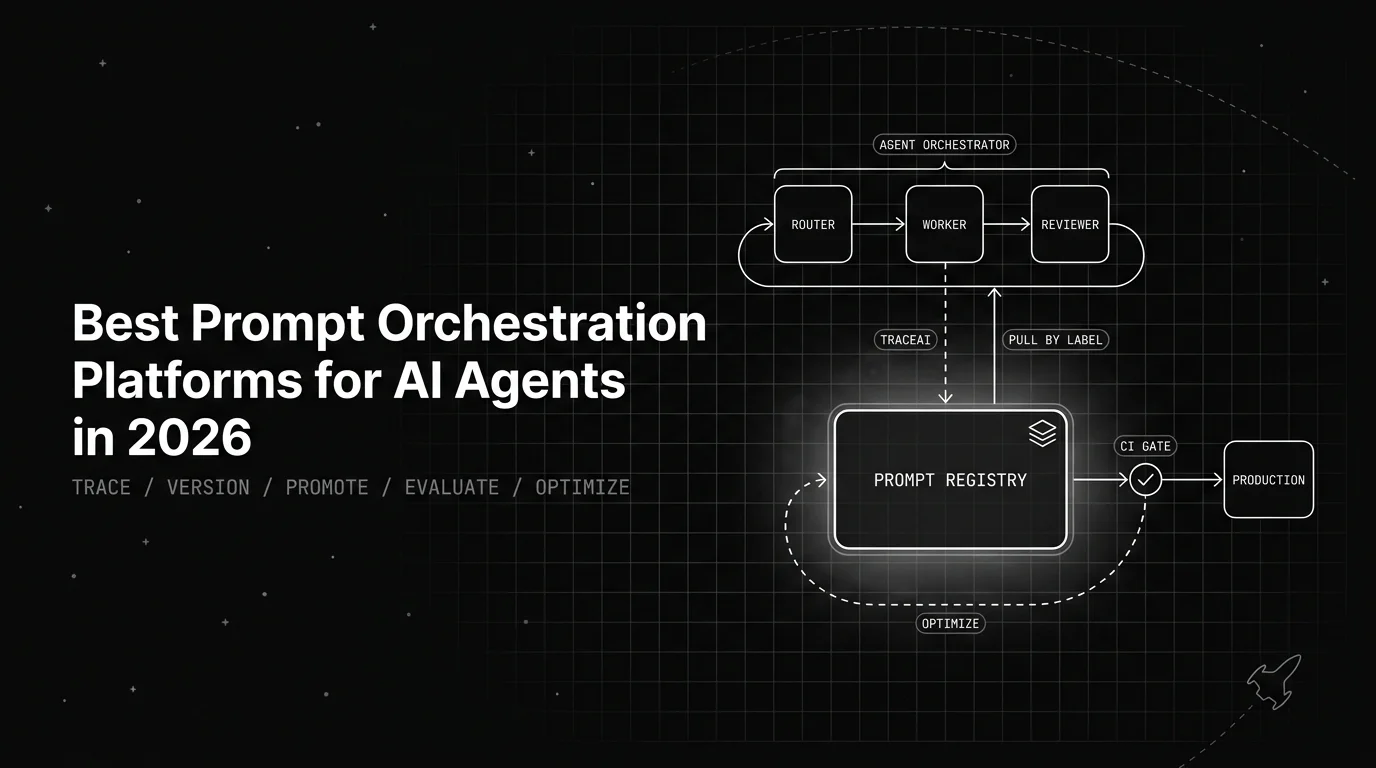
Compare the 6 best prompt orchestration platforms for AI agents in 2026 on per-step versioning, tracing, evaluation, and automated prompt optimization.