Best 5 OpenAI Agents SDK Alternatives in 2026
Five OpenAI Agents SDK alternatives on multi-provider routing, production patterns, observability. What each actually fixes once OpenAI-only lock-in bites.
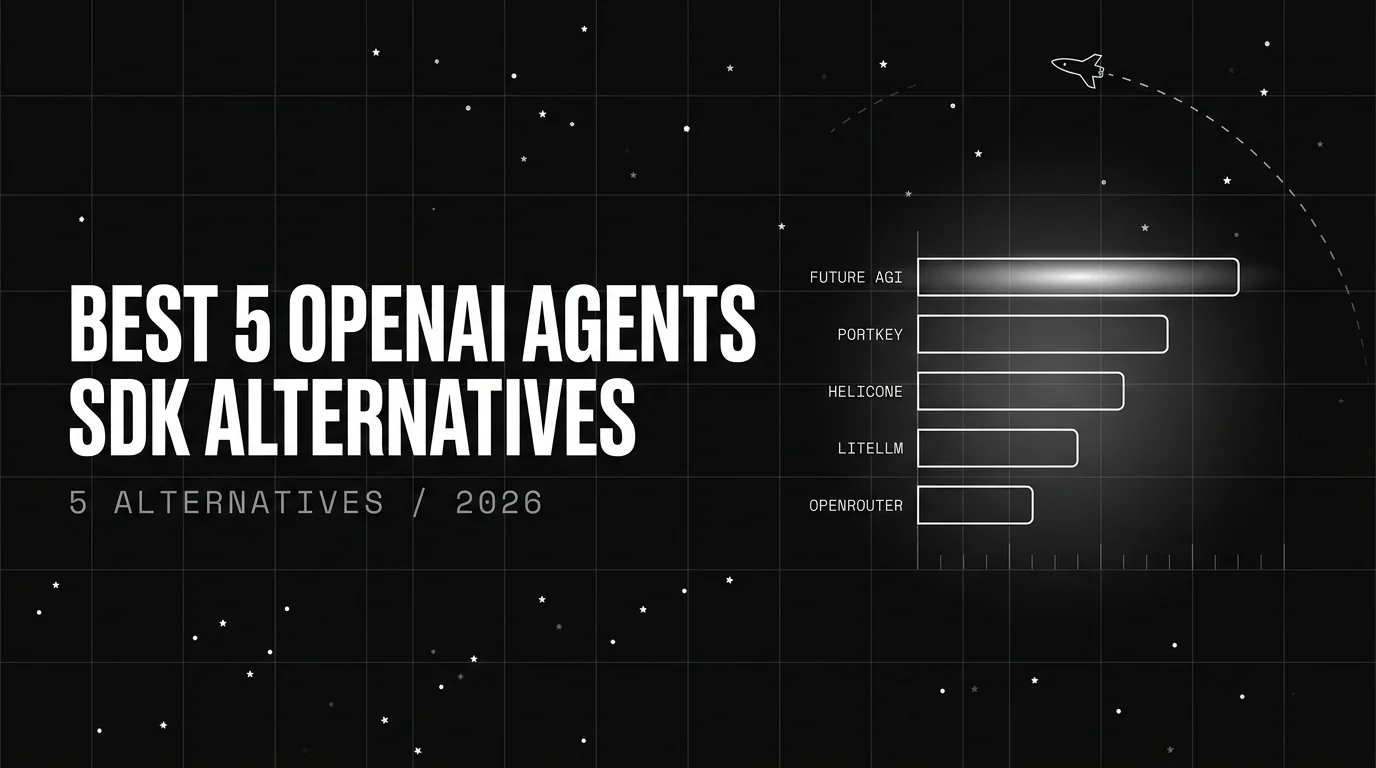
Table of Contents
OpenAI’s Agents SDK shipped in March 2025 as the official successor to the Assistants API beta, a Python and TypeScript runtime for agent loops with handoffs, guardrails, and tracing. A year later, teams that picked it for the developer experience are hitting the same wall: the runtime assumes OpenAI models, the production patterns are still being written in public, and the observability story leans on OpenAI’s own tracing dashboard. For teams that need provider flexibility, mature multi-agent patterns, or graph-shaped control flow, the SDK starts to feel like training wheels you can’t remove.
This guide ranks five real agent-framework alternatives worth migrating to, names what each fixes, and ends with the platform layer that augments whichever framework you pick.
TL;DR: five real OpenAI Agents SDK alternatives
| Why you are leaving OpenAI Agents SDK | Pick | Why |
|---|---|---|
| You want role-based crews and a YAML-first authoring surface | CrewAI | Crew, agent, and task primitives with a mature config-driven workflow |
| You want multi-agent conversations with built-in human-in-the-loop | AutoGen | Microsoft Research’s group-chat pattern with rich orchestrator semantics |
| You want explicit graphs over implicit handoffs | LangGraph | Typed state graphs, durable execution, and a debugger that mirrors the topology |
| You want strict typing and Pydantic models all the way through | Pydantic AI | Pydantic-native agent definitions with first-class validation and dependency injection |
| You want a retrieval-first agent surface with deep RAG primitives | LlamaIndex Agents | Native query engines, workflows, and structured retrieval over many sources |
Future AGI isn’t in this table. FAGI isn’t an agent framework, it’s the platform layer (gateway, observability, evals, optimizer, guardrails) that augments whichever of the five you pick (or the SDK itself, kept in place). The dedicated FAGI section is below the five alternatives.
Why people are leaving OpenAI Agents SDK in 2026
Four exit drivers come up repeatedly in Hacker News threads on the SDK’s GA, /r/LocalLLaMA and /r/LLMDevs migration posts, and the openai-agents-python issue tracker.
1. OpenAI-only model lock-in
The SDK was designed around OpenAI’s responses and function-calling APIs. Anthropic, Google, and the rest of the field are documented as “experimental” or community-maintained, and the official adapter list lags new releases by weeks. Teams that pick a model per task. Claude for long-context, Gemini for vision, GPT for tool dispatch, an open-weights model for cheap drafts, write the routing layer themselves. The /r/LLMDevs March 2026 thread has a recurring pattern: the SDK starts as Agent(model="gpt-4o") and ends as a fork with a custom ModelProvider the team now maintains.
2. Framework newer than the patterns it needs
The SDK reached GA in 2025 and has iterated quickly, but production patterns (durable execution, retry policies, idempotent tool calls, deterministic replays) are still being established in public. The agent architecture patterns guide names the shapes most production agents settle on. Compared with LangGraph (two-plus years of LangChain production scars) or AutoGen (public since 2023), the SDK’s cookbook is thinner.
3. Flat handoff model limits multi-agent topology
The SDK’s Handoff primitive is intentionally minimal, one agent delegates to another, run context propagates. That covers simple delegation cleanly. It doesn’t cover hierarchical crews, conversation-style group chat with N peers, or graph-shaped workflows with cycles and checkpoints. For teams whose product map needs roles, conversation patterns, or explicit topology, the SDK’s flatter model is a ceiling.
4. Sparse third-party observability integrations
The SDK’s tracing emits to OpenAI’s dashboard cleanly. Sending the same data to Datadog, Honeycomb, Arize, or any OTel sink works in principle through set_trace_processors, but docs cover one or two examples, the schema is OpenAI-specific (not OpenTelemetry GenAI), and integrators report writing adapter code that the next SDK release breaks. For teams whose observability stack predates the SDK, the cost is real and recurring.
What to look for in an OpenAI Agents SDK replacement
Score replacements on the seven axes that map to the surfaces you’re actually moving off:
| Axis | What it measures |
|---|---|
| 1. Multi-provider model support | Are Anthropic, Google, and open-weights models first-class, not experimental? |
| 2. Production patterns documented | Durable execution, retries, idempotency — covered or invented per team? |
| 3. Multi-agent topology depth | Crews, group chat, graphs — or just flat handoff? |
| 4. State and persistence | Can workflows survive process restarts? Checkpoints? Human-in-the-loop? |
| 5. Type safety | Typed inputs, outputs, tool args — validated at the boundary? |
| 6. Migration tooling from OpenAI Agents SDK | Are there published shims, importers, or examples to ease the cutover? |
| 7. Licensing and ecosystem maturity | OSS, permissive, large community? |
Note: gateway, observability, eval, optimizer, and guardrails are not on this list. None of the five frameworks ship those natively. That gap is what the Future AGI section below covers.
1. CrewAI: Best for role-based, config-driven crews
Verdict: CrewAI is the pick when the mental model is “a team of specialists with roles, tools, and a shared goal” and the authoring surface should look like configuration rather than imperative code. Crews, agents, and tasks are first-class; YAML and Pydantic configs are idiomatic; two years of production deployments to point at.
What it fixes versus OpenAI Agents SDK:
- Multi-provider out of the box. CrewAI uses LiteLLM under the hood, so Anthropic, Google, Bedrock, Vertex, and open-weights endpoints are first-class. The SDK’s
model="gpt-4o"becomesllm=ChatAnthropic(...)without a fork. - Crew, agent, task primitives. A crew composes agents (role, goal, backstory, tools) with tasks (description, expected output, assignment). The SDK’s
Agent+Handoffpair is lower-level; CrewAI’s primitives encode the orchestration pattern teams typically build by hand. - YAML-first authoring. Crews and agents can be defined in YAML with Python wiring only for tools and runtime hooks. The SDK is Python-first; CrewAI’s YAML lets non-engineering stakeholders edit role specs without a PR.
- Mature ecosystem. CrewAI Studio (visual builder), CrewAI Enterprise (managed, RBAC, audit), and a tools registry covering hundreds of integrations.
Migration from OpenAI Agents SDK: SDK Agent(name, instructions, tools) maps to CrewAI Agent(role, goal, backstory, tools), the instruction string splits into role/goal/backstory. SDK handoffs translate to CrewAI’s task dependency graph. SDK tools port near-directly; CrewAI prefers BaseTool subclasses but accepts plain callables. Timeline: five to eight engineering days for a moderate system.
Where it falls short:
- No native gateway, eval, or optimizer.
- The role/goal/backstory pattern is opinionated; teams that want bare agents find it heavyweight.
- Python-only; if language reach was an exit driver, CrewAI doesn’t move that axis.
Pricing: Open source under MIT. CrewAI Enterprise from custom pricing, with a free starter tier.
Score: 5 of 7 axes (missing: language reach, state/persistence depth).
2. AutoGen: Best for multi-agent conversations with HITL
Verdict: AutoGen is the pick when the system is fundamentally a conversation among several specialized agents (planner, coder, critic, executor) with a human optionally in the loop. Microsoft Research’s framework has been public since 2023, went through a major v0.4 redesign, and ships orchestrator semantics, group chat, swarm, Magentic-One, that the SDK’s flatter Handoff doesn’t match.
What it fixes versus OpenAI Agents SDK:
- Multi-agent orchestration as the core primitive. GroupChatManager, RoundRobinGroupChat, SelectorGroupChat, and Magentic-One give built-in patterns for N-agent topologies.
- Human-in-the-loop as a first-class participant. UserProxyAgent is a peer in the conversation, not a callback. For workflows where a human approves tool calls, the SDK’s
input_guardrailpattern feels grafted-on; AutoGen’s HITL is native. - Multi-provider via model clients. OpenAIChatCompletionClient, AnthropicChatCompletionClient, AzureChatCompletionClient, and Ollama clients are first-class.
- Microsoft Research provenance. Magentic-One (which scored on GAIA and AssistantBench) is built on AutoGen.
Migration from OpenAI Agents SDK: SDK Agent ports to AutoGen AssistantAgent. SDK tools port to AutoGen tool registrations. SDK handoff chains translate to a GroupChatManager with a routing function. The mental model shift is bigger than CrewAI. AutoGen thinks in conversations, the SDK in handoffs. Timeline: seven to ten engineering days, plus a sprint to learn v0.4 patterns.
Where it falls short:
- No native gateway, eval, or optimizer.
- The v0.4 redesign is recent enough that some community examples still target v0.2, a documentation maze for newcomers.
- Multi-agent conversations produce noisier traces than the SDK’s flatter model; observability investment pays off faster here.
Pricing: Open source under MIT.
Score: 5 of 7 axes (missing: language reach, type-safety in the conversation contract).
3. LangGraph: Best for explicit graphs and durable execution
Verdict: LangGraph is the pick when implicit handoffs feel like a regression, you want control flow as a typed state graph you can render, debug, and reason about node-by-node. Built on the LangChain runtime, with the most mature durable-execution story (persistence, time-travel, replay) in this list. (See what LangGraph is for the stateful-graph model.)
What it fixes versus OpenAI Agents SDK:
- Explicit graphs over implicit handoffs. Every node is a step; every edge a transition; conditional routing is a function on the state. The SDK’s handoffs are easier to write but harder to reason about at twenty-plus agents. LangGraph Studio renders the graph live with state at every step.
- Durable execution. Checkpointers (Postgres, SQLite, in-memory) persist graph state. Crash recovery, time-travel debugging, and pause-and-resume HITL are first-class.
- Multi-provider via LangChain. Any LangChain chat model works. Anthropic, Google, Bedrock, Vertex, Mistral, Ollama, dozens of others.
- LangGraph Platform. Hosted deployment, assistants API, cron triggers, and human-feedback queues, with self-host options.
- TypeScript implementation. Polyglot teams get a real second language.
Migration from OpenAI Agents SDK: SDK Agent maps to a LangGraph node (typically a ToolNode plus an LLM-call node). SDK handoffs translate to conditional edges keyed on graph state. SDK tools port via @tool. The graph mental model is the biggest shift in this list, most teams budget a learning sprint. Timeline: ten to fifteen engineering days for a moderate system.
Where it falls short:
- The graph mental model is the steepest learning curve here. Teams that want fewer lines of code find it heavyweight.
- LangSmith handles tracing but the eval surface is light, and prices climb on production traffic.
- Heavy reliance on LangChain primitives, migrating off LangGraph later means migrating off LangChain abstractions too.
Pricing: Open source under MIT. LangGraph Platform from $39/month per seat (Plus), Enterprise custom.
Score: 6 of 7 axes (missing: smallest-surface ergonomics).
4. Pydantic AI: Best for typed, validation-first agents
Verdict: Pydantic AI is the pick when the strongest opinion is “every input and output should be a Pydantic model, validated at the boundary.” Built by the Pydantic team in 2024, focused on type safety, dependency injection, and structured outputs, closest to FastAPI’s ergonomics for the agent world.
What it fixes versus OpenAI Agents SDK:
- Pydantic-native type safety. Agent inputs, outputs, tool arguments, and responses are Pydantic models. Validation at the boundary; downstream code receives typed objects, not stringly-typed JSON.
- Dependency injection via
RunContext. Tools receive a typed context (database connections, HTTP clients, feature flags) injected at runtime. Closer to FastAPI’sDependsthan the SDK’s kwargs. - Multi-provider via model factories. OpenAI, Anthropic, Google, Groq, Mistral, Ollama, and Cohere are first-class.
- Smaller surface area. Pydantic AI deliberately ships fewer primitives than CrewAI, AutoGen, or LangGraph, closer in shape to the SDK, which makes migration shorter.
Migration from OpenAI Agents SDK: SDK Agent maps closely to Pydantic AI Agent. SDK tools port near-directly via @agent.tool. SDK structured outputs map to result_type. SDK handoffs need the most work. Pydantic AI ships no built-in handoff primitive, so teams encode them as tools returning a typed “delegate to X” object. Timeline: four to seven engineering days, the shortest migration in this list.
Where it falls short:
- No first-class multi-agent orchestration. Handoffs and crews are hand-rolled on top of the agent primitive.
- Observability lives in Logfire (paid add-on) or via OTel exporters you wire.
- Opinionated dependency on Pydantic is a feature for some teams and a constraint for others.
Pricing: Open source under MIT. No hosted product from the Pydantic team; deployment is BYO.
Score: 4 of 7 axes (missing: multi-agent orchestration depth, state/persistence, hosted ecosystem).
5. LlamaIndex Agents: Best for retrieval-first workflows
Verdict: LlamaIndex Agents is the pick when the workload is retrieval-heavy, agents that search documents, run query engines, and synthesize structured answers across many sources. The agent surface sits on top of LlamaIndex’s mature retrieval primitives, so RAG quality is unusually high without a second framework.
What it fixes versus OpenAI Agents SDK:
- Native retrieval primitives. Vector indexes, hybrid retrievers, query engines, and re-rankers are framework-native. SDK users typically pair with a separate RAG layer.
Workflowprimitives. Event-driven steps cover graph-shaped patterns without a separate orchestration framework.- Multi-provider via model adapters. OpenAI, Anthropic, Bedrock, Vertex, Ollama, and dozens more.
- LlamaIndex.TS. TypeScript implementation covers the polyglot case for retrieval-driven agents.
Migration from OpenAI Agents SDK: SDK Agent maps to a LlamaIndex AgentRunner or Workflow. SDK tools port near-directly via FunctionTool. SDK handoffs translate to workflow events or agent delegation. Timeline: seven to ten engineering days.
Where it falls short:
- Heavier than the SDK for non-retrieval workloads. If the agent never reads documents, LlamaIndex is overkill.
- Multi-agent patterns (crews, group chat) aren’t the framework’s strength.
- No native gateway, eval, or optimizer.
Pricing: Open source under MIT. LlamaCloud (managed retrieval) is usage-priced.
Score: 5 of 7 axes (missing: deep multi-agent topology, conversation patterns).
Future AGI: the platform layer that augments whichever framework you pick
CrewAI, AutoGen, LangGraph, Pydantic AI, and LlamaIndex Agents are agent runtimes. Future AGI isn’t. FAGI doesn’t define Agent classes, Crew compositions, or graph nodes. It’s the platform layer that sits underneath (and in front of) whichever agent runtime you pick (the OpenAI Agents SDK itself, or any of the five above) and closes the gaps every one of these frameworks has in common: no native multi-provider gateway with budgets and fallbacks, no LLM-shaped observability without a paid add-on, no eval suite scoring production traces, no prompt optimizer, no inline guardrails.
The shape is a self-improving loop, trace, eval, cluster, optimize, route, re-deploy, wrapped around your agent runtime.
What FAGI adds to any framework on this list (including the SDK itself):
traceAI(Apache 2.0). OpenInference-compatible instrumentation with 35+ framework integrations including the OpenAI Agents SDK, CrewAI, AutoGen, LangGraph, Pydantic AI, LlamaIndex, and LangChain. Spans flow into FAGI’s Command Center or any OTel sink (Grafana, Datadog, Honeycomb).ai-evaluation(Apache 2.0), task-completion, faithfulness, tool-use, structured-output, and custom rubrics that score every trace automatically.
agent-opt(Apache 2.0), prompt optimizer that takes eval-scored traces and rewrites prompts via ProTeGi, Bayesian search, or GEPA. Output is a new prompt version with a measured eval delta.
- Agent Command Center (hosted), multi-provider gateway fronting OpenAI, Anthropic, Google, Bedrock, Vertex, Azure, Mistral, and self-hosted endpoints with consistent failover, per-tenant budgets, virtual keys, RBAC, failure-cluster views, AWS Marketplace procurement, SOC 2 Type II.
- Protect guardrails. Inline PII, prompt-injection, jailbreak, and policy enforcement with median ~67ms text-mode latency and ~109ms image-mode (per arXiv 2510.13351).
Why “augment, not replace”: FAGI is framework-agnostic. You can keep the OpenAI Agents SDK and add FAGI underneath to fix multi-provider, observability, eval, and optimizer gaps without migrating the runtime. Or migrate to CrewAI/AutoGen/LangGraph/Pydantic AI/LlamaIndex Agents and put FAGI underneath that, the platform layer survives the framework migration. Most teams that try to “replace the SDK” because observability or routing is painful end up regretting the runtime churn; the right call is usually to layer the platform.
Capability matrix
| Axis | CrewAI | AutoGen | LangGraph | Pydantic AI | LlamaIndex Agents |
|---|---|---|---|---|---|
| Multi-provider model support | Via LiteLLM | Via per-provider clients | Via LangChain | Via per-provider factories | Via per-provider adapters |
| Production patterns documented | Mature crew + task patterns | Group-chat + Magentic-One | Durable execution + replay | Type-safe boundary | Workflow + retrieval |
| Multi-agent topology depth | Crews + processes | GroupChat + conversation | Graphs + cycles | Hand-off via tools | Workflow events |
| State and persistence | Limited | Limited | Strong (checkpointer) | Request-scoped | Workflow-scoped |
| Type safety | Pydantic-based | Lighter on types | Pydantic for state | Pydantic-native | Pydantic for responses |
| Language reach | Python only | Python only | Python + TS | Python only | Python + TS |
| Licensing | MIT | MIT | MIT | MIT | MIT |
Future AGI isn’t in the matrix because it isn’t a framework. FAGI plugs into all five (and the SDK itself).
Migration notes: the pattern that always works
Three surfaces always need attention.
Pick the right replacement, not any replacement alone
The cleanest migration isn’t “rewrite every agent on day one.” It’s “pick a target runtime that matches the topology you actually need.” Crews of specialists then CrewAI. Conversation among peers then AutoGen. Graph-shaped workflows then LangGraph. Strict typing then Pydantic AI. Retrieval-heavy then LlamaIndex Agents. Mis-picking the runtime is the most expensive mistake.
Move agents one capability tier at a time
Start with the lowest-risk agent, typically read-only research or summarization with no irreversible tool calls. Port its definition, tool set, and eval harness. Run both runtimes in parallel against the same inputs for one sprint, validate parity on a held-out eval set, then port the next. This keeps the migration reversible.
Bolt on the platform layer once, not per framework
This is where FAGI sits. traceAI instruments whichever runtime you ended up on. ai-evaluation scores the traces. agent-opt rewrites prompts. Agent Command Center fronts the agents with a gateway and guardrails. The platform layer survives a framework migration, when CrewAI doesn’t pan out and you swap to LangGraph six months later, the gateway config changes but the instrumentation, evals, and optimizer keep working.
Do not migrate the SDK if the gap is platform, not runtime
If your reason for leaving is the multi-provider, observability, or optimizer gap (none of which are runtime concerns) the framework migration is wrong. Keep the SDK and add FAGI underneath. Point the SDK’s model client at the Agent Command Center base URL, drop traceAI instrumentation in, wire ai-evaluation into CI, and turn on agent-opt once a baseline exists.
Decision framework: Choose X if
Choose CrewAI if the mental model is a team of specialists with roles and goals, and you want a YAML-first authoring surface.
Choose AutoGen if the workflow is fundamentally multi-agent conversation, with a human optionally in the loop as a peer.
Choose LangGraph if implicit handoffs feel like a regression and you want control flow as a typed state graph with durable execution.
Choose Pydantic AI if the bar is “every boundary is a Pydantic model” and the system is closer in shape to the SDK than to a multi-agent platform.
Choose LlamaIndex Agents if the workload is retrieval-heavy and you would otherwise stand up a separate RAG stack alongside the SDK.
Add Future AGI underneath any of the five (or the SDK itself, kept in place) when the gap is multi-provider routing, observability, evals, optimizer, or inline guardrails.
What we did not include
Three products show up in other 2026 listicles that we left out. Semantic Kernel is Microsoft’s earlier agent framework, increasingly superseded by AutoGen for new projects, worth a second look only if you’re deep in the .NET ecosystem. Smolagents (Hugging Face) is great for code-generating agents on local models but lacks the production patterns this cohort needs for enterprise deployments. OpenAI Swarm was OpenAI’s pre-Agents SDK multi-agent reference and is no longer recommended. Swarm’s handoff pattern lives on inside the Agents SDK itself.
Related reading
- Best 5 LangGraph Alternatives in 2026
- Best 5 CrewAI Alternatives in 2026
- Best 5 AutoGen Alternatives in 2026
- Best AI Gateways for Agentic AI in 2026
Sources
- OpenAI Agents SDK documentation, openai.github.io/openai-agents-python
- OpenAI Agents SDK GitHub repository, github.com/openai/openai-agents-python
- CrewAI GitHub repository, github.com/crewAIInc/crewAI
- AutoGen GitHub repository, github.com/microsoft/autogen
- LangGraph GitHub repository, github.com/langchain-ai/langgraph
- Pydantic AI documentation, ai.pydantic.dev
- LlamaIndex GitHub repository, github.com/run-llama/llama_index
- Future AGI Agent Command Center, futureagi.com/platform/monitor/command-center
- Future AGI traceAI, github.com/future-agi/traceAI (Apache 2.0)
- Future AGI ai-evaluation, github.com/future-agi/ai-evaluation (Apache 2.0)
- Future AGI agent-opt, github.com/future-agi/agent-opt (Apache 2.0)
- Future AGI Protect latency benchmark, arxiv.org/abs/2510.13351 (67 ms text, 109 ms image)
Frequently Asked Questions
Why are people moving off OpenAI Agents SDK in 2026?
What is the closest like-for-like alternative?
Do I need to rewrite my agents to migrate?
Can I keep the SDK and still fix the multi-provider, eval, and optimizer gaps?
Is there an open-source alternative?
How does Future AGI compare to the SDK?
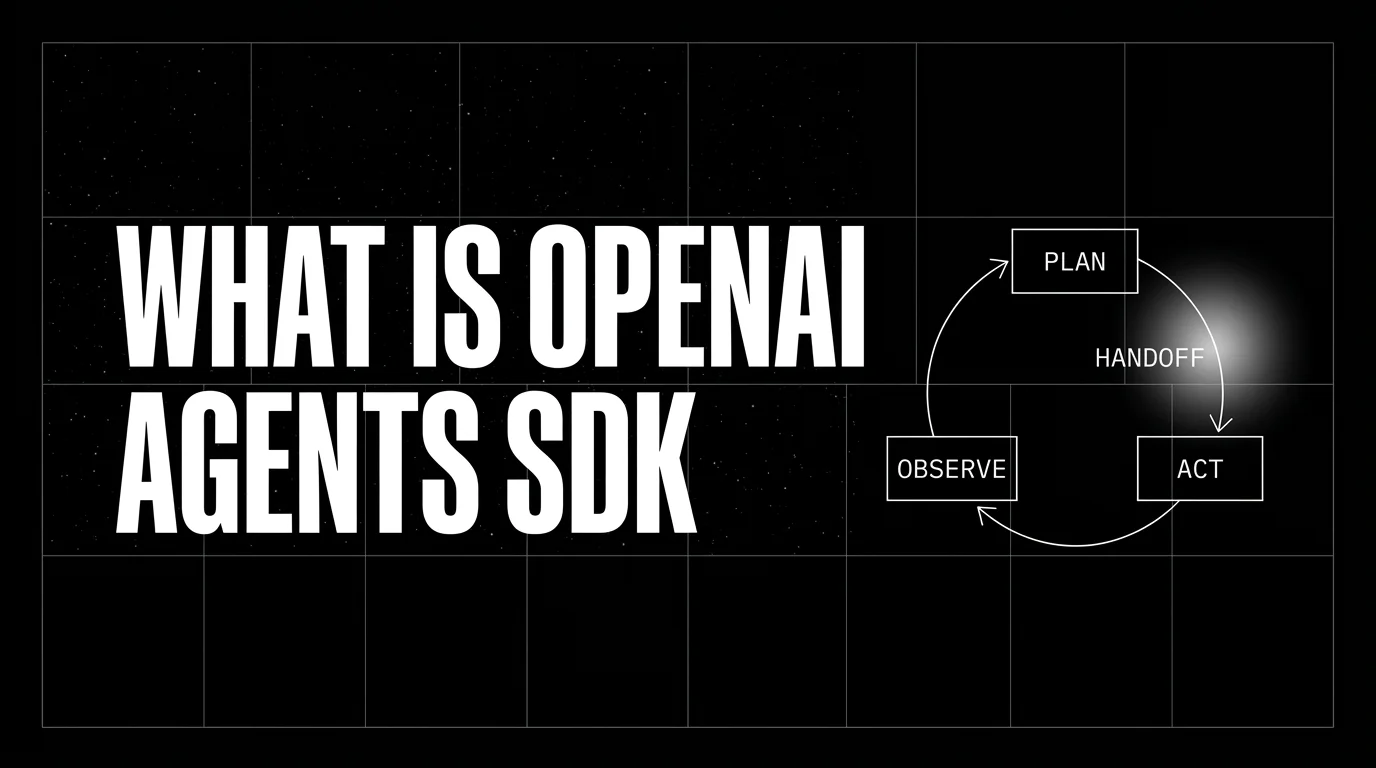
OpenAI Agents SDK is OpenAI's open-source framework for agent loops, handoffs, guardrails, and sessions. Architecture, primitives, and how to trace it.

LangGraph, CrewAI, Microsoft Agent Framework, AutoGen, Mastra, OpenAI Agents SDK, and Google ADK ranked for 2026 by debug, eval, and production readiness.
Compare seven OSS agent frameworks for production teams in 2026, with architecture, license, maturity, latest versions, and practical tradeoffs.