Best 5 NVIDIA NeMo Guardrails Alternatives in 2026
Five NVIDIA NeMo Guardrails alternatives on inline runtime latency, gateway, optimizer, languages. What each actually fixes outgrowing Colang flows.
Table of Contents
NVIDIA NeMo Guardrails is the open-source toolkit that opened the “programmable guardrails as a flow language” category in 2023, a Python framework with a DSL called Colang for declaring conversational rails, plus a runtime that executes those rails before, between, and after model calls. Three years later the toolkit that won the category is also the surface teams outgrow. Rails are one capability inside a stack that also needs a gateway, an inline runtime guardrail layer, an eval harness, and an optimizer. NeMo ships the Colang runtime and stops; the gateway, the optimizer, and the multi-language coverage are bring-your-own, and the commercial roadmap stays tied to NVIDIA AI Enterprise.
This guide ranks five alternatives worth migrating to, names what each fixes versus NeMo Guardrails, and walks through the migration that always bites: replacing Colang flows with inline runtime guardrails at the gateway hop.
TL;DR: pick by exit reason
| Why you are leaving NeMo Guardrails | Pick | Why |
|---|---|---|
| You want inline guardrails plus a native gateway, eval, and optimizer in one stack | Future AGI Agent Command Center | Protect inline at ~67 ms text + ~109 ms image plus gateway, eval, and a self-improving loop on Apache 2.0 |
| You want a managed prompt-injection detector with a published benchmark cadence | Lakera Guard | Hosted REST detector with PINT and Gandalf adversarial corpora and SLA |
| You want a hosted policy-and-session control panel | Aporia | Policy-first guardrails platform with sessions and analytics in one surface |
| You want a hosted gateway with a Guardrails plugin layer | Portkey | Managed proxy plus Guardrails plugin in one dashboard |
| You want a pure OSS validation library staying close to NeMo’s surface area | Guardrails AI | Python validator hub with RAIL spec and Pydantic-typed outputs |
Why people are leaving NVIDIA NeMo Guardrails in 2026
Six exit drivers show up repeatedly in /r/LLMDevs, the NeMo Guardrails GitHub issue tracker, and AppSec Discord servers.
1. Colang is a DSL with its own learning curve
Colang is NeMo’s domain-specific language for declaring rails, define user, define bot, define flow, and the indent-sensitive flow grammar. The 1.0 syntax is approachable for a single rail; Colang 2.0 (the 2024 rewrite) added asynchronous flows, actions with explicit return values, and richer pattern matching, and the curve climbed. Every new hire adds a “learn Colang” task before they can extend the rails, when the underlying logic is a handful of regex matches, a classifier call, and a policy decision.
2. Latency overhead from rail-checks on the request path
A NeMo request executes input rails, dialog rails, retrieval rails (around RAG), and output rails. Each can call out to a classifier, a moderation API, or a self-check LLM. Stacked rails commonly add 200 to 600 ms p95 on top of model latency, self-check LLM rails (an extra LLM call to score the model’s own output) account for the larger share. Real-time agents see the rail budget eat the latency headroom the gateway optimizes for.
3. NVIDIA-tied roadmap direction
NeMo is Apache 2.0 and runs anywhere, but the commercial roadmap, integrations, and enterprise support contracts route through NVIDIA AI Enterprise. Flagship integrations highlight NIM endpoints, the NeMo Retriever, and NVIDIA-hosted moderation models. For teams whose model stack is OpenAI, Anthropic, Bedrock, and Vertex, the runtime works, but the roadmap signals where the maintainers are putting polish.
4. Python-only: TypeScript, Go, Java, and Rust services bring their own
NeMo is a Python package. The Colang parser, rails runtime, and action registry all assume a Python call site. Teams with TypeScript, Go, Java, or Rust services either expose the runtime behind a Python HTTP shim or rewrite the rails in their host language. The safety policy splits across two codebases the moment the stack spans more than one language.
5. No native gateway, optimizer, or eval beyond guardrails
NeMo owns rails. It doesn’t route to upstream providers, cache prompts, hold virtual keys, score traces, cluster failures, or optimize the candidate prompt. The 2023 buy was “slot Colang in front of the LLM call.” The 2026 review is “we run a gateway, an eval suite, an optimizer, and NeMo, four things carrying overlapping concerns, three of them outside the toolkit.”
6. Smaller community than Lakera and Aporia for inline guardrails
The NVIDIA/NeMo-Guardrails repository is active, but the split between OSS Colang and NVIDIA AI Enterprise has slowed cadence on inline-runtime polish. Lakera and Aporia ship a hosted-first surface with the SLA and benchmark cadence (PINT, Gandalf for Lakera) AppSec procurement asks for.
What to look for in a NeMo Guardrails replacement
Score replacements on the seven axes that map to the surfaces you’re consolidating off:
| Axis | What it measures |
|---|---|
| 1. Inline runtime latency | Median and p95 detection latency on the request path |
| 2. Native gateway, routing, fallback | Does the runtime ship a gateway, virtual keys, and routing in one product? |
| 3. Eval and optimizer loop | Does the runtime feed miss-classifications back into the candidate-prompt corpus? |
| 4. Multi-language coverage | Can TypeScript, Go, Java, and Rust call sites use the same runtime without a Python shim? |
| 5. Vendor neutrality | Is the roadmap tied to a single hardware or model vendor, or cross-provider? |
| 6. Direct + indirect + tool-output coverage | Are the three injection channels first-class on the same span, or only direct? |
| 7. Block / sanitize / log modes per route | Does the runtime own the verdict-to-action policy without writing a Colang flow? |
1. Future AGI Agent Command Center: Best for inline runtime with gateway, eval, and optimizer
Verdict: Future AGI is the only alternative here that replaces NeMo’s Colang flows with an inline runtime and replaces the three adjacent surfaces (gateway, eval, optimizer) at the same time. Agent Command Center captures the trace, runs Protect inline at the gateway hop, scores on the same OTel span, clusters failures, runs the optimizer, and pushes the updated corpus back into the runtime on the next request. NeMo is a rails framework with a DSL; FAGI is a runtime, a gateway, an eval suite, and an optimizer wired together, policy in YAML on the route rather than Colang.
What it fixes versus NeMo Guardrails:
- Inline runtime, no rail-stack overhead. Protect runs inside the gateway process at a median 67 ms text-mode and 109 ms image-mode latency per arXiv 2510.13351. The input-dialog-retrieval-output rail chain and the self-check LLM call inside it both disappear.
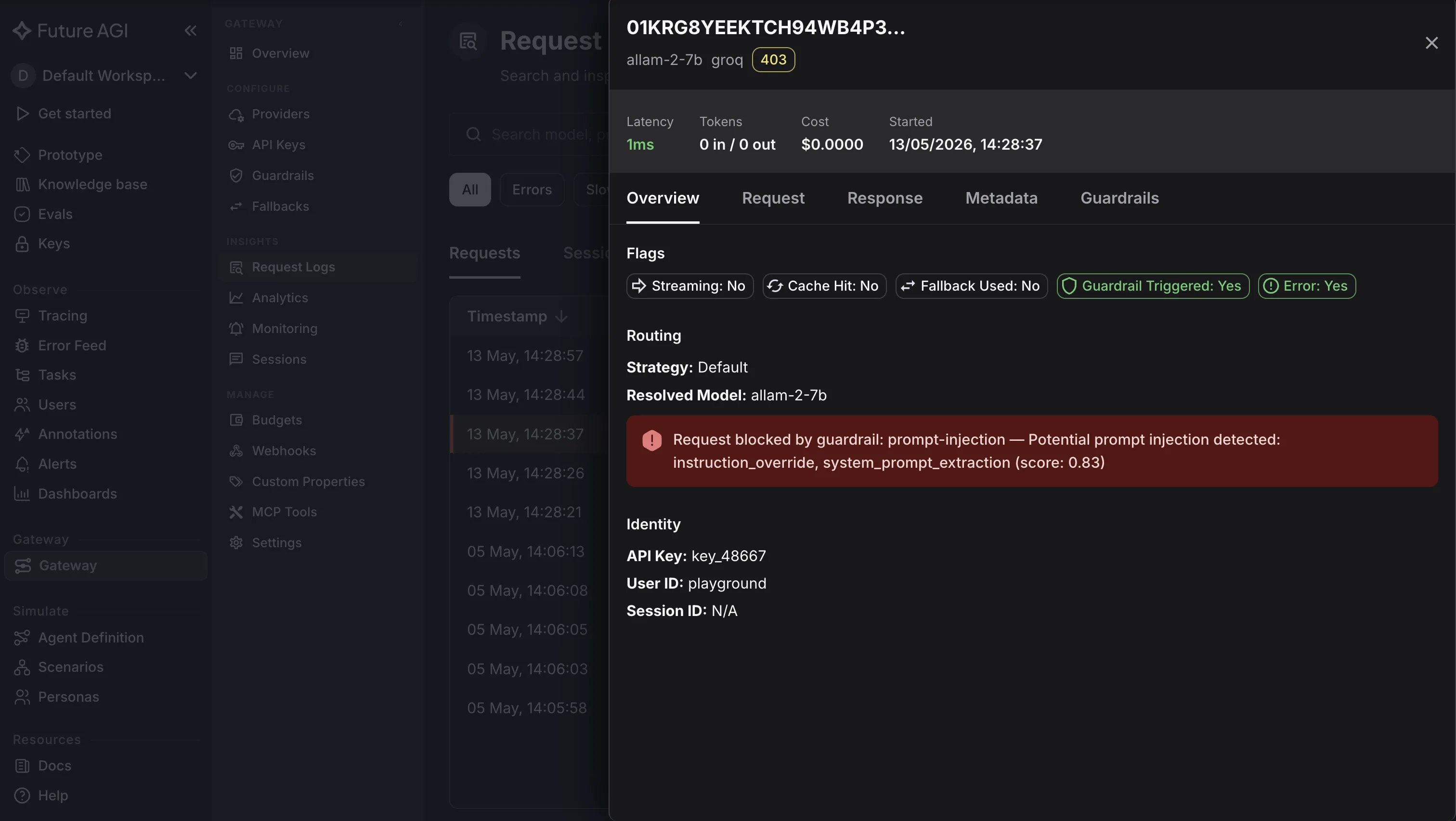
- No DSL. Per-route policy is YAML or a UI toggle. A 20-line Colang rail becomes a one-line scanner config.
- Native gateway plus eval plus optimizer. OpenAI-compatible drop-in across 100+ providers, prompt registry, virtual keys, and OTel traces sit on the same plane as the guardrail.
ai-evaluation(Apache 2.0) scores every trace against task-completion, faithfulness, and tool-use rubrics.agent-opt(Apache 2.0) rewrites prompts via six optimizers — ProTeGi, GEPA, Bayesian, MetaPrompt, RandomSearch, PromptWizard.
- Vendor-neutral. OpenAI, Anthropic, Bedrock, Vertex, Together, Groq, and Ollama are peer providers, no first-class hardware vendor.
- Multi-language. OpenAI-compatible HTTP plus OTel; TypeScript, Go, Java, and Rust hit the same gateway as Python services.
- Self-improving corpus. Production miss-classifications feed back into the next training pass via agent-opt; FAGI’s loop closes on the buyer’s traces.
- Direct + indirect + tool-output as peers. 18+ built-in scanners cover direct prompt injection, indirect injection on retrieved RAG context, and tool-output injection on MCP egress (aligned to CVE-2026-30623). Block, sanitize, and log are per-route policy switches.
- Open-source instrumentation.
traceAI,ai-evaluation, andagent-optare Apache 2.0. The hosted Command Center adds RBAC, failure-cluster views, the Protect guardrails layer, and AWS Marketplace procurement.
Migration from NeMo Guardrails: The LLMRails(...) wrapper disappears: the application becomes a plain OpenAI-compatible call, the rails become per-route Protect policies, and the self-check LLM rail becomes the eval library scoring on the same OTel span. Timeline: seven to ten engineering days for fewer than 30 rails across five to ten flows.
Where it falls short:
-
The optimization layer carries a learning curve; a pure rails swap won’t exercise it in week one.
-
Colang’s dialog-flow primitive doesn’t map one-to-one onto FAGI’s per-request scanner surface; teams using Colang for conversation state keep that logic in their agent framework (LangGraph, LlamaIndex Workflows) and let FAGI handle the safety layer.
Pricing: Free tier with 100K traces/month. Scale tier from $99/month with linear per-trace scaling above 5M (no add-on multipliers). Enterprise with SOC 2 Type II and AWS Marketplace.
Score: 7 of 7 axes.
2. Lakera Guard: Best for managed detector with published benchmark cadence
Verdict: Lakera Guard is the pick when the exit reason is “we want a managed prompt-injection detector with a published benchmark cadence and SLA, not a Colang rails framework we maintain ourselves.” Lakera ships the hosted REST detector that opened the detector-as-a-service category, with PINT and Gandalf adversarial corpora as the externally branded benchmark surface AppSec procurement asks for.
What it fixes versus NeMo Guardrails:
- Hosted detector with SLA. Pro is per-request; Enterprise adds the SLA, SOC 2 Type II, and on-prem. The conversation becomes “we have a vendor contract with a detector SLA.”
- Externally branded benchmark cadence. PINT and Gandalf are published adversarial benchmarks Lakera refreshes regularly. NeMo ships rails but not an externally branded benchmark.
- Language-agnostic. Lakera is a REST API; non-Python services hit the detector over HTTP.
- No DSL. A REST call replaces a Colang flow.
- Vendor-neutral. No tie to NVIDIA NIM.
Migration from NeMo Guardrails: Replace the input and output rails with a Lakera REST call before the model call (and optionally after). Colang bot refuse to respond flows become an explicit if flagged: branch. Self-check LLM rails retire. Timeline: five to seven engineering days for fewer than 30 rails.
Where it falls short:
- No native gateway, optimizer, eval suite, or prompt registry, the four-vendor stack remains four vendors.
- Self-host and on-prem live behind Enterprise; the standard Pro tier is hosted-only.
- The paid REST call model adds 5 to 15 ms p50 and 30 to 60 ms p95 round-trip on top of the single-digit-ms detector median.
- Enterprise pricing climbs into the high five to low six figures annually.
Pricing: Free tier with 1K requests/month. Pro tier billed per request. Enterprise custom-priced.
Score: 5 of 7 axes (missing: native gateway in one hop, optimizer loop).
3. Aporia: Best for hosted policy-and-session control panel
Verdict: Aporia is the pick when the exit reason is “we want a hosted guardrails control panel with policies, sessions, and analytics in one surface, not a Colang rails repo.” Aporia’s surface is policy-first: define a policy on a route, attach the detector, and the platform owns the verdict-to-action and analytics, without a DSL.
What it fixes versus NeMo Guardrails:
- Policy-first surface, no DSL. Aporia exposes guardrails as policies on sessions and routes, with the verdict-to-action wired inside the platform.
- Session-level analytics. Verdicts aggregate per session, per route, per policy, with drill-down into the offending payload.
- Multi-detector composition. Prompt injection, PII redaction, off-topic flagging, and toxicity sit under one policy framework rather than four rails across four Colang flows.
- Language-agnostic via HTTP and SDK shims.
- Vendor-neutral. No tie to NVIDIA NIM.
Migration from NeMo Guardrails: The LLMRails(...) wrapper becomes a plain OpenAI-compatible call routed through Aporia’s policy gateway. Colang input, retrieval, and output rails map to Aporia policies on the relevant routes. Self-check LLM rails retire. Timeline: five to seven engineering days.
Where it falls short:
- No native gateway. Aporia is the guardrails layer; the routing gateway is a separate product.
- No optimizer; policies update on manual rule edits, not on production miss-classifications.
- Mid-market hosted pricing, noticeably above NeMo’s zero direct cost.
- Self-host exists for enterprise contracts; the standard tier is hosted-only.
Pricing: Hosted with usage-based pricing on requests and detectors. Enterprise tier for SOC 2 Type II and on-prem.
Score: 5 of 7 axes (missing: native gateway in one hop, optimizer loop).
4. Portkey: Best for hosted gateway with Guardrails plugin
Verdict: Portkey is the pick when the exit reason is “we want the gateway and the inline guardrail layer in one hosted product.” Portkey was acquired by Palo Alto Networks on April 30, 2026, a fit for Fortune-500 teams already on Prisma and Cortex, a yellow flag for SMB teams watching for SKU consolidation in 12 to 24 months.
What it fixes versus NeMo Guardrails:
- Gateway and Guardrails plugin in one hop. Portkey’s Guardrails plugin runs as a pre-request and post-response check on the same proxy hop that does routing, fallback, and caching. The NeMo rail chain collapses into per-route plugin config.
- No DSL. Plugin policies are configured in YAML, not Colang. Self-check LLM rails retire.
- Polished hosted dashboard. Per-route cost, per-virtual-key attribution, per-session traces, and Guardrails verdicts share one dashboard.
- Language-agnostic via the proxy. Any HTTP-capable language hits the gateway.
- Vendor-neutral. OpenAI, Anthropic, Bedrock, Vertex, Groq, Together first-class.
Migration from NeMo Guardrails: The LLMRails(...) wrapper becomes a Portkey route configuration that enables the Guardrails plugin. Colang input rails map to pre-request plugin checks; output rails to post-response checks. Timeline: four to six engineering days.
Where it falls short:
- The Palo Alto Networks acquisition is the elephant in the room; every prior PANW acquisition (Bridgecrew, Cider, Talon, Dig) saw the standalone SMB SKU sunset within 18 to 24 months.
- No native eval or optimizer surface. Traces inform humans, not the gateway.
- Adversarial benchmark cadence is vendor-published, less external than Lakera’s PINT and Gandalf.
- Indirect-injection coverage on retrieved RAG context is partial.
Pricing: Free tier with 10K requests/month. Scale tier from $99/month. Enterprise pricing varies; PANW bundle pricing under review.
Score: 5 of 7 axes (missing: native eval, native optimizer).
5. Guardrails AI: Best for pure OSS validation library staying close to NeMo’s surface area
Verdict: Guardrails AI is the pick when the exit reason is “we want to drop Colang but keep an OSS Python library we maintain in our own repo, with no managed runtime contract.” The trade is sideways on most axes, both are OSS Python libraries. But the validator-hub model is leaner than Colang for teams that need structured-output enforcement and a handful of unsafe-content checks.
What it fixes versus NeMo Guardrails:
- No DSL. Validators are Python classes from the validator hub, configured in-code or via a RAIL spec (an XML-shaped schema rather than a flow grammar). New hires learn the validator hub catalogue instead of Colang.
- Pydantic-typed structured outputs in one line.
Guard.from_pydantic(MyModel)returns a typed Python object. NeMo can enforce a schema via an output rail, but the developer experience is heavier. - Vendor-neutral. No tie to NVIDIA NIM.
- Lower-overhead default path. A single validator runs in-process without a self-check LLM rail.
Migration from NeMo Guardrails: Replace LLMRails(config).generate(...) with Guard.from_pydantic(MyModel)(llm_api=...) or Guard.from_rail_string(...).__call__(...). Colang input and output rails map to validators in the Guard.use(...) chain; self-check LLM rails map to validators that call moderation or classifier APIs. The .co files retire. Timeline: four to six engineering days; the migration is sideways on the runtime axis, so expect to revisit if the team needs a gateway, eval, or optimizer.
Where it falls short:
- Still Python-only. The multi-language island problem doesn’t shrink.
- No native gateway, no optimizer, no eval pipeline, same gap as NeMo on the adjacent surfaces.
- A long validator chain adds 100 to 400 ms p95 of overhead, similar in order to NeMo’s rail-stack overhead.
- The OSS-vs-Pro community split has slowed cadence; long-tail validators are community-maintained at varying polish.
Pricing: Open source under Apache 2.0. Guardrails Pro (hosted) is usage-based.
Score: 4 of 7 axes (missing: native gateway, optimizer, multi-language).
Capability matrix
| Axis | Future AGI | Lakera Guard | Aporia | Portkey | Guardrails AI |
|---|---|---|---|---|---|
| Inline runtime latency | ~67 ms text / ~109 ms image (arXiv 2510.13351), in-process | Single-digit-ms median + 5–15 ms p50 round-trip | Hosted, sub-100 ms typical | In-process Guardrails plugin | In-process Python, validator-dependent |
| Native gateway, routing, fallback | Yes (gateway + detector + eval + optimizer) | No (detector only) | No (policy layer only) | Yes (gateway + Guardrails) | No (library only) |
| Eval + optimizer loop | Yes (ai-evaluation + agent-opt) | No | No | No | No |
| Multi-language coverage | OpenAI-compatible HTTP + OTel | REST API, any language | HTTP + SDK shims | OpenAI-compatible HTTP | Python only |
| Vendor neutrality | Yes (100+ providers, no hardware tie) | Yes (cross-provider) | Yes (cross-provider) | Yes (cross-provider) | Yes (cross-provider) |
| Direct + indirect + tool-output | Yes (all three) | Direct + PII | Direct + PII + off-topic | Direct yes; indirect/tool partial | Direct + structured output |
| Block / sanitize / log per route | Yes (all three, no DSL) | Verdict only; calling layer acts | Yes (all three) | Yes (all three) | Validator return + re-ask |
Migration notes: what breaks when leaving NeMo Guardrails
Three surfaces always need attention when the migration is “Colang flows in application code to inline guardrails at the gateway hop.”
Replacing Colang flows with inline runtime guardrails
NeMo is invoked from Python as LLMRails(config).generate(...). Colang flows live in .co files under a config/ directory and actions register via register_action. In FAGI’s case the wrapper disappears because Protect runs in-process at the gateway hop and the application becomes a plain OpenAI-compatible call. In Portkey it becomes a plugin configuration on the route. In Lakera an explicit REST call. In Aporia a policy attached to the route. In Guardrails AI a Guard.from_pydantic(...) chain. Search the repo for LLMRails, RailsConfig, register_action, .co files, and config.yml to inventory every call site before the swap.
Mapping rail semantics: safety vs dialogue orchestration
NeMo’s rails return verdicts inside Colang flows, bot refuse to respond, bot inform fact, bot ask follow-up. The mapping pass is one-time: write a translation layer that converts each rail’s outcome to the target gateway’s policy. FAGI ships scanner_id, verdict, confidence, attack_class, and atlas_subtechnique natively on the OTel span. The trickier piece is dialog flows: rails that change conversation state are doing two jobs, safety and dialogue orchestration. Document which rails belong to safety (migrate to the gateway policy) and which belong to dialogue orchestration (migrate to the agent framework: LangGraph, LlamaIndex Workflows, or an in-house state machine).
Retiring the self-check LLM rails
NeMo’s self-check LLM rails (those that invoke an extra LLM call to score the model’s own output) are the single largest latency contributor in a typical NeMo deployment. FAGI’s Protect runs the safety verdict in-process with no extra LLM round-trip; ai-evaluation runs task-completion and faithfulness scoring asynchronously rather than blocking the request. Lakera, Aporia, and the hosted gateway each replace the self-check LLM with a detector call faster than a full LLM round-trip. Audit every self_check_input or self_check_output rail; the migration replaces the LLM-on-LLM scoring pattern with a dedicated detector or an asynchronous eval pass.
Decision framework: Choose X if
Choose Future AGI Agent Command Center if your reason for leaving is more than the Colang learning curve, you also want the gateway, the eval suite, and the optimizer in one stack, with Apache 2.0 instrumentation and a self-improving loop on your own traces. Pick this when the renewal cycle forces a consolidation, or when the Python-only constraint is splitting policy across TypeScript, Go, Java, and Rust services.
Choose Lakera Guard if you want a managed detector with a published benchmark cadence (PINT, Gandalf) and the procurement conversation is “what’s the SLA on the slide.”
Choose Aporia if the surface that matters is a policy-first guardrails platform with sessions and analytics, and you’re comfortable pairing it with a separate gateway.
Choose Portkey if you want the gateway and the Guardrails plugin in one hosted product with a polished dashboard, and you can absorb the Palo Alto Networks acquisition uncertainty.
Choose Guardrails AI if you want to drop Colang but keep an OSS Python library, and the use case is “one safety check plus a Pydantic-typed structured output.”
What we did not include
Three products show up in other 2026 NeMo Guardrails alternatives listicles we left out: Llama Guard (Meta’s classifier model wrapped as an OSS check, useful as a single validator but not a replacement for the rails-plus-runtime stack); PromptArmor (red-team-as-a-service rather than runtime detection, different buying conversation); agentgateway.dev (Apache 2.0 Rust proxy under LF Agentic Trust with a built-in MCP scanner, strong on foundation governance and CVE-2026-30623 coverage, but the dashboard plus eval loop are bring-your-own; worth a look in Q3 2026).
Related reading
- Best AI Gateways for Prompt-Injection Defense in 2026
- Best AI Gateways for Cybersecurity in 2026
- What Is Prompt Injection Defense in 2026?
- Best AI Gateways for PII Redaction on LLM Calls in 2026
Sources
- NVIDIA NeMo Guardrails GitHub repository, github.com/NVIDIA/NeMo-Guardrails
- NeMo Guardrails documentation (Colang 1.0 and 2.0), docs.nvidia.com/nemo/guardrails
- NVIDIA AI Enterprise NeMo Guardrails commercial overview, nvidia.com/en-us/ai-data-science/products/nemo
- OWASP Top 10 for LLM Applications 2025 (LLM01: Prompt Injection), owasp.org/www-project-top-10-for-large-language-model-applications
- MITRE ATLAS AML.T0051 sub-technique catalogue, atlas.mitre.org
- April 2026 MCP STDIO RCE class (CVE-2026-30623) disclosure by OX Security, ox.security
- Lakera Guard product page, lakera.ai
- PINT (prompt-injection-test) benchmark, github.com/lakeraai/pint-benchmark
- Aporia product page, aporia.com
- Portkey product page, portkey.ai
- Palo Alto Networks press release on Portkey acquisition, April 30, 2026, paloaltonetworks.com/company/press
- Guardrails AI GitHub repository, github.com/guardrails-ai/guardrails
- Guardrails AI validator hub, hub.guardrailsai.com
- Future AGI Agent Command Center, futureagi.com/platform/monitor/command-center
- Future AGI Protect latency benchmark, arxiv.org/abs/2510.13351 (67 ms text, 109 ms image)
- Future AGI traceAI, github.com/future-agi/traceAI (Apache 2.0)
- Future AGI ai-evaluation, github.com/future-agi/ai-evaluation (Apache 2.0)
- Future AGI agent-opt, github.com/future-agi/agent-opt (Apache 2.0)
Frequently Asked Questions
Why are people moving off NVIDIA NeMo Guardrails in 2026?
What is the closest like-for-like alternative to NeMo Guardrails?
How do I migrate Colang flows out of NeMo Guardrails?
What is the latency tradeoff between NeMo Guardrails and an inline runtime?
Is there an open-source NeMo Guardrails alternative?
Which NeMo Guardrails alternative covers TypeScript, Go, Java, and Rust call sites?
How does Future AGI Agent Command Center compare to NeMo Guardrails?
Senior-engineer comparison of the best AI agent guardrails platforms 2026: latency budgets, placement, deployment topology, vendor fit.

Five Guardrails AI alternatives on inline runtime latency, native gateway, eval, multi-language. What each actually fixes beyond Python-only validation.

Senior-engineer guide to LLM guardrails: placement, 9 open-weight + 4 API backends, latency budgets, ensembles, precision/recall that actually catches.