Best LLMs of October 2026 as Google's Top Model Stays Gated
The best LLM for October 2026 depends on access: Gemini 4 Carbon tops the AI model boards but stays gated, so compare Argon, Claude Haiku 5.5 and GPT-6.1 Terra.
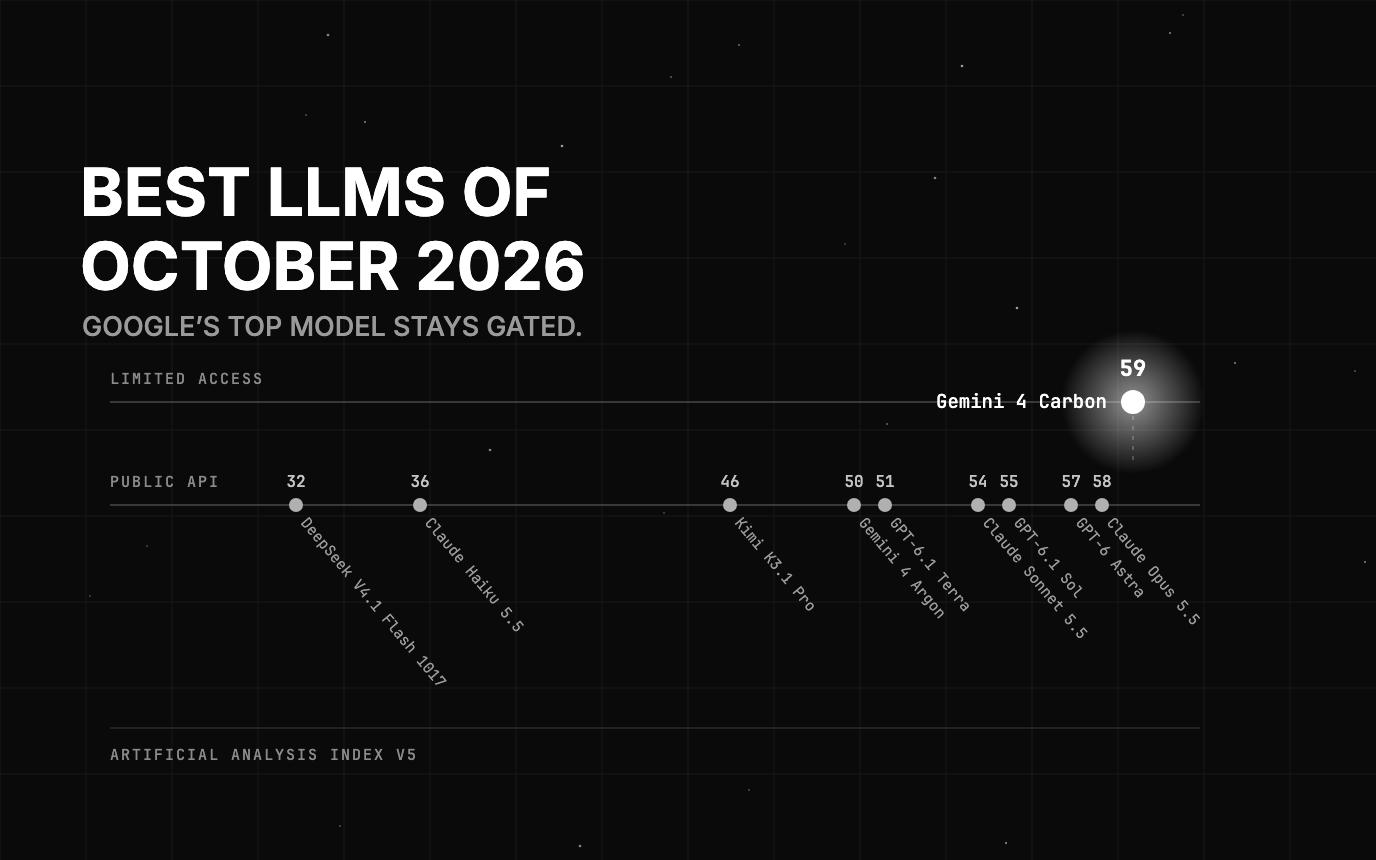
Table of Contents
Picture a platform team that opens the Artificial Analysis leaderboard after October 28 to choose its next default model. The top row reads Gemini 4 Carbon, at 59 on Intelligence Index v5. Someone goes looking for the model ID to put in the config, and there is none, because Google opened Carbon only to cyber defenders in its Fairwind Program.
For this guide, the best LLM for October 2026 means the strongest AI model you can call, price and test this week. That rules out the model at the top of both leaderboards, so Carbon gets one section of its own. Every other October language model release here is sorted by what a developer can use today.
Prices moved as well. Gemini 4 Argon, the Google model you can call, doubles its price on December 1, while Anthropic and OpenAI added cheaper tiers. Three open-weight releases arrived under three different licenses, and Artificial Analysis changed its index evaluations and weights on October 27, so last month’s scores need a fresh read before they guide a decision.
If you are coming from last month’s picks, the September 2026 edition covers the models that still hold their place below.
TL;DR
- Gemini 4 Carbon ranks first on Artificial Analysis Index v5 (59, high) and LMArena Text (1528 at High, from 4,403 votes), but only Google’s Fairwind Program members can use it, as of 2026-11-03.
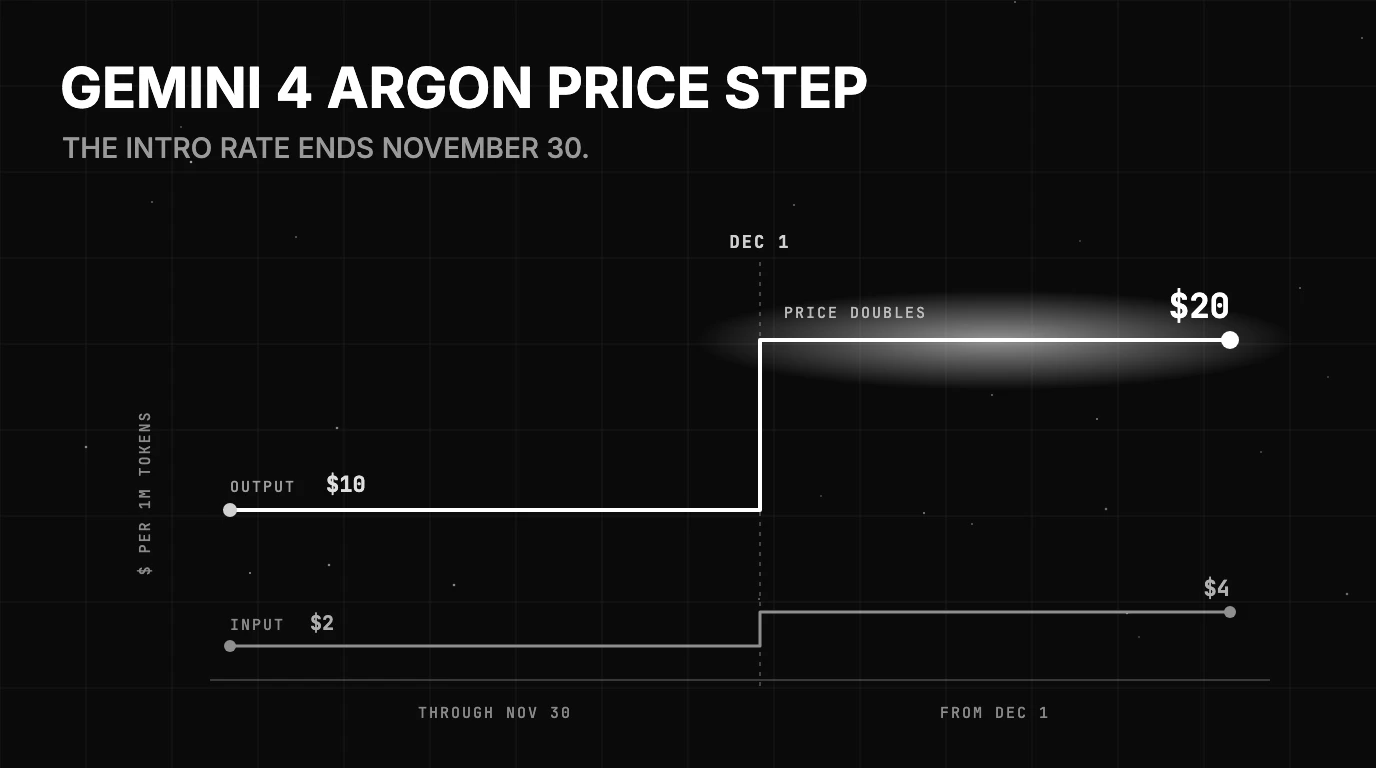
- Gemini 4 Argon is the Google flagship you can call: generally available since October 13 at $2/$10 per million tokens, rising to $4/$20 on December 1.
- The low-cost tier changed: Claude Haiku 5.5 at $0.10/$0.50, GPT-6.1 Terra at $1/$5 with a 1,050,000-token window, and Claude Sonnet 5.5 cache reads cut to $0.10 per million.
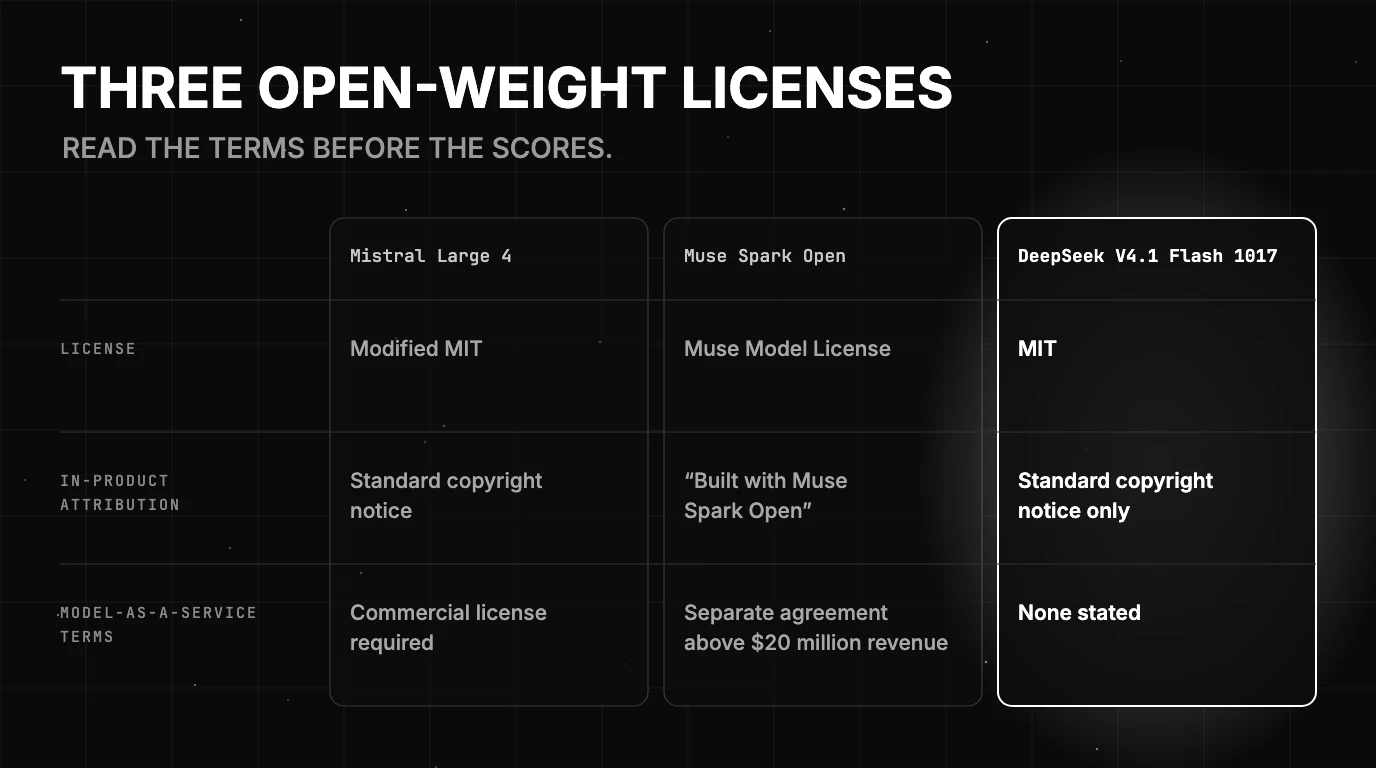
- Open weights shipped under three licenses: Mistral Large 4 (modified MIT), Muse Spark Open (notice rule and revenue clause) and DeepSeek V4.1 Flash 1017 (MIT).
- Artificial Analysis moved to Index v5 on October 27, so September scores do not compare with October’s.
Gemini 4 Carbon ranks first but only Fairwind Program members can call it
Gemini 4 Carbon took the top spot on Artificial Analysis Intelligence Index v5 at 59 (high) and on LMArena Text at 1528 (High), from 4,403 votes, as of 2026-11-03. Google announced it on October 28 for a subset of cyber defenders in its Fairwind Program. There is no public model ID, so most production teams cannot use it yet.
Google describes who gets in through the Fairwind Program in Google’s Gemini 4 Carbon announcement.
Google did publish a launch price. Carbon will launch at the same introductory price as Argon, $2 per million input tokens and $10 per million output tokens, with cached input priced at 95% off. After the introductory period, $4 input and $20 output apply, and Google gives no end date for that period, so plan around the later rate.
If you searched for a Gemini 4 Carbon release date, the date that matters is the day your team can call it. The October 28 announcement is the only date so far, and the Gemini API changelog has no Carbon entry as of November 3. Without a model ID, nothing goes in a config file.
Both of Carbon’s leads are narrow. On LMArena Text, all at High, Carbon’s 1528 carries a ±9 margin, Gemini 4 Argon sits second at 1520 ±6 from 11,889 votes, and Claude Opus 5.5 is third at 1509 ±7. On Index v5, Carbon leads Opus 5.5 (max with fallback) by a single point, 59 to 58.
You can check the votes and settings yourself on the LMArena text leaderboard.
A first place nobody can call changes how to read a leaderboard. Your shortlist starts at the rows below Carbon, because those models have model IDs and published prices today. On LMArena, Carbon at 1528 ±9 and Argon at 1520 ±6 overlap within their stated margins, so the callable model sits very close to the gated one.
Should you plan around Carbon? Plan around what you can call, and keep Carbon as a watch item. Re-check Google’s announcement page and the Gemini API changelog before your next model review, since the changelog is where Argon’s general availability and model ID were posted on October 13.
Gemini 4 Argon is the Google model you can ship, until its price doubles
Gemini 4 Argon has been generally available since October 13 as gemini-4-argon, with a 1,048,576-token context window and no free tier. It costs $2 input and $10 output per million tokens through November 30. From December 1 it costs $4 and $20, so any budget you set this month needs the December rate.
Both rates for every token type are printed on the Gemini API pricing page.
What does Argon cost after the intro rate? Input doubles from $2 to $4 per million tokens and output from $10 to $20, starting December 1, 2026. Cached input follows the same step, from $0.10 to $0.20 per million. Google’s pricing page also says Argon supports implicit caching only, and explicit caching is not supported.
Argon is not on the Gemini API free tier, so even a quick trial needs a paid plan. Teams that prototype on free keys before they ask for budget lose that option here. Start the trial on a paid project from day one, and size its budget at the December rate rather than the November one.
On quality, Argon scores 50 on Artificial Analysis Index v5 at the high setting, as of 2026-11-03. That ties Claude Fable 5.1 (xhigh with fallback) and Muse Wonder Full (max), and trails Carbon by nine points. On LMArena Text it sits second at 1520 (High), so voters rate it much closer to Carbon than the index does.
Is Argon cheaper than Opus 5.5? Through November 30, yes: Argon’s $2/$10 is half of Claude Opus 5.5’s $4/$20. From December 1 both list at $4 input and $20 output per million tokens. So in December, Gemini 4 Argon vs Opus 5.5 comes down to quality on your tasks.
The public numbers split on that question. Opus 5.5 leads Argon on Index v5, 58 (max with fallback) to 50 (high), while Argon leads Opus 5.5 on LMArena Text, 1520 to 1509 with both at High, as of 2026-11-03. When two boards disagree, your own prompts decide, and neither board tells you the cost per completed task.
Google’s model page calls the 1,048,576-token window a unified limit for input and output together. A long-document job that fills most of it leaves less room for the answer, so size prompts with output in mind. Claude Haiku 5.5 and GPT-6.1 Terra offer similar windows at lower prices, covered next.
The unified limit is stated on the Gemini 4 Argon model page.
One migration note comes from the Gemini API changelog, where Google posted an October 8 routing change for older Flash names.
Requests to gemini-3.7-flash now route automatically to gemini-3.8-flash, and gemini-3.5-flash routes to gemini-3.6-flash. If you pinned 3.7 Flash for stability, your traffic already runs on 3.8 Flash, so re-run your evals on the new model instead of trusting old results. Gemini 3.8 Flash pricing sits in the still-current table below.
Claude Haiku 5.5 and GPT-6.1 Terra reset the low-cost tier
Two cheap models and one price cut landed in October. Claude Haiku 5.5 launched at $0.10 input and $0.50 output per million tokens with a one-million-token window. GPT-6.1 Terra arrived at $1 and $5 with 1,050,000 tokens of context, and Anthropic halved Claude Sonnet 5.5 cache reads to $0.10 per million.
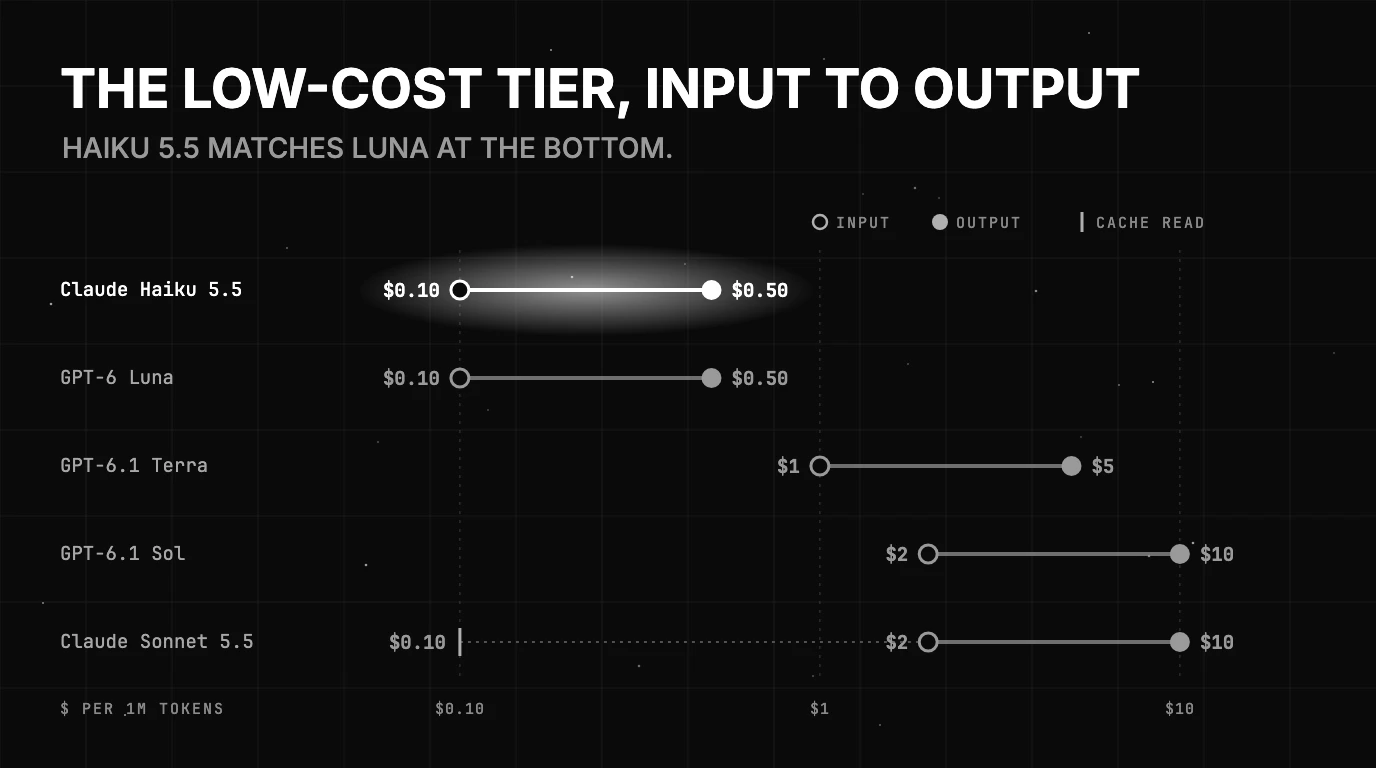
Each change comes with fine print that decides whether it saves money. Haiku 5.5’s rate holds only for prompts up to 100,000 tokens, Terra’s only up to 272K input tokens, and the Sonnet cut helps only cached reads. The sections below give each price with its boundary, and the pick table later turns them into monthly bills.
Anthropic’s numbers come from the Claude API pricing page, which lists both of Haiku 5.5’s prompt-length bands.
Claude Haiku 5.5 launches at $0.10 input with a 1M window
Anthropic · released October 7, 2026 · 1M context · 128k max output · $0.10/$0.50 per 1M tokens for prompts up to 100,000 tokens · as of 2026-11-03
Claude Haiku 5.5 is Anthropic’s new low-cost model, launched on October 7 with a one-million-token context window and up to 128k output tokens. At $0.10 input and $0.50 output per million tokens, it costs one twentieth of Sonnet 5.5’s $2/$10 base rate on short prompts. That makes it the cheapest Claude tier in this post.
Haiku 5.5’s price changes at the 100,000-token boundary. Prompts above it cost $0.50 input and $2.50 output per million tokens, five times the base rate, so a long-context job that fills the window pays a much higher price than a short classification call. Check your prompt-length distribution before you budget on the headline rate.
Haiku 5.5 scores 36 on Index v5 at the max setting, as of 2026-11-03. Teams running short, repetitive calls such as routing, tagging or ticket summaries should test it first. Long agentic chains are a harder sell, and the score gap below explains why.
What it does not win: frontier quality. Its Index v5 score of 36 sits far below Claude Opus 5.5 at 58, so test hard multi-step tasks against a larger model before moving them.
GPT-6.1 Terra brings a 1,050,000-token window at $1 input
OpenAI · released October 26, 2026 · 1,050,000 context · 128,000 max output · $1/$5 per 1M tokens for prompts up to 272K input tokens · cached input $0.05 · cache writes $1.25 per 1M (30-minute retention) · as of 2026-11-03
GPT-6.1 Terra is OpenAI’s new middle option, released on October 26 with 128,000 output tokens and a June 1, 2026 knowledge cutoff. It costs $1 input and $5 output per million tokens, with cached input at $0.05 and cache writes at $1.25 with 30-minute retention. It scores 51 on Index v5 at max, as of 2026-11-03.
The long-prompt terms are on the GPT-6.1 Terra model page, and they apply to the full request once a prompt crosses the line.
Above 272K input tokens, OpenAI bills the whole request at 2x input and 1.5x output. Terra’s $1/$5 becomes $2/$7.50 per million tokens. GPT-6.1 Sol has the same surcharge ($4/$15), so Terra stays at half of Sol’s price. Teams that picked Terra for its window should still track how often prompts cross the line.
Anyone comparing GPT 6.1 Sol vs Terra vs Luna should know Luna is a GPT-6 model. GPT-6 Luna costs $0.10/$0.50, Terra $1/$5 and GPT-6.1 Sol $2/$10 per million tokens, so each step costs ten times, then twice as much. On Index v5 at max, Terra’s 51 sits four points below Sol’s 55.
Terra fits jobs that need a large window but cost more on Sol than they should, such as retrieval over long documents with short answers. Jobs with short prompts and simple outputs may run fine on Luna at a tenth of Terra’s price. Test all three on the same prompts before you move traffic.
What it does not win: the top of the range. Its Index v5 score of 51 trails Gemini 4 Carbon, Claude Opus 5.5, GPT-6 Astra, GPT-6.1 Sol (55) and Claude Sonnet 5.5 (54), and prompts above 272K tokens cost 2x input and 1.5x output on both Terra and Sol.
Sonnet 5.5 cache reads fall from $0.20 to $0.10
Anthropic · changed October 7, 2026 · cache reads $0.20 to $0.10 per 1M tokens · base $2/$10 unchanged · as of 2026-11-03
On October 7, Anthropic halved the price of prompt cache reads on Claude Sonnet 5.5, from $0.20 to $0.10 per million tokens. The base price stays at $2 input and $10 output. The cut lands on the repeated part of the bill, such as a long system prompt sent with every call.
Agents and chat apps that send the same long instructions with every request gain the most, because each repeat is billed as a cache read. A cache read now costs one twentieth of fresh input on Sonnet 5.5. The model scores 54 on Index v5 (max with fallback), as of 2026-11-03, so the saving comes on a strong model.
What it does not win: short prompts. The base price is unchanged, so calls with little or no cached input see no saving.
From October 7, GPT-6 Sol became the Chat tab model for Plus, Pro, Business and Enterprise, with GPT-6 Luna for Free and Go from October 8. The Pro reasoning option stays on GPT-6 Astra, and the models behind Work and Codex did not change. This is a ChatGPT product change, so the API prices above stay as listed.
Open weights from Mistral, Meta and DeepSeek come with three licenses
Three open-weight releases shipped in October, and their licenses differ more than their specs. Mistral Large 4 uses a modified MIT license that requires model-as-a-service operators to get a commercial license. Meta’s Muse Spark Open adds a notice rule and a revenue clause, and DeepSeek V4.1 Flash 1017 stays MIT.
Read the license before the benchmark. A model you run inside your own product, a model you resell as an API, and a model you only call through its vendor face different terms. The sections below give each license in plain words, and a fourth covers Kimi K3.1 Pro, which has an API but no weights yet.
Mistral Large 4 releases its weights under a modified MIT license
Mistral · API public preview October 6, 2026 · weights October 29, 2026 · about 1T parameters, 49B active per token (52B including embeddings and output layers) · 1M context · $0.70/$2.10 per 1M tokens · as of 2026-11-03
Mistral Large 4 reached the API as a public preview on October 6 and released its weights on October 29. The model has about one trillion parameters with 49 billion active per token, or 52 billion counting embeddings and output layers, per its Hugging Face card. Both the card and Mistral’s October 6 changelog give it a 1M context window.
The license and API price are spelled out in Mistral’s open-weight release post.
The license is the Mistral Ecosystem Open-Weight license, a modified MIT license that keeps the standard copyright and permission notice in all copies. A company that operates a model-as-a-service business must sign a separate commercial license before any commercial use. Internal use, which keeps the model away from third parties, is exempt, so read the clause against your own deployment.
On Mistral’s API, Large 4 costs $0.70 input, $0.07 cached input and $2.10 output per million tokens, as of 2026-11-03. That is below GPT-6.1 Terra’s $1/$5. On Index v5 it scores 26 at high and 23 at medium, as of 2026-11-03, far below Terra’s 51 at max, so test it on your own prompts first.
What it does not win: hosted resale. A company that operates a model-as-a-service business needs a separate commercial license from Mistral before any commercial use, internal use aside.
Muse Spark Open ships 816B parameters with a revenue clause for model hosts
Meta · released October 15, 2026 · about 816B parameters, 42B active per token · 1M context (1,048,576 tokens per the Hugging Face blog) · as of 2026-11-03
Meta released Muse Spark Open on October 15 as open weights, with about 816 billion total parameters and about 42 billion active per token. Its context window is one million tokens, and the Hugging Face blog’s H200 deployment recipe runs it at 1,048,576 tokens. Meta ships it under the Muse Model License rather than a standard open-source license.
The full terms are in the Muse Model License on the Muse Spark Open model card.
Two license terms shape most deployments. Products built on the model must prominently display “Built with Muse Spark Open” in the user interface, documentation, website or settings menu. Model-as-a-service providers whose aggregate gross revenue exceeds $20 million must notify Meta and sign a separate written agreement before offering it, so large hosts negotiate from day one.
If the gap between these terms and true open source is new to you, read how open-weight licenses differ from open source.
For product teams, the practical cost is the notice, since the revenue clause excludes internal use and features of your own product. For a hosting company or large platform, it means a contract with Meta before launch. Either way, legal review should finish before engineering spends a sprint on serving the model.
What it does not win: an OSI open-source label. The notice rule and the revenue clause put it outside standard open-source terms.
DeepSeek V4.1 Flash 1017 upgrades in place at the same price
DeepSeek · released October 17, 2026 · MIT license · API name deepseek-flash · cache-miss input $0.30 peak, $0.15 off-peak · output $1.20 peak, $0.60 off-peak per 1M tokens · as of 2026-11-03
DeepSeek upgraded its Flash model in place on October 17. Calls to deepseek-flash now reach DeepSeek V4.1 Flash 1017, and the pricing did not change. The weights carry the MIT license on Hugging Face, the simplest terms of the three releases in this section, with only the standard MIT copyright notice and no revenue clause.
The upgrade note is on DeepSeek’s API updates page, which tells you to keep using the same model name.
Pricing has two bands, peak and off-peak. Cache-miss input costs $0.30 per million tokens at peak and $0.15 off-peak, and output costs $1.20 at peak and $0.60 off-peak, as of 2026-11-03. Batch jobs that can wait for the off-peak window pay half the peak rate on both sides.
Both bands are listed on DeepSeek’s API pricing page.
Because the upgrade happened in place, any team already calling deepseek-flash changed models on October 17 without editing code. Re-run your regression prompts now if you have not done so yet. On Index v5 at max, V4.1 Flash 1017 scores 32, as of 2026-11-03, which Artificial Analysis ranked joint highest among released-weights models at the October 27 launch.
What it does not win: quality. Its Index v5 score of 32 trails Claude Haiku 5.5 at 36, a closed model with a lower short-prompt price.
Kimi K3.1 Pro is live in the API while its weights wait
Moonshot · API released October 23, 2026 · 1,048,576 context · $2/$10 per 1M tokens (Highspeed $4/$20) · Index v5 46 (setting not shown) · status: API released, weights announced · as of 2026-11-03
Moonshot launched Kimi K3.1 Pro in its API on October 23, at $2 input and $10 output per million tokens, with a Highspeed version at $4 and $20. Every K3 series model supports a 1,048,576-token context window. That puts its standard price level with GPT-6.1 Sol and with Gemini 4 Argon’s intro rate.
Both prices are listed on the Kimi API pricing page.
The weights promise comes from Moonshot’s Kimi K3.1 Pro announcement, which says full model weights will be released by November 4, 2026.
The Kimi K3.1 release date has two answers. The API went live on October 23, and the weights have not shipped: as of November 3, Hugging Face lists no K3.1 repository under Moonshot’s account, and the newest one is Kimi-K3, last updated in September. Until a repository appears, treat open weights as a promise.
The missing weights affect teams that picked Kimi for self-hosting. A team that needs the model on its own hardware should wait for the repository and its license file before it plans capacity. A team that only needs the API can test it now, at an Index v5 score of 46.
What it does not win: self-hosting, for now, and the top of the board. Until the weights ship it cannot run on your own hardware, and its Index v5 score of 46 trails the closed frontier models.
Index v5 resets the scale, so older scores no longer compare
The Artificial Analysis Intelligence Index v5.0 launched on October 27 with nine evaluations and new weights, so its scores do not line up with v4. Claude Opus 5.5 led at launch with 58 before Gemini 4 Carbon took first at 59. August and September scores belong to the old index and should not sit beside v5 numbers.
The method change is explained in the Artificial Analysis Index v5 article.
Why did the number for your favorite model drop? The index changed. A v5 score lower than last month’s v4 score says nothing about the model getting worse, because v5 adds two benchmarks, upgrades three and removes three, and Artificial Analysis says v5 leaves significant room for progress across all nine. Compare v5 with v5 only.
Read the setting label beside each score. Each effort setting (max, xhigh, high, medium, low) gets its own row, so Gemini 4 Carbon at medium scores 58 and Claude Opus 5.5 at xhigh with fallback scores 57. Opus, Sonnet and Fable rows carry a “with fallback” suffix, such as “max with fallback”, while Haiku 5.5 rows do not.
The selected rows below, as of 2026-11-03, come from the Artificial Analysis model leaderboard.
| Model | Setting | Index v5 score |
|---|---|---|
| Gemini 4 Carbon | high | 59 |
| Claude Opus 5.5 | max with fallback | 58 |
| GPT-6 Astra | max | 57 |
| GPT-6.1 Sol | max | 55 |
| Claude Sonnet 5.5 | max with fallback | 54 |
| GPT-6.1 Terra | max | 51 |
| Claude Fable 5.1 | xhigh with fallback | 50 |
| Muse Wonder Full | max | 50 |
| Gemini 4 Argon | high | 50 |
| Kimi K3.1 Pro | not shown | 46 |
| Muse Wonder | max | 43 |
| Claude Haiku 5.5 | max | 36 |
| DeepSeek V4.1 Flash 1017 | max | 32 |
| Mistral Large 4 | high | 26 |
This LLM leaderboard snapshot shows two patterns. The top four rows span four points, 59 to 55, so a small index edge rarely settles a choice. Low-cost and open-weight models sit far down the list, with Claude Haiku 5.5 at 36, DeepSeek V4.1 Flash 1017 at 32 and Mistral Large 4 at 26.
Muse Wonder is the one new name in the snapshot without a section above. Meta released it on October 12 and made it available through the Meta Model API, with Muse Wonder Full available to Muse Code subscribers. Muse Wonder scores 43 at max and Muse Wonder Full 50 at max, a tie with Gemini 4 Argon at high.
Use the board as a shortlist filter. Pick the three or four models that fit your price and access limits, then compare them on your own prompts at the settings you plan to run. Re-run any comparison you built on v4 scores, because those numbers do not convert to v5.
EmbeddingGemma 2, Rerank 5 and Nano Banana 2.1 round out the releases
Outside the chat models, Google’s EmbeddingGemma 2 arrived in October as an Apache-2.0 embedding model with about 740 million parameters. It maps text, code, image, video and audio into one 768-dimensional space. Cohere shipped Rerank 5, and Google made Nano Banana 2.1 generally available for image generation.
The parameter count and license are on the EmbeddingGemma 2 model card.
For retrieval stacks, the pair to test together is EmbeddingGemma 2 for first-pass search and Rerank 5 for ordering results. Google released EmbeddingGemma 2 on October 6 under the Apache 2.0 license. Cohere followed on October 21 with two rerankers, rerank-v5.0-pro and rerank-v5.0-fast.
Both model names are listed in the Cohere Rerank 5 changelog.
On images, Nano Banana 2.1 became generally available in the Gemini API on October 6. Google deprecated gemini-3.1-flash-image the same day with no shutdown date announced. Alibaba shipped Qwen-Image-2.1 Pro on October 2 and Qwen-Image-2.1 Turbo, which is open source, on October 9.
Google began rolling out Genie 4, a world model, to a limited group of trusted testers on October 27. Google says it is coming soon to AI Ultra subscribers in Project Genie and to early access partners in the Gemini API and AI Studio. It is the only release in this section without public access, so watch it.
New AI models by release date, from Qwen-Image-2.1 to GPT-Rosalind-6
The table below lists October’s new AI models, price changes and deprecations in date order, each with the primary page that confirms it. We re-read each row’s primary page on November 3. Leaderboard numbers come from reading each board that day, so you can verify any line before acting on it.
| Date | Provider | Model or change | What changed | Primary source |
|---|---|---|---|---|
| Oct 2 and 9 | Alibaba | Qwen-Image-2.1 Pro and Turbo | Image models; Turbo is open source | Qwen Cloud changelog |
| Oct 6 | Mistral | Mistral Large 4 | API public preview, 1M context | Mistral changelog |
| Oct 6 | Nano Banana 2.1 | GA; gemini-3.1-flash-image deprecated, no shutdown date | Gemini API changelog | |
| Oct 6 | EmbeddingGemma 2 | Apache-2.0, 768-dim multimodal embeddings | Hugging Face model card and Google blog | |
| Oct 7 | Anthropic | Claude Haiku 5.5 | $0.10/$0.50 per 1M up to 100K-token prompts, 1M context | Claude release notes |
| Oct 7 | Anthropic | Sonnet 5.5 cache reads | $0.20 to $0.10 per 1M | Claude release notes |
| Oct 7 | OpenAI | GPT-6 Sol and Luna in ChatGPT | Chat tab model change; Work and Codex unchanged | ChatGPT release notes |
| Oct 8 | Flash routing | gemini-3.7-flash to 3.8 Flash; gemini-3.5-flash to 3.6 Flash | Gemini API changelog | |
| Oct 12 | Meta | Muse Wonder | Released, available through the Meta Model API | Meta research blog |
| Oct 13 | Gemini 4 Argon | GA, $2/$10 per 1M to Nov 30, then $4/$20 | Gemini API pricing | |
| Oct 15 | Meta | Muse Spark Open | Open weights, about 816B total and 42B active | Hugging Face blog |
| Oct 17 | DeepSeek | V4.1 Flash 1017 | In-place upgrade, MIT, same price | DeepSeek updates and Hugging Face card |
| Oct 21 | Cohere | Rerank 5 | Pro and Fast rerankers | Cohere changelog |
| Oct 22 | OpenAI | Decisions API | GA with gpt-6-luna (beta since Oct 6) | OpenAI API changelog |
| Oct 23 | Moonshot | Kimi K3.1 Pro | API $2/$10 per 1M; weights announced | Kimi API pricing and Moonshot forum post |
| Oct 26 | OpenAI | GPT-6.1 Terra | $1/$5 per 1M up to 272K-token prompts, 1,050,000 context | OpenAI model page |
| Oct 27 | Artificial Analysis | Intelligence Index v5.0 | Nine evaluations, new weights | AA article |
| Oct 27 | Genie 4 | World model, trusted testers first | Google blog | |
| Oct 28 | Gemini 4 Carbon | Announced, Fairwind Program only | Google blog | |
| Oct 29 | Mistral | Mistral Large 4 weights | Modified MIT, $0.70/$2.10 per 1M | Mistral news |
| Oct 30 | OpenAI | GPT-Rosalind-6 | Biology model, trusted access; API ID gpt-6-rosalind | OpenAI API changelog and system card |
Two rows carry dates that matter after October. Gemini 4 Argon’s intro price ends on November 30, and Moonshot says the Kimi K3.1 Pro weights will be released by November 4. Put both dates on the team calendar, because each one can change a pick made from this table.
GPT-Rosalind-6 needs a naming note. OpenAI’s system card calls it GPT-Rosalind-6, while the API changelog lists it as GPT-6 Rosalind with the model ID gpt-6-rosalind. Either way, it is a biology model offered only through trusted access, published on October 30.
The Decisions API row is easy to miss. OpenAI released it in beta with gpt-6-luna on October 6 and made it generally available on October 22. On /v1/decisions, uncached gpt-6-luna input costs $0.10 per million tokens and output tokens are not charged. Teams already on Luna can test it without a new model in the mix.
Opus 5.5, GPT-6 Astra and Gemini 3.8 Flash held their place
Claude Opus 5.5, GPT-6 Astra, Gemini 3.8 Flash and several other models from the last two editions did not change price or model in October and remain the picks for the use cases below. We re-checked each price on November 3. Each row links the edition that covers the model in full.
| Model | Provider | Last covered in | Still the pick for | Price | Price checked |
|---|---|---|---|---|---|
| Claude Opus 5.5 | Anthropic | September 2026 edition | Balanced agentic coding | $4/$20 per 1M | 2026-11-03 |
| Claude Fable 5.1 | Anthropic | September 2026 edition | Premium Claude tier for long-horizon reasoning | $10/$50 per 1M | 2026-11-03 |
| GPT-6 Astra | OpenAI | September 2026 edition | Frontier reasoning on OpenAI | $10/$50 per 1M | 2026-11-03 |
| GPT-6.1 Sol | OpenAI | September 2026 edition | Mid-tier OpenAI | $2/$10 per 1M | 2026-11-03 |
| GPT-6 Luna | OpenAI | September 2026 edition | Lowest-cost OpenAI tier | $0.10/$0.50 per 1M | 2026-11-03 |
| Gemini 3.8 Flash | September 2026 edition | Cheap fast Gemini | $0.75/$3.75 per 1M through Dec 31, then $1.50/$7.50 | 2026-11-03 | |
| Grok 4.7 | SpaceXSI | September 2026 edition | Reasoning with real-time data | vendor pricing page | 2026-11-03 |
| GLM-5.3 | Z.ai | September 2026 edition | Open coding model | vendor pricing page | 2026-11-03 |
| Qwen3.8-Max | Alibaba | August 2026 edition | Large-scale coding | vendor pricing page | 2026-11-03 |
Claude Opus 5.5 is the anchor for this month’s comparisons. Its $4/$20 price matches Gemini 4 Argon’s December 1 rate, and it scores 58 on Index v5 (max with fallback), second only to Carbon, as of 2026-11-03. A team on last month’s Opus 5.5 pick keeps the same price and faces no forced migration.
GPT-6 Astra and Claude Fable 5.1 remain the premium tiers at $10/$50 each. Astra scores 57 at max and Fable 5.1 scores 50 at xhigh with fallback, both below the cheaper Opus 5.5. That makes the premium price hard to justify unless your own tests show a clear win.
Gemini 3.8 Flash keeps its $0.75/$3.75 price through December 31, then moves to $1.50/$7.50 from January 1, 2027. Teams whose gemini-3.7-flash calls now route to 3.8 Flash should plan for that rate too. For Grok 4.7, GLM-5.3 and Qwen3.8-Max, use the vendor pricing links in the table.
Which is the best LLM for October 2026 if you cannot wait for Carbon?
Most teams should not wait for Gemini 4 Carbon, so the best LLM for October 2026 is one they can call now. The practical choices are whether to adopt Gemini 4 Argon before its December price, whether Haiku 5.5 or GPT-6.1 Terra can take high-volume calls, and which open-weight license fits a hosted product. Five questions follow.
Should you wait for Carbon? No. Carbon has no public model ID, and access runs through Google’s Fairwind Program for cyber defenders, so there is nothing to integrate yet. Pick from the models you can call today, and set a date to re-check Google’s announcement page and the Gemini API changelog.
Should you adopt Argon now? Yes, if it wins on your prompts, but budget at $4 input and $20 output per million tokens, the December 1 rate. Treat the $2/$10 intro price as a trial window that closes on November 30. A cost model built on November prices shows half of the real bill from December.
Should subagents or summarization move to Haiku 5.5 or Terra? Compare cost per completed task on your own prompts. A cheaper model that needs retries or longer outputs can cost more per task. Test lower reasoning-effort settings first, and check the board at that setting: GPT-6.1 Terra scores 51 at max but 42 at high.
Which open model should you self-host? Choose by license terms first. DeepSeek V4.1 Flash 1017 under MIT asks only for the standard copyright notice. Mistral Large 4 needs a commercial license if your company operates a model-as-a-service business, internal use aside, and Muse Spark Open needs a visible notice plus separate terms for hosts above $20 million in revenue.
Should you re-run comparisons on Index v5? Yes. Any internal doc that ranks models with v4 scores is now out of date, because v5 launched on October 27 with new evaluations and weights. Re-pull the scores for your shortlist and keep v4 and v5 numbers apart, or drop the v4 ones entirely.
The table turns those answers into picks by use case, with each price per million input and output tokens as of 2026-11-03. Carbon’s row shows Google’s announced launch price, which no developer outside the Fairwind Program can pay yet. Every other row is generally available or downloadable today.
| Use case | Model | Price per 1M now | Price from Dec 1 | Access |
|---|---|---|---|---|
| Callable frontier | Claude Opus 5.5 | $4/$20 | $4/$20 | GA |
| Google flagship | Gemini 4 Argon | $2/$10 | $4/$20 | GA |
| Lowest-cost Claude | Claude Haiku 5.5 | $0.10/$0.50 up to 100K-token prompts | Same | GA |
| Long context at low cost | GPT-6.1 Terra | $1/$5 up to 272K-token prompts | Same | GA |
| Lowest-cost OpenAI | GPT-6 Luna | $0.10/$0.50 | Same | GA |
| Permissive open weights | DeepSeek V4.1 Flash 1017 | $0.30/$1.20 peak, $0.15/$0.60 off-peak | Same | MIT weights |
| Largest open Mistral | Mistral Large 4 | $0.70/$2.10 | Same | Weights under a modified MIT license |
| Top of the boards | Gemini 4 Carbon | $2/$10 announced launch price | No Dec 1 step announced | Fairwind Program only; $4/$20 after an intro period with no end date given |
To see what the price step does to a real bill, take 10 million input and 2 million output tokens a month. The cost is 10 times the input price plus 2 times the output price, at list rates with no caching. The Terra and Haiku 5.5 rows assume every prompt stays under 272K and 100K tokens.
| Model | 10M input + 2M output per month |
|---|---|
| Gemini 4 Argon | $40 until Nov 30, then $80 |
| Claude Opus 5.5 | $80 |
| GPT-6.1 Sol | $40 |
| GPT-6.1 Terra | $20 |
| Claude Haiku 5.5 | $2 |
| GPT-6 Luna | $2 |
Argon’s bill doubles from $40 to $80 on December 1, exactly Opus 5.5’s $80. GPT-6.1 Terra halves Sol’s $40 at $20, and Haiku 5.5 and GPT-6 Luna each cost $2, forty times less than Opus 5.5. Gaps that wide are why cost per task on your own traffic should decide the cheap tier.
Two migrations need no code change but do need a test. Gemini 3.7 Flash users already run on 3.8 Flash after Google’s October 8 routing change, and DeepSeek Flash users moved to V4.1 Flash 1017 on October 17. A team on September’s Opus 5.5 pick keeps the same $4/$20 price and can stay put.
How to test a model switch before December 1
A model switch is safest when the new model runs beside the current one on real traffic and both are scored on the same prompts. Three steps cover that. Route a small share of calls to the candidate, score both on your own cases, then run multi-turn conversations before you move all traffic.
The rollout pattern behind step 1 is covered in our guide to canary rollouts through an AI gateway.
- Route a small share of traffic. Keep one OpenAI-compatible endpoint with Agent Command Center routing, change the model name, and use the weighted strategy to send a small share of calls to Gemini 4 Argon, Claude Haiku 5.5 or GPT-6.1 Terra, with fallbacks on. The gateway code lives in the open-source Future AGI repo.
- Score both models on the same prompts. Run Future AGI Evaluation on the current and candidate outputs. Each eval returns a score, plus a plain-language reason when an evaluator model is involved, and a threshold turns the score into a merge gate in CI/CD.
- Run multi-turn conversations before cutover. Future AGI chat Simulation runs scenario and persona conversations against the candidate, so you see how it holds up across a full dialogue. Simulation runs on Future AGI Cloud or Enterprise.
Picking a model you can call this week
Start from the models you can call today and budget every pick at its December price. Shortlist Gemini 4 Argon at its December 1 price and Claude Opus 5.5 for agentic coding. Add Haiku 5.5 or GPT-6.1 Terra for volume, then test each on your own prompts this week.
That is where the team from the opening ends up. The top row had no model ID, but the rows under it do: Argon budgeted at $4/$20, Opus 5.5 at the same price, Terra or Haiku 5.5 for volume, and an open-weight model chosen by its license. Each one can be called and tested this week.
Put two dates on the plan. November 30 is the last day of Argon’s intro price, so finish the comparison before then. November 4 is Moonshot’s deadline for the Kimi K3.1 Pro weights. Keep checking Google’s Carbon announcement for wider access, because the leaderboard’s leader becomes a real option only on the day it gets a public model ID.
If your models feed a voice agent, the October voice AI edition covers this month’s speech releases.
Frequently Asked Questions
Is Gemini 4 Argon available yet?
How much does Gemini 4 Argon cost?
What is the difference between Gemini 4 Argon and Carbon?
What is the difference between GPT-6.1 Terra and Sol?
Is Mistral Large 4 open source?
What is the Artificial Analysis Intelligence Index?
Best LLMs of June 2026 by use case: Claude Fable 5 for raw coding, GLM-5.2 for open-weight value, GPT-5.5 for agents, Gemini 3.1 Pro for long-context multimodal.

Best LLMs May 2026: compare GPT-5.5, Claude Opus 4.7, Gemini 3.1 Pro, and DeepSeek V4 across coding, agents, multimodal, cost, and open weights.
Best LLMs April 2026: compare GPT-5.5, Claude Opus 4.7, DeepSeek V4, Gemma 4, and Qwen after benchmark trust broke and prices compressed fast.