Best LLMs of June 2026: Top Closed-Source, Open-Weight, Multimodal, and Coding Picks
Best LLMs of June 2026 by use case: Claude Fable 5 for raw coding, GLM-5.2 for open-weight value, GPT-5.5 for agents, Gemini 3.1 Pro for long-context multimodal.
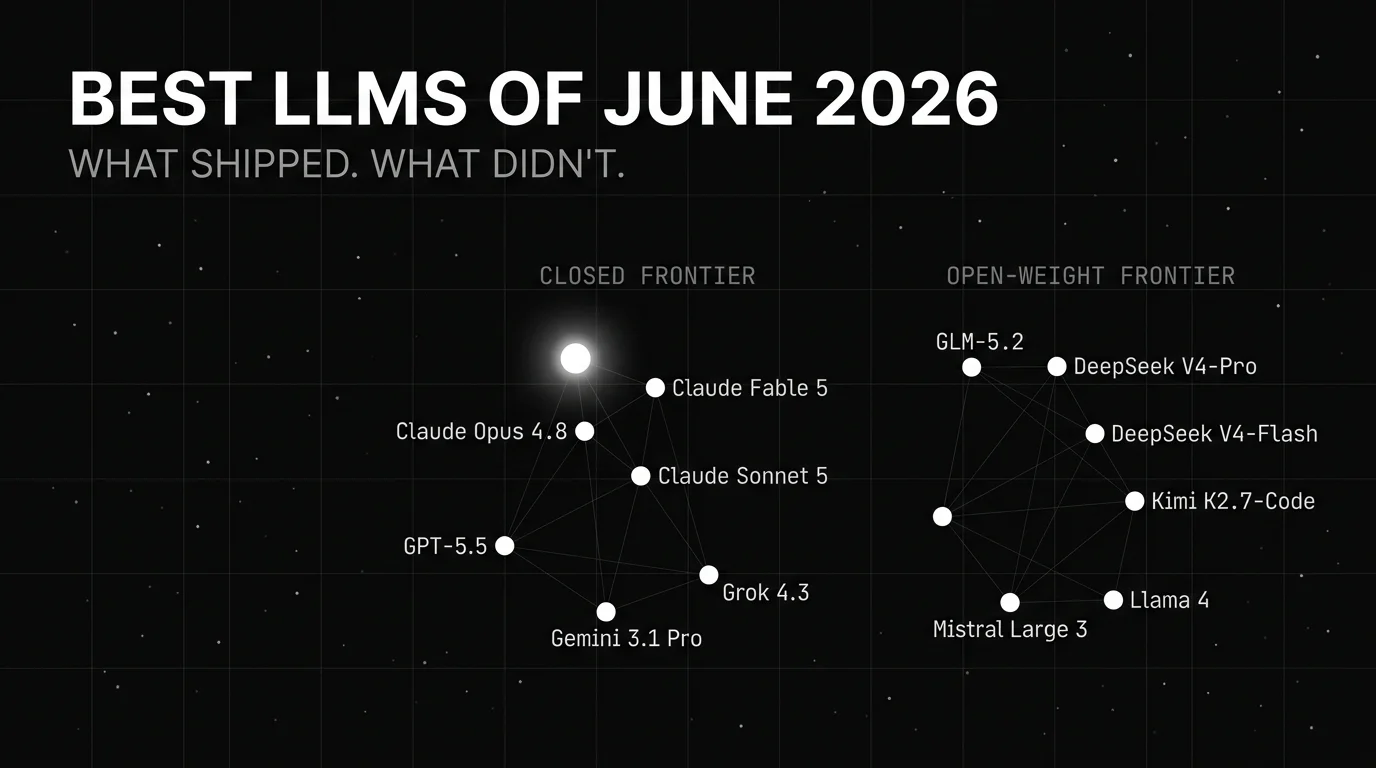
Table of Contents
Series note. This is the June 2026 entry in our monthly best-LLMs series. New frontier models now ship weekly, and June shipped a lot of them. We track what shipped, what won which category, and what the public leaderboards do not capture. Previous: May 2026 ←. the model layer rested while infrastructure moved. April 2026 ←←. six frontier models in 30 days, Berkeley breaks the trust.
TL;DR: Best LLM per category, June 2026
| Use case | Best pick | Why | Output $/M tokens |
|---|---|---|---|
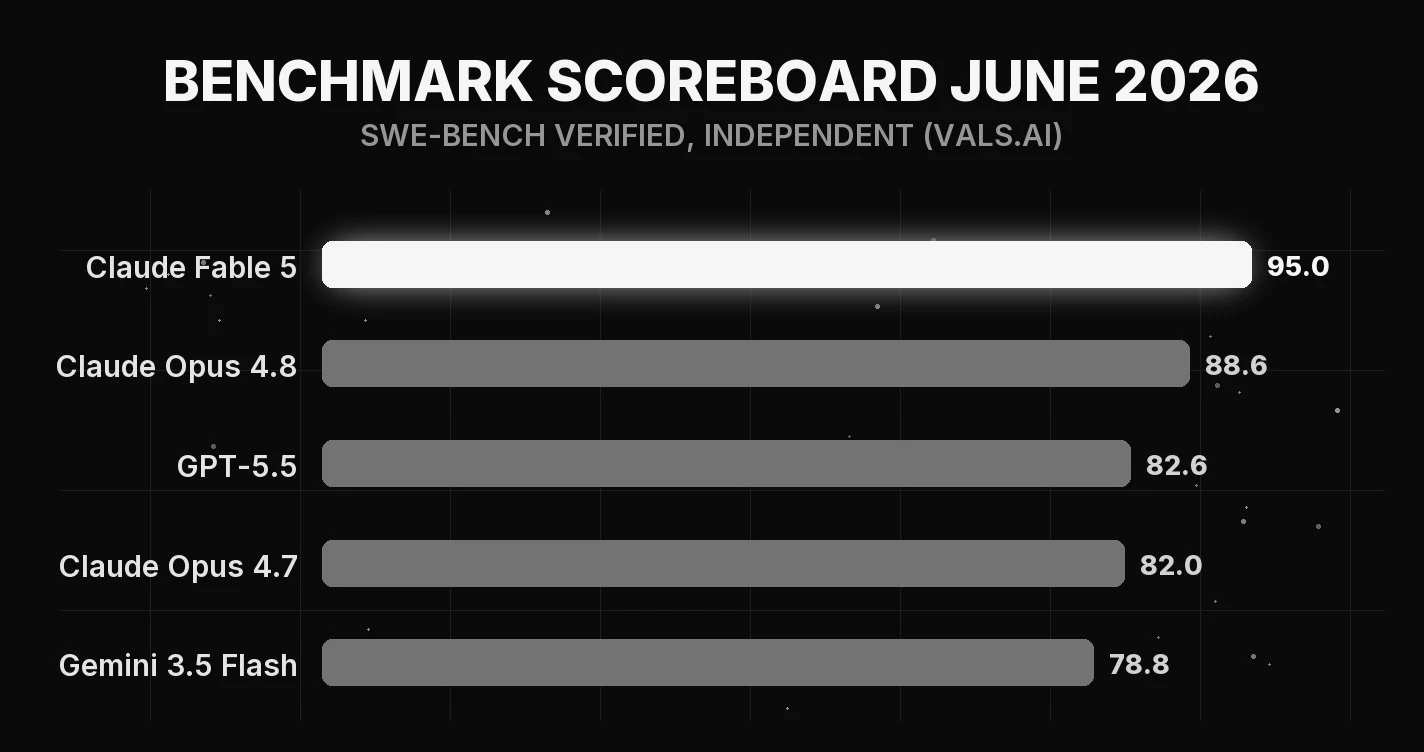
| Raw coding capability | Claude Fable 5 (1M context) | 95.0% SWE-bench Verified (vals.ai), an unusually high, harness-sensitive ceiling | $50 |
| Open-weight coding value | GLM-5.2 (MIT) | Beats GPT-5.5 on vendor-reported SWE-bench Pro (62.1 vs 58.6) at ~1/6 the cost | ~$3.00–$4.10 |
| Balanced frontier (GA) | Claude Opus 4.8 | 88.6% SWE-bench Verified (vals.ai) | $25 |
| Agentic terminal / tool-calling | GPT-5.5 | 82.6% SWE-bench Verified (vals.ai), hosted flagship | $30 |
| Cheap new default | Claude Sonnet 5 | Default for Free and Pro, $2/$10 introductory pricing | $10 (intro) → $15 |
| Long-context multimodal | Gemini 3.1 Pro (1M) | Cheapest US-frontier multimodal tier; native image, audio, video | $12 ($18 above 200K) |
| Cheap fast frontier | Gemini 3.5 Flash | 78.8% SWE-bench Verified (vals.ai) at $9 output | $9.00 |
| Reasoning + real-time data | Grok 4.3 | 90.1% GPQA Diamond (independent), X integration | $2.50 |
| Cost-performance open coder | DeepSeek V4-Pro (MIT) | ~80.6% SWE-bench Verified (vendor), $0.87 output | $0.87 |
| Cheapest frontier-class open | DeepSeek V4-Flash (MIT) | 1M/384k, routine bulk work | $0.28 |
| Token-efficient open coding agent | Kimi K2.7-Code (Mod. MIT) | 256K context, agent-tuned (no independent bench yet) | $4.00 |
| Closed-weight benchmark outlier | Qwen3.7-Max | API-only, 1M context, 90% cache discount | $7.50 |
| Non-Chinese open-weight | Mistral Large 3 (Apache 2.0) | 256K context, permissive license | ~$1.50 |
If you only read one row: GLM-5.2 for open-weight coding at roughly one-sixth the GPT-5.5 price, Claude Fable 5 for top-end capability, Claude Sonnet 5 for the cheap new default, GPT-5.5 for terminal and tool-calling, DeepSeek V4-Flash for the absolute cheapest. Everything else is a tradeoff on those five.
The single biggest story of June 2026: the open-weight coding price war went mainstream. GLM-5.2 (MIT, June 13) reports beating GPT-5.5 on long-horizon coding at roughly one-sixth the cost, arriving the same week as Kimi K2.7-Code (June 12) and alongside the still-current DeepSeek V4 (MIT). In the same window, Anthropic opened a new $10/$50 top tier with Claude Fable 5, and OpenAI’s GPT-5.6 stayed in limited preview. The “cheap follower, expensive leader” split that held through 2025 is now under real pressure.
The story of June 2026: the open-weight coding price war, and a new top tier
May was quiet at the model layer. June was the opposite. Three permissively licensed models landed in five days, a new frontier tier opened above Opus, and a frontier model got pulled offline by a government mid-launch.
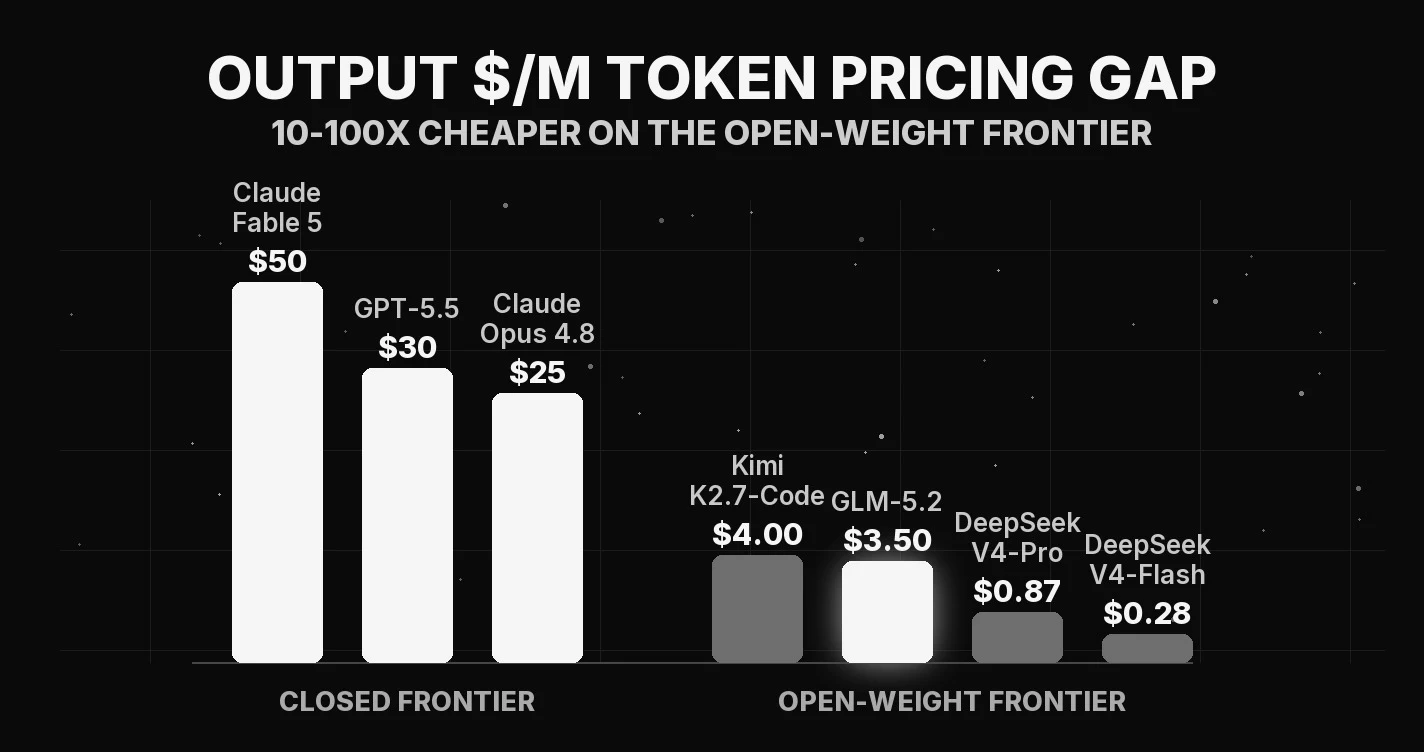
The headline is cost. GLM-5.2 went generally available June 13 under an MIT license with a 1M-token context window, and Z.ai reports it beating GPT-5.5 on vendor-run SWE-bench Pro (62.1% vs 58.6%) and PostTrainBench (34.3 vs 25.0). Those are vendor numbers, and an independent SWE-bench Pro run is still pending, so read them as a claim to verify. The price, though, is not in dispute: GLM-5.2 lists around $3.00 to $4.10 per million output tokens against GPT-5.5’s $30.
GLM-5.2 did not arrive alone. Moonshot shipped Kimi K2.7-Code on June 12 under a Modified MIT license, a 256K-context model tuned as a token-efficient coding agent. Its published numbers are Moonshot-internal, so we list the model and skip the scores until an independent run exists. DeepSeek V4-Pro and V4-Flash, both MIT and both generally available since April 24, remain the cost-performance anchors underneath.
At the top of the market, Anthropic went the other direction. Claude Fable 5 went generally available June 9 as the most capable model Anthropic has widely released, opening a new $10 input / $50 output tier above Opus. It posts 95.0% on SWE-bench Verified per vals.ai, a number we read as unusually high and harness-sensitive. Treat it as a capability ceiling, not a production guarantee, and reproduce it on your own domain before you budget around it.
Then the wrinkle. US export controls pulled Fable 5 offline on June 12, three days after launch. The restriction was lifted June 30 and the model returned globally July 1. Frontier availability now has a regulatory dependency stacked on top of the usual capacity and safety gates, and that is a planning constraint, not a footnote.
OpenAI stayed quiet by comparison. GPT-5.6 (Sol, Terra, and Luna) was announced June 26 but remained in limited preview through month end, so it is not a June generally available model and its quoted prices are preview figures. Google announced Gemini 3.1 Flash Lite Image on June 23, then confirmed on June 29 that Gemini 3.5 Pro slips to July 17. xAI’s Grok 4.5 entered private beta June 28 to 29 with no public access. The month closed on June 30 with Claude Sonnet 5 going generally available at $2/$10 introductory pricing as the new Free and Pro default, and Fable 5’s export controls lifting the same day.
The takeaway from June 2026: capability kept climbing at the top while price collapsed at the bottom, and the two moved in the same month. Model choice is now a cost-and-license decision as much as a capability one, and the gap between a vendor benchmark and your production number is the variable that decides whether the cheap pick actually holds.
Top closed-source / proprietary LLMs in June 2026
Claude Fable 5. Best for raw coding capability
Anthropic. Generally available June 9, 2026. 1M context, 128k max output.
The most capable model Anthropic has widely released, and the opening of a new price tier above Opus at $10 input / $50 output per million tokens. It posts 95.0% on SWE-bench Verified per vals.ai. We read that score as unusually high and harness-sensitive, so treat it as the public ceiling rather than a number you will hit in production.
- 1M-token context window, 128k max output
- $10 input / $50 output per million tokens
- 95.0% SWE-bench Verified (vals.ai), an unusually high, harness-sensitive ceiling
- Best for: hardest multi-file coding and reasoning work where capability outranks cost
What it does not win: cost (it is the most expensive tier on this list), availability certainty (US export controls pulled it offline June 12 to 30), and routine bulk work where Sonnet 5 or an open-weight coder is a fraction of the price.
Claude Sonnet 5. Best cheap default for high-volume agents
Anthropic. Generally available June 30, 2026. Default for Claude Free and Pro.
The new default model across Claude Free and Pro, and the cheap, high-volume tier below Opus 4.8 and Fable 5. Anthropic describes it as close to Opus 4.8 capability without publishing per-benchmark numbers on the launch page, so we hold the capability claim as vendor framing pending independent scores.
- 1M-token context window, 128k max output
- $2 input / $10 output introductory through August 31, 2026, then $3 / $15
- Default model for Free and Pro
- Best for: high-volume agents, chat surfaces, and cost-sensitive production where Opus is overkill
What it does not win: top-end capability (Fable 5 and Opus 4.8 sit above it), and rock-bottom price (open-weight coders undercut it on output tokens).
Claude Opus 4.8. Best balanced generally available frontier
Anthropic. Generally available May 28, 2026. Carryover into June.
The balanced generally available frontier pick. Opus 4.8 posts 88.6% on SWE-bench Verified per vals.ai, which puts it second only to Fable 5 on independent coding while staying a tier cheaper.
- $5 input / $25 output per million tokens; fast mode $10 / $50
- 88.6% SWE-bench Verified (vals.ai)
- 1M-token context window
- Best for: production coding and agent work that wants frontier capability without the Fable 5 price
What it does not win: raw capability ceiling (Fable 5 leads), and cost against Sonnet 5 or open-weight coders for routine work.
GPT-5.5. Best for agentic terminal and tool-calling
OpenAI. Current flagship, generally available since roughly April 2026. Native vision and audio.
OpenAI’s flagship for agentic and tool-calling work. It posts 82.6% on SWE-bench Verified per vals.ai and ships as a hosted, widely integrated model with a 1M-token context window. GPT-5.5 Pro adds a higher-compute tier at $30/$180 for the hardest reasoning calls.
- $5 input / $30 output per million tokens (cached input $0.50); Pro tier $30 / $180
- 82.6% SWE-bench Verified (vals.ai)
- 1M-token context, native vision and audio
- Best for: agentic terminal automation, function-call-heavy applications, broad ecosystem support
What it does not win: cost (GLM-5.2 matches or beats it on vendor coding at roughly one-sixth the price), and the raw SWE-bench Verified ceiling (Fable 5 and Opus 4.8 lead).
Gemini 3.1 Pro. Best for long-context multimodal at low cost
Google DeepMind. Current, in public preview.
The cheapest US-frontier tier, with a 1M-token context window and strong multimodal handling across image, audio, and video. The default pick when multimodal input or US data residency drives the decision.
- $2 input / $12 output per million tokens (up to 200K prompt); $4 / $18 above 200K
- 1M-token context window
- Native multimodal (image, audio, video understanding)
- Best for: long-context pipelines, multimodal workloads, cost-sensitive US-data-residency deployments
What it does not win: the coding leaderboard (Fable 5, Opus 4.8, and GPT-5.5 lead on SWE-bench Verified), and absolute output price against the open-weight tier.
Gemini 3.5 Flash. Best cheap fast frontier
Google DeepMind. Generally available May 19, 2026 (Google I/O). Carryover into June.
The cheap, fast frontier option. Gemini 3.5 Flash posts 78.8% on SWE-bench Verified per vals.ai at $1.50/$9.00 per million tokens, which makes it a strong default for high-throughput work that still needs frontier-adjacent quality.
- $1.50 input / $9.00 output per million tokens
- 78.8% SWE-bench Verified (vals.ai)
- 1M-token context window
- Best for: high-volume, latency-sensitive workloads that want frontier-adjacent quality cheaply
What it does not win: top-end coding and reasoning (the Pro and Opus tiers lead), and open-weight economics for bulk output.
Grok 4.3. Best for reasoning with real-time data
xAI. Beta April 17, API April 30, 2026. Current in June. 1M context.
xAI’s current API flagship, and the pick when graduate-level reasoning meets a need for current-events grounding. Grok 4.3 posts 90.1% on GPQA Diamond across independent trackers and pulls real-time data from X without a separate retrieval layer.
- $1.25 input / $2.50 output per million tokens (2x input above 200K)
- 90.1% GPQA Diamond (independent)
- 1M-token context window, real-time data via X
- Best for: research agents that need current data, reasoning-heavy workflows, X-native grounding
What it does not win: the coding leaderboard (it does not lead SWE-bench Verified), and open-weight licensing (it is hosted only).
Top open-weight and Chinese-frontier LLMs in June 2026
The open-weight tier is where June’s price war played out. Three permissively licensed models are defensible at or near the frontier, plus one closed-weight Chinese outlier (Qwen3.7-Max) that matters for production decisions even though its weights are not downloadable.
GLM-5.2. The June price-war headliner
Z.ai / Zhipu. Generally available June 13, 2026. MIT license, 1M context.
The single most important open-weight release of June 2026. GLM-5.2 ships under an MIT license with a 1M-token context window (about 131k max output), and Z.ai reports it beating GPT-5.5 on long-horizon coding: 62.1% vs 58.6% on SWE-bench Pro and 34.3 vs 25.0 on PostTrainBench. Both are vendor-reported, and an independent SWE-bench Pro run is still pending, so treat them as a claim to reproduce.
The part that is not in dispute is price. GLM-5.2 lists roughly $0.95 to $1.20 input and $3.00 to $4.10 output per million tokens depending on provider, against GPT-5.5’s $5/$30. That is frontier-adjacent coding at open-weight economics, which is exactly the pressure the closed labs spent June responding to.
- MIT license, downloadable weights on Hugging Face
- 1M-token context window, about 131k max output
- Vendor-reported SWE-bench Pro 62.1% vs GPT-5.5 58.6% (independent run pending)
- Roughly $0.95–$1.20 input / $3.00–$4.10 output per million tokens (provider-dependent)
Best for: self-hosted or hosted coding agents where open weights and cost both matter, and teams willing to run their own eval to confirm the vendor coding numbers on their domain.
Skip if: you need an independently verified coding score today (wait for the neutral SWE-bench Pro run), or you want a single hosted flagship with vendor support.
DeepSeek V4-Pro and V4-Flash. Best cost-performance on the open frontier
DeepSeek. Generally available April 24, 2026. MIT license, downloadable weights.
The cost-performance anchors of the open tier, both MIT and both current through June. V4-Pro is the coder at about 80.6% SWE-bench Verified (vendor and aggregator reported, so label it), with a 1M-token context window and 384k max output. V4-Flash is the routine-work option at a fraction of the price.
- V4-Pro: $0.435 input / $0.87 output per million tokens (cache-hit input as low as $0.0036); ~80.6% SWE-bench Verified (vendor/aggregator)
- V4-Flash: $0.14 input / $0.28 output per million tokens; no independent standard-bench score yet
- Both MIT, 1M-token context, 384k max output
Best for: high-volume coding and general work where output price dominates, and teams that can self-host or accept inference from DeepSeek’s API.
Skip if: you need an independent benchmark on V4-Flash specifically (there is not one yet), or English-nuance-heavy work where a Western frontier model still edges ahead.
Kimi K2.7-Code. Token-efficient open coding agent
Moonshot AI. Generally available June 12, 2026. Modified MIT, 256K context.
Moonshot’s June coding drop, tuned as a token-efficient agent with a 256K-token context window and a $0.95/$4.00 price. Its published benchmark numbers are all Moonshot-internal, so we list the model and hold the scores until an independent run exists. That is the honest position on a model whose whole pitch is agentic coding.
- Modified MIT license, 256K-token context window
- $0.95 input / $4.00 output per million tokens
- No independent public-benchmark numbers yet (all published scores are Moonshot-internal)
Best for: teams building open coding agents that want a token-efficient option and are willing to benchmark it themselves on their own tasks.
Skip if: you need a published independent score before adopting, or you want a longer context window than 256K for whole-repository work.
Qwen3.7-Max. Top closed-weight benchmark outlier from a usually-open lab
Alibaba. Generally available May 19 to 20, 2026. API-only, closed weights. Current in June.
The closed-weight outlier worth tracking. Qwen3.7-Max ships API-only with a 1M-token context window and a 90% cache discount at $2.50/$7.50, continuing Alibaba’s move to keep its flagship tier closed while the smaller Qwen models stay open. Its headline benchmarks are vendor single-source, so we name the model and omit the numbers.
- API-only, closed weights, 1M-token context window
- $2.50 input / $7.50 output per million tokens, 90% cache discount
- Vendor benchmarks are single-source (omitted pending independent confirmation)
Best for: production teams already on Alibaba Cloud or Qwen SDKs who want the top Qwen tier and do not require downloadable weights.
Skip if: open weights are a hard requirement (use the open Qwen sizes, GLM-5.2, or DeepSeek V4 instead).
Llama 4 Scout and Maverick, and Mistral Large 3. The open-weight carryovers
Meta (April 5, 2025) and Mistral AI (late 2025). Legacy, still available.
The stable open-weight options that carry into June. Llama 4 Scout still holds the longest context window of any production-ready open model at 10M tokens, with Maverick at 1M, under Meta’s Llama 4 Community License (which carries redistribution restrictions). Mistral Large 3 remains the strongest non-Chinese permissive option at Apache 2.0, 256K context, and roughly $0.50/$1.50.
- Llama 4 Scout / Maverick: 10M / 1M context, Llama 4 Community License (restricted)
- Mistral Large 3: Apache 2.0, 256K context, ~$0.50 / $1.50 per million tokens
Best for: long-context open deployments (Scout), and teams that need a truly permissive non-Chinese license (Mistral Large 3).
Top multimodal LLMs in June 2026
Multimodal is no longer a single dimension. Vision, image generation, and video generation each have their own leaders and their own price floors. Treat the tables below as a starting point, and run your own eval on the exact task before committing.
Vision (image and document understanding)
| Use case | Best closed | Best open |
|---|---|---|
| General image understanding | Gemini 3.1 Pro | Qwen open VL family |
| Document / OCR / chart reading | Claude Opus 4.8 / Fable 5 | Qwen open VL family |
| Long-context multi-image | Gemini 3.1 Pro (1M tokens) | Llama 4 Scout (10M) |
| Screen / UI understanding | GPT-5.5 | Qwen open VL family |
Every Western frontier model now handles vision natively. The open column has closed the gap on the basics while still trailing on subtle layouts like dense charts and technical diagrams. For high-volume document work, a self-hosted open VL model is often close enough at a fraction of the cost, but confirm it on your own document distribution first.
Image generation
The image-gen category stayed fragmented in June. There is no single best model; pick by what the image is for.
| Use case | Best pick | Why | Pricing |
|---|---|---|---|
| Photorealism / product | Imagen 4 Ultra | Best-rated photorealistic output per third-party reviews | ~$0.06/img |
| Balanced quality / cost | Imagen 4 (Standard) | Strong general-purpose quality | ~$0.04/img |
| Speed / high volume | Imagen 4 Fast | Fastest Imagen tier | ~$0.02/img |
| General-purpose closed | GPT Image 2 | Broad quality, generally available April 21 2026 | API tier |
| Cheap image tier (new) | Gemini 3.1 Flash Lite Image | Cheap tier expansion, June 23 2026 | Flash-Lite tier |
| Open-weight / self-host | FLUX.2 (dev weights) | On your hardware, open dev weights from Black Forest Labs | self-host |
June image-gen note worth knowing: Google expanded the cheap tier with Gemini 3.1 Flash Lite Image on June 23. Exact per-image pricing for GPT Image 2, FLUX.2, and Seedream was not consistently confirmable across two sources at publication, so we list the models and hold the exact numbers.
Video generation
Video-gen leadership was set before June and carried through the month.
| Use case | Best pick | Why |
|---|---|---|
| Best all-around | Google Veo 3.1 | Current flagship, native audio, strong prompt adherence |
| Multi-shot storytelling | Kling 3.0 (Feb 5, 2026) | Sequences with subject consistency across cuts |
| Audio-video joint generation | Seedance 2.0 (ByteDance, Feb 12, 2026) | Unified audio and video with lip-sync |
| Physics simulation | Sora 2 (winding down) | Still strong on physics, but the API discontinues September 24, 2026 |
For production video in June 2026, Veo 3.1 is the default for narrative scenes and Kling 3.0 for multi-shot. If you built on Sora 2, its September 24 API sunset makes migration a deadline-bound project.
Audio understanding
Native audio handling (speech as input, not via a separate transcription step) is standard across the Western frontier models. GPT-5.5 and Gemini 3.1 Pro both handle speech-in directly, which preserves prosody and disambiguates accent or noise that breaks transcribe-then-prompt pipelines. For the full speech stack, see the dedicated voice guide below.
Voice and audio (covered separately)
Voice AI has its own decision logic. STT (Deepgram, AssemblyAI, ElevenLabs), TTS (Cartesia, ElevenLabs, Deepgram, Hume), and voice-agent platforms (LiveKit, Pipecat, Vapi, Retell) all follow different picks than text-only LLMs. The conversational latency budget alone, anchored on the ITU-T G.114 one-way ceiling, drives different choices than text-LLM workflows.
See Best Voice AI of June 2026 for the full STT, TTS, and voice-agent stack.
Top embeddings and retrieval models in June 2026
Embeddings have two production constraints: retrieval quality on your domain, and price per million tokens. The public leaderboards churn month to month, so the honest move is to name the durable options and run your own retrieval eval rather than chase a live MTEB row.
| Use case | Durable pick | Notes |
|---|---|---|
| Best retrieval (closed) | Voyage-4-large | Tops Voyage’s RTEB retrieval benchmark (independent run pending) |
| Multimodal retrieval | Gemini Embedding | Text plus image, audio, and PDF in one model |
| OpenAI ecosystem default | OpenAI text-embedding-3-large | Strong general default; -3-small for cheapest viable |
| Multilingual enterprise | Cohere embed-v4 | Multilingual production coverage |
| Open-weight / self-host | Qwen3-Embedding-8B | Strong open multilingual option on your hardware |
We are deliberately not printing specific MTEB numbers here. The leaderboard positions move often enough that a frozen score misleads more than it helps, and several current figures did not clear a two-source check at publication. For a new retrieval pipeline, shortlist two or three of the models above and score them on your own documents. Add a reranker (Cohere or Voyage) for a few points of retrieval quality at small added cost.
Top coding-specific LLMs in June 2026
Coding is the highest-stakes category. Most enterprise AI deployments are coding agents, and June’s releases pushed both the capability ceiling and the price floor at once.
| Use case | Top pick | Score | Output $/M tokens |
|---|---|---|---|
| Raw capability (SWE-bench Verified) | Claude Fable 5 | 95.0% (vals.ai), unusually high | $50 |
| Balanced GA (SWE-bench Verified) | Claude Opus 4.8 | 88.6% (vals.ai) | $25 |
| Terminal / agentic coding | GPT-5.5 | 82.6% SWE-bench Verified (vals.ai) | $30 |
| Cheap fast frontier coding | Gemini 3.5 Flash | 78.8% SWE-bench Verified (vals.ai) | $9.00 |
| Open-weight coding value | GLM-5.2 | 62.1% SWE-bench Pro vs GPT-5.5 58.6% (vendor) | ~$3.00–$4.10 |
| Cost-performance open coder | DeepSeek V4-Pro | ~80.6% SWE-bench Verified (vendor) | $0.87 |
| Token-efficient open agent | Kimi K2.7-Code | No independent bench yet | $4.00 |
Two labels matter here. SWE-bench Verified scores above come from vals.ai (independent), and we read Fable 5’s 95.0% as unusually high and harness-sensitive, so do not treat it as a production floor. The SWE-bench Pro numbers for GLM-5.2 are vendor-reported, because an independent Pro leaderboard run was still pending at publication. The gap between a vendor score and your reproduction is the number that decides your pick.
Top reasoning and math LLMs in June 2026
Reasoning is the category where June’s headline numbers need the most caution. The one figure that cleared a two-source independent check is Grok 4.3 at 90.1% on GPQA Diamond, which makes it the verified reasoning pick when you also want real-time data grounding.
The new frontier models (Fable 5, Sonnet 5, Opus 4.8, GPT-5.5) all carry vendor reasoning claims on suites like FrontierMath and Humanity’s Last Exam, but those did not clear an independent two-source gate for June at publication. Rather than print vendor numbers as if they were independent, we hold them. If reasoning is your core workload, run your own eval on a graduate-level or olympiad-style set that matches your domain, and weight the independent GPQA Diamond result above any single-source claim.
Best LLM for X: decision framework
Choose GLM-5.2 if:
- Open weights and low cost both matter for coding work.
- You can run your own eval to confirm the vendor SWE-bench Pro numbers on your domain.
- MIT licensing matters for redistribution.
Choose Claude Fable 5 if:
- You need the highest available coding capability and cost is secondary.
- Your work is hard multi-file reasoning where the capability ceiling pays for itself.
- You can plan around availability constraints (it was offline June 12 to 30).
Choose Claude Sonnet 5 if:
- You want a cheap, high-volume default for agents and chat surfaces.
- You are already on the Anthropic ecosystem and want the Free/Pro default.
- $2/$10 introductory pricing fits your budget better than Opus.
Choose GPT-5.5 if:
- You are building agentic terminal automation or tool-calling-heavy applications.
- You want a hosted flagship with broad ecosystem support.
- You need native vision and audio in one model.
Choose Gemini 3.1 Pro if:
- You need a 1M-token context window for whole-corpus or long-document work.
- Multimodal handling is core to your application.
- US data-residency cost matters and $2/$12 is your ceiling.
Choose DeepSeek V4-Pro or V4-Flash if:
- Output price is the dominant constraint.
- Your workload is primarily coding (V4-Pro) or high-volume routine work (V4-Flash).
- MIT licensing matters for downstream redistribution.
Choose Grok 4.3 if:
- Graduate-level reasoning and real-time data are both core.
- You want X-native grounding without a separate retrieval layer.
Avoid GPT-5.6, Grok 4.5, and Gemini 3.5 Pro for now. GPT-5.6 stayed in limited preview through June, Grok 4.5 is private beta, and Gemini 3.5 Pro slipped to July 17. None is a June generally available option.
Common mistakes when picking an LLM in June 2026
The four most expensive errors we see production teams make:
- Trusting a single benchmark, especially an outlier. Fable 5’s 95.0% SWE-bench Verified is an unusually high, harness-sensitive outlier. If you budget around it without a domain reproduction, your production number will disappoint. Use multiple benchmarks plus your own prompts.
- Treating vendor scores as independent. GLM-5.2’s SWE-bench Pro lead over GPT-5.5 is vendor-reported, with an independent run pending. The claim may hold, but confirm it on your workload before you migrate.
- Ignoring total cost of ownership. Listed price times token volume is the sticker number. Real cost includes retry rate, test-time-compute multipliers, and failure recovery. A flaky agent triples the bill before you notice.
- Assuming availability is guaranteed. Fable 5 was pulled offline mid-launch by export controls. Frontier availability now carries a regulatory dependency, so build a fallback model into any production path that cannot afford downtime.
Recent platform updates
| Date | Event | Why it matters |
|---|---|---|
| June 9 | Claude Fable 5 generally available | New $10/$50 top tier above Opus |
| June 12 | US export controls pull Fable 5 offline | Government action on a frontier model mid-launch |
| June 12 | Moonshot Kimi K2.7-Code (Modified MIT) | Token-efficient open coding agent |
| June 13 | Z.ai GLM-5.2 (MIT, 1M context) | The price-war headliner, open weights vs GPT-5.5 on coding |
| June 23 | Google Gemini 3.1 Flash Lite Image | Cheap image tier expansion |
| June 26 | OpenAI GPT-5.6 (Sol/Terra/Luna) limited preview | Flagship successor announced, not generally available in June |
| June 28–29 | xAI Grok 4.5 private beta | Next-gen confirmed, no public access |
| June 29 | Google delays Gemini 3.5 Pro to July 17 | Confirms 3.5 Pro was not a June release |
| June 30 | Claude Sonnet 5 generally available; Fable 5 controls lifted | Cheap new default, and Fable 5 cleared to relaunch |
How to actually pick one for production
The leaderboard is the wrong artifact to make a June 2026 production decision from. Three things to do instead:
- Run a domain reproduction. Take 100 to 500 of your actual production prompts, run them through your two or three candidate models with your harness, and score them with Future AGI evals or your own judge. For June specifically, this is how you separate Fable 5’s unusually high 95.0% and GLM-5.2’s vendor coding claim from the number you will actually ship.
- Measure reliability under load. A public score is an aggregate over a fixed task set. It does not predict variance across your prompts and repeated agent runs. Use Future AGI Simulate to stress-test agents across long sessions, where most frontier models lose a chunk of headline accuracy that benchmarks never surface.
- Cost-adjust every score. June’s spread runs from $0.28 to $50 per million output tokens. Compute score-per-dollar on your domain before you default to a brand. GLM-5.2 and DeepSeek V4 are the obvious value picks if they hold up on your traffic, and the obvious miss if the vendor numbers do not survive your reproduction.
June rewarded teams that treated model choice as a cost, license, and reliability decision rather than a single-benchmark race. The capability ceiling rose with Fable 5 while the price floor fell with GLM-5.2 and the open coders, and both moved inside one month.
The practical answer is to shortlist by your dominant workload, then let your own reproduction and reliability numbers pick the winner. Put more effort into the eval loop above the model than you spend comparing leaderboard rows, because that is the layer that decides whether June’s cheapest pick or its most capable one actually works for you.
Sources
Frontier model launches (primary):
- Claude Fable 5 and Mythos 5 (Anthropic)
- Claude Sonnet 5 (Anthropic)
- Claude Opus 4.8 (Anthropic)
- Redeploying Fable 5 (Anthropic)
- OpenAI API pricing
- Previewing GPT-5.6 Sol (OpenAI)
- Gemini API pricing (Google)
- DeepSeek V4 release (DeepSeek API docs)
Benchmarks and leaderboards:
- SWE-bench on vals.ai
- Grok 4.3 (Artificial Analysis)
- GLM-5.2 analysis (Interconnects)
- Artificial Analysis Intelligence Index
Previous: Best LLMs of May 2026 ←. the model layer rested while distribution, compute, and regulation moved.
Frequently Asked Questions
What is the best LLM in June 2026?
What is the best open-source LLM in June 2026?
What is the best LLM for coding in June 2026?
What new LLMs were released in June 2026?
How does GLM-5.2 compare to GPT-5.5?
What is Claude Fable 5?
How much does Claude Sonnet 5 cost?
What happened with Claude Fable 5 and export controls?
Best LLMs May 2026: compare GPT-5.5, Claude Opus 4.7, Gemini 3.1 Pro, and DeepSeek V4 across coding, agents, multimodal, cost, and open weights.

Best LLMs April 2026: compare GPT-5.5, Claude Opus 4.7, DeepSeek V4, Gemma 4, and Qwen after benchmark trust broke and prices compressed fast.
Best LLMs March 2026: compare Gemini 3.1 Pro, Claude Opus 4.6, Mistral Small 4, and Qwen for coding, cost, multimodal, and open-weight picks.