Open-Source vs Open-Weight LLMs: The OSI Test
Open-source and open-weight LLMs are not the same. Use the OSI test to check model weights, code, data information, licenses, and deployment rights.
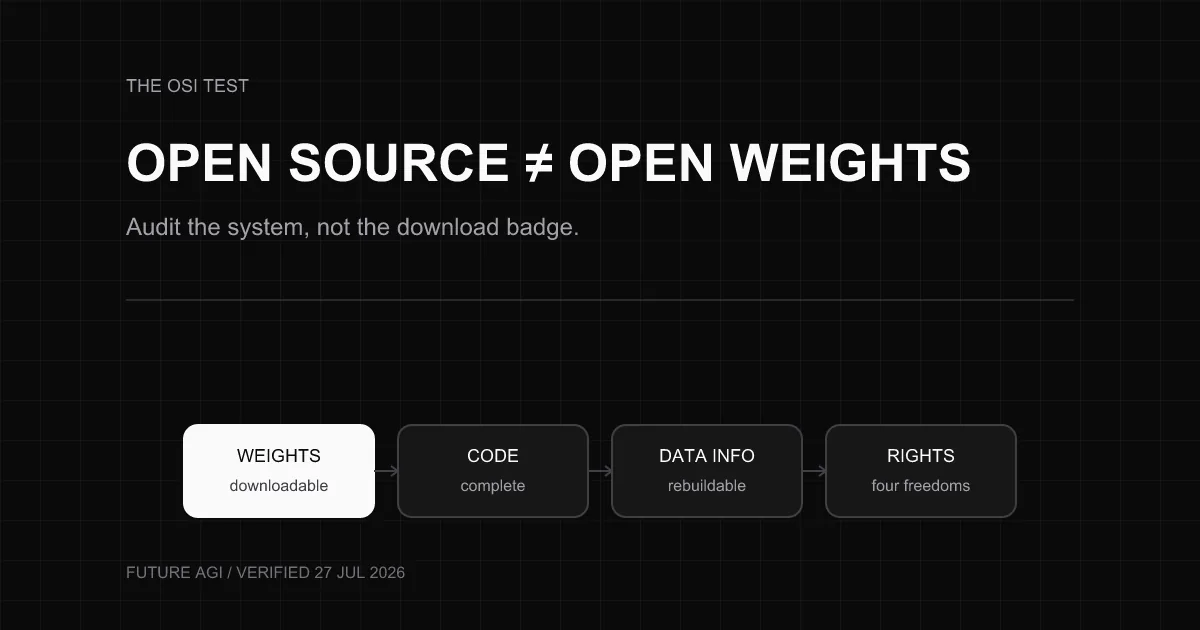
Table of Contents
Open-source and open-weight LLMs are not the same thing. Open weight means you can download the trained parameters. Open source AI, under the Open Source AI Definition (OSAID) 1.0, also requires the freedoms to use, study, modify, and share the system, backed by the code and data information needed to make meaningful changes.
That distinction is not academic. It decides whether your team can reproduce the system, redistribute a derivative, pass a license review, or move away from the original vendor.
Our position: if a release gives you Apache-2.0 weights but withholds the training code and data information, call it permissively licensed open weight. Calling the whole AI system open source overstates what was released.
This article focuses on that disputed line. For the shorter definition, see the open-source LLM glossary. For software licenses rather than model releases, use the open-source software guide.
What Is the Difference Between Open Source and Open Weight?
The cleanest way to compare model releases is to separate access to weights from openness of the full system.
| Release pattern | Weights | Training and inference code | Data information | Typical license posture | Honest label |
|---|---|---|---|---|---|
| Full OSAID-aligned release | Yes | Complete | Sufficient to recreate a substantially equivalent system | Grants the four freedoms | Open-source AI |
| Permissively licensed weights | Yes | Partial or missing | Partial or missing | Apache-2.0, MIT, or similar on the weights | Open weight |
| Restricted weights | Yes | Partial or missing | Partial or missing | Custom terms, use limits, or branding rules | Restricted open weight |
| Source-available release | Sometimes | Some source is visible | Varies | Research-only, non-commercial, or competitive-use limits | Source available |
| Closed model | No | No | No | API terms | Closed |
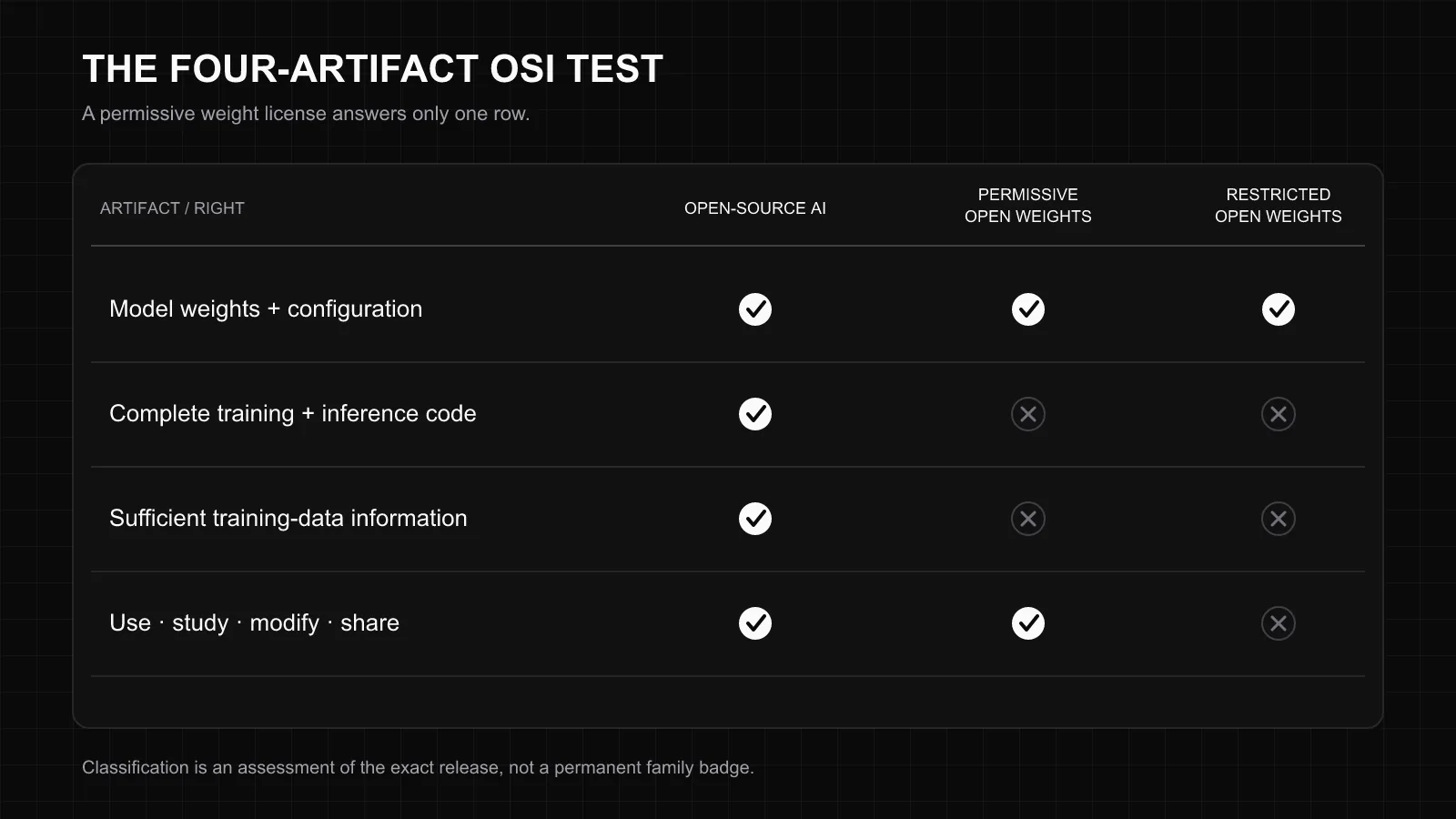
The middle row causes most confusion. A permissive license can make the weights easy to use while the system still falls short of OSAID because its training pipeline is not available.
Open weight is still useful. It can enable self-hosting, fine-tuning, quantization, and vendor independence. It simply answers a different question from “is the full AI system open source?”
What Does the Open Source AI Definition Require?
OSAID applies the open-source idea to an AI system rather than treating a model as one file. It asks whether a recipient can exercise four freedoms and has the preferred form for making modifications.
The Four Freedoms
A user must be able to:
- Use the system for any purpose without asking permission.
- Study how it works and inspect its components.
- Modify the system, including its outputs and behavior.
- Share the original or a modified version for any purpose.
A field-of-use restriction breaks the first freedom. A revenue threshold that requires a separate deal can break the freedom to use or share without permission.
The Three Artifact Groups
The preferred form for modification includes:
- Parameters: weights, configuration, tokenizers, and other material needed to run or change the model.
- Code: complete training, data-processing, validation, testing, and inference code under OSI-approved licenses.
- Data Information: provenance, scope, acquisition, selection, labeling, processing, and filtering details, plus where public or third-party data can be obtained.
The OSAID FAQ is explicit that raw training data does not always need to be redistributed. What must be available is enough information and code for a skilled team to build a substantially equivalent system.
That compromise is contested. Some free-software advocates argue that modification is not meaningful without the exact dataset. The practical point remains: OSAID asks for much more than downloadable weights.
Why Is an Apache-2.0 Weight File Not Enough?
Apache-2.0 and MIT are excellent software licenses. They grant broad copyright permissions, and Apache-2.0 includes an express patent grant. But a license only governs the artifact to which it applies.
If a model card marks its weights as Apache-2.0 while the training data, preprocessing code, and full training pipeline remain undisclosed, the license does not make those missing artifacts appear.
| Model family | Weight-license signal | What still needs checking | Safe description |
|---|---|---|---|
| Qwen3 | Apache-2.0 on this checkpoint | Training code and OSAID-level data information for the exact release | Permissively licensed open weight |
| Phi-4 | MIT on this checkpoint | Full preferred form for modification | Permissively licensed open weight |
| DeepSeek-R1 | MIT on the main release, with derivative-model caveats in the card | Training pipeline and data information | Permissively licensed open weight |
| OLMo | Apache-2.0 code and weights | Exact licenses and terms for every dataset component | Close to the full-system model of openness |
OSI does not certify individual models. Treat “OSAID-compliant” lists as an assessment, not an official seal.
OLMo also shows why “everything is Apache” is too simple. Its Dolma corpus has an ODC-By license and source-specific terms. A transparent stack can still contain multiple licenses that legal and data teams must review.
How Can You Audit a Model in 60 Seconds?
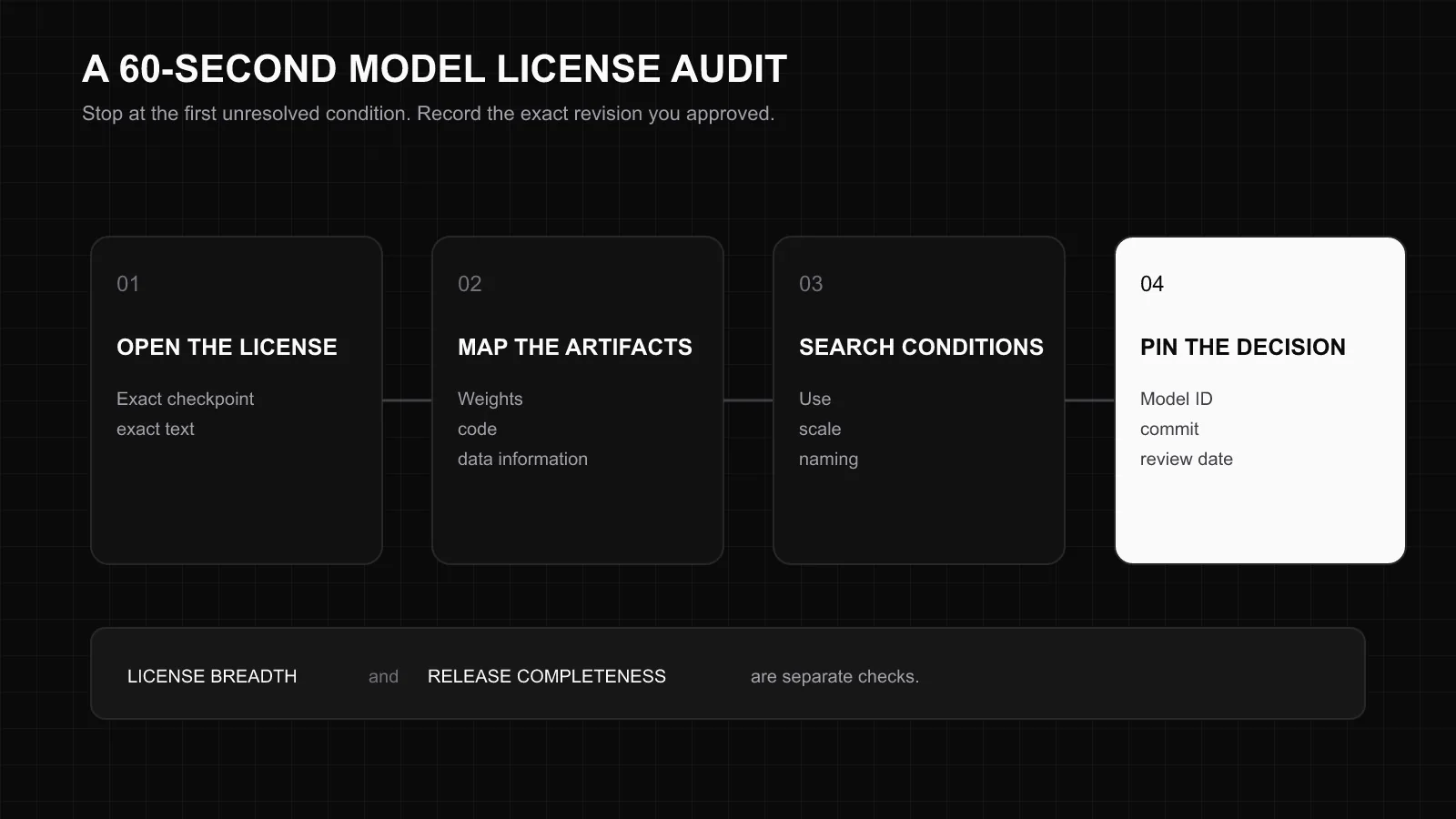
Use this four-check audit before you read benchmarks or start a deployment.
Check 1: Open the Actual License
Do not stop at a marketing page or a repository badge. Open the LICENSE file and the model card for the exact checkpoint.
An SPDX identifier is a machine-readable name, not proof that a license is OSI-approved. The SPDX License List marks OSI approval separately and also includes many non-OSI licenses.
Check 2: Map the Released Artifacts
Write down whether the release includes:
- weights and configuration;
- inference code;
- training and evaluation code;
- data-processing code;
- data information or a dataset card;
- training recipe, checkpoints, and logs.
Do not infer a missing artifact from the license on another one.
Check 3: Search for Conditions
Look for these terms inside the license:
- acceptable use;
- monthly active users;
- annual or monthly revenue;
- non-commercial or research-only;
- derivative naming and branding;
- redistribution and notice requirements;
- patent or copyright litigation termination.
Conditions do not automatically make a license bad. They tell you which label and review path are honest.
Check 4: Record the Version You Approved
Save the model ID, commit hash, model-card revision, license text, and review date. Model families mix licenses, and vendor terms can change between releases.
The decision record should say what your team approved, not “Qwen is open” or “Llama is free.”
Which Model Licenses Need Extra Review?
Custom model licenses often permit broad use while adding one or two conditions that matter only at scale. Those conditions still keep the release outside a strict OSAID label.
| License | Practical permission | Condition to notice | Classification |
|---|---|---|---|
| Llama Community License | Download, run, and modify weights | Acceptable-use terms and a large-user commercial threshold | Restricted open weight |
| Gemma Terms of Use | Commercial use and modification | Prohibited-use policy and pass-through obligations | Restricted open weight |
| Kimi K3 License | Run, fine-tune, distribute, and sell | Separate agreement for large model-as-a-service businesses; branding at defined scale | Restricted open weight |
| Upstage Solar License | Apache-like copyright and patent grants | Derivative-model name and “Built with Solar” requirements | Restricted open weight |
| OpenMDW-1.1 | Broad rights over model materials provided under it | Notice retention and patent/copyright litigation termination | Model-specific open license |
OpenMDW illustrates another subtlety. Its definition covers artifacts provided under the agreement; it does not promise that every artifact needed to rebuild a model was provided. License breadth and release completeness are separate checks.
What Changes When You Self-Host an Open-Weight LLM?
Downloading a model changes who owns the operational work.
You Gain Control
You can pin a checkpoint, keep prompts inside your environment, tune the model, and move between serving providers. For regulated or offline workloads, that control can decide the architecture.
You Take On the Infrastructure
There is no per-token API bill, but GPUs, batching, autoscaling, upgrades, and incident response are now yours. At low or irregular volume, a hosted API can still be cheaper.
Serving engines such as vLLM make deployment easier, but they do not remove capacity planning or model-specific compatibility work.
You Still Need a Quality Gate
The model card was not measured on your customer traffic. Quantization, prompts, tool schemas, and retrieval context can all change the result.
Openness improves inspection and portability. It does not guarantee factuality, safety, latency, structured output, or task completion.
How Should You Compare Candidate Models?
Use a fixed evaluation set before moving a model into production.
- Collect 25–100 real inputs that represent normal cases and costly failures.
- Define pass criteria for task accuracy, grounding, tool calls, and output format.
- Run every candidate with the same prompt, temperature, context, and serving precision.
- Measure quality with latency, GPU memory, and cost rather than ranking quality alone.
- Review the failures by cohort before choosing a winner.
For a UI-based workflow, FutureAGI’s Evaluate platform lets a team manage datasets, evaluators, and eval runs in one place without building a code-first harness for the comparison.
The July open-source LLM release tracker applies the license half of this process to current releases. Your workload-specific evaluation supplies the other half.
The Label Is a Starting Point, Not a Deployment Decision
The useful distinction is no longer “closed or open.” It is:
- What can we download?
- What can we legally do with it?
- Can we study and rebuild the system?
- Does it work on our task at an acceptable operational cost?
Call a model open source only when the full release earns that label. Call downloadable parameters open weight when that is what shipped.
Then test the model. The most open checkpoint can still be the wrong production choice, and the best benchmark score can still hide a license your team cannot accept.
Frequently Asked Questions About Open-Source and Open-Weight LLMs
What is the difference between an open-source and an open-weight LLM?
Does an Apache-2.0 model card make an LLM open source?
Is Llama an open-source LLM?
Does open-source AI require publishing the full training dataset?
Which model should a production team choose?
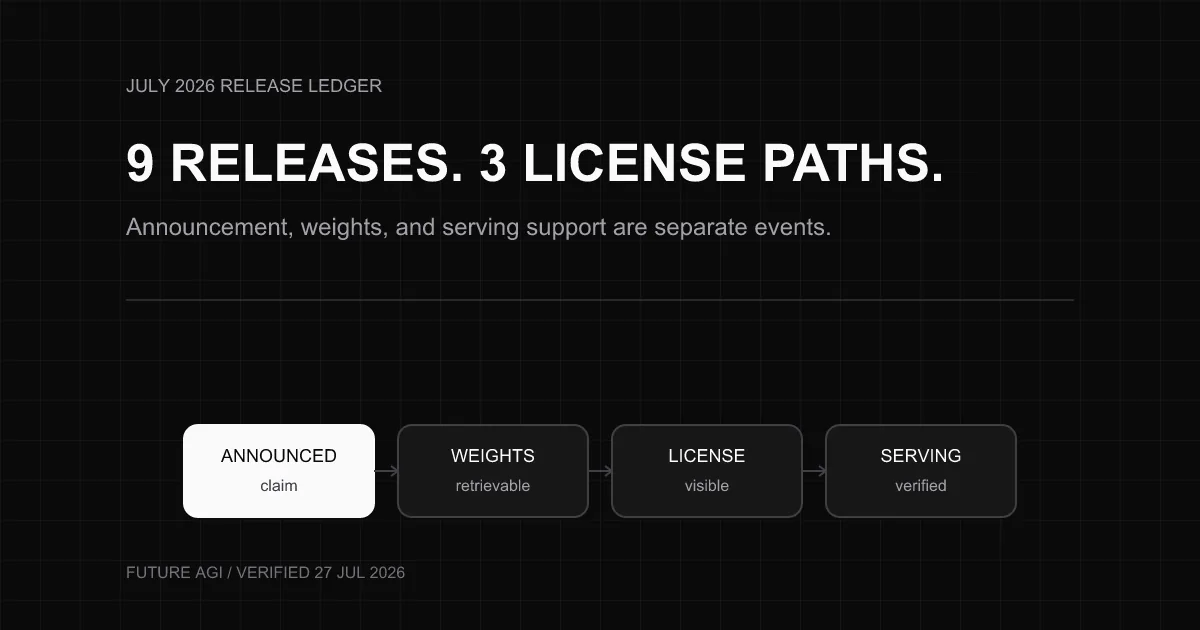
A verified July 2026 open-source LLM release tracker separating announcements from downloadable weights, original models from derivatives, and license types.

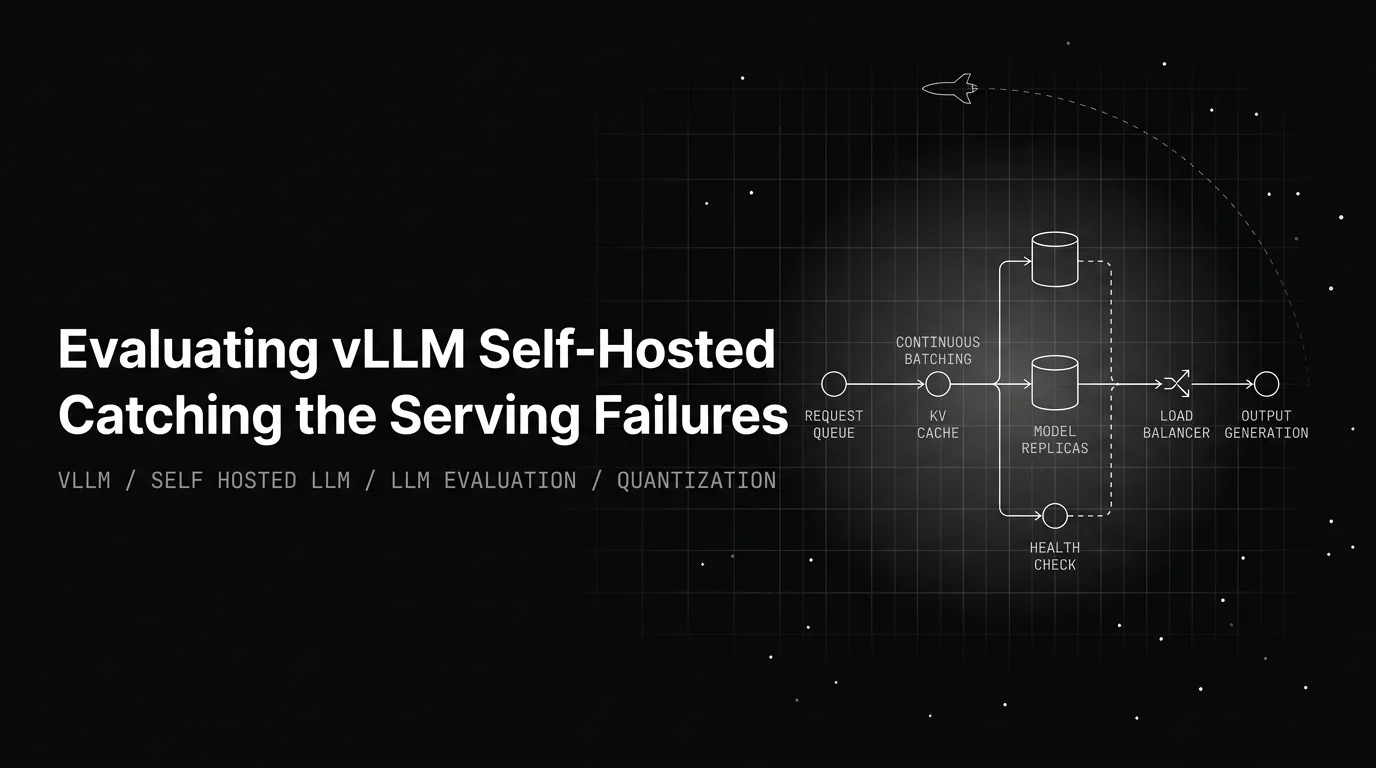
How to evaluate a vLLM self-hosted LLM in 2026: catch continuous-batching jitter, KV-cache eviction, and AWQ/GPTQ/FP8 drift before prod.

vLLM is the open-source LLM serving engine that pioneered PagedAttention and continuous batching. How it serves, how teams use it in production 2026.