Best LLMs of September 2026: Top Closed-Source, Open-Weight, Multimodal, and Coding Picks
The best LLMs by use case for September 2026: Opus 5.5 for agentic coding, GPT-6 Astra for reasoning, Gemini 3.8 Flash for speed, DeepSeek for open weights.
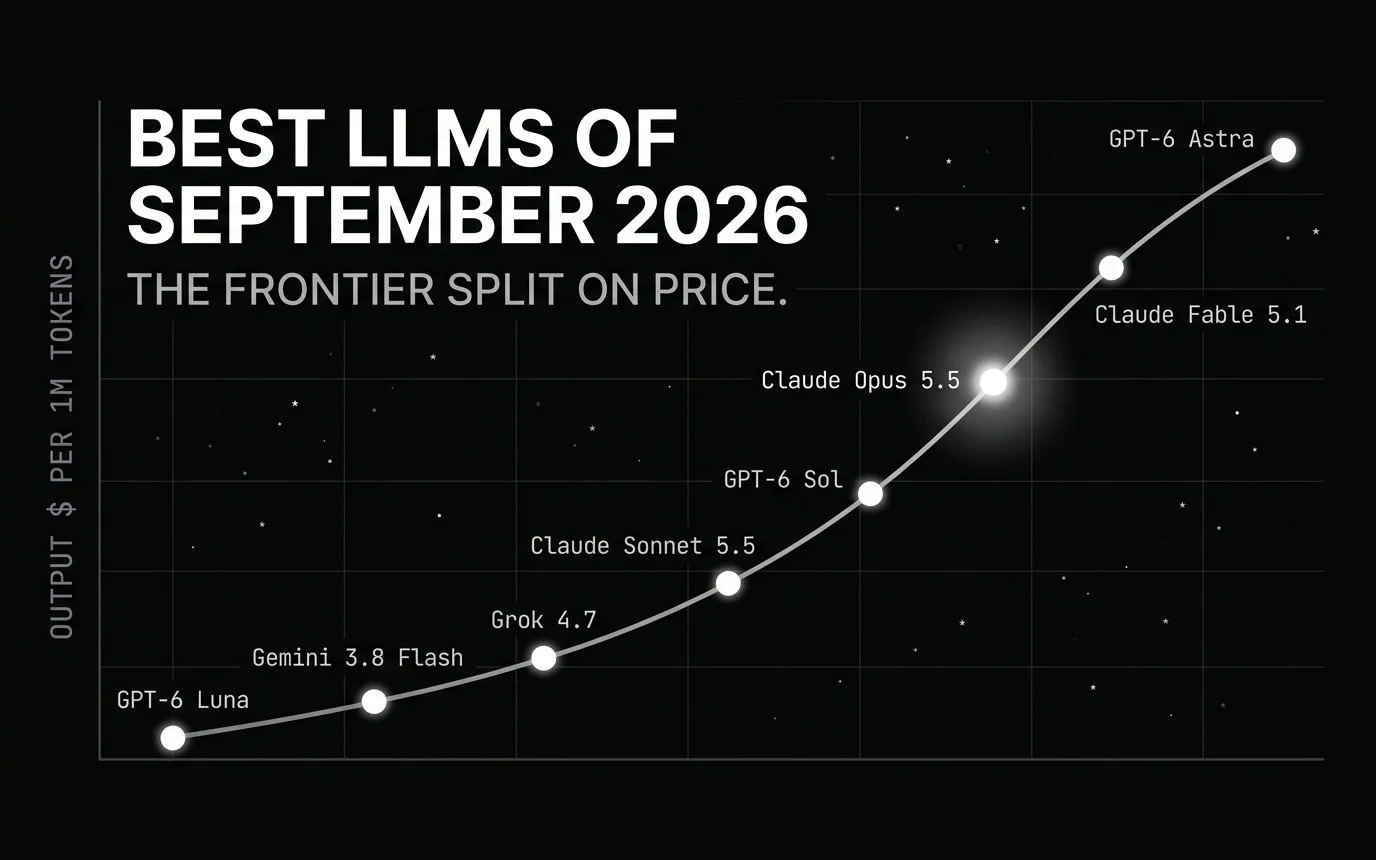
Table of Contents
Series note. This is the September 2026 entry in our monthly best-LLMs series. September split the frontier on price: Anthropic cut its flagship while OpenAI’s new top model went the other way. We track what shipped, what won each category, and what the public leaderboards miss. For the prior editions, see Best LLMs of August 2026, where Claude Opus 5 topped the intelligence index while Gemini 3.5 Pro stayed unreleased, and Best LLMs of July 2026, when the closed frontier repriced itself and open weights hit a new scale record.
TL;DR: Best LLM per category, September 2026
| Use case | Best pick | Why | Output $/M tokens |
|---|---|---|---|
| Balanced agentic frontier (GA) | Claude Opus 5.5 (1M context) | New $4/$20 flagship, 20% cheaper than Opus 5, built for agentic coding | $20 |
| Frontier reasoning | GPT-6 Astra | 96.0% GPQA Diamond, 97.6% FrontierMath Tier 4 v2 | $50 (>272K: $75) |
| Highest-capability Claude | Claude Fable 5.1 | Top Claude tier, cache read cut 75% to $0.25 | $50 |
| Cheap balanced default | Claude Sonnet 5.5 | 70.6% Terminal-Bench 4.0, above Opus 5.5 on that board | $10 |
| Fast long-context pick | Gemini 3.8 Flash | $0.75/$3.75 frozen through Dec 31, 1M context, 95.3% GPQA (AA) | $3.75 |
| Budget OpenAI API | GPT-6 Luna | $0.10 input / $0.50 output per million tokens | $0.50 |
| Balanced OpenAI mid | GPT-6 Sol | $2/$10 mid tier below Astra | $10 |
| Open-weight cost leader | DeepSeek V4.1 Flash (MIT) | 1M context, $0.15/$0.60 off-peak, downloadable weights | $1.20 ($0.60 off-peak) |
| Open-weight scale leader | Kimi K3 | Largest open-weight model, 2.8T parameters, 1M context | $15 |
| Open MIT alternative | GLM-5.2 / GLM-5.3 | 753B, GLM-5.2 MIT and GLM-5.3 custom license | self-host |
| Permissive non-Chinese open | Mistral Large 3 (Apache-2.0) | 675B, our Apache-2.0 general-model pick | self-host |
| Reasoning + real-time data | Grok 4.7 | 500K context, X-native grounding, API-only | $6 (>200K: $12) |
| Gemini Pro flagship | Gemini 3.1 Pro | Still the Pro tier, no 3.5 Pro shipped | $12 (>200K: $18) |
If you only read one row: Claude Opus 5.5 for balanced agentic coding at 20% off Opus 5, GPT-6 Astra for frontier reasoning, Gemini 3.8 Flash for fast, long-context work, GPT-6 Luna for a budget OpenAI tier, and DeepSeek V4.1 Flash for MIT open weights. Everything else trades off around those five.
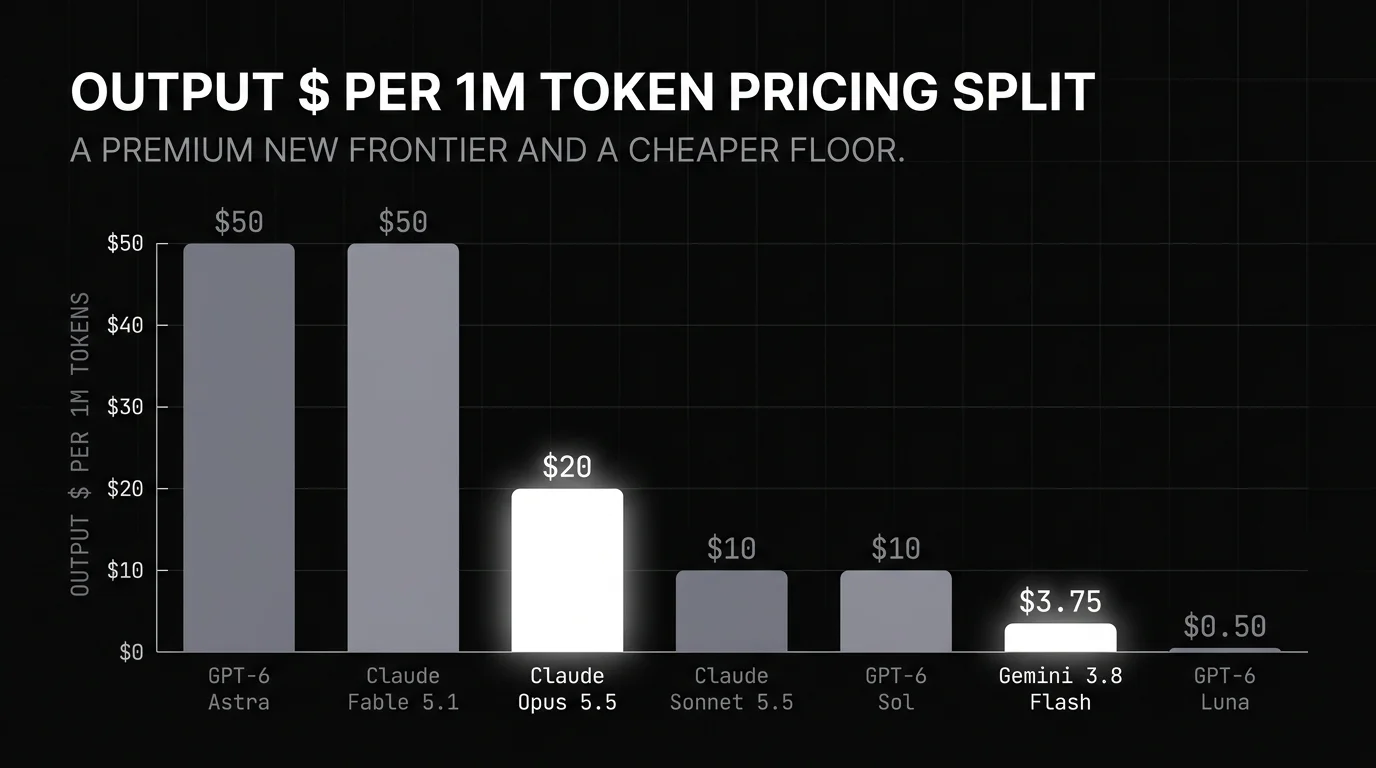
The single biggest story of September 2026: the frontier split on price. Anthropic cut its flagship, shipping Claude Opus 5.5 (September 22) at $4/$20, a 20% list-price drop from Opus 5, while OpenAI pushed its new top model the other way with GPT-6 Astra (public September 4) at $10/$50, rising to $20/$75 above 272K tokens.
The same month brought a cheaper fast frontier (Gemini 3.8 Flash at $0.75/$3.75, September 2), a new budget OpenAI tier (GPT-6 Luna at $0.10/$0.50, September 22), and fresh MIT open weights (DeepSeek V4.1 Flash, September 10). The top of the market is now a direction decision: one leader cutting, one raising.
The story of September 2026: a flagship price cut, a pricier new frontier, and a cheaper floor
July repriced the closed frontier and August held it steady. September split it. Two flagships moved in opposite directions in the same three weeks, and each move changes a production budget.
Anthropic opened with a cut. Claude Opus 5.5 (claude-opus-5-5) went generally available September 22 at $4 input / $20 output per million tokens, a 20% drop from Opus 5’s $5/$25, with a 1M-token context window, 128k max output, and cache reads at $0.20.
Anthropic frames the real saving as larger than the list cut. Opus 5.5 uses fewer tokens and runs about 30% faster, which the company estimates at roughly 40% lower cost per task. Treat the 20% as the rate change and the 40% as a workload estimate to reproduce on your own traffic.
OpenAI went the other way. GPT-6 Astra (gpt-6-astra) reached public availability September 4 at $10 input / $50 output per million tokens, rising to $20/$75 above 272K tokens. It posts 96.0% GPQA Diamond and 97.6% FrontierMath Tier 4 v2, carries a 1.05M-token context window, and exposes a reasoning-effort control from low to max.
OpenAI also filled the cheaper tiers. GPT-6 Sol ($2/$10) and GPT-6 Luna ($0.10/$0.50) reached general availability September 22, with Luna a budget OpenAI tier.
Google had already shipped the cheap fast frontier on September 2: Gemini 3.8 Flash at $0.75/$3.75, with pricing frozen through December 31 2026, a 1,048,576-token context window, and a 95.3% GPQA Diamond score measured by Artificial Analysis (Google publishes no official GPQA for Flash).
The open tier moved too. DeepSeek released V4.1 Flash September 10 under an MIT license with downloadable weights, a 1M-token context window, and off-peak pricing at $0.15/$0.60.
Kimi K3 stayed the largest open-weight model at 2.8 trillion parameters, and Z.ai’s GLM-5.3 (753B) shipped weights in late August under a custom license alongside the MIT GLM-5.2.
The takeaway from September 2026: the price of the frontier is now a two-way bet. The gap between a list price and your real cost per task is the number that decides which side you take.
Top closed-source / proprietary LLMs in September 2026
Claude Opus 5.5. Best for balanced agentic coding
Anthropic. Generally available September 22, 2026. 1M context, 128k max output.
This is the September headline, and the new default for most Anthropic production work. Opus 5.5 lands at $4 input / $20 output per million tokens, a 20% cut from Opus 5, with cache reads at $0.20.
Anthropic estimates roughly 40% lower cost per task from fewer tokens and about 30% faster output, so the effective saving runs ahead of the list cut.
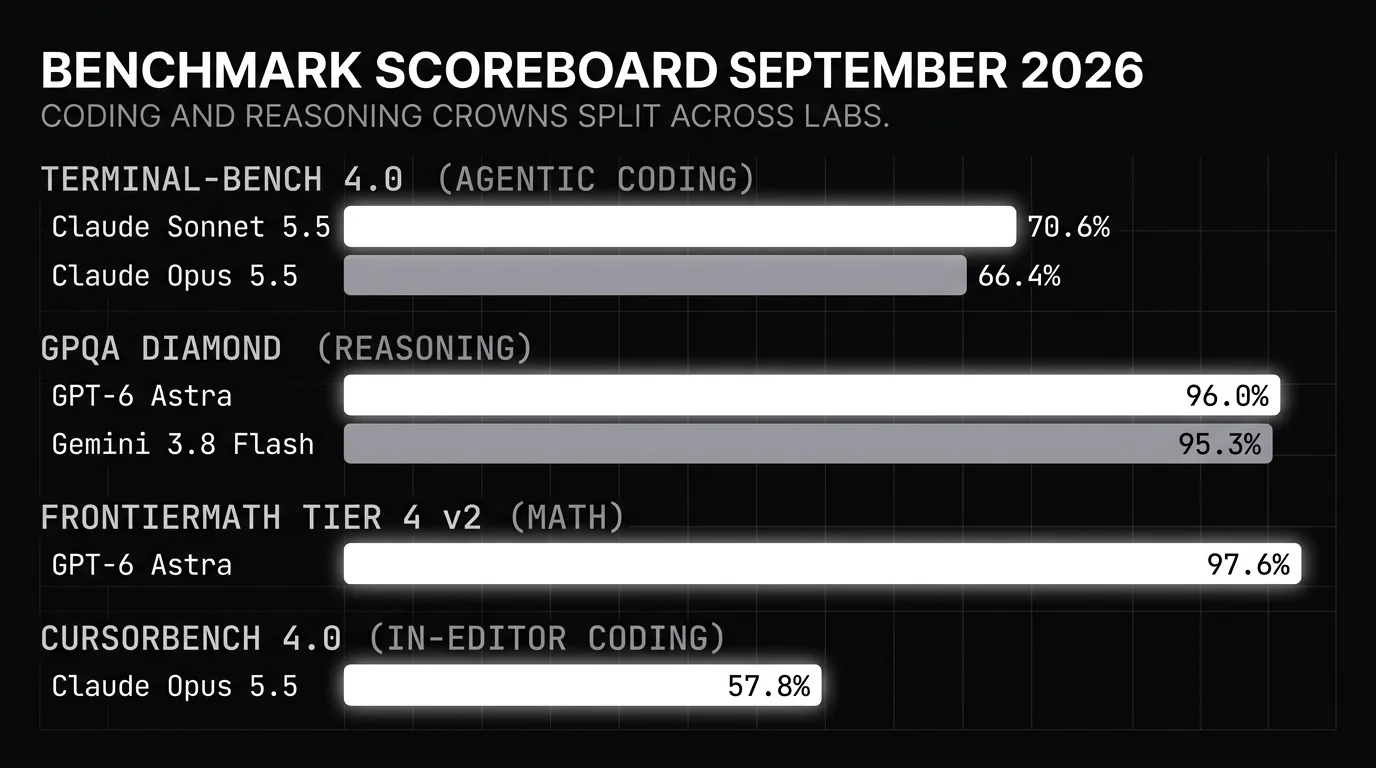
It posts 66.4% on Terminal-Bench 4.0 and 57.8% on CursorBench 4.0, with a GDPval-AA v2.1 rating of 1846.
- 1M-token context window, 128k max output
- $4 input / $20 output per million tokens, cache read $0.20
- 66.4% Terminal-Bench 4.0, 57.8% CursorBench 4.0 (provider-reported)
- Best for: production coding agents and long-horizon enterprise work that wants frontier capability at a cut price
What it does not win: the reasoning headline (GPT-6 Astra leads GPQA Diamond) and rock-bottom cost (open-weight coders undercut it on output tokens). Reproduce the roughly 40% per-task estimate on your own workload before you budget around it.
Claude Sonnet 5.5. Best cheap balanced tier
Anthropic. Generally available September 28, 2026.
This is the cheap, balanced coding and tool-use tier below Opus 5.5, and it delivered the September surprise: it posts 70.6% on Terminal-Bench 4.0, above Opus 5.5’s 66.4% on that specific board. Opus uses Xhigh effort, so this is not a same-setting comparison.
Sonnet leads on this board, not necessarily across every coding task.
Sonnet 5.5 lists at $2 input / $10 output per million tokens.
- $2 input / $10 output per million tokens
- 70.6% Terminal-Bench 4.0 (provider-reported, above Opus 5.5 on that board)
- Balanced coding and tool-use tier
- Best for: high-volume agents, chat surfaces, and cost-sensitive production where Opus 5.5 is overkill
What it does not win: the full benchmark spread (Opus 5.5 and Fable 5.1 sit above it broadly) and open-weight economics for the cheapest bulk output. A single-board lead is not a general one, so match it to your task mix.
Claude Fable 5.1. Best for highest capability
Anthropic. Early September 2026. 1M context, 128k max output.
The capability ceiling of the Claude lineup, refreshed to 5.1 in early September at $10 input / $50 output per million tokens, with cache reads cut 75% to $0.25. It stays the pick when capability outranks cost.
- 1M-token context window, 128k max output
- $10 input / $50 output per million tokens, cache read cut 75% to $0.25
- Best for: the hardest multi-file coding and reasoning work where capability outranks price
What it does not win: cost (it is the most expensive Claude tier) and the reasoning headline (GPT-6 Astra leads GPQA Diamond this month).
GPT-6 Astra. Best for frontier reasoning
OpenAI. Preview September 3, public September 4, 2026. 1.05M context, 128k max output.
OpenAI’s new top model is also the September reasoning leader. Astra posts 96.0% GPQA Diamond and 97.6% FrontierMath Tier 4 v2, with a reasoning-effort control from low to max. It is the priciest general frontier tier this month at $10 input / $50 output per million tokens, rising to $20/$75 above 272K tokens.
- 1.05M-token context window, 128k max output
- $10 input / $50 output per million tokens ($20/$75 above 272K)
- 96.0% GPQA Diamond, 97.6% FrontierMath Tier 4 v2
- Reasoning-effort control (low to max)
- Best for: reasoning-heavy and math-heavy work that wants the highest measured scores
What it does not win: cost (GPT-6 Sol and Luna undercut it heavily, and Opus 5.5 is cheaper for coding) and open-weight licensing (it is hosted only). OpenAI also offers a higher-effort GPT-6 Astra Pro on Pro, Business, and Enterprise plans for teams that need the maximum reasoning tier.
GPT-6 Sol and Luna. The cheaper GPT-6 tiers
OpenAI. Generally available September 22, 2026.
These two cheaper GPT-6 tiers are where OpenAI set its price floor. Sol lists at $2 input / $10 output per million tokens, and Luna at $0.10 input / $0.50 output, a budget OpenAI tier this month.
- Sol: $2 input / $10 output per million tokens
- Luna: $0.10 input / $0.50 output per million tokens
- Both reached general availability September 22
- Best for: balanced production inside the OpenAI ecosystem (Sol) and cost-sensitive bulk work (Luna)
GPT-6.1 Sol followed on September 29 for complex coding and professional work. Standard pricing is $2 input / $10 output per million tokens for prompts up to 272K input tokens.
What it does not win: top-end reasoning (Astra leads the family) and self-hosting flexibility: DeepSeek offers downloadable weights; Sol and Luna do not.
Gemini 3.8 Flash. Best cheap fast frontier
Google DeepMind. Generally available September 2, 2026.
Gemini 3.8 Flash is our pick for fast, long-context work. It runs at $0.75 input / $3.75 output per million tokens, with that pricing frozen through December 31 2026, a 1,048,576-token context window, and 65,536 max output.
Its 95.3% GPQA Diamond score is an Artificial Analysis measurement, since Google publishes no official GPQA Diamond figure for Flash.
- $0.75 input / $3.75 output per million tokens (frozen through December 31 2026)
- 1,048,576-token context window, 65,536 max output
- 95.3% GPQA Diamond (Artificial Analysis)
- Best for: high-volume, latency-sensitive agentic work that wants frontier-adjacent quality cheaply
What it does not win: the absolute lowest price (GPT-6 Luna is cheaper) and top-end coding and reasoning (Astra and Opus 5.5 lead). It is our fast, long-context pick, not the cheapest API overall.
Gemini 3.1 Pro. Still the Gemini Pro flagship
Google. Current Pro tier. No 3.5 Pro shipped.
Google’s Pro flagship remains Gemini 3.1 Pro, priced at $2 input / $12 output per million tokens up to 200K, then $4/$18. Google shipped Flash point releases through 3.8 but did not ship a Gemini 3.5 Pro, so 3.1 Pro is still the current Pro tier.
- $2 input / $12 output per million tokens (up to 200K), then $4/$18
- Current Pro flagship, no Gemini 3.5 Pro exists
- Best for: Gemini-ecosystem work that wants the Pro tier rather than a Flash model
What it does not win: the newest release cycle (Google’s September motion was on the Flash line) and the cheapest fast tier (3.8 Flash undercuts it heavily).
Grok 4.7. Best for reasoning with real-time data
xAI. Generally available September 21, 2026. 500K context. Proprietary, API-only.
xAI’s current flagship is the pick when reasoning meets a need for current-events grounding. Grok 4.7 ships proprietary and API-only with a 500K-token context window at $2 input / $6 output, rising to $4/$12 above 200K tokens. It retrieves current X data through X Search, billed separately, and xAI did not ship a Grok 5.
- $2 input / $6 output per million tokens ($4/$12 above 200K)
- 500K-token context window
- Real-time data via X Search (separate charges)
- Best for: research agents that need current data, reasoning-heavy workflows, X-native grounding
What it does not win: open-weight licensing (it is hosted only) and the longest context window (it stays at 500K). There is no Grok 5 this month, so 4.7 is the current tier.
Top open-weight and Chinese-frontier LLMs in September 2026
The open-weight tier moved on price and license in September. DeepSeek shipped fresh MIT weights, Z.ai released GLM-5.3 in late August, and Meta’s open work stayed under the Muse line rather than a new Llama. Weigh license and real inference cost alongside download size, because the biggest model is not the cheapest to run.
DeepSeek V4.1 Flash. Best open-weight cost-performance
DeepSeek. Released September 10, 2026. MIT license, 1M context.
This is the September open-weight headline and the cheapest frontier-class open option. V4.1 Flash ships under an MIT license with downloadable weights on Hugging Face and a 1M-token context window.
Its 552B figure is the mixture-of-experts backbone, while the model card lists 763B total with a small active-parameter count per token. Standard pricing is $0.30/$1.20, dropping to $0.15/$0.60 off-peak.
- MIT license, downloadable weights, 1M-token context window
- 552B mixture-of-experts backbone, 763B total (model card)
- $0.30 input / $1.20 output standard, $0.15 / $0.60 off-peak
- Best for: high-volume work where output price dominates and MIT licensing matters for redistribution
These are API prices, not self-hosting costs.
Skip if: you need a single hosted flagship with vendor support, or a published independent benchmark today (verify its scores on your own workload).
Kimi K3. The open-weight scale leader
Moonshot AI. API July 16, open weights July 27, 2026. Custom “Kimi K3 License”, 1M context.
Still the largest open-weight model available in September, carried from its July release. Kimi K3 has 2.8 trillion total parameters, about 104B active, and a 1M-token context window under Moonshot’s own “Kimi K3 License”, so it is open-weight rather than OSI open-source. It lists $3 input / $15 output per million tokens.
- Custom “Kimi K3 License” (open-weight, not OSI open-source), downloadable weights
- 2.8T total parameters, about 104B active, 1M-token context window
- $3 input / $15 output per million tokens
- Best for: teams that need open weights at record scale and can run or rent the inference
Skip if: output price is your dominant constraint (DeepSeek undercuts it heavily) or you need an OSI-approved license.
GLM-5.3 and GLM-5.2. The Z.ai open flagships
Z.ai / Zhipu. GLM-5.3 weights released late August 2026. Custom GLM-5.3 License, GLM-5.2 MIT.
Z.ai shipped GLM-5.3 weights in late August, carried current into September. GLM-5.3 is 753B under a custom GLM-5.3 License, and the prior GLM-5.2 is the same 753B under a permissive MIT license, so pick by whether you need the newest weights or the more permissive terms.
- GLM-5.3: 753B, custom GLM-5.3 License, weights released late August
- GLM-5.2: 753B, MIT license
- Downloadable weights
- Best for: self-hosted coding agents that want a large open model, with MIT terms (GLM-5.2) or the newest weights (GLM-5.3)
Skip if: you need a 1M-token context on a truly permissive license (DeepSeek V4.1 Flash fits that better).
Mistral Large 3 and the Muse line. Permissive and Meta’s open work
Mistral AI (Apache-2.0) and Meta (Muse Glimmer, August 10, 2026).
Two names for teams that want a permissive non-Chinese license. Mistral Large 3 is our Apache-2.0 general-model pick at 675B, carried over from its December 2025 release.
Meta’s open work moved to the Muse line: Muse Glimmer (30B, Apache-2.0, August 10) is a permissively licensed open-weight model, while the flagship Muse Spark stays proprietary. Meta shipped no Llama 5 this year and no “Llama 4.5” as of late September, so the last open Llama remains Llama 4 from April 2025.
- Mistral Large 3: Apache-2.0, 675B, our permissive non-Chinese general-model pick
- Muse Glimmer: 30B, Apache-2.0 open-weight model (August 10)
- Muse Spark: proprietary flagship
- Best for: a truly permissive license (Mistral Large 3, Muse Glimmer) on your own hardware
Skip if: you need the largest open model (Kimi K3) or a 1M-token MIT context (DeepSeek V4.1 Flash).
Top multimodal LLMs in September 2026
Multimodal is three separate races: vision, image generation, and video generation, each with its own leaders. Native vision is now standard across the Western frontier, and one video deprecation lands this month.
Vision (image and document understanding)
| Use case | Best closed | Best open |
|---|---|---|
| General image understanding | Gemini 3.1 Pro | Qwen open VL family |
| Document / OCR / chart reading | Claude Opus 5.5 / Fable 5.1 | Qwen open VL family |
| Long-context multi-image | Gemini 3.8 Flash (1M tokens) | DeepSeek and Qwen open VL |
| Screen / UI understanding | GPT-6 Astra | Qwen open VL family |
Every Western frontier model now handles vision natively, including Opus 5.5, Fable 5.1, GPT-6 Astra, Gemini 3.8 Flash, and Grok 4.7. The open column has closed the gap on the basics while still trailing on dense charts and technical diagrams, so confirm any open VL model on your own document distribution before you switch.
Video generation
Video-gen leadership shifted since July, and one API shuts down this month.
| Use case | Best pick | Why |
|---|---|---|
| Text-to-video leader | Wan 3.0 | Leads the current text-to-video arena on Elo |
| Cinematic with native audio | Google Veo 3.1 | High-resolution output and native audio, strong for spoken dialogue |
| Best value for high volume | Gemini Omni Flash | Strong quality-per-dollar well below flagship video cost |
| Long story beats | Seedance 2.5 | Long sequences and large reference sets |
For production video in September 2026, Wan 3.0 leads the text-to-video arena on Elo, Veo 3.1 is the pick for cinematic output with spoken dialogue, and Gemini Omni Flash is the value option for high volume. Remove OpenAI Sora 2 from new builds: its API shuts down September 24, 2026.
Image generation and audio
Image generation stayed a closed-frontier plus open-weight split. The Gemini and GPT image tiers lead the hosted side, and open-weight FLUX models remain the pick for self-hosting. The category churns fast on version numbers, so benchmark a shortlist on your own prompts rather than trust a single ranking.
For audio, some frontier models support native audio, and the full speech stack has its own decision logic in the voice guide below.
Voice and audio (covered separately)
Voice AI has its own decision logic. STT (AssemblyAI, Deepgram, ElevenLabs, OpenAI), TTS (Cartesia, ElevenLabs, Deepgram, Hume), and voice-agent platforms (LiveKit, Pipecat, Vapi, Retell) follow different picks than text-only LLMs. Turn detection, inference, and first-audio latency drive different choices than text-LLM workflows.
See Best Voice AI Models in September 2026 for the full STT, TTS, and voice-agent stack.
Top embeddings and retrieval models in September 2026
Embeddings have two production constraints: retrieval quality on your domain, and price per million tokens. The public leaderboards churn month to month, so the honest move is to name the durable options and run your own retrieval eval rather than chase a live board position.
| Use case | Durable pick | Notes |
|---|---|---|
| Contextualized retrieval | voyage-context-4 | Chunk embeddings with document context |
| Best general retrieval (closed) | voyage-4-large | Voyage’s top retrieval model |
| Multimodal retrieval | gemini-embedding-2 | Text plus image, audio, and PDF in one model |
| OpenAI ecosystem default | text-embedding-3-large | Strong general default, -3-small for cheapest viable |
| Multilingual enterprise | Cohere embed-v4 | Multilingual production coverage |
| Open-weight / self-host | Qwen3-Embedding-8B | Strong open multilingual option on your hardware |
We are deliberately not printing MTEB numbers here, because the board positions move often and several current figures did not clear a two-source check at publication. Shortlist two or three of the models above, score them on your own documents, and add a reranker for a few points of retrieval quality at small added cost.
Top coding-specific LLMs in September 2026
Coding is the highest-stakes category, and September gave it a cheaper capable pick at the top and a cheap tier that beats it on one board.
One caveat frames the table: Vals AI archived its SWE-bench coverage on September 1 after reporting saturation. The SWE-bench repository itself is not archived. This month leads with Terminal-Bench 4.0 and CursorBench 4.0 as the fresher agentic-coding discriminators.
| Use case | Top pick | Score | Output $/M tokens |
|---|---|---|---|
| Balanced agentic coding | Claude Opus 5.5 | 66.4% Terminal-Bench 4.0, 57.8% CursorBench 4.0 | $20 |
| Cheap agentic coding | Claude Sonnet 5.5 | 70.6% Terminal-Bench 4.0 | $10 |
| Frontier reasoning + code | GPT-6 Astra | 96.0% GPQA Diamond | $50 |
| Cheap fast frontier coding | Gemini 3.8 Flash | 95.3% GPQA (AA) | $3.75 |
| Open-weight cost coder | DeepSeek V4.1 Flash | MIT, 1M context | $0.60 off-peak |
| Open-weight scale | Kimi K3 | 2.8T parameters | $15 |
Terminal-Bench 4.0 and CursorBench 4.0 come from Anthropic’s own pages, GPT-6 Astra’s GPQA Diamond and FrontierMath are from OpenAI, and Gemini 3.8 Flash’s GPQA Diamond is an Artificial Analysis measurement. The gap between a published score and your own repositories is the number that decides your pick, so run a domain eval before you migrate.
Top reasoning and math LLMs in September 2026
Reasoning is where September’s cleanest numbers live. GPT-6 Astra leads at 96.0% GPQA Diamond and 97.6% FrontierMath Tier 4 v2, with Gemini 3.8 Flash at 95.3% GPQA Diamond (Artificial Analysis) close behind on a far cheaper tier.
GPQA Diamond is approaching saturation, so the gaps at the top are narrow and increasingly sensitive to prompt and effort settings. FrontierMath Tier 4 is the harder discriminator now, and Astra’s 97.6% is the September high. Grok 4.7 adds real-time grounding for reasoning that needs current data, though its benchmark figures are single-source at launch.
If reasoning is your core workload, weight the GPQA Diamond and FrontierMath results above any single-source claim, and run your own eval on a graduate-level set that matches your domain. As the top scores saturate, the separation that matters moves to your task distribution, not the leaderboard.
Best LLM for X: decision framework
Choose Claude Opus 5.5 if:
- You want balanced frontier capability for agentic coding at 20% below Opus 5’s rate.
- You need a 1M-token context window for long-horizon or whole-repository work.
- You are on the Anthropic ecosystem and want the new production default.
Choose GPT-6 Astra if:
- Reasoning or math is your core workload and you want the highest measured scores.
- You want a 1.05M context and a reasoning-effort control, and can absorb the $10/$50 tier.
Choose Claude Sonnet 5.5 if:
- You want cheap, balanced coding and tool use at $2/$10.
- Terminal-Bench-style agentic coding is your main task and Opus 5.5 is overkill.
Choose Gemini 3.8 Flash if:
- You want cheap, fast frontier-adjacent quality at $3.75 output with a 1M context.
- Pricing stability through December 31 2026 matters for budgeting.
Choose GPT-6 Luna if:
- Output price is the dominant constraint and you want a low hosted rate.
- You are in the OpenAI ecosystem and can trade top-end capability for cost.
Choose DeepSeek V4.1 Flash if:
- You need MIT open weights with a 1M context and the cheapest off-peak output.
- Self-hosting or redistribution matters more than vendor support.
Choose Kimi K3 if:
- You need open weights at record scale and can run or rent the inference.
Choose Grok 4.7 if:
- Graduate-level reasoning and real-time X data are both core.
Avoid Gemini 3.5 Pro, Grok 5, and “Llama 4.5” for now. None shipped: Google’s Pro flagship is still 3.1 Pro, xAI stopped at Grok 4.7, and Meta’s last open Llama is Llama 4 from April 2025. GPT-6 Astra Pro, by contrast, is real: it is the higher-effort Astra tier on OpenAI’s Pro, Business, and Enterprise plans.
Common mistakes when picking an LLM in September 2026
Here are the four most expensive errors we see production teams make:
- Reading the 40% as a rate cut. Opus 5.5’s list price fell 20%, and the roughly 40% is Anthropic’s per-task estimate from fewer, faster tokens. Model the two separately, and reproduce the per-task number on your traffic.
- Chasing a saturated benchmark. GPQA Diamond is near its ceiling. SWE-bench scores depend on the harness and settings. Vals AI archived its coverage after reporting saturation, not the benchmark code. Pair public scores with harder benchmarks and your own tasks.
- Assuming the biggest open model is the cheapest. Kimi K3 is the largest open-weight model at 2.8T parameters, and at $15 output it costs more than most Western mid-tiers. Scale is not savings, so price the inference before you adopt it.
- Building on a name that did not ship. Gemini 3.5 Pro and Grok 5 are not September options. Build on generally available models, and keep a fallback in any path that cannot afford downtime.
Recent platform updates
| Date | Event | Why it matters |
|---|---|---|
| Early September | Anthropic Claude Fable 5.1 | Top Claude tier refresh, cache read cut to $0.25 |
| September 2 | Google Gemini 3.8 Flash generally available | Cheap fast frontier, $0.75/$3.75 frozen through year-end |
| September 4 | OpenAI GPT-6 Astra public | New top model and reasoning leader at $10/$50 |
| September 10 | DeepSeek V4.1 Flash (MIT) | Fresh open weights, 1M context, $0.15/$0.60 off-peak |
| September 21 | xAI Grok 4.7 generally available | Reasoning with real-time X data, 500K context |
| September 22 | Anthropic Claude Opus 5.5, OpenAI GPT-6 Sol and Luna | Flagship cut to $4/$20, OpenAI fills the cheap tiers |
| September 24 | OpenAI Sora 2 API shutdown | Remove Sora 2 from new video builds |
| September 28 | Anthropic Claude Sonnet 5.5 | Cheap tier posts 70.6% Terminal-Bench 4.0 |
| September 29 | OpenAI GPT-6.1 Sol | Complex coding and professional work; standard $2/$10 |
How to actually pick one for production
The leaderboard is the wrong artifact for a September 2026 production decision, especially in a month where two flagships moved in opposite directions. Three things to do instead:
- Run a domain reproduction. Take 100 to 500 of your actual production prompts, run them through your two or three candidate models with your harness, and score them with Future AGI evals or your own judge. For September specifically, this is how you turn Opus 5.5’s roughly 40% per-task estimate and Astra’s reasoning scores into the number you will actually ship.
- Measure reliability under load. A public score is an aggregate over a fixed task set, and it does not predict variance across your prompts and repeated agent runs. Use Future AGI Simulate to stress-test agents across long, multi-turn sessions, where headline accuracy from single-shot benchmarks often does not hold.
- Cost-adjust every score. September’s spread runs from $0.50 to $75 per million output tokens. Compute score-per-dollar on your domain before you default to a brand, because a 20% cut or a saturated benchmark only pays off if it holds on your traffic.
September rewarded teams that treated model choice as a price, license, and reliability decision. The frontier split on price and the open tier refreshed its weights, and both moves reward the team that measures before it commits.
The practical answer is to shortlist by your dominant workload, then let your own reproduction and reliability numbers pick the winner. Put more effort into the eval loop above the model than into comparing leaderboard rows, because that is the layer that decides whether September’s cheaper flagship or its pricier frontier actually works for you.
Sources
Frontier model launches (primary):
- Claude Opus 5.5 (Anthropic)
- Claude Sonnet 5.5 (Anthropic)
- Claude models overview (Anthropic)
- OpenAI models (GPT-6)
- Gemini 3.8 Flash (Google)
- Gemini API pricing (Google)
- Grok 4.7 (xAI)
- OpenAI deprecations (Sora 2)
Open-weight and benchmarks:
- DeepSeek V4.1 Flash (Hugging Face)
- GLM-5.3 (Hugging Face)
- Kimi K3 (Hugging Face)
- Mistral Large 3 (Mistral AI)
- Muse Glimmer (Meta)
- GPQA Diamond via Artificial Analysis
Previous: Best LLMs of August 2026. Claude Opus 5 topped the intelligence index while Gemini 3.5 Pro stayed unreleased.
Frequently Asked Questions
What is the best LLM in September 2026?
What is the best LLM for coding right now?
What is the best open-source LLM?
What is the best LLM to run locally?
Claude Opus 5.5 or GPT-6: which is better?
What is the cheapest LLM API?
Is GPT-6 out yet?
How much does Claude Opus 5.5 cost?
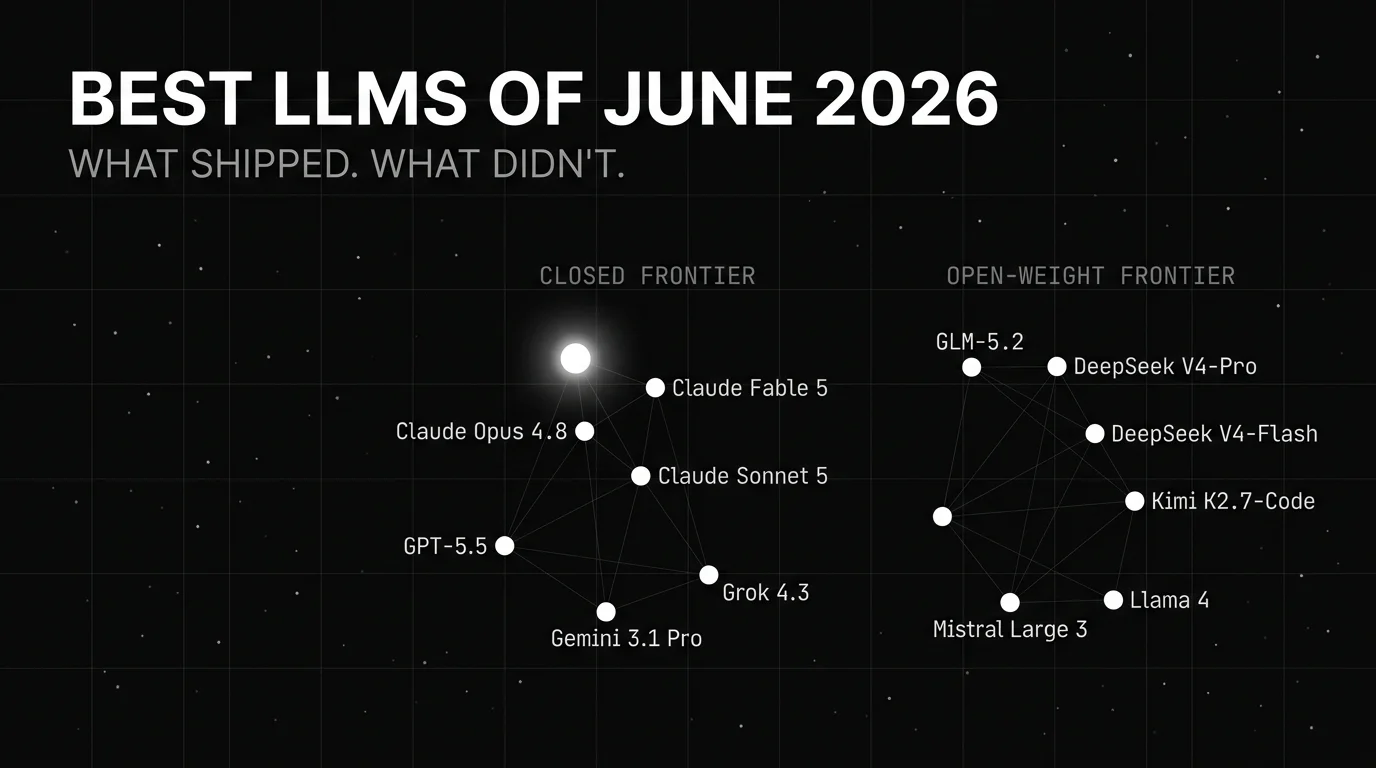
Best LLMs of June 2026 by use case: Claude Fable 5 for raw coding, GLM-5.2 for open-weight value, GPT-5.5 for agents, Gemini 3.1 Pro for long-context multimodal.

Best LLMs May 2026: compare GPT-5.5, Claude Opus 4.7, Gemini 3.1 Pro, and DeepSeek V4 across coding, agents, multimodal, cost, and open weights.
Best LLMs April 2026: compare GPT-5.5, Claude Opus 4.7, DeepSeek V4, Gemma 4, and Qwen after benchmark trust broke and prices compressed fast.