Best Voice AI Models in October 2026 as Speech-to-Speech Gets Crowded
For the best voice AI model in October 2026, compare Grok Voice 3.0, Eleven Realtime v1, Cartesia Managed Agents and the new STT and TTS releases this month.
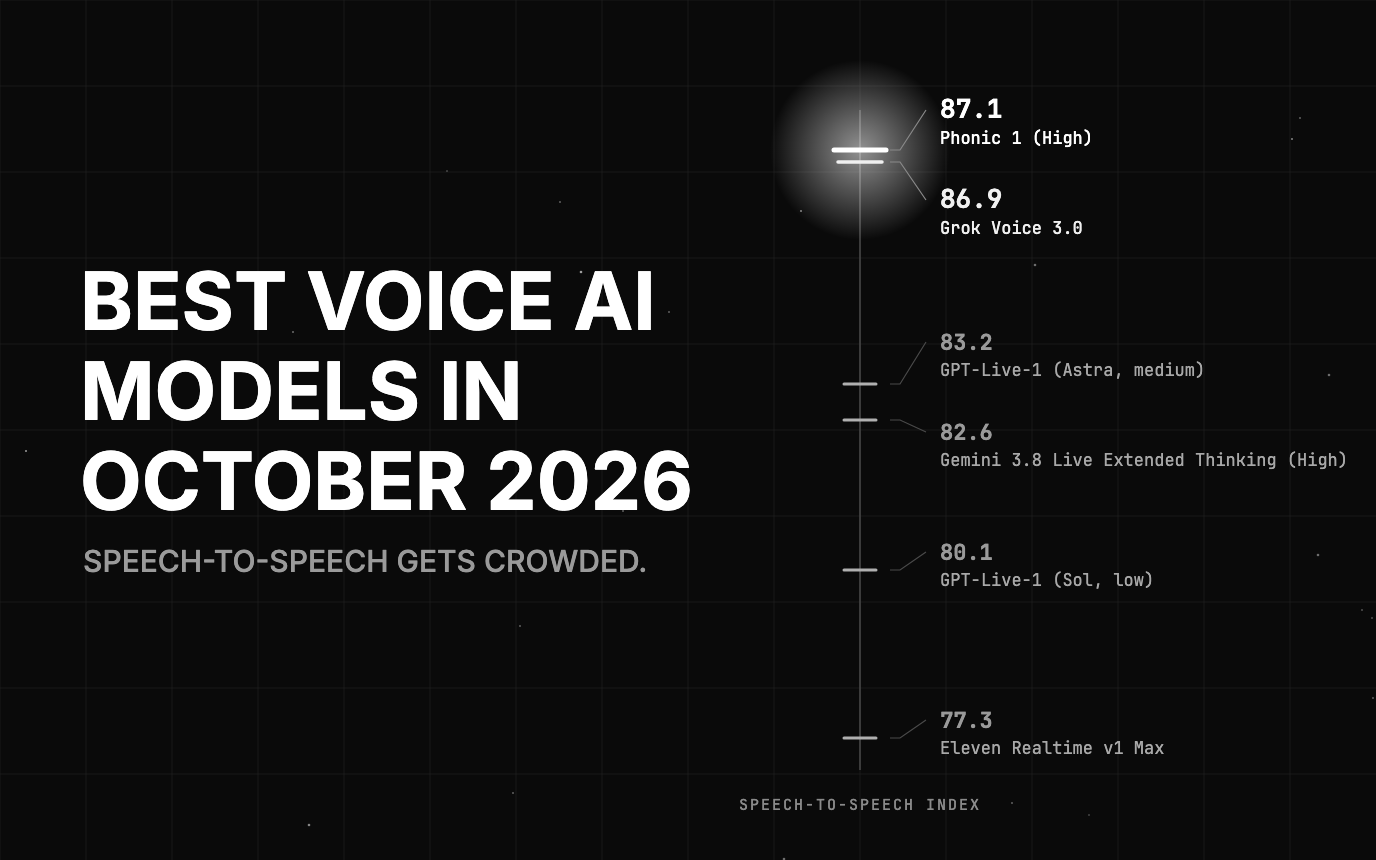
Table of Contents
A support team runs its phone line on a cascade of speech-to-text, a language model and text-to-speech. In October it counted four new or updated realtime voice APIs and a managed agent at three cents a minute. So is the best voice AI model now a single realtime API, or still a tuned pipeline?
The answer splits by layer. Speech-to-speech got crowded at the top of the Artificial Analysis index, Deepgram announced it is acquiring the company behind Pipecat, and three text-to-speech models arrived at or under $15 per million characters. Speech-to-text gained a streaming Microsoft model, Mistral’s Voxtral Transcribe 3 and open NVIDIA weights.
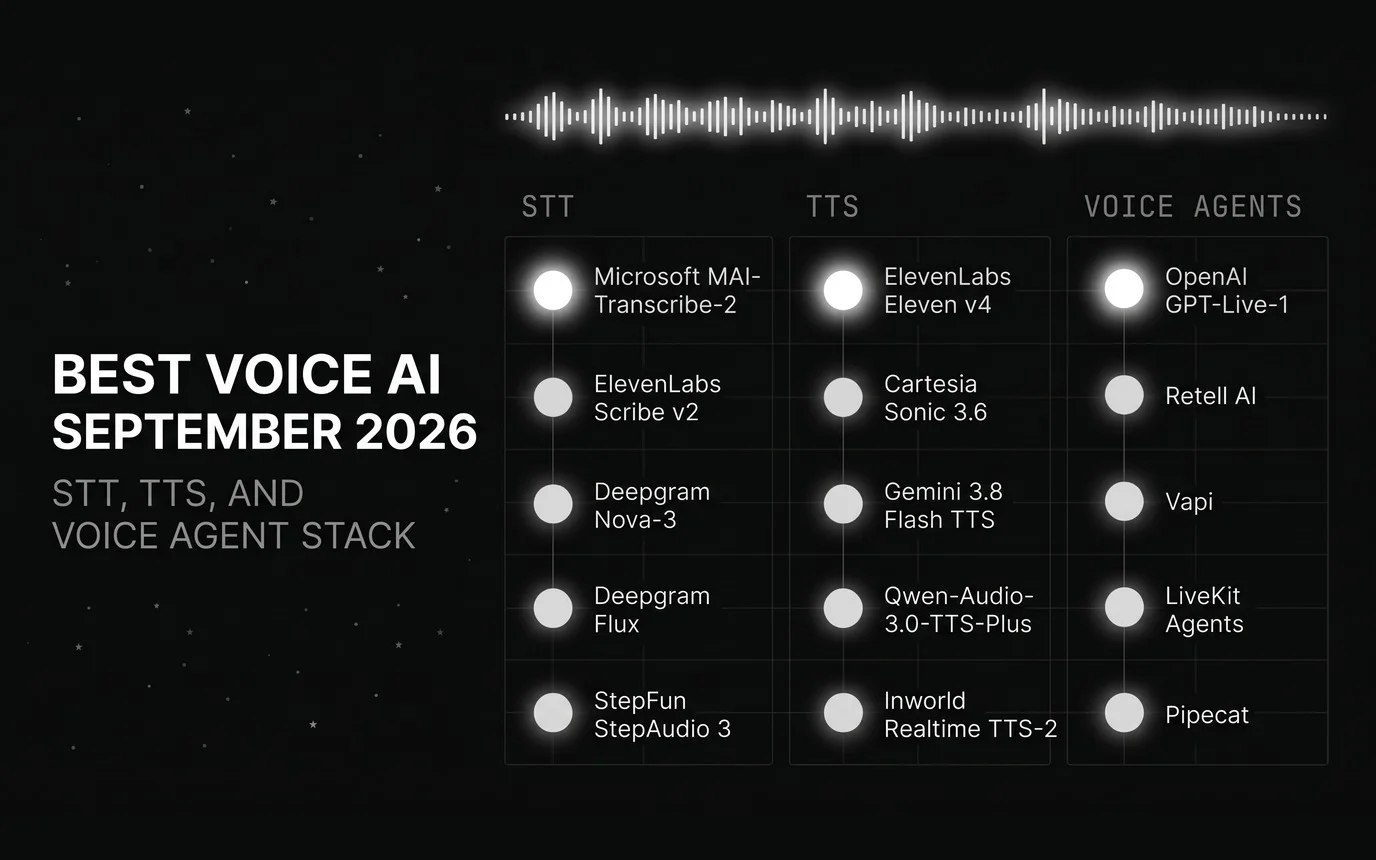
Last month’s picks, including Eleven v4 and GPT-Live-1, are in the September 2026 voice edition.
TL;DR
- Grok Voice 3.0 scores 86.9 on Artificial Analysis’ speech-to-speech index, second to Phonic 1 (High) at 87.1 as of Nov 3, at $0.08 per minute.
- ElevenLabs launched Eleven Realtime v1 Max and Mini, speech-to-speech models with an OpenAI Realtime-compatible API at $0.08 per minute plus LLM usage.
- Cartesia Managed Agents ranks #1 of 30 on the Artificial Analysis Speech Agent Arena, a lead that is not settled, at a $0.03 per minute launch price that excludes LLM usage.
- Deepgram is acquiring Daily, the company behind Pipecat; Pipecat stays BSD-2.
- The best STT models and best TTS models gained new options: MAI-Transcribe-2-Streaming, Voxtral 3, Nemotron 3.5 Transcribe and AssemblyAI-TTS-1.
Four realtime voice APIs to test this month
October gave voice teams four realtime speech-to-speech APIs. Grok Voice 3.0 sits second on the Artificial Analysis speech-to-speech index behind Phonic 1, and Eleven Realtime v1 speaks the OpenAI Realtime protocol. Amazon Nova 2.5 Sonic adds a 256K context, and GPT-Live-1 gained prompt-to-voice at an unchanged five cents a minute.
The speech to speech models leaderboard used here is the Artificial Analysis speech-to-speech index, read on November 3, 2026.
Grok Voice 3.0 sits second on the speech-to-speech index at $0.08 a minute
xAI · released October 14, 2026 · $0.08 per minute ($4.80 per hour) as of 2026-11-03 · speech-to-speech index 86.9 as of 2026-11-03
Grok Voice 3.0, xAI’s speech to speech API, costs the same $0.08 a minute as Grok Voice 2.0, which scores 81.3. xAI’s launch post called it #1 at 86.9 from an October 13 reading. By November 3, Phonic 1 (High) led at 87.1, with Gemini 3.8 Live Extended Thinking (High) at 82.6.
xAI lists the price and score in its Grok Voice 3.0 announcement.
What it does not win: latency proof. xAI says only “under one second”, with no median, and it sits fifth at 1059 on the Speech Agent Arena as of November 3.
Eleven Realtime v1 brings an OpenAI-compatible realtime API
ElevenLabs · launched October 20, 2026 · v1 Max and v1 Mini · speech-to-speech index 77.3 (v1 Max) as of 2026-11-03 · $0.08 per minute plus LLM usage as of 2026-11-03
ElevenLabs launched v1 Max and v1 Mini behind an API it calls compatible with OpenAI’s Realtime API, so OpenAI client code is a starting point. ElevenLabs reports 98.8% on Big Bench Audio for Max and 75.9% for Mini. It says both run on a cascaded architecture tuned end to end.
The details are in the Eleven Realtime announcement, and the rate is on ElevenLabs API pricing.
What it does not win: the index or an all-in price. v1 Max scores 77.3, below Grok Voice 3.0 and both GPT-Live-1 settings, v1 Mini scores 64.4, and the $0.08 a minute excludes LLM usage.
Amazon Nova 2.5 Sonic keeps Nova 2 prices with a 256K context
AWS · generally available October 5, 2026 · 256K-token context · 7 languages in 4 regions · US East (N. Virginia) speech $3.00 input and $12.00 output, text $0.33 and $2.75 per 1M tokens as of 2026-11-03
Nova 2.5 Sonic runs in US East (N. Virginia), US West (Oregon), Europe (Stockholm) and Asia Pacific (Tokyo). AWS says it ships at Nova 2 Sonic pricing, which holds exactly in US East. AWS’s price list shows higher 2.5 speech rates in the other three regions, so price your own region.
AWS announced it in a Nova 2.5 Sonic launch note; the Bedrock model card and Amazon Nova pricing hold the details.
What it does not win: a public score. It is not on the speech-to-speech index as of November 3, and it prices by token, so convert call lengths to compare.
GPT-Live-1 adds prompt-to-voice with its $0.05 per minute price unchanged
OpenAI · prompt-to-voice released October 16, 2026 · $0.05 per minute as of 2026-11-03 · speech-to-speech index 83.2 (Astra, medium) and 80.1 (Sol, low) as of 2026-11-03
OpenAI still lists GPT-Live-1 at $0.05 a minute, unchanged since September. It released prompt-to-voice to all API customers on October 16. Artificial Analysis scores the Astra, medium setting at 83.2 and Sol, low at 80.1, so pick a setting before comparing it with Grok Voice 3.0.
OpenAI lists the per-second billing on its API pricing page.
What it does not win: a settled gap. The agentic τ-Voice part of its index score rests on one trial for both settings.
| API | Price | AA speech-to-speech index | Protocol | Status |
|---|---|---|---|---|
| Grok Voice 3.0 | $0.08 per minute | 86.9 | xAI speech-to-speech API | GA |
| GPT-Live-1 | $0.05 per minute | 83.2 (Astra, medium) | OpenAI Live API | GA |
| Eleven Realtime v1 Max | $0.08 per minute plus LLM usage | 77.3 | OpenAI Realtime-compatible | Launched Oct 20 |
| Amazon Nova 2.5 Sonic | $3 input and $12 output per 1M speech tokens (US East) | Not listed | Amazon Bedrock | GA |
Index scores are as of November 3. Block’s Dessa, a full-duplex speech model announced October 23, is missing from this table. Block offers a waitlist and early access for a small group of AI safety researchers, with no public API or price.
Cartesia Managed Agents tops the agent arena at $0.03 a minute
Cartesia launched Managed Agents on October 29, and it ranks first of 30 on the Artificial Analysis Speech Agent Arena. Cartesia prices agent calling at $0.03 a minute, a launch price its blog calls 50% off, and bills LLM usage separately. That undercuts Grok Voice 3.0, GPT-Live-1 and Eleven Realtime v1 per minute.
A managed agent is a different product from a speech-to-speech API. xAI’s pricing page lists Grok Voice 3.0 at $0.08 a minute plus $0.004 per text input. OpenAI bills GPT-Live-1’s backend model separately, ElevenLabs adds LLM usage, and Cartesia excludes LLM usage and charges $0.014 a minute for a phone number.
The arena reads 1111 for Cartesia (95% CI 1083 to 1140, rank range 1 to 2) as of November 3, down from 1115 at launch. Gemini 3.1 Flash Live Minimal sits second at 1089 ±25, so the lead is not settled. Cartesia says its benchmarks ran GPT-5.5 as the reasoning model, whose tokens sit outside the $0.03.
The live standings are on the Artificial Analysis Speech Agent Arena.
Is $0.03 a promo? Cartesia says it is. Its launch post reads “Launch pricing: Run production voice agents at 50% off, just $0.03 a minute.” Its pricing docs call the same $0.03 the base rate, with no end date or later rate, so ask Cartesia before a long contract.
Both statements are in the Cartesia Managed Agents post and the Cartesia pricing docs.
Deepgram is acquiring Pipecat’s maker, and Pipecat stays BSD-2
On October 29 Deepgram announced it is acquiring Daily, the company that created Pipecat, and Pipecat stays open source. The same day Pipecat 1.15 shipped with Real-time Context Standard 0.1 support. Six days earlier, Deepgram added 41 languages to Flux text-to-speech.
For teams running Pipecat, the code and license stay put. Deepgram says Pipecat will “remain fully open source and free to all developers under its existing BSD V2 license,” and the repository still lists BSD-2-Clause. The deal is announced and has not closed.
Deepgram’s terms are in Deepgram’s announcement.
Real-time Context Standard 0.1, co-developed by Deepgram and the Pipecat team, is an alpha spec that passes tone and emotion tags between pipeline models. The tags carry how the user sounded and how the agent should speak. Pipecat 1.15.0 and later implement it in the alpha expressive conversation feature, so pin your version if you adopt it.
Expressive conversation is listed in the Pipecat 1.15 release.
Flux text-to-speech added 41 languages on October 23 and kept its English voices unchanged. Nine of them ship with text normalization, and the other 32 are in early access. Flux speech-to-text Multilingual now has 10 languages, with 31 more in early access.
Flux TTS details are in Deepgram’s October 23 changelog; the STT count is in Deepgram’s October 29 post.
Is Pipecat still vendor-neutral? On license terms, yes: BSD-2 lets you run it with any speech provider and fork it if direction changes. LiveKit Agents teams are untouched, and teams choosing a framework now can weigh Deepgram’s backing against that independence.
The best STT models add MAI-Transcribe-2-Streaming, Voxtral Transcribe 3 and open-weight Nemotron
The best STT models gained three October options. Microsoft shipped MAI-Transcribe-2-Streaming at an introductory $0.54 per audio hour through December 31. Mistral’s Voxtral Transcribe 3 reached 2.1% and 2.2% word error on Artificial Analysis, and NVIDIA released Nemotron 3.5 Transcribe as open weights.
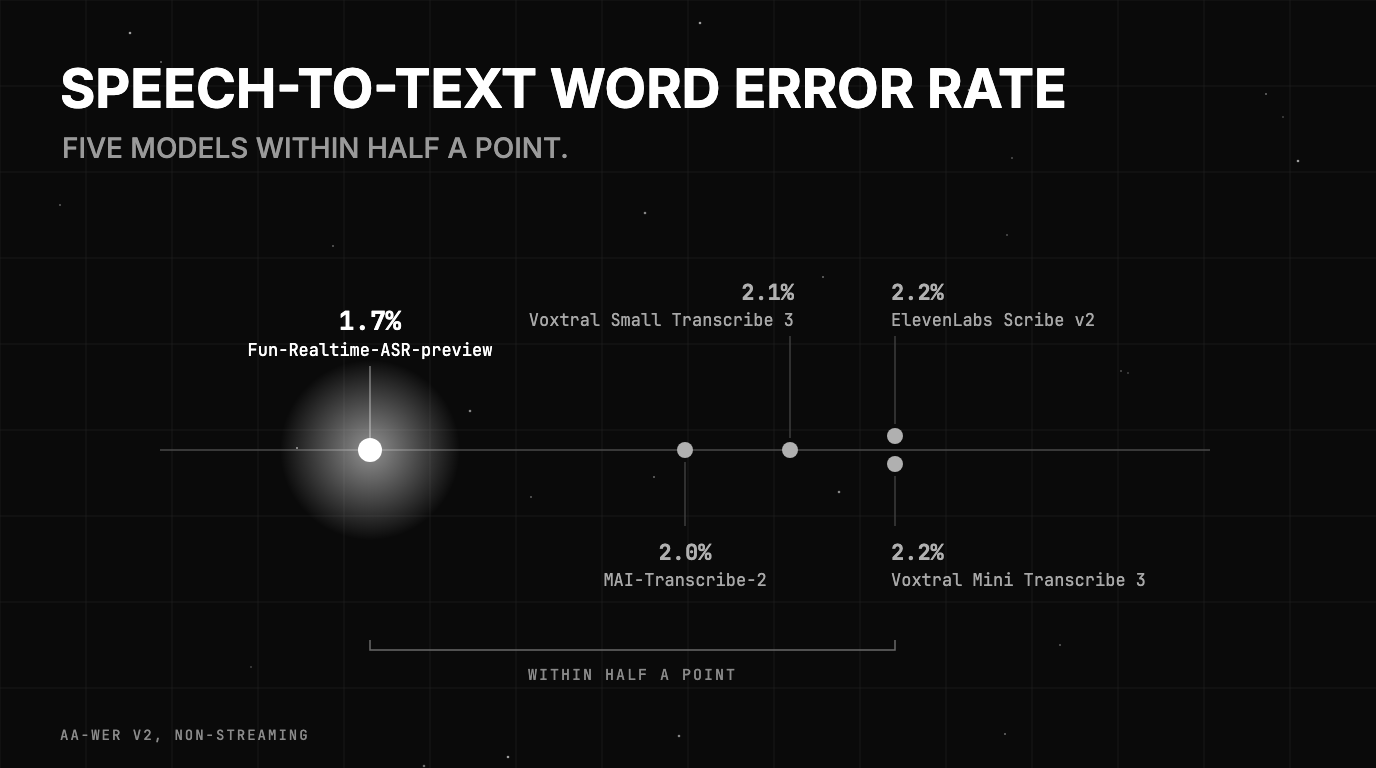
On the Artificial Analysis AA-WER v2 board for non-streaming models, read November 3, the top five sit within half a point. Fun-Realtime-ASR-preview leads at 1.7%, then MAI-Transcribe-2 at 2.0%. Voxtral Small Transcribe 3 follows at 2.1%, and ElevenLabs Scribe v2 and Voxtral Mini Transcribe 3 tie at 2.2%.
The full list is on the Artificial Analysis speech-to-text board.
MAI-Transcribe-2-Streaming adds live transcription in 60 languages
Microsoft · released October 1, 2026 · 60 languages · $0.54 per audio hour ($0.009 per minute) introductory through December 31, 2026, later rate not published
Microsoft’s MAI-Transcribe-2-Streaming returns real-time transcripts in 60 languages at $0.009 a minute during the introductory period. The 2.0% board score above comes from the batch MAI-Transcribe-2. Do not carry that score over to the streaming model. Test it on your own live audio.
Microsoft announced it in its streaming transcription post.
What it does not win: price certainty. The $0.54 rate ends December 31, 2026, with no later rate published, so 2027 contracts carry pricing risk.
Voxtral Transcribe 3 reaches 2.1% WER, behind only MAI-Transcribe-2 among GA models
Mistral · released October 22, 2026 · Mini Transcribe 3 (batch) $0.0035 per minute, Small Transcribe 3 $0.0040, Mini Transcribe Realtime 3 $0.008, as of 2026-11-03 · AA-WER Small 2.1%, Mini 2.2% as of 2026-11-03
Mistral’s Voxtral Small Transcribe 3 scores 2.1% on the board, ahead of Scribe v2 at 2.2%. It costs $0.0040 a minute. Mini Transcribe 3 ties Scribe at 2.2% for $0.0035, and Mini Transcribe Realtime 3 covers live audio at $0.008.
Prices are in the Voxtral 3 announcement.
What it does not win: first place. It is second among generally available models behind MAI-Transcribe-2, and third overall behind the Fun-Realtime-ASR preview.
Nemotron 3.5 Transcribe ships open weights for 40 languages, offline only
NVIDIA · released October 28, 2026 · Nemotron 3.5 Transcribe 30B-A4B · OpenMDW-1.1 license · 40 languages · 4.71% mean English WER on 9 public Open ASR sets per the model card
Nemotron 3.5 Transcribe is the open-weight pick this month, under NVIDIA’s OpenMDW-1.1 license. Its model card reports a 4.71% mean English word error rate across nine public Open ASR Leaderboard sets. Those sets differ from the Artificial Analysis board, so do not compare the two.
Weights and license terms are on the Nemotron 3.5 Transcribe card.
What it does not win: live calls. NVIDIA describes it as an offline model with no real-time streaming, so keep it on recorded calls.
Two smaller STT updates also shipped. Deepgram Nova-3 Multilingual now transcribes 55 languages in one model as of October 23. IBM released Granite Speech 5.0 2B under Apache 2.0, dated October 20 on its model card. Pick them when language coverage or a permissive license matters most.
IBM’s terms are on the Granite Speech 5.0 2B card.
The best TTS models now include three at or under $15 per million characters
AssemblyAI-TTS-1 launched at $15 per million characters, Voxtral Mini TTS 3 at $13 and MAI-Voice-2.1-Flash at $15. ElevenLabs lists Eleven v4 at $80 and v4 Turbo at $40, so the new entrants cost a fifth or less of ElevenLabs’ top tier. The two on the quality board rank well below it.
AssemblyAI-TTS-1 became generally available on October 27 at a $15 per million character list price. It speaks English, Spanish, French, German, Italian and Portuguese. On the Artificial Analysis text-to-speech board it ranks 14th at 1221, about 113 points under Eleven v4.
AssemblyAI’s terms are in its TTS-1 launch post.
Voxtral Mini TTS 3 is the cheapest of the three at $13 per million characters. It shipped in the same October 22 Voxtral 3 release. The board lists Voxtral 3 TTS 15th at 1218, three points behind AssemblyAI-TTS-1, so Mistral’s model costs less for nearly equal quality.
Microsoft’s MAI-Voice-2.1 costs $22 per million characters and MAI-Voice-2.1-Flash costs $15, both covering 23 languages as of the October 1 release. Neither model appears on the TTS board below. Run a listening test against your current voice before you switch.
If you still call OpenAI’s tts-1 or tts-1-hd, plan a migration. OpenAI will shut down tts-1, tts-1-hd, gpt-4o-mini-tts-2025-03-20 and gpt-4o-mini-tts-2025-12-15 on January 6, 2027, and names gpt-realtime-2.1-mini as the replacement. Leave time to re-tune voices and prompts before that date.
The dates are on OpenAI’s deprecations page.
Eleven v4 leads at 1334 and v4 Turbo follows at 1331, and ElevenLabs lists them at $0.08 and $0.04 per thousand characters as of November 3. The best text to speech quality still costs the most. The table shows the top eight as of November 3, 2026.
ElevenLabs lists both rates on its API pricing page, and the scores come from the Artificial Analysis text-to-speech leaderboard.
| Model | Speech Arena Elo |
|---|---|
| Eleven v4 | 1334 |
| Eleven v4 Turbo | 1331 |
| Qwen-Audio-3.1-TTS-Plus | 1301 |
| Cartesia Sonic 3.6 | 1293 |
| Gemini 3.8 Flash TTS | 1282 |
| Fish Audio Drama 3 | 1272 |
| Lightning V3.1 Pro | 1269 |
| Qwen-Audio-3.0-TTS-Plus (tied with Inworld Realtime TTS-2) | 1266 |
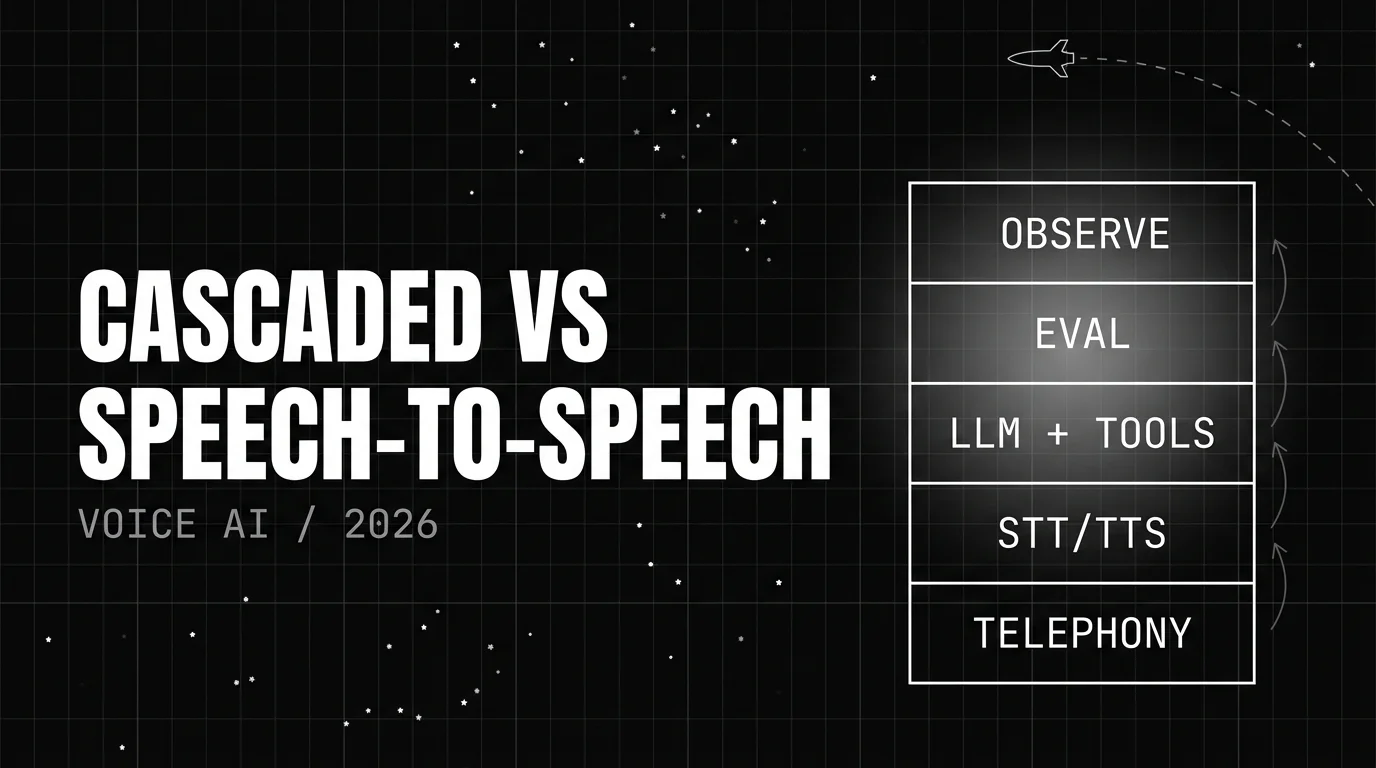
Cascade vs speech to speech at 100,000 minutes a month
October changed both sides of the cascade vs speech to speech choice. Four vendors shipped or updated single-API speech-to-speech, three with Artificial Analysis scores, while cascades gained new TTS and streaming STT. At 100,000 minutes a month, per-minute charges alone are $3,000 for Cartesia’s launch price and $8,000 for Grok Voice 3.0 or Eleven Realtime v1.
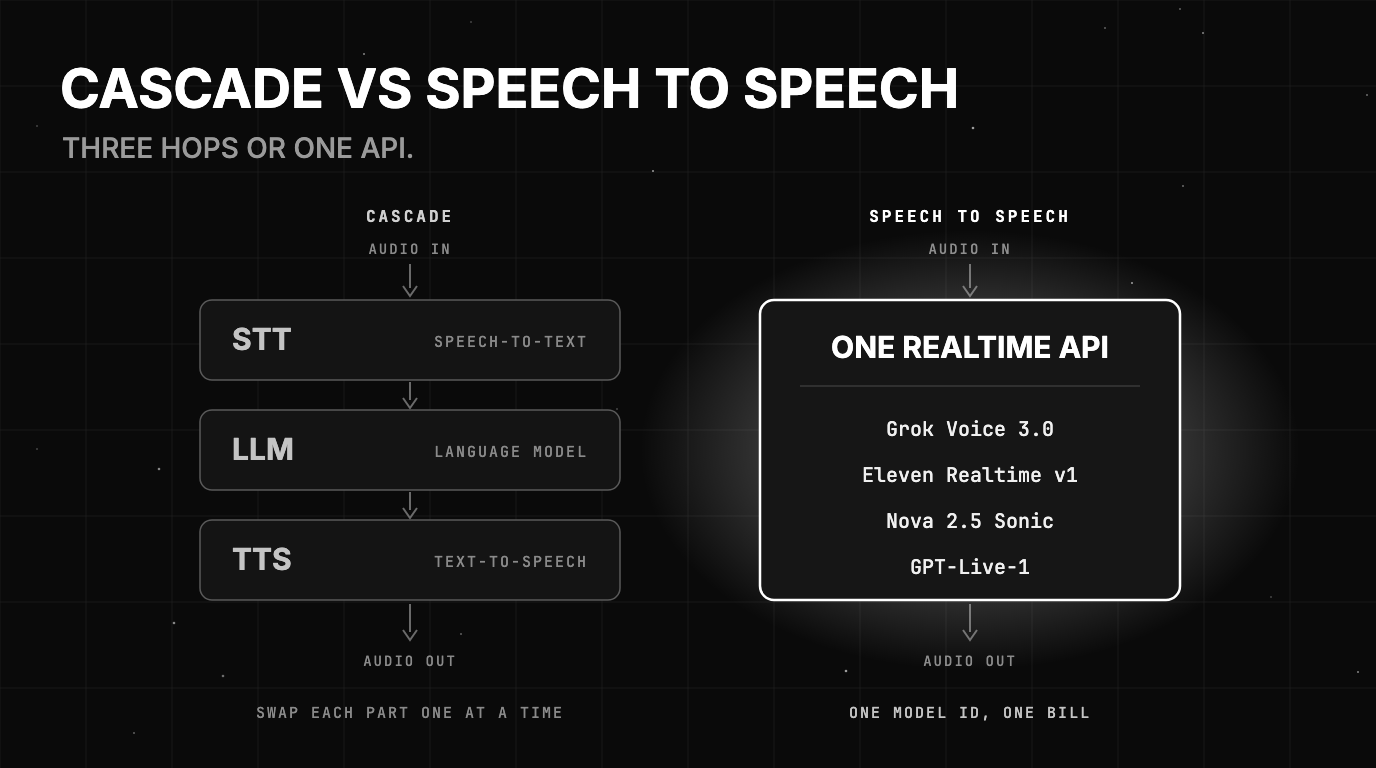
The speech to speech vs STT, LLM, TTS choice comes down to control. A cascade lets you swap the transcriber, language model and voice one at a time. A realtime API gives you one model ID and one bill, and ElevenLabs sells a tuned cascade behind that same interface, so judge price and measured results.
For the architecture trade-offs in depth, read cascaded voice AI versus speech-to-speech.
AssemblyAI and ElevenLabs self-report latency. AssemblyAI reports a 47 ms median time to first byte for TTS-1 in the lab and 90 ms time to first audio in production. ElevenLabs says Eleven Realtime v1 Max starts speaking in 0.57 seconds on average and v1 Mini in 0.62 seconds. Test p95 latency yourself at peak concurrency, phone leg included.
| Option | Rate per minute | 100,000 minutes |
|---|---|---|
| Cartesia Managed Agents (launch price, later rate not published; LLM usage excluded) | $0.03 | $3,000 |
| GPT-Live-1 (backend model billed separately) | $0.05 | $5,000 |
| Grok Voice 3.0 | $0.08 | $8,000 |
| Eleven Realtime v1 Max or Mini (LLM usage excluded) | $0.08 | $8,000 |
| LiveKit agent session (models billed separately) | $0.01 | $1,000 |
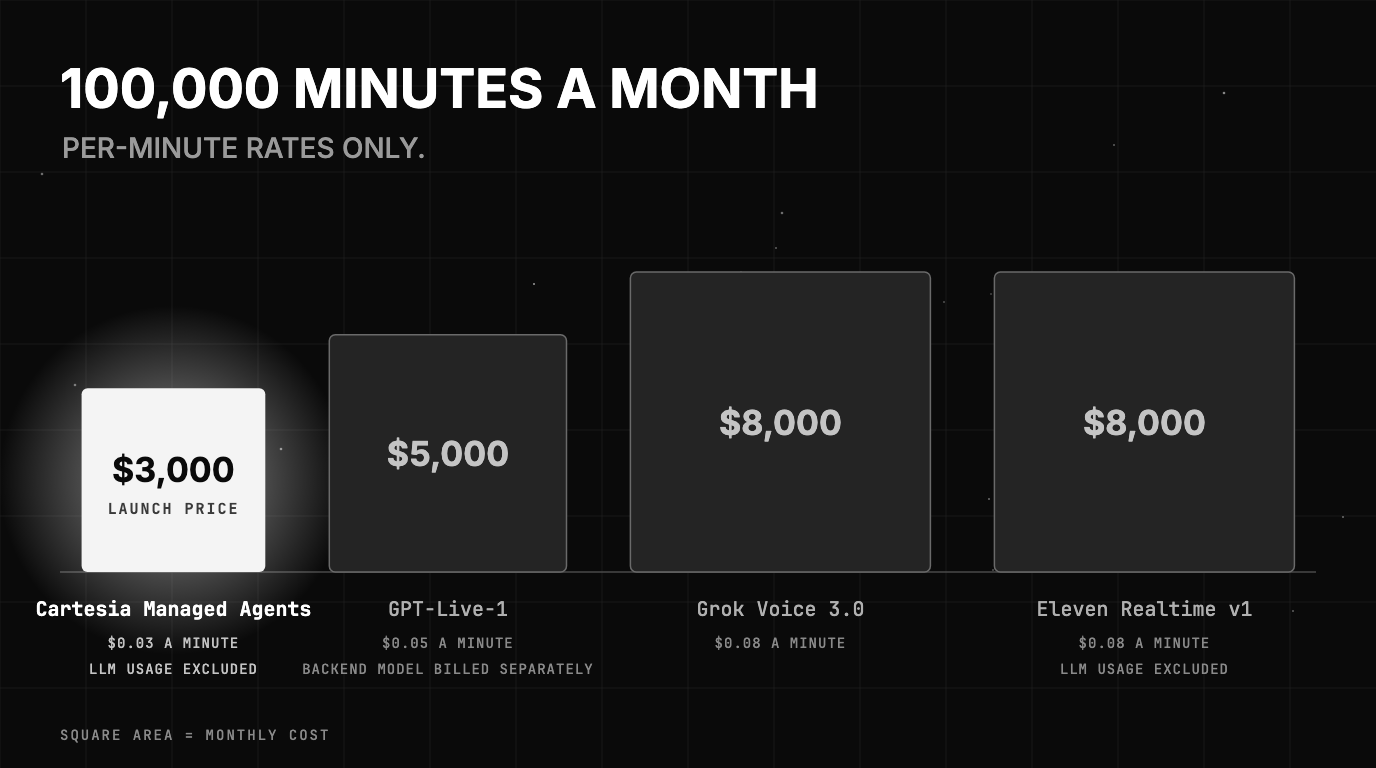
Each total is the November 3 rate times 100,000 minutes, before telephony, xAI’s text-input fee and the model usage that Cartesia, ElevenLabs and OpenAI bill separately. A Cartesia phone number lifts it to $0.044, or $4,400 a month. Nova 2.5 Sonic is absent because it prices by token.
Is speech to speech cheaper? Only on the per-minute line. A cascaded stack prices each component, so add your own STT, language model and TTS rates to compare like for like. For scale, Voxtral Mini Transcribe Realtime 3 alone costs $0.008 a minute.
Voice releases by date, from OpenAI’s TTS retirements to the Real-time Context Standard
The table below lists each October voice release, price change and deprecation in date order, with the primary page that confirms it. We re-read each of those pages on November 3. Scan the dates for what changed at each layer before you switch vendors.
| Date | Provider | Model or change | What changed | Primary source |
|---|---|---|---|---|
| Oct 1 | OpenAI | tts-1, tts-1-hd, two gpt-4o-mini-tts snapshots | Shutdown on Jan 6, 2027; gpt-realtime-2.1-mini replaces them | OpenAI deprecations |
| Oct 1 | Microsoft | MAI-Transcribe-2-Streaming | Streaming STT, 60 languages, $0.54 per hour introductory through Dec 31, later rate not published | Microsoft AI news |
| Oct 1 | Microsoft | MAI-Voice-2.1 and 2.1-Flash | $22 and $15 per 1M characters, 23 languages | Microsoft AI news |
| Oct 5 | AWS | Nova 2.5 Sonic | GA, 256K context, Nova 2 Sonic prices in US East | AWS What’s New |
| Oct 5 | OpenAI | API BAA | Self-serve standard BAA for eligible organizations | OpenAI API changelog |
| Oct 14 | xAI | Grok Voice 3.0 | $0.08 per minute, AA index 86.9 | xAI news |
| Oct 16 | OpenAI | GPT-Live-1 prompt-to-voice | Released to all API customers, $0.05 per minute unchanged | OpenAI API changelog |
| Oct 20 | ElevenLabs | Eleven Realtime v1 Max and Mini | OpenAI Realtime-compatible, $0.08 per minute plus LLM usage | ElevenLabs blog |
| Oct 20 | IBM | Granite Speech 5.0 2B | Apache 2.0 open model | Hugging Face card |
| Oct 22 | Mistral | Voxtral 3 | Transcribe and TTS models, from $0.0035 per minute and $13 per 1M characters | Mistral news |
| Oct 23 | Deepgram | Nova-3 Multilingual | 55 languages in one model | Deepgram changelog |
| Oct 23 | Deepgram | Flux TTS | Adds 41 languages, 32 of them in early access | Deepgram changelog |
| Oct 23 | Block | Dessa | Waitlist; early access for AI safety researchers | Block, dated by TechCrunch |
| Week of Oct 26 | Vapi | HIPAA assistants | AssemblyAI allowed as transcriber | Vapi changelog |
| Oct 27 | AssemblyAI | AssemblyAI-TTS-1 | GA, $15 per 1M characters | AssemblyAI blog |
| Oct 28 | Twilio | ConversationRelay | Mid-call reconfiguration and application reconnect GA | Twilio changelog |
| Oct 28 | NVIDIA | Nemotron 3.5 Transcribe 30B-A4B | Open weights, OpenMDW-1.1 | Hugging Face card |
| Oct 29 | Cartesia | Managed Agents | $0.03 per minute launch price, later rate not published, LLM usage extra; arena #1 | Cartesia blog |
| Oct 29 | Deepgram | Acquiring Daily (Pipecat) | Announced; Pipecat stays BSD-2 | Deepgram blog |
| Oct 29 | Deepgram and Pipecat | Real-time Context Standard 0.1 | Alpha, co-developed; Pipecat 1.15 implements it | Pipecat docs |
Eleven v4, Sonic 3.6, Retell and LiveKit are unchanged since September
The six models and platforms below did not change in October and remain the picks. We re-checked each price on November 3, and each row links the September edition. If a vendor shows no readable per-model rate, the cell links its pricing page.
| Model | Provider | Last covered in | Still the pick for | Price | Price checked |
|---|---|---|---|---|---|
| Eleven v4 | ElevenLabs | September 2026 edition | Top TTS quality (Elo 1334) | $0.08 per 1K characters; v4 Turbo $0.04 | 2026-11-03 |
| Cartesia Sonic 3.6 | Cartesia | September 2026 edition | Low-latency TTS | vendor pricing page | 2026-11-03 |
| MAI-Transcribe-2 (batch) | Microsoft | September 2026 edition | Major-cloud STT accuracy (2.0%) | vendor pricing page | 2026-11-03 |
| Gemini 3.8 Flash TTS | September 2026 edition | Low-cost cloud TTS | $9 per 1M audio output tokens through Dec 31, 2026, then $18 | 2026-11-03 | |
| Retell AI | Retell | September 2026 edition | Managed platform with self-serve BAA | $0.07 to $0.31 per minute, pay as you go | 2026-11-03 |
| LiveKit Agents | LiveKit | September 2026 edition | Open-source orchestration | $0.01 per minute agent session; BAA requests on Scale from $500 per month, subject to approval | 2026-11-03 |
Is the best voice AI model now a single realtime API?
Not by default. Keep your cascaded pipeline, and treat a single speech-to-speech API as the best voice AI model only after it beats that pipeline on your own calls. Answer the five questions below first, in order, because vendors now differ on each.
- Is a single realtime API cheaper for my volume? Start from the 100,000-minute table above, then add model usage for Cartesia, Eleven Realtime and GPT-Live-1, and telephony on every row.
- Which options fit a HIPAA workload? OpenAI’s API offers a self-serve standard BAA to organizations with an established history of API usage. Vapi allows AssemblyAI as the transcriber on HIPAA assistants and lists its Business Associate Agreement at $2,000 a month. Retell offers a self-serve BAA on pay as you go, and LiveKit offers BAA requests on Scale from $500 a month, subject to approval. ElevenLabs and Cartesia list BAAs on Enterprise plans; ask xAI directly.
- Does the Deepgram deal change my framework choice? Not on license terms: Pipecat stays BSD-2, per Deepgram.
- Which STT handles many languages and phone audio? Nova-3 Multilingual covers 55 languages and MAI-Transcribe-2-Streaming covers 60. Test both on your own 8 kHz call recordings at peak concurrency.
- Do I need to migrate TTS? Yes, if you call tts-1, tts-1-hd or the two retiring gpt-4o-mini-tts snapshots. Move before January 6, 2027.
How to compare a realtime voice model with your current pipeline
Run the realtime model and your current pipeline through the same scripted calls, and score both the same way. Future AGI Simulation places the calls, Evaluation scores the transcripts and audio, and production traces show whether the result holds on live traffic. It works alongside Vapi, Retell, LiveKit and Pipecat instead of replacing them.
- Simulation: give Future AGI Simulation a phone number for each stack, since a number is all a voice agent definition needs. Run the same scenarios and personas against both from the dashboard. Every run returns the transcript, the call audio, latency, interruptions, talk ratio and an eval score.
- Evaluation: score both stacks’ transcripts and audio with the same Future AGI evaluations. Each one returns a result, plus a plain-language reason when an evaluator model judges it, so a regression arrives with an explanation you can read.
- Production traces: after launch, instrument LiveKit, Pipecat or OpenAI Realtime sessions with the open-source traceAI instrumentors; the OpenAI Realtime one is early. Running on Vapi, Retell or Bland.ai instead? Voice observability pulls their call logs into Observe as traces with no SDK.
For the scoring method behind these checks, see how to evaluate voice AI agents.
Choosing the voice stack for your next release
The support team now has a two-week plan for November. It shortlists one realtime API: Grok Voice 3.0 or GPT-Live-1, the top scorers with published per-minute prices, or Cartesia Managed Agents on price once its LLM cost is added. It runs that API beside the current pipeline on the same scripted calls.
After two weeks, the team decides on three measured numbers: p95 latency, cost per minute including telephony, and task completion rate. If the realtime API wins all three, it takes a share of live calls first. The cascade stays as the fallback until the numbers hold on real traffic.
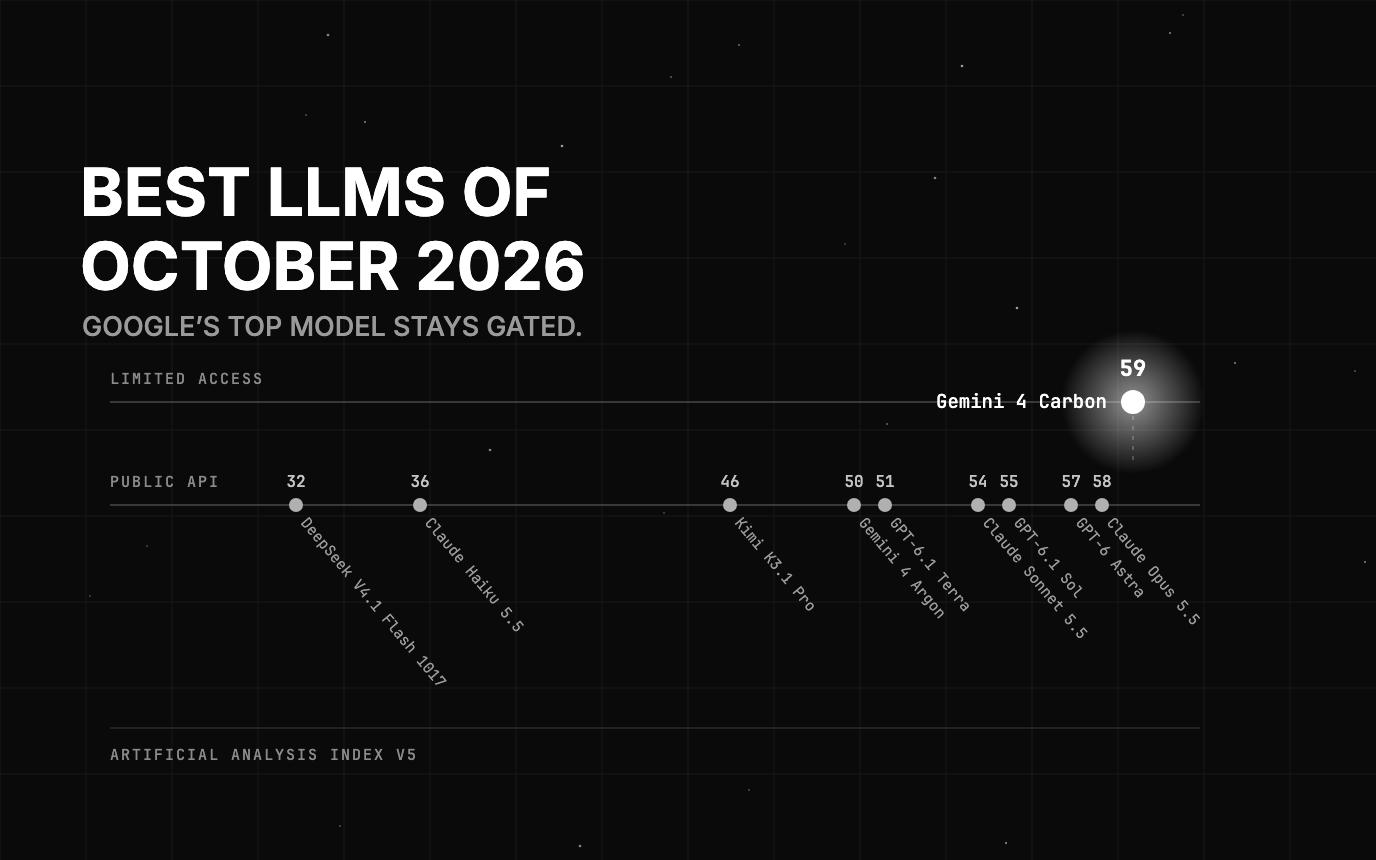
If the cascade stays, its language model hop is the next thing to tune, and the October LLM edition covers this month’s model changes.
Frequently Asked Questions
What is a speech-to-speech model?
Is cascaded or speech-to-speech better for voice agents?
How much does Grok Voice 3.0 cost?
Does ElevenLabs have a realtime API?
What is Amazon Nova 2.5 Sonic?
Which STT model has the lowest word error rate?
Which voice AI wins the STT, TTS, and agent layers in September 2026, from Eleven v4 and MAI-Transcribe-2 to GPT-Live-1, with latency and per-minute cost.

The best LLM for October 2026 depends on access: Gemini 4 Carbon tops the AI model boards but stays gated, so compare Argon, Claude Haiku 5.5 and GPT-6.1 Terra.

Cascaded voice AI vs speech-to-speech in 2026: latency, eval depth, debug cost, model flexibility, and the architecture decision every voice team faces.
