Best 5 Janus AI Alternatives in 2026
Five Janus AI alternatives on integrated observability, eval, optimizer, gateway, routing, self-host. What each actually fixes vs a hosted agent-builder.
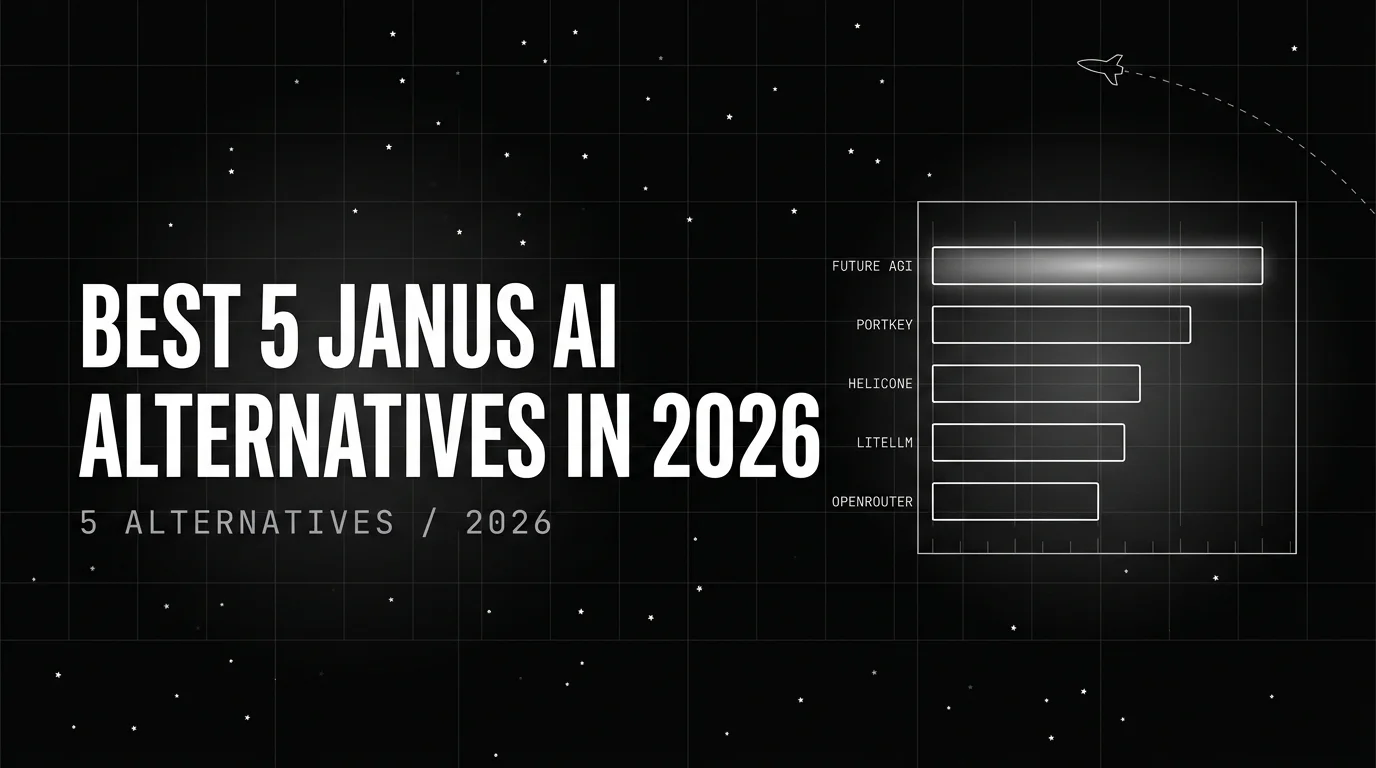
Table of Contents
Janus AI is the tool many teams reach for when they want to ship an agent without standing up a framework, a tracing backend, an eval harness, and a gateway in the same week. Define the agent via the agent-definition API, point it at tools, hit deploy, hosted runtime handles the rest. For one agent inside one product, that holds. The trouble starts when the rest of the company wants in: a second agent needs to share prompts; production cost shows up in FinOps and the console has no virtual keys, no routing, no cost dashboard sliced by repo or user; eng wants traces in their existing OTel stack and Janus’ export is thin; QA wants evals in CI and there’s no eval library; SecOps asks for self-hosted and the answer is “hosted-only, 2027 roadmap.”
This guide ranks five alternatives, names what each fixes versus Janus, and walks through the migration that always bites: replacing the agent-definition runtime and the observability surface at the same time.
TL;DR: pick by exit reason
| Why you are leaving Janus AI | Pick | Why |
|---|---|---|
| You want an agent runtime plus traces, evals, optimizer, and a gateway in one stack | Future AGI Agent Command Center | Closes the loop from agent run to trace to eval to optimizer to route |
| You want a hosted gateway with virtual keys and a prompt registry | Portkey | Mature gateway with per-service keys and Prompt Studio |
| You want hosted plus self-host observability with prompt management and evals | Langfuse | Apache 2.0 self-host, prompt versions, eval pipelines |
| You want a high-throughput Go-based gateway tied to an eval and simulator stack | Maxim Bifrost | Bifrost gateway plus Maxim’s agent simulator |
| You want lightweight hosted observability without agent-builder weight | Helicone | Drop-in proxy with per-request cost and session traces |
Why people are leaving Janus AI in 2026
Five exit drivers show up repeatedly in r/LLMDevs migration threads, the Janus AI community Discord #help channel, GitHub discussions on agent-builder portability, and G2 reviews from the last two quarters.
1. Agent-builder focus, narrow scope
Janus’ product surface is the agent: a definition (prompt, tools, model, memory), a hosted runtime, a console for runs and replays. That’s the whole stack. Teams hit the boundary the day they want to do anything outside the agent: route a non-agent call through the same gateway, score a non-agent span, version a prompt that lives outside an agent definition. Janus is shaped for one job; the moment that job becomes a wedge into a broader LLM stack the team owns one tool that does it well and four more to do everything else. r/LLMDevs threads from Q1 2026 describe the same realization: agent in Janus, gateway in Portkey, trace in Langfuse, eval in ragas, and nothing joins them.
2. No integrated observability, eval, or optimizer
Janus captures runs and lets you replay them. It doesn’t score them against a rubric in CI, cluster failures into actionable buckets, or feed those buckets back into a prompt or routing change. The export is JSON-shaped but not OpenTelemetry-native, so dropping data into Datadog, Honeycomb, or Phoenix is a custom ETL job. The optimizer step (rewriting prompts from failure clusters or shifting model assignment for a class of requests) doesn’t exist. The absence of an eval-plus-optimizer loop is the single biggest migration trigger.
3. Hosted-only: no self-host or VPC deployment
Janus runs in Janus’ cloud. No on-prem build, no helm chart, no air-gapped option. For regulated industries and any team whose SecOps tightened data-egress policy in the last twelve months, hosted-only is the dealbreaker. The runtime processes prompts and tool calls that often contain PII or production secrets, and the audit trail required to keep that data inside a VPC doesn’t exist. Public-roadmap mentions of a self-host SKU have slipped twice since H1 2025.
4. Smaller community and ecosystem
Janus is younger than the broader cohort and GitHub stars, contributor count, and Discord activity reflect that. Practical impact: fewer community integrations, slower responses to framework releases, a thinner long tail of how-to content. Search for a Janus failure mode and you get the official docs or nothing, not the StackOverflow tail you get for Langfuse or Phoenix.
5. No native gateway or routing primitives
The agent definition lets you specify a model. It doesn’t let you specify a fallback chain, a virtual key with per-service attribution, a cost-aware route that swaps the model on token budget, a guardrails layer before the model call, or a per-user rate cap. Teams that need any of those bolt a gateway next to Janus, at which point they own two surfaces and a correlation problem. The trace lives in Janus, the cost data in the gateway, and joining them is custom code.
What to look for in a Janus AI replacement
The default “best agent platform” axes are necessary but not sufficient for a Janus exit. Score replacements on the seven that map to the surfaces you’re actually re-platforming on:
| Axis | What it measures |
|---|---|
| 1. Agent runtime portability | Can you redeploy the agent definition without rewriting tools, memory, and orchestration? |
| 2. Native observability + tracing | OpenInference or OTel spans, native sessions, exportable to your stack? |
| 3. Eval pipeline | Are scores generated in CI and joined to traces and runs by default? |
| 4. Optimizer loop | Does the tool rewrite prompts or shift routing from eval results? |
| 5. Gateway, routing, and cost control | Does the stack stand in the request path with virtual keys and policy? |
| 6. Self-host posture | Can the stack run inside your VPC, fully air-gapped? |
| 7. Migration tooling from Janus | Is there a published path for re-platforming Janus’ agent-definition API onto the new tool? |
1. Future AGI Agent Command Center: Best for closing the loop
Verdict: Future AGI is the only stack here that fixes Janus’ biggest weakness, runs and replays feed humans but never feed the system. Agent Command Center captures the trace via traceAI, scores it with ai-evaluation, clusters failures, runs the optimizer (agent-opt), and pushes the updated route or prompt back into the gateway on the next request. The other four are observation layers or gateway-plus-eval pairs. FAGI is the only one wired end-to-end from agent run through eval to optimizer to route.
What it fixes versus Janus AI:
- Agent runtime plus everything Janus lacks. Agent Command Center is the agent runtime, gateway, eval store, and prompt registry in one product. The Janus agent definition gets re-expressed as a
traceAI-instrumented agent (CrewAI, LangGraph, AutoGen, OpenAI Agents SDK, Google ADK, or your own loop), and FAGI captures the full span tree by default. - Native observability via OpenInference.
traceAIships first-party instrumentation for CrewAI, LangGraph, AutoGen, LangChain, LlamaIndex, OpenAI SDK, Anthropic SDK, Bedrock, Vertex, Vercel AI SDK, and Mastra. Spans are OpenInference-shaped, any OTel backend reads them. Janus’ thin export stops being the constraint.
- Gateway, routing, and Protect in the same stack. Virtual keys, per-service routing, fallback policies, and the Protect guardrails layer (median 67 ms text-mode latency per arXiv 2510.13351) sit beside the agent run. The cost dashboard slices by session, user, repo, and route natively.
- Native eval, not bolt-on. Every captured run is scored against task-completion, faithfulness, tool-use, and ground-truth rubrics by default.
ai-evaluationis Apache 2.0, the same evals you run in CI feed production scoring.
- Optimizer in the loop.
agent-opt(Apache 2.0) is the rewrite engine. Failure clusters become inputs to six optimizers — ProTeGi, GEPA, Bayesian, MetaPrompt, RandomSearch, PromptWizard prompt optimization. The rewritten prompt ships to the registry; the next agent run uses it. Janus stops at “here is the replay”. FAGI continues to “here is the rewrite.”
- OSS instrumentation, hosted polish.
traceAI,ai-evaluation, andagent-optare all Apache 2.0. The hosted Command Center adds RBAC, failure-cluster views, Protect, and AWS Marketplace. The OSS posture makes BYOC plausible for the regulated teams Janus can’t serve at all.
Migration from Janus AI: Janus’ agent-definition API exposes prompt, tool schemas, memory, and model. A migration script reads Janus’ definitions and emits a traceAI-instrumented agent skeleton. CrewAI by default. Prompts move into the FAGI registry as Jinja2; tags map mechanically. Tool definitions become callables wrapped by traceAI tool decorators. The hosted runtime gets replaced by your own deployment surface (Lambda, container, service); FAGI publishes reference helm charts and Vercel templates. Timeline: seven to ten engineering days for under ten agents and under 100 prompts.
Where it falls short:
-
agent-opt is opt-in, start with traceAI + ai-evaluation in week one and turn the optimizer on once eval baselines stabilize. The loop compounds value over weeks rather than at day one.
-
No single-click hosted agent runtime the way Janus has. You bring the deployment surface; the Command Center brings everything around it. For teams that picked Janus to avoid touching deployment, this is real friction, the trade is escaping hosted-only and gaining six other surfaces.
Pricing: Free tier with 100K traces/month. Scale tier from $99/month, linear per-trace scaling (no add-on multipliers). Enterprise with SOC 2 Type II and AWS Marketplace.
Score: 7 of 7 axes.
2. Portkey: Best for hosted gateway with prompt management
Verdict: Portkey is the pick when you need the gateway, routing, virtual keys, and prompt registry that Janus AI lacks, and you want a hosted product with mature ops. The Palo Alto Networks acquisition on April 30, 2026 added SMB SKU uncertainty, but the product is unchanged for the next twelve months. Portkey isn’t an agent runtime, pair it with a framework for that piece.
What it fixes versus Janus AI:
- Virtual keys and per-service routing. Per-developer keys that fan out to one provider key, preserving bulk pricing with per-identity attribution. The cost dashboard slices by virtual key, route, and metadata.
- Prompt Studio. Versioned prompts with diffs, A/B groups, and server-side rendering. The dialect is Portkey-specific (handlebars + Portkey filters), so plan for one format migration when you eventually leave Portkey too.
- Mature observability surface. Per-request trace, per-session view, audit log, OTel export. Not as agent-native as
traceAIor Phoenix, but well ahead of Janus’ replay-only view. - Guardrails and policy. Portkey Guardrails sit in the request path with PII filtering, schema validation, and content policy. Janus offers none of this.
Migration from Janus AI: Janus definitions split into three artifacts. Prompt moves into Prompt Studio (rewrite to handlebars). Model, fallback chain, and policy move into a Portkey routing config. Agent loop moves into your framework of choice; CrewAI or the OpenAI Agents SDK with Portkey as base_url is the common pattern. Timeline: seven to ten engineering days.
Where it falls short:
- No optimizer. Trace and eval feed humans, not the system.
- The April 2026 Palo Alto acquisition created medium-term pricing uncertainty for SMB customers.
- Eval is a separate, less-mature product compared to Langfuse or FAGI.
- Hosted-only for the polished experience; the OSS gateway exists but Prompt Studio is hosted.
Pricing: Free dev tier. Scale from $99/month with per-request usage. Enterprise custom.
Score: 5 of 7 axes (missing: native agent runtime, optimizer loop).
3. Langfuse: Best for hosted-plus-self-host observability and evals
Verdict: Langfuse is the pick when the requirement is “real observability, prompt management, and eval pipelines, hosted today and self-hosted tomorrow.” Apache 2.0 self-host on Postgres plus ClickHouse, hosted SaaS for teams that don’t want to operate it, and one of the broadest community surfaces in this category. You give up native agent runtime and gateway; you gain the most balanced observability-plus-eval-plus-prompt-management stack.
What it fixes versus Janus AI:
- Native sessions and traces. Langfuse captures the full span tree, joins it with prompt version and eval score, and renders the per-session view Janus’ replay UI hints at but stops short of. Python and TypeScript SDKs integrate cleanly with LangChain, LlamaIndex, OpenAI SDK, and CrewAI.
- Self-host posture. Apache 2.0 self-host on Postgres + ClickHouse addresses the regulated-industry case Janus can’t serve. Helm charts, Terraform modules, and a tested upgrade path are published.
- Eval pipeline. LLM-as-judge, rule-based scorers, and a CI-friendly run model. Scores join the trace by default.
- Prompt management. Versioned prompts with labels (
production,staging) and A/B groups. Plain string-substitution dialect; Janus’ inline prompts port over without a rewrite.
Migration from Janus AI: Janus exports run data as JSON; an importer maps it onto Langfuse’s trace + observation + score model. The agent definition re-platforms onto a framework with the Langfuse SDK wrapped around LLM and tool calls. Timeline: five to seven engineering days plus framework migration in parallel.
Where it falls short:
- No gateway, no virtual keys, no native routing. Pair with LiteLLM or Portkey.
- No optimizer. Eval scores feed humans, not a prompt rewriter.
- No native agent runtime. Langfuse observes; the framework runs the agent.
Pricing: Hosted free tier with 50K observations/month. Pro from $59/month. Self-host free under Apache 2.0; commercial features (SSO, audit logs) require a paid license.
Score: 5 of 7 axes (missing: native agent runtime, gateway, optimizer).
4. Maxim Bifrost: Best for high-throughput gateway plus agent simulator
Verdict: Maxim’s Bifrost is the pick when the workload is high-concurrency, the gateway’s own latency budget matters, and you also want Maxim’s agent-simulation surface for pre-production testing. Bifrost is Go-based, designed for low-latency routing, and benchmarks above Python proxies on RPS per node. Together with Maxim’s hosted eval and simulator it covers the production-traffic and pre-production-testing sides Janus’ replay-only model is shallow on.
What it fixes versus Janus AI:
- Throughput per node. Go runtime plus connection pooling gives Bifrost higher RPS per node than Python-based gateways. Maxim claims sub-millisecond overhead at p50.
- Agent simulator surface. Maxim’s simulator runs adversarial personas and scripted scenarios against the agent, surfacing rule violations and tool-call failures that Janus’ replay model only catches in production.
- Self-host posture. Bifrost runs as a Go binary, container, helm chart, or static binary on a VM. Janus’ hosted-only constraint disappears.
- Tight integration with Maxim’s eval stack. Gateway, simulator, and eval share data models, no cross-product correlation layer needed.
Migration from Janus AI: Janus definitions get re-platformed onto a framework (typically the OpenAI Agents SDK or a Maxim-native loop) with Bifrost as the gateway and Maxim’s simulator wired into CI. Prompts move into Maxim’s prompt store. Timeline: seven to ten engineering days; add a week for simulator scenario design.
Where it falls short:
- No native prompt optimizer.
- Younger than Portkey or Langfuse; the ecosystem (Terraform providers, off-the-shelf dashboards) is thinner.
- Throughput is the headline; teams that picked Janus for the agent-builder UX rather than gateway latency won’t feel the upside.
- The simulator’s persona library is strong for chat and voice agents and lighter for tool-heavy autonomous agents.
Pricing: Bifrost is open source. Maxim’s hosted gateway and simulator pricing is custom, anchored to the eval product’s usage.
Score: 4 of 7 axes (missing: native prompt registry, optimizer, mature ecosystem).
5. Helicone: Best for lightweight hosted observability
Verdict: Helicone is the pick when your reason for leaving Janus is “observability and cost telemetry, no agent runtime needed.” Drop-in proxy with per-request cost, session traces, and a clean dashboard. Helicone acquired Mintlify in March 2026 and parts of the docs surface folded into Mintlify’s stack, the roadmap reflects the org change.
What it fixes versus Janus AI:
- Friendlier cost telemetry. Helicone’s Pro tier starts at $25/month and scales gently below 10M requests. Cost-per-request, session view, and request-replay are native.
- Self-host option. Apache 2.0 self-host on Postgres + ClickHouse. Scale-out above a few hundred RPS gets non-trivial, but for most teams that’s a future problem.
- Simpler surface area. If you used Janus mostly to “wrap the OpenAI call and see what happens,” Helicone covers that with a quarter of the configuration.
- OpenAI-compatible base URL. Set
base_urlto Helicone’s proxy and existing SDK code works unchanged. No framework migration for the observability piece.
Migration from Janus AI: Helicone covers observability; the agent runtime moves to a framework and the Helicone proxy sits in front of LLM calls. Janus’ inline prompts can stay in-repo as Jinja2 or move into Helicone’s lighter prompt module. Timeline: three to five engineering days without a deep prompt-registry replacement.
Where it falls short:
- No optimizer.
- No native agent runtime; pair with a framework.
- Routing intelligence is basic (round-robin and failover); cost-aware model routing requires upstream code.
- Eval surface is shallower than Langfuse’s or FAGI’s.
- The Mintlify acquisition is recent enough that some surfaces are still in flux.
Pricing: Free tier with 10K requests/month. Pro from $25/month. Enterprise custom.
Score: 4 of 7 axes (missing: native agent runtime, deep eval, optimizer).
Capability matrix
| Axis | Future AGI | Portkey | Langfuse | Maxim Bifrost | Helicone |
|---|---|---|---|---|---|
| Agent runtime portability | traceAI-wrapped framework | Pair with framework | Pair with framework | Pair with framework | Pair with framework |
| Native observability + tracing | OpenInference, sessions, RBAC | Per-request trace, OTel export | Native sessions, OTel exporters | OTel pluggable | Per-request dashboard |
| Eval pipeline | ai-evaluation (Apache 2.0) | Newer eval add-on | Native LLM + rule-based | Maxim eval stack | Shallow |
| Optimizer loop | agent-opt (Apache 2.0) | No | No | No | No |
| Gateway, routing, cost control | Native (virtual keys, Protect 67 ms) | Native (virtual keys, Guardrails) | None — pair with gateway | Bifrost (Go, low-latency) | Drop-in proxy |
| Self-host posture | BYOC + OSS instrumentation | Hosted-first | Apache 2.0 self-host | OSS Go binary | Apache 2.0 self-host |
| Janus migration tooling | Agent-definition importer | Prompt + route migration scripts | Trace JSON importer | Manual setup | Manual setup |
Migration notes: what breaks when leaving Janus AI
Two surfaces always need attention, and a third (gateway) usually shows up by week two.
Re-platforming the agent definition
Janus’ agent-definition API exposes prompt, tool schemas, memory configuration, model, and run policy. The migration is translation, not a code-port. The steps: dump every definition via GET /agents and GET /agents/{id}; for each, extract the prompt (rewrite to Jinja2 for FAGI and Langfuse, handlebars for Portkey), the tool schema (@tool for CrewAI, Tool for LangGraph, function_tool for the OpenAI Agents SDK), the memory config (framework-native primitives for simple cases; custom configs are manual), and model + fallback policy (move to the gateway you pick).
The hosted runtime becomes your responsibility, usually a containerized service or Lambda. FAGI, Langfuse, and the hosted gateway publish reference deployment patterns; Maxim and the lightweight proxy leave it to you. Under ten agents fits in a sprint; above that, plan two.
Replacing the observability surface
Janus’ replay UI is the visible surface; the export is JSON of runs plus events. Re-mapping into the destination’s trace model is mechanical. Langfuse and FAGI publish importer scripts; Helicone and Portkey assume you re-instrument going forward and accept Janus’ historical runs live in cold storage.
The bigger lift is OTel alignment. If your stack already has an OTel collector, picking a destination whose SDK emits OpenInference-shaped spans (FAGI’s traceAI, Langfuse, Phoenix) means the export plugs into your existing pipeline. Janus’ export isn’t OTel-native, so this becomes a clean upgrade rather than a lossy translation.
Standing up a gateway
If cost and routing are unmanaged on Janus, the gateway is a separate decision. FAGI’s Command Center includes it natively. Portkey is the closest standalone match. LiteLLM is the self-hosted option. Bifrost is the high-throughput pick. Helicone is the lightweight proxy. Cutover pattern: stand the gateway up in shadow mode behind the agent’s existing base_url, validate parity for a week, then flip.
Decision framework: Choose X if
Choose Future AGI if your reason for leaving is more than the agent-builder ceiling, you also want trace and eval data to drive prompt rewrites and routing-policy updates, so cost and quality curves bend over time. Pick this when production agent workloads are a real line item. Largest functional upgrade in the list.
Choose Portkey if the missing surface is gateway and prompt registry, not eval and optimizer. Pick this when you’ll keep the framework decision separate and want a polished hosted product under the agent runtime. Note the Palo Alto acquisition’s medium-term pricing trajectory.
Choose Langfuse if the missing surface is observability, prompt management, and eval, and self-host is non-negotiable. Pick this for regulated teams whose blocker on Janus was hosted-only.
Choose Maxim Bifrost if the workload is high-concurrency and pre-production simulation is the wedge, gateway and simulator at once.
Choose Helicone if you only want the observability layer and the team is fine running OpenAI SDK calls directly with a proxy base URL. Smallest commitment, smallest surface area.
What we did not include
Three products show up in other 2026 Janus alternatives listicles that we left out: Arize Phoenix (excellent OSS-first observability, but it observes, it doesn’t run agents or stand in the gateway path); Mastra (TypeScript-native agent framework with growing momentum, but it occupies the framework slot rather than replacing the bundle); Vellum (hosted prompt and workflow surface, but workflow-shaped rather than agent-shaped, with no gateway or optimizer, closer to a Portkey alternative than a Janus alternative).
Related reading
- Best 5 AgentOps Alternatives in 2026
- Best 5 Portkey Alternatives in 2026
- Best LLM Gateways in 2026
- Best AI Gateways for Agentic AI in 2026
Sources
- Janus AI product documentation, janus.ai/docs (agent-definition API and run model)
- Reddit /r/LLMDevs migration discussions, February-May 2026
- Janus AI community Discord,
#helpand#migrationschannels - Hacker News threads on hosted agent-builder ceilings, Q1-Q2 2026
- Portkey product documentation, portkey.ai/docs
- Palo Alto Networks press release on Portkey acquisition, April 30, 2026, paloaltonetworks.com/company/press
- Langfuse self-host guide and Apache 2.0 license, langfuse.com/docs/deployment/self-host
- Maxim Bifrost product page and benchmarks, getmaxim.ai/bifrost
- Helicone open-source self-host, github.com/Helicone/helicone
- Helicone acquisition of Mintlify, March 2026, helicone.ai/blog
- Future AGI Agent Command Center, futureagi.com/platform/monitor/command-center
- Future AGI traceAI, github.com/future-agi/traceAI (Apache 2.0)
- Future AGI ai-evaluation, github.com/future-agi/ai-evaluation (Apache 2.0)
- Future AGI agent-opt, github.com/future-agi/agent-opt (Apache 2.0)
- Future AGI Protect latency benchmark, arxiv.org/abs/2510.13351 (67 ms text, 109 ms image)
Frequently Asked Questions
Why are people moving off Janus AI in 2026?
What is the closest like-for-like alternative to Janus AI?
How do I migrate agent definitions out of Janus AI?
Is there an open-source Janus AI alternative?
How does Future AGI Agent Command Center compare to Janus AI?
Can I keep Janus and add the missing layers?
Five AgentOps alternatives on multi-framework instrumentation, eval pipeline, gateway, optimizer. What each actually fixes past agent-only Python tracing.


FutureAGI ACC, Helicone, OpenRouter, Portkey, LiteLLM, Cloudflare AI Gateway, Vercel AI Gateway as 2026 LLM gateways. Routing, caching, guardrails.

Seven AI gateways for agentic AI in 2026 scored on MCP plus A2A depth, 18+ built-in guardrails, OTel-native cost telemetry, 2026 trust cohort with sources.
